Reading Round-Up: December 2011

Reading is my oldest and favorite hobby.  I literally can’t remember a time in my life when I didn’t love to curl up with a good book.  Here are my reads for December, 2011…

Night and Day, by Virginia Woolf – Started in London, and I finally finished it this month!  I hoped to enjoy this “classic English comedy of manners” more than I actually did.  It was well-written, but a bit dreary and I didn’t find any characters to love.

Tears of the Giraffe, by Alexander McCall Smith – Loved the second installment of the adventures of Precious Ramotswe and the No. 1 Ladies Detective Agency!  It was a fun, light read and I’m already looking forward to reading the next book in the series.

Shakespeare’s Kitchen, by Lore Segal – I liked this collection of interrelated short stories, especially toward the middle.  It got a bit heavy-handed with the insights into human nature by the end, but there were some really great passages throughout.

A Christmas Carol, by Charles Dickens – I’d been meaning to read this forever and finally got to it this holiday season.  It’s a fast read, unexpectedly funny in parts, and I can see it becoming a Christmas tradition for me!  Really enjoyed it.

The Buddha in the Attic, by Julie Otsuka – This new release, like Otsuka’s last novel (When the Emperor Was Divine), was almost more like poetry than prose.  An account of the stories of Japanese picture brides in the early 1900s, told in the first person collective – a really interesting choice that worked extremely well – it packed a powerful punch.  Highly recommended.

The Postmistress, by Sarah Blake – This one had been on my to-read list for awhile and I enjoyed it.  It’s the story of an American “radio gal” in London during the Blitz, and the way her life intersects with the residents of small-town Franklin, Massachusetts.  An interesting, engaging story, but the word choices were a bit weird at times (as the New York Times review pointed out).  Still, a good read.

Possession, by A.S. Byatt – Another one from the to-read list, I really loved this story of two literary scholars unearthing a hidden affair between a pair of Victorian poets.  It was a smart and exciting book and if you can tolerate some sexy scenes, well worth checking out.  I’m definitely planning to rent the movie, too.

Another good reading month!  I sprinkled a few new releases and a bit of lighter reading in amongst the classics and enjoyed myself thoroughly.  As always, to see full reviews of all the books I read, feel free to follow me on Goodreads!

Cinnamon Applesauce

Put your hand up if you, like me, get absolutely crazed during the week between Christmas and New Year’s.  I’m currently preparing for houseguests (my lovely mother-in-law and her sister are visiting for Christmas 2.0 this coming weekend), which means I’m cleaning and organizing like a maniac.  Part of my organizing frenzy is the always fun “clean out the fridge and try not to scream” game.  Now, I generally keep a pretty clean fridge and we don’t have things that sit in there for months (except condiments, mmmmm, condiments).  But I find it doesn’t matter how clean you keep the fridge, or how disciplined you are about not buying more food than you can realistically eat… it still gets scary in there.

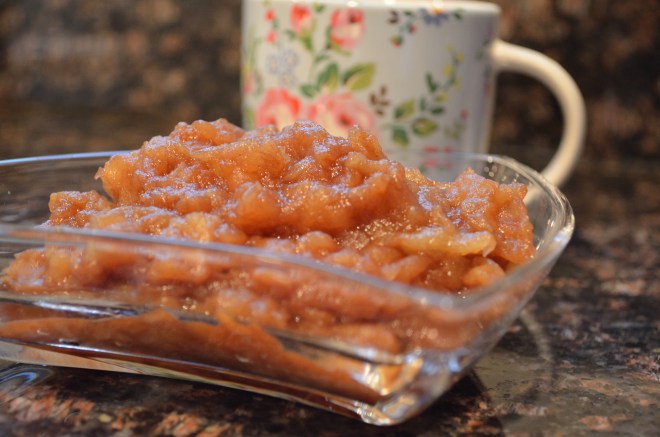
One element of this round of “clean out the fridge and try not to scream” involved me finding a creative use for a bag of apples that were aging gracelessly in my crisper drawer.  I think I’ve mentioned before that I have this compulsion when it comes to apples.  They’re available year-round and I frequently toss them in my cart without stopping to think about whether I need more or not.  At the moment, though, I’m on a citrus kick (it happens around this time every year) and I’ve been ignoring apples in favor of tangerines, clementines and grapefruits.  So the last batch of apples I had bought were still sitting in my crisper, getting younger by the day (not).  What to do, what to do?  I didn’t really feel like baking with them, and I have an idea percolating for a fun muffin that doesn’t involve apples anyway, so baked goods were out.  But I had another trick up my sleeve – applesauce!  It’s one of my go-to recipes for using extra apples; it’s easy, healthy and delish.  Sweetened with a kiss of maple syrup and flavored with a generous helping of cinnamon, this applesauce will take tired apples from your crisper and turn them into a healthy treat that will definitely not last long in your fridge.

Cinnamon Applesauce

4 pounds apples, peeled and large-diced
1/4 cup maple syrup
1 generous teaspoon cinnamon

  • Pile apple pieces into a Le Creuset (3 1/2 quart capacity or larger) or other heavy pot and begin cooking on high, tossing frequently.  When apples are beginning to warm and a few have acquired golden crusts, turn the heat down to medium-low.
  • Add maple syrup and cinnamon and stir thoroughly to combine.
  • Place lid on pot and simmer, stirring occasionally, for two hours.
  • Remove lid and stir.  Continue cooking on medium-low until apples are extremely soft and falling apart.  Mash with a fork (or potato masher) to achieve desired consistency.
  • Try to let it cool before you dive in, or you’ll burn your tongue!

Source: Covered In Flour

THE MASTER AND MARGARITA

 Basically nothing about The Master and Margarita is as you would have expected, which is pretty much about what I expected. A modern Russian novel that couldn’t be published during the author’s lifetime due to its controversial message, the book alternates between being hilarious and moving, fantastical and all too realistic.

The plot, in a nutshell: The devil arrives in Soviet-era Moscow, bearing the name of Woland and accompanied by an entourage of demons and a naked witch, and he proceeds to spread chaos, confusion and mild destruction all over the city. The Muscovites, who don’t really do the whole religion thing, consider him to be basically an unethical sleight-of-hand artist. They flock to his “black magic expose” and are delighted when money flies down from the ceiling, horrified when all of their womenfolk end up running au naturel down the street, and a bit disgruntled that this “foreign artiste” never gets around to the actual expose part of the show and never bothers to explain how he managed to rip off the M.C.’s head without actually killing the man. (The M.C. was probably the most disgruntled one in the theater.) But it turns out that Woland isn’t all bad. Okay, sure, he never gets around to the expose, all of the money turns into either foreign currency (bad) or scraps of paper (worse), and one of his minions has an alarming encounter with the police and, later, a salmon… but at least three people end up pleased that the devil is in town. One is probably Dr. Stravinsky, the head of the insane asylum that ends up doing outstanding business treating half of Moscow. One is the Master, a residential patient in the asylum who was driven insane by slanderous newspaper critiques of his unpublished novel about Pontius Pilate. And the last is Margarita, the Master’s married mistress, who loves the Master passionately and believes wholeheartedly in his genius, and who makes a Faustian deal with Woland to rescue the Master from his emotional torment.

Like many Russian novels, there is a vast and diverse cast of characters, many of whom wander in and out of the action and remain on the periphery yet still influence the main plot. The primary cast includes, of course, Woland, his retinue – Azzazello the fallen angel, Korovyov the former choirmaster, Behemoth the giant talking cat (one of the best characters in the book), Hella the nude witch, and of course, the Master and Margarita. Of these characters, Margarita is by far the best developed and the most sympathetic – you can really feel her pain and loneliness, her desperation to be reunited with the Master, and her joy to see him again. The chapter in which she makes the choice to trust Woland is incredibly finely crafted. Her glee and destructiveness upon becoming a witch and her flight over Moscow was one of my favorite parts of the book.

Woland was a fascinating character as well – certainly not the Satan you think you know. He was more complex than the Satan that you hear about in church; more than the personification of evil, I would say he was the personification of shadow. And of course, as he explains, what is light without shadow? Woland thus is a necessary counterpoint to Christ, or Yeshua as he is referred to in the Master’s opus – and Woland is not all bad. He’s a bit sinister, yes, and he certainly has a wicked sense of humor. If he was pure evil, if he was the traditional Satan, he would be far less interesting, amusing, or dare I say, sympathetic, than he in fact is.

Meanwhile, as the main story of Woland, the Master, and Margarita unfolds in twentieth-century Moscow, there is a parallel story of the events in Yershalaim (Jerusalem), with parallel themes, running as we are occasionally treated to what could be excerpts from the Master’s book, could be Woland’s own recollection, or could be both. The parallel story is the story of Christ’s execution told, not necessarily from Pontius Pilate’s perspective, but certainly with Pilate as the central character. Yeshua is not the traditional Jesus, nor is Pilate the traditional Pilate (either the reluctant executioner of the Christian tradition or the brutal governor that history tells us he actually was). Pilate is a conflicted man who does wish that he could save Yeshua from his fate, but knows that he can’t – and who exacts his own indirect, secret revenge against Yeshua’s betrayer.

The Moscow chapters were both moving and funny, at different times; the Yershalaim chapters were simply moving and very powerful. When I finished the book, I was satisfied with the ending and had plenty of material for thought and reflection. What more could you possibly ask for? An amazing reading experience.

The Master and Margarita, by Mikhail Bulgakov

(Image Source)

Get Merry

Happy day-after-Christmas, friends!  I hope that everyone who was celebrating yesterday had a wonderful day.  Hubby and I spent Christmas with my in-laws in upstate New York and it was a lovely, relaxing, fun weekend.  We…

  • Had lunch downtown at a favorite red-checkered-tablecloths type of Italian restaurant and then walked off the lunch while checking out changes to the downtown area since hubby lived in this city.
  • Visited my in-laws’ newly built cabin for the afternoon of Christmas Eve – six adults and two dogs in a one room cabin (okay, granted, one of the dogs stayed outside) was cozy indeed.  Good thing we all like each other!
  • Went to midnight mass with hubby, sister-in-law and hubby’s aunt, while my father-in-law lent his voice to the magnificent choir.  It was gorgeous.  Soaring cathedral ceilings and voices mingled with incense and candlelight.
  • Went to the Christmas Day service with the entire family, then to brunch with the extended family on a bright and sunny afternoon.
  • Chatted with my family across the state, then opened gifts with the in-laws.  I was gifted with – among other things – a lovely necklace from hubby and a big box o’ tea from my in-laws.  Oh, do these people ever know me!

Merry Christmas!

2011 Book Superlatives

It seems as though there’s always a blog trend.  Every year, it’s something new.  This year, I can’t help but notice the hilarious monthly “Superlatives” posts that have been floating around, started by the brilliant John and Sherry of Young House Love.  I like to follow the crowd while simultaneously marching to the beat of my own drummer, so I’m doing a “Superlatives” post too but I’m putting my own spin on it.  And now, without further adieu, I shall proceed to give high school yearbook-style awards to some of the books I read in 2011.

Brainiest: War and Peace, by Leo Tolstoy

It has to be War and Peace!  This is the ultimate “intellectual snob” book around, if you ask me.  Want to come across as smart?  Be reading War and Peace.  Preferably while wearing a pair of librarian specs and a cardigan with elbow patches.  But don’t overlook this book just because it’s smart.  War and Peace was one of the most epic and moving books I have ever read.

Brainiest (Runner-Up): Beowulf, by Anonymous

If we’re crowning a valedictorian, we need a salutatorian too, right?  Beowulf is another one of those books that people think only smartie-pants types read.  But it’s definitely worth a look!  Beowulf is exciting (there’s monster-slaying, y’all) and fast-moving.  And since it’s an epic poem, it’s pretty short.  So if you want to up your library cred over a weekend, pick up Beowulf.
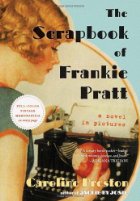
Best Looking: The Scrapbook of Frankie Pratt, by Caroline Preston

This gorgeous book is the prom queen of my 2011 book list.  A novel almost entirely made up of pictures, in the form of a 1920s scrapbook, it’s just visually stunning.  With page upon page of colorful vintage memorabilia and a charming, spunky heroine, no one can begrudge this lovely lady her tiara.

Most Creative: The Night Circus, by Erin Morgenstern

In every high school, there’s bound to be an artsy type who just astonishes you with the depths of her creativity.  In the high school of my bookshelf, that’s definitely The Night Circus.  The descriptions of the magical Cirque des Reves and the incredible characters who populate it were lush and vivid, and the writing was magnificent.  It was probably my favorite book read in 2011.

Most Likely to Give You Nightmares: The Hunger Games, by Suzanne Collins

I know from experience, because The Hunger Games did give me nightmares.  But wow, I was so sucked into the world of Suzanne Collins’ novels that I just couldn’t put them down, bad dreams or not.  I usually don’t read dystopia and I’m not big into young adult fiction, but that mattered not one iota – The Hunger Games is just that good.

Class Clown: Notes From a Small Island, by Bill Bryson

A little levity should help us recover from dystopia-induced nightmares, and there’s no one better for that than Bill Bryson.  In Notes From a Small Island, Bryson skewers England, the English and Scottish people, his wife, his kids, and especially himself with his trademark wit.  While he comes across as a bit curmudgeonly at times, there’s no one better for a laugh.

Biggest Flirt: Anna Karenina, by Leo Tolstoy

Tolstoy’s killing it on these superlatives, huh?  Anna Karenina, the story of a woman who enters into an extra-marital affair, definitely takes the award for biggest flirt.  No one knows better how to rock a ball gown than Madame Karenina.
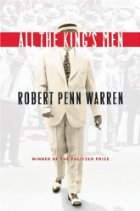
Most Likely to End Up In Jail: All the King’s Men, by Robert Penn Warren

This story of a politician tumbling from a pedestal of honesty into the swamp of corruption is beautifully written, and the characters draw you in even as they make terrible choice after terrible choice.
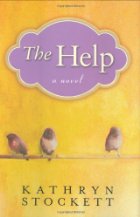
Most Popular: The Help, by Kathryn Stockett

Is there a book club in America that hasn’t read The Help?  I’m guessing not.  But The Help is definitely worthy of its popularity.  The story of a daring group of women, who decide to tell it like it really is in the segregated South at the dawn of the Civil Rights Movement, is intelligent, thought-provoking, and moving.

Most Likely to End Up In Hollywood: A Discovery of Witches, by Deborah Harkness

I could have given this one to The Hunger Games, but since that one has already wrapped filming, it wouldn’t be much of a prediction, would it?  But A Discovery of Witches is destined to be pure movie gold if you ask me.  A fragile blonde witch and a brooding, brilliant vampire falling in love and starting an inter-species war?  Come ON, that’s got movie script written all over it!  And you betcha I’ll be at the theater on opening night, cranky husband in tow.  Oh, hey, the book was pretty good too.

Most Opinionated: The Wordy Shipmates, by Sarah Vowell

A little history, a little current events, a little – okay, a LOT of – opinion.  Mix them together and you get an explosive concoction by Sarah Vowell, heroine of history booknerds everywhere.  The Wordy Shipmates is that girl who always has her hand in the air in American History class, ready to regale the group with obscure trivia and tirades against the government.  But don’t tune her out – listen to her.  She’s got a lot to say, and she’s well worth hearing (or reading).

Most Athletic: Believe It, Be It, by Ali Vincent

I don’t normally read “inspiration lit” – not my cup of tea – but I’m a fan of the Biggest Loser show and Ali Vincent is one of my all-time favorite past players.  I downloaded Believe It, Be It, mainly because I wanted to read some inside dirt on what life is really like on the Biggest Loser Ranch, and Ali definitely delivered.  She dished out a VIP tour of the ins and outs of her season of the show, gossiped about the trainers, told you what a day of filming a reality show is really like, and finished with a heaping helping of inspiration (which, fortunately, is calorie free).  Ali is truly an inspiring person and I loved reading about her journey.

Most Likely to Succeed: As Always, Julia, by Julia Child and Avis de Voto

When the letters start, Julia is an unknown wife of a relatively unknown diplomat, living in Paris and developing an interest in cooking and food.  By the last page, she has written the masterpiece cookbook of the century, lived in several different countries, and made a friend for life in Avis, her correspondent and literary champion.  There aren’t many success stories bigger than Julia’s, but Avis is just as interesting of a woman and the reader gets to know both of them through this wonderful collection of their letters.

So there you have it – my 2011 reading highlights!  What were your favorite books this year?

Cabbage Frittata

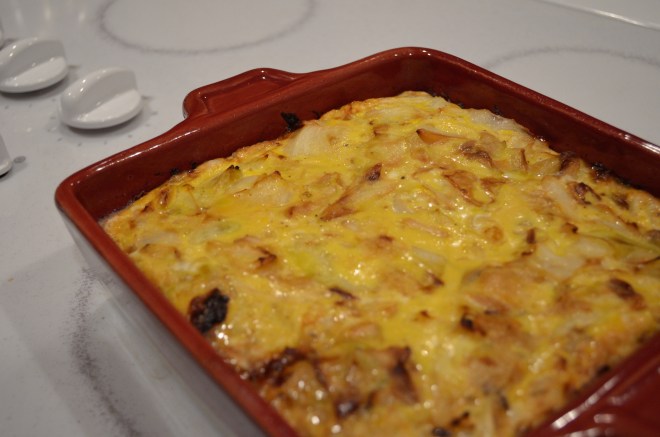
Okay, I realize that I haven’t behaved quite as you may have expected this holiday season.  I haven’t given you cookie or pie recipes.  If it’s any consolation, I haven’t baked anything for my friends or co-workers, either.  In fact, the other day several people brought treats into work and I can’t even tell you how many people stopped by my office to ask if the treats were from me.  The answer is, well, I just haven’t felt like baking recently.  It’s just not on my radar screen at the moment.  What IS on my radar screen?  Quick and easy, but still healthy, dinners to power me through long evenings of gift-wrapping, card-writing, tree-decorating, et cetera.  Like this cabbage frittata, which I’ve now made twice (plus another time as a sort of deconstructed frittata – scrambled eggs with a side of cabbage).  It’s definitely good enough for a repeat, and – bonus – packs plenty of protein and nutrients to get you through those long days ahead.  So I’m being a little bit different and not giving you more ways to rot your teeth this year… I’m just trying to go with my heart.  Enjoy!

Cabbage Frittata

1/2 head green cabbage, shredded
1 tablespoon olive oil
8 eggs
splash milk
1/2 teaspoon kosher salt
1/4 teaspoon pepper

  • Preheat oven to 375 degrees Fahrenheit.
  • In a heavy-bottomed saucepan or saute pan, heat olive oil until shimmering.  Add shredded cabbage and saute, tossing frequently so as to avoid burning.  When cabbage is softened and browned in parts, remove from heat.
  • Beat together eggs, milk, salt and pepper.  Add cabbage to egg mixture and toss to coat cabbage well with eggs.
  • Add cabbage and egg mixture to a greased or sprayed casserole dish.  Bake for 30-35 minutes, until top is set.

Source: Covered In Flour

Winter Wonderland

Did I not promise that I would step up my game for Christmas decorating?  Christmas is my favorite holiday, so I do get excited about decking the halls and all that jolly goodness.  My mom was a teacher, so when I was growing up we always had multitudes of decorations that came to us in the form of teacher gifts – including a whole section of teacher ornaments on the tree.  I don’t have those kind of suppliers, but I’ve pulled together some nice decorations for my house.  In addition to the tree, I did another seasonal mantle using greenery from my yard.  I have holly bushes along my front walk, so I snipped a few branches and laid them across the mantle.  On either side I put some seasonal flair…

I kept out the hurricane vase I bought from Target this fall, but swapped out the golden yellow candle for a simple white one.  I retired the river rocks to their home in my candle cabinet – they’ll be back after the holidays – and surrounded the candle with jingle bells that I bought at Target this weekend.  Next to the hurricane, on one side I have an already-owned candlestick (a wedding gift) and an already-owned candle.  On the other side, a vintage glass vase from my grandmama’s old house, which I filled with red berries from a bush in my backyard.

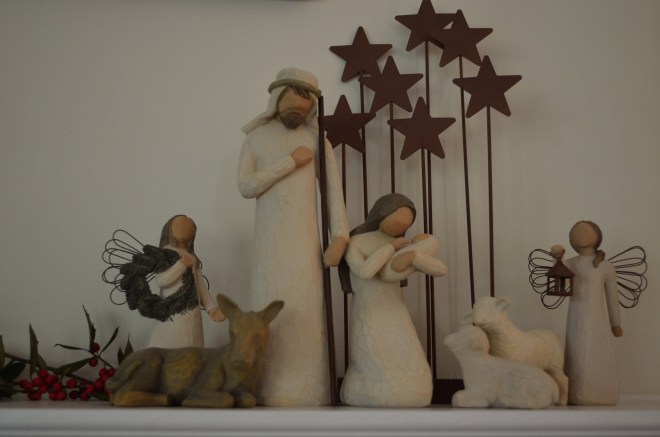
On the other side of the mantle is my Nativity.  I bought this last year after several years of looking for a Nativity but being unable to find just the right one.  I wanted something modern, but still whimsical.  Finally I found the Willow Tree Nativity and it fit the bill perfectly.  I bought the metal star backdrop at the same time as I acquired the Nativity – I liked it better than a creche.  This Nativity includes a shepherd, but I preferred it with just Mary, Joseph, and the baby.  But I included two Willow Tree angels – the Angel of Winter, holding the wreath, and the Angel of Hope, holding the lantern (which I imagine contains the Christmas star).  So it’s a bit non-traditional, but hey, so am I.

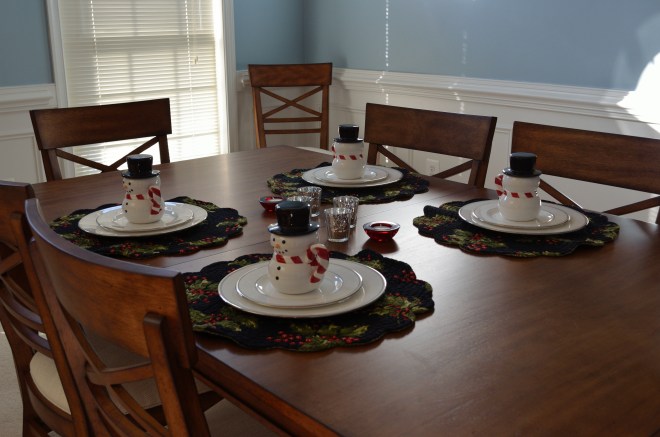
The dining room got a visit from the decorating fairy too!  On the table… April Cornell placemats (a gift last year), Lenox Federal Platinum dinner and salad plates (wedding gift), Target mercury glass votive holders (bought this year) and Crate & Barrel red glass votive holders (a gift several years ago).

And if you’re wondering about the snowman hot cocoa mugs, they’re from Williams-Sonoma and were a present from my mother-in-law.  The hats are lids to keep the cocoa warm until you’re ready to drink it!  Does that cuteness not just slay you?

Remember I said I had plans for the buffet?  These are the plans: my Christmas village!  When I was a kid, I thought that the ultimate mark of an adult at Christmas was that she had her own Department 56 Christmas village.  My mom collected the Dickens Village and my grandmama had Christmas in the City.  Obviously as soon as I was married and had my own place I started my own collection.  My choice…

New England Village!  Want to see my favorites?

Here’s the Lakeshore Holiday House, the 2011 limited edition building, which I just got, with the Salt Bay Lifesaving Station, a gift I received a few Christmases ago.

Sawyer Family Tree Farm, an earlier limited edition

And my all-time favorite, Wheaton Christmas Bakery!  This is one of the limited editions, I think maybe from 2009?  I obviously love the bakery most of all… the yellow bricks, the adorable miniature pastries in the window, and the baker kneeling outside with a tray of goodies for the local kids – too cute! 

How do you decorate for Christmas?

Holiday Wine Guide

Well, friends, it’s the most wonderful time of the year!  Time to gather with family and friends around the fire… sing carols… light candles… generally make merry.  And what’s merrier than wine?  You might be wondering what bottle to bring to your in-laws, or what to pour if you’re hosting, or what to chug when your Aunt Matilda corners you and demands to know when you’re going to learn how to hold onto a man.  Look no further, darling readers, because I can answer all of those questions and more.

First things first – sparklers! 

There’s nothing more festive than a glass of bubbles.  But please, oh please, don’t call these wines “champagne.”  Repeat after messy: “Champagne comes from the Champagne region of France.  Anything else is sparkling wine.”  Actually, sparklers can have different names depending on their country of origin.  For instance, a sparkling wine from France, but not from Champagne, is called cremant.  If it’s from Spain, it’s cava.  Italian vintners offer up Prosecco.  Listen up, now, there’s nothing, I repeat, nothing wrong with drinking a sparkling wine that’s not from Champagne. This weekend hubby and I had a wonderful rose Cremant d’Alsace (a.k.a. a rose sparkler from the Alsace region of France) by Wolfberger.  Check it out.  It was dry and berry-rific and luscious.  And you can’t go wrong with anything from my absolute favorite California sparkling wine producer – Domaine Carneros.  Anything from their widely-available brut to their lovely rose to their high end “Le Reve” wine is phenomenal.  There’s no better wine for a celebration, in my opinion, than a sparkling wine.

Winter whites…

White wines are always a good option at the holidays, because pretty much everyone will drink them.  There are a few people who will only drink red, but in my experience most people will happily drink white wine.  But they can be tricky at the same time, because they vary widely in terms of body, aroma and flavor.  For instance, while a crisp, refreshing sauvignon blanc is absolutely delicious, it’s probably better suited to quaffing pool-side while noshing on a farmers market salad sometime in July.  For fireside sipping, you want something with more heft.  Consider a California chardonnay (I love the offerings from Carneros, the Russian River Valley, or Santa Barbara).  One widely available chard that smells and tastes like a small-batch production instead of a mass market wine is the Sonoma Coast Chardonnay from La Crema.  My parents introduced me to this wine and I could have sat with the full glass in my hand all night, just breathing in the aroma.  (Don’t worry, I did eventually drink it.)  La Crema’s Sonoma Coast is available in pretty much every wine shop I’ve been to, and at around $20, is a good value for an excellent wine. 

Or you might consider a white Burgundy.  These wines are also, generally, made with chardonnay grapes, although a few Burgundy producers also offer up aligote.  (But it’s extremely difficult to find in the U.S., so don’t worry about accidentally buying it.  If you buy a bottle of white Burgundy from an American wine store and they’re not making it super obvious that it’s aligote, it’s definitely chard.)  Burgundy wines follow the French classification system, as they must.  French wines are generally classified into Grand Cru, Premier Cru, Village, and table wine, depending on the location of the vineyard the particular grapes hail from.  Grand Cru is the best, is almost certain to be prohibitively expensive (especially after you toss in the cost of importing it) and is hard to find.  Don’t waste your time looking for a Grand Cru, unless you are proposing and have a wad of cash burning a hole in your pocket.  Premier Cru, the next-best designation, is still expensive, but you can find a reasonably-priced bottle now and then and it’s very, very good.  Village wines will – duh – include the name of the village on the bottle.  If you have a well-stocked wine shop with a French focus, you’ll likely find a bottle or two with a Village designation, and they’re generally very good.  And of course, you can’t go wrong with a wine from Burgundy sub-region Chablis.  Chablis produces all white, all chard, no oaked, and its wines have a delicious, refreshing flinty character.  Chablis wines are some of my absolute favorites.  Just please, please don’t buy anything labeled “California Chablis,” or my heart will shed tears of grape juice for you.

Red Red Wine… 

If you are serving a roast, or you just like reds better than whites, there are many, many options that would work wonderfully for the holidays.  First of all – wine purists, please feel free to close your eyes and start humming now – you can’t ignore Beaujolais Nouveau.  Great wine it is not.  So what is it?  Fun, fruity, festive and cheap.  Yes, there are plenty who scoff at Beaujolais Nouveau, saying “if I want candy, I’ll eat candy, goshdarnit!” – and maybe, maybe those types will consider the slightly earthier Beaujolais-Villages.  Which is good too.  But you shouldn’t dismiss Nouveau.  The current season begins with a release of bottles in early November, and those bottles are really only good until Valentine’s Day.  But if you’re entertaining a group that likes their wines flighty and fruity – and drinks some volume – consider Nouveau.

Okay, say you’re too snobby for Beaujolais Nouveau.  (You’re missing out, but whatevs.)  Try bringing a little South of France sunshine to your holiday with a Cotes du Rhone.  The Cotes du Rhone region is found in Provence – land of suntans, olives and lavender, and lovely grapevine-planted hillsides (like in the picture heading this post).  The wines are luscious and fruity, but earthy at the same time.  Cotes du Rhone wines come at all different price points – you can pay top dollar for a bottle from neighboring region Chateauneuf-du-Pape – but many Rhone reds are a very good value for the excellent quality of the wine you get.  Hubby and I drove through several towns in the Cotes du Rhone last year, and we’re particularly fond of Gigondas, where we had lunch (and I drank a carafe of local rose, nearly without help, and then slept all the way to Burgundy).  A good wine shop will probably stock a few bottles from Gigondas and nearby Vacqueyras, but if you look even closer for offerings from tiny Provencal villages like Sablet and Seguret, you’ll be amply rewarded.  A good Cotes du Rhone will set you back anywhere from $15-30, so they’re not cheapie wines, but provided you like your dinner guests, you’ll find these wines are worth more than their price point.

What are your favorite holiday wines?  And happy sipping, friends!

THE SWEET LIFE IN PARIS

The Sweet Life in Paris, by David Lebovitz

Let’s get one thing out of the way right off the bat: this book will make you hungry. It will make you hungry for hot, crunchy baguettes… frisee salad with melting rounds of goat cheese… and, of course, for chocolate. This book will make you especially hungry for chocolate. Case in point: I hardly ever drink hot cocoa. I generally find it to be too sweet and it’s just not my cup of tea. (See what I did there?) But after reading David Lebovitz’s rhapsodizing about Parisian hot cocoa, I had two cups at lunch that day. No, it wasn’t Parisian… but I was jonesing. David Lebovitz’s delicious writing will do that to you.

Because oh, yes, this book is delicious. From the first page to the last, it was warm, funny, engaging, absorbing, and delightful. Needing a change in his life after experiencing the untimely death of his partner, Lebovitz picks up and moves his entire life to Paris. There he explores the city through its food, tracking down the best baguettes and hot chocolate in the city. He learns to gut fish at a corner poissonerie, to avoid pushy Parisians at the grocery store, and to differentiate between confusingly named chocolate candies. He finds love again, almost has a heart attack (seriously one of the funniest moments in the book), watches the Parisians march under his window over anything and everything, and juggles government red tape and an apartment painter who seems to want to move in with him. Oh, and if great writing about a memorable city isn’t enough to entice you to read this book… there are recipes. Lots of them. And knowing David Lebovitz’s work (I have his ice cream book, The Perfect Scoop) they are all amazing. So even if you can’t go to Paris this weekend – if only! – you can have a little taste of the sweet life in your own kitchen. C’est delicieux.

(Image Source)

Ornamentation

I love checking out the ornaments on other people’s trees!  Ornaments can tell you so much about the family that has chosen to display them every year.  I think we all have our favorites, ornaments that are particularly meaningful to us.  Here are some of mine.

 Hubby and I bought this little guy on a trip back to our alma mater.  We have a little bit of a snowman theme going on with our tree – unintentional, but I just seem to accumulate them – and he fits right in.  Plus we love hockey, we love Cornell, and we love Cornell hockey.  It seemed only right to celebrate the Big Red on our tree!

This is the South Light on Block Island, RI.  My brother lives there, and this was a gift from him two years ago.  It’s a beautiful ornament and it reminds me of one of my favorite guys.
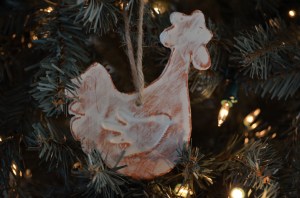
I don’t know if this is really an ornament, but it’s been on my tree for two years now.  I bought this rooster from a traditional Provencal pottery in Gigondas in 2010.  This year instead of packing it away, I’m leaving it out and planning to incorporate it into my year-round decor.  But it’ll always be on my tree, too.
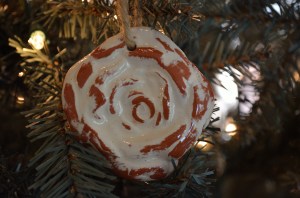
This is another piece of Provencal pottery from that shop in Gigondas.  The rooster is quintessentially French, but this rose is even closer to my heart.  I love how it’s modern and traditional at the same time – just like me.

This is one of two sets of four “Snowman Chefs” that I got from Williams-Sonoma.  I love them and their cheerful reminders to enjoy the treats of the season!
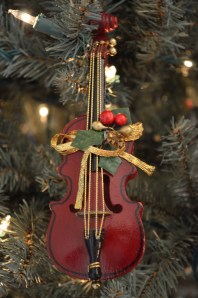
This is a violin ornament that I’ve had since I was a little girl.  I played the violin for years and picked up the cello more recently.  It’s one of those childhood ornaments that just has to be on the tree!

Do you have any favorite Christmas ornaments?  Do share!