
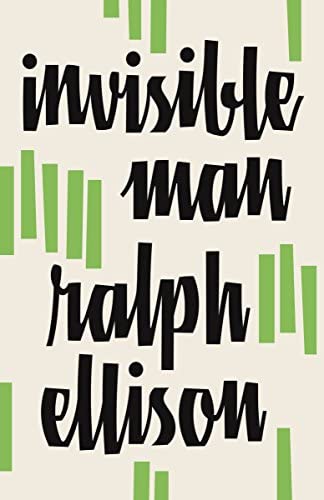
The back cover of my copy of Invisible Man (which was actually Steve’s copy, from college) characterizes the story as a “nightmare journey across the racial divide” – it checked out. The 1952 novel opens with the nameless narrator describing his life as an invisible man; he squats in a basement and siphons power off the city grid in order to light his room, blindingly, with dozens or perhaps hundreds of lights, secure in his knowledge that he’ll never be caught and brought to account because he is invisible. But the narrator didn’t always know that he was invisible, and his journey to that knowledge is the compelling story that follows.
The narrator turns back to his childhood and to the moment when his dying grandfather cursed him. His grandfather had – as far as the family could tell – been a subservient, quiet and obedient Black man, in short, everything the white men who ran their Jim Crow-era Southern society wanted. But the grandfather tells the narrator that he has actually been subversive, a double agent in effect, and the narrator will be the same. He just doesn’t explain how, and the narrator will spend the rest of his life wondering about this. As a young man, still puzzling over his grandfather’s curse, the narrator writes and delivers a speech about race that garners him an invitation to a gathering of the white city fathers – where he is roped into participating in a “battle royal” with other Black youth, a barbaric ritual that reduces the young men to a humiliating spectacle. He then delivers his subservient speech and is rewarded with a scholarship to a nearby Black college.
At college, the narrator works hard and earns the esteem of his instructors and college administration, and is rewarded with a plum task: driving one of the white donors around on a tour of the campus and surrounding countryside. Matters quickly get out of hand, and the narrator ends up introducing the wealthy donor to a local farmer who the college would prefer to keep hidden (as one who has committed a horrifying crime against nature) and then taking him to recover at a rambunctious local bar, where a brawl promptly breaks out. This disastrous day is – spoiler alert – the end of the narrator’s college career, and he is promptly dispatched to New York City to make his own way. The narrator arrives, starry-eyed, in Harlem – only to discover that his college President has sabotaged his chances of a responsible white-collar job. Instead, he ends up in a paint factory, where he lasts one day before being injured in a workplace accident and spending an unspecified amount of time in a very strange hospital, where he apparently has some kind of bizarre procedure done (to be honest, that section was wildly confusing to me – as I expect it was meant to be).
Emerging from the hospital after some unspecified time, the narrator finds new lodgings and a new lease on life as a celebrated speaker with a Communist organization. He believes that he has found his place and secured an important, responsible job – just as he hoped for after leaving college – but outside forces attempt to warn him that the white men who run the organization do not view him as an equal and won’t hesitate to punish him if he steps out of his prescribed place. Meanwhile, he begins to experience the sensation of being anonymous in a large city – his first taste being a taste, quite literally, of a yam from a cart. The narrator buys a hot yam with syrup, a messy meal he wouldn’t dream of eating in public in his Southern hometown, and discovers that no one in Harlem cares that he is eating on the street.
I took a bite, finding it as sweet and hot as any I’d ever had, and was overcome with such a surge of homesickness that I turned away to keep my control. I walked along, munching the yam, just as suddenly overcome by an intends feeling of freedom–simply because I was eating while walking along the street. It was exhilarating. I no longer had to worry about who saw me or what was proper. To hell with all that, and as sweet as the yam actually was, it became like nectar with the thought.

The narrator, who describes himself as invisible in the opening pages, is also blind to his circumstances. He believes the Communist organization – a shadowy concern known as “the Brotherhood” – considers him an expert on Harlem and an important asset; he fails to recognize that while he has an exalted status as their trophy speaker, they have no interest in hearing his opinions. And indeed, as an anonymous “friend” warns him, the moment he begins to assert himself he is promptly sidelined: sent off downtown to speak on “The Woman Question.” While the narrator is away, Harlem slips from the Brotherhood’s grasp and another trophy Black member and speaker, Brother Tod Clifton, falls from grace and disappears. When the narrator encounters Clifton again, he is selling racist caricature dolls on the street and is shot by police while resisting arrest. The narrator watches, helpless, as his friend and colleague’s life is snuffed out – a cataclysmic event that sets off the chain of events that concludes with the narrator finally realizing that he is “invisible.”
Why had he turned away? Why had he chosen to step off the platform and fall beneath the train? Why did he choose to plunge into nothingness, into the void of faceless faces, of soundless voices, lying outside history? I tried to step away and look at it from a distance of words read in books, half-remembered. For history records the patterns of men’s lives, they say. Who slept with whom, and with what results, who fought and who won and who lived to lie about it afterwards. All things, it is said, are duly recorded–all things of importance, that is. But not quite, for actually it is only the known, the seen, the heard and only those events that the recorder regards as important that are put down, those lies his keepers keep their power by.
The entire narrative does have a dreamlike – or nightmarish – quality, with strong magical realism effects throughout. The narrator seems to swim through an increasingly opaque soup of circumstances, and is nearly always in the dark. At the beginning of the book, he describes himself as living in a blinding light box, which he likes – having spent so much time in darkness. (He’s referring to his sewer escape, but the reader knows the darkness is symbolic, too.) But this light is more than just the literal lighting arrangement in the narrator’s room, and is more than just a reaction to time he spends hiding in a sewer at the end of the book; it’s a metaphor for his transition from wilful blindness as a striving college student and “Brother” to an embracing of his own invisibility, and his own existence as a personality outside of recorded history. The light the narrator surrounds himself with symbolizes the dawn of his own consciousness that these organizations that purport to uplift him are actually reliant on him staying quiet and remembering “his place” – and that as soon as he steps outside of his prescribed roles, he will be immediately punished and sentenced to obscurity, or to put it another way – invisibility.
I could go on and on and on… and on… about this book. The edition I read was over 580 pages and there was something thought-provoking on every page; it could be material enough for an entire college course and there’s no way to do justice to the book in one blog post, however long-winded. I found myself focusing on the elements of illumination and darkness; transparency and opaqueness; visibility and invisibility, that swirled in a confusing cloud throughout the book. It was a fascinating read, and I can see myself returning to it again to see what else is there that I missed on this first round.
Have you read The Invisible Man? What did you think?
 covered in flour
It is an amazing book. Good job reviewing and presenting it.
Thank you!
Pingback: Reading Round-Up: October 2022 – covered in flour