

The Song of the Lark is technically the second book in Willa Cather’s “Great Plains” trilogy, although it stands alone perfectly well, and you don’t need to read the first book (O, Pioneers!) or the third (My Antonia) to follow and enjoy this unrelated story. Considered to be the most autobiographical of Cather’s novels, The Song of the Lark follows young Thea Kronborg, a talented pianist and singer, from her childhood in a small village in rural Colorado, through her musical education in Denver and Chicago, and her awakening as a stage artist.
As a young girl, Thea knows that she is special. Her mother encourages and facilitates her gifts (even through her siblings’ jealousy and her father’s preoccupation with his religious vocation). Thea attracts the attention of older men in the town – the local doctor, a railway worker who (rather creepily in my 2022 eyes) wants to marry her, a migrant laborer from Mexico. It’s a little strange, this fixation that older men have on Thea, but nothing horrifyingly inappropriate happens (thank goodness) and a few of these relationships lead Thea to leave her small-town home to study and experience music in the big city.
In Denver, and later – especially – Chicago, Thea is a fish out of water. She struggles to concentrate in her lessons and she fights against constant, grinding poverty. Thea does find friends everywhere she goes – a few, good friends – but she also finds a lot of indifference and discouragement. But there are moments of light, when she begins to awaken to her art, lose her heavy guard, and the reader sees the potential artist.
She was not ready to listen until the second number, Dvorak’s symphony in E minor, called on the programme, “From the New World.” The first theme had scarcely been given out when her mind became clear; instant composure was upon her, and with it came the power of concentration. This was music she could understand, music from the New World indeed! Strange how, as the first movement went on, it brought her back to that high tableland above Laramie; the grass-grown wagon-trails, the far-away peaks of the snowy range, the wind and the eagles, that old man and the first telegraph message.
Side note: while context clues made it clear that Thea hails from somewhere around Fort Collins (or thereabouts) Cather’s gritty, glittering descriptions of the landscape called to mind the western slope of Colorado, where my brother lives, and I couldn’t shake that picture.
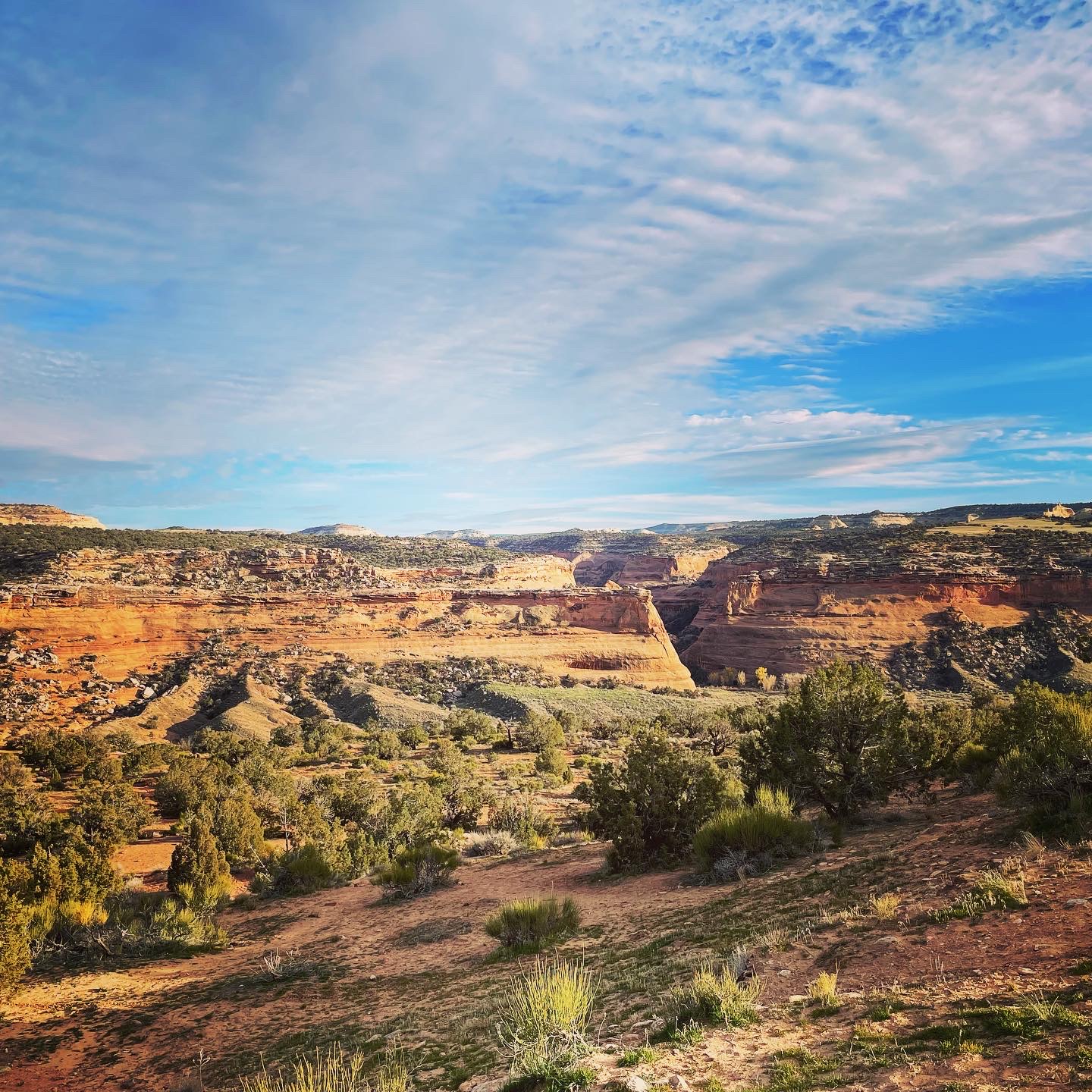
Wire fences might mark the end of a man’s pasture, but they could not shut in his thoughts as mountains and forests can. It was over flat lands like this, stretching out to drink the sun, that the larks sang – and one’s heart sang there, too. Thea was glad that this was her country, even if one did not learn to speak elegantly there. It was, somehow, an honest country, and there was a new song in that blue air which had never been sung in the world before. It was hard to tell about it, for it had nothing to do with words; it was like the light of the desert at noon, or the smell of the sagebrush after rain; intangible but powerful. She had the sense of going back to a friendly soil, whose friendship was somehow going to strengthen her; a naive, generous country that gave one its joyous force, its large-hearted, childlike power to love, just as it gave one its coarse, brilliant flowers.
I have not read Willa Cather in many years – I think I read My Antonia back in college, and not since, and I’d never read any other Cather. I bought The Song of the Lark at the Strand in New York City at least ten years ago and have been moving it from house to house ever since, so it was long past time. My (admittedly very shady) memory of My Antonia was that I loved Willa Cather’s gorgeous writing about the western landscape, but didn’t find the characters as compelling as I’d expected to – and the experience of reading The Song of the Lark was the same. I certainly rooted for Thea to find her way in a big world; my eyes welled up when one character died in a horrific accident; I liked Thea’s “beer prince” boyfriend and her sad sack piano teachers (both of them) – but I didn’t find the characterization that powerful. This may have been due to the fact that I read The Song of the Lark while I was sick and had some other (private, personal) stuff distracting me – I definitely didn’t give the book my full attention, or really anywhere near as much attention as it deserved, and I’ll bet I’d have had a better, more fulfilling reading experience if I had. Even operating at only half strength, though, I still thought The Song of the Lark was a lovely read, gorgeously written and well worth the time I spent on it. I’ll have to revisit it soon at my full readerly powers and see if the experience expands – like the western landscape – as a result.
Have you read any Willa Cather?
 covered in flour
My Antonia and loved it.
Wonderful book!