
My “IRL” friends know that there are two types of critters that really – and I mean really – freak me out. One is butterflies. (I cannot. Don’t @ me. I just cannot with them.) The other is fish. I know – that one seems weird, right? I love the ocean.
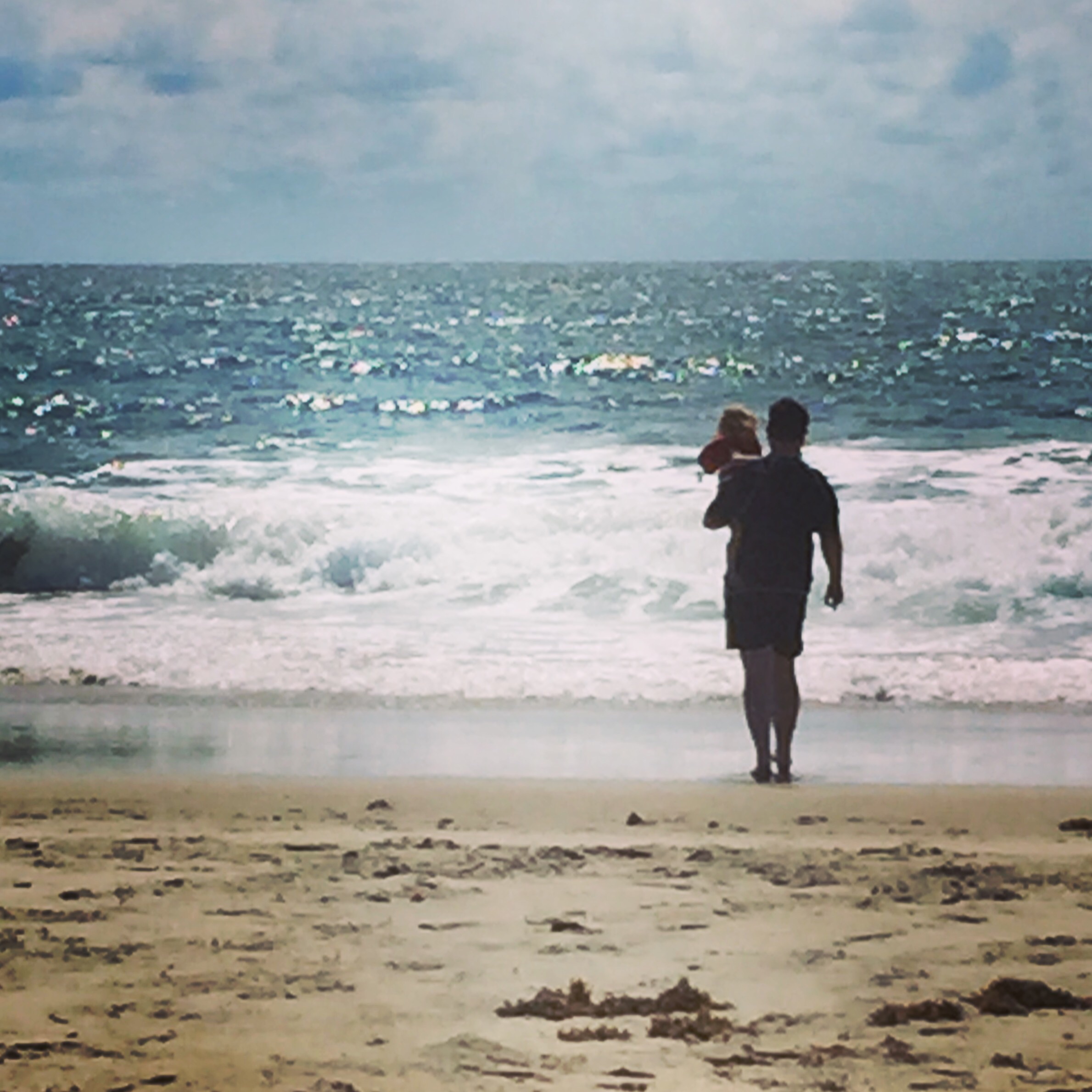
I love the sunlight sparkling on the waves, the feeling of sand between my toes, the warm sunshine and the cool, salty surf. And I do love many of the creatures that call the ocean home. Especially the really big ones. The bigger, the better, actually.

Whales are my favorite animal on the planet – land or sea. (Followed by elephants in second place. I just like really, really big critters.) But I love other cetaceans – dolphins and porpoises – almost as much, and I have a real soft spot for sea turtles. Fish, though, that was another story. Since I was a little kid I’ve had a very strong revulsion reaction (see above re: butterflies) and fish triggered it. My parents pushed me to snorkel to try to get over it, but that just made it worse. (Sorry, Mom and Dad.) But a few years ago, I started to think seriously about trying to get past my fear of fish. (Or “thing about fish,” really. It’s not a fear – it’s a revulsion at the idea of them touching me or brushing up against my skin. And yes, I know they don’t actually want to touch me. I didn’t say it was rational.) It just felt like, loving the ocean as I do, I was missing out on experiencing it in a truly special way.
I started thinking about learning to scuba dive as a way to get over my fear. I know – that seems weird too, right? Because if snorkeling freaked me out so deeply, why would scuba be better? Stick with me here. I thought about it a lot and figured out that my issue, thanks to that revulsion reflex, was with the idea of a fish touching me. The idea of fish scales and slime brushing against my bare leg or arm gave me the creeps in a very intense way (still does, actually). But if I was covered from head to toe with neoprene, so that I couldn’t feel the sensation that was so scary to me, could I interact with the ocean as I really wanted to?
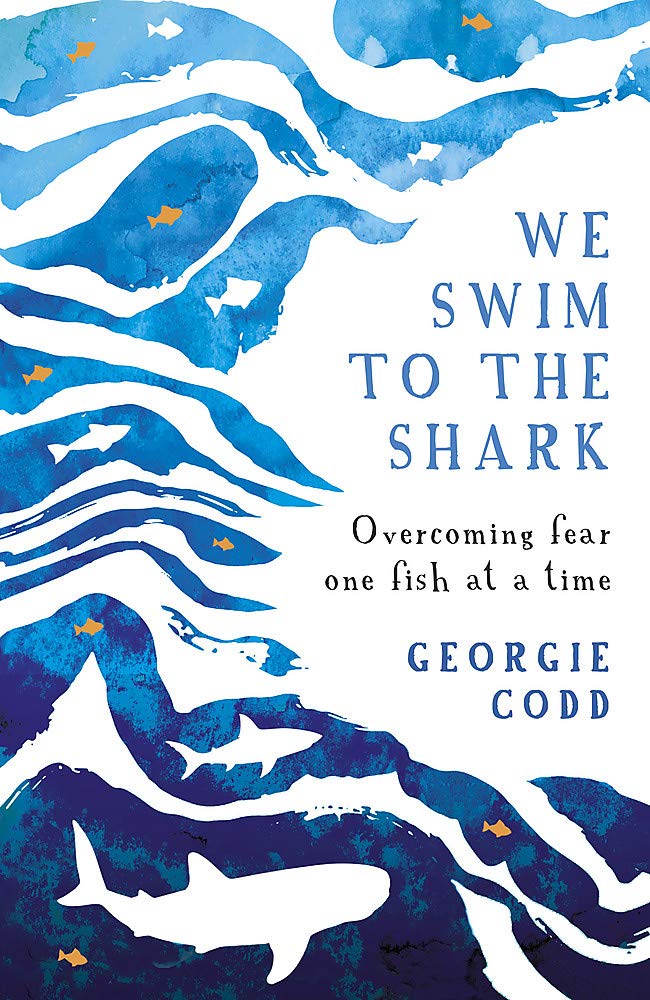
As I thought about these things, I found others – a few others – considering the same questions. Jack Steward, host of one of my favorite travel/nature/adventure shows, “Rock the Park,” described his nerves before a night dive with manta rays: “I really don’t like critters up in my business. But I also pride myself on my ability to, you know, find my peace and just really take in an experience.” (Or something along those lines; I may have gotten the exact wording wrong, but that was the gist and I really identified with it.) And Georgie Codd, who struggled with full-blown ichthyophobia – much more debilitating than my “ick” reaction – learned to dive and set herself the goal of swimming with a whale shark as a way of conquering her fear. Her book about her journey, We Swim to the Shark, floored me.
So I told Steve I wanted to get scuba-certified. He’s generally on board with whatever I want to do, no matter how out of the blue or seemingly crazy (I know, what a guy, right?) and he was immediately interested. We kicked the idea around for awhile, but it was low on the list because we were planning our Antarctica trip. (It turns out you actually can dive off Ushuaia, Argentina – so stay tuned.) But when Antarctica got postponed, and we started scouting around for another adventure, diving bobbed back up to front-of-mind.

We kicked the idea around for a little while, but when we decided that Costa Rica would be our consolation for postponing Antarctica, we figured – why not go for it? So we signed up for the PADI (Professional Association of Diving Instructors) open water certification course. And then – well, I can’t speak for Steve, but – immediately questioned our sanity.
The first phase of PADI open water training was a fifteen-hour online course. Fifteen hours. It wasn’t so much the time commitment (I crammed it into about seven evenings) as the sheer volume of information. So much to remember – acronyms, equipment, routines – and so many ways things can go really alarmingly wrong. Even as I passed every quiz and unit final exam with flying colors, I freaked out that there was no way I’d ever be able to remember all this. And what if the thing I forgot turned out to be the thing I really needed to know – for safety?
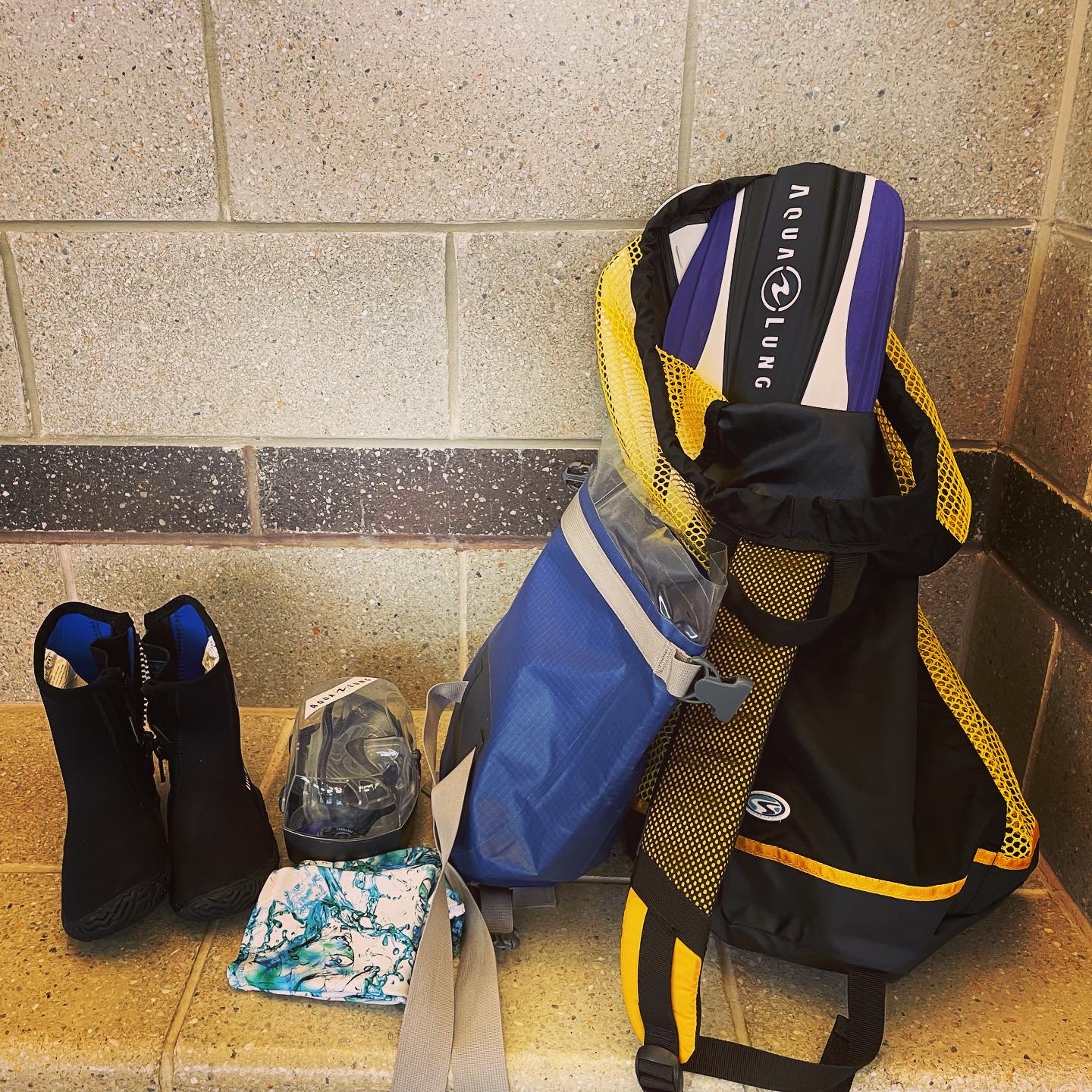
It was scary thinking about how complicated (not to mention expensive) this new hobby was going to be. But as I was getting more and more nervous and questioning my decisions, Steve was getting more and more excited. We suited up with the most bare minimum of basics – fins, masks, snorkels, dive boots and socks, and mesh bags to tote it all in – and on a frigid December day, we headed to the pool at Dulles Community Center.
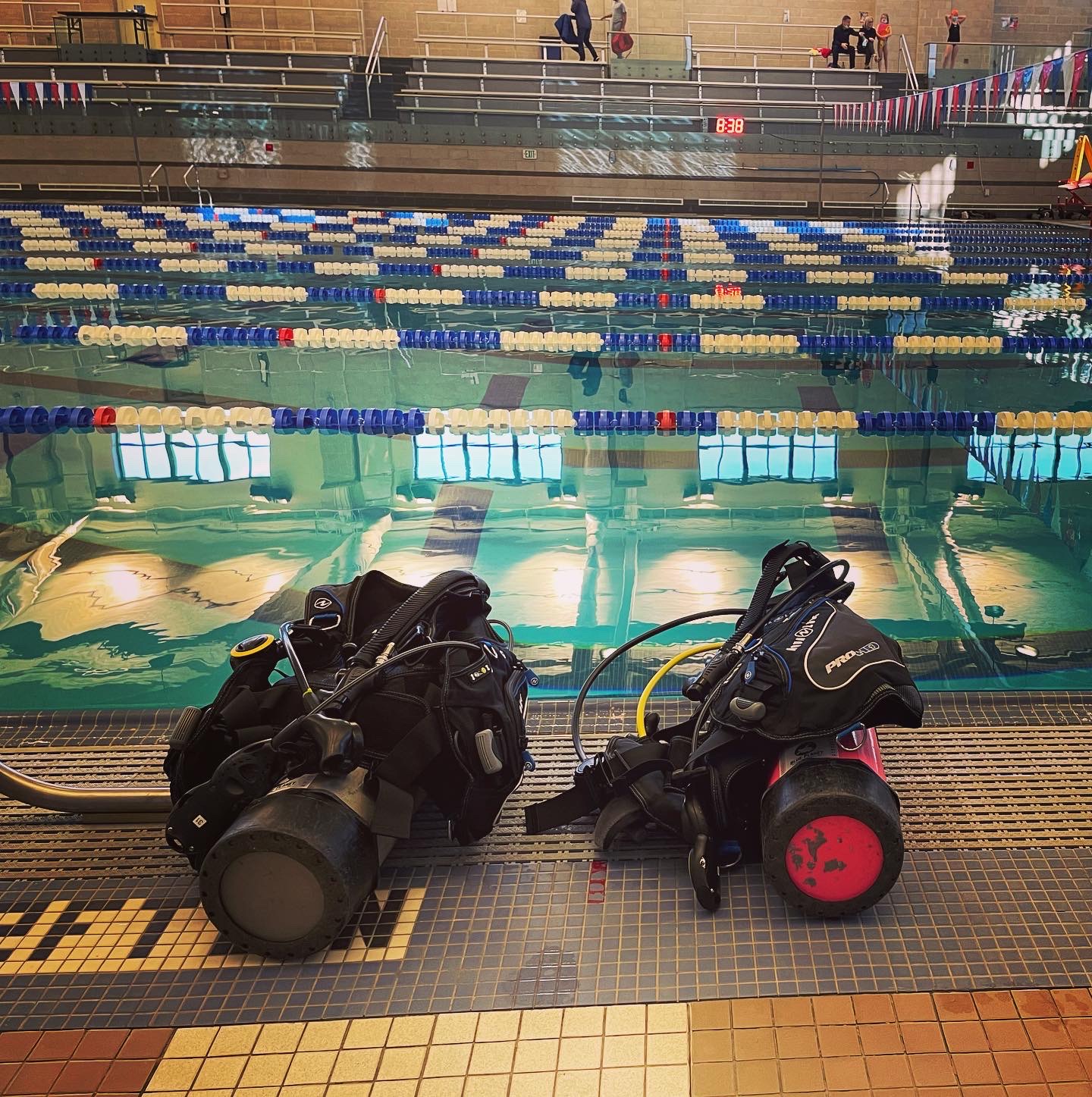
Begin With Review And Friend. #IYKYK.
We suited up in wetsuits borrowed from the local dive shop that was also providing instruction for the pool component of our training, flopped awkwardly around the pool deck in our fins, strapped on our (also borrowed) BCDs and tanks, and giant-stepped into a new world.
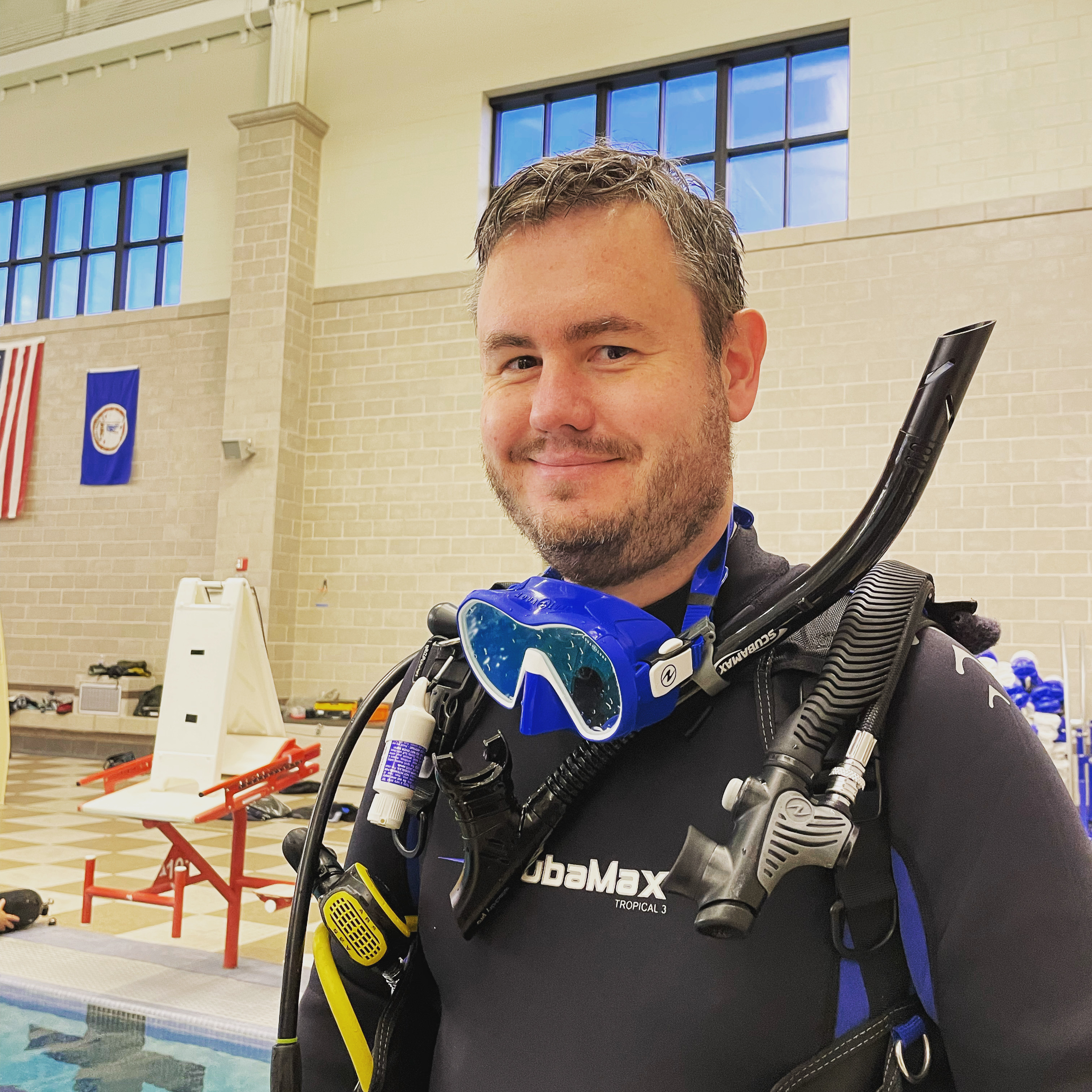
The PADI open water e-learning notes for newbie divers that: “Your first breath underwater is an exhilarating experience.” I didn’t know what to expect, but I was really nervous. As I sank below the shallow-end pool water with my regulator in for the first time, all of the disaster scenarios ran through my head on a loop. And then I settled onto the pool floor with Steve and the rest of our dive class and took that first breath, and – it was exhilarating, yes, but the sensation that flooded from the top of my head to the tips of my toes was pure peace.
It is silent underwater (at least, it is in a pool). I looked up and could see lap swimmers making their way through their evening workouts, but they appeared to be moving in slow motion and I couldn’t hear their kicks and splashes. The only sound that broke the silence was my own breath. Another thing the PADI e-learning drives home is that it’s critical that you never hold your breath while diving. I was worried about the opposite: that I would freak out and hyperventilate (as I have done while snorkeling). But the experience couldn’t have been more different. It was like meditating – on another planet. I felt serene, and joyful, and filled with a sense of well-being. I was completely, totally, at peace.
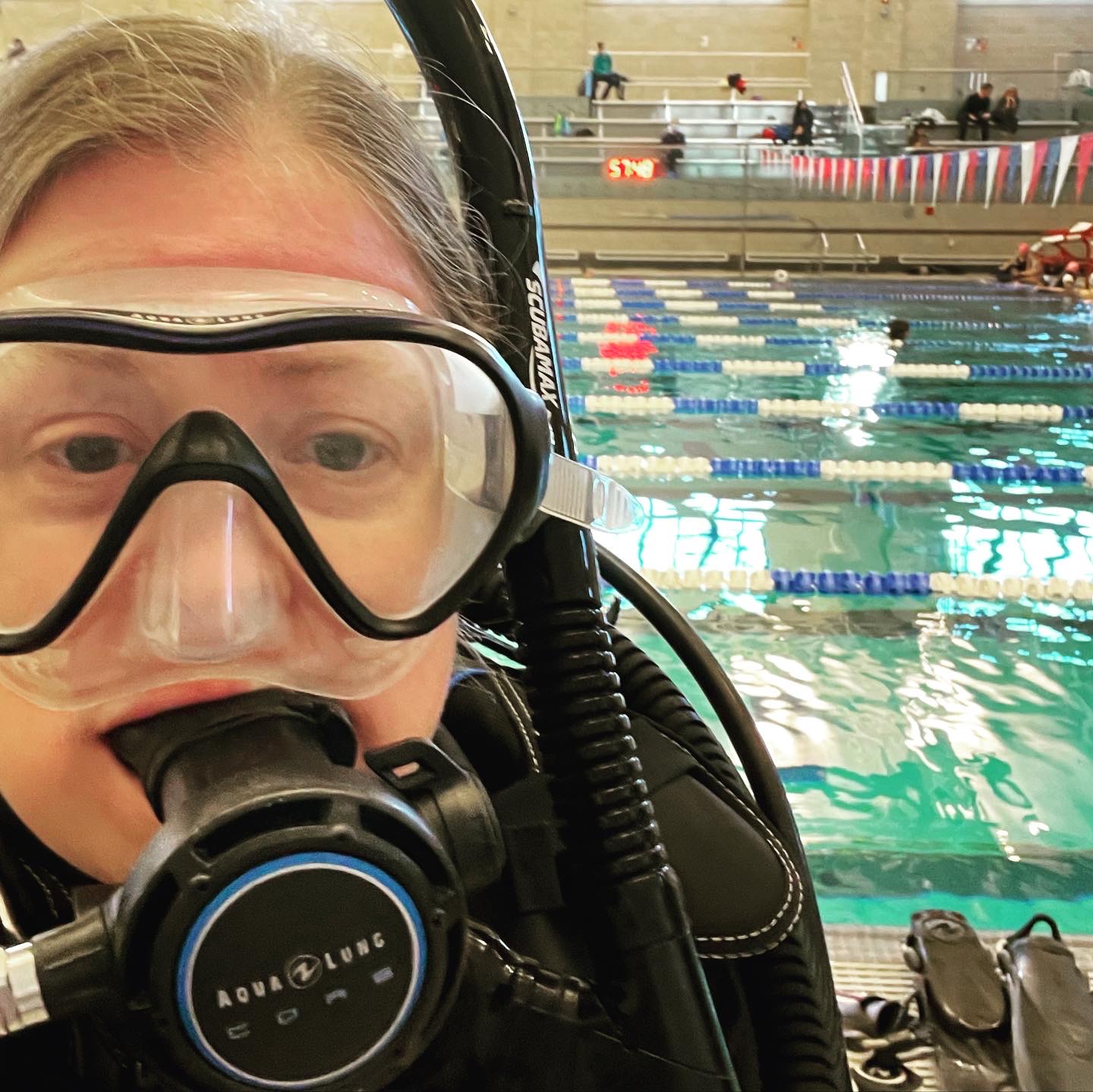
The word you are looking for is: elegant.
The pool classes were exhausting. Two consecutive Saturdays, seven hours each day. It was a big time commitment and a lot of babysitter dollars. We left the pool wrinkled like prunes (and my hands were itchy and irritated from dry winter skin spending hours in chlorine). And I actually found the instructor really off-putting. But all of the worries about forgetting something important disappeared when I slipped under the surface of the water and took a breath. I was still worried that I would panic in the actual ocean – but that was a problem for another day.
Check back on Friday and I’ll tell you how the first day of certification dives went…
 covered in flour
Just came across your blog – Loved reading of your adventures – all sounds fantastic – and well done for conquering your fears – Lois
Thanks for stopping by and hope you enjoy! 🙂
Pingback: Costa Rica 2022: Scuba Day 2 – covered in flour