
In fall 2003, I was a first year law student in Washington, D.C. In class one day, my criminal law professor assigned the entire section to go down to the Supreme Court, observe an oral argument, and write about it – just a few paragraphs about the case, the argument itself, and our impressions of the experience. So on a bitterly cold morning, I huddled outside the Court with friends, waiting to enter through the public doors, sit in the gallery, and watch an argument for the first time.
We arrived early – 6:00 a.m. – because we had decided to watch argument of one of the line of “Pledge of Allegiance” cases that were making their way through the courts and garnering lots of media attention (or what passed for media attention in our little law school bubble). My memories of the day are foggy; it was so long ago. I remember that my friend Mike was in the group. I don’t remember who else joined us. (Mike and I did everything together throughout most of law school.) I remember gazing at the separate entrance for members of the Supreme Court Bar and wondering if I would ever be part of that group. (Spoiler: not yet, although my BFF is being sworn into the Bar of the Supreme Court in April.) I remember filing past the Supreme Court cafeteria and the partially obstructed view behind a pillar in the gallery. I remember wondering if the rumors were true that the reason Justice Thomas never asked a question was because he slept through every argument. (Answer: I don’t know, but I can confirm from visual evidence that he was asleep during the argument I watched.)
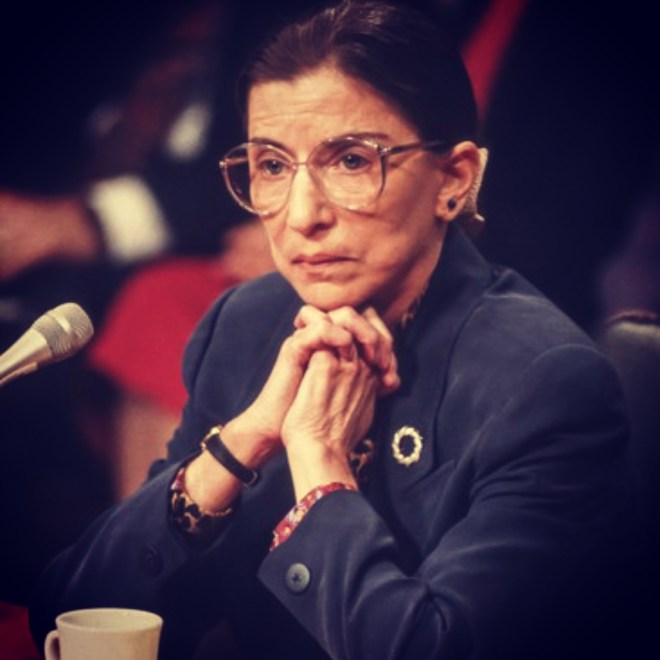
Justice Ginsburg asked a few questions – just a few. Although the argument we watched was a high profile case, I don’t think it was all that controversial, by which I mean the Justices all pretty much already knew what they thought about the legal issues – although they certainly were giving the arguments their attention. I don’t remember any of the questions now, seventeen years later. I wish I could remember what Justice Ginsburg asked about.
I do remember the chills I felt at seeing the legendary RBG in action. I was a female law student; obviously she was my idol. (To the extent that when I got married, I elected to have “two last names” and not to hyphenate: “If it’s good enough for Sandra Day O’Connor and Ruth Bader Ginsburg, it’s good enough for me!” Big mistake. Justice O’Connor and Justice Ginsburg clearly had more organized minds than I did and never said “I don’t know” in response to the dentist’s receptionist asking them what their names were.) So: chills. And a powerful sense of a grave responsibility from joining the same professional universe – however many millions of degrees removed from Justice Ginsburg’s powerful perch.
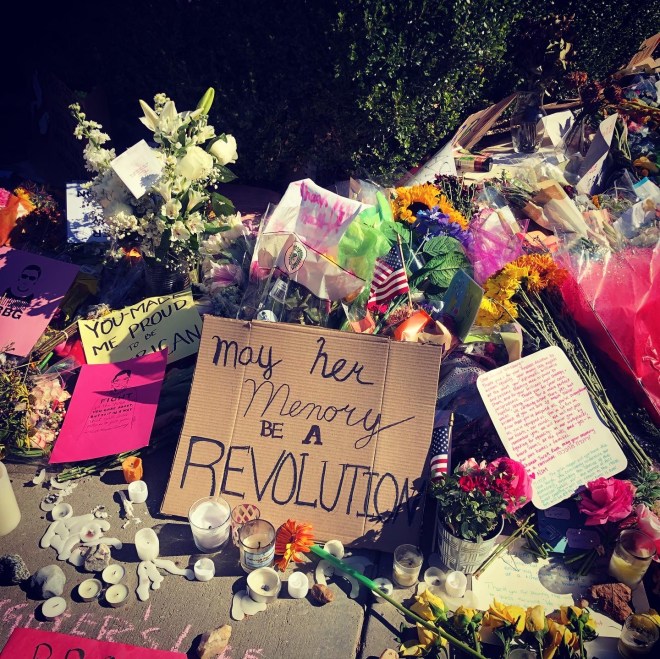
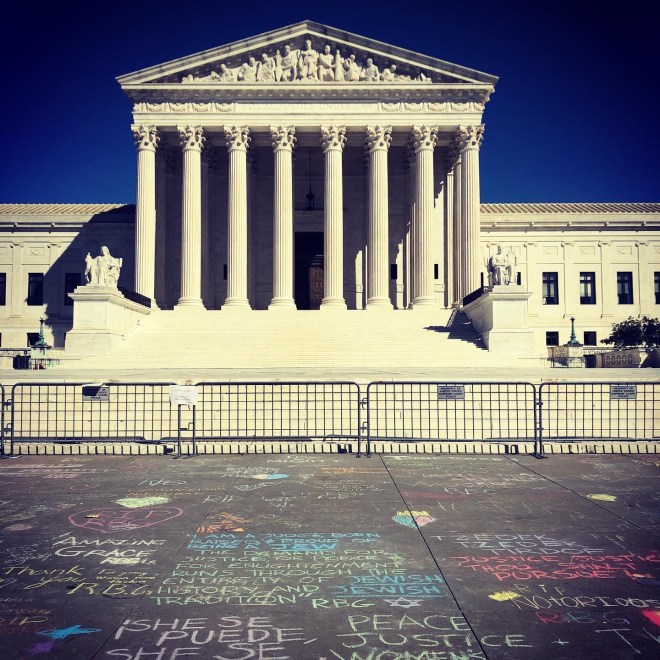
Yesterday, I planned my running route to go by the Supreme Court. I have been working through my grief and my fear for our democracy over the past few days, like so many. And I wanted to go in person, to stand before the pillars, to read the words “EQUAL JUSTICE UNDER LAW” inscribed over the door – that principle that RBG made the core of her jurisprudence – and thank her for breaking ground for me and millions of other female attorneys.
I’ve been watching and marveling at the social media posts celebrating RBG’s legacy. As a woman, I owe her so much: because of RBG, I can sign a lease or a mortgage in my own name; have a credit card, again in my own name; work while pregnant without fear of discrimination; play a high school sport – all of which rights I have personally enjoyed – and so much more. So I ran to the Court (I felt RBG would approve that part, too) stood before the front entrance, bowed my head, and thanked her. Then I cried the tears I needed to cry, squared my shoulders, and continued on my run.

As I ran down Capitol Hill and onto the National Mall, on my way back to my car, I noticed a sign in front of the U.S. Capitol: Stop Trump. Vote.
I wish that we could all just mourn RBG and celebrate her legacy without a political firestorm. But this is 2020 and that mourning period – like so many other things this year – has been denied to us by malfeasance and hypocrisy. So along with grief must go resolve.
I did not agree with the “McConnell Rule” in 2016. I do not believe there was any justifiable – or logical – reason to deny a Supreme Court nominee a vote, or even so much as a hearing, as was done to President Obama and Judge Merrick Garland. At the time, I believed that the American people had spoken on who they wanted appointing Supreme Court Justices. We spoke in 2012 when we elected President Obama to another four-year term. Not a three-year term. A four-year term. And there were still, at the time, nine months left in that four-year term. (Enough time to grow a human. Certainly enough time to approve a Supreme Court Justice.)
Although there was no logical support for their position, Republicans under McConnell took the position that there was somehow precedent for not appointing Supreme Court Justices in an election year. (Do the research: not true.) So they created the “Mitch McConnell Rule” that SCOTUS Justices are not confirmed in an election year. Fine. It’s a bad rule. It doesn’t make logical sense. But they decided that this was a rule because – at the time – it was politically expedient for them, and it doesn’t magically become a not-rule when it is no longer politically expedient.
My legal practice – which I owe, in large part, to RBG and the ground she broke for the women lawyers who would come after her – involves a lot of counseling managers in the application of work rules. What I tell them is: don’t have a rule unless you’re committed to applying it every time the situation comes up. Don’t make policies that you are not sure you can apply evenly and consistently. Because inconsistent application of rules leads – in the best case – to diminished workplace morale. In the worst case, it leads to litigation.
I would say the same to Senate Republicans, if they would listen (they wouldn’t). The “Mitch McConnell Rule” is a stupid rule. It doesn’t make any logical sense. The “precedent” they cited in support of this harebrained idea – that SCOTUS Justices are not confirmed in election years – was about 20% based on the fact that SCOTUS Justices don’t often pass away or retire during election years, and 80% imaginary. It was always a dumb idea. But it’s a rule now. And you don’t get to have one set of rules for when it benefits you, and another set for when it doesn’t.
Steve doesn’t think there is enough time to ram a nominee through the Senate even if they want to (which, clearly, they do). One of my law school friends agrees. I hope they’re right, but I fear that they are wrong. So it is left to us – the voters – to tell the Senate that there will be consequences at the ballot box. It is left to us to vote them out. To vote blue up and down the ballot, to send a message that the American people demand better from our representatives. We demand that they choose country – us – over the craven clawing of any scrap of power they can find.
Thank you, Justice Ginsburg, for everything you have done for women. Now it is up to us to carry on.
 covered in flour
I am sitting here with a lump in my throat and tears in my eyes as I read this because you summed up what I think alot of us are feeling. Couldn’t have said it better. Thanks for sharing!
Thank you, Nicole – that is so kind. I don’t feel that I did justice to RBG or her legacy at all, but I am glad that my words spoke to you.
Pingback: It’s Monday! What Are You Reading? (September 28, 2020) – covered in flour