
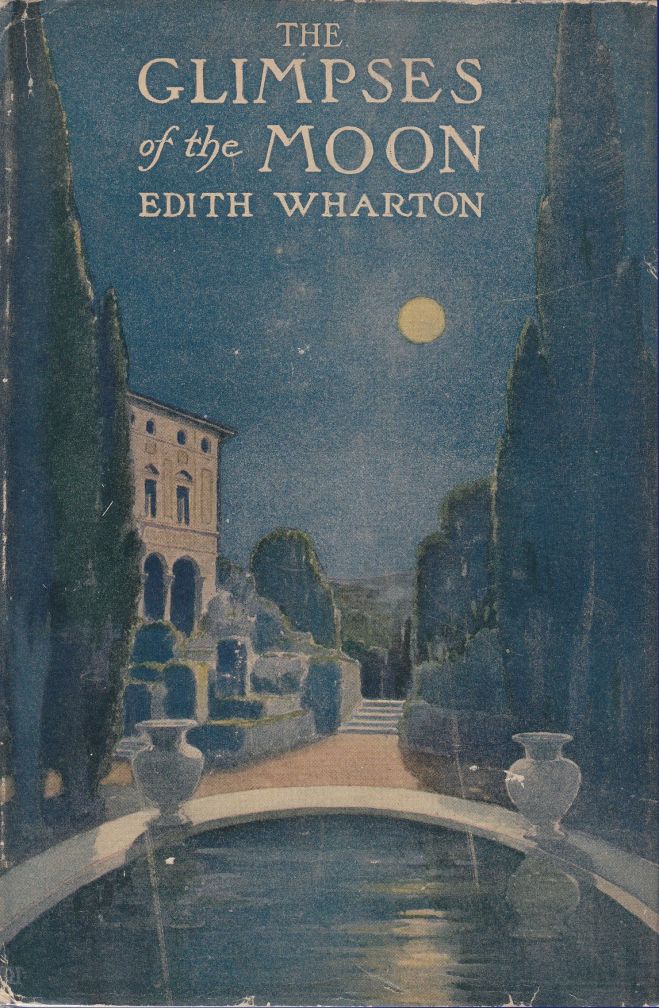
Edith Wharton was already at the height of her powers and acknowledged as one of the most important American writers of an age – maybe ever – when she first published The Glimpses of the Moon in 1922. Most of her best-known works, including the big three – The House of Mirth, The Custom of the Country, and The Age of Innocence (my favorite) – were behind her. Yet, for some reason, The Glimpses of the Moon is shrouded in semi-obscurity even as Wharton’s better-known works continue to be read and discussed. I’m not sure why. If anything, I’d have expected Moon to be one of the most enduring, as it has all of the hallmarks of Wharton – her characters traipse around Europe, flit in and out of drawing rooms, have relationship agonies on Venetian balconies, and shop for furs – but (spoiler alert!) it ends happily. (Of course, I’d disagree with those who believe that The Age of Innocence ends unhappily. I think Newland Archer ends up with exactly the right person, and the only tragedy in the book is the fact that he’s too dim to realize it. FIGHT ME. But I realize that’s an unpopular opinion, and I won’t deny that Innocence is poignant.)
The Glimpses of the Moon spins the tale of a marriage conceived as a business arrangement but that soon takes on a greater significance. Nick and Susy Lansing decided on a whim to marry. They were good friends, liked each other immensely, and there was an undeniable spark – but the marriage itself was something between a big joke and a limited liability partnership. Both the “poor relations” in their group of friends, both social hangers-on, they concocted a scheme to marry, collect lots of wedding checks, and spend a year honeymooning in their rich friends’ villas, palaces and manor houses. If at any point in the marriage, one of them caught wind of an opportunity for something better – a wealthy spouse, for instance – they’d part as friends, no hard feelings, and give one another a leg up.
The suggestion, at first, had seemed to Lansing as mad as it was enchanting: it had thoroughly frightened him. But Susy’s arguments were irrefutable, her ingenuities inexhaustible. Had he ever thought it all out? She asked. No. Well, she had; and would he kindly not interrupt? In the first place, there would be all the wedding presents. Jewels, and a motor, and a silver dinner service, did she mean? Not a bit of it! She could see he’d never given the question proper thought. Checques, my dear, nothing but checques–she undertook to manage that on her side: she really thought she could count on about fifty, and she supposed he could take up a few more? Well, all that would simply represent pocket-money! For they would have plenty of houses to live in: he’d see. People were always glad to lend their house to a newly-married couple. It was such fun to pop down and see them: it made one feel romantic and jolly. All they need do was to accept the houses in turn: go on honey-mooning for a year! What was he afraid of? Didn’t he think they’d be happy enough to want to keep it up?
I’m sure you see where this is going.
Although both entered into the partnership with eyes wide open, the business side of things falls away fairly quickly. Spending the first part of their honeymoon at their friend Charlie Strefford’s villa on Lake Como, Nick and Susy become deeply attached to one another. And then Nick starts to feel squeamish about the foundations on which they’ve built their relationship. There are little squabbles to start – how Nick hates Susy’s habit of referring to her sponging off rich friends as “managing” – and then a big blowup when Nick realizes how far Susy has had to bend ethics to make their plan come to fruition. It’s not so much that Nick suddenly acquires scruples, as that he doesn’t really consider how the arrangement is going to work until they’re in the thick of it. And when he finally looks the situation full in the face, he can’t handle it and he bolts.
And that’s just the first third of the book! Nick and Susy spend the bulk of the novel separated from one another, each missing the other horribly but afraid or unwilling to admit it. Susy drifts from rich friend to rich friend and nearly becomes engaged to their old friend Streff, suddenly and unexpectedly elevated to the peerage. And Nick has his own flirtation with possibility when he becomes private secretary to a fabulously wealthy family and their daughter confesses her love for him. Yet deep down, each knows that their hearts are not free and never will be. But they will need to do a lot of growing before they can realize it.
Susy’s growth happens gradually over the course of the novel. She gradually becomes disenchanted with the glittering social world she moves in, disgusted by her so-called friends’ loose morals and shifting definitions of marriage, and disillusioned by the pointlessness of it all:
That was the way of the world they lived in. Nobody questioned, nobody wondered any more — because nobody had time to remember. The old risk of prying curiosity, of malicious gossip, was virtually over: one was left with one’s drama, one’s disaster, on one’s hands, because there was nobody to stop and notice the little shrouded object one was carrying. As Susy watched the two people before her, each so frankly unaffected by her presence, Violet Melrose so engrossed in her feverish pursuit of notoriety, Fulmer so plunged in the golden sea of his success, she felt like a ghost making inaudible and imperceptible appeals to the grosser senses of the living.
“If I wanted to be alone,” she thought, “I’m alone enough, in all conscience.” There was a deathly chill in such security.
Nick, meanwhile, has his own growing to do. It’s far easier to sympathize with Susy than with Nick, who had eyes wide open at the beginning of the deal but who deserts Susy with no explanation when she is at her most vulnerable, and who lets months go by without delivering the letter he had promised to send within a few days. Nick will come to his own realizations, but I don’t want to tell you about them, because I don’t want to take away the delights of how it all comes together.
It’s no secret that I love Edith Wharton – all the more for feeling as though I need to make up for lost time with her. When I first read Wharton, in high school – Ethan Frome as a class assignment and The Age of Innocence on my own – I didn’t care for her at all. I was bitterly disappointed, because I so wanted to love Wharton’s books. I knew that she had made a home in western Massachusetts, just a short distance from where I grew up in upstate New York. But her books left me profoundly disappointed. Then years later, in my late twenties, I picked up The Age of Innocence again, and fell hard and fast for it. My friend Susan has a theory: she believes that teenagers are incapable of enjoying Wharton, or George Eliot for that matter, because they write about adults not being able to do whatever they want – and that is the last thing a teenager wants to know about. Certainly I was unable to appreciate Wharton when I first tried (I never even attempted Eliot until my thirties) and now, she’s a favorite. The Glimpses of the Moon was a wonderful read. It didn’t eclipse (<–pun intended, #sorrynotsorry) The Age of Innocence for me, but it is solidly in second place. I think that Nick and Susy wouldn’t disagree.
Have you read Wharton? What’s your favorite?
 covered in flour
Wow, second place! I too loved The Glimpses of the Moon. It seems to me Wharton is rewriting The House of Mirth and giving it a happy ending.
I haven’t made it to The House of Mirth yet! I’ll have to bear that in mind when I get to it. That’s probably going to be my next Wharton, because I own a copy.
Ah, sorry if I’ve spoiled the ending! I won’t give any details. I suspect you’ll find some similarities with Glimpses. I love both of them, along with some of Wharton’s other less famous novels, such as The Children and The Mother’s Recompense.
Oh, you didn’t spoil anything! I knew the ending to The House of Mirth already, thanks to the Edith Wharton biography. (Plus, it’s so rare that her books end happily that I would have assumed, anyway – LOL.) I’m enjoying working my way through Wharton, and love her work, although I think my favorite recent venture has been Trollope. I just love those happy endings.
Yes, it’s usually a safe assumption! One of the reasons Glimpses stands out so much. I’ll look forward to your next Wharton and Trollope reviews.
As will I! Library deadlines beckon, but Barsetshire is also calling…
I have read some of Edith Wharton.
I found Ethan Frome too sad.
I liked the Buccanneers.
The Age of Innocence is on my TBR.
I had not heard of Glimpses of the Moon. I am definitely going to find it now.
Great review !
Hope you enjoy it, if you do check it out! I haven’t read The Buccaneers yet, but it’s on my list. Good to know it comes recommended!
Thank you.
Have you read anything by Penelope Fitzgerald?
I saw a movie based on one of her books called The Bookshop and am looking for the book now.
I haven’t! I heard The Bookshop was sad, so it hasn’t been a priority. Sometimes I think I’ve read Penelope Fitzgerald, and then I realize that I’m actually thinking of Penelope Lively… ha!
Yes I have read a book by Penelope Lively called Consequences.
And more are on my TBR.
The movie The Bookshop is not so tragic . It is bittersweet.
I think you would like it
I haven’t read Consequences yet! Just Moon Tiger and Life in the Garden – although I have Dancing Fish and Ammonites on my living room table… one of these days, when the library deadlines are under control…