

Reading is my oldest and favorite hobby. I literally can’t remember a time in my life when I didn’t love to curl up with a good book. Here are my reads for August, 2018…
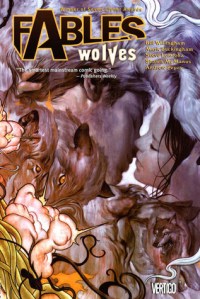
Fables, Vol. 8: Wolves, by Bill Willingham – It had been quite some time since I read any installment of Fables, but I stopped by the comics shelf at my library branch and there it was, looking like just what the doctor ordered. In this installment, Mowgli has been dispatched to find Bigby Wolf, who Mayor Prince Charming believes is the only Fable who can successfully deliver an ultimatum from Fabletown to the Adversary. (What about swashbuckling assassin Little Boy Blue? was my question.) Meanwhile, Snow White is still living on the Farm, raising their cubs with help from her sister Rose Red, and the North Wind. Fables was one of the first series I picked up when I started reading comics, and I still love it – it’s literary, witty, and so much fun.
The Village, by Marghanita Laski – I’ve been meaning to read Laski, who is one of Persephone’s top two authors (the other being Dorothy Whipple, whose book Greenbanks I loved) and The Village looked like a perfect place for me to start. The novel opens on the day that peace in Europe was declared after years of fighting World War II. For the residents of Laski’s village, that means the war is basically over – and they now have to figure out what life is going to look like in the aftermath. During the war, social conventions were upended, but now that it’s all over, can they go back to what was normal before? While we meet a number of characters on either side of the tracks, the book focuses on two families in particular – the Trevors, who are upper middle class gentry, but impoverished, and the Wilsons, working-class but doing well financially and on the rise. When the Trevors’ daughter falls in love with the Wilsons’ son, battle lines are drawn. I’ll have a more thorough review coming soon, but I really enjoyed this. At times it could be a bit heavy-handed and overly expository about class distinctions, but the characters were so real and so well-drawn that it was a delight to read.

The Introvert Advantage: How to Thrive in an Extrovert World, by Marti Olsen Laney – I’d been reading this one on my phone for months, and I liked that the sections were so short that it could be read in snippets. It was an interesting book with a fair amount of science, but I was underwhelmed by it. I’ve read a fair amount of books about introversion at this point, and this one didn’t really add anything new for me, and it annoyed me that the author kept referring to introverts as “innies” and extroverts as “outies.” Excuse me, but I am a person, not a belly button.
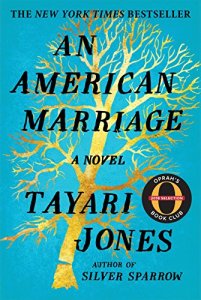
An American Marriage, by Tayari Jones – After reading one of Jones’ earlier novels, The Untelling, and thinking it was fine but not outstanding, I was worried about this one. An American Marriage was so heavily hyped, and I waited for months on the library holds list to get it, and I was really dreading being disappointed. I needn’t have worried, because the hype was totally valid in this case, and I thought the book was just wonderful. An American Marriage tells the story of the unraveling of the titular marriage. Roy and Celestial have been married only eighteen months when the police kick down the door of the motel room they’re staying in while visiting Roy’s parents, and arrest Roy for rape. Roy quickly learns that being innocent of the crime (he was with his wife the entire time that the rape occurred), and having a clean record, are no help, and he is convicted and sent to prison for twelve years. At first, Celestial dutifully visits him, but soon finds herself chafing under the pressures of being married to a wrongfully convicted man and falls into a relationship with her childhood best friend, Andre. When Roy is unexpectedly released after five years instead of twelve, Celestial has to decide if she wants to save her marriage or seek her freedom. An American Marriage was incredibly compelling, and the characters were living and breathing. I loved the different perspective on the criminal justice system – I don’t think I’ve ever read a story told through this lens before – and I was on the edge of my seat, furiously turning pages to find out what happened. My only complaint is that Jones never explains exactly what it was that got Roy released early – there’s a mention of prosecutorial misconduct, but I’d have liked more details about what the legal arguments were that led to his freedom. (Was there new DNA evidence? Other physical evidence? What was the prosecutorial misconduct? Inquiring lawyers wanna know.) But I think that’s probably a complaint that is rooted in my being an attorney, and non-lawyers wouldn’t think twice about it.
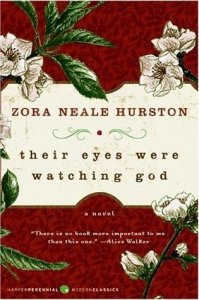
Their Eyes Were Watching God, by Zora Neale Hurston – This one has been on my to-read list for years, and I am so glad that I finally got around to it, because it was absolutely gorgeous. The dialogue was written in dialect, which was a bit hard to get into, but once I got it, I found it easy enough to read – and the non-dialogue was just beautiful, and the story compelling and wrenching. I reviewed it in full for my Classics Club list here.
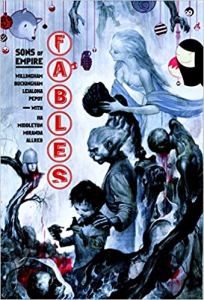
Fables, Vol. 9: Sons of Empire, by Bill Willingham – After Bigby Wolf has delivered Fabletown’s message to the Adversary (and a very destructive message it is), the villains of the Homelands convene a council of war to discuss their response. The Snow Queen proposes waging a wildly dramatic war, complete with plagues that will wipe out all of civilization on Earth, and she’s pretty gleeful about her idea. (Elsa! WHY???) But Pinocchio successfully dismantles the Snow Queen’s plan, explaining why it can’t possibly work, and Fabletown is safe for the moment. Meanwhile, Bigby and Snow are finally back together, raising their family at Wolf Manor – but then Snow tells Bigby that she wants them to take the cubs for a family visit to Bigby’s estranged father, the North Wind. Obviously, there is no way that could end badly! This series continues to be pure delight.
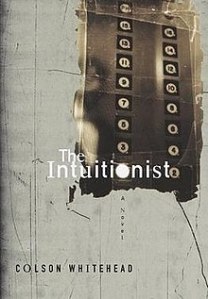
The Intuitionist, by Colson Whitehead – Lila Mae Watson is the first African-American woman in the history of her city’s Department of Elevator Inspectors, and so she is more than an elevator inspector; she’s a symbol of progress and inclusivity. She’s also an Intuitionist, one of a minority of elevator inspectors who are able to simply meditate and sense any problems with an elevator (as opposed to the more methodical Empiricists, who visually inspect the elevators and their parts). The Elevator Inspectors’ Guild is in the midst of an election season, and an Intuitionist is running against an Empiricist. When an elevator has a catastrophic freefall on Lila Mae’s watch, she suddenly finds herself at the center of the storm, racing against time to find a “black box” – a perfect elevator design – hidden away by the founder of Intuitionism. So, I enjoyed this once I gave up on understanding what was going on, or even really following it. Magical realism isn’t my thing, and it was definitely at play here – but the story was compelling and Lila Mae was a wonderful character.

Portage: A Family, A Canoe, and the Search for the Good Life, by Sue Leaf – I so enjoyed this lovely, ruminative, expansive look at a lifetime of paddling. Sue Leaf is trained as a zoologist, and she is a passionate canoeist, as are her husband and their children, who grew up paddling the lakes and rivers of the upper Midwest. Portage is a hard book to describe – it’s part memoir, part history, part nature journal, part sports book. Leaf begins the book by describing how she came to canoeing at age 10. The rest of the book is organized into chapters or essays about various canoeing excursions she has taken with her family – everything from an afternoon’s paddling on an urban Minneapolis stream to two weeks canoe trekking the Boundary Waters Wilderness Area. In each essay, she muses on the natural and human history touching the river in question; gleefully describes the avian life she saw there; writes touchingly about parenthood, marriage and aging; muses about climate change; and more. I read it at a slow pace and enjoyed every moment. I’m a kayaker, not a canoeist, and I am used to paddling different waters, but Leaf’s joy in time spent on the water and the pleasure she takes in her paddles splashing in and out of a lake or river were very familiar to me.
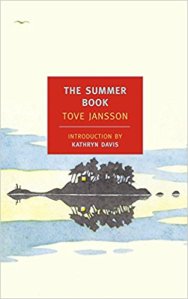
The Summer Book, by Tove Jansson – I’ve been meaning to read this one for awhile, and I’d be lying if I said that I wasn’t first attracted by the gorgeous cover. But the book is a joy to read as well as to hold. It’s one of those stories in which nothing really happens, but the clarity and elegance of the prose make it pure pleasure to read. The Summer Book tells the story of six-year-old Sophia, recently bereft of her mother, and her summer pursuits on a small island off Finland with her Grandmother. Sophia and Grandmother wander the island, build a miniature Venice, trespass in a neighbor’s house, brave a storm and a day of danger, and more. Sophia was a completely realistic six-year-old (and I should know, because I have one of those) and her relationship with Grandmother was sparkling and heart-wrenching. I marked so many passages of gorgeous writing to which I want to return.

Be Prepared, by Vera Brosgol – I saw this graphic novel on Instagram (specifically, on Colin Meloy’s stories) and ordered it immediately. It’s a lightly fictionalized, but mostly pretty realistic, graphic memoir of the author’s time at a summer camp for Russian kids. Vera feels different and set apart from her American friends – her mother, a single mom of three, can’t afford expensive dolls or fancy summer camps. But when Vera learns of a summer camp for Russian kids, she figures she’s finally found a place where she’ll fit in. Of course it’s not that simple, and Vera learns lessons about friendship and popularity over a summer of trying to carve out a niche for herself even at Russian camp. Oh, and a chipmunk bites her. I just loved Be Prepared, and I blew through it in one sitting. It was sweet, a little bit sad, and really, really funny.

Canoeing in the Wilderness, by Henry David Thoreau – The last of my vacation reading, if you can call it that, since I started the book about one hour from home on the journey back, Canoeing in the Wilderness is Thoreau’s account of a paddling expedition in Maine with a number of companions, over one summer week. In classic Thoreau language, he describes portages, campsites, and the vistas of rivers and lakes. I really enjoyed it, but my twenty-first century sensibilities were bothered by his descriptions of the Native American guide the group hired to conduct them through the wilderness. Although the man has a name – Joe Polis – which is given early on, Thoreau mostly refers to him as “the Indian” or even worse, “our Indian.” Thoreau seems fascinated by Polis, as if he is another specimen of wildlife, and some of his descriptions of Polis’s directional capabilities, physical traits, and language really set my teeth on edge. Throughout the book, when Thoreau would recount their conversations, I found myself hoping that Polis was trolling Thoreau and his friends with the intent of laughing at them later.
Pretty good August in books, if I do say so myself! Eleven this month, including two comic trades and a graphic novel/memoir, which provided some of the highlights. Other highlights: the absolutely gorgeous Their Eyes Were Watching God and the lovely The Village have to be up there, and I was really impressed with An American Marriage. I also enjoyed some blissful vacation reading, and Portage especially was a joy. On to September – I picked the book club book this month, which is a favorite re-read of mine, and I also have some other fun reading on deck. Check in with me next month for more short book reviews.
 covered in flour
Pingback: It’s Labor Day Monday! What Are you Reading? (September 3, 2018) | Covered In Flour
Oh, you’ve read The Summer Book, it’s one of my absolute favourite books, I’m glad you liked it!
It was wonderful!
Portage sounds wonderful. And I love the cover.
I’m going to be reading An American Marriage soon, so I’m glad to hear you give it a thumbs up!
I’ll be interested to hear what you think of An American Marriage! Everyone that I know who has read it has come away very impressed. And Portage was great! The cover is SO pretty, and the feel of the paperback is very nice.