

Reading is my oldest and favorite hobby. I literally can’t remember a time in my life when I didn’t love to curl up with a good book. Here are my reads for February, 2018…
 Salvage the Bones, by Jesmyn Ward – Esch lives with her brothers on a hardscrabble patch of land called the Pit. Life is tough. Esch’s mother died in childbirth and her father is usually drunk and mostly absent. Salvage the Bones tells the story of approximately two weeks leading up to, and encompassing, Hurricane Katrina. Esch is fourteen and newly pregnant, her father has snapped out of a fog and is obsessively preparing for the hurricane – which doesn’t really concern any of the kids – Esch’s brother Skeet is worrying over his pitbull’s new puppies and her other brothers are trying to carve out a place for themselves. Salvage the Bones was a gritty book – grittier than I usually read. There was a dogfighting scene which I knew was coming and was able to avoid, but the rest of the book was nearly as brutal. It was well-written but hard to read.
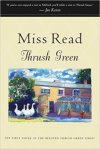 Thrush Green (Thrush Green #1), by Miss Read – There’s nothing like Miss Read to counteract the effects of a particularly tough book. Thrush Green is the first in a series of the same name, and introduces the reader to the village of Thrush Green and its inhabitants, and those of a larger market town, Lulling, nearby. All the events of the book take place on a single day – May 1, when Curdle’s Fair visits and sets up on the village green. Through the day, we meet many of the characters who will recur throughout the Thrush Green series – sweet, sad Ruth, gentle Dr. Lovell, mischievous Paul, bustling Dimity, blustering Ella, kind Dr. and Mrs. Bailey… and we see the town through the eyes of Mrs. Curdle, the fair’s proprietress, and her grandson and heir apparent, Ben, who is in love with a Thrush Green girl. Not to prattle on, but it was such a delight. A re-read for me, I loved reacquainting myself with Thrush Green and its environs – like an English spring day, it’s pure refreshment.
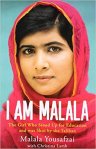 I Am Malala: The Story of the Girl Who Stood Up for Education and was Shot by the Taliban, by Malala Yousafzai – This one had been on my list for a very long time, and I finally got around to checking it out from the library. It was a powerful story, indeed. I was already acquainted with Malala’s story, in general, as most are – she is now, after all, a global celebrity. But I really wanted to read her story in her own words. So, I thought that I Am Malala was wonderful, but with one reservation. The book was co-written, naturally, and I felt that the word choices sometimes strayed too far into the territory of making the voice sound like a young girl’s. I found myself wondering how much was authentically Malala, and how much was the co-writer imposing what she thought should be Malala’s style. That said, I wouldn’t have missed this for the world, and especially once Malala starts her activism, the narrative takes off and becomes absolutely riveting. It’s an important read and well worth picking up.
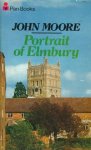 Portrait of Elmbury (Brensham Trilogy #1), by John Moore – I’ve collected the first two volumes of the Brensham Trilogy from Slightly Foxed (the third is due to be released this summer) and have been so excited to dig in. In this first volume, Moore captures the heart and spirit of an English market town from the late Edwardian period through to World War II. Occasionally gritty, occasionally sentimental, most often real, Moore presents “Elmbury” (the thin disguise he gives his actual hometown of Tewkesbury) warts and all. He starts the book by rhapsodically describing the high street outside the window of “Tudor House” (the splendid home where he grew up) then pivots directly into a down-and-dirty portrayal of the domestic squabbles of the residents of the hardscrabble alley across the street. But even while being unabashedly real and portraying country town life in all its darknesses and difficulties, you can sense a real affection behind Moore’s portrayal of the town and its inhabitants. I loved it. (Word of caution: as with so many books of the period, there are a few sentences that are extremely jarring and offensive to the modern reader. At some point, I am contemplating a post about babies and bathwater. For now, reader be forewarned. This one, I think, is worth the comparatively little problem language.)
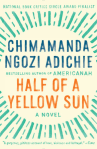 Half of a Yellow Sun, by Chimanda Ngozi Adichie – In my quest to read through Adichie’s backlist, Half of a Yellow Sun was next up. This is Adichie’s book about the Biafran War, a subject which seems to be close to her heart (I did some research into Adichie and she hails from the section of Nigeria which was once Biafra). The narrative follows three main characters – Ugwu, a houseboy; Olanna, the wealthy lover of Ugwu’s master; and Richard, an expat who becomes friends with Olanna and her lover, Odenigbo. Olanna and her twin sister, Kainene – Richard’s lover – are the daughters of a rich and important chief, and all of the characters (Ugwu, perhaps, excepted) begin the novel in great domestic comfort and end it barely surviving (or maybe not surviving – it’s not entirely clear, in one case) the horrors and privations of the Biafran War. This is a period in history, and a region, that I am sorry to say I know very little about, and I was shocked and heartbroken at Adichie’s portrayal of the suffering that attended Biafra’s three-year secession from Nigeria. Adichie, as always, writes extremely powerfully and beautifully, and while there are some hard passages, Half of a Yellow Sun was an astonishing read.
Well, a bit of a light February in books. It was to be expected, since it’s a short month and I was (and still am) absolutely crazed at work. Everything I read was good, so that is comforting. Portrait of Elmbury had to be the highlight – I love a good descriptive book (fiction or non-) about rural England, and that was right in my wheelhouse. On to March – a longer month, maybe a slightly less busy one (we can hope) and I am excited about my to-read pile. For #femmemarch, I plan to read only women – shouldn’t be hard; most of my books are by women – and I’m excited to dig into some of my library acquisitions and to browse my own shelves a bit more.
What was the best thing you read in February?
 covered in flour
The only one of these books I’ve read is I Am Malala and I also wondered how much the story was shaped by her co-author. I also wished the writing had been a little more polished and I wondered sometimes if the co-author shaped how the story was packaged based on what they thought an audience outside of Pakistan would want to hear.
Glad to hear I’m not the only one! It does seem like the co-writer took a heavy hand, and I agree with you that the writing could have been more polished. I follow Malala on Twitter and her tweets are much more sophisticated – obviously the book is a few years old, but I do suspect that if Malala had been left to her own devices, the book would have been better. I still thought the story was so powerful that it made up for it.