
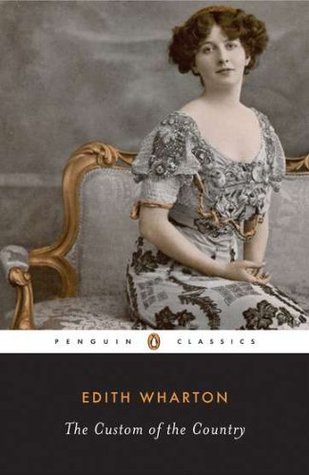
Considered by many to be Edith Wharton’s masterpiece, The Custom of the Country follows an acquisitive, social-climbing anti-heroine from marriage to marriage. When the novel opens, Undine Spragg, recently of Apex (a vaguely middle-American town) is living with her parents in New York City, navigating the social mores of the “stylish” set who have been closed off to her up until that point. Undine’s father, Mr. Spragg, is rich and indulges his daughter – after a bit of fighting, maybe – in most of her whims. Undine, for her part, is ambitious and striving, much like the young USA of the day. (According to the introduction in the edition I read, it’s no coincidence that Undine Spragg shares her initials with United States.) A lucky break – the quiet admiration of Ralph Marvell, one of New York society’s favorite sons – introduces Undine into the American aristocracy on which she has set her sights. A whirlwind courtship later, they’re married and Undine is pregnant. But Ralph, while he may be part of the exclusive crowd to which Undine is desperate to belong, is not rich – and so he soon proves to be a “disappointment” to his wife. And instead of swallowing her “disappointment,” or – gasp! – learning to budget, Undine takes a not-quite-socially-acceptable-yet plunge and divorces Ralph. Her next marriage, to a French Marquis, doesn’t fare much better – after brash American Undine makes a major faux pas by pressing her husband to sell some family heirlooms (so as to keep her Paris seasons in rich style) another break seems inevitable. The novel ends – spoiler alert! – with Undine married to a billionaire from Apex who… it turns out… was actually her first husband! WHAT!
My thoughts, which seem to lend themselves to bullet point form for this review:
- Wharton has written a novel made up almost exclusively of unlikable characters. I did like poor Ralph Marvell, and Clare Van Degen (repenting her marriage in diamonds) as well. And I felt for poor Mr. Spragg, trying so hard to make ends meet in New York over the demands of his wife and daughter. And that was pretty much it. Now, usually, I’m a fairly character-driven reader. If I can’t root for the main character, I find it hard to stick with a book. There have been one or two notable exceptions, and this was one of them. (W. Somerset Maugham’s The Painted Veil was the other.) While I disliked Undine intensely (and that seemed to be the universal reaction) I really respected the literary achievement of making me hang with an unlikable character. (I think that’s also what Jane Austen is trying to do, to a certain extent, in Emma – she famously wrote that she had created a heroine nobody but her would much like – but she falls short because, while Emma is an engaging novel, Emma herself is a far more likable protagonist than Wharton’s Undine. Emma is flawed, but good at heart and pretty charming. Undine is flawed, not good at heart, and really quite off-putting.)
- Thanks to the introduction’s pointing it out, I was very aware of Undine’s representation of brash American-ness throughout the book. (I quit reading the introduction shortly after the fact was noted, because it gave away a pretty major spoiler and sort of ruined the book’s big surprise for me.) Wharton deftly skewers the nouveau-riche Americans of the day, holding Undine up against the old money (that’s mostly gone) standard set by Ralph Marvell and Raymond de Chelles and very pointedly showing the reader all of the areas where Undine and her upstart sort fall short. Of course, old society doesn’t escape either – Peter Van Degen represents the very worst of what the “old money” set can mutate into – and it costs his wife and Ralph Marvell their happiness.
- I found the name of Undine’s hometown – Apex – fascinating. The word suggests a workaday kind of bland American outpost, but also the pinnacle of achievement. And (spoilers!) Apex does turn out to be the pinnacle – for both Mr. Spragg, who never replicates the same success he had in Apex after the family arrives in New York – and for Undine, the fulfillment of whose wildest, most money-grabbing aspirations were rooted in Apex after all (despite her determination to be part of New York society at all costs).
- I’ve now read two Wharton novels, and each of them had odd, arguably unsatisfying, endings. (Spoilers!) The Age of Innocence, one of my favorite books, ends with a whimper – Newland Archer on a park bench, widowed, deciding that he’s not going to attempt to reunite with Ellen Olenska after all. And The Custom of the Country, which probably should end with Undine getting her comeuppance once and for all (certainly that would be more satisfying for the reader) ends instead with her rolling in money and her billionaire husband realizing that he’s got to “lump it” or be cast off like his predecessors. Oof. Yet I still – literary achievement again, here – really enjoyed the ride, horrible undeserving anti-heroine and all. Well done, Edith Wharton. Slow clap.
In reading The Custom of the Country, Jen and I were joined by two other smart and prolific readers, both of whom share my impression that Undine is just. the. worst.
Thoughts from my friend Zandria:
It’s not bad enough to fall into the “Not Recommended” category, but it was impossible to like it when I didn’t care for ANY of the characters — they all annoyed me in one way or another. Although it seems silly to say this, the main character was such an awful person I wanted the story to be over so I could stop giving her more attention than she deserved.
(Zan’s full post here.)
And the always-insightful A.M.B. had great thoughts on the subjugation of women as discussed in the book:
And poor Undine (which I can admit despite hating her). She is the product of stifling times. The demeaning gender norms of her day persist to some extent in ours; however, in our century, a woman as ambitious as Undine could reasonably strive to be a prominent person in her own right, and not just the wife of one.
(Read her full post here – and congratulations to Mr. A.M.B. on opening his own law practice! I wish him much success and joy in his career.)
Have you read any Edith Wharton? What do you think of her depictions of Gilded Age New York?
 covered in flour
Undine was just awful! I wish she had stuck with Elmer from the beginning and left poor Ralph alone. Her selfishness reminded me a little bit of Scarlett O’Hara (though I liked Scarlett more than I liked Undine). There was also the theme of “like marrying like” in both books.
The Custom of the Country was a fascinating read. Thanks for organizing this read-along–and thanks for the link and the well wishes for Mr. AMB!
I think Scarlett had some redeeming characteristics, whereas Undine basically had none. She really was terrible. Glad you joined me in reading the book, though! I love Edith Wharton.
Pingback: Reading Round-Up (September 2015) | Covered In Flour