

One of Jane Austen’s several residences in Bath.
Dear Aunt Jane! How I love the witty social commentary and subtle jokes hidden in those perfectly crafted comedies of manners. I am often asked what my favorite book and/or author is, and I always give the same answer – although Jane Eyre is my favorite book, Jane Austen is my favorite author. (Because while Miss Eyre gets top billing on my bookshelves, Miss Austen overall has more novels that I consistently love. Does that make sense?) So, given the depths of my Jane Austen fangirling, it’s kind of surprising that I’ve never participated in Austen in August, an annual reading event hosted by Adam of Roof Beam Reader. Some of my favorite bloggers, and best blog friends, do this event year after year, and I’ve always wanted to, but something always prevents me – a teetering library stack, travel plans, work nuttiness – you name it. My excuses are many and varied. This year, however, I was bound and determined to participate, even with a tiny baby at home and a big pile checked out from the library.
The basic idea behind Austen in August is this: spend a month focusing on “all things Jane Austen, including her primary texts, any re-imaginings of her works, biographies, critical texts, etc.” (That’s a direct quote from Adam.) So, basically, anything goes. If it’s Austen-related, it’s fair game.
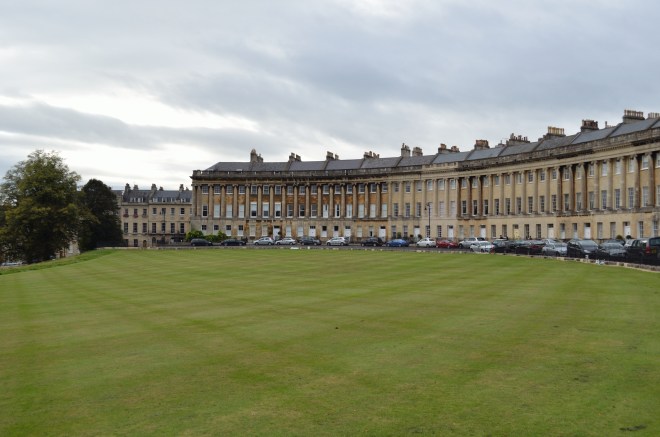
Bath’s Royal Crescent – fashionable Georgian condos.
Going into this year’s event, I had three hopes. (Not goals, I didn’t call them goals, because I really was trying to be more low-key about the whole thing.) First, I really wanted to tackle Love and Freindship, Austen’s juvenilia. Penguin Clothbound Classics recently published a gorgeous edition, which I have (after some delivery drama in which FedEx deposited the package containing the book inside my garbage can – yes, you read that right). Anyway, that was my top priority. Second, I wanted to read a nonfiction history focusing on Jane Austen and/or her environment; I was targeting either Jane Austen’s England or Jane Austen: A Life in Small Things, both of which I own. Third, and least pressing, I thought I may make the time to revisit one of the six novels in the main Austen canon – probably Pride and Prejudice, my favorite – and review it for The Classics Club. But I did have a number of other reading commitments this month, and it was my last full month of maternity leave, so if I didn’t get to P&P I wasn’t going to beat myself up.
Anyway – even being sleep-deprived and buried under library books, I did actually manage to put in a decent showing for Austen in August! And it occurred to me, as I was looking back over my Austen activity for the month, that each of my reading endeavors was super-geeky in its own way. So, apparently, “nerding out on Austen” was the theme of Austen in August, at least for me, this year. Behold:
Nerd Flag #1: The Hardcore Austen Scholar

It takes a particular brand of commitment to an author in order to commit to reading her juvenilia. I mean, it’s usually pretty bad. Sometimes unreadable. (If I’m ever a famous author – which at this rate, I won’t be, since no one seems interested in legal briefs – I hope to God that no one reads anything I wrote before the age of, say, 25. Because it’s ALL garbage.) But if you’re really into a classic author, like Austen, it could be seen as a mark of your interest that you actually make the effort to delve into the lesser-known works, and juvenilia is prime among them.
Jane’s juvenilia is incredibly rewarding. First off, it’s hilarious. Most of the commentary that I’ve read on Austen’s Love and Freindship is of the opinion that even the teenaged Jane was a witty social satirist. Was she? I’m not sure. Some of her pieces do seem quite sophisticated in the manner in which they poke fun at the establishment, other authors, etc. But… then again… you can definitely tell this stuff was written by a teenager. And I do question whether it was all in fun, or whether some of the pomposity was actually real – the product of a kid taking herself way too seriously, as most of us do at that age. (Teenaged Jane seems particularly fond of – even fixated upon – the Roman Catholic religion, for example. Was this her way of rebelling, quietly, against her Church of England vicar father? A more informed Janeite scholar may know the answer to that question. I don’t.)
But, whether serious or entirely in fun, the juvenilia is absolutely hilarious. For one thing, teenaged Jane can’t spell. No one, apparently, taught her the rule “I before E, except after C.” As a result, words like “friend,” or “grief,” are routinely misspelled. (Even in the title of the collection!) Every time I read the word “freind” or “freindship” – which was often – I chuckled. And pronounced it phonetically, because funny.
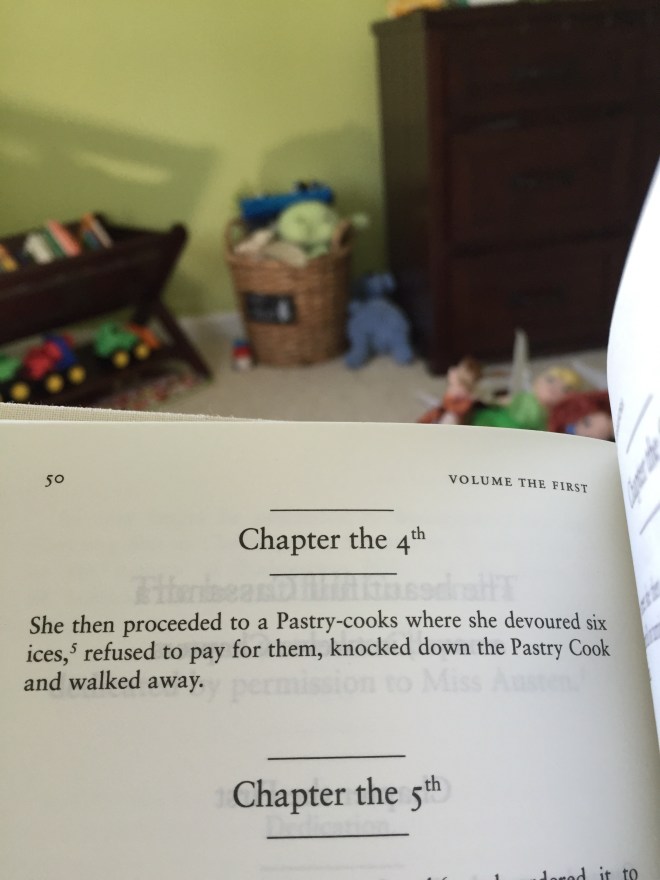
But it wasn’t just Jane’s terrible spelling that made Love and Freindship such a hoot. The characters, for instance – they’re all despicable. And half of them are, to quote the author, “dead drunk” most of the time. Even the sober characters are just terrible. The heroine of “The Beautiful Cassandra,” for example, is a lovely young criminal who barges into a pastry shop, “devours” half a dozen ices, refuses to pay, knocks down the proprietor and walks away. It’s possible I may have snorted tea out my nose upon reading that. But none of Jane’s characters – nay, not even the beautiful Cassandra – are as depraved as Jane’s most-hated historical figure, Queen Elizabeth I. (Even Henry VIII’s worst crime, in Austen’s opinion, was fathering the despicable Elizabeth.) Jane’s History of England was, I think, my favorite piece from the collection – although I loved “The Beautiful Cassandra,” too.
Nerd Flag #2: The History Dork
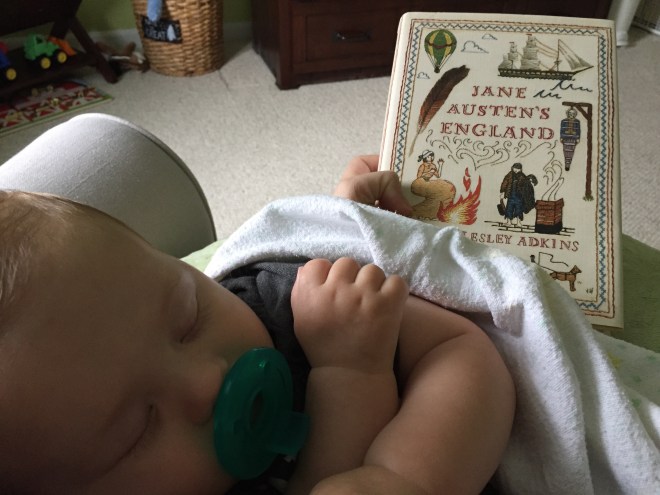
I wasn’t sure if I’d get to it, what with my ridiculous library stack and all, but one thing I really hoped to pull off during Austen in August was some Austen-related non-fiction. I was waffling between Jane Austen’s England and Jane Austen: A Life in Small Things, both of which I own. Ultimately I decided that I could make the time for one of them, and chose Jane Austen’s England.
The premise of Jane Austen’s England was an exploration of how people in each class lived, from cradle to grave, in Georgian and Regency England. (Did you know that the bulk of Austen’s life was lived during the Georgian period, not the Regency period? I don’t know that I’d ever put two and two together that way. We’re so used to calling the dress fashion “Regency style” and calling Austen’s work “Regency novels” that we forget (or at least, I do) that the Regency period only actually started a few years before Austen’s death.
Anyway, the book begins with a discussion of marriage, then moves on to pregnancy and childbirth, the years of childhood, and then gives a full exploration to adulthood with chapters exploring “wealth and work,” leisure pursuits, crime, medicine, and more. Where Austen’s surviving letters (mostly written to her sister Cassandra) gave pertinent information, they were used as primary sources. Other letters and writings of the times filled in the gaps. I learned a ton. For instance, did you know that some brides of the era got married in the buff? It was thought (incorrectly) that if the bride was nude then her new husband’s creditors could not touch any property she might be bringing to the marriage in discharge of his debts. (The practice was, unsurprisingly, rare – but it did happen.) My favorite fact came from the childbirth chapter: it was a custom of the era for new fathers to provide “a cake and a large cheese” upon the birth of a child. (Sometimes the baby was passed through a hole in the center of the cheese as part of the Christening festivities.) When I read that, I immediately demanded that Steve provide me with two large cheeses – one for Peanut and one for Nugget. I’m still waiting.
Fun facts aside, the main takeaway I got from Jane Austen’s England was that I’m really, REALLY glad I live in 2015 and not, say, 1792. Modern medical care and justice system FTW! I did enjoy the book, and found it really interesting. My one small critique would be that I wish the authors had spent more time actually talking about Austen herself, or about the middle class. They focused heavily on the upper and lower classes, neither of which was particularly representative of Austen’s own experience. At times it even seemed as though the book was a straight history of Georgian and Regency England – which would have been fine – and that the title, Jane Austen’s England, was a gimmick designed to grab readers who like Austen but might not otherwise pick up a history book. Every so often Austen would be dropped into the narrative, as if throwing the Austenites a bone – and then she’d vanish for twenty pages while the authors discussed street sanitation in London. I’d have preferred if the book really was an exploration of Austen’s England, and focused on her own experience and the experiences of others in similar living situations. That said, it was a really interesting book (and I probably already knew more about the status of the working classes than most, as we talked a lot about English labor history in my college classes) and I definitely picked up some interesting, previously-unknown, facts about the England of the period.
Nerd Flag #3: The Comics Geek
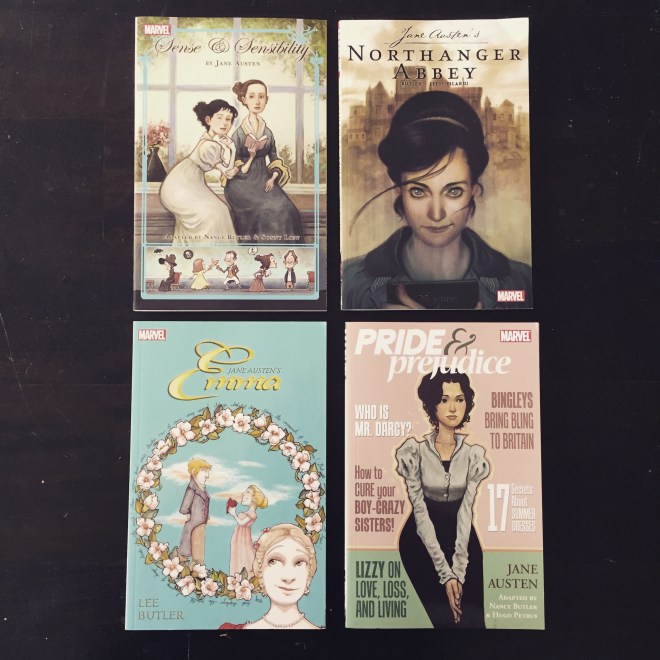
Disclaimer: I wouldn’t consider myself a comics fan. I’m just starting to read in the medium. But in the course of beginning to explore comics and graphic novels, I happened to discover that a few years ago, Marvel put out adaptations of four of Austen’s novels – Pride and Prejudice, Sense and Sensibility, Emma, and Northanger Abbey. I thought the idea of adapting classics to comics was so different and cool, and I really wanted to check it out, so I ordered online. I was only able to get to Pride and Prejudice this month, but what a fun spin on the book it turned out to be! The writer stuck to the original dialogue and the art was modern but expressive.
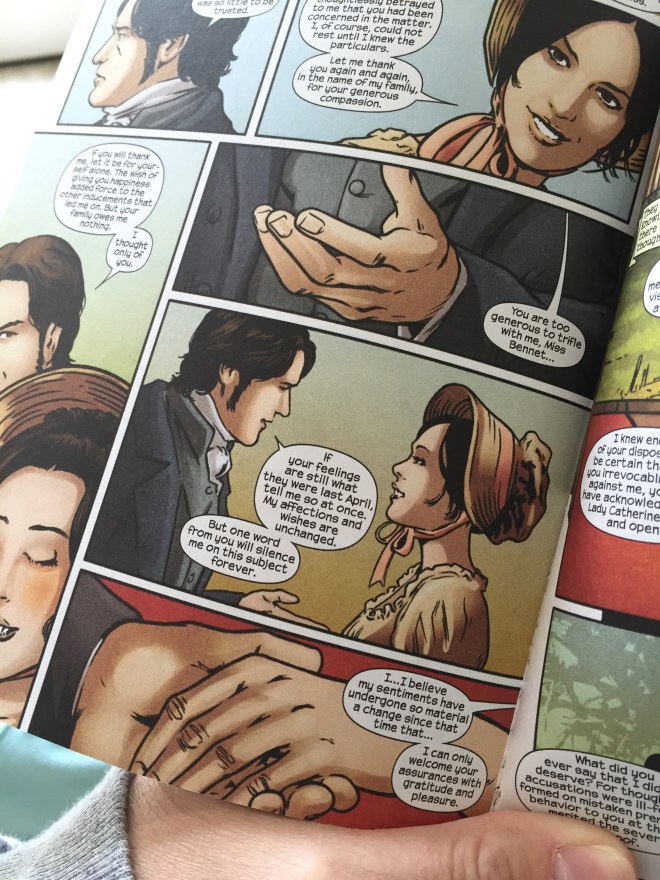
My only complaint about Marvel’s Pride and Prejudice was not with the adaptation itself, but rather with the introduction that the writer, Nancy Butler, included. Butler writes that she was excited to learn that Marvel was adapting classic literature to the comic form, because she thought (and I agree) that the adaptations might draw more girls into reading in the medium. But she was disappointed with the first selections: “So when Marvel started up their Marvel Illustrated line, adapting classic books to a graphic novel format, I asked . . . when they were going to do something female friendly. I mean Treasure Island and Man in the Iron Mask are great books, but they are boy books.”
GAHHHHHHHH! This is a subject too loaded to go into detail on here, in this post that is already too long, but NOPE NOPE NOPE NOPE NOPE. Can we please stop referring to books as “girl books” and “boy books” already? Treasure Island is not a “boy book” – it’s an awesome book that anyone would enjoy. (I haven’t read Man in the Iron Mask but I am confident it’s just as good.) And Jane Austen, while she has legions of female fans, is not just “for girls.” (My friend A.M.B. has some great posts on that very point – go check out her blog, and be sure to read her husband’s witty, insightful reviews of Austen’s novels.) Anyway, I’ll step down from my soapbox now, and encourage you to go check out the Marvel Illustrated versions of Austen’s work, which are available on Amazon (if your local comics shop doesn’t have any copies stashed away in a back room – mine didn’t). It was an unexpected, and very cool, approach to Austen’s work, and I’m definitely planning to read the other three comics as soon as possible. (Especially Northanger Abbey, which in addition to being my second favorite Austen novel – Pride and Prejudice will always hold the top spot – seems uniquely suited to the graphic novel format.)
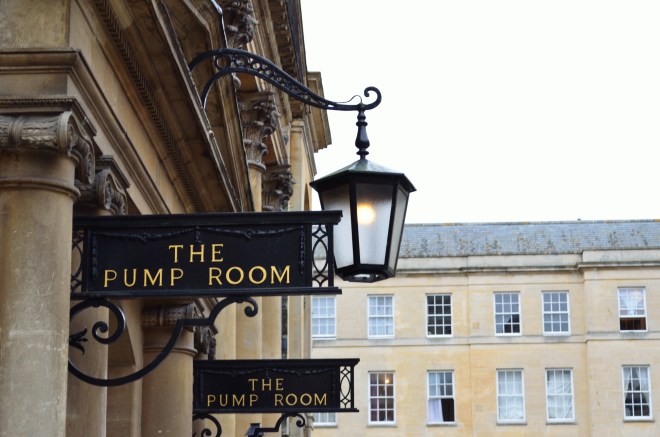
The Pump Room, where the well-heeled Elliots took afternoon tea.
What a fun month of reading! I loved spending time digging deeper into Austen’s world. Thanks, Adam, for hosting! And how about you, my friends? Did you participate in Austen in August? What’s your favorite Austen work?
 covered in flour
Agree completely about girl books and boy books. Actually anything that’s like “this is for girls!” or gender roles in general makes me want to vomit.
Me, too! I had a long conversation about that very issue with Adam (the host of this event) on Twitter recently. I think I’m going to have to write a post about it, because it really makes me crazy and I probably have too many words to get out on the topic, to just get by with a rant buried in another post.
Looking forward to it!!
THANK YOU for your remarks on boys’ and girls’ books!!
Also, this post was so fun. I’ve only read a bit of Austen’s juvenelia, but she is HILARIOUS. (I mean, I’ve read all the novels. I haven’t gotten to the juvenelia yet. I love how in Love & Freindship everyone faints. Also, I want to read those comic books.)
Love the pictures. 🙂
Thanks for your comment! Adam hosts a great event, doesn’t he? 🙂
The boys’ books and girls’ books issue is a real thorn in my side. There’s certainly a longer post coming on that, but the devaluing and minimizing of things that matter to girls really makes me see red. But on a happier note, I also love how everyone in Love and Freindship faints! (Perhaps if they weren’t dead drunk all the time…) I was practically weeping the entire time I read that book, it was so awesome and ridiculous.
Off to check out your blog now!
Pingback: The Summer List: Final (Super Belated) Update | Covered In Flour
Pingback: 2015: A Look Back | Covered In Flour