
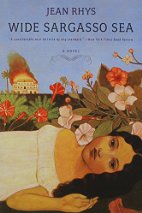
Wide Sargasso Sea, originally published in 1966, is Jean Rhys’ imagining of the backstory behind Bertha Mason, the “madwoman in the attic” from Jane Eyre. “Bertha,” in Rhys’ version, is really Antionette Cosway, a beautiful young woman growing up on a dilapidated old plantation in the West Indies. Antionette’s widowed mother eventually remarries, to a wealthy man named Mr. Mason, but the damage from their years of poverty and isolation is done. Antionette’s mother dies mad and forsaken, and Antionette herself becomes a prize in marriage to an aloof man who withholds his love from her. (That aloof man is Mr. Rochester, although he is never named in the story.) Antionette (called “Bertha” only by her husband, and for no apparent reason) descends into drunkenness and – arguably – madness of her own, driven insane by her husband’s coldness.
Well. I have to preface my thoughts on this book by saying that there was no way I could come to it without some preconceived biases. After all, Jane Eyre is my all-time favorite book, and has been since high school. I knew that the portrayal of Rochester in Wide Sargasso Sea probably wouldn’t be the most flattering. But it certainly didn’t agree on any level with the story given in Jane Eyre – that Rochester was a fundamentally good man who had run into some very bad luck in his past. (If the bad luck, that is, was his marriage to Bertha, which is certainly how Bronte presents things.) The Rochester of Wide Sargasso Sea is, to put it mildly, a jerk. When his wife begs him to tell her he loves her even a little, he refuses. He also proceeds to have a wild night of passion with a maid who openly disrespects his wife, right next to his wife’s room and certainly within her hearing. Not very nice.
Had Wide Sargasso Sea been a stand-alone type of work, with brand new characters, I may have liked it more. But the incredibly unsympathetic portrayal of my favorite brooding literary leading man – while expected – didn’t endear the book to me. I also felt that Antionette/Bertha’s descent into madness was a bit abrupt and didn’t really make sense. She didn’t want to marry Rochester anyway, but we’re supposed to believe that she snapped overnight just based on his “withholding” of his love? It seemed disjointed – Antionette goes from an unhappy, but certainly sane, young woman to a drunken, raving lunatic overnight. I didn’t find the story particularly believable. Of course, there is a question – and I believe Rhys intended to leave this open-ended – whether Antionette was really insane, after all. She was certainly drunk on occasion, but was she really a lunatic? Or was she just disheartened, and classified as mad because it suited Rochester’s purposes? That would be an interesting question for a book club to explore.
There were other disconnects as well. As mentioned above, Rochester calls Antionette “Bertha.” Why? No reason is given, even when Antionette says, in effect, “Why do you keep calling me Bertha? That’s NOT my name!” Rochester just replies that, in short, she seems like a Bertha. While I don’t think that it would necessarily push me to the brink of madness, I would be pretty irritated if my husband suddenly started calling me by a different name because he thought it fit better than “Jaclyn.” (Although when I taught arts and crafts at a summer camp in high school, my campers called me Cheryl, because they thought I seemed like a Cheryl. I went with it. But of course, they were my campers, not my husband.)
I did, however, give the book three stars (“I liked it”) on Goodreads. Why, then? If I wasn’t a fan of the portrayal of Rochester and didn’t find the main plot believable, how does this book merit three stars? Well, I may not have liked the characters or the plot, but I loved the writing. The book has a dream-like quality, which certainly reads right in light of the story. None of the characters are particularly fleshed out, but that seems to work as well, because it’s as if the entire story takes place in a heavy tropical mist. The writing was incredibly evocative – I could see the black velvet sky, smell the tropical flowers, and taste the rum. The writing, and the atmosphere of the story, saved it for me. That means a lot – I’m a very character-driven reader, and it’s rare that even excellent writing can rescue a book for me if I didn’t care for the way the characters were drawn. So the fact that I still enjoyed the book, even while chafing at the description of Rochester and finding Antionette unbelievable, is really telling.
Recommended for fans of twentieth century classics, or novels set in the post-slavery West Indies. Cautiously recommended for Jane Eyre fans, but don’t expect brooding heartthrob Rochester to make an appearance – this Rochester is straight up nasty.
I’m submitting this review as part of my Classics Club Challenge.
 covered in flour
I’ve always meant to get to this one. I think I’ll have to start soon! Thanks so much for the thorough review! If you’re ever interested in some other great book reviews and musings, be sure to follow! Thanks!
Thanks for your comment! I hope you enjoy the book if you do pick it up
Pingback: Reading Round-Up: April 2015 | Covered In Flour