
Last week, the bookish internet erupted in the biggest scandal since that Miami mayor tried to close all the libraries. If you weren’t watching, book reviewer Emily M. Keeler published an article consisting entirely of quotes (long ones, not short-out-of-context quotes capable of being misinterpreted) in which acclaimed Canadian author David Gilmour essentially revealed himself to be a racist misogynist. I’m not going to go into detail about what he said, but under cover of giving a tour of his personal library, essentially he stated that he only teaches his University of Toronto students books by heterosexual white men, since that’s what he loves and he can only teach what he loves. (LOLWUT?) Gilmour disdains other Canadian writers, women, and inexplicably, the Chinese. (I repeat: LOLWUT?) Gilmour also, confusingly, explained that he prefers to teach books by heterosexual men, real guys’ guys – which is why he teaches one short story by Virginia Woolf (such a man!), as well as works by Truman Capote and Marcel Proust (so heterosexual!) and F. Scott Fitzgerald (such a guy’s guy!). (Interestingly, he doesn’t give even a mention to Ernest Hemingway, which is who I think of when I think of heterosexual guy’s guy white male writers.)
Gilmour then made a bad situation worse by issuing an “apology” that in no way apologized. Instead, he just repeated all of the offensive things he said to begin with, claimed that the (female) reporter was “trying to make a little name for herself,” and then grudgingly concluded that he was sorry if people were offended. (One more time: LOLWUT?) Book Riot, one of my favorite bookish websites, published a few responses to this crazy escapade: a hilarious GIF-filled response by Amanda Nelson, and a thoughtful, well-reasoned piece by Brenna Clarke Gray, who incidentally has a Ph.D. – which Gilmour doesn’t – in Canadian literature. Boom.
It’s Gray’s piece that inspired this post. In her post, amongst several thought-provoking questions (like: isn’t it interesting that the article was published by Random House, which is not Gilmour’s publisher, a mere two weeks before the short lists are announced for a major Canadian literary prize in which Gilmour is up against several Random House writers?), Gray makes the following statement:
Here’s the thing: David Gilmour has unsavory, but not uncommon, views about literature. I know lots of people who would never voice these opinions but whose bookshelves tell a similar story.
Hmmm. Amidst a very intelligent, thought-provoking piece, this is probably the sentence that provoked the most thought from me. I stopped gagging over Gilmour’s sexist philosophies and ran straight to my bookshelf to see what story it would tell, stopping only to snap two Instagram photos of my current shelves (I’m working with the built-ins in my current rental), exactly as they were in that moment, to force me to be honest with myself. Observe:
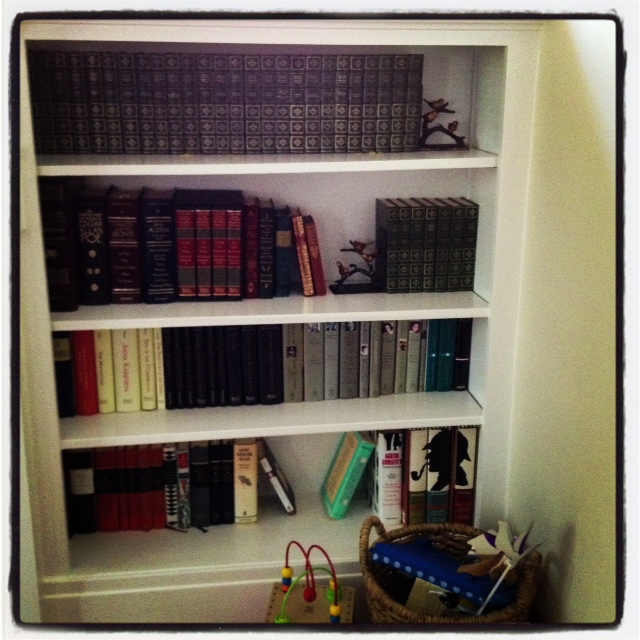
(Please ignore the baby toys. They were just there. They’re not part of this experiment.)
This is my “fancy bookshelf.” Meaning: this is the shelf where I keep my prettiest hardcovers. The forest-green leather Dickens; the complete works of Shakespeare, Austen, and two of the Brontes, and the hardcover classics from Barnes & Noble, Modern Library and Everyman’s Library. (And a few well-loved mysteries.) Most of this shelf is given over to English literature: the aforementioned Dickens, Austen, Shakespeare and Brontes, plus Winston Churchill, Sir Arthur Conan Doyle, and Agatha Christie. But I’ve got some other stuff in there too: Americans (Edith Wharton, Herman Melville, Nathaniel Hawthorne…), Russians (Tolstoy, Dostoevsky) and some world lit, like Murasaki Shikibu’s The Tale of Genji (which I haven’t read, but am itching to – it’s long, and that’s all that’s delayed me) and Isak Dinesen’s Out of Africa and Seven Gothic Tales.
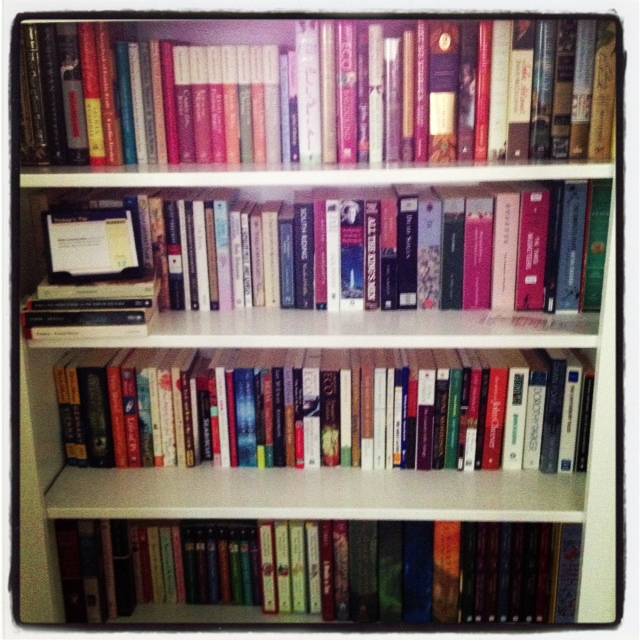
Here’s the other built-in. Comedy on the top left; children’s on the bottom; a mix of non-fiction, paperback classics and literary fiction. A glance at the shelf reveals a mix of male and female authors (maybe a few more women than men, but I think pretty balanced overall) from the following locales (this is just a sampling):
- England – Daphne du Maurier; Virginia Woolf; Ian McEwan; Anne Bronte; J.K. Rowling
- The United States of America – Harper Lee; Dorothy Parker; Toni Morrison; Maya Angelou; Henry James (American-British); Maud Hart Lovelace; Madeleine L’Engle
- Canada – Margaret Atwood; Yann Martel; L.M. Montgomery
- Ireland – Edna O’Brien
- Russia – Leo Tolstoy; Anton Chekhov; Nikolai Gogol; Mikhail Bulgakov
- France – Collette; Alexandre Dumas
- Italy – Umberto Eco
- China – Dai Sijie (actually Chinese-French); Sun Tzu
- India – Salman Rushdie (British-Indian)
- Portugal – Jose Saramago
- Czech – Franz Kafka
- Brazil – Paolo Coelho
Okay, that’s just at a glance; I’m sure there are more nationalities and ethnicities represented, but I’m squeezing this post into naptime. I learned two things from this quick exercise: (1) my reading tastes are pretty diverse, and (2) they could be more diverse. I could do with more African literature (other than Isak Dinesen, who isn’t actually African although she lived in and loved Africa), more books about the African-American experience (I have that experience represented a little bit through Maya Angelou, who I’ve loved since high school, and Toni Morrison, who I have on my shelf but who’s still in the to-read pile), and more books from Asia, the Middle East, and Latin America. I do tend to read a disproportionate number of American, Canadian, and European writers – as a British lit lover, I’ve always known I had that tendency. But I’m quite proud that I’ve branched out beyond Austen and the Bronte sisters. I can do better – we all can – but now I’m not worried that I’m only giving lip service to diversity in reading tastes while my bookshelf speaks otherwise.
I haven’t read any of David Gilmour’s work. And I’m not saying I never will. I’ll try to do what Margaret Atwood (a FEMALE, CANADIAN writer!) would advise, and separate the person from the literature. (He’s not high on my to-read list, though; I have a lot of other books to get through before Gilmour would cycle to the top.) But I’d encourage anyone who considers him- or herself to be an avid reader to take a look at your bookshelves, do a little soul-searching, and ask yourself: Am I open to new perspectives and experiences in my reading? And whatever your response is, work on doing a little bit better… because while some of us (cough) can do a lot better, we can all do a little better.
 covered in flour
Such a cosmopolitan collection! I see Peanut enjoying those in her teen years, after she outgrows the urge to eat paper products.
Oh, dear, I hope it doesn’t take her until her teens to outgrow the urge to eat paper. 😉
Ask Hubby to slip in a couple of Mark Twains, for diversity.
After all, “Austen for climate — Twain for society.”
I probably shouldn’t admit this, especially in Buffalo, but… I don’t like Mark Twain. I’ve read quite a few of his novels and just can’t seem to enjoy them. Hubby has the complete collection somewhere, but I think it’s still in a box. Maybe someday I’ll make another attempt at reading and enjoying Twain, but I have a LOT of books in the TBR that I’d want to get through first.
Very interesting post! I don’t separate people from the literature they create. The book itself is the primary factor, but when deciding between two potentially interesting books, I choose the one written by the better person (based on my definition of what makes a person “better”). I support their right to hold disgusting views, but I have no obligation to give them my money or time. I love reading books that challenge my world view, but I have no interest in blatant and unapologetic racism, sexism, or homophobia.
As for the toys in the picture, they serve as a good reminder of why your experiment is so important. Not only does our selection of books impact what the publishing industry chooses to disseminate, but it also contributes to the environment in which we are raising our children. Peanut is very lucky to grow up with bookcases like the ones in your home.
When thinking about what books you might add to your personal library, you might be interested in Biblioglobal’s reviews (books from around the world): http://biblioglobal.wordpress.com/
Gilmour’s new book, NIGHT FILM, is supposed to be spectacular. I wouldn’t drop it from my reading queue if it was on there (aside from the nebulous “all the books are my TBR” attitude I have) but I’m with you – I would have some trouble giving Gilmour my money at this point. (Borrowing from the library – different story, if I really, really wanted to read his book.) I do think it’s rather hilarious that Gilmour, in his “apology,” suggested that readers separate his work from his sexist and racist opinions, and uses as his support for this proposition a statement that Margaret Atwood made to him some time ago, that she separates the author from the literature. Margaret Atwood being, of course, a female Canadian writer and therefore in the group that Gilmour refuses to teach because he can’t “love” their work. Irony. It’s a beautiful thing.
You raise an interesting point about the baby toys. I left them in the picture not to make a symbolic statement but rather because I wanted to capture my bookshelves exactly as they looked in that moment in time, so I didn’t move anything. (Integrity of the exercise, and all that.) It didn’t occur to me that they might stand for something, but like you, I want to raise my kids in an environment in which books and reading are paramount. And unlike David Gilmour, I hope that Peanut grows up a reader who can seek out and enjoy books that describe a different life, or showcase a different perspective, from her own. Gilmour only “loves” books about the heterosexual middle-aged guy experience, because he is a heterosexual middle-aged guy. (Of course, he also loves Proust, Truman Capote, and Virginia Woolf. Irony, again.) Reading is such a vital way – sometimes, the only way – for us to understand and respect experiences and perspectives outside our own life paths. That’s why books have enriched my life so much, and that’s what I hope they’ll do for Peanut. And a teacher who refuses to teach anything that differs from his own life is not a very good teacher at all. (I don’t know if you follow Brenna Clark Gray on Twitter, but she tweeted along the lines of “If I only taught my own experience, my class would be called ‘Thirtysomething Women and the Cats that Love Them,’ and who would take that course?” Heh.)
I’ve never heard of Biblioglobal, but I’m going to give it a look – I’ve been wanting to find some good reads from other regions! Thanks for the tip!
I think you’ve got some diversity going on in there, but I agree that it’s good to read outside your comfort zone sometimes, too. I’m going to try and take part in Aarti’s A More Diverse Universe event this year (http://www.aartichapati.com/2013/09/tss-more-diverse-universe-revisited.html).
I saw Aarti’s event when she posted it and was definitely interested! I generally don’t dive into those types of blog events because every time I do, I end up getting an avalanche of library books from the holds queue, and then I end up not being able to complete the blog event and looking like a flake as a result. But maybe I should try AMDU… I do want to expand my reading horizons (I think I’m doing okay on that front, but more reading diversity is ALWAYS good).
Pingback: 2013: A Year in Books | Covered In Flour