The Babyfood Diaries: Sweet Potato

babyfood5

Well, the babyfood party is well underway, and we’re having so much fun.  Peanut is really enjoying the experiment – she has been having fun discovering some new flavors and textures, and I am having fun giving them to her.  So far, I’ve found it extremely easy to make her food.  It’s only been a few weeks, but we haven’t yet had to resort to prepared or packaged foods, and I’m thrilled about that.  There are some days when Peanut is less open to the experience than others, but that’s to be expected.  Still, I think I can say we’ve been very successful to this point.  (Finally, I can say that about something!)

Peanut’s first food was sweet potatoes.  I asked her pediatrician whether it was essential that we start with cereal grains, because I preferred not to if possible.  I didn’t believe there was much added nutrition in cereal grains, and the pediatrician confirmed that the only nutrition in baby cereal is iron, of which Peanut gets plenty through her preemie formula and vitamins.  Purees aren’t really about nutrition – they’re about introducing new flavors – and I don’t think grains taste like much if you don’t season them (which I wasn’t planning to do).  So I did some research online and in my new baby cookbooks to find a good vegetable to start Peanut on first, and after considering a few different options I settled on sweet potato.  So – are you ready?  Let’s whip up some sweet potato puree!

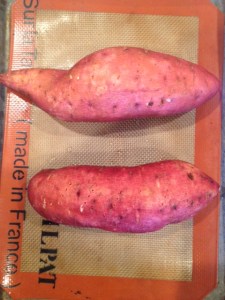
babyfood1

There are a few different possible ways to cook the sweet potatoes before you puree.  I checked out both of my cookbooks: one recommended chopping and steaming the potato, and the other recommended roasting.  Since I think roasting brings out flavors better, and I was not planning on putting any seasoning into the puree, I decided to roast.

Preheat your oven to 400 degrees Fahrenheit and lay two extremely well-scrubbed, small-to-medium sized, sweet potatoes on a baking sheet.  Prick all over with a fork, then roast for 45-50 minutes, until cooked through.  (Times may vary, depending on your oven.)

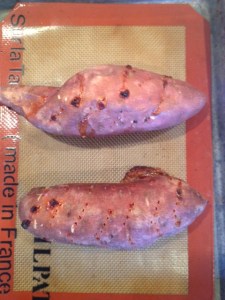
babyfood2

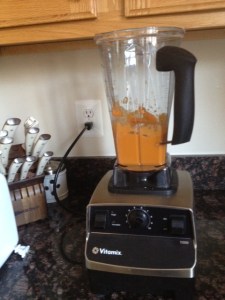
Mmmmm, roasted deliciousness.  Using a serrated knife, slice each sweet potato lengthwise and scoop the flesh out with a spoon.  (The skin is for you, mama.)  Place the flesh into the bowl of a food processor or heavy-duty blender.  (I used my VitaMix with fantastic results – the silky puree is as smooth as store-bought.)

babyfood3

Puree until the potatoes reach the consistency your baby prefers, thinning as necessary with formula, breast milk or water – whatever you have handy.  (I used formula.)  Recipe adapted from The Baby and Toddler Cookbook, by Karen Ansel and Charity Ferreira.

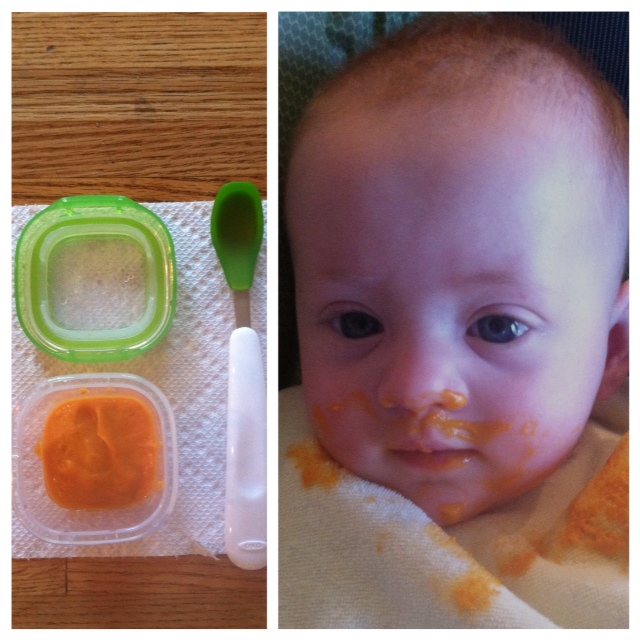
Feed to your baby while giggling uncontrollably and snapping tons of pictures:

babyfood6

This recipe will make about twelve ounces of sweet potato puree, give or take (and depending on the size of the potatoes you use and how much liquid you add).  I divided the puree into one-ounce portions and froze them in Oxo Tot babyfood storage containers (pictured above).  We’ve been feeding Peanut around 8:30 each morning, and I take a new jar out of the freezer and place it into the fridge for the next day, at that time.  I like to leave the food out for about 20 minutes on the counter before giving it to Peanut, just to take the chill off, but I do not microwave it.  Microwaving can cause hot spots and burn baby’s mouth – ouchie!  If absolutely necessary, defrost by floating the closed jar in a cup of warm water – but the fridge is better.

babyfood4

Enjoy!

THE SCARLET PIMPERNEL

The Scarlet Pimpernel(Source)

If you’ve been avoiding The Scarlet Pimpernel because you thought it was some kind of sequel to The Scarlet Letter, hide no more.  The Scarlet Pimpernel is a silly, rowdy, wacky good time.

The time: 1792.

The place: Paris.

The outrage: Entire families of aristocrats, sentenced to the guillotine, are escaping the jaws of Paris, through the most crowded, frequently-used city gates, under the very nose of the French military.

The rescuer: The Scarlet Pimpernel, a mysterious, swashbuckling avenger who sweeps would-be victims practically from the mouth of the guillotine and spirits them to safety in England through a combination of cunning, dashing disguises, and “demned cheek.”

Who is the Scarlet Pimpernel?  He’s a figure of mystery who has captured the imaginations of the entire British people, the hopes of the French aristocracy, and the ire of the bloodthirsty Committee of Safety – who hate losing victims almost as much as they hate being embarrassed.  The French government hatches a brutal plan to capture their No. 1 enemy: they dispatch agent Chauvelin to England to blackmail a certain lady into helping him.  Marguerite St. Just, now Lady Blakeney, is widely known to be a revolutionary sympathizer.  Her brother, however, once a revolutionary himself, has had second thoughts and is now aiding the aristocrats.  Chauvelin gives Lady Blakeney a choice: help him unmask the “demned elusive Pimpernel” or her brother will suffer a traitor’s fate.  Marguerite experiences a momentary pang on behalf of the dashing stranger, but there’s no question: she’ll save her brother.

Until she makes a disturbing discovery: the Scarlet Pimpernel is none other than Sir Percy Blakeney, widely regarded as an indolent but amusing moron, and Marguerite’s husband.  Sir Percy’s mask is so opaque that even Marguerite bought into his disguise and is perhaps more shocked than anyone else to learn of her husband’s double life.  And she learns too late – Sir Percy is off to Calais to rescue an aristocrat whose family he has already led to England, and  in choosing to save her brother from the guillotine, Marguerite has unwittingly sent her husband into a trap.  Marguerite takes off in a panic, running pell-mell in the direction of France, determined to warn Sir Percy of his peril before it’s too late.  Chauvelin, meanwhile, gleefully lays the net he plans to cast around the Pimpernel… Sir Percy will need all of his wits and his “demned cheek” to accomplish his mission and slip from the grasp of the revolutionaries once again.

I don’t know what took me so long to get around to The Scarlet Pimpernel.  It was a riot from the first page to the last.  Laugh-out-loud funny and edge-of-seat exciting, I couldn’t put it down.  Highly recommended, with the caveat that the pivotal scene is a touch racist, so you need to keep in mind the times in which the book was written – but still a fun romp, well worth a read.

The Scarlet Pimpernel, by Baroness Emmuska Orczy, available here (not an affiliate link).

On Authors and Conversation

DSC_0031

It’s 2013, and the world has shrunk to the size of a microchip, and in many ways, that’s a great thing.  There have never been so many conversations as there are going on right now, at this very moment.  It has never been so easy to connect with others, at least on a superficial level.  (Getting to know someone – really know them, inside and out – is a very different matter, but that’s a topic for another day.)  And for the first time in history, thanks to the miracle of Twitter, it’s never been so easy to strike up a conversation with an author.

I’ve had the experience of getting tweets from several authors I admire, and it hasn’t yet stopped being excruciatingly cool.  On a few occasions, I’ve tweeted my #fridayreads and received a response from the author.  Alex George, for instance, told me I made his day when I praised his novel A Good American on the mini-blogging site.  (Well-deserved praise, by the way.  A Good American is incredible.  If you haven’t read it yet, what are you waiting for?)  Alex George telling me that I “made his day” pretty much made my month.  And when I tweeted during a Friday lunch hour that I was enjoying a salad and Mrs Queen Takes the Train, William Kuhn shot back a charming tweet that Mrs Queen prefers walnuts on her arugula, leaving me grinning for the rest of the day.

I started thinking about authors and their various levels of engagement with their fans when Amal posted this interesting take on a Bryan Garner article she read.  While I agreed with her critiques of Garner (and she formed them much better than I would, so go read her post), I had to chime in with a comment noting that he was extremely gracious to his fans.  My best friend, unlike me, is a huge Garner fan.  While serving as a civilian U.S. government employee in a war zone that I personally would find pretty terrifying, R got into a debate over an esoteric point of grammar with her colleagues and emailed Garner to get his opinion.  He responded with a very kind email in which he answered her question, thanked her for her service, and asked her where he could send her some free books.  Since she’s basically the guy’s biggest fan, you can imagine how excited she was.

When I told Amal that story, via comment (and you can see our exchange in the comments section of her post), she responded that it was nice to hear that Garner took more of a “Dr. Seuss” attitude in responding to fans, and then linked me to a letter that a “grumpy” E.B. White once sent to a young fan.  The acclaimed author answered his little admirer’s request for another book by suggesting that the child start a national movement dedicated to NOT sending letters to E.B. White until he produces another book.  The response wended its way to the recipient’s librarian, who wrote to White to complain about his tart response, which he answered with a long letter explaining the demands that fan mail places on him.  While he made some good points – what a time-consuming effort it must be to answer thousands of fan letters personally – I still give the side-eye to his sarcastic response to a young child who probably wasn’t capable of grasping the snarky point, and who was just excited about Charlotte’s Web, anyway.  I think he probably just snapped after too much time spent trying to be gracious in fan responses and not enough time doing what he really wanted to do, which was writing, and I do sympathize.  But still.  There’s no need to get huffy, especially not when the recipient is a young child.  (If my Peanut received a letter like that from an author she admired, you can bet I’d be dashing off a reply of my own.)

The exchange between the author, the child and the librarian was a very interesting one to read, and I was grateful to Amal for pointing it out to me.  It also got me thinking about the things that writers must do to earn their incomes – aside from just writing, that is – and wondering whether the profession has gotten more demanding in recent years.  E.B. White bridled at answering fan letters.  Well, nowadays there’s the book tour, which can mean weeks on the road if you’re an author with bestseller potential.  (Have you seen John and Sherry Petersik’s posts about their Young House Love book tour?  Yowza.)  There’s the added work of “networking” on Facebook and Goodreads, maintaining your own blog or website as many authors do, and tweeting at starry-eyed fans like me.  On the one hand, the Internet makes it easier for authors to reach many more fans at once, just by updating their Facebook pages or putting up 140 characters.  On the other hand, when it’s easier to do, people demand that you do more.  If authors feel compelled to respond to every fan tweet, when exactly do they have time to write?  After all, we all know that the Internet can suck away hours of the day.  (Ever logged into Pinterest and lost two hours of your life?)

The relative ease of online communication has emboldened fans to insist on more contact with their heroes.  And I expect it’s probably added work for the writers who depend on readers to buy their books.  They now have to “sell” to readers online, or risk losing a reader to an author who is more engaging toward fans.  E.B. White-style reticence just doesn’t work in the Internet age, and an author who snaps back that fans should stop tweeting him if they want another book is probably going to alienate a few people.  (There are plenty of cases of Authors Behaving Badly that have enraged the book community – usually when an author responds angrily to a blog review.  I’m not even going to get into those sticky situations.)

It’s a tricky balancing act.  On the one hand, I like tweeting my favorite authors and seeing their responses.  I get excited at the thought of making contact, however superficial that contact is, with a writer whose work I admire.  And I also like giving credit where credit is due: if I really enjoyed a book, I want to tell people that I enjoyed it and congratulate the author on a job well done.  If I was a published author, I can’t imagine I would ever get tired of hearing from people who enjoyed my hard work.  But maybe we readers, as a group, need to back off a little bit.  Maybe we need to give our favorite authors some space to do what they do best: write books.

I’m not going to stop tweeting about the books I like, or telling the authors how much I enjoyed their work, because I know that if I had written a book I’d really want to hear from the people my words touched.  But when I tweet or blog about authors I like, I don’t expect a response from them.  I don’t expect them to take time out of their schedules to engage me in conversation.  When they do, though, it makes my day.

And with that, I’ll leave you with my absolute favorite quote about fan mail, from the great Maurice Sendak:

Once a little boy sent me a charming card with a little drawing on it. I loved it. I answer all my children’s letters — sometimes very hastily — but this one I lingered over. I sent him a card and I drew a picture of a Wild Thing on it. I wrote, “Dear Jim: I loved your card.” Then I got a letter back from his mother and she said, “Jim loved your card so much he ate it.” That to me was one of the highest compliments I’ve ever received. He didn’t care that it was an original Maurice Sendak drawing or anything. He saw it, he loved it, he ate it.”

Peanut: Seven Months

7mosold

It’s my birthday! Yeah! Why am I not in your arms right now? UP! I said UP!

We’ve had another exciting month with Peanut.  I guess every month is exciting when you’re a baby, huh?

The biggest news… I can hardly hold it in, I’m so excited… is that Peanut has been consistently sleeping through the night.  (Oh, man, I hope I didn’t just jinx it.)  We had been waking Peanut up for a 1:00 a.m. dream feed for a couple of months, but once she hit twelve pounds her pediatrician decided she was ready to sleep through the night (and so were we).  We gradually reduced the amount she took in her dream feed until she got down to 50 ml, and then we eliminated the bottle altogether.  We expected a few shenanigans while she adjusted, but – knock wood – she got the message right away and has only woken up during the night once since.  It’s been about two weeks of pure bliss.  I’ve gone into her room a little bit before her 6:00 a.m. bottle and found her awake, just quietly sucking her thumb or examining her pajamas, leading me to believe that if she is waking up in the middle of the night, she’s self-soothing and falling back to sleep on her own.  Seriously.  Miracle.

sundaysmiles

I’m well-rested! Are you, Mommy? Don’t get used to it.

Bedtime has been going surprisingly well, too.  Peanut is going through a phase where she can’t really sleep if hubby and I are there – we’re apparently too cool and exciting.  (First time anyone, anywhere, has ever thought that about us.)  If she is in our arms or can see one of us, about 80% of the time, she thinks it’s playtime.  So our routine lately has been the following: I feed her the final bottle of the evening around 7:00 p.m., then I rock her until she’s drowsy, put her in her crib, and putter around her room quietly putting away laundry or cleaning up her toys – just so she knows I’m around if she needs me.  If she fusses, I soothe her in the crib and help her find her thumb to suck.  If not, I kiss her goodnight, tell her to call me if she needs anything, and tiptoe out of the room.  Most nights, that’s the last I hear from her as she just quietly plays in her crib and drops off to sleep within twenty minutes or so – leaving me with a long stretch of free time to read in the evenings, which you can believe I’m enjoying.  I’m not singing or dancing on rooftops about this development, because if there’s one thing I’ve learned about Peanut, it’s that she is unpredictable at bedtime.  We’ve had other stretches of good bedtime routines that have lulled me into believing we conquered the crib, only to regress in spectacular fashion.  I’m just appreciating it while it lasts.

highchair

Why am I in this chair? Who are you? What is my name?

The other big news of the month is that we officially started solids!  Peanut has been eating sweet potato puree for about two weeks now and just moved on to Mom’s homemade applesauce.  I don’t want to say too much about it right now, since I have a big post planned for next week with lots of pictures and details.  For now, I’ll just tell you that it’s adorable and hilarious, and tease you with this picture (don’t worry, there are plenty more to come):

I can get messier.

I can get messier.

It’s been a great month, but we’ve also had a challenge or two.  Daylight savings time messed Peanut up pretty good, which is to be expected, since it does a number on her parents as well.  Peanut had a few days of rejecting bottles, refusing naps, and shrieking at bedtime, all right around “spring forward.”  Add that to the fact that hubby and I both have trouble sleeping for a few days after a time shift, especially this one, and you have one exhausted family.  We’ve all adjusted by now.

We also had a couple of days of spotty weight gain this month, attributable to the time shift funk and to dropping the dream feed.  It always takes Peanut a few days to understand what’s going on when a feeding is dropped, and we went through the same thing when we eliminated her 3:00 a.m. feeding months ago.  We bump up her food during the day, but it takes her a little longer to get the message and start polishing off bigger bottles to make up for the feeding that was eliminated.  I always get jumpy when weight gain doesn’t happen as quickly as I think it should – even if I know that Peanut is not sick and there’s a perfectly reasonable explanation for it – but for the past few days she’s been relatively good about finishing her bottles with a minimum of histrionics.  So I hope we’re over that particular hump.

stpattysday

I’m Irish, I have green pants, and I’m ready to party. Where’s my green formula?

Peanut at 7 Months:

Adjusted Age: 5 months.

Weight: 13 lbs, 4 oz

Clothing Size: 6 months, although she’s growing out of her wardrobe again.  She has an incredibly long torso, so her Carter’s clothes are still fitting well, since they seem to be cut for longer babies, but some of her other 6 month outfits are starting to pull in the shoulders.

Sleep: See above.  It’s great!  And now that I’ve said that, we’ll get slammed with a long spell of Gitmo-style sleep deprivation.

Likes: Auntie Em’s dog Ezra, who is thrilled that his love for Peanut is no longer unrequited.  She cranes her neck to get a look at him and giggles whenever she sees him.  Ezra is overjoyed.  He throws his toys up in the air, does little tricks, and generally busts his doggie butt trying to impress Peanut.  It’s hilarious.

Dislikes: Her boppy lounger.  She used to enjoy sitting in it to listen to stories, but no more.  It’s too reclined for her current attitude of must-see-the-world-and-be-involved-in-everything and she spends all her time trying to sit up.  (Her little baby abs are so toned with all those crunches.)  We have to sit her in our laps or lay her flat on her back for storytime now.  The in-between is no bueno.

Favorite Toys: We’ve been spending lots of time playing with her linking rings, at the suggestion of the occupational therapists in the NICU development clinic (she got the rings from Santa but we hadn’t used them much before).  She loves passing them from hand to hand and shaking them.  She’s also enjoying her O-ball, again because she can hold it with both hands, and a Fisher Price teething rattle that is shaped like an Elizabeth Taylor-style gigantic diamond ring.  I’m a little concerned about the precedent that sets.

My bling is bigger than Mommy's.

My bling is bigger than Mommy’s.

Milestones: The biggest ones are sleeping through the night and eating solid foods!  We’re also working on sitting upright and creeping, and she’s made some progress toward both but she’s not quite there yet.  Next month, I’ll bet!

Quirks: We’ve started what I call the Stranger Danger phase, where Peanut freaks out at any adult who isn’t hubby, me, or Auntie Em.  And when I say freaks out, I mean freaks out.  We’ve had major meltdowns with “Silence of the Lambs” style screams both when her grandparents visited and tried to hold her (the horror!) and at the NICU development clinic when she sat on my lap facing away from me and could only see the (very friendly) occupational therapist.  I’m told that this is a good thing that she recognizes and prefers her caregivers over other adults, but man, is it ever loud.


Riding It Out

Hah.

Hah.

It’s still winter.  Still.  Winter.  It’s not as bad here in D.C. as some other places – we’re in the odd in-between season where it will snow one day and be 60 degrees the next (yep, that was Monday and Tuesday of this week) – but notwithstanding all that… it’s still winter.  Still grey, and it snowed (just flurries) on Monday.  There are daffodils poking up along my drive home, and a few early cherry trees starting to adorn themselves, and I’m thinking about starting my annual Claritin regimen, but it’s… still winter.

Winter’s last gasps in the mid-Atlantic region aren’t furious or frigid, just dreary, but we still have to get through them every year.  (As E so poetically put it the other day, “March: in like a lion, out like a lion, acts like a lion all month.”)  And while I’m not looking forward to pollen season, I am looking forward to seeing the back of this entire month of drizzle.  In the meantime, here’s what’s getting me through:

  • Those daffodils on my drive home.  There are more every day.
  • Lavender Earl Grey, brewed in my travel pot at my desk in the mornings.
  • Shopping for an Easter dress.  The dress I wanted is no longer available in my size, so now I’m thinking of a colorful top and skirt combination, maybe.
  • Speaking of Easter, doing some additional shopping on behalf of Sir Bunny for Peanut’s basket this year.  She’s getting lots of board books about bunnies.
  • Really good salads.  Lately I’m loving a combo of mixed greens, chopped red pepper, rolled and chopped cold cuts, a drizzle of olive oil and a sprinkle of smoked sea salt.  And maybe some massaged kale on the side.
  • The strawberry theme Peanut’s wardrobe has going on right now (guess I was having a craving the day I bought her 6-month clothes).
  • Origins Gloomaway body souffle.  But you can’t eat it.
  • Good books.  I’m currently back in Fairyland with September and friends, in The Girl Who Fell Beneath Fairyland and Led the Revels There.  And it’s winter-almost-spring there too.
  • Big baby smiles and squeals of glee.

What’s keeping you going through the last gasps of winter?


Moving the Ball: Women, Work, and Sports Metaphors

Hockey2

Hockey: the only sport I care about.

I recently learned a new sports metaphor: “moving the ball forward.”  Oh, I’d heard it before, and I had a vague idea that it meant making progress – or something along those lines – but I didn’t know it was about football.  You can laugh (and you will) but I’m just not a football fan.  (I remain confused about why a game with sixty minutes of playing time should take four hours.  That’s 25% playing, and 75% breaks.  Who has that kind of time?  Think about it.)  Anyway, I just learned this metaphor a few weeks ago and since then I’ve managed to overuse it until it has lost all meaning, because obviously.  I have to be me.

A client and I were joking about this very metaphor – “moving the ball forward” – the other day.  She couldn’t believe I’d only just figured it out, until I explained that I’m a hockey fan and there is no room in my heart for other games.  (Other sports are not nearly violent enough for me, apparently.  I’m very bloodthirsty.)  I bemoaned the fact that there aren’t really any common sports metaphors for the wannabe-Canadians among us and confessed that I’m now on a mission to learn more sports metaphors and overuse them.

The degree to which I am obtuse about sports metaphors is amusing, among other things, but it also raises a more serious point: sports, sports talk, and sports metaphors are a big part of the reason that many women still feel excluded or alienated in their male-dominated workplaces.  I’ve been lucky and escaped feeling excluded, to a large extent.  At my first job, I worked with mostly women, none of whom had much use for sports in general.  (There were a few guys there who were big hockey fans, and we bonded.  They liked the Rangers, but I didn’t hold it against them.  Nobody’s perfect.)  When I left that job and joined my firm, I was the only female attorney in the office (that is no longer the case), but I never felt left out.  The men in my current office are great guys who made me feel welcome right away, and while they’re all big sports fans, they never used sports to exclude me or tease me.

(Well, there was some gentle mocking when I picked Cornell to win March Madness.  But here’s the thing: I’m 4’11” and I can’t relate at all to basketball, so I have never followed it.  I could waste my time doing hours upon hours of research and I’d still be flying blind when it comes to March Madness picks.  I don’t stand a chance of winning.  So I might as well pick my alma mater.  They did make it to the Sweet Sixteen, which I always thought was a party.)

There are times when all-attorney meetings veer onto the subject of baseball, which most of the other attorneys in my office (including the women) follow passionately.  I don’t because, again, I am apparently too bloodthirsty.  (Now, if baseball players were allowed to fight…)  I sometimes tune out of those conversations, but I’m never teased or excluded based on my lack of participation, which says more about the people I work with than it does about me.

Not all of my friends are so lucky.  One of my closest friends, also a lawyer, was cruelly mocked at a business dinner for not being able to recite the rules of football.  She was put on the spot in front of her entire department by her boss, who – knowing she did not follow football – demanded that she explain the game, and then laughed at her when she couldn’t.  An extreme example, perhaps – but then again, perhaps not.  Women can’t be groped in the workplace anymore, or excluded for promotions based on their sex – at least, not legally – but they can be and often are made to feel out-of-place and embarrassed by not being “one of the guys.”  I’ve escaped this fate through a combination of personal luck (in that I found a job where I work with nice, friendly people who wouldn’t dream of making me feel unwelcome), hockey knowledge (at least I can talk intelligently about one sport), and the fact that my co-workers also read widely and enjoy international travel, so we have other conversation topics.

But just because it hasn’t affected me (yet) doesn’t mean that sports knowledge doesn’t contribute to many women’s personal glass ceilings.  Succeeding in many professions still demands at least a certain degree of behaving as if you’re “one of the guys.”  You don’t have to put up with harassment or laugh at misogynist jokes, but there are many women who help their careers immensely by participating in sports talk at work.  Even if you’re not passionate about athletics, it can often help to learn a few sports metaphors and scan the headlines of the sports page, especially if you’re in a male-dominated profession.  Here are just a few that I’ve heard (and subsequently looked up on Wikipedia, where there are TONS of examples on the “Sports Idioms” page):

  • Moving the ball forward – making progress toward a larger goal.  (football)
  • Drop the ball – make a mistake, screw up.  (football)
  • Fumble – same thing.  (football)
  • Hail Mary – last ditch, long-shot attempt.  (football)
  • Play Monday morning quarterback – second-guess something after the fact.  (football)
  • Run interference – handle something for someone else.  (football)
  • Throw in the towel – surrender.  (boxing)
  • Wheelhouse – area of expertise (baseball)

Unfair!, you shout.  Why should I have to learn about sports when they other people don’t have to learn about my interests?  Well, I agree, it is unfair, when you put it that way, but so is life.  And you don’t have to.  Some women find learning about sports useful when it comes to climbing their career ladders; some don’t.  For many people, there comes a point in your career when advancement depends on how well you can bond with people (especially the higher-ups), even more than the quality of your work – because everyone else is just as good as you, so what really matters is whether you can fit in.  Given that, learning about a topic that lots of men and women find interesting can only help you, right?  (I found a great blog – Talk Sporty to Me – which lists a bunch that I have never heard, and more that I was wondering about.)  Still, if it’s really painful for you, then you would be better served by bonding with your co-workers over topics you both enjoy, like traveling or current events.  But know that sooner or later, you’ll probably encounter a sports metaphor or two in your career, and it can’t hurt to know what they mean.  Just think of it as moving the ball forward when it comes to your career.

 Note: I don’t usually write about topics related to the workplace, since many of them touch upon what I do for my day job.  This was just something I was thinking over and wanted to write about.  So, to be on the safe side, I’ll just say that this post represents nothing more than my own personal opinion about a topic that’s been on my mind recently.  Please don’t construe this as legal advice or the official position of my firm, because it’s not.  Over and out.

An Unsettling “Gilmore Girls” Revelation

Sis-in-law E and I have been watching “Gilmore Girls” when we get the chance lately – which is not often, but we’re trying.  E has never seen the show, which I find all kinds of shocking.  I knew she’d love it, and she does.  (We’ve gotten as far as “Rory’s Birthday Parties” in season 1, so we’re going slowly.  She also has to catch up on “Downton Abbey” so we can all watch season 3 together as a family.)  And while we were watching recently, I had an unsettling revelation.  Here it is:

Right now, I am only one year younger than season 1 Lorelai.

WHAT?!?!?!?!?!?!?!?!

I started watching “Gilmore” when the third season was airing.  I was nineteen, a junior in college, and not that different from Rory – and Paris, bless her heart.  I could remember being a slightly awkward, bookish teenager with Ivy League dreams (although mine focused with laser-like intensity on Cornell, not Harvard).  In fact, I still was a bookish teenager, just a few years further into my own college journey than Rory was at the time, since season 3 is her senior year of high school.  I liked Lorelai, Sookie, Michel, Luke, Miss Patty and the rest of the townsfolk (except Taylor, of course), and Richard and Emily too (especially Richard), but I watched the show for Rory and Paris, and to a lesser extent, for Lane.  They were my contemporaries.  Rory and I read the same books.  Lane and I both liked Rilo Kiley.  Paris and I had the same neuroses.

Lorelai, meanwhile, was out of my immediate sphere.  I loved the character, of course – her determination to give her daughter the best education even though they didn’t have much money, her passionate follow-through on her dreams of starting her own business with Sookie and Michel, her cool outfits and flirty banter with Luke, her string of boyfriends (remember Jason and his crazy dog?)… but I didn’t really relate to her.

Now, watching the show all over again from the beginning, it blows my mind that Lorelai is only 32.  Dudes.  I’m 31.  I still feel younger than Lorelai – much younger.  I suppose that’s because I have taken a very different life path than the character did.  But my head just about exploded when I realized that, at this point, I have more in common with Lorelai than with Rory.

We’re both moms (but thankfully, I’m not a single mom to a teenager).  We both pay a mortgage and hold down steady jobs.  I’m not the boss, by any stretch of the imagination, the way Lorelai is.  But as the senior associate in the office, I have people coming to me to get feedback on their work, or for mentoring, which strikes me as pretty weird (until I remember that I’m 31 and I’ve been out of law school for almost seven years).  I have dreams of starting my own (non-law-related) business someday, as most lawyers do.  I don’t have to worry about Peanut driving a car or applying to colleges for awhile (although E thinks she might be starting to contemplate crawling… hoo, boy) but I have a little person depending on me to make good decisions for her and to give her a good start, much like Rory depends on Lorelai.  (Although Rory can feed herself and doesn’t need to be rocked to sleep every night; I didn’t say it was exactly the same.)

There’s no specific thesis to this post… except to say that I am totally wigged out now that I’ve realized I have more in common with Lorelai than Rory.  (This I can handle.  But if one day I discover that I have more in common with Emily than with Lorelai… well, I think my head might explode.)  But it’s also telling that this show has so much staying power with me, that I can enjoy it just as much now, as a mom in my thirties, as I did when I was a book-devouring teenager like Rory.  That’s a sign of a darn good show.

And now, because of reasons, I will conclude with my favorite quote from an immensely quotable series:

Rory: “No one reads The Decline and Fall of the Roman Empire unless it’s for a class assignment.  It’s a honkin’ long book.  This is clearly a cry for help.”

Lorelai: “You’re very anti-intellectual.”

A LONG LONG TIME AGO AND ESSENTIALLY TRUE

A Long, Long Time Ago and Essentially True…

(Source)

In the late 1930s, on top of a hill outside a Polish village called Half-Village, a young man nicknamed the Pigeon sees a beautiful girl for the first time.  He is stricken by the girl’s blonde hair, beautiful face, and the patient way she speaks to his developmentally disabled brother.  The Pigeon soon learns that the girl, who his brother calls “the Angel,” is Anielica Hetmanska, widely considered the most beautiful girl in the village – or any village, for that matter.  The Pigeon is poor and awkward, but he knows that Anielica must be his wife, so he presents himself at her father’s door and courts her using the only thing he has: his carpentry skills.  The Pigeon offers to renovate the Hetmanski family house for free and stone by stone, board by board he builds himself into Anielica’s heart and the Hetmanski family.  But World War II, and then Communism, conspire to delay the day when the Pigeon will finally call Anielica his wife – and even when that day comes, their troubles are far from over.

The story of Anielica and the Pigeon alternates with that of their granddaughter, Beata (nicknamed “Baba Yaga” after a Polish fairytale witch), who is trying to make her way in 1990s Krakow .  Baba Yaga’s Krakow is very different from the Krakow her grandparents discovered in the 1940s.  Energetic and a little frenetic, Krakow – like Baba Yaga – is deciding what it will be now that the future and the “New Poland” have arrived.  Baba Yaga drifts through her city life, buffeted on all sides by her cousin Irena, Irena’s daughter Magda, her coworker Kinga and her boss Stash, and others.  Where does Baba Yaga fit into this New Poland?  This is the question she will have to answer when tragedy strikes and a figure from the past appears without warning in her life.

Now, I would have been interested in this story no matter where it was set.  I’m all about the love-story-with-historical-background, in general.  (I’m referring to Anielica and the Pigeon, who were the stars of the book for me.  Baba Yaga gets more “airtime,” but I didn’t find her as compelling of a character as I did the Pigeon, and especially Anielica – at least, not until the end of the book, anyway.)  But being part Polish myself, I was especially interested, because I thought the book might give me some insights into that part of my heritage.  I don’t know much about Poland – I know that pierogis are delicious (and that I set kitchen fires when I try to make them); I also know that Poland gave the world amazing people like Chopin, Copernicus, and Pope John Paul II; and I’m fairly well-versed in Polish Christmas traditions.  But that’s basically it.  What I know about Polish history, I’ve mostly picked up from the occasional mention in AP Euro and more recently, from fiction (like The Winter Palace, which taught me more about the Polish government of the 1700s than history class ever did – sad, considering the entire novel was set in Imperial Russia).  Poland gets short shrift in fiction, generally, so I was happy to pick up Brigid Pasulka’s ode to the country that she loves.

And it was well worthwhile.  On top of learning more about Polish culture, history and tradition than I have from any source other than my grandmother, I loved the story.  Anielica and the Pigeon share a real, strong, beautiful love and their sad but hopeful tale was lovely to read.  Baba Yaga, too, won me over in the end (not that I ever disliked her – she just wasn’t as interesting to me).  The writing was elegant, but also rang true to the settings and the characters, and the cast of supporting characters (Anielica’s brother and his wife, Irena and Magda, Stash and Kinga, Pani Bozena, Magda’s friends…) were all well-drawn and complex.  I’ll definitely be looking for Brigid Pasulka’s next book.

A Long Long Time Ago and Essentially True, by Brigid Pasulka, available through IndieBound (not an affiliate link).

Babyfood Diaries: Let the Wild Rumpus Start!

Big news, fellow foodies: a certain little lady is starting her gustatory journeys!  Peanut is now six months old (four months adjusted) and her pediatrician has given us the go-ahead to start introducing solid foods.  Even though we’ve known for awhile that we’d be beginning the solid food journey around now, it still snuck up on me.  The decision to start now is based on a few things: Peanut’s age is the primary factor (our pediatrician starts most kids at 4 months, but our little preemie is starting at 6 months/4 months adjusted), but the doctor also took into account our report that Peanut has been staring at our food lately.  She watches me cook and watches all three of us eat with a “you’re holding out on me” expression on her face.  Yep, she’s interested all right.  Interested, and developmentally ready, so we’re charging forward.

Now comes the part that many of you are going to say is crazy: I’ve decided to make all of her food from scratch.

Oh you are, are you?  And with what free time do you plan to do this?

I know, I know, it sounds nuts.  I don’t have a lot of spare time on my hands, it’s true, and do I really want to spend it making baby food?  Well… yes, I do.  I have a lot of reasons for wanting to make Peanut’s food from scratch, not least of which is my desire to fill her little tummy with healthy, fresh options without preservatives.  I think her food will taste better if it’s freshly prepared from ingredients chosen by her picky mama, and she’ll learn to eat fresh, whole foods from day one.  It’s also cheaper (those little jars add up, especially if you buy organic – I want Peanut to eat all organic at least for the first couple of years of her life, and it will cost me a lot less if I DIY) and better for the environment, because I’ll be able to reuse her jars and buy produce without packaging.

There’s another part of my reasoning which is, admittedly, a little bit selfish.  You see, I had to let go of a lot of things when Peanut was born two months early.  A full pregnancy, for one.  The experience of being oh-so-pregnant, which I know isn’t the most pleasant, but I didn’t have it, so.  A baby shower – mine was cancelled; I spent the day in the NICU instead.  Taking the baby home from the hospital immediately – I got to spend the next seven weeks commuting to the NICU instead, coming home to a house that seemed so empty every night.  Cloth diapering – it was something I really wanted to do, but it just seemed too overwhelming with everything else we had going on when Peanut came home from the hospital.  And there was other stuff too – like the way I have had to feed Peanut in her early days; it hasn’t been what I expected, and that’s all that I’m going to say about that.  The last of my pregnancy “expectations” was that I would make Peanut’s food from scratch and… I just don’t want to let go of this too.  I want one thing to go as planned.

So when we got the green light to start Peanut on solids, I was psyched.  I immediately started researching the best foods to start babies on – I knew I wanted to do a vegetable, not rice cereal, which doesn’t have any added nutrition for her (the only benefit is iron, but she gets plenty of that from formula), and I decided to go with sweet potato.  I looked at dedicated baby food makers like the Beaba Babycook and decided to use what I already have in my kitchen (a pot, a food processer, and a Vitamix) and see how that goes, and I stocked up on OXO Tot puree cubes and silicone spoons, plus two cookbooks that should take Peanut into her toddler years.

I’m so excited for this step!  I hope that my making Peanut’s purees (we’re also going to dabble in a bit of baby-led weaning, at the pediatrician’s advice, but I’m planning to wait to start that until she’s bigger) will set her up for a lifetime of enjoying fresh, healthy foods.  Next week – sweet potatoes, a recipe, and some hilarious photos.

Let the wild rumpus start!

In Which I Ponder Genre-Bending

DSC_0029

Like many readers, I love to look back at what I’ve read over the course of a month, a year, or even more.  (There are other readers who do this, right?  Please tell me I’m not the only one.)  I make lists in my email and on my blog, I track my reads on Goodreads, I assign book superlatives, and I make pie charts

When I sat down to look over my 2012 books and make my pie charts, I spent a lot of time agonizing over what genres to assign to certain books.  (Yes, I said agonizing.  I realize that’s melodramatic, and I don’t care.)  Here’s the chart I ended up with for my fiction books:

Download Your Pie Chart

It’s likely no one would notice or remark upon this next fact except for me, but: the chart shows that I only read one historical fiction book in 2012.  That would be Elizabeth I, by Margaret George (which was fabulous, by the way).  But Elizabeth I is not the only hi-fi I read in 2012.  I’ve always been one to read books set in other time periods, and 2012 was no exception.  So why does my pie chart say I only read one hi-fi book last year?  Well, because the chart only shows what I considered the “primary” genre of each book, and poor hi-fi got stripped as those books dropped more neatly into other genres.  Like what, for instance?  Well, there were the Maisie Dobbs books, which were set in the late 1920s in London and which relied heavily on historical detail to inform their storylines.  They’re mysteries, so they slotted into the mystery genre, but I could easily make a case for them as historical fiction.  Then there were books like The Snow Child, by Eowyn Ivey, and Wolf Hall and Bring Up The Bodies by Hilary Mantel, which were certainly historical fiction (The Snow Child is about early Alaskan settlers, and the Wolf Hall novels are set during the reign of Henry VIII) but their strong prose pushed them into the literary fiction category.  (Hmmm, now that I’m thinking about it, Elizabeth I was very well-written, too.  Should I have called that lit-fic and completely raided the hi-fi category?  And what makes something lit-fic instead of general fiction or hi-fi, anyway, and who decides?  These are the things that keep me up at night.)  Then there were books like The Hobbit, which could have been considered children’s lit (or fantasy, a genre which didn’t even make it onto my chart) but instead landed in classics, a genre that tends to be whatever people say it is.  Or the Fairacre books, which could have populated a genre of gentle fiction, but instead got plopped into classics, too – because I say so.

I realize that this pie chart is not important to anyone but me.  But it’s fun for me to look back and see what I read the previous year, and I like my reads to be neatly organized.  Cross-referencing genres, or thinking about how I should have cross-referenced genres, really drives home the point that I read a lot of genre-benders.  And this past month has been a perfect example of that.  While I was flying through The Midwife’s Tale – for example – I stopped to scratch my head and wonder whether I would categorize it as a mystery (since it is a murder mystery with a classic whodunit plot) or historical fiction (since the setting of York in 1644 is so important to the plot, and so richly detailed too).  I’ll probably call it a mystery, but then, there’s an argument the other way too.  And there was The Song of Achilles – hi-fi, clearly, since it’s set during the Trojan War, but the beautiful, alluring, almost poetic prose is certainly going to tip the scales in favor of this one going in the lit-fic bucket.  And poor hi-fi gets raided again.  Then there’s the Lord of the Rings trilogy, which I’m working my way through (I’ve already read the first two this year) – fantasy?  Or classic?  On balance, I think classic.  But again, a case could be made in the opposite direction.

When I’m not lying awake at night debating these things because my life is apparently too easy, I’m pretty happy to be reading all of these genre-benders.  A mystery with strong historical fiction elements?  A lit-fic offering that nods to an age-old classic?  A classic fantasy?  How could I go wrong with any of these?  I’m not going to stop reading genre-benders anytime soon.  I’m having too much fun with these books that pick and choose from among different genres and refuse to be pigeonholed.  And at the end of the year… well, I guess I’ll have to come up with some system for cross-referencing.

This may call for more pie charts.  Oh, darn.