Oricchiette with Greens and Goat Cheese

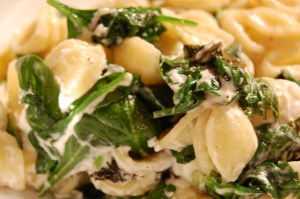
This is one of my favorite pasta dishes.  It’s easy to make – a matter of tossing a few ingredients together – and the creamy, tangy goat cheese is the perfect complement to the soft pasta and wilted greens.  A perfect, light weeknight dinner, the work of 15 minutes or less.  Now that’s what I call an instant classic!

Oricchiette with Greens and Goat Cheese

1/3 box oricchiette pasta (or substitute other short pasta)
2 ounces goat cheese, such as Laura Chenel
2 cups mixed salad greens
1/4 cup olive oil
salt and pepper

  • In a pot of boiling, salted water, cook the pasta until al dente, according to the package directions.  Drain the pasta, but don’t do too thorough a job – you need a little water still in the pasta, to loosen up the sauce.
  • Crumble the goat cheese into the drained pasta, turn the heat on low, and toss until the cheese melts and coats the pasta.  Add the greens and toss until they wilt.  Drizzle the olive oil over – no more than 1/4 cup – and season to taste with salt and pepper.
  • That’s it!

Source: Adapted from Everyday Pasta, by Giada de Laurentiis

Farfalle with Broccoli

When I was a kid, I hated broccoli.  H-A-T-E-D it.  The smell, the taste, the frightening green color… broccoli made me shudder.  Then, as often happens, I grew up.  And – who’da thunk? – now I adore broccoli and green is my favorite color.  But still, as much as I love broccoli now, I don’t reach for it in the grocery store.  I’ll load my plate up with it if someone else cooks it, but for some reason, it doesn’t occur to me to actually buy broccoli and cook it myself.  It’s as if my subconscious mind is still stuck in my childhood, at least at 8:00 on Saturday mornings when I’m at Wegmans.  Or I’m just too busy putting five English cucumbers into my cart… I’m not sure which it is.

Since it seems stupid to love a vegetable so much but never cook it, I have embarked on a quest to find and cook broccoli recipes.  I like to roast broccoli, sure – I’ll roast any vegetable I get near – but I think that broccoli deserves a special treatment.  After all, what better way can there be to make up for all those years of demeaning and disparaging broccoli than to find some creative and exciting ways to cook it now?  Here’s one way – saute/steamed, with a rich sauce and Parmesan cheese, tossed with farfalle pasta.  Look, Mom, I’m eating my broccoli!

Farfalle with Broccoli

1/2 pound farfalle pasta
2 tablespoons unsalted butter
2 tablespoons olive oil
2 cloves garlic, minced
4 anchovy fillets, minced
2 heads broccoli, chopped into florets
1/2 teaspoon red pepper flakes
grated Parmesan, to taste (optional)

  • Cook the pasta to al dente according to the package directions.
  • While the pasta is cooking, melt the butter into the olive oil in a medium saute pan (with a cover) over medium-low heat.  When the butter and olive oil are melted and blended together, add the garlic, anchovy fillets and red pepper flakes and allow to cook for 5 minutes, until fragrant.
  • Add the broccoli to the butter sauce and toss to coat.  Cover the saute pan and allow the broccoli to steam until the pasta is done cooking.
  • When the pasta is finished cooking, toss it with the broccoli and sauce in a large serving bowl.  If necessary, add a little pasta water to thin and evenly distribute the sauce.  Finish with grated Parmesan to taste, if desired.

Yield: Serves 4 for a main course or 8 for sides

Source: Adapted from Everyday Pasta, by Giada de Laurentiis

Cranberry Bean and Spinach Risotto

DSC_0866

Risotto is one of my all-time favorite fall and winter dishes, and I’ve experimented with so many different recipes over the few years that I’ve been cooking.  Sausage, tomato and spinach risotto, mushroom and pea risotto, champagne risotto with lobster… these have all made repeat appearances on my table, some on special occasions and some on chilly weeknights.  Risotto is simple to make, yet it never fails to impress.  It has become a staple in my kitchen… so I can’t believe it took me this long to try risotto with beans.  I mean, I love risotto, and I love beans.  Put them together and it’s how-come-I-didn’t-think-of-this-sooner good.

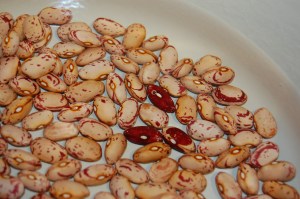
This recipe calls for cranberry beans, which are an heirloom bean varietal that I order online from Rancho Gordo.  I’d strongly encourage you to seek out heirloom cranberry beans for this recipe, whether it is through Rancho Gordo, your local farmers market or co-op, or another source.  However, if you are really at a loss for cranberry beans in your neighborhood, and you don’t want to order online, you can substitute dried pinto beans from the supermarket.  Under no circumstances, however, can you use canned beans!  Please trust me on this one.  The key to this risotto’s unbelievable deliciousness is the rice absorbing all of the beans’ pot liquor, which is what bean people call the magical substance that the bean water turns into after the beans have been cooking for a couple of hours.  The pot liquor absolutely makes this dish, and you won’t get it from canned beans.  I’m not saying that canned beans don’t have their role to play – believe me, if that was the case I wouldn’t have to dodge falling cans of cannellini beans every time I open up my crammed pantry.  But canned beans just don’t belong in this dish.  It’s as simple as that.

Cranberry Bean and Spinach Risotto

1/2 cup dried cranberry beans (or pinto, in a pinch)
1 tablespoon butter
1 tablespoon extra-virgin olive oil
1 shallot, medium-diced
1 cup arborio rice
1/2 cup dry white wine
4 cups (approx.) low-sodium chicken broth
2 cups baby spinach
1/3 cup Parmeggiano Reggiano

  • Start soaking the beans 12-24 hours in advance.  Place the beans in the pot in which you plan to cook them, cover with about an inch of water, put the lid on the pot and allow the beans to soak.  (The longer you soak the beans, the less time you will have to spend cooking them.)

DSC_0859

  • After the beans have been soaking for a ridiculous length of time, start cooking them: just crank up the heat, bring the beans to a boil, then reduce down to a simmer for an hour or two hours or more.  How long you will cook the beans depends on how fresh they are (yes, there are variations in freshness, even amongst dried beans) and how creamy you like them.  You can tell the beans are done when the entire kitchen smells magical.  Test a bean for doneness periodically, if you think they might be getting close.  Once the beans are cooked through, season them with salt; don’t rush this step.  Seasoning the beans before they are done cooking will make them tough.  So really, wait until the beans are done before you go tossing in a handful of salt.
  • When the beans are cooked through and the pot liquor is aromatic, pour in four cups of chicken stock and allow the mixture to come to a simmer.
  • Meanwhile, melt a tablespoon of butter with a tablespoon of olive oil in a large Dutch oven over medium heat.  Add the shallot, season with salt and pepper, and cook until softened.  Add the arborio rice and toast until shimmering.
  • Pour in the wine and stir the rice until it absorbs the wine.  Working a ladleful or two at a time, continue adding liquid from the broth and bean mixture, adding more when the previous addition has absorbed.  (Nota Baker: It is an urban legend that you have to stir risotto constantly.  You don’t.  I have never made a risotto that I stirred constantly.  You do, however, have to keep an eye on it and stir it often enough that the rice doesn’t stick to the bottom of the pot.  I like to stick around and clean the kitchen while I make risotto; that way I am on the premises to stir it plenty, but I am not obsessing.  The bottom line is, you do need to stir and stir often, but you don’t have to spend 30 minutes hunched over the stove stirring obsessively.)
  • When you have ladled the majority of the liquid in and it’s mostly beans left in the bean pot, begin ladling the beans in at a bit of a faster clip.  Allow any liquid that came over with the beans in each ladle to absorb before the next ladle.
  • Once all the beans have moved over to the risotto – it will have taken on a beautiful burnished golden color; that’s from the pot liquor – add the spinach and stir until wilted.  Finish the risotto off with some grated Parmeggiano Reggiano cheese, or any other cheese/cream/butter routine that you typically do for risotto.  Serve with a little extra cheese grated on top, if desired.

DSC_0863

Source: Adapted from Heirloom Beans, by Steve Sando

Baked Macaroni & Cheese

DSC_0742

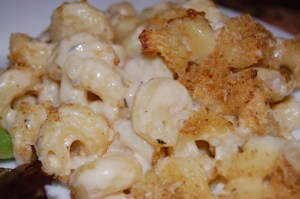
Cheesy, creamy, crunchy, chewy.  That’s what the best macaroni and cheese brings to the table.  I’m not talking about the out-of-the-box stuff – no way.  I’m talking about homemade macaroni and cheese.  I’m talking about beer-infused white sauce and freshly grated cheddar and gruyere.  I’m talking about crispy Parmesan and bread crumb topping, and baking the whole thing until it’s golden and bubbly.  It takes longer, and it dirties more pots (hey,when have I ever complained about a mess?), but it’s soooooo worth the time.  Especially when your hungry brother is in town.  Because if you’re a baker who likes to make a mess, your hungry brother deserves the best boy food you can make!

Baked Macaroni & Cheese

1/2 package cavatappi (or other fun-shaped) pasta
1 small shallot, minced fine
1 cup skim milk
1 cup half-n-half
1 dried bay leaf
1 1/2 teaspoons dried thyme
2 tablespoons butter
2 tablespoons flour
1/3 cup beer
cheddar (1 cup grated)
gruyere (1 cup grated)
salt and pepper

  • Preheat oven to 350.  Butter a souffle dish or other large baking dish and set aside.
  • Fill a large stockpot with water and boil for pasta.  When water is boiling, season generously with salt and add cavatappi.  Cook until al dente according to package directions.
  • While the pasta cooks, place the minced shallot, milk and half-n-half in a small pot.  Add the bay leaf and thyme and warm over medium heat.  When the mixture is warm-hot, take off heat and allow to stand.
  • Drain the pasta and place pasta in a large bowl; set aside.  Return the pasta pot, empty, to the stovetop and melt the butter.  When the butter is melted, stir in the flour and cook briefly.  Add the infused milk mixture and the beer and turn heat to low.  Allow to cook for three to five minutes, stirring occasionally, until thickened.
  • Meanwhile, grate the cheese.  When the sauce has thickened, stir in the cheese.  Season to taste with salt (if necessary – the cheese is pretty salty) and pepper.  Pour cheese sauce over pasta and stir to combine.  Spoon pasta into baking dish.
  • If desired, make bread crumb topping – stir together 1/4 cup breadcrumbs and 1/4 cup grated Parmesan and toss with a tablespoon of olive oil.  Sprinkle evenly over the top of the pasta and drizzle additional olive oil, if desired, over.
  • Bake 40 minutes, until cheese sauce is bubbly and top is golden brown.

DSC_0738

Yield: Serves 4-6.

Source: Adapted from Williams-Sonoma Savoring America

Orzo with Sausage, Peppers and Tomatoes

DSC_0002

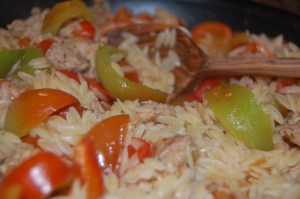
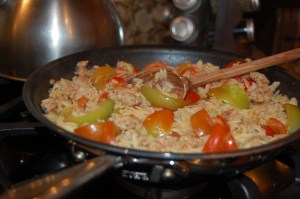
This dish encompasses some of my very favorite things: adorable pastina, chicken sausage, and peppers.  It’s also easy… ridiculously easy.  You just start browning the sausage at the same time as you put the orzo’s water on to boil, and by the time the orzo is done, you have your sauce ready to go.  It doesn’t get much simpler than that, and the flavors are unbelievable, with sweet, crisp-tender peppers, tart fresh cherry tomatoes, and spiced sausage bits in every bite.

Orzo with Sausage, Peppers and Tomatoes

1/4 box orzo
1 package fresh sausage (I used garlic and tomato chicken sausage)
2 peppers, cut into strips
1/2 package cherry tomatoes, halved or quartered (depending on size)
salt and pepper

  • Start water to boil for the orzo.  When water is boiling, season with kosher salt, add orzo and cook according to the package directions.
  • Meanwhile, begin browning the sausage in a nonstick pan.  If the sausage is still in its casing, squeeze it out so that it is in a mass in the pan.  Break it up with a wooden spoon and distribute it so it browns in small chunks.
  • While the sausage is browning, cut the peppers into strips and prepare the cherry tomatoes.  After the sausage has made some good progress, add the peppers and tomatoes and stir to distribute them.  Continue to cook the sausage, peppers and tomatoes together, keeping a careful eye on the orzo.
  • When the orzo finishes cooking, drain it and add it to the pan with the sausage and vegetables.  Mix together and serve.
DSC_0003

Yield: Serves two or three for a main course, four to six as a side.

Source: Adapted from Giada’s Kitchen, by Giada de Laurentiis

Note: The original recipe actually called for roasted red peppers in a jar, cut into strips.  This is usually a standard pantry item for me, so I didn’t even give it a second thought when I made my grocery list and it turned out that when I went to look for them in my pantry or fridge, I was out – who’d have thought?  Instead, I used sweet Hungarian peppers from my farmer’s market.  However, I think this recipe would work equally well with sauteed red, orange and/or yellow bell peppers, or with roasted red peppers from a jar.

Wine Pairing: Hubby and I are trying to work through the bulk of our wines these days, because we are preparing for a trip to Napa in about a week and a half, and we’re going to be bringing quite a bit home!  For this dinner, we poured Pinot Grigio from Doukenie Winery in Purcellville, Virginia.  Doukenie is our favorite winery in the region – we are actually members of the wine club there, which requires simply that we buy twelve bottles per year (easy; their wines are delicious).  Pinot Grigio is normally not my choice.  I once received a bottle as a gift and it had oxidized.  Ever since then, I have been turned off by Pinot Grigio and will almost always choose Sauvignon Blanc or a more obscure white instead.  But Doukenie’s PG is very nice, crisp and yet smooth, with mellow fruit aromas.  It’s making headway toward changing my mind about Pinot Grigio, and I think it worked well with this dish.  I’d also recommend a northern Italian white, or a lighter-bodied Italian red such as Barbera d’Asti.  If you substitute pork sausage for the chicken or turkey, you could pair it with Chianti and it would be delightful.  Enjoy!

Pasta e Fagioli

DSC_0002

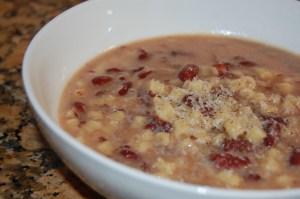
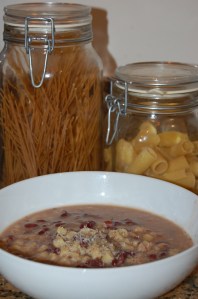
I love to have soup for dinner.  I’ve been known to whip up a big pot of chicken noodle, or corn chowder, or my grandmother’s roasted red pepper soup, and live on it for a week.  That, of course, was when I was a law student living alone in Foggy Bottom.  Now that I’ve got a man around the house, the situation has changed slightly.  Soup for dinner is still okay, but only if it has some substance to it.  So my favorite split pea soup is scorned, but this pasta e fagioli – with red kidney beans, chewy pasta and a thick broth – is acceptable.  In fact, it’s more than acceptable; it’s hearty but healthy, with a delicious, savory flavor, and it’s a one pot meal.  Sign me up!  But of course, I’m the notorious soup lover in the household.  The hubs is the real critic, when it comes to soup… and he loved it too.

DSC_0006

Pasta e Fagioli

1 shallot, minced
2 strips turkey bacon (optional)
1 can red kidney beans, drained and rinsed
4 cups chicken stock, divided (preferably organic and free-range)
1/2 cup pastina (such as ditalini or small elbows)

  • In a large, heavy stock pot, heat approximately 2 tablespoons of olive oil over medium heat.  Add minced shallot, season with kosher salt, and saute until tender.  (If desired, add turkey bacon here and cook until crisp, then remove from the heat, leaving the renderings.  Place bacon on a paper towel and allow it to cool, then dice it.  I didn’t bother with any of this; so don’t feel it’s necessary – it’s just nice if you have time, which I didn’t…)
  • Once shallots are tender and translucent, add kidney beans and 1 cup of the chicken stock.  Bring to a boil, then turn the heat down slightly and allow the beans to cook at a high simmer or low boil for 10 minutes.
  • Using an immersion blender, blend soup just slightly, until some of the beans are broken up and thickening the stock, but most are still whole.  Alternatively, you can transfer about 1/4 to 1/3 of the beans to a blender or food processor, puree them, and transfer them back into the pot.  (This is actually how you are supposed to do it – I’m just lazy.)
  • Add the remaining 3 cups of chicken stock and 1/2 cup of pastina.  Elbow macaroni works great, but I used ditalini, which was yummy too.  Any small pasta will do.
  • Boil approximately 10 minutes.  (If you bothered with bacon, now would be the time to stir most of it back in, reserving some as a garnish.)  Season to taste with salt (if needed) and pepper, then serve with parmesan grated fresh over the top.

Source: Adapted from Giada’s Family Dinners, by Giada de Laurentiis

Herbed Orzo

DSC_0014

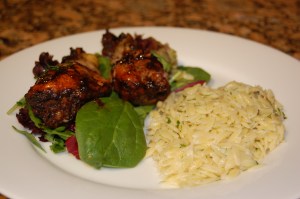
I came up with this herbed orzo to act as a simple foil to the flavorful balsamic roasted chicken I made on Saturday night – but it came close to stealing the show, at least if you ask me.  The smooth flavor of extra-virgin olive oil and the green bite of parsley and dill are perfect against orzo, my favorite pastina.  Sometimes it’s the low key side dishes that taste the best.

Herbed Orzo

1/2 cup dried orzo (0r other pastina)
1 1/2 tablespoons (approx.) extra-virgin olive oil
1 tablespoon finely chopped Italian Parsley
2 tablespoons finely chopped dill
salt and pepper

  • Cook the orzo according to the package directions.
  • Drain the orzo and transfer to a large bowl.  Add remaining ingredients and toss to combine.  Season to taste and serve alongside roasted meat or chicken.

Source: Covered In Flour

Pasta with Goat Cheese and Sundried Tomatoes

DSC_0002

Another weeknight wonder!  As much as I love to cook elaborate dinners and put together exciting menus, or learn new skills and try out new recipes… weeknights just don’t allow for that.  I get home at 7:00 and I’m starving, and I need something quick and easy.  Most nights, I’ve forgotten to take whatever I had planned on serving out of the freezer to defrost, too, so it helps to have a few vegetarian dishes or pantry stand-bys on the weekly menu.  This is one of the easiest, and one of the most flavorful.

DSC_0006

Pasta with Goat Cheese and Sundried Tomatoes

8 ounces pasta (in the shape of your choice)
4 ounces goat cheese
4 ounces sundried tomatoes
extra-virgin olive oil
splash of red wine (optional)
salt and pepper
1 tablespoon chopped chives

  • Cook the pasta in boiling, salted water, according to the directions on the package.
  • Meanwhile, roughly chop approximately 4 ounces of sundried tomatoes.
  • When the pasta reaches al dente, drain it and put it back in the pot.  Add the sundried tomatoes.  Crumble in goat cheese and moisten with a little olive oil, add a splash of red wine (if desired), and season with salt and pepper.  Garnish with chives and serve.

Yield: Serves 4.

Wine Pairing: Because the flavors of sundried tomatoes and goat cheese are quite robust, a somewhat fuller-bodied red wine can stand up to this dish.  Go for a Bordeaux blend or – if the budget allows – a Chateauneuf-du-Pape.

Source: Adapted from Giada de Laurentiis

Roasted Vegetable Pasta Sauce

DSC_0248

Despite the title of this blog, I am actually something of a neat freak.  Although I do flail about and throw flour everywhere while I bake, I’m an extremely tidy cook and am very conscientious about cleaning my condo – particularly the kitchen, since I spend so much of my time there.  But one cleaning chore that I geniunely hate is cleaning the refrigerator – especially the dreaded produce drawers.  Mostly, I hate doing this because it bums me out.  I end up throwing so much away – mostly vegetables that were intended for dinners which never materialized, because I worked late or came home exhausted or forgot about happy hour plans I had made when I wrote my weekly menu.  Throwing that stuff away makes me sad, partly because I hate to waste anything (especially money, and since I shop at Whole Paycheck, it really is like tossing cash down the drain) and because I was really looking forward to those dinners that never happened.

The solution?  Make something out of nothing.  I’m good at this – you should have seen my 1L Torts outline.

DSC_0250

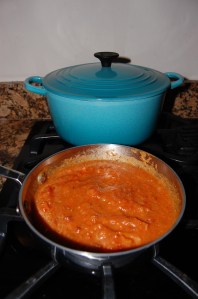
I don’t always succeed, but I try not to get to the point where I have to throw food away.  Instead, once a week I try to do a fridge-clearing meal and actually use those vegetables that would otherwise be thrown out on the next market day.  Because I like alliteration and keeping my husband on his toes, I come up with cute, catch-all names for the dinners, like “Pantry Pasta” or “Fridge Frittata” so that he never knows what he’s going to get for dinner that night.  (Evil laughter.)  These dinners don’t really take to being written down in recipe form, but here’s one I made recently.  Alter as you see fit, depending on what’s languishing in your vegetable drawer…

DSC_0255

Roasted Vegetable Pasta Sauce

2 Japanese eggplants
1 red bell pepper
1 orange bell pepper
1 cup shredded carrot
1 28-ounce can crushed San Marzano tomatoes
1 teaspoon light brown sugar
1/2 teaspoon dried oregano
1/2 teaspoon dried thyme
1 dried bay leaf
1/4 cup grated Parmesan
2 tablespoons light cream (optional)
salt and pepper to taste

  • Cut eggplants and peppers into medium-sized chunks.  Toss on a baking sheet with extra-virgin olive oil, kosher salt and pepper.  Roast in a 450 degree oven for approximately 40-45 minutes (keep an eye on it) tossing halfway through.
  • Bring remaining ingredients to a simmer over medium-low heat.  Stir in roasted vegetables and simmer together 20 minutes.  Remove bay leaf.
  • Process in a blender or in the pot with an immersion blender until sauce reaches the consistency you prefer.  Stir in Parmesan cheese and cream, if using, and season to taste with salt and pepper.

You can serve this over any pasta that you happen to have in your pantry.  I served it over whole wheat spaghettini, but it would also work well with linguine, penne, rigatoni or cavatappi, either classic or whole wheat.

Happy cleaning!

Source: Covered In Flour