
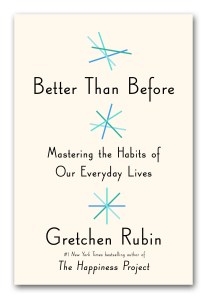
As I mentioned last week, I’ve been on something of a Gretchen Rubin kick lately, reading three of her bestselling personal improvement books in the span of about two months. While Better Than Before, her latest, wasn’t my favorite, I did take away a few points from the book, and I’m preserving my thoughts on them here so I can reference them again after I return the book to the library.
The Four Tendencies
Rubin posits that each of us falls into one of four “tendencies” when it comes to our nature and our ability to stick to commitments. There are:
- Upholders, who readily meet both internal and external commitments
- Obligers, who meet external commitments but struggle with internal
- Questioners, who generally meet internal commitments but will not meet external ones unless they are satisfied that the commitments are based on sound reason
- Rebels, who don’t like committing to anyone or anything, including themselves
As hubby and I were laying in bed one evening, I showed him the section in which the four tendencies are first outlined, and I asked him which one he thought I was. He immediately said that he thinks I’m an Upholder. While I’d love to be an Upholder, I actually disagree with him. I told him that I think I do have a few Upholding traits, but if I’m being realistic, I have to admit that I’m an Obliger. It is far, far easier for me to meet an external expectation or commitment to someone else. When I first picked up running, for example, I ran along the Potomac every other day at the absurd hour of 5:00 a.m. one summer. I was completely faithful to this schedule, for one important reason – my friend Erin was my summer running buddy, and she was waiting for me. I never once hit the snooze button, because leaving Erin standing on a street corner was unthinkable. And the same held true during my first and second Whole30s, in which I had a different buddy – my sister-in-law, Emma. Whenever I was tempted to cheat on the program, I thought of Emma. I might cheat on myself, but I’d never cheat on her. I wish I was an Upholder or a Questioner, but knowing that I’m an Obliger, I think I can put that new understanding to good use when it comes to my goals.
(Hubby also asked me what I think his tendency is. I told him that I believe he’s a Questioner. If he decides he’s going to do something, he follows through, but he likes to have full information and to understand why he’s making a particular commitment. I think it’s much easier for him to commit to himself rather than to meet an expectation simply because it’s there – whereas I tend to blindly follow rules, which is a little bit of Upholder coming out, and to get very caught up in what other people need/want/expect from me, as a classic Obliger.)
Personality Dichotomies
Rubin also references several personality dichotomies, some of which will be familiar to readers of her other books (especially the overbuyer/underbuyer dichotomy and the abstainer/moderator dichotomy). I liked reading through her list and trying to figure out where I fell.
- Am I a lark or an owl? I think I’m a lark, for the most part. I’m not the earliest riser, but if left to my own devices I rarely sleep past 7:00 or 7:30. (These days I’m never left to my own devices – that’s life with small children in the house!)
- Am I a marathoner, a sprinter, or a procrastinator? While I’d like to think I’m a marathoner, I think I’m a sprinter. I tend to get my best work accomplished in intense bursts. I’ve tried for years to become more methodical and marathoner-like in my work style, and what has worked for me is to set myself little private deadlines for different aspects of a project. (Complete all research by Monday; have brief outlined by Tuesday; draft facts section by Wednesday, etc.) I hope I’m a sprinter and not a procrastinator.
- Am I an underbuyer or an overbuyer? Rubin has explored this distinction at length in Happier at Home, and I knew immediately – I’m an overbuyer. I will generally not wait until I’m out of paper towels before buying more, for instance. I don’t go nuts with this, but I find it comforting to know that I’m stocked with the essentials and that if I run out of, say, shampoo, there’s another bottle right under the sink where it belongs. I like the feeling of having a full pantry and of knowing that I have what I need – and that tendency has served me well in the past. (For instance, when we were snowed in at home for a week last November, we never ran out of food and were still eating fresh, healthy meals after six days of being unable to open our doors.) I’m perfectly comfortable with being an overbuyer.
- Am I a simplicity lover or an abundance lover? This is one I can’t decide upon. I don’t like having a ton of clutter in my house, and lately, especially, I’ve been feeling a powerful urge to clear things out. I get decision fatigue easily and I’m working on finding ways to minimize it. All that points to simplicity lover (a bit at odds with my overbuyer tendency). However, there are certain areas in my life where I do like abundance. I like that my pantry is always fully stocked. I like my tea cabinet stuffed to the brim. While I don’t like having a ton of choice in my clothing, I do enjoy lots of accessories, and my scarf collection proves that. And I love my overflowing bookshelves. I guess I’m a simplicity lover in general, but a lover of abundance in certain defined areas. I’m going to write more about this soon.
- Am I a finisher or an opener? Oh, a finisher. Definitely a finisher. I get the world’s biggest charge out of finishing something I’ve started – which is why I rarely have more than one knitting project or book on the go (and I find it very hard to abandon a book I’ve begun), and I found myself nodding in recognition when Rubin mentioned feeling great satisfaction at returning books to the library.
- Am I a familiarity lover or a novelty lover? I would have thought that I was a familiarity lover (after all, I love to re-read my old favorite books), but when I’m really considering the matter, I have to admit that I’m a novelty lover. I get a big charge out of the new, and I enjoy exploring new places, trying new foods, and seeking out exciting new experiences. Although I’m a homebody and I love my routines, and although I find comfort in returning to them at the end of the day, eventually most things get old and I’m itching to move on.
- Am I promotion-focused or prevention focused? My initial instinct was to say that I’m prevention-focused. But then I read this sentence from Rubin: “A promotion-focused person recycles in order to make the environment cleaner; a prevention-focused person recycles in order to avoid getting a fine.” When I undertake an action or start a habit, I’m usually thinking of the larger goals. So I think I’m promotion-focused.
- Do I like to take small steps or big steps? Oh, small steps. Definitely small steps. I get easily overwhelmed by a large looming task, and often the only way I can wrap my mind around a big goal is to break it down into small, manageable bites. I’m not sure I’m even capable of taking big steps. I have short legs (both literally and figuratively).
Abstaining v. Moderating
One personality dichotomy not listed above, but on which Rubin spends a great deal of time, is the dichotomy of abstaining v. moderating. Abstainers find it much easier to tell themselves “No, I never do/have/drink/eat that.” Moderators chafe under such rigid rules. Rubin is an abstainer, a trait she whole-heartedly embraces. She doesn’t drink. She eats low-carb. And it works for her. Rubin suggests that while most people believe they are moderators, many are mistaken – there are more abstainers than we realize.
For a long time, I’ve believed I was an abstainer. It’s why I was able to sustain long periods of vegetarianism, why I’ve made it through three Whole30s, why I have no problem abstaining from alcohol or sushi during pregnancy, etc. But laying in bed the other night, I had an epiphany. I’m not an abstainer. I’m the opposite of Rubin’s suggestion. I’m a moderator who thinks I’m an abstainer. I do find it easy to abstain from things (like grains, etc.) for defined periods of time – hence my devotion to the Whole30. But key to that ability is my knowledge that I can have the things I’m giving up, in moderation of course, when that period is over. There are some things I find it harder to moderate than others – like sugar – but if I were to say that I never eat sugar, it would immediately become all I can think about. Meanwhile, I have no trouble moderating my intake of other things – especially alcohol. I’m not a big drinker and it’s very easy for me to nurse one glass of red wine all evening long, or to stop drinking after one or two beverages, even at a party. While alcohol can be a very slippery slope for many people, it simply isn’t for me. Knowing I can have a glass of wine, or a croissant, if I want one, means I’m much less likely to crave those things. And if I do crave them, I indulge and then I move on.
I’m not sure what I’m going to do with this newfound realization. Probably continue on as I have been. But it’s good to know that I’m not an abstainer without self-control, as I’ve believed, but actually a pretty decent moderator.
The “One-Coin Loophole”
Rubin discusses the “loopholes” that we look for in order to derail our good habits or indulge in our bad habits. One interesting loophole, she has dubbed the “one-coin loophole.” Basically, this loophole allows us to tell ourselves that one small action or omission won’t make a difference – a slippery slope in which we ultimately abandon all of our good efforts.
There’s a reverse to this. Reading this section, I thought about a reading and talk I attended some years ago, given by Stephanie Pearl-McPhee (otherwise known as The Yarn Harlot). I’m a big fan of Pearl-McPhee’s, and it was one of the highlights of my knitting career when I was included on her blog, with my first sock, after that reading. Pearl-McPhee told a number of stories that stuck with me, and one that came to mind as I read this section of Better Than Before, was her update on how her initiative to get her readers to donate to Doctors Without Borders (an organization in which her brother was active) was going. Pearl-McPhee’s brother was amazed at the response that her readers gave – donating in much higher proportions than the general population. According to him, knitters are a group that is known, in charity parlance, as “super-responders.” Why is this? Pearl-McPhee’s theory is that knitters understand the value of one small action. One stitch seems like a very tiny thing. But when combined with another stitch, and another, and another, they add up to a sock… a scarf… a hat… or a sweater. Without each stitch, the garment would be incomplete. So no, one coin, or one stitch, or one vote for that matter, doesn’t seem like a big thing. But they add up. Good motivation to stick with good habits, and to jump back on the bandwagon if we slip up.
Reward and Motivation
Rubin is not a fan of rewards for sticking with good habits. She worries that, by paying yourself to stick with a habit, you’re devaluing the habit itself – teaching yourself to “associate the activity with an imposition, a deprivation, or suffering.” She probably makes a good point. Anyway, rewards are not particularly motivating to me. Of course it makes no sense to say, when I lose twenty pounds, I’m going to reward myself with a big slice of chocolate cake. But I’ve tried using rewards that are not associated with the habit I’m trying to form. For instance, I’d never reward myself for finishing a Whole30 by granting myself chocolate cake. But I did promise myself a new glassybaby (obsessed) when I finished my most recent Whole30. I even chose the color I was going to order – hyacinth. Then I finished the Whole30 and forgot to order the glassybaby. Clearly, I did not do a Whole30 to get a candle holder.
Rubin has a list of motivations other than reward:
- Challenge
- Curiosity
- Control
- Fantasy
- Cooperation
- Competition
- Recognition
I immediately recognized, on reading that list, that fantasy is my prime motivator. I’m big into visualizing results. When I need motivation to finish a run strong, I picture the finish line of my next race just ahead of me. Or I indulge in daydreaming about how my life will look once I’ve reached a particular goal or changed a habit that I want to change. I love to use my imagination to get a boost and help me stay on track. I think I’m also motivated by curiosity, challenge, and recognition, but fantasy is definitely my prime motivator.
Treats
Treats are different from rewards. While Rubin discourages using rewards as a major motivation tool for sticking with a habit, she is a big fan of indulging in treats – within reason, of course. Her treats include logging books she wants to read, returning library books, and adding to her collection of favorite quotes. I was inspired to make my own list of favorite (non-food,non-alcohol, non-shopping) treats:
- Hiking with my family in a beautiful place
- Looking at pictures or watching videos of my kids (I often reward myself with a video of Peanut doing something adorable after I’ve finished an arduous task at work)
- Sipping a cup of one of my favorite teas (I save the really special ones for treats)
- Scrolling through Instagram
- Taking a bubble bath with my favorite products (I love doing this, and I almost never do)
- Lighting my glassybaby votives and gazing at them for awhile
- Reading a good book
- Relaxing in front of the fireplace on a cold day
- Running on a pristine trail
Seatbelt Habits
This is not a Rubin phrase, but something that popped into my head as I was reading through this book. Seatbelt habits are what I call good habits that run completely on auto-pilot – and I give them this name because the prime example, for me, is buckling my seatbelt. When I get into the car, I immediately buckle my seatbelt. I do this every single time I get in the car. I never think about it. It’s a habit that is so ingrained in my life that I do it unconsciously at this point. It’s also a very, very good habit – seatbelts save lives; wearing one is one of the most important things we can do. I have a few seatbelt habits, in addition to the namesake – brushing my teeth, drinking my morning tea, wearing a helmet every time I ride my bike, etc. But there are other habits that I’d like to make into seatbelt habits – namely flossing (I really should be better about this, but like so many people, I hate it and find it hard to remember, although I do use mouthwash faithfully) and making my bed in the morning. I’m going to think of some more habits that I want to become automatic and work on internalizing them.
Have you read Better Than Before? What did you think? Are you inspired to work on your habits after reading the book?
P.S. You may have noticed that I titled this post “Margin Notes.” As I’ve been reading more non-fiction, I often want to make notes or highlight passages more often – but I get most of my non-fiction from the library, because I rarely re-read a non-fiction book. So I’m thinking of doing a sporadic blog series in which I post the thoughts that would have been margin notes had I been scribbling in these books instead of returning them to the libe. It won’t be a regular thing – just whenever I have something to say. So there ya go.
 covered in flour