Cranberry Bean and Spinach Risotto

DSC_0866

Risotto is one of my all-time favorite fall and winter dishes, and I’ve experimented with so many different recipes over the few years that I’ve been cooking.  Sausage, tomato and spinach risotto, mushroom and pea risotto, champagne risotto with lobster… these have all made repeat appearances on my table, some on special occasions and some on chilly weeknights.  Risotto is simple to make, yet it never fails to impress.  It has become a staple in my kitchen… so I can’t believe it took me this long to try risotto with beans.  I mean, I love risotto, and I love beans.  Put them together and it’s how-come-I-didn’t-think-of-this-sooner good.

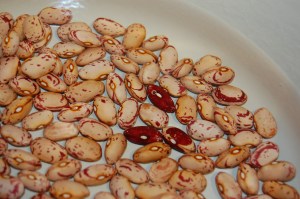
This recipe calls for cranberry beans, which are an heirloom bean varietal that I order online from Rancho Gordo.  I’d strongly encourage you to seek out heirloom cranberry beans for this recipe, whether it is through Rancho Gordo, your local farmers market or co-op, or another source.  However, if you are really at a loss for cranberry beans in your neighborhood, and you don’t want to order online, you can substitute dried pinto beans from the supermarket.  Under no circumstances, however, can you use canned beans!  Please trust me on this one.  The key to this risotto’s unbelievable deliciousness is the rice absorbing all of the beans’ pot liquor, which is what bean people call the magical substance that the bean water turns into after the beans have been cooking for a couple of hours.  The pot liquor absolutely makes this dish, and you won’t get it from canned beans.  I’m not saying that canned beans don’t have their role to play – believe me, if that was the case I wouldn’t have to dodge falling cans of cannellini beans every time I open up my crammed pantry.  But canned beans just don’t belong in this dish.  It’s as simple as that.

Cranberry Bean and Spinach Risotto

1/2 cup dried cranberry beans (or pinto, in a pinch)
1 tablespoon butter
1 tablespoon extra-virgin olive oil
1 shallot, medium-diced
1 cup arborio rice
1/2 cup dry white wine
4 cups (approx.) low-sodium chicken broth
2 cups baby spinach
1/3 cup Parmeggiano Reggiano

  • Start soaking the beans 12-24 hours in advance.  Place the beans in the pot in which you plan to cook them, cover with about an inch of water, put the lid on the pot and allow the beans to soak.  (The longer you soak the beans, the less time you will have to spend cooking them.)
DSC_0859

  • After the beans have been soaking for a ridiculous length of time, start cooking them: just crank up the heat, bring the beans to a boil, then reduce down to a simmer for an hour or two hours or more.  How long you will cook the beans depends on how fresh they are (yes, there are variations in freshness, even amongst dried beans) and how creamy you like them.  You can tell the beans are done when the entire kitchen smells magical.  Test a bean for doneness periodically, if you think they might be getting close.  Once the beans are cooked through, season them with salt; don’t rush this step.  Seasoning the beans before they are done cooking will make them tough.  So really, wait until the beans are done before you go tossing in a handful of salt.
  • When the beans are cooked through and the pot liquor is aromatic, pour in four cups of chicken stock and allow the mixture to come to a simmer.
  • Meanwhile, melt a tablespoon of butter with a tablespoon of olive oil in a large Dutch oven over medium heat.  Add the shallot, season with salt and pepper, and cook until softened.  Add the arborio rice and toast until shimmering.
  • Pour in the wine and stir the rice until it absorbs the wine.  Working a ladleful or two at a time, continue adding liquid from the broth and bean mixture, adding more when the previous addition has absorbed.  (Nota Baker: It is an urban legend that you have to stir risotto constantly.  You don’t.  I have never made a risotto that I stirred constantly.  You do, however, have to keep an eye on it and stir it often enough that the rice doesn’t stick to the bottom of the pot.  I like to stick around and clean the kitchen while I make risotto; that way I am on the premises to stir it plenty, but I am not obsessing.  The bottom line is, you do need to stir and stir often, but you don’t have to spend 30 minutes hunched over the stove stirring obsessively.)
  • When you have ladled the majority of the liquid in and it’s mostly beans left in the bean pot, begin ladling the beans in at a bit of a faster clip.  Allow any liquid that came over with the beans in each ladle to absorb before the next ladle.
  • Once all the beans have moved over to the risotto – it will have taken on a beautiful burnished golden color; that’s from the pot liquor – add the spinach and stir until wilted.  Finish the risotto off with some grated Parmeggiano Reggiano cheese, or any other cheese/cream/butter routine that you typically do for risotto.  Serve with a little extra cheese grated on top, if desired.

DSC_0863

Source: Adapted from Heirloom Beans, by Steve Sando

Bean and Barley Salad

DSC_0726

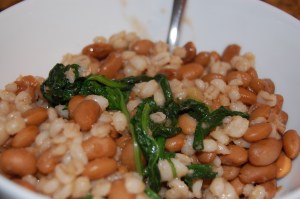
I belong to salad.  It’s year round for me.  What salad and I have together… well, it’s special.  It’s not a summer fling.  I do love salads in the summer… grilled tuna and avocado salad, for instance.  And there’s nothing like roasted fall vegetables over greens in late fall, or a tart and crisp fennel and grapefruit salad in the winter.  But one of my all-time favorite salad categories is the warm grain salad.  It’s a perfect salad for a fall dinner – hearty enough to make a meal out of it, but extremely wholesome and nourishing all the same.  And I’m not just talking about rice – although a wild rice salad with grapes is very nice.  Any whole grain can bulk up a salad, whether as an accent or as one of the basic building blocks – and you’re supposed to eat whole grains, anyway.  Bonus!  Take barley for instance – I’ve always got some in my pantry and sometimes it can be hard to know what to do with it.  But I’m telling you… give this salad a try, and you’ll never wonder what to do with that barley you bought in a fit of crunchiness.  This salad is what barley is made for.

A note on the beans, before I give you the recipe: while this salad would work with your run-of-the-mill dried pinto beans from the grocery store, it’s just better if you use heirloom beans.  The recipe was written to be made with the Yellow Indian Woman beans from Rancho Gordo… and no, I’m not being racist.  That’s really what they’re called.

DSC_0730

See?

Anyway, these beans are wonderful in this salad.  They hold their shape beautifully and bring a fantastic, rich flavor that goes extremely well with the barley and other ingredients – chopped preserved lemon and wilted spinach.  They really do make a difference, I promise!

Bean and Barley Salad with Spinach and Preserved Lemon

1/2 cup Rancho Gordo Yellow Indian Woman beans
1/2 cup organic pearl barley
1/2 package spinach (or equivalent amount of another leafy green)
1/4 preserved lemon, minced fine (use more if you like)
salt and pepper to taste

  • Put dried heirloom beans in a heavy stockpot, cover with water – about an inch – and cover the pot.  Allow to soak at room temperature for at least two and up to eight hours.  (I know this is annoying, but it’s crucial.  This recipe is really better on a weekend, I realize… but canned beans would not be the same.  Trust me on this one.)
  • Bring beans to a boil, then reduce to a simmer and cook for 1-2 hours, until extremely fragrant.  Test a bean occasionally to gauge doneness.  The Yellow Indian Woman beans should keep their shape but still be soft enough to eat without crunching.
  • Meanwhile, cook the barley according to the package directions.
  • When the beans are about done cooking, stir in the spinach (or other dark green – chard would be lovely here and was actually my original intention, but my grocery store was out, darn them).  Allow the greens to wilt, then drain the beans as necessary – but don’t get too precious about it.  A little pot liquor (what bean folks call the cooking liquid) is a very, very nice addition.  Stir in the minced preserved lemon and season to taste with salt and pepper.  Finally, add the barley and stir everything together.  Serve the salad while it’s still warm and congratulate yourself for eating such a healthy dinner!

DSC_0727

Yield: Serves 4.

Source: Adapted from Heirloom Beans, by Steve Sando

Tomatillo Chicken with Black Beans

DSC_0002

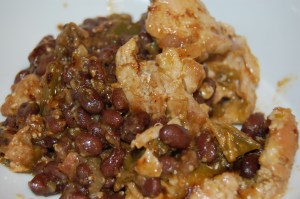
The addition of black beans to a recipe for tomatillo chicken was complete serendipity.  True to form, I planned to serve the tomatillo chicken over brown rice and then forgot to actually make the brown rice.  (I think this is my subconscious self reminding me that I think brown rice is a huge, ever-lovin’ hassle.)  The tomatillo chicken, in and of itself, was not going to be enough for dinner – especially not with my hubby in the house – so in an effort to quickly fill out the dish I popped open a can of black beans and tossed them in.  They added a wonderful creamy texture and, happily, more protein without much fat.  (Not that the dish was hurting for protein…)  I’d still recommend serving this over brown rice if you can remember it – I can’t – and if you did, this dish could stretch to a main course for 4 instead of just 2.

Tomatillo Chicken with Black Beans

4-6 boneless, skinless chicken thigh pieces
1/2 white onion or 1 whole large shallot, diced
1 poblano pepper, diced
8 tomatillos (approx), husks removed
kosher salt
ancho chili powder
1 can black beans, drained and rinsed

  • In a medium Dutch oven over medium-high heat, warm a glug of vegetable oil until shimmering.  Season the chicken thigh pieces and lay them in the oil to brown, turning over once.  When the chicken thigh pieces are browned, remove them to a plate.
  • Meanwhile, whir the tomatillos in a food processor until pureed.  Reserve for later.
  • Add the onion and poblano pepper to the oil, season with kosher salt and cook until softened and slightly caramelized.  Pour the tomatillo sauce into the pot and stir around to coat the peppers and onions.
  • Return the chicken to the pot, nestling each piece into the tomatillo sauce and turning to coat.  Cover the pot and simmer on medium-low heat for 20-25 minutes, until the chicken is cooked through.  (How long you cook this will depend on how thick your chicken pieces are.  If you use bone-in thighs or breasts, adjust the cooking time accordingly.)
  • Drain and rinse the black beans.  Add them to the pot and stir everything together.  Continue to simmer until the beans are warmed through.  Season with more ancho chili powder if necessary and serve, alone or over brown rice.

DSC_0001

Source: Adapted from Everyday Food, September 2009

Note: As you can probably tell from the references to poblano pepper and ancho chili powder, I like warmth but not a four-alarm fire on my dinner plate.  Feel free to play with the heat-adding elements in this dish, substituting a couple of jalepenos for the poblano, for example, if you want something spicier.  My palate is simply not made to tolerate really hard-core chili action, but if yours is, by all means, go nuts.

Pasta e Fagioli

DSC_0002

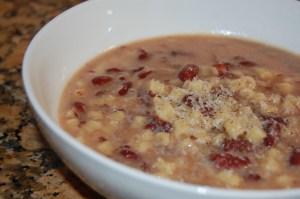
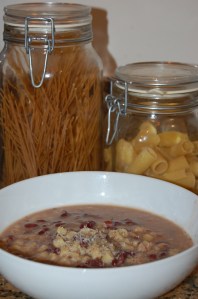
I love to have soup for dinner.  I’ve been known to whip up a big pot of chicken noodle, or corn chowder, or my grandmother’s roasted red pepper soup, and live on it for a week.  That, of course, was when I was a law student living alone in Foggy Bottom.  Now that I’ve got a man around the house, the situation has changed slightly.  Soup for dinner is still okay, but only if it has some substance to it.  So my favorite split pea soup is scorned, but this pasta e fagioli – with red kidney beans, chewy pasta and a thick broth – is acceptable.  In fact, it’s more than acceptable; it’s hearty but healthy, with a delicious, savory flavor, and it’s a one pot meal.  Sign me up!  But of course, I’m the notorious soup lover in the household.  The hubs is the real critic, when it comes to soup… and he loved it too.

DSC_0006

Pasta e Fagioli

1 shallot, minced
2 strips turkey bacon (optional)
1 can red kidney beans, drained and rinsed
4 cups chicken stock, divided (preferably organic and free-range)
1/2 cup pastina (such as ditalini or small elbows)

  • In a large, heavy stock pot, heat approximately 2 tablespoons of olive oil over medium heat.  Add minced shallot, season with kosher salt, and saute until tender.  (If desired, add turkey bacon here and cook until crisp, then remove from the heat, leaving the renderings.  Place bacon on a paper towel and allow it to cool, then dice it.  I didn’t bother with any of this; so don’t feel it’s necessary – it’s just nice if you have time, which I didn’t…)
  • Once shallots are tender and translucent, add kidney beans and 1 cup of the chicken stock.  Bring to a boil, then turn the heat down slightly and allow the beans to cook at a high simmer or low boil for 10 minutes.
  • Using an immersion blender, blend soup just slightly, until some of the beans are broken up and thickening the stock, but most are still whole.  Alternatively, you can transfer about 1/4 to 1/3 of the beans to a blender or food processor, puree them, and transfer them back into the pot.  (This is actually how you are supposed to do it – I’m just lazy.)
  • Add the remaining 3 cups of chicken stock and 1/2 cup of pastina.  Elbow macaroni works great, but I used ditalini, which was yummy too.  Any small pasta will do.
  • Boil approximately 10 minutes.  (If you bothered with bacon, now would be the time to stir most of it back in, reserving some as a garnish.)  Season to taste with salt (if needed) and pepper, then serve with parmesan grated fresh over the top.

Source: Adapted from Giada’s Family Dinners, by Giada de Laurentiis