Squash and Ginger Soup

I realize that I have committed the cardinal sin of blogging: the disappearing act.  And I present to you my most humble apology for being AWOL so long, with no explanation.  In fact, I’m not going to bore you with the details of my explanation right now – or ever.  I’ll just leave it at this: for the past week, at any given time, either hubby or I have been subsisting entirely on the following three things: (1) chicken soup; (2) saltine crackers; and (3) ginger ale.  I really didn’t think anyone would be interested in reading about our meals.  The recipes would go something like this: Open Campbell’s chicken soup.  Heat on stove.  Serve with saltines, ginger ale, and sympathy.  Lie on couch and watch Bringing Up Baby (if you’re me) or Star Trek (if you’re hubby).  There… you’re now caught up on all of our meals for the past week.

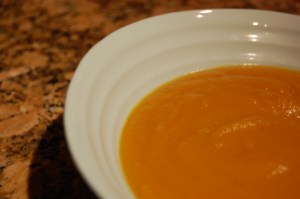
Now that I’m back to sitting upright and being able to stand the sight/smell/thought of food, though, I’m eating this squash and ginger soup to get me back to 100%.  Ginger is miraculous when you have a tender tummy.  I’ll admit that I didn’t always like ginger – other than the luridly pink pickled ginger that comes with Whole Foods sushi – but I’m a convert.  I love it in baked goods, in teas, in stir-fries and, yes, in soups.  And the best part: you don’t even need to have a sick tummy to enjoy this subtly spicy ginger-infused puree.  It’s a wholesome, warming, wonderful winter soup.  Yum.

Squash and Ginger Soup

1 large Butternut or Blue Hubbard squash (I used Blue Hubbard here)
1 yellow onion, large-diced
2 russet potatoes, cubed
1 tablespoon extra-virgin olive oil
1 teaspoon sea salt, more to taste
3 cups vegetable broth
2 cups water
3 tablespoons grated fresh ginger (not the powdered stuff)
1/3 cup chopped cilantro (optional)
2 teaspoons rice vinegar

  • Preheat the oven to 400 degrees Fahrenheit.
  • Peel and seed the squash: halve it very carefully, then scoop out the seeds, chop the squash into cubes and remove the skin.  Scrub the potatoes and chop them into cubes of roughly equivalent size to the squash.  Toss the squash and potatoes with olive oil and sea salt.  Roast for 30 minutes, then reduce the heat to 375 degrees Fahrenheit and continue cooking for another 20 minutes.
  • In a large soup pot, saute onions until translucent.  Combine the roasted vegetables with the broth, water, fresh ginger, cilantro (if using) and rice vinegar.  Simmer together for approximately 30 minutes to allow the flavors to meld.  Turn off the heat.  Puree the soup (in batches, please, unless you want soup all over your ceiling, and trust me, you don’t – ask me about the Great Pesto-Tastrophe of 2005 if you want more details) in a blender, or in the pot with an immersion blender.  Thin the soup with more broth if you prefer.
  • Season to taste with salt and pepper.  Serve with a garnish of cilantro or plain yogurt if desired.

Source: adapted from Love Soup, by Anna Thomas

Curry-Roasted Carrots

By now, you all know how much I love roasted vegetables.  Carrots are no exception – just like most of their veggie cousins, when carrots are roasted they become caramelized and deeply sweet-savory.  Now, I could eat plain roasted veggies, with just olive oil, salt and pepper, and maybe a squirt of lemon juice, every day for the rest of my life and never be bored.  But I realize that not everyone is as single-mindedly obsessed with vegetables as I am, and that some of my darling readers might appreciate me changing things up once in awhile.  So here’s a little variation on plain roasted carrots (which are good just as they are) for ya: curry-roasted carrots.

Forrest Gump said many times that he and Jenny were like “peas and carrots.”  What he really should have said was that they were like curry and carrots.  There are very few things, in my opinion, that go better together than curry and carrots.  Curry just loves carrots, and I’ve combined the flavors before in my curried carrot salad.  And not only are these flavors made for each other, but both curry and carrots are great for you.  Carrots contain beta-carotene, which is such an important nutrient that I’ve been known to dream about it and wake up craving orange vegetables.  And curry is thought to possibly prevent degenerative diseases such as Alzheimer’s and dementia if you eat it in small quantities throughout your life.  If that goodness isn’t reason enough to make these curry-roasted carrots, I’ll give you another reason: they’re freaking delicious.  The carrots take on a resonant sweetness, which is perfectly complemented by the spicy crunch of curry powder and garam masala.  Healthy and delicious… yes!

Curry-Roasted Carrots

2 bunches baby garden carrots with greens attached
extra-virgin olive oil
kosher salt and black pepper
1/2 to 1 teaspoon garam masala
1/2 to 1 teaspoon curry powder

  • Preheat oven to 450 degrees Fahrenheit.
  • Trim carrots so that only a small tuft of green remains.  Wash them, but there’s no need to peel them (unless you bought them already-peeled in a bag from Whole Foods like I did, cheater that I am).
  • Lay carrots out on a foil-lined baking sheet and dress with olive oil; toss until carrots are lightly coated.  Add kosher salt (a generous amount), black pepper, garam masala and curry powder.  (I like lots of spice, so I go for the full teaspoon.  If you like less, start with 1/2 teaspoon and see how it looks to you.  You can always add more, but it’s rather hard to subtract.)
  • Roast carrots for 1 hour, tossing once, midway through.

Yield: Serves 4-6.

Source: Covered In Flour.

Roasted Halibut with Salsa

If you’re looking for ways to eat light-n-healthy in 2010, here’s a great tip: roast fish slathered in salsa.  I saw this trick on “Get Fresh with Sara Snow,” or “that hippie show,” as hubby likes to call it.  Fish is tricky to cook – you certainly don’t want it underdone, unless you’re serving sushi!  But in the effort to make sure that fish is cooked through, I (and probably many others) often end up with fish that’s so dry as to be virtually inedible.

Salsa is a great way to solve that conundrum and add some wonderful flavor and nutrients without many calories.  The salsa keeps the fish moist and flavors the fish throughout, while the fish still cooks through.  Now, in the interests of full disclosure, I made this dish with halibut steaks.  If you choose to use fillets, as I may very well do in the future – hubby isn’t a fan of bones in fish – you will want to adjust the cooking time downward, as the fillets will cook (and dry out) more quickly than most steaks.  I’d check fillets after 10 minutes, unlike these steaks, which I checked at 20 minutes and found they weren’t quite done.  This is a versatile recipe – not only can you substitute fillets for steaks, but you could substitute other types of fish as well.  I think this would be delicious with salmon or tilapia and would be a wonderful way to dress up cod as well.  That’s the best part about this recipe, in my book – for someone who loves salmon, like hubby does, or for someone who generally prefers white fish, like me (I like salmon too, but I’ve had so much of it since meeting the hubs that I’m starting to burn out)… it’s equally good.  No matter what kind of fish you choose to make, moist and flavorful are good characteristics.

Roasted Halibut with Salsa

2 halibut steaks (or fillets)
2 tablespoons store-bought salsa
kosher salt and black pepper

  • Preheat oven to 400 degrees Fahrenheit.
  • Season halibut steaks with salt and pepper.  Spread salsa over steaks in an even layer.

  • Roast for 20-25 minutes, until cooked through (you can tell if the fish seems sturdy when you poke at it).

Source: Adapted from Sara Snow.

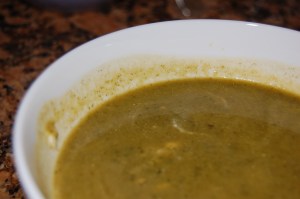
Green Soup

Don’t be scared: this only looks like pond scum.  I promise you, it tastes much better.  (Not that I know what pond scum tastes like…)

I bought my copy of Anna Thomas’s Love Soup some months ago and simply haven’t had time to cook anything from it.  This is sad, and not a reflection on Anna at all – most of her recipes are very easy and tempting.  It’s just that my schedule has been so hectic that I feel like I’ve barely sat down since mid-October.  If nothing else, that fact alone means I’m crying out for some homemade soup, which in my book is about the most comforting, lovely food imaginable.  Of course, when I finally got the opportunity to make myself some soup, I found I had misplaced my copy of Love Soup.  (It’s probably in my den buried under the 36 bottles of wine that hubby and I bought in California.)  No worries, though – I knew exactly what kind of soup I wanted… green soup!  Anna touts her green soup – which is actually a whole category of pureed soups with some sort of dark leafy green – as a perfect post-holiday cure-all.  She’s not kidding.  I made this fly-by-the-seat-of-your-pants version of Anna’s green soup, sans cookbook, and it was delicious – light but also warming, comforting, nutritious and tasty.  The perfect January food, in my opinion. 

Green Soup

2 Carnival squash, tops lopped off and seeds scooped out
extra-virgin olive oil
kosher salt and black pepper
1 shallot, minced
1 carton (4 cups) vegetable broth
1 bunch Swiss Chard, stems trimmed out and leaves julienned
2-3 cups water
salt and pepper for seasoning
2 tablespoons Ricotta cheese (optional)

  • Preheat oven to 450 degrees Fahrenheit.  After preparing the Carnival squash (that just happened to be the variety I had laying around the kitchen, left over from a farmers market visit – but you can substitute any hard winter squash), dress them with a generous drizzle of olive oil and sprinkle with salt and pepper.  Roast squash for 45 minutes, then remove from oven to cool.
  • While squash is cooling, warm a glug of extra-virgin olive oil in a large stockpot or Dutch oven over medium-high heat.  Add the minced shallots and sprinkle with salt; stir occasionally until softened and slightly caramelized (about 5-8 minutes).
  • Trim the skin from the cooled Carnival squash and large-dice the squash flesh.  Add to the softened shallots and stir briefly.  Pour vegetable broth over squash and shallots and stir to deglaze the pot.  Add julienned Swiss Chard leaves and stir to combine.
  • Reduce heat to medium-low and cover pot.  Allow soup to cook for 30 minutes, until flavors meld and squash and greens are completely soft.  Turn off heat and process the soup in a blender or food processor, or in the pot with an immersion blender (my choice) if you have one.
  • Add water and cook soup on medium heat for another 10 minutes.  Taste for seasoning and add salt and pepper as needed.  The soup is good as-is, but if you would like a little creaminess, stir in up to 2 tablespoons of Ricotta cheese.

Source: Adapted from Anna Thomas’s Love Soup.

Lemony Avocado Halves

I really wasn’t sure what to call this post.  It’s my favorite way to eat avocado, but I can barely justify calling it a recipe… nor do I have a name for the dish, to be frank.  And I don’t even really know what this is.  Is it a side dish?  A salad?  An appetizer?  All of the above?

I know one thing: it’s delicious.  Rich, buttery avocado, enveloped in a sheen of extra-virgin olive oil and freshly-squeezed lemon juice, with the crunch of sea salt and cracked peppercorns on top… does it get better than that?  Oh, wait, it does!  Because avocado is good for you!  It’s a wonderful source of “good” heart-healthy fats – as is extra-virgin olive oil.  As Jamie Oliver would say, happy days.

Ingredients

2 ripe Hass avocados, split
1 tablespoon extra-virgin olive oil
juice of 1/2 lemon
pinch of sea salt (Maldon is nice)
cracked black pepper

Method

  • After splitting the avocados, remove the pit.  Using a spoon, scoop out the flesh into neat mounds.  Arrange on a plate.
  • Dress with a drizzle of olive oil and a squeeze of lemon juice on each avocado half.
  • Season with a scattering of sea salt and cracked black pepper to taste.
  • That’s it!

Yield: Serves 2 to 4 (depending on if you want half an avocado or a whole one… you’ll probably want a whole one)

Source: I’m not sure.  I’ve been making these for years.  I might have seen it in a Martha Stewart magazine, or it might have been in Cosmopolitan when they do one of their “make people believe you’re Martha Stewart” blurbs.  I learned to make chocolate covered pretzels from Cosmopolitan, so don’t hate… Anyway, let’s just say inspired by Martha Stewart.

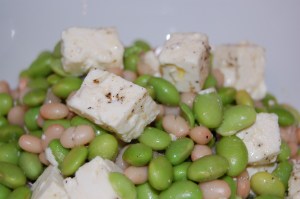
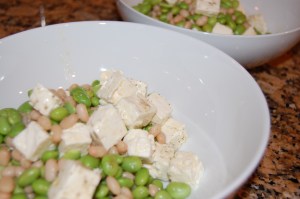
Warm Bean and Edamame Salad with Feta

I love January.  Does that make me weird?  I also love Mondays, for the same reason – because I love a fresh start.  I’m that annoyingly perky girl at the office on Mondays – the one who says things like “Big day!  Lots to do!” and drives everyone crazy with her enthusiastic list-making.  I just love that feeling of being revved up, motivated and ready to go.  And in January, I take it to extremes.  I’m all about the healthy eating and I’m the most over-zealous gym rat you’ll find.  I make the same resolutions that everyone else makes.  I always go into January with plans to: (1) get more organized; (2) run a half marathon; and (3) be all zen and peaceful and stuff.  I always have high hopes for the year ahead, and even if I miss the mark on some of my resolutions, I never stop believing that I can make positive changes.  And at the end of the year, even if I’ve fallen short in some areas, I’m usually so happy with the way things are going in my life that I really have no complaints.  I’m annoying that way too.

So for all of my brothers and sisters on the January motivation bandwagon, I have a belated holiday gift for you: warm bean and edamame salad with feta.  If you want to eat healthy, here’s a great place to start.  This salad is pure protein – creamy navy beans, crunchy edamame, and tangy feta cheese wrapped in a silky squeeze of lemon juice, a pinch of salt and a bit of pepper.  It’s filling, satisfying, packed with good stuff like vitamins and minerals – and it’s vegetarian too!  The recipe makes so much that you’ll be guaranteed bonus leftovers for your lunches… unless you invite your whole Pilates class home with you. 

Warm Bean and Edamame Salad with Feta

1 package frozen edamame beans, pre-shelled, thawed
1 can navy beans*, drained and rinsed
1/2 block Greek-style Feta in brine, cubed
1 lemon
pinch kosher salt
pinch black pepper
extra-virgin olive oil

  • In a large Dutch oven over medium heat, warm a drizzle of olive oil – just enough to coat the bottom of the pan, no more.  Add the edamame and navy beans and heat until warmed through.  Remove from heat.
  • Add juice of one lemon, Feta cubes, pinch of salt and pepper (not much salt, because the Feta is salty), and an additional drizzle of olive oil, then toss all together.

Source: Adapted from Giada de Laurentiis

Happy New Year!

Happy 2010!  I’m so grateful for the last several months – starting this blog has been an amazing ride.  Thank you so much to my blogging friends, for the incredibly warm welcome to the food blogging world, and to all of the family and friends who have come out of the woodwork to read about my wine-soaked California trip and my adventures throwing flour all over the kitchen.  I’ve had so much fun cooking and baking for you all, and I’ve even been able to reconnect with some old friends with whom I’d lost touch.  What a gift!  I can’t wait to see what the new year brings, but I’m sure it will involve salad.  (And pie.  I’m all about balance.  Salad.  Pie.  Pie.  Salad.  See?  Balance.)

The best thing about a blog, in my opinion, is that it constantly pushes me to try new and different things, and to experiment with different methods in the kitchen.  In 2010 I plan to finally, finally defeat my fear of yeast breads.  I’ve made several attempts to bake with yeast in 2009.  One attempt was a great success.  The others… not so much.  But next year, armed with my new copy of The Bread Baker’s Apprentice, which I got for Christmas from my mother-in-law (thanks, Mom!), I am going to conquer the world of yeast breads!

And now it’s your turn.  What are you planning to cook and bake this year?

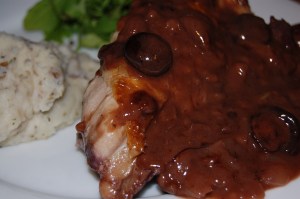
Simple Coq au Vin

Coq au vin is a fantastic dish to make for company.  For one thing, it’s easy and you don’t need to pay all that much attention to it – leaving you more time with your guests.  For another thing, it sounds fancy because it’s French.  Coq au vin is a traditional French dish of chicken braised in red wine (or Riesling, for a fun Alsatian variation).  It is a wonderful, warming, rustic and filling dinner – one of my favorite things to eat in the fall and winter.  Because of the intense flavor of the sauce and the braised chicken, it is also a good meal to prepare for someone who is cutting back on their salt intake.  I recently served coq au vin to several of my family members, including one person who is on a low-sodium diet.  Most dishes are bland and boring without salt, so I turned to coq au vin as a dish that packs enough flavor to make salt almost superfluous – and it worked!  The salt-free coq au vin was so flavorful that the whole family ate the dish without salt and didn’t miss a thing.  Cooking salt-free can be a challenge, but if you keep a recipe for coq au vin in your back pocket, you’ll never be short on flavor.

Coq au Vin

3 tablespoons extra-virgin olive oil
1 chicken, cut into 6-8 pieces
kosher salt (optional) and pepper
2 pints cremini or baby bella mushrooms
3 carrots, cut thinly into rounds
20 pearl onions
1 clove garlic, minced
1 750-ml bottle red wine (Burgundy or American Pinot Noir)
1 cup low-sodium chicken broth
1 bay leaf
2 sprigs fresh thyme (optional)
3 tablespoons flour

  • In a large French oven over medium-high heat, warm olive oil until shimmering.  Season chicken pieces with salt (if using) and pepper, then brown both sides in the oil.  Remove chicken to a paper towel-lined dish.
  • Add mushrooms, carrots, onions and garlic to pot and saute until golden and beginning to soften.  Add half the bottle of wine and cook over high heat for 8-10 minutes.
  • Return the chicken to the pot.  Add the remaining wine, broth and herbs and allow mixture to come to a boil.  Reduce heat to a simmer, cover, and allow to cook for 45 minutes.
  • Remove bay leaf and thyme sprigs.  Transfer chicken and vegetables to a serving bowl, using a slotted spoon.  Add 3 tablespoons of flour.  Return mixture to a boil and whisk frequently until sauce thickens slightly.  Pour sauce over chicken and vegetables and serve.

Source: Adapted from Epicurious.com.

Yield: Serves 6.

How To Make A Cheese Board

Ah, the cheese board.  Star of the after-dinner hour.  Hero of the wine-and-cheese party.  (Oh, who am I kidding?  Beer me some Pinot.)  No, but really… the cheese board has its place.  After dinner, served in place of dessert, it’s the height of sophistication.  As much as I love to bake and serve people desserts, a cheese board can be a wonderful change of pace.  When hubby and I were traveling in California this fall, we had some fantastic cheese boards that highlighted the best local cheeses, as well as some exotic choices.  I came home itching to make my own cheese board.  It’s actually very easy, if you follow a few simple guidelines…

First, you need cheese.  Obviously.  A cheese board without cheese would be… well… kind of a non-starter.  (Nothing against my vegan friends.  But it’s true.)  I like to serve at least three cheeses on a cheese board, and I generally stick with the following ratio: one hard, one soft, one blue.  If you have an extra-large cheese board, you can feel free to add on as you desire, but one hard, one soft, one blue is a good rule to follow for a fairly universally-pleasing cheese board.  Above, I’ve chosen a Cabot cloth-aged cheddar (hard), a Hudson Valley camembert (soft), and a milder French blue (blue, duh).  If  I had the space or the crowd to feed, I might have added a creamy goat cheese (sans herbs, please – it’s dessert) or a cave-aged gruyere, or perhaps a smoked gouda.  However, you need at least one hard, one soft, one blue.

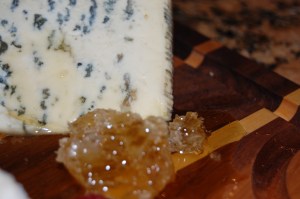
With the blue cheese, I love to add honeycomb.  I always keep some honeycomb in my pantry, for just this purpose.  The sweetness of the honey counteracts the pungency of the cheese, which hubby really appreciates.  Together, the two flavors are perfection.

I always add a few extras to fill out the cheese board.  To this cheese board, I added half of a small date-and-walnut loaf, a handful of dried black mission figs, and a pile of fresh raspberries.  When you’re shopping for your cheese board, pick out your cheeses first and then think about how the flavors will interact with each other.  The dates and the figs both went equally well with the camembert and the cheddar.  You need some extras for visual interest – to break up the cheeses – and for flavor complexity.  For dessert cheese boards, I like to add dried fruits; for appetizer cheese boards, I pile up olives, a variety of crackers, and cherry tomatoes.  Last but not least, whether this is dessert or hors d’ouvres, you’ll need of bread or crackers to serve with the cheeses.

Oh, and wine.  You can’t forget the wine.

Citrus Roasted Brussels Sprouts

I can practically hear you screaming now.  “NOOOOOOOO!!!!!!  Mommmmmmm!!!!!  No brussels sprouts!  No, no, NOOOOOO!!!!!”

Well, save me the drama.  Sure, they’re good for you.  Cry me a river.  The fact of the matter is, brussels sprouts are good.  No, better than good – they’re delicious.  Of course, I think all vegetables are delicious (except okra… I’ve tried, but I can’t, I just can’t).  But brussels sprouts are one of my favorite vegetables.  Carrots?  Yes, please.  Squash?  Mmmm, indeed I will.  Broccoli?  Load ’em up.  Brussels sprouts?  GIMME!  Because I love brussels sprouts so much, I have taken it upon myself to change people’s minds about them.  It’s my mission in life.  Because most people, ya know, HATE them.  They are the butt of every Thanksgiving joke.  They’ve even made an appearance on “Friends” as “Monica’s stinky brussels sprouts.”  Well, I’m sick of it.  Enough with the smelly gym socks references!  Brussels sprouts don’t deserve the reputation they seem to have acquired.  So I’m here to make the case for brussels sprouts, and this is it: Roast them.  Roast them now.  If you are one of the multitudes who hate brussels sprouts, it’s because you haven’t had them like this.  So go roast them, then eat them, then apologize to all brussels sprouts you have scorned over the years.  Your Honor, the defense rests.

Okay, I’m being a little bit quippy here, but it’s true: there are ways to screw up brussels sprouts.  In fact, it’s pretty easy to screw them up, and when you do, they’re the definition of gross.  For instance, boiling brussels sprouts, to put it mildly, does not show these vegetables off to their best advantage.  They are actually very versatile and tasty, but people insist on boiling them.  Don’t!  Put the saucepan down and back away from the stove!  Roast them like this, or shred and saute them with a tiny bit of creme fraiche and bacon, or steam them and dress them with a tart vinaigrette.  But don’t boil them.  (And if you disregard this advice, don’t come crying to me about gym socks, ‘cuz I don’t want to hear it.)  Brussels sprouts are wonderful many ways, it’s true, but I think they’re at their best when roasted.  The outer leaves caramelize and become crispy and salty and savory, and the inside leaves take on the wonderful, nutty character that you will NEVER achieve by boiling.  And then when you hit them with some lemon juice and zest, man, oh man, they are amazing.  Brussels sprouts will change your life.

Citrus Roasted Brussels Sprouts

2 cups brussels sprouts, stems trimmed, outer leaves removed
1 lemon, zested and zest reserved
1/4 cup extra-virgin olive oil
kosher salt
fresh black pepper

  • Preheat oven to 450 degrees Fahrenheit.
  • Clean and trim brussels sprouts: slice off the bottom of the sprout (the woody, tough part) and remove any outer leaves that have become tough and/or yellow and/or wilted.  Cut sprouts in half and rinse under running water.
  • Place brussels sprouts halves in a large bowl and dress with olive oil and a generous seasoning of kosher salt and fresh-ground pepper.  Zest a lemon, reserving half of the zest.  Add the remaining half of the zest to the brussels sprouts mixture.  Roll the lemon to distribute the juices, then slice in half.  Squeeze the juice of half the lemon over the sprouts, reserving the second half for later.
  • Roast for 45-50 minutes, tossing once or twice.  Remove from oven and transfer to serving bowl.  Squeeze the second lemon half over the sprouts, and sprinkle the remaining zest over the top.
  • Change minds, change lives.

Source: Adapted from The Barefoot Contessa Cookbook