Sweet Potato Biscuits

I don’t really know anything about horse racing.  I grew up not far from Saratoga Springs, NY, and we used to go to the track from time to time during racing season.  I never won anything.  (My refined technique of picking the prettiest horse never worked.  I wonder why?)  These days, I am one of the millions of people who only tune into the racing world on Derby Day, or for the Belmont if there is a chance that a horse might win the Triple Crown.  I know who Calvin Borel is, but he’s the only jockey I can name.  It’s safe to say that horse racing is not my sport – although I do love the hats, the roses and the green grass at Churchill Downs.  But if you want to hear me talk intelligently about a sport, ask me about ice hockey, not horse racing.

One thing I do know about, though, is baking.  Different people may disagree on what is necessary for Derby Day.  Some can’t do without Derby Pie; some think the day is incomplete without spiced pecans.  (I think we’d all agree on Mint Juleps, though.)  I personally must have sweet potato biscuits.  You can make these all year ’round, although I think they would also do very nicely for a Southern Thanksgiving celebration.  But I need them on Derby Day.

Sweet Potato Biscuits

2 cups all-purpose flour
4 tablespoons baking soda
1/2 teaspoon kosher salt
6 tablespoons Earth Balance (or butter)
1 can sweet potatoes in syrup
1/2 cup soymilk (or buttermilk)

  • Preheat oven to 375 degrees Fahrenheit.
  • In a large mixing bowl, whisk together the flour, baking powder and salt.  Add the Earth Balance (it must be cold) and “cut it in” using a pastry cutter or two knives.  Work the Earth Balance until the pieces are the size of small peas.  Set aside.
  • Drain the canned sweet potatoes, but not too enthusiastically.  (A little syrup left really adds to the flavor!)  Mash with a fork.  Mix in the soymilk and stir until the soymilk and sweet potatoes are smooth.  Add wet ingredients to dry and mix with hands until dough comes together in a rough/sticky ball.
  • Roll dough or simply pat it into a disk of about 1 inch height.  (It’s so soft that you don’t really need a rolling pin unless, say, you have a lavender silicone French rolling pin that is super cute and you love to use it…)  Using a round biscuit cutter or a small glass (I went with a cordial glass I had lying around, because I actually don’t have a biscuit cutter) cut rounds and place on a silicone- or parchment-lined baking sheet.  Pat the dough scraps back into another disk and continue cutting biscuits and reshaping dough until all the dough is used up.
  • Bake for 15-20 minutes.  Allow to cool slightly and serve with…

Maple Butter

1/2 cup Earth Balance, softened or spreadable
2-3 tablespoons maple syrup

  • Using a fork, mix the Earth Balance vigorously with the maple syrup until they form a whipped consistency.  Serve in a cute bowl alongside the biscuits.

Source: Adapted from TheKitchn

Psst!  I have a secret for you – these biscuits and the maple “butter” are completely vegan!  You can always make them non-vegan by using butter instead of Earth Balance and buttermilk instead of soymilk, but I really encourage you to try the vegan version.  No one will ever guess that they are vegan – and they will be amazed when you tell them.

Cucumber Coolers

If I ever decide to open a spa (instead of a wine bar like I’m currently planning), I’m going to serve these Cucumber Coolers to my clients.  They look and taste like refreshing cocktails, but there’s nothing in them except for whole fruits and veg.  Crisp and clean – does it get better than that?

Cucumber Coolers

1 cup water
1/2 cup mint leaves, packed
1 apple, peeled
1 English cucumber, cut into large chunks
juice of 1/2 to 1 lemon (to taste)
1 cup ice

  • Combine all ingredients, in the above order and starting with the juice of just 1/2 lemon, in VitaMix or ohter high speed blender.  Process until smooth.  Taste and decide if you need to add more lemon juice.  Serve garnished with cucumber rounds.

Source: Covered In Flour

Potato-Leek Frittata

It took me awhile to come around to frittatas, but I have to admit: they might be the perfect brunch food.  They are savory and flavorful at their best, accommodate endless variations, and are delicious at every temperature.  This is the quintessential spring frittata: potatoes, leeks, and well-seasoned eggs that come together in a dish where the whole is greater than the sum of its parts.  It’s easy, fairly quick, and practically a guaranteed crowd-pleaser.  What better dish to serve on a lazy Sunday morning in spring?

Potato-Leek Frittata

1 tablespoon extra virgin olive oil
1 leek, cleaned and sliced (white and light green parts only)
2 russet potatoes, cleaned and thinly sliced
6 eggs
2 tablespoons skim milk
pinch salt and pepper
minced chives or freeze-dried chives (optional)

  • Preheat oven to 350 degrees Fahrenheit.
  • Heat olive oil in a nonstick pan.  Add leeks and season with salt.  Saute until leeks are beginning to soften.
  • Arrange potato slices over leeks in concentric circles.
  • Meanwhile, beat together eggs, milk, salt and pepper.  Pour egg mixture over potatoes and jiggle pan until egg mixture fills in all crevices.  Cook until sides are just beginning to set.  Transfer to oven.
  • Bake 30 minutes.  Remove from oven and allow to cool slightly.  Remove to a serving platter and garnish with chives if desired.  Serve hot, at room temperature, or cool.

Source: Covered In Flour

Books for the Veg-Curious

When I told you all about my vegetarian journey, I teased that I had spent a lot of time reading books (both nutrition books and cookbooks) that helped me along the way.  I thought you might want to know which books I found to be particularly useful or interesting.  There are other vegetarian booklists floating around the Internetz and mine is pretty similar to those, but that’s because these books are good.  I refer back to them regularly, to clarify a point or to help me stay motivated, and of course I’ve got my nose in these cookbooks on a weekly basis.

Nota Baker: For clarification purposes, none of these books were given to me for free (except for one that was a birthday gift from my lovely mother-in-law, who is not affiliated with anyone in the publishing world).  I paid for each of them with my own money and I’m recommending them because I like them.  Also, I am linking to Amazon for convenience, but I am not an Amazon affiliate, I don’t care if you order from Amazon or by clicking the link I give you, and I think it would be pretty rock ‘n roll if you supported your local bookstore if you feel like purchasing a book on my list (or any other book for that matter).

Vegetarian Nutrition and Ethics

The China Study by Dr. T. Colin Campbell: This granddaddy of vegetarian nutrition books was the first book I picked up when I was considering trying a vegetarian diet, and it was nothing if not eye-opening.  Dr. Campbell, a respected researcher (and Cornell professor emeritus, Go Big Red!) shares his magnum opus, a study of the occurrence of Western diseases in numerous Chinese rural counties.  What Dr. Campbell discovered was that Western diseases such as cancer, heart disease, diabetes, obesity and many more were all but nonexistent in the rural parts of China where people ate almost no animal products.  Chinese-Americans, who shared the genetic makeup of the subjects of the China Study, showed no such results, indicating that the prevalence of these diseases is attributable to lifestyle (and specifically to the Standard American Diet) to a large degree.  Dr. Campbell also showed, in lab animal experiments, that it was possible to “turn off cancer” by removing animal proteins from the diet.  He devoted entire chapters to discussion of the effects of diet on many “diseases of affluence” and also described his experience with big government and NGOs, which (needless to say) were not happy to see the results of his research.  It was a fascinating book, and I’m not just saying that because this research was done at my beloved alma mater.  I learned a lot about what the Standard American Diet does to our bodies (and I even read somewhere that it was The China Study that convinced Bob Harper to go vegan… not sure if that’s true, but I think it’s awesome that Bob is out there waving the veggie banner no matter what his reasons!).

Thrive by Brendan Brazier: This is the book that proves that vegans can be just as strong and bad@$$ as omnivores!  Brendan Brazier is a vegan and a professional Ironman – how awesome is that?  Brendan went vegan when he discovered that a vegan diet dramatically reduced his recovery time, allowing him to get in more workouts and improve his racing performance; today he’s the mastermind behind the Vega nutrition line.  Oh, and he’s not some stereotypical jock – this is a smart, well-researched, thoughtful book about the effects of a plant-based lifestyle on athletic performance.  Now, I’m no elite athlete – I love to run and ride my bike, but I’m not going to be winning any races – but I was interested in Brendan’s book because I wanted to learn how I could utilize my diet to give me more energy to do my normal daily activities.  Happily, Thrive can help there too.  It was from Brendan that I first grasped the concept of alkaline v. acidifying diets and understood why that was important.  He also includes some cool recipes for homemade energy and recovery drinks.

Crazy Sexy Diet by Kris Carr: Here is the new kid on the block.  Crazy Sexy Diet just came out in January and I was so excited when it finally ended up on my doorstep.  (I had to wait awhile, because it actually SOLD OUT on Amazon!)  Crazy Sexy Diet includes a lot of information about alkalizing diets that I remembered from Thrive, and it also discusses the benefits of juicing and eating a high raw diet (salad, YUM!), plus chapters on natural beauty care, stress relief, and so much more.  It’s truly a book about how to be your best self.  Kris is like your chatty girlfriend or big sister throughout, ready to guide you to a place of peace, love and veggies.  (You may know Kris’s name from her Crazy Sexy Cancer documentary and books, and while she shares a little about how changing her lifestyle helped her to rebound from a devastating cancer diagnosis and regain her health, this book is more a book for everyone, about how to prevent these diseases before they happen.)

Eating Animals by Jonathan Safran Foer: The lone vegetarian ethics book I purchased for my library, Eating Animals is about Jonathan Safran Foer’s inner exploration of the cultural reasons why we eat meat, in the face of impending parenthood.  He describes his own experience with on-again, off-again vegetarianism, discusses America’s meat-eating history, explains the environmental and public health ramifications of our addiction to meat, and even reports from deep inside a slaughterhouse.  It also includes interviews with everyone from PETA activists to beef ranchers who are trying to raise their meat humanely.  Parts of this book are extremely disturbing – the slaughterhouse scene especially was not for the faint of heart.  But it was worth reading for me and it definitely inspired me.  The book ends, not with an exhortation to the reader to become vegan because it’s the only ethical way to live, but simply with a plea to live more mindfully and to really think about our food choices.

Vegetarian and Vegan Cookbooks

How To Cook Everything Vegetarian by Mark Bittman: This tome has it all.  Bittman includes hundreds of (delicious) vegetarian and vegan recipes, of course, but what I found most helpful was the introductory sections in each chapter, which explained generally how to cook different, maybe unfamiliar, vegetarian ingredients.  I owe my love of tempeh to Bittman.  And I fed his crispy tempeh to two hungry boys (the hubs and his buddy) over spaghetti and marinara sauce, and ended up with two very happy, well-fed video-game-playing machines.  But don’t just get it for the tempeh recipes.  As I am trying to branch into cooking more dried beans and legumes, I’m finding Bittman is always there with ratios and suggestions for me.  Love that guy!

Veganomicon by Isa Chanda Moskowitz and Terry Hope Romero: Yum.  Yum yum yum yum yum.  Isa and Terry, the rock ‘n roll geniuses behind The Post Punk Kitchen, present a cookbook full of vegan comfort food.  This is where Tempeh Shepherdess Pie comes from.  Their recipes are warming to the tummy and the soul and they’ve been a fixture in my kitchen all winter.  I even whipped up a Veganomicon casserole for my firm’s Thanksgiving lunch (this one) and had to come home with the very bad news for hubby that it was All Gone.  These recipes are that good.

Eat, Drink & Be Vegan by Dreena Burton: Dreena Burton is a Vegan Goddess.  Her recipes are foolproof and family friendly.  I can see them being the perfect vegan recipes to serve in a house with kiddos – they are simple and nutritious but also yummy and fun.  So far, everything I’ve made from ED&BV has been a hit with the hubs, but pasta with Dreena’s “Hide The Lentils Sauce” has become a particular favorite in our house.  We have it several times a month.  In fact, I have some sauce leftover in the fridge right now…

Love Soup by Anna Thomas: Although all of the books above are good, I’ve saved for last the one that is nearest and dearest my heart.  Anna Thomas is the fairy godmother of vegetarian cooking, if you ask me.  Back in the 1970s, Anna was fed up with the bland and boring vegetarian options she was eating, so she blessed the world with The Vegetarian Epicure, a book for vegetarians who want to eat food that tastes like food.  Love Soup is her newest effort, a book entirely devoted to soups and stews and their accompaniments (there are a couple of bread, salad and dip recipes in there to round out your soup feasts, but they are not the focus of the book).  The recipes are all vegetarian and mostly vegan (and even the non-vegan ones are easily veganified).  I love soup and Anna’s are fantastic.  I know, I know, a book about soup?  But it works.

These are not the only vegetarian books and cookbooks in my library, but they are the ones I enjoy the most and learn the most from.  Of course, I’m never done learning, so if you have great recommendations, please send them my way!

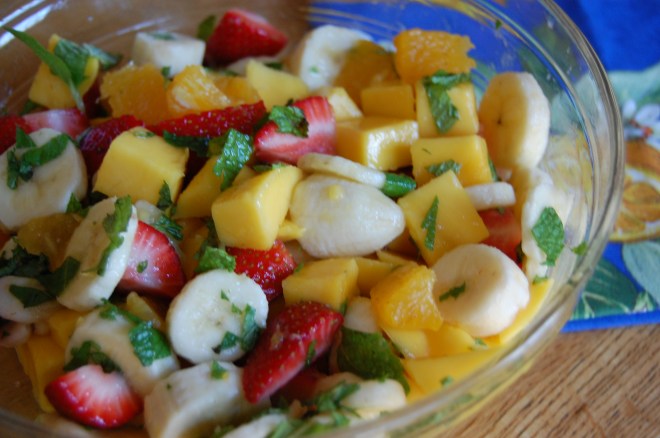
Minted Fruit Salad

Fruit salad is one of my favorite foods.  Growing up, it always seemed like a special treat to have fresh fruit salad.  Now that I’m an adult (according to the government, anyway), I get to have fruit salad whenever I want… and I want a LOT of fruit salad.  Several mornings a week, I’ll throw together a quickie fruit salad from whatever fresh fruit I happen to have on hand and take it to work to eat for breakfast at my desk.  But this isn’t your run-of-the-mill weekday fruit salad, although it’s almost as easy.  The addition of mint and fresh orange juice really take this salad to the next level and make it perfect for a fresh dessert or celebratory brunch… or even for any spring weekend when you just feel like having something extra special.

Minted Fruit Salad

2 mangoes
2 oranges
1 cup quartered strawberries
2 bananas
1/2 cup mint, roughly chopped

  • Peel and cut mango as follows: slice the cheeks off, being careful not to cut into the pit.  Score into the mango cheeks in a grid.  Pop mango cheeks inside out and carefully cut the pieces out, creating cubes.  Add to mixing bowl.  Repeat with second mango.
  • Segment an orange: cut the tops and bottoms off, then slice the peel off between the pith and the flesh.  Cut between the membranes and pop out orange segments.  Cut each segment in half and add to mixing bowl.  Squeeze the juice from the membranes over the mango and orange segments.  Repeat with second orange.
  • Slice two bananas and add to mixing bowl, along with strawberries and mint.  Carefully toss all together.

Nota Baker: You don’t have to use the fruit I suggested above.  If you happen to have something else knocking around your produce drawer, or you see a particularly good-looking pineapple at the market, by all means, use that.  Just make sure you invite me over to enjoy it with you!

Source: Covered In Flour

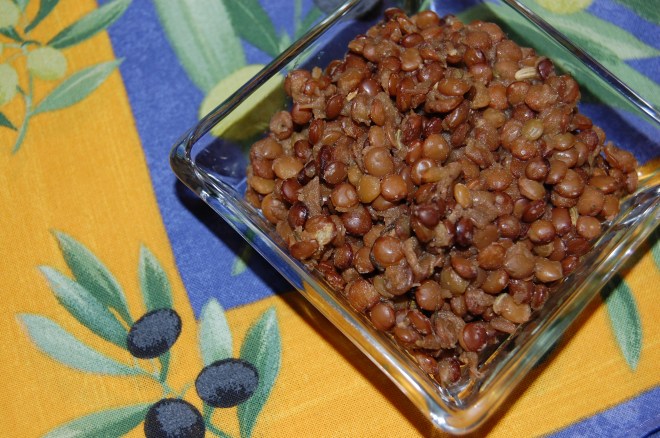
Provencal Lentils

Obviously I loved every place that hubby and I visited in France, but I have to admit that I have a soft spot for Provence.  I’ve wanted to visit Provence since I was a little girl.  I papered the inside of my closet door with pictures of Europe, which seemed to be disproportionately pictures of Provence (although there were a good number of Alpine villages thrown in there too) and I would stare at the pictures every day and dream of visiting them in person.  When hubby and I finally made that trip last fall, Provence was everything I imagined it to be and more.  I loved the hot sun, the lush grapevines, the sleepy hill towns, the bustling markets, the towering Pont du Gard and the spires of the Palais des Papes in Avignon, and the relaxed outdoor cafes where – even if it’s not on the menu – you can always get pastis.  And of course, I loved the flavors of Provence – the tomato-pepper-eggplant trio that makes up ratatouille, the briny olive taste of pistou (I even had a risotto that seemed to have olive tapenade mixed in – outrageous – note to self: must recreate) and the quintessential herbs de Provence, naturally.

With these lentils, I am putting a Provencal twist on a very simple, rustic dish (which is kind of Provencal in and of itself, if you think about it).  If you’re simply going to cook up a pot of lentils – and why not? – herbs de Provence impart a heady lavender and thyme flavor.  And I went one better than that, even, by adding a teaspoon of fennel seed to give a whiff of the licorice aroma of pastis. In one bite of these lentils, I felt as though I had stopped by the Arles market to collect a big bunch of aromatic dried herbs and then sauntered into a corner cafe, sat down and requested pastis, sil vous plait.  Not a bad trip for a Friday night in my kitchen.

Provencal Lentils

1 cup Urban Garden mixed lentils (or brown lentils)
4 cups vegetable broth
1 teaspoon mustard powder
1 teaspoon Herbs de Provence (substitute thyme)
1/2 to 1 teaspoon whole fennel seeds

  • In a heavy pot, bring the lentils and the vegetable broth to a boil, reduce to simmer, and cover.  Allow lentils to cook for 45 minutes, stirring occasionally to keep from sticking to the bottom of the pot.  (Nota Baker: It’s really important that you use brown lentils here.  French green lentils take forever to cook – although you can use them if you have all day – and red lentils will break down into a delicious mush, which is great but not what we’re going for here.  The lentils I had were a mix of green, brown and red and so there were several textures represented.  That’s great, but if you can only use one, go for brown.)
  • Once the lentils have fully cooked (taste a small bite just to make sure) drain off the remainder of the vegetable broth – but don’t get too overenthusiastic with the draining; we want the lentils to be a little loose so some remaining broth is a good thing.
  • Return the lentils to the pot and stir in a teaspoon of mustard powder, a teaspoon of herbs de Provence (or you can substitute thyme if you don’t have herbs de Provence), and either 1/2 or 1 teaspoon of fennel seeds.  (I used a full teaspoon, which tasted fantastic to me, but hubby isn’t wild about the flavor of fennel seeds – he liked that it was in this dish but would have preferred it to be a little subtler.  So I’ll reduce it for his sake next time I make this, but if you like fennel seeds, then a full teaspoon will be very nice indeed.)
  • Season to taste with salt and pepper.  Serve over greens, buttered baguette slices, or simply in a bowl.  Yum.

Source: Covered In Flour

Go Veg for Earth Day!

Well, my lovely readers, it’s that time of year again… when we all turn our thoughts to the planet and how we can keep it clean and tidy for future generations.  That’s right, I’m talking about Earth Day.  I think it’s safe to say that the general consensus is that we only have this one planet to live on, and we haven’t been doing the best job of taking care of it.  Now, while April 22 isn’t the only day that we should all be “green,” I still love Earth Day and use it as an opportunity to examine my own habits and think about how I can do better in the future.  I’ve planted a garden, switched to using eco-friendly cleaning and personal care products almost exclusively, and committed to buying local and/or organic as much as possible.  These are all things that we can do day in, day out to keep our Mama Earth fresh.

But if you want to take it to another level, there’s one thing you can do that beats out almost any other personal action you can take to better the environment: eat less meat.  I’m not saying you have to go vegetarian or vegan (although it would be totally rock ‘n roll if you did), but even reducing your meat consumption just a little bit will have a huge impact.  Here are the facts:

  • One quarter of the Earth’s surface, one third of its arable land, is dedicated to livestock (that includes both the space the animals themselves take up, and the space devoted to growing their feed) (source).  That’s a lot of land that could be put to other uses – like growing grain and vegetable crops to feed the poorest and hungriest people in the world.
  • In 2009 Elke Stehfest, a Dutch scientist, reported to the Copenhagen Climate Congress that if people in Europe and the United States switched to a plant-based diet, they could free up an area of land equivalent to Russia and Canada combined, which could be replanted as forest (source).  Since we know that plants suck up carbon dioxide, that would have a huge impact in reducing emissions – representing up to a 70% decrease in climate change mitigation costs by 2050 (source).  However, Stehfest cautions that if we don’t change our eating habits, by 2050 we will have to cut our emissions by two-thirds, to the tune of some $40 trillion (source).
  • Cows emit methane gas, which is 23 times more powerful than carbon dioxide (source).  Experts disagree on what percentage of greenhouse gas emissions are attributable to animal agriculture, with Science Daily estimating that animal agriculture (including feed, production, and transport) accounts for 18% of our greenhouse gas emissions (source) and Worldwatch International placing its estimate at more than 50% (source).  One thing we can all agree on is that fewer factory farms = fewer emissions.
  • For every 1 kilogram (2.2 pounds) of beef, farmers must feed a cow 15 kilograms of grain (which requires energy-intensive fertilizer to grow) and 30 kilograms of forage (source).  45 kilograms of input for every 1 kilogram of output is about as inefficient a production as you can find.
  • The Natural Resources Defense Council has warned that factory farms are major polluters, producing massive levels of nitrates, a toxic substance that contaminates groundwater and has been linked to higher than average numbers of miscarriages and other health problems, in areas where wells are drawn nearby (source).  Cattle manure runoff is believed to cause E.coli (source) – gross!
  • Scientists at the prestigious Carnegie Mellon University calculated that the average American household emits 8.1 tons of carbon dioxide due to its meat consumption, but driving a car that gets 25 miles per gallon of gas, 12,000 miles a year (also the American average) yields only 4.4 tons of carbon dioxide (source).  So we are basically taxing the environment almost twice as much at dinner as we are on our commutes!
  • Many scientists regard avian influenza (the bird flu) as having been caused by pathogens related to changes in livestock feed (source and source).  The current practices of animal agriculture have frightening consequences for human health.  And I’m not even talking about the thousands of statistically significant correlations between animal protein consumption and “Western” diseases such as heart disease, diabetes, and cancer (source).

Now, while I think it would be awesome if everyone transitioned to a plant-based diet – I firmly believe that we would be healthier and so would our Earth – I’m a realist.  I know that there are those of you out there who love a burger or a roast chicken, and I don’t want to scare you away.  But please consider reducing your meat consumption, even just a little.  Meatless Mondays are a great place to start.  After all, even reducing your meat one day per week is better than doing nothing at all!  And heck, even Mario Batali is jumping on the Meatless Monday train!

So while I know that there are those of you out there who do like your meat, please consider trying replacing your meaty meals with some savory and Earth-friendly veg a few times a week.  You could make pizza Margherita at home, have lentils instead of meat in your Bolognese sauce, or whip up a savory tempeh hash or Shepherdess pie.  Look around my vegan and vegetarian archives or explore some of the other veggie blogs that are cooking up amazing meals on a daily basis.  Meatless meals are healthy and delicious, and even going meatless just once or a few times each week has a positive impact on the environment.  And if you want to dial it up and think about going completely veg, give me a shout – I’ll be happy to share my personal tips and thoughts with you.  The compassionate will inherit the Earth!

How will you celebrate Earth Day this year?

Mock Tuna Noodle Casserole

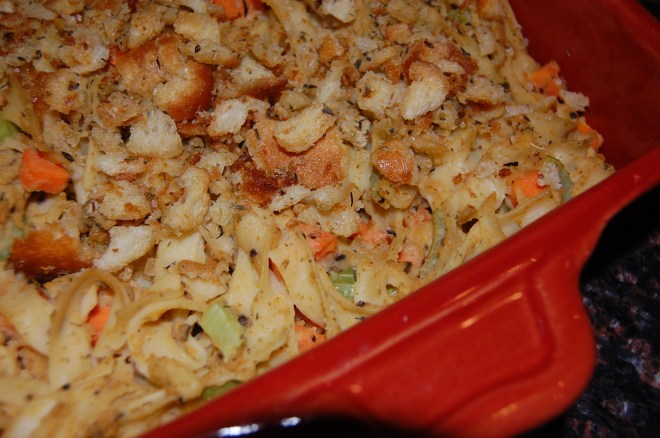
April in D.C. has been acting really weird. One day it will be 75 degrees and hubby and I are eating salads and popsicles.  Then the next day it’s rainy and 41.  This is that time of year when D.C. can’t make up its mind as to whether it wants to be grey and gloomy and cold, or sunny and beautiful.  We go through this every year, but this year it seems to be taking longer than usual.  By Easter we should have sorted ourselves out, but in the meantime comfort food is still called for.  And I know that it’s still cold up north where my family is… so this recipe is a gift for all of us.  It’s warm and soothing, briny and salty from the Chickpeas of the Sea, and even includes a crispy golden crust.  In short, Mock Tuna Noodle Casserole is the total package, perfectly designed for taking us out of the winter doldrums and into spring and summer.

Mock Tuna Noodle Casserole

6 ounces egg noodles (1/2 package)
1 cup Chickpeas of the Sea
1/2 cup Homemade Bread Crumbs (or substitute panko)
olive oil

  • Preheat oven to 350 degrees Fahrenheit.
  • Boil egg noodles in salted water, until al dente.  Remove noodles to a mixing bowl, reserving some of the pasta water.
  • Add Chickpeas of the Sea to the noodles and fold together gently.  Add pasta water, a little at a time, to loosen mixture as needed.
  • Remove noodles and Chickpeas of the Sea to a casserole dish.
  • Sprinkle bread crumbs in an even layer over the top of the casserole.  Drizzle with olive oil to ensure browning.
  • Bake at 350 for 3o-35 minutes, until top of casserole is golden brown and casserole is heated through.

Yield: Serves 4.

Source: Covered In Flour

Source: Covered in Flour.

Spring Green Soup

Spring is the most glorious season of the year in DC.  There are flowers, literally, everywhere.  For a few weeks, it seems like there isn’t a tree in the mid-Atlantic region that’s not in bloom.  Dogwood, cherry trees, and my favorite redbuds are on every street corner.  And then there are the fields of daffodils, the flowers blooming up and down every street in the city, and you should see my neighborhood – gardens in bloom everywhere.  It’s gorgeous.  I love it.

Unfortunately for me, spring in DC also brings epic amounts of pollen – obviously – and every year my body completely revolts.  I usually spend several weeks of the spring holed up indoors and even that isn’t enough to keep me from coming down with a miserable case of spring allergies.  In the worst years, I’m virtually unintelligable.  This year I thought I was getting off easy and I got cocky and went out for a run on Sunday morning.  I waited until the worst pollen time (5:00-10:00 a.m.) was over, but I was out the door at about 10:05 and apparently I didn’t wait long enough, because I am a mess now.  Yesterday I spent the entire day sneezing and rubbing my eyes.  Fortunately, my office is well acquainted with my allergy woes and they know I’m not contagious!  Still, by the end of the day I was a pretty unhappy girl and desperately in need of something soothing and nourishing.  I knew exactly what I wanted – green soup.  Between the leeks, potatoes and spinach, I enjoyed each and every nutrient.  Now, I’m not delusional – I know that green soup isn’t going to cure my allergies.  But it’s a nice way to celebrate the season while I stare wistfully at the gardens outside my window.  Here’s to a few days of low pollen counts…

Spring Green Soup

2 tablespoons olive oil
3 leeks, white and light green parts only, cleaned
3 potatoes, large-diced
kosher salt
5 cups water
1 tablespoon Better Than Bouillon vegetable base
4 large handfuls baby spinach
freshly ground pepper to taste

  • In a large cast iron pot, heat olive oil over medium-high.  Chop leeks and add to oil.  Season with a pinch of kosher salt and stir to coat with oil.  Allow leeks to cook down for about 5 minutes.
  • Add potatoes and season with another good pinch of kosher salt.  Stir potatoes and leeks together.
  • Add water and Better Than Bouillon and bring to a boil.  Cook for 20-25 minutes, until potatoes are fork tender.
  • Add spinach and stir into soup until spinach is wilted down.  Blend soup in a high speed blender or in the pot with an immersion blender until it reaches the consistency desired.  Season to taste with freshly ground black pepper.  Garnish with a drizzle of extra-virgin olive oil and serve immediately.

Source: Covered In Flour

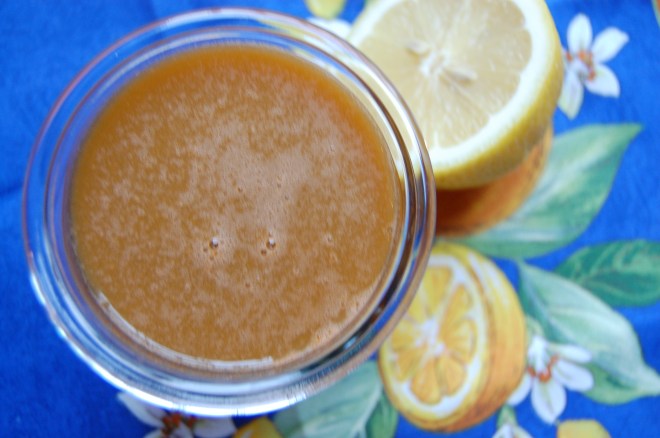
Carrot-Mint Juice

Confession time: I don’t like orange juice.  I’ll drink it on a very infrequent basis, when I’m really in the mood, but I am not the one throwing back a glass of Tropicana every morning.  For a long time, I was a “don’t drink your calories” person.  I stuck to water and tea (unsweetened) as my beverages on a daily basis, and wine for a treat.  I still don’t believe in drinking calories in the form of sugary soda, calorie-laden “coffee drinks,” cocktails (okay, I bend this rule occasionally) or sugar-bomb “juices.”

However… I have come to realize that there is a place for getting nutrients through liquids.  I’m talking about healthy whole-fruit smoothies (especially green smoothies) and fresh juices.  I recently got a VitaMix (cue angels singing) and I’ve been blending and juicing my veg-loving heart out.  Here is one of my first creations: a minty fresh carrot juice that’s full of fiber and Vitamin A goodness.  This is nothing but fruits and veggies, mint, and water.  No added sugar, nothing fake.  Just pure carroty goodness.

Carrot-Mint Juice

1 1/2 cups water
1/2 cup mint leaves, lightly packed
1 apple (such as Golden Delicious), quartered and cored
2-3 medium carrots, chopped into thirds
1 cup ice

  • Place all ingredients in VitaMix in the order they appear in ingredient list.  Start VitaMix on variable speed 1, raise quickly to 10, and then to high.  Blend on high for one minute or until desired consistency is reached.  Makes 3 cups.

Source: Adapted from VitaMix