Said at Starbucks

Jaclyn: “Hello!”
Starbucks employee: “Hot tea?”
Jaclyn: “Wow.  Yes, please!”
Starbucks employee: “Refresh?”
Jaclyn: “Actually, Awake, please.”
Starbucks employee: “Where do you work?”
{Starbucks employee #2 correctly names client I’m working for.}
Jaclyn: “I’m here a lot, huh?”

(Let it be noted for the record that I’m more of an indie coffeehouse girl.  But at present, Starbucks is my only option, and I’m finding it hilarious that they now recognize me.  And know what I’m going to order before I’ve even opened my mouth.)

Reading Round-Up: January 2012

Reading is my oldest and favorite hobby.  I literally can’t remember a time in my life when I didn’t love to curl up with a good book.  Here are my reads for January, 2012…

Arthur and George, by Julian Barnes – I plumbed this one from the depths of the TBR and really enjoyed the story of George Edalji, a half-Indian vicar’s son who is unjustly accused of mutilating cattle, and the champion he finds in Sir Arthur Conan Doyle.  It was especially cool to read, knowing that it was based on a true story.  The only thing I disliked was that the author kept switching tenses with no apparent rhyme or reason.  I still find it hard to believe that the author, editor and publisher would all have missed such an obvious mistake, so I’m thinking it’s me and I was too dense to understand the reasons behind it.  Otherwise, great writing and wonderful characters.

Morality for Beautiful Girls (No. 1 Ladies’ Detective Agency #3), by Alexander McCall Smith – Each book I read in the No. 1 Ladies’ Detective Agency series, I like better than the last.  This one in particular was a sweet, simple read but managed to pack in a fair amount of philosophizing about morality, African culture, depression, and other issues.  I’ll be continuing to read through this cozy mystery series for sure.

Haroun and the Sea of Stories, by Salman Rushdie – Another book that I had been meaning to read for quite some time and finally got to this month, I loved this gentle tale of a storyteller’s son trying to help his father gain his abilities back.  Although it was sweet and funny, Haroun also visited upon themes of environmental destruction and the power of language.  Loved.

The Weird Sisters, by Eleanor Brown – I enjoyed this story of three sisters who reunite at their family home to nurse their mother through a bout with cancer and, in the process, must learn to forgive old hurts and relate to one another as adults.  I was slightly bothered by the way the author lumped each sister into traditional birth-order stereotypes (there was the staid, responsible eldest, the “bad girl” middle child, and the flighty, volatile youngest), but I did like the writing.

The Coffins of Little Hope, by Timothy Schaffert – This one disappointed me.  It was well-written, but I simply didn’t find either the plot or the characters to be engaging.  I kept turning the pages, thinking “maybe in the next chapter something will really grab me in this story,” but it never happened.  I think my opinion is the minority though, so don’t let me dissuade you from reading it if you had Little Hope on your TBR.  It just didn’t quite hit home for me.

We, the Drowned, by Carston Jensen – This tome has already been praised as “an instant classic” in Europe and as the newest addition to the genre of great seafaring literature.  And although I don’t normally go in for sailor-lit (I’ve never read Moby-Dick and The Old Man and the Sea did nothing for me), I really enjoyed it.  Jensen doesn’t gloss over the harshness of the sailing life, or the atrocities of war.  From the very beginning, We, the Drowned was violent and dark.  But the writing was beautiful – couldn’t believe this was translated – and the characters were compelling.  I particularly loved Albert Madsen’s search for his father (except one scene which terrified this lepidopterophobe) and the relationship between the aging Albert and young Knud Erik Friis.

Maisie Dobbs (Maisie Dobbs #1), by Jacqueline Winspear – I’d been wanting to get into this mystery series for awhile and finally got around to checking the first book out of the library.  Maisie is a charming and vivid heroine.  A brilliant young woman who worked her way up from a housemaid’s position to Cambridge, she has set up a detective business with the help of her old mentor, Maurice Blanche, and has begun taking on cases.  But Maisie’s first case will require her to revisit her memories of nursing in the Great War – memories which she had long buried.  Maisie Dobbs was a charming and exciting mystery and I’m looking forward to reading the rest of the series.

The Dean’s December, by Saul Bellow – I chose The Dean’s December for my first entry in Beth Fish Reads‘ “What’s in a Name?” challenge.  It is the story of Albert Corde, Dean of Students at a Chicago university, and the mess he has made as he meddled in a murder trial and published an expose of the crime and corruption in the Chicago jails.  As the Dean’s mother-in-law lay dying in Rumania, he accompanied his wife to say goodbye and, during the interminable waiting that was part of life behind the Iron Curtain, reflected on the American psychology as he observed it in Chicago.  The Dean’s December was a difficult, challenging book, but rewarding if you could stand the graphic descriptions of violence.  I found myself glazing over during introspective passages, while reading over my lunch break in a particularly noisy place.  I was only able to really appreciate the great writing when I sat down with it for a quiet afternoon at home over the weekend.

Un Amico Italiano: Eat, Pray, Love in Rome, by Luca Spaghetti – Yes, he exists, and yes, that’s really his name.  I loved this cute memoir by Luca Spaghetti, best known as the ebullient Roman who shows Elizabeth Gilbert around during the Italy section of Eat, Pray, Love.  Luca loves soccer, American music, the Grand Canyon, and pasta (of course!).  He shares his incomparable love of life in this charming memoir, which left me yearning for un amico Italiano (an Italian friend) of my own.

WOW, what a January!  Is it just me, or did this month seem really long?  And how did I ever manage to cram in nine books – especially when you consider that We, the Drowned was 675 pages long?  I mean, sheesh.  I’m scratching my head about this one, really, because I also lost a lot of reading time this month due to the fact that I’m driving myself to work three days a week (I usually ride with hubby, which means I get to read while he drives).  I sort of feel like this month might have been two months, maybe I missed the January recap and it’s actually the end of February.  But my calendar says it’s January, so I suppose not.  Anywho, I had a great reading month.  I mixed up the reads, including some darker or more violent books than I would normally choose (We, the Drowned and The Dean’s December), and it was certainly interesting to read some different styles.  But I made sure to mix in plenty of fluff, including two cozy mysteries (one Precious Ramotswe and one Maisie Dobbs – and I started the second installment, so expect that in February’s round-up) and Luca Spaghetti, who had me running to the pantry for pasta and dreaming of Rome.  I have another gigantic stack of library books for February, and I’m hoping to mix in some comfort reading with the library books next month to ward off the chill.  So look for another long list at the end of February!

THE DEAN’S DECEMBER

 Albert Corde is not exactly a self-made man; he comes from a wealthy Chicago family – as his old friend, Dewey Spangler, couldn’t fail to notice, Corde’s father drove a Packard. But even if Corde isn’t a self-made man, he did make himself into a world-reknowned journalist. And then he unmade himself. Deciding he’d had enough of current events, he returned to Chicago and took on a position as a professor, and later Dean of Students, at a local university. He married a brilliant astronomer and settled down to further his education and live a quiet life.

But circumstances have a way of interrupting, and Corde eventually found himself at the center of two maelstroms, at least in part of his own creation. He wrote two articles for Harper’s on the racial politics that were destroying his city – the slums, the corruption, the hideously graphic violence of the Cook County Jail. His articles struck a nerve with the powers that be in Chicago government and at the university – and while no one could do anything to him, exactly, the atmosphere was tense. And on top of that, Corde became involved in the trial of a local ne’er-do-well for the slaying of a married graduate student at the university. Corde identified the body (as Dean of Students, it was his responsibility). He took the slain student’s stricken wife under his wing, offered a reward for information leading to the capture of the killers, and was a fixture at the trial. Corde’s involvement in the trial embarrassed the university – especially when circumstances (again, those darn circumstances) shook down such that the accused murderer was a friend of Corde’s nephew Mason (and Mason was himself given to threatening witnesses), and Corde’s cousin Max was the defense lawyer.

With all these tribulations at home, Corde’s mother-in-law is dying in Rumania. He accompanies his wife, Minna, to “the old country,” to bid farewell to her mother. Dr. Valeria Raresh was once a dedicated Communist Party member – but she, like Corde, has fallen from grace, having left the Party and sent her daughter to America. Now, as Valeria lies on her deathbed, the Party officials are determined to punish Minna for her emigration and her mother’s defection. Corde is helpless as he and Minna try to navigate the Rumanian beaurocracy and visit Valeria as she lies dying in the hospital. As he waits – oh, yes, there is interminable waiting involved in this process – Corde reflects on the mess he’s left behind in Chicago and on his own fall from grace.

The Dean’s December is not a plot-driven book, and neither are there particularly compelling characters. (I’d have liked to know more about Minna and Tanti Gigi, but Corde himself was not particularly sympathetic, nor were his friends and relations.) To appreciate The Dean’s December, you’ve got to appreciate the raw and wrenching writing. Saul Bellow’s prose is something like a punch in the face – sharp and surprising. But still, you can enjoy the writing if you make the mental space for it. I found that I was not liking The Dean’s December at all when I tried to read it in bits, here and there, during the cacophany of lunchtime at a client site. It was when I settled in for a weekend afternoon, in the silence of my house, that I was able to allow Bellow’s prose to really work its magic on me, and then I was amazed. I read a Goodreads review that said that The Dean’s December is a “quiet book,” and it was. It was quiet in that there wasn’t much action – or even, during certain chapters, much dialogue – it was reflective. And it was also quiet in that it demanded quiet, attention, focus, and only yielded up its considerable gifts when you were devoted to delving into the text and extracting them for yourself.

For example, here’s a passage I like, from when the Dean reflects on a visit he paid to a Public Defender in the course of researching his Harper’s articles:

Anguish beyond the bounds of human tolerance was not a subject a nice man like Mr. Varennes was ready for on an ordinary day. But I (damn!), starting to collect material for a review of life in my native city, and finding at once wounds, lesions, cancers, destructive fury, death, felt (and how quirkily) called upon for a special exertion – to interpret, to pity, to save! This was stupid. It was insane. But now the process was begun, how was I to stop it? I couldn’t stop it.

Zing. No, Corde couldn’t stop. He was compelled to go forward and tell the truth that no one really wanted to hear, and of course they didn’t like it once it was told. And as he sits in Minna’s old room in Rumania, reflecting on the strange conflict that he created, Corde is able to see Chicago’s psyche as America’s psyche, and to explain how different it is back home from the world behind the Iron Curtain:

“What was the lesson? Well, they set the pain level for you over here. The government has the power to set it. Everybody has to understand this monopoly and be prepared to accept it. At home, in the West, it’s different. America is never going to take an open position on the pain level, because it’s a pleasure society, a pleasure society which likes to think of itself as a tenderness society. A tender liberal society has to find soft ways to institutionalize harshness and smooth it over with progress, buoyancy. So that with us when people are merciless, when they kill, we explain that it’s because they’re disadvantaged, or have lead poisoning, or come from a backward section of the country, or need psychological treatment…”

The prose is really extraordinary. It’s harsh and terse and jumpy, but elegant. (And to read it, you have to have a certain tolerance for strong language and violence. It’s not my cup of tea, but I’m willing to trust an author as celebrated as Bellow. Just a warning to those who aren’t – steer clear.) One more passage I like, then I promise I’ll stop. When {spoiler alert, but it’s clear from the start that it was bound to happen} Valeria dies, her old friends come out of the woodwork for the funeral. And their presence is both a comfort and a rebuke to Minna, the one that got away:

They came… well, they had their reasons. They were there to signify, to testify. They came also to remind Minna of their existence. “Yes, we’re still here, in case you wondered, and we could tell you plenty. And your mother, she got you away, and it was one of her great successes. Good for you. And for her. Now it’s over for her, and soon for us, too. And this is what turns us out, in this gloom.”

No, The Dean’s December isn’t easy. It demands that you think, and check your expectations at the door, and read with care. I think it’s good to read difficult books. I don’t read them in succession, most of the time. But it helps to read a book that makes you struggle and work a little bit. If you’re willing to make the effort, The Dean’s December will deliver. Recommended.

I am submitting this post as my first entry in the “What’s In A Name?” blog challenge hosted by Beth Fish ReadsThe Dean’s December is submitted to the category “something on a calendar.”

The Dean’s December, by Saul Bellow (not an affiliate link)

(Image Source)

Reason #1,465,327 Why My City Rules

Special Saturday post because I’m excited about the news that came out last week – for the second year in a row, Washington, D.C. is officially ranked as the most literate city in the United States!  (Read the USA Today BookBuzz article here.)  The rankings are based on factors such as number of bookstores (and we have some awesome indies, like Kramerbooks and Politics & Prose), library resources, newspaper circulation and internet resources.

I love living in the D.C. metro area – I love the sunshine, the free museums, the great restaurants, music and theatre at the Kennedy Center, and this news just reinforces why I love this city so much.  No wonder I was drawn to D.C. – it’s a city of readers!

Dartmoor

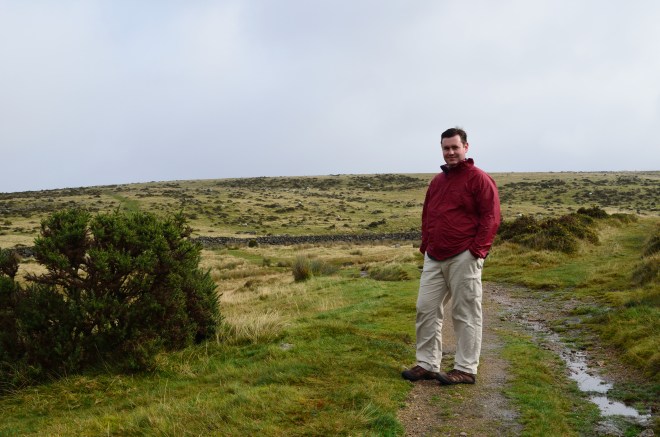
After leaving Salisbury, we headed for the West Country.  Our destination was Cornwall, but hubby had planned an overnight stop in the tiny village of Easton Cross and a hike in Dartmoor National Park on the way.  Our Dartmoor hike ended up being his favorite day of the trip.  The scenery was spectacular – even with England throwing heavy mist and gusting winds at us!

We parked at a little country inn (where we’d later return, chilled to the bone, to eat butternut squash soup, drink tea – me – or ale – hubby, and watch a pack of sheep attack the lawn furniture).  From there we headed just across the road to pick up the trailhead.  The tightly packed dirt path led up a slight incline through some scrubby bushes and out onto the moor itself.

Our first move was to take a wrong turn.  There were two paths – one leading uphill and one leading downhill.  The uphill path looked slightly more traveled, so we decided to take that route.  Wrong!  We ended up hiking far out of our way, up to a windy hilltop looking down at our final destination, to which we ended up bushwhacking across the moor.  But it was worth it – the views were fantastic.  Serendipity.

One thing that invariably amazes me about the British people is the way they enjoy their outdoor spaces no matter the weather.  Hiking (or “walking,” as many call it there – but make no mistake; it’s strenuous) is a national pastime.  I’ve remarked on this before, but I was astounded the first time I went out hiking on a rainy day in England.  I saw more people out on the trails on a relatively icky morning in Keswick than I saw on the most beautiful days in the U.S.  Many English people truly embrace the idea that “There is no bad weather – only bad clothing.”  Mist, wind, even rain – they just bundle up and go.  Don’t let these pictures fool you – Dartmoor was far from deserted, even on this chilly and relatively wet day.  There were several people out with their dogs and a few photographers with tripods set up in Wistman’s Wood.  I love it – I love seeing people outside, taking advantage of their natural surroundings no matter the weather.  This “can-do” spirit when it comes to outdoor activity is one of my absolute favorite things about England.

Our destination: Wistman’s Wood, a grove of stunted oak trees growing from a carpet of moss-covered rocks.  It was a unique ecosystem, but the proprietress of our B&B confessed she was disappointed to discover that the trees were about 10 feet tall.  Sure, 10 feet is mighty short for an oak, but she was expecting them to be knee-height.  A forest of Bonsai trees, if you will.  Which is a pretty intriguing thought, but we loved Wistman’s Wood just the same.

I’m guessing that fairies live here.  It just seems like that sort of place.  Thoughts?

View through the trees, out onto the moor – spectacular.  Well worth the gusts of wind and the driving mist!  I’m not aware of anyplace like Wistman’s Wood, anywhere else in the world.  It was truly a unique experience.

Stay tuned for next Friday’s post, when we head deeper into the West Country!

Easy Poached Eggs for Two Friends

I can still picture the kitchen where I believe I learned to cook.  Oh, I knew how to make a scant few dishes before I ever stepped foot there.  But it was in this small, warm kitchen that I acquired the confidence to just throw things at a pot and see what happens, and that, to me, is the essence of cooking.  It was in this kitchen that I broke free of my compulsion to slavishly follow a recipe and learned to approach dinner preparations with a freer, can-do attitude.  The kitchen belonged to a little house on College Avenue in Ithaca, New York.  You’d step in the front door, turn left, and there you were.  It was an eat-in kitchen, which I think was probably rare in our college student walk of life.  The range was in the corner, the sink nearby.  It was a small space, and the table and chairs took up most of the room.  Cozy.

It wasn’t my kitchen.  “My” kitchen wasn’t really my kitchen at all.  It was a few blocks uphill on the same street, on the third floor of an apartment building, sounds of the bar downstairs wafting their way through the open windows.  The kitchen in my apartment was the domain of C, one of my five roommates.  The rest of us used it as a cereal repository only, perhaps respecting C’s exclusive right to the kitchen since she made delicious things there and we did not.  Yes, I made spaghetti from time to time and fancied myself a chef because I seasoned the jarred marinara with garlic powder and dried oregano.  But I didn’t cook there.  No, I cooked in that other kitchen, down the hill, where eggplant slices sizzled in olive oil and coconut milk turned into sweet and spicy Thai soups thanks to the power of a confident imagination.  R’s imagination.

It was a thrill to grocery shop with her.  I couldn’t see the potential of a pile of spinach or a jar of miso, but she could.  And into the cart things would fly.  Then we’d load the spoils into R’s car, hope it wouldn’t start raining (the wipers were temperamental) and drive back uphill, back to Collegetown, serenaded by Snoop Dogg and Dr Dre.  We’d laugh and chatter as we made dinner in her kitchen – invariably something delicious that came from R’s head; I never saw her consult a cookbook in those days – and after dinner we’d curl up on the couch with glasses of wine and watch quality television such as “Married By America,” our favorite reality show.  (Anyone remember that gem?)  Those days were bittersweet.  We were seniors and going our separate ways soon.  R was bound for Africa with the Peace Corps.  I was headed to law school in Washington, D.C.  We would write letters, but I think we both realized that the days of spending every waking moment together, except for the couple of classes we took separately, were numbered.  I knew that soon I wouldn’t see R every morning as we walked up College Avenue together toward the main Cornell campus, that I wouldn’t stumble smack into her after Wines class, that we wouldn’t be able to cook dinner and watch bad TV together every night until 11:00 when I would finally wend my way home to my own apartment.    We had a brief few months left of freedom before our lives began, and those months were steeped in the scents of spices and sauces, and they played out to the sounds of sizzle and simmer.

R changed my relationship with food.  She made it something I thought about.  Whether it was Thai-inspired eggplant soup or the melting-hot tomato, cream cheese and muenster bagels we ordered at Collegetown Bagels (or CTB, as we called it), food was suddenly interesting.  It was something people talked about and created and enjoyed.  It was more than pretzels that you popped in your mouth during an all-nighter before an economics final or the pickles you snacked on because they were virtually calorie-free.  (Just me?)  Food was an experience.  Where before I hadn’t really given food a second thought, now I knew things about it.  I knew that you had to salt eggplant and then rinse it off, and I knew how it wrung out like a sponge when you squeezed it under the running water.  I knew that one bay leaf was plenty and you needed to pick it out of the sauce before you ate.   I knew that you could cook together and laugh and gossip and share a meal, and that a warm and spicy soup could leave an impression on your mind as well as your tongue.

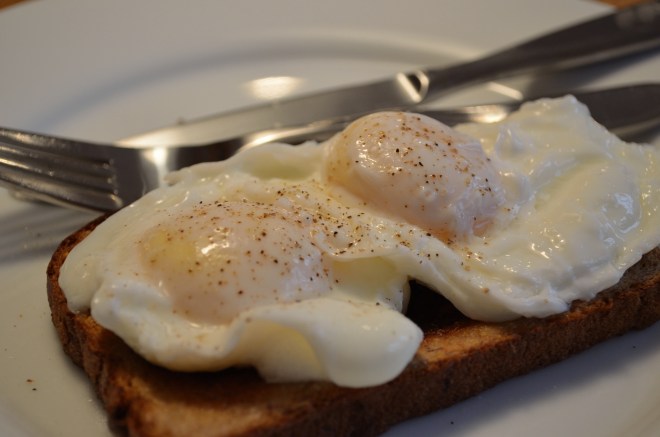
I knew these things because of R and I desperately wanted to give something back to her.  Finally, I got my chance when she asked me to show her how to make poached eggs.  Poached eggs were one of the few dishes that I could make when I started college, and they’ve always been my standby quick dinner or Sunday breakfast.  I learned to make them by watching my grandmother.  She made them simple, fuss-free; no swirling or fancy gadgets for her.  You slip the toast in the toaster slot, plop the eggs in the water and you’re halfway there.  Over the years I figured out that the eggs would come out perfectly if I followed a certain series of acts, and I felt as though I’d unlocked a great culinary secret.  No, my poached eggs aren’t pretty.  But they are good.  And I got to share them with R, and they became one of her go-to dishes, too.  After all that I learned from watching her, it’s the least I could do.

Easy Poached Eggs for Two Friends

4 eggs
2-4 slices bread*
butter or margarine
salt and pepper to taste

  • In a saucepot or saute pan, bring approximately 2 inches of water to just shy of a boil.
  • Place bread slices in toaster and set for medium.
  • Immediately upon putting in toast, crack the eggs directly into the water.
  • As soon as the toast pops, turn the water off and then butter the toast as fast as you can.  Take the eggs out and place them on the toast, 1-2 eggs per slice.  Season with salt and pepper and serve.

*Nota Baker: I used to eat 1 egg to 1 slice of toast but lately I’ve been putting 2 eggs on 1 slice of toast.  It cuts the carbs in half and hubby thinks that “the egg to toast ratio” is better.  ROTFL, as R and I would say.

Source: Messybaker’s grandmother

I, CLAUDIUS

I, Claudius is the fictionalized autobiography of Roman Emperor Tiberius Claudius, also known as Clau-Clau-Claudius, Claudius the Idiot, Claudius the Stammerer, That Claudius, and Poor Uncle Claudius.  Before he became Emperor, Claudius was a historian, and he records his family’s wild story in his autobiography.  And what a cast of characters – there is the Emperor Augustus, second husband of Claudius’s grandmother, the Lady Livia (deliciously evil, cunning and manipulative – I wondered if Lady Macbeth could trace her history back to Livia!), Claudius’s parents – descendants of Marc Antony – and his siblings, his courageous and kindhearted brother Germanicus and his malicious sister Livilla.  And there are a host of minor characters, each one perfectly drawn and amusing in his or her own way.

When the story begins, Livia has divorced her husband (Claudius’s grandfather) and married Augustus to help him rise to power.  Claudius’s father is a General leading Roman troops against the German barbarians, a role that Germanicus later takes on.  Livia schemes to remove all of Augustus’s potential heirs, by poison, intrigue or banishment, so that her own sons and grandsons will inherit the monarchy instead.  One by one, she dispatches with them until only her own line remains, taking out several of Claudius’s few friends, including his cousin Postumus.  Claudius himself manages to avoid the scourge not just because he is a member of Livia’s line, but because no one considers him a threat.  Born lame and painfully shy, Claudius is relentlessly mocked and despised by his own family for his limp and his stammer.  Only a few people – namely, Germanicus, Postumus and the tutor Athenodorus – have bothered to discover that Claudius is actually witty, intelligent and loyal.  Even Claudius’s own mother can’t stand him, and his grandmother Livia refuses to allow him to eat at her table (probably for the best, because people who ate at Livia’s table didn’t always survive the night).  That’s one dysfunctional family!

Precisely because Claudius is so despised, he manages to skate through three Imperial reigns – that of the bumbling Augustus, his paranoid uncle Tiberius, and his insane nephew Caligula.  I, Claudius is the story of how Claudius manages to fly under the radar long enough to survive three very bloody regimes and ultimately become Emperor of Rome himself.  The story was fantastic and the writing vivid and engaging.  I could picture the ancient Roman streets and see the characters walking in their processions or attending gladiator competitions.  Oh, and this book was funny.  I laughed during so many scenes – for instance, the moment when Claudius described his brother Germanicus’s ambush of some German tribes, surprising them at their beer, and then goes on to define “beer” and explain that the Germans drink it to “extraordinary excess” was simply hilarious.  The dry humor of the book definitely worked for me.  Altogether, such a fun read and highly recommended.

I, Claudius, by Robert Graves (not an affiliate link)

(Image Source)
TBR Insanity

Please, someone tell me that I’m not the only person who alleviates boredom by running through my “To Be Read” list… or gets inordinately excited about checking books off.  Seriously, any other booknerds out there?  Anyone?  Bueller?

In this digital age, my current TBR list resides, in part, on Goodreads… but the main list is on two sheets of lined paper that live in my purse, because I’m old school that way.  Here, in no particular order, are the books on my “main TBR” list.

THE NAME OF THE ROSE, by Umberto Eco
FOUCAULT’S PENDULUM, by Umberto Eco
BAUDOLINO, by Umberto Eco
FRENCH LESSONS, by Peter Mayle
THE PARTLY CLOUDY PATRIOT, by Sarah Vowell
CROME YELLOW, by Aldous Huxley
THE PHYSICK BOOK OF DELIVERANCE DANE, by Katherine Howe
PARROT AND OLIVIER IN AMERICA, by Peter Carey
AUNTS AREN’T GENTLEMEN, by P.G. Wodehouse
GREAT EXPECTATIONS, by Charles Dickens
A TALE OF TWO CITIES, by Charles Dickens
UNFAMILIAR FISHES, by Sarah Vowell
CUTTING FOR STONE, by Abraham Verghese
DOCTOR ZHIVAGO, by Boris Pasternak
EUGENE ONEGIN, by Alexander Pushkin
DEAD SOULS, by Nikolai Gogol (this would be a re-read)
THE HOBBIT, by J.R.R. Tolkein
THE DEAN’S DECEMBER, by Saul Bellow
MIDDLEMARCH, by George Eliot
LES LIASONS DANGEREUSES, by Choderlos de Laclos
THE DEVIL IN THE WHITE CITY, by Erik Larson
THE BOOK THIEF, by Marcus Zusak
A ROOM WITH A VIEW, by E.M. Forster
WHERE ANGELS FEAR TO TREAD, by E.M. Forster
DIMANCHE, by Irene Nemirovsky
YEAR OF WONDERS, by Geraldine Brooks
THE RAZOR’S EDGE, by W. Somerset Maugham
THE CANTERBURY TALES, by Geoffrey Chaucer
MIDDLESEX, by Jeffrey Eugenides
THE MARRIAGE PLOT, by Jeffrey Eugenides
SPEAK, MEMORY, by Vladimir Nabokov
LES MISERABLES, by Victor Hugo (another re-read)
THE GOOD EARTH, by Pearl S. Buck (another re-read)
VANITY FAIR, by William Makepeace Thackeray
TESS OF THE D’URBERVILLES, by Thomas Hardy (another re-read)
THE CAIRO TRILOGY, by Naguib Mahfouz
SWANN’S WAY, by Marcel Proust
BRIDGE OF SIGHS, by Richard Russo
THE FORGOTTEN GARDEN, by Kate Morton
TWELFTH NIGHT, by William Shakespeare
ALIAS GRACE, by Margaret Atwood
BRAVE NEW WORLD, by Aldous Huxley
PEYTON PLACE, by Grace Metalious
WE, THE DROWNED, by Carsten Jensen
THE INVISIBLE BRIDGE, by Julie Orringer
METAMORPHOSES, by Ovid
THE DIVINE COMEDY, by Dante
BLEAK HOUSE, by Charles Dickens
TOM JONES, by Henry Fielding

Ridiculous, no?  That’s not even counting the books I’ve checked off since putting this particular list on paper.  Eeks.  And, yeah, this list is fluid.  Things get checked off and added all the time – and my Goodreads list has selections that aren’t on here (and vice versa).  Oh, and I’ve been known to read books that don’t appear anywhere on either list, just on a whim.  Think I’ll be busy in 2012?

What’s on your TBR list?

Salisbury Cathedral

After visiting Avebury and Stonehenge (yes, on the same day; slow blogger, sorry), hubby and I drove over to Salisbury to visit the Cathedral.  Salisbury Cathedral came highly recommended by my father-in-law, who had visited on a choir tour and told us it was a can’t-miss destination.  Now, I won’t pretend to be an architecture buff (wish I was, but I have plenty of hobbies already), but I’ve visited my share of cathedrals – York Minster, Westminster Abbey, and St. Paul’s in England; Notre-Dame, St. Severin, Sainte-Chappelle and Sacre-Cour in France; St. John the Divine in New York and the National Cathedral in Washington, D.C., for instance.  (I think I also visited one or two cathedrals in Germany during my exchange student days, but I was sixteen and most of the pictures I took were of German boys.  Just telling it like it is.)  So, to the extent that I’ve seen a few cathedrals and therefore have some degree of credibility, I’ll tell you that Salisbury was one of my favorites.

The Cathedral was a short walk from the center of Salisbury, a lovely town in its own right.  Hubby and I split a pasty for lunch – which quickly became our go-to routine for mid-day – and ate it while walking through town to the Cathedral Green.  We took our time wandering around outside, admiring the graceful architecture and ornamental carvings.

The interior of the Cathedral was just as impressive as the exterior.  Intricate stained-glass windows lined every wall, from the nave to the side-chapels.  The stone ceilings defied gravity and soared – or so it seemed – up to Heaven itself.  And the side-chapels boasted old, faded, but still grand flags (one of my favorite things about English cathedrals; it seems I rarely find flags in other cathedrals).

We stopped into this small free-standing chapel on an assignment from my father-in-law.  Inside the chapel we found a decorated ceiling with a relief-carved pomegranate and apple motif.  The apple was the symbol of England’s King Henry VIII (he of six-wives fame).  The pomegranate was the symbol of his first wife, Queen Catherine of Aragon.  When Henry created the Church of England and divorced Catherine, he ordered her pomegranate symbols destroyed wherever they could be found – but somehow this one was missed.  Catherine of Aragon is a distant ancestor of hubby’s, so my father-in-law told us to keep an eye out for this special bit of family history.


Can you spot the pomegranates?  Salisbury Cathedral was a gorgeous place and a meaningful – if brief – stop on our southern England road trip!  I’m sure it’s one that we will want to re-visit in the future.

Stay tuned for the next stop on our southern England tour, coming up next Friday!

Thrifty Marketing Tips

Three months and change ago, I set a goal to save money at the grocery store.  I was tired of standing at the checkout counter, cringing at the bill.  I knew that there had to be a way to whittle down grocery costs without sacrificing the taste or quality of our meals.  Last week I recapped the results of my Thrifty Challenge – overall, success! – and promised to share some tips with you based on what I learned.  Some of these tips are common sense things that most people already know, but my experience with the Thrifty Challenge reinforced that they are really TRUE.

1. Make a LIST and check it twice!  The biggest thing that you can do for your grocery bills is to plan out your purchases for the week, and then stick to it.  Each week I sit down and create a menu before I go to the grocery store.  First, I look in my crisper drawer to see what perishable produce I still have on hand, and then I incorporate it into my planned meals for the week (trying to use up the older produce earlier in the week before it goes bad).  I then make a grocery list based on what items I know I will need based on my menu, always making sure to add things like fruit and lunch items for hubby and myself.  I go to the store with my list and a pen in hand, checking off each item as I go along and not deviating from the list.

2. Use coupons.  This is an area where I still need improvement!  There were a few weeks where I was really gung-ho, checking coupon blogs and websites, my grocery store’s website, and my favorite product pages for coupons and discount codes.  I then printed them off, cut them out, and kept them clipped to my grocery list.  The weeks that I did that bit of legwork (usually the morning of my grocery trip) I noticed some actual savings in my bill.  Oh, I wasn’t about to be featured on “Extreme Couponing” anytime soon, but a few dollars shaved off my bill made me very happy.  Of course, there’s an important caveat – don’t buy an item just because you have a coupon!  If you wouldn’t normally buy chips or cookies, then a coupon isn’t an excuse – it’s just a waste of money and calories.  I make a point of only using coupons for items that I would buy anyway.  That way I’m not being lulled into actually spending more money when my goal is to save, and I’m not blowing my calorie budget on processed foods that I wouldn’t otherwise consume.

3. Don’t shop hungry.  Another obvious one, but in my experience it’s really true.  If you go to the grocery store hungry, you’ll be tempted to throw all kinds of snacks and processed food into your cart.  Not only is the food you grab while shopping hungry generally less healthy than what you would put on your list, but it’s often more expensive too.  If you need to, have a small snack before shopping so that you’re not tempted to deviate from your healthy and thrifty meal plan.

4. Don’t over-plan.  It sounds counter-intuitive, but I find that making my menu and cooking schedule too rigid is actually bad for my budget.  If I plan 7 meals in a week – which I used to do – I invariably end up jettisoning one or two of them.  Maybe I get home late from work one evening and don’t have time to put together an elaborate dinner.  Maybe I decide I’m just really, really in the mood for scrambled eggs.  (That happens on a weekly basis.)  Maybe I forget to pull something out of the freezer, or hubby wants veggie burgers on the grill.  If I’ve planned and purchased the ingredients for seven dinners, and two or three don’t get made, the fresh stuff ends up going to waste.  But if I plan 4 or 5 dinners, I will usually end up making all of the planned meals; nothing gets edged out by egg or burger nights and no ingredients are wasted.

How do you save money at the market?