THE SNOW CHILD

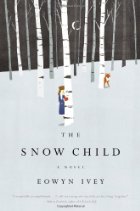
My first thought upon reading a few chapters of The Snow Child was: “This is like a depressing version of Little House in the Big Woods.”  But oh, it quickly became much more than that.  Jack and Mabel are an aging couple who have never been able to have children.  They moved to Alaska to escape the judging, pitying eyes of friends and relations who wonder why they have remained a family of two, and to be alone with their sadness.  But Jack and Mabel aren’t alone for long.  One night they build a little girl out of snow, and soon after, a real, live, flesh and blood little girl appears in their yard.  Faina, as they come to know her, is the orphaned daughter of a trapper, who flits through the forest, dancing atop the snow, killing small animals for her meals and migrating north when spring thaws the fertile Alaskan valleys.  At first Faina is afraid of Jack and Mabel, but they give her space and she gradually grows closer and closer to them, until they come to love her as a daughter and she to consider them her parents.  But Faina is growing up, and Jack and Mabel begin to dread the day when they will lose the only child they’ve ever had.

This book.  Was.  Incredible.  The language is so evocative, so transforming, that I felt as though I could see Faina’s tiny child-sized footprints in the crystalline Alaska snow.  I cried in the beginning, middle, and ends of this book – Jack and Mabel’s grief at not being able to have children of their own, their love for Faina, their struggles to survive in the wilderness of Alaska, their fear that Faina will melt away like the snow maiden in the old Russian fairy tale… are all portrayed with such realism, such sensitivity, that I was a weepy mess throughout the story.  But please, please don’t let that dissuade you from reading this wonderful sob-fest!  Pick it up for the quality of the writing alone, if for no other reason.  Pick it up so that you can feel rich soil and feathery snowflakes and cold Alaskan streams, even while all you’re holding is paper.  This book is destined to be a treasure of magical realism, maybe even a classic someday.  I for one will be waiting anxiously for Eowyn Ivey’s next book.

Read it: The Snow Child, by Eowyn Ivey (not an affiliate link)

(Image Source)

Some Thoughts On QUIET

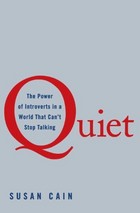
I’ve been looking forward to reading Quiet: The Power of Introverts in a World That Can’t Stop Talking since it was released.  But I had to wait awhile, because there was a looooooong holds queue at the library.  Apparently there are a lot of introverts in Fairfax County, and we all have library cards.

It took me a long time to recognize and embrace my introvert tendencies.  As the child of two very extroverted parents and the product of a school system that pushed group work and socialization, I got used to “faking extrovert” at a young age.  By the time I was in high school, I had completely internalized the “Must be bubbly and chatty!” compulsion, but it never stopped feeling like work.  Hard work.  Especially in college.  Every time I left a party early or skipped a social event to read, I mentally berated myself for being boring.

Still, I was shocked when I took the Myers-Briggs Type Indicator (for a class in college) and my results came back “INTJ.”  I had been faking extrovert for so long that I had even convinced myself that I was an extrovert – just a really, really bad one – so seeing that “I” for “Introvert” was a big surprise.  Even knowing that there was a reason I preferred books to keggers and downtime to party time, though, I still continued to push myself out the door to the frat parties.  I’m a slow learner, I guess.  It wasn’t until I started dating hubby – who is decidedly introverted – that I experienced the sweet, sweet relief of not having to force myself to loud parties every weekend.  We bonded over dinners out as a duo and long quiet hikes in the state park around our campus.  It was nice to finally feel like I could relax and stop trying so hard.

Of course, that didn’t mean that I completely embraced my introverted personality.  I went into law – a profession that would seem to attract introverts but requires a certain degree of extroversion if you want to build a client portfolio.  I’ve forced myself to get involved in community activities as part of my career-building efforts.  But networking and schmoozing do not come naturally to me.  My dad was shocked when I told him I hated networking.  “But you’re so good at it!” he said, shaking his head.  I explained that, yes, I am pretty good at networking – that’s the result of a LOT of hard work and practice and making myself do things (like attend big events) that don’t necessarily appeal to me and even stress me out.  (And I learned a technique that changed my networking life: zero in on the other uncomfortable-looking introvert standing in the corner and latch onto them.)  I won’t stop forcing myself to interact with people, but I don’t  expect it to ever come as easily to me as formulating an argument or a tackling a research problem does.

Quiet is a book for and about people like me.  It starts by explaining that our modern society is set up to reward extroverts.  From an early age, kids in school are socialized in the most extroverted ways possible.  Desks are arranged in pods, and group work is pushed at all education levels.  I always hated group work, mainly because I was usually the only one in the group actually doing any work.  My group government project in high school slapped me with a C because the teacher said it looked like it was done by one person.  It was: me.  In college, my International Human Resource Management professor assigned a group project but let me opt out and work alone… which led to an “A+++ I can’t believe you did this by yourself!!!” on my paper.  To which I said: it was easy when I didn’t have to pull three other people along with me.

Introverts are considered unappealingly shy, even anti-social, while extroverts are favored.  But introverts aren’t necessarily shy and anti-social – I don’t consider myself shy, although it takes me awhile to warm up to new people and I don’t care for large groups.  And while I might prefer a book to a big party, I’m not anti-social.  I have a group of close friends that I love spending time with, and I have a great marriage.  There’s NOTHING wrong with my personality.

Quiet goes on to discuss the biology of introversion, how introverts might train themselves to excel in the professional world, and how to love an introverted partner or raise an introverted child.  It’s a fascinating mix of social science, anecdotes, and encouragement for those of us who need our downtime more than most.  Some have criticized the book for being too “rah rah introverts!” but I say it’s about darn time someone cheered us.  We’re not all creepy loners.  Just because my perfect Friday night is a glass of wine and a book, or a quiet dinner with my husband, doesn’t make me weird at all.  It makes me… well, me.  It’s just who I am.

Read it: Quiet: The Power of Introverts in a World That Can’t Stop Talking, by Susan Cain (not an affiliate link)

(Image Source)

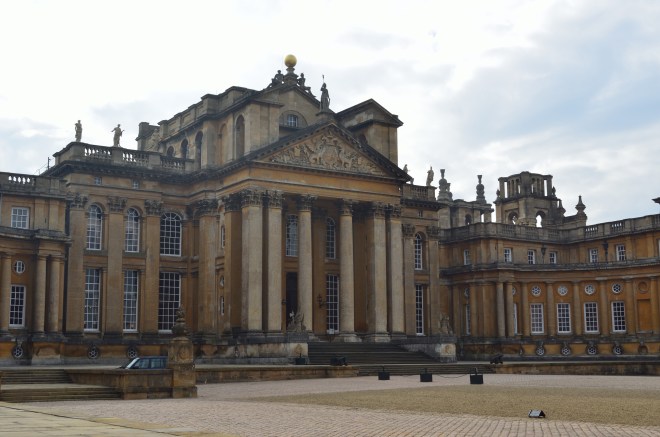
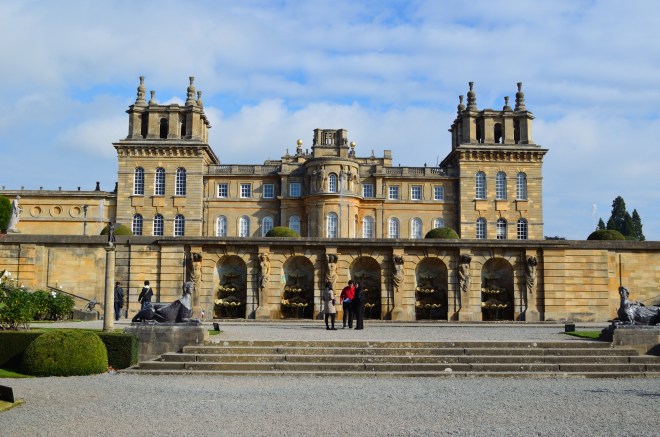
Blenheim Palace

During our stay in the Cotswolds, hubby and I knew we had to see Blenheim Palace.  Blenheim (which is pronounced Blen-um, and if you say it phonetically you’ll get laughed at) is the historic residence of the Dukes of Marlborough.  The current Duke and his family still keep it as a residence and are there from time to time.  There were family pictures scattered around the place and it had a lived-in feel that I loved.  Our last palace experience was Versailles, and I liked Blenheim much better.  Between the crowds and the ostentation of Versailles, I was practically sprinting to get on the next train back to Paris.  But we lingered at Blenheim, and I could have lingered even longer.

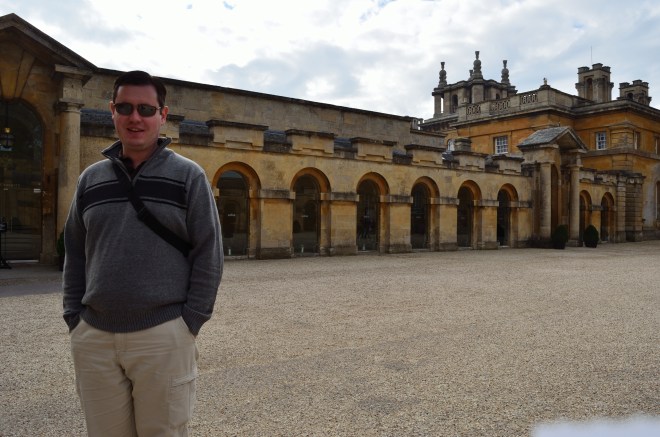
What is hubby doing here?  Assessing the real estate value?

The gardens were sumptuous but not overdone.  I could picture myself sitting out here with a book and a pot of tea, soaking up that golden Cotswold sunlight.

Blenheim also has historical significance as the birthplace of one of my favorite British historic figures: Winston Churchill.  The future Prime Minister, apparently a politician from a very early age, made his appearance while his mother was at a party here.  Churchill’s mum was closely related to the Duke of Marlborough and Churchill spent much of his childhood tooling around Blenheim.  He even chose the “Temple of Diana” in the gardens here to propose to his beloved wife Clementine.  One of Churchill’s hobbies was painting – he was actually really talented; there were a number of his pieces on display in the palace – and Blenheim landscapes were his favorite art subject.  The palace contained a few rooms devoted to a small Churchill museum with letters, photos and other memorabilia.  And – the best part for a booknerd like myself – the Duke has a copy of Churchill’s four-volume History of the English-Speaking Peoples, which I read a few years ago – in his library!  It’s fair to say I was in Churchill heaven.  Yes, I realize that I’m a nerd.  No, I don’t care.

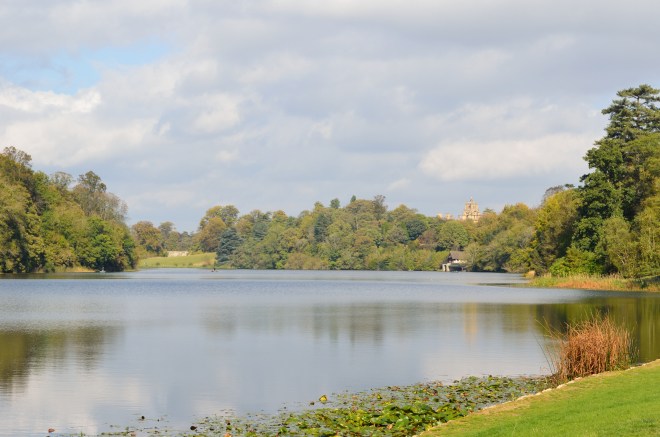
After touring the Palace and the formal gardens, hubby and I wandered through the surrounding parklands for awhile and happened on this serene little lake.  Even in October, the park was green and there were (a few) flowers in bloom.  Oh, yes, I could definitely stay here awhile.

But I didn’t stay!  We’re off on more Cotswold and Midland adventures next Friday, so check back then!

ELIZABETH I

Elizabeth I is the story of two red-haired women at the end of the sixteenth and beginning of the seventeenth century. One is Queen Elizabeth I, daughter of Henry VIII and Anne Boleyn, avowed virgin and monarch during what would come to be known as a golden age for Great Britain. Elizabeth’s story begins in 1588 with the first Spanish Armada. Throughout the book, her reign is plagued by threats both internal and external – scheming courtiers, Irish rebels, and the ever-present Spanish menace over all. The other woman is Elizabeth’s “lookalike cousin” and rival Lettice Knollys. Lettice, having made no vow to remain a virgin, had seduced and married Elizabeth’s romantic interest, Robert Dudley. For that crime she was banished from court – although Dudley was eventually forgiven – and has been spending the rest of her life plotting to get back in the Queen’s good graces. Lettice’s best hope for regaining her family’s power and influence lies with her son Robert, Earl of Essex, who becomes one of Elizabeth’s favorite courtiers. But Essex is a deeply flawed man – entitled, petulant, and ultimately dangerous – and Elizabeth’s consistent overlooking of his flaws will ultimately threaten her crown.

I had never read any Margaret George before, because I thought that she was fluffy. (I was lumping her in with Philippa Gregory and assuming that George wrote historical fiction in the style of The Other Boleyn Girl.) Clearly, I was wrong. Elizabeth I was absorbing and engaging, meticulously researched, and extremely well-written. Not fluffy at all! (Not that there’s anything wrong with fluff; it can be just what the doctor ordered at times. I just don’t like fluff in my historical fiction for some reason. Chalk it up to personal preference.) The characters become real – Elizabeth, for instance, is maddening in her insistence upon giving Essex chance after chance to live up to his potential, refusing to believe that this “wayward child” cannot be molded into a responsible man. Even after he directly threatens her person, Elizabeth refuses to believe that the courtier she loves like a son could be a threat to her. Her gradual dawning realization that Essex is a danger to the realm is almost painful to watch, and the moment when she finally gives up her hopes for him is poignant. Lettice, meanwhile, is even more conflicted over Essex. She sees the dangerous games he is playing, even as he tries to hide them from her, but she cannot turn her back on her son.

I loved every word of this honking big tome. In Elizabeth I, Margaret George proves that there is such a thing as a fastidiously detailed page-turner in the historical fiction genre. I’m a convert and will be reading everything she has written before this and everything she writes from now on. Highly recommended.

Elizabeth I, by Margaret George (not an affiliate link)

(Image Source)

THE DECAMERON

Giovanni Boccaccio’s Decameron is not a book that you can expect to dispatch with in a few days. (I’d say that’s fairly typical of medieval literature.) But it’s not a book you’ll get sick of, either. I read this book on a beach in Mexico, on the subway on my way to work, and everywhere in between, and was endlessly entertained the entire time.

The premise is this: at the time of the Black Plague, ten young Florentine nobles – seven women and three men – decide to escape the carnage and pandemonium of their city and retire to one of their pleasant country estates. Once there, in search of amusement, they decide to tell stories to one another. Each day, they gather in a garden to entertain each other. The book consists of the hundred stories they tell – ten stories per day for ten days, the Decameron. On some days they tell whatever story they think their companions will find most amusing; on other days they speak on a predetermined topic. The stories range from slapstick comedy to bawdy hijinks to cautionary tales.

A couple of notes: the book is very much a product of the times in which it was written. Many of the stories poke fun or censure at corrupt friars – Boccaccio seemed to have none too high an opinion of clergy in general. I’d also note that although Boccaccio was known by his contemporaries to be a defender (and admirer) of the ladies, the book does come off as quite misogynist at times, which would have irritated me profoundly if I didn’t keep in mind the times in which it was written. I definitely would encourage anyone who picks up The Decameron to read the introduction first (not the translator’s note). The version I had was introduced by G.H. McWilliam, who did a fantastic job at placing the book in the context of its times and explaining some of the inside jokes in the stories, which Boccaccio’s contemporaries would have understood at once but which can seem obtuse to the modern reader. It’s a long intro – about 100 pages – but the book will be that much more enjoyable for those who put the time in to read it.

Each story is entertaining and, on average, brief – so it’s a great book to pick up and put down at your leisure. It took me a few weeks to get through it, but I’m glad I did – both because Boccaccio influenced many writers who came along later, including Chaucer and Shakespeare, and because reading “The Decameron” was just an all around silly, racy, good time.

The Decameron, by Giovanni Boccacio (not an affiliate link)

(Image Source)

The Cotswolds

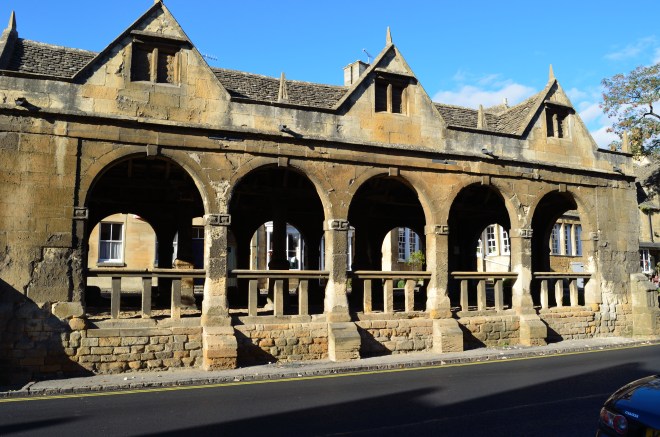
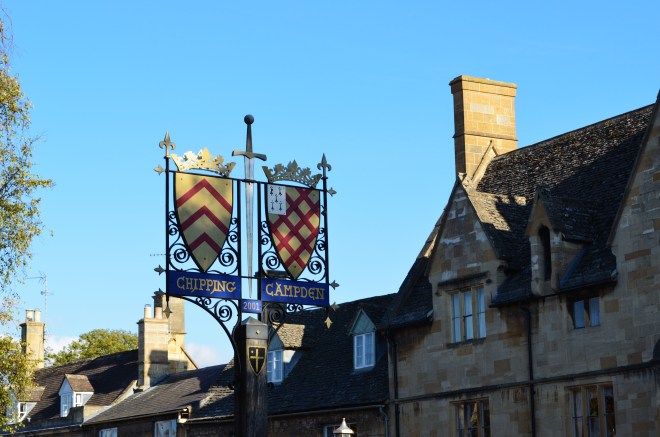
Welcome to the Cotswolds!  This is the quintessential England of rambling manor houses, sunny villages, and stone cottages with charmingly overgrown gardens.  This is storybook England.

We stayed in Stow-on-the-Wold and poked around there and the nearby village of Chipping Campden, which is as quintessential Cotswolds as they get.  And we were graced with cloudless skies, all the better to set off the golden Cotswold stone buildings.

Chipping Campden (town sign pictured above) was a prosperous town during the wool years.  In fact, wool money made the Cotswolds.  It built the houses, the gates, and the churches – which now shelter the remains of wool barons.  Even today, the fields surrounding the Cotswold villages are overrun with sheep.

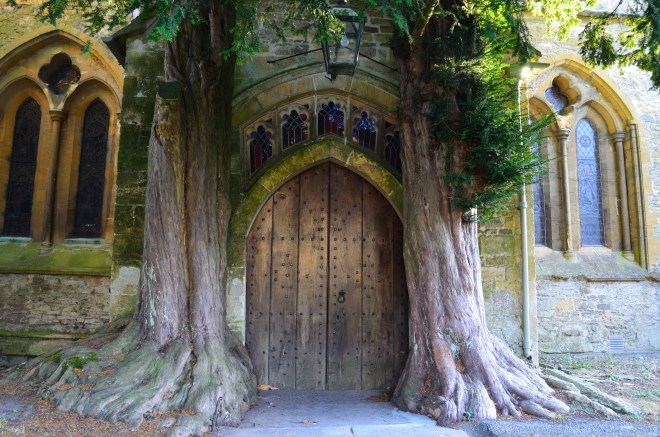
J.R.R. Tolkein famously hiked through the Cotswolds and sketched the sights, including this door (below), which inspired a drawing in his Lord of the Rings series.  (Which I haven’t read – sorry, Katie – but will get to eventually.  Really.)

I could easily picture myself settling into Cotswold village life, chatting with neighbors over a cup of tea and wandering over the footpaths on sunny afternoons.  We stayed a few days, and that wasn’t near enough time to absorb the quirky charm of the region.  This is going to have to be a repeat destination!

Next Friday we leave the village for a day and tour a palace!  Check back!

Strawberry-Almond Muffins

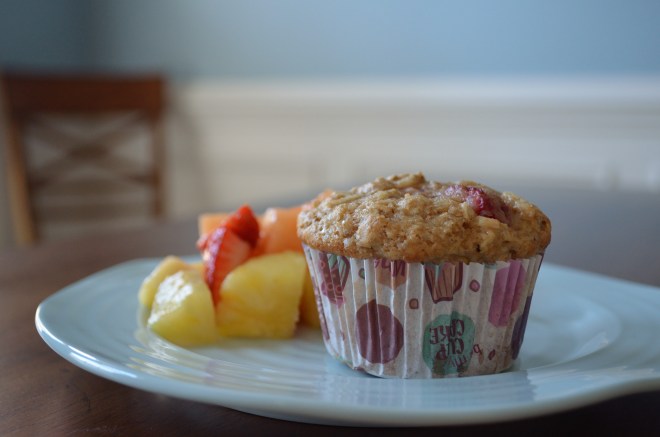
Hubby has this little habit of making suggestions.  Usually, his suggestions involve things that I should bake.  (This is clearly a strategy on his part – he knows he’ll get the baked goods when I pull them out.)  This past weekend, my mom, aunt and friend were visiting, and hubby suggested me right into baking muffins for them before they woke up on Sunday morning.  (I’m an early riser.)  I thought first of making a batch of banana muffins, but I had a beautiful box of strawberries in my fridge, and the end of a bag of sliced almonds, and strawberry almond muffins were born.  They were the perfect fuel for a day of walking the monuments on my girls’ weekend, but I’m sure they’d be perfect for lazier mornings too.  These muffins are officially in the rotation.

Strawberry Almond Muffins

1 cup rolled oats
1 cup all-purpose flour
1 cup whole wheat flour
3/4 cup sugar
1/2 teaspoon baking soda
2 teaspoons baking powder
1/4 teaspoon fine salt
3/4 cup milk
2 eggs
3/4 cup applesauce
2 teaspoons almond extract
1 1/2 cups large-diced strawberries*
1/2 cup sliced almonds

  • Preheat oven to 375 degrees Fahrenheit.
  • Prepare a muffin tin with 12 wells (line with paper liners or spray with baking spray such as Baker’s Joy or Pam for Baking).
  • In large bowl, whisk together oats, flours, sugar, baking soda, baking powder and salt.
  • Add milk, eggs, applesauce and almond extract and stir to combine well, but do not over-stir.
  • Fold in strawberries and almonds, just until combined.
  • Spoon into muffin wells and bake for 25 minutes, until a toothpick inserted in the middle comes out clean.  Serve warm.

*I used fresh strawberries.  To substitute frozen, just thaw and drain the strawberries so they are as dry as possible.  They will almost certainly still be wetter than fresh berries, so do use fresh if you can.  This winter, when fresh strawberries aren’t available, I’ll see about trying out the recipe with frozen berries and let you know if I have any tips.

Yield: 12 large muffins.

Source: Covered In Flour

Oh This Is Ladies’ Weekend

Living in a city like Washington, D.C., I sometimes have to pinch myself.  I have access to great restaurants, wonderful (mostly FREE) museums, and lovely scenery and weather practically all year long.  These days I’m too busy to take full advantage, but I’ve had days in the past where I nipped over to the National Gallery on my lunch hour, and I still get out for tasty lunches and dinners at my favorite restaurants.  And every so often I get lucky enough to play tourist in my own town and share my favorite places with visitors.  This past weekend was one of those weekends: my mom, my favorite aunt, and our close family friend visited for a ladies’ weekend.  And let me tell you, we did it up right.

There was food:

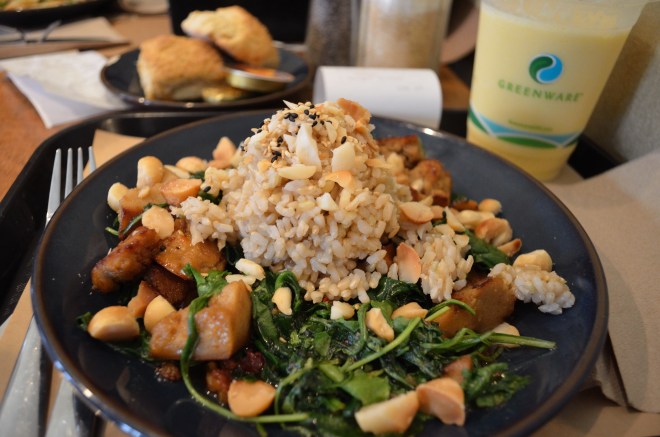
(Pictured: my lunch at Teaism, my old standby – seitan stir-fry, which is freaking delicious, and a mango lassi.  Unpictured: everybody else’s lunches at Teaism, which they said were delish – my mom had chicken curry, our friend had a salmon bento box, and darned if I can’t remember what my aunt had, but I know she loved it – our appetizer spread for dinner that night, our lunch at the American Indian Museum on Sunday, and our dinner of tilapia with brown-butter citrus sauce, roasted fennel and herbed orzo.  We were too busy eating to snap many pictures, sorry ’bout that.  It was all so stinking good.)

There were musums:

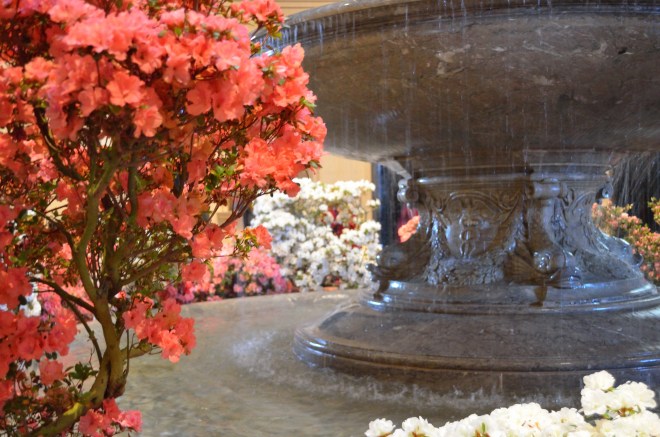
(That’s the atrium in the National Gallery, which is one of my favorite places in D.C.  We hit the old standards – the Impressionists and Ginevra de Benci, then moved on to the American History Museum and the First Ladies.)

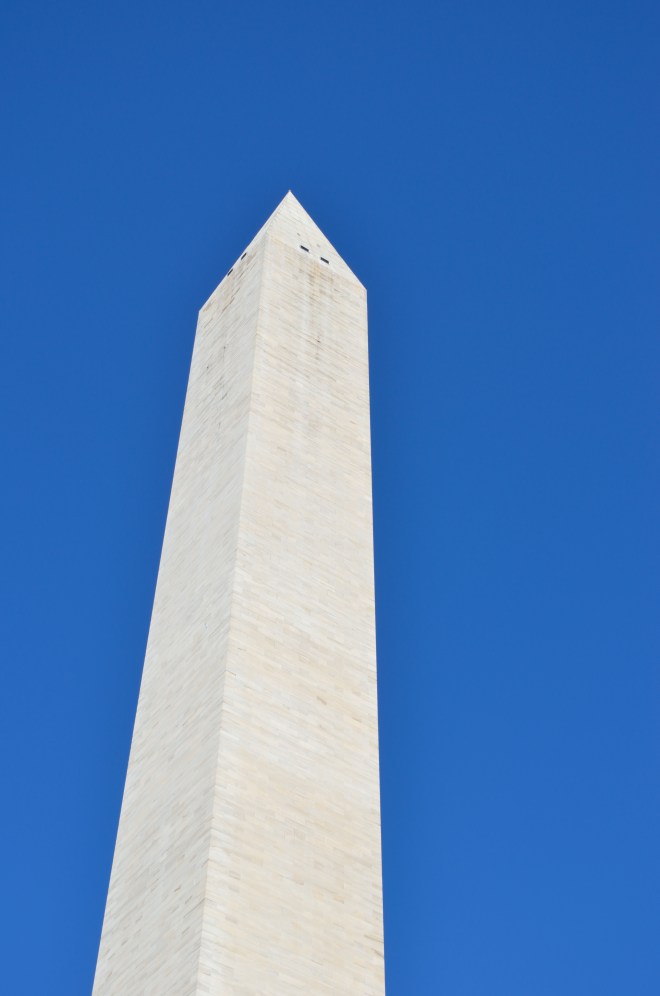
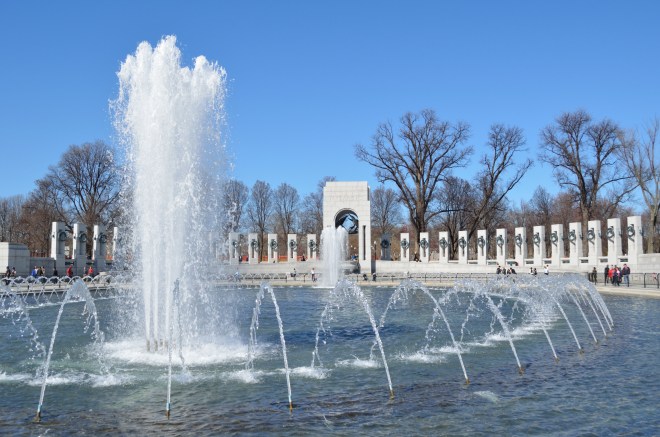
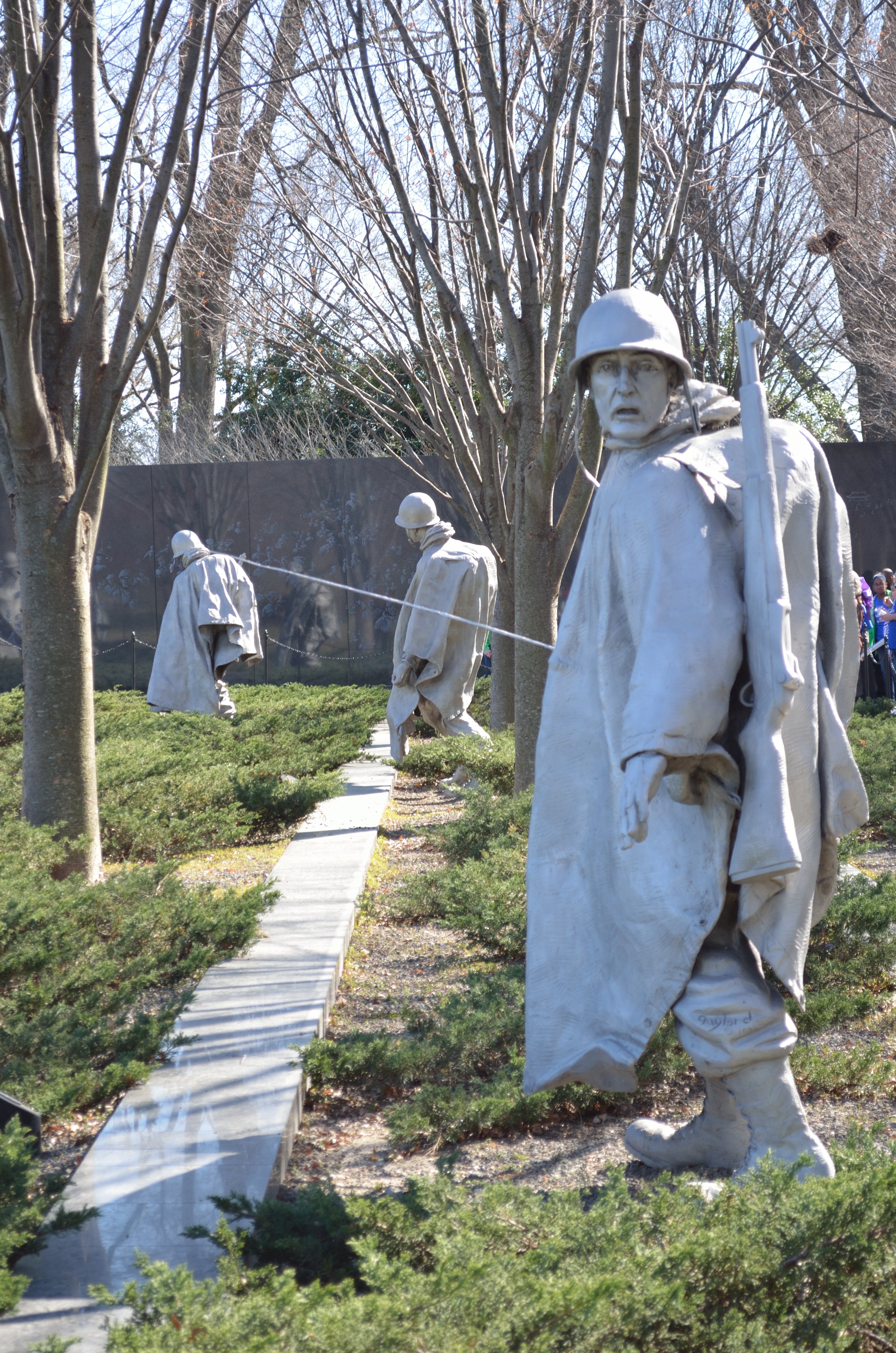
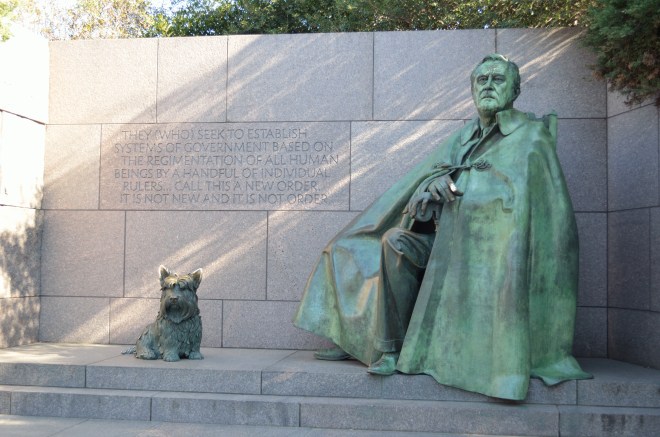
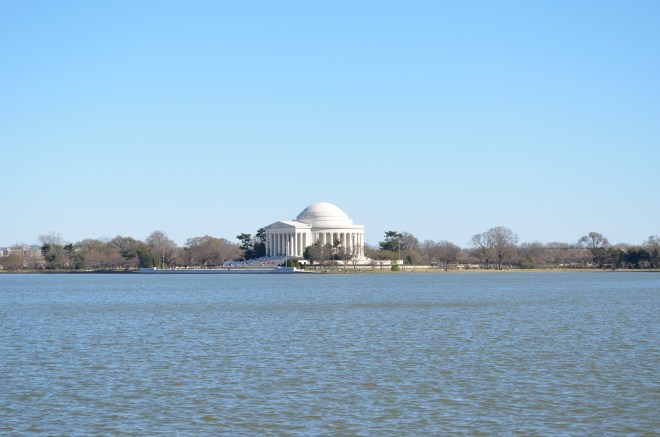
On Sunday we took a long walk through the monuments, which is something I don’t do nearly as often as I should.  Spectacular…

Washington Monument

World War II Memorial

Korean War Memorial

FDR Memorial (my favorite!)

And a view of the Jefferson.

Thanks for a lovely weekend, ladies!  Come again anytime!

Creative Consumption

Sometimes it seems like all we do is buy and consume, buy and consume.  We burn gas on our long, stressful commutes.  Pick up takeout for lunch and bolt it down at our desks while we stare at our preferred news outlet’s website.  Grab a pizza on the way home – more food that we took no part in creating – and spend the evening staring at the television, letting messages sink into our brain without any help or hindrance from us.  As the economy spirals further out of control and the world teeters on the brink of complete insanity every day – and the bad news, always the bad news – it’s easy to understand why people want to create things with their hands.

There has been a resurgence in handicraft.  DIY blogs are exploding in popularity as people look for ways to save money and create a personal space in their homes.  The popularity of crafts like knitting and of art like photography is soaring, and it seems everyone and their mom wants to grow a garden – wants to get their hands dirty and work the earth and nurture something that wouldn’t be there without them.  When you spend all day consuming, sometimes you just want to create.  You want to feel real and connected and grounded again, by using your hands as they were meant to be used.

There are plenty of ways that I can be creative.  I cook – healthy meals and snacks for hubby and myself – and bake yummy treats to fatten up hubby’s coworkers.  (I don’t think they mind.)  I write, both here and offline (in journals and other projects).  I do decorating projects at home, working on making personal space for hubby and me to unwind and relax.  And, although I don’t think I’ve mentioned it here before, I knit.  (I tend to run hot and cold on knitting and I usually lose focus before completing a project, which is why I don’t blog about my creations – they are usually unfinished and/or riddled with mistakes.)

Yet I also do plenty of consuming.  As a reader, I spend hours each week downloading messages from a printed page to my brain.  I don’t tend to be one for zoning in front of the television for large chunks of each evening, but that doesn’t mean I’m not taking in more information than I’m putting out.  I read, on average, two books each week.  I don’t write two books’ worth of blog posts each week, for sure.  I’m wordy – but not that wordy.  So my choice of consumption methods might be a little more old-school (flipping pages, rather than channels).  Does that make me any less of a consumer of information?  Well, no.

Still, I don’t feel that by reading as voraciously as I do, I’m sacrificing my place in the creative process.  After mulling it over, I’ve concluded that I view certain acts of consumption – like reading a book (which I didn’t write), listening to a song (which I didn’t record) or playing a piano sonata (which I didn’t compose) – as acts of creativity.  When I read a book, yes, I take in the messages that the author is attempting to convey; or at least I do if I’m reading closely.  But I don’t approach a book in a vacuum.  I bring my own perspectives to each reading experience.  I endow characters with personality points and physical traits that might not be written in black and white, but that come from my own experience and fit with the character as I have read him or her.  I relate to books in a way that is completely unique because it’s based on my own accumulated knowledge over 30 years.  You do the same thing, when you read.

You might read a book and have a completely different response than I would have, because we’re approaching the same book from different perspectives, different world-views.  And that is creative.  That is adding to the information out there in the world – especially when we talk about our perspectives.  But even if I don’t talk about a book – even if I just pause and think a new thought, and never voice it, that’s still creative.  That’s still a thought that wouldn’t have been thought if I hadn’t opened this particular book and applied my own personality and experience to the words inside.

It’s not just reading, either.  When you listen to a song (pop, classical, or otherwise) or look at a painting or photograph, your experience (your consumption) of that art is informed by your own experience and personality.  So you’re not the musician or the painter – you’re still part of the creative process; you’re the “appreciator.”  I simply can’t view myself or anyone else as dumb information receptacles.  My understanding and appreciation of a piece of art or music (whether I’m listening to or playing the music – it’s still someone else’s score) is unique to me.  Without me, it would be a different piece.

And that makes all the difference to me.  I can curl up with a book on my sofa and feel like I’m still creating something.  I may not be working with my hands, cooking or baking or gardening, but I’m still creating.  I’m creating feelings, experiences, and unique perspectives – me and my books.  Or music, or paintings, or what-have-you.  By reading/viewing/listening critically and thinking intelligently, by letting myself become emotionally involved in a plot or with a character, I am actively participating in the act of creating.

Do you view reading (or other information consumption) as a creative act?

Wales: Tintern Abbey and Abergavenny

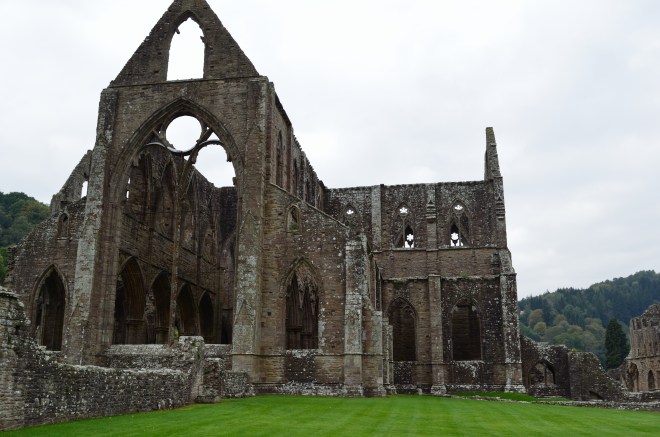
Although we stayed in England proper for most of our road trip, we did nip into Wales for a day trip on our way from Devon to the Cotswolds.  (I looked for Will and Kate, but didn’t see them.  Maybe next time.)  Our first destination was Tintern Abbey.

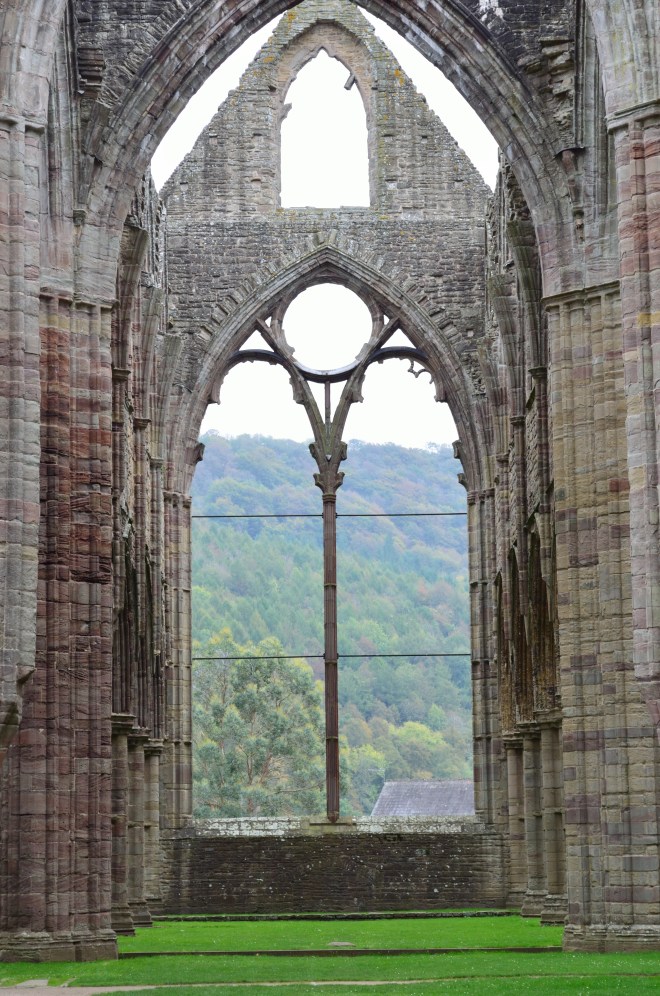
Tintern Abbey was stunningly beautiful.  There’s something about the carpet of emerald green grass below and the wide open sky above… I actually find these “ruined” abbeys more spiritual than most churches.  I got the shivers wandering up and down the nave, imagining what this place must have been like when it was in use.

To add to the mysterious vibe, there were white doves all over the place.  Check out this shot of one of the doves taking flight.  I’d think it was too perfect to be true, but I was there.  (Can’t take credit for the picture, though – that was all hubby.  He excels at capturing these wild moments.)

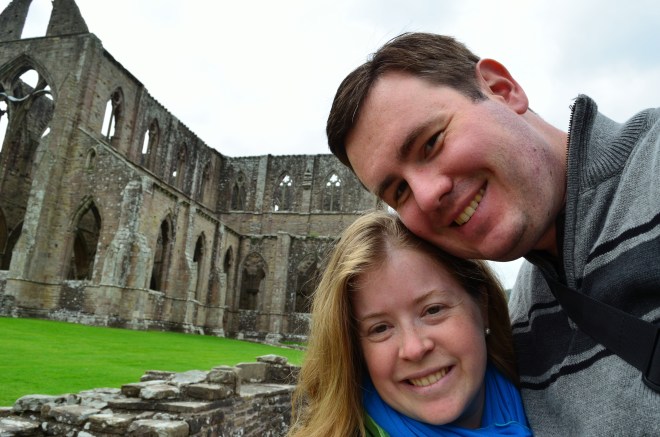
We wandered around the monastery compound, reading the placards that described what each foundation once was.  Here I am – I think – in the Abbot’s first house.  (Please excuse my hair.  I wore it down to keep my ears warm, but it was windy that day.)

If I should be where I no more can hear
Thy voice, nor catch from thy wild eyes these gleams
Of past existence–wilt thou then forget
That on the banks of this delightful stream
We stood together; and that I, so long
A worshipper of Nature, hither came
Unwearied in that service: rather say
With warmer love–oh! with far deeper zeal
Of holier love.  Nor wilt thou then forget
That after many wanderings, many years
Of absence, these steep woods and lofty cliffs,
And this green pastoral landscape, were to me
More dear, both for themselves and for thy sake!

William Wordsworth, from “Lines Composed A Few Miles Above Tintern Abbey”

After exploring every corner of Tintern Abbey, we headed to Abergavenny, for the next stop on hubby’s family reunion tour 2011.

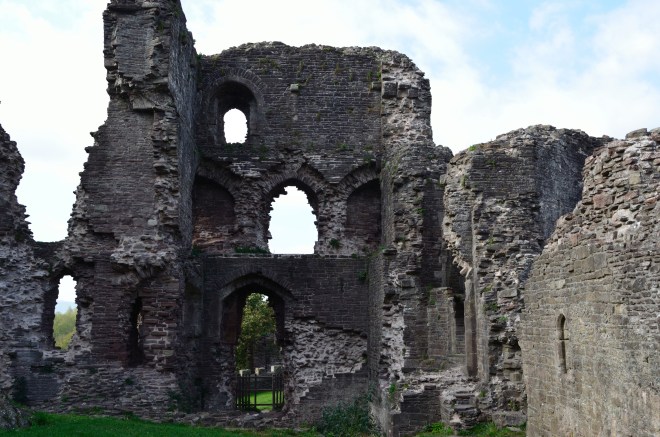
The main castle was built around the 1300s.  It was a smallish site, and interesting, but we had a different goal in mind.

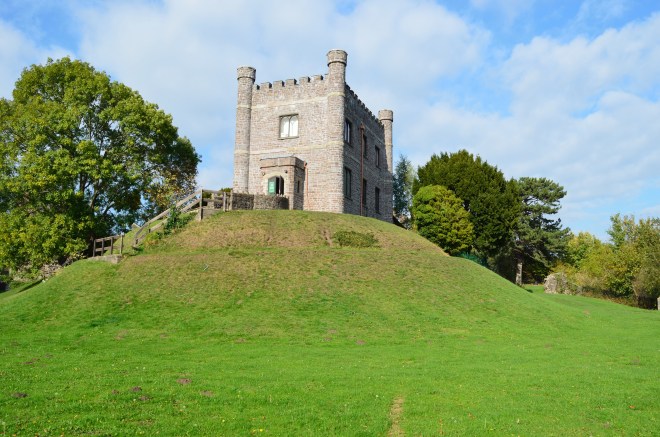
See this hill?  It’s actually a “motte,” or a defensive fortification, built during Norman times by Hamelin de Ballon, the first Baron Abergavenny and one of hubby’s ancestors.  Hamelin came over from France as part of the Norman invasion and settled in Wales at the behest of his “BFF” (father-in-law’s term, not mine), William the Conquerer, to provide a civilized place for the Norman kings and knights to hang up their armor and to keep the locals quiet.  The motte is original, although the Norman tower is long gone and replaced with this modern structure, which is now a pretty interesting local museum.  Hubby wanted to see this piece of family history, so we decided to swing by and see about retaking the family castle.

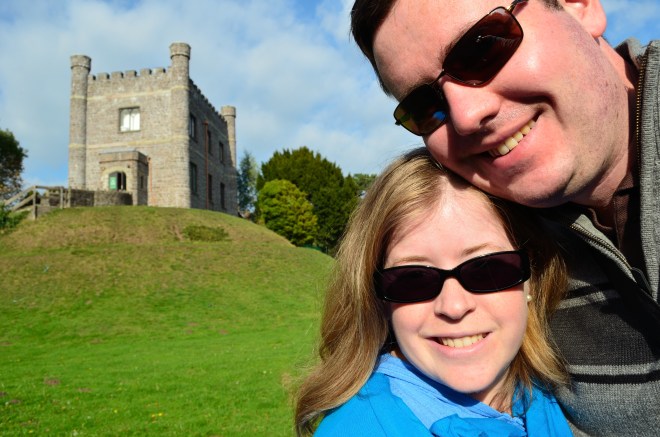
Unfortunately, hubby’s plan to “take back the family castle” didn’t quite go.  His problem is that he’s just too nice.  Dude couldn’t even chase the teenage girls away from racing up and down the motte.  Ah, well, we like our digs in northern Virginia too much to leave, anyway.  😉

Wales was a fantastic day-trip!  And stay tuned for next Friday, because I already spilled the beans about our next destination, if you were reading closely.  And if you weren’t, I’ll say it again here: we’re off to the Cotswolds!