Ending My Journey (For Now) With Mma Ramotswe

No 1 Ladies Detective Agency Books (Source)

Recently I wrapped up the thirteenth and final (for now) book in the No. 1 Ladies’ Detective Agency series, The Limpopo Academy of Private Detection and, in doing so, closed the book on a group of characters I’ve grown to love.  There’s Mma Precious Ramotswe, traditionally built lady, tea lover, and proprietress of the only private detective agency in Botswana.  Mma Grace Makutsi, her loyal (although sometimes a bit envious) secretary-turned-assistant-detective, and of course, Mma Makutsi’s pithy “talking” shoes.  Mr. J.L.B. Matekoni, the finest mechanic in Botswana, and Mma Ramotswe’s love interest.  And the side characters: Charlie and Fanwell, the two feckless apprentices serving under Mr. J.L.B. Matekoni; Mr. Phuti Radiphuti, Mma Makutsi’s love interest; the treacherous Violet Sephotho; sweet Motholeli and challenging Puso; mild Mr. Polopetsi; and of course, the indomitable Mma Potokwame.

The mysteries themselves are usually fairly mild, even a bit tepid – not nearly the intellectual puzzles expected from an Agatha Christie or Dorothy L. Sayers novel.  They’re background, more than anything else: they provide the stage on which the characters can act out their everyday dramas.  Indeed, the plots usually focus more on the lives of the characters, and their problems and encounters are far more interesting than the central mysteries.  When will Mma Ramotswe and Mr. J.L.B. Matekoni finally marry?  What about Mma Makutsi and Phuti Radiphuti?  Will Charlie ever show even the slightest bit of initiative – or will he forever be a stain on the good reputation of Tlokweng Road Speedy Motors?  And oh no, Mma Potokwame has brought by an entire fruitcake – what will she rope poor Mr. J.L.B. Matekoni into fixing for her now?

I have an odd little reading quirk: I’m a mystery monogamist.  I can’t seem to read two mystery series at the same time, so I’ll either wait to start a new series until I’ve finished the current one, or I’ll throw one completely over in favor of another.  (That’s what happened to Mma Ramotswe & co. when I discovered Maisie Dobbs.)  For a few weeks now, I’ve been itching to start reading the Flavia de Luce novels, but I was so deep into the No. 1 Ladies’ Detective Agency that I decided to finish those first, and now that I have, I’m a little bit sad.  These people have become friends, and I’m going to miss them.

I’m going to miss Mma Makutsi’s shoes and their snarky commentary, not to mention the way they call her “Boss.”  I’m going to miss Mr. J.L.B. Matekoni’s musings on all things mechanical, and the way Mma Potokwame is completely dedicated to the orphans in her care, and the spirited arguments between Mma Makutsi and the apprentices.  And I’m especially going to miss Mma Ramotswe’s “traditionally built” wisdom, her ruminations on the power of tea to cure all ills (we have that in common), her incessant references to Clovis Andersen and his book The Principles of Private Detection, and especially her penchant for adding the phrase “That is well known” to her own statements of opinion, or else attributing common-sense quotes – which she makes up on the spot – to Sir Seretse Khama.

I wish that I could meander down the Gaborone street and pop by the detective agency – on donut day, of course.  Or that I could sit with Mma Ramotswe on her porch, savoring a cup of red bush tea and looking out at the pumpkins growing ripe and round in her garden.  But it’s nice to imagine that, somewhere, my friends are living their full, busy lives.  Mma Makutsi is shopping for shoes.  Mr. J.L.B. Matekoni is fruitlessly trying to convince Mma Potokwame to replace a piece of vintage machinery at the orphan farm.  Charlie is cruising for dates, and he’s dragged poor Fanwell along with him.  And Mma Ramotswe is sitting at her kitchen table, helping Motholeli and Puso with their homework while a big pot of stew bubbles nearby, her hands curled around her thirtieth cup of red bush tea of the day.
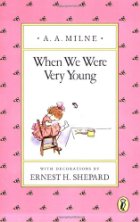
Peanut’s Picks: WHEN WE WERE VERY YOUNG

When We Were Very Young (Source)

My mom says it’s National Poetry Month and that this means I should share with you some poetry.  (Is it only a month?  Feels like it’s been about an eighth of my life.  Oh, wait…)  Anyway, I like poetry a lot.  It’s kind of like songs, except there’s no key for my mom to wander in and out of.  (Mommy, I love you, but let’s leave the singing to Auntie Em, okay?)

So for National Poetry Decade Month, Mommy and I decided to read a book of poems together.  Mommy let me pick (okay, that’s a lie) and I chose When We Were Very Young, by A.A. Milne.  Mommy says that was a good choice, because I am very young.  Mommy and I have been reading a few poems most days and then we discuss them and I ask questions like:

Where is Buckingham Palace?  Why have you not taken me there?

Can I have a puppy?

What is rice pudding?  It sounds terrible.

Why won’t the doctor just leave the dormouse alone?  NICU flashback!

What is a knight?  Is that another word for bedtime?

Can I have tea?

Then Mommy explains to me that Buckingham Palace is in England and I can’t go there until I learn to travel without going on hunger strikes (but that doesn’t sound fun), that no I can’t have a puppy (why not?!), that rice pudding is what it sounds like and not too terrible, that she doesn’t know why the doctor won’t leave the poor dormouse alone, that a knight goes on adventurers and that I’m too young for tea.  And more stuff too.  Mommy is very good at explaining poetry.

Also, she said I could pick a favorite poem from the book and share it with you.  Obviously, I picked Puppy and Me, because puppies!

Puppy and Me

I met a Man as I went walking;
We got talking,
Man and I.
“Where are you going to, Man?” I said
(I said to the Man as he went by).
“Down to the village, to get some bread.
Will you come with me?” “No, not I.”

I met a Horse as I went walking;
We got talking,
Horse and I.
“Where are you going to, Horse, today?”
(I said to the Horse as he went by).
“Down to the village to get some hay.
Will you come with me?” “No, not I.”

I met a Woman as I went walking;
We got talking,
Woman and I.
“Where are you going to, Woman, so early?”
(I said to the Woman as she went by).
“Down to the village to get some barley.
Will you come with me?” “No, not I.”

I met some Rabbits as I went walking;
We got talking,
Rabbits and I.
“Where are you going in your brown fur coats?”
(I said to the Rabbits as they went by).
“Down to the village to get some oats.
Will you come with us?” “No, not I.”

I met a Puppy as I went walking;
We got talking,
Puppy and I.
“Where are you going this nice fine day?”
(I said to the Puppy as he went by).
“Up to the hills to roll and play.”
I’ll come with you, Puppy,” said I.

Lesson for parents: I need a puppy!

When We Were Very Young (by A.A. Milne) is puppy-rific!  Buy a copy here!

NEWS FROM HEAVEN

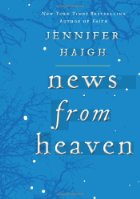
News from Heaven (Source)

Bakerton, Pennsylvania , could be Anywhere, USA .  It’s a coal-mining town that struggles to redefine its identity after a tragic accident and the 1970s strip away the business that has sustained the residents for decades, in Baker Towers (reviewed here).  It’s also home to dozens of families filled with complex characters: the Bernardis, the Lubickis, the Stusicks, and especially the Novaks, who were the novel’s main focus.

Baker Towers was a critically acclaimed novel that won Jennifer Haigh plenty of fans.  I was already a fan, having read her most recent novel, Faith, and enjoyed it immensely.  But I felt an even stronger connection to the characters in Baker Towers, and their story resonated with me in particular because of my academic background; I majored in labor relations, and the story of a blue-collar company town fraying at the seams during the recession of the 1970s was familiar.  So having felt at home in Bakerton before, I was thrilled to learn that the author had just released this collection of short stories set in, around, or in relation to my favorite fictional coal-mining town.  (By the way, it’s not necessary to have read Baker Towers in order to enjoy News from Heaven, but if you have, you’ll recognize many of the characters from the novel.)

The stories themselves are lovely, managing to be both gritty and luminous at the same time.  There’s the tale of Annie Lubicki, who moves to New York City to be a live-in maid to a Jewish family and forges an unexpected connection there; there’s a glimpse into the life of a lonely schoolteacher who rediscovers a little of her femininity while doing some Christmas shopping; there’s a redemptive story about a man who returns to attend his parents’ fiftieth wedding anniversary; there’s so much more.  And there are several stories featuring the Novak kids, and particularly practical Joyce, who was my favorite.  (How I identified with her overwhelming sense of duty and responsibility.)

News from Heaven only contains ten stories, but all ten will tug at the reader’s heartstrings.  I know these people.  Their lives seem small, but they’re rich and full and heartbreaking and inspiring.  Highly recommended.

News from Heaven, by Jennifer Haigh: available here, or support your local indie!  (Not an affiliate link.)

Poetry Challenge: Reading Anna Akhmatova

DSC_0029

Well, fellow bibliophiles, it’s National Poetry Month again!  And you know what that means: lots of bloggers reading, writing, and posting poems all month.

I’m not a big poetry reader.  I have a poetry sweet spot – not too simplistic, not too everyday, not so complex or flowery that the whole thing goes over my head – and there are hardly any poems out there that hit it.  I have my small group of beloved poets – A.A. Milne, Robert Frost, Emily Dickinson and, most of all, my cherished e.e. cummings.  (I have a recurring fantasy of sitting A.A. Milne and e.e. cummings down together and forcing them to like one another.  No, love.  Forcing, if I have to.)

But when all’s said and done, I just don’t read much poetry at all.  I’d prefer a good historical classic, or an atmospheric new release, or a biography or memoir of a favorite personality, to a volume of poetry.  Since I read for the joy of it, I don’t have any problem with skipping books or genres that don’t bring me happiness.  (Which is why you never see true crime or thrillers on here.)

Still.  Every so often, a girl wants to expand her horizons a little bit.  You know, find something – or someone – new, and fall in love afresh.  So I’ve decided to find someone new on the poetry front and hope to fall in love, and I’ve chosen Anna Akhmatova.

I had never heard of Akhmatova until 2011, when I read Molotov’s Magic Lantern, a nonfiction pseudo-memoir-slash-travelogue-slash-history by journalist Rachel Polonsky, who discovered that she was living in a flat below the former residence of a notorious Soviet honcho, who – ironically – was an “ardent bibliophile” who collected the works of many writers and intellectuals he personally sent to the Gulag.  Akhmatova came up as an essential reading experience for anyone who considers herself a fan of Russian literature, and I’m ashamed to say I had no idea who she was.

I’ve read many of the major Russian writers – Tolstoy, Chekhov, Bulgakov, Gogol – but there are major holes in my tour of Russian literature, if I can even say I’ve embarked on one.  (There’s a difference between a fan of Russian writers and a fan of Richard Pevear and Larisa Volokhonsky.  I’d like to think I’m both, but if I’m being scrupulously honest, it really may be that I’m just the latter.)  I want to read more Russian literature – and comprehend it, ideally – and I want to “discover” a new-to-me poet, and what better place to start than the realm of Anna Akhmatova?

Akhmatova was born in 1889 near Odessa.  She grew up in Tsarskoye Selo and Kiev, attended Kiev University, and went on to become the preeminent Russian female poet.  She was a modernist who favored clarity and simplicity (thank you) in her work, and her themes ranged from love to religion to the experience of living through the Soviet regime.  She was in “official disfavor” for much of her career and her work was banned in the U.S.S.R., but she was one of the few writers who chose to remain in her homeland and bear witness to events there, rather than seek friendlier writing climates elsewhere.

For National Poetry Month 2013, I am challenging myself to read at least one Anna Akhmatova poem every day – and I’ve already started.  I bought a selection of her poems (a selection that, according to Amazon reviews, is missing some of her best work – but I’m looking for an introduction; I can always delve deeper later) and I intend to read it slowly and savor it over the course of the month.  I’ll try to pick a favorite or two to share with you all along the way, too.

Have you read Anna Akhmatova?  Which of her poems should I simply not miss?

Reading Round-Up: March 2013

Reading is my oldest and favorite hobby.  I literally can’t remember a time in my life when I didn’t love to curl up with a good book.  Here are my reads for March, 2013…

The Miracle at Speedy Motors (No. 1 Ladies’ Detective Agency #9), by Alexander McCall Smith – Another sweet installment in the adventures of Precious Ramotswe & co.  Mma Ramotswe is busily investigating her latest case, that of a woman who is looking for her family but doesn’t know her name or where she was born.  Mma Makutsi, meanwhile, is negotiating another relationship hurdle: her wealthy fiance, Mr. Phuti Radiphuti, has bought her a bed but, inadvertently, it was left in the rain and ruined.  Should Mma Makutski come clean, or should she try to replace the bed on her own?  I’ve come to care about these characters, and I always enjoy visiting with them.

How the Light Gets In, by M.J. Hyland – Meh.  I read this book – about a troubled foreign exchange student – because it was on “Rory’s Book List” from Gilmore Girls, and I’ve been on a GG kick lately as my sis-in-law discovers Stars Hollow for the first time.  But I have to disagree with Rory on this one.  The writing was a little too Salinger-esque for me, but not in a good way (only Salinger himself can pull off that level of teen angst) and I just didn’t care about the protagonist.  I found her exasperating, irritating, and a whole mess of other things that end with -ing.  Not for me.

Mrs ‘Arris Goes to Paris, by Paul Gallico – Much better!  Mrs ‘Arris caught my eye on the “1001 Books to Read Before You Die” list because the title was so cute.  I’m so glad I discovered this one.  The jaunts of a London charwoman in Paris – where she has come to buy herself a Dior dress after two years of scrimping, just for the pure joy of owning something beautiful – were sweet, charming and uplifting.  I’ve been recommending this one to everybody, and I’ll recommend it to you, too.  It’s 150 pages, the work of an afternoon, and such a jolly romp.

Cloud Atlas, by David Mitchell – Another one from the “1001 Books” list, and WOW.  This book blew. my. mind.  Six stories, each remarkably different – different form, different style, different tone – all tied together via literary tricks and possible reincarnation.  The skill that went into this book is incredible, and the stories are each so captivating.  I don’t want to talk too much about the structure of the book, since that would be giving too much away, so I’ll just say that it was so fresh, so unique, and – I think – absolute genius.  Plus there were several twists that really shocked me (and I can usually smell a twist coming 100 pages away), including one absolute bombshell that left me on the floor.  Literally.  I fell out of my chair.

Tea Time for the Traditionally Built (No. 1 Ladies’ Detective Agency #10), by Alexander McCall Smith – Okay, I keep saying this, but I think this was my favorite Precious Ramotswe mystery yet.  Mma Ramotswe has been called upon by a football (soccer, for my American friends) magnate to find out what is wrong with his team.  They’re a good team, with plenty of talent, but they keep losing (sound familiar, Sabres fans? ugh, I don’t want to talk about it) and the owner thinks there’s a traitor in their midst.  Mma Ramotswe knows nothing about football, but she’ll get help from an unlikely assistant detective: her young foster son, Puso.  Meanwhile, Mma Makutsi has her own problems: the treacherous Violet Sephotho has gotten a job at the Double Comfort Furniture Store and is trying to poach the proprieter, Mr. Phuti Radiphuti, from his rightful fiancee.  Ultimately, Mma Makutsi will get her help from an unlikely quarter as well.  I loved this one.  Seeing Mma Ramotswe out of her depth at a football game was classic, and I loved that she teamed up with Puso to solve the football mystery.  And Violet Sephotho is a bad, bad lady.

The Girl Who Fell Beneath Fairyland and Led the Revels There (Fairyland #2), by Catherynne Valente – Back to Fairyland!  I read the first Fairyland installment over the summer and I’m so glad it’s a series, because I was certainly left wanting more.  This second jaunt was even better than the first: the language was less jarring after reading it all through the first book, the story was captivating, and the ending was sweet and hopeful, even more so than the first.  Just wonderful.  I hope there are many more to come!

The Double Comfort Safari Club (No. 1 Ladies’ Detective Agency #11), by Alexander McCall Smith – This was a particularly fun installment, as Mma Ramotswe and Mma Makutsi journeyed into the Okavango Delta to track down a safari guide who had received a bequest from a grateful past visitor.  The Okavango Delta hadn’t featured in the series before – most of the mysteries take place in Gaborone or the surrounding area, or around the Kalahari – and it was fun seeing Mma Ramotswe in a different place.  (The scene where Mma Ramotswe and Mma Makutsi take a water taxi to the safari camp might be the funniest image in the entire series.)  I looked up the Okavango Delta after reading this and WOW, beautiful.  I now need to plan a trip.

The Saturday Big Tent Wedding Party (No. 1 Ladies’ Detective Agency #12), by Alexander McCall Smith – Mma Ramotswe might just be in over her head this time.  She’s been asked to investigate some cattle killings by a gentleman who seems frightened, but might actually not be – and who, to make matters worse, could potentially be responsible for the crime.  Mma Makutsi is deep into her wedding preparations and, of course, her shoes are causing drama.  And then, as if this wasn’t enough, Mma Ramotswe is being haunted by the ghost of her tiny white van.  Sometimes, the truth isn’t always what it seems to be.

The Limpopo Academy of Private Detection (No. 1 Ladies’ Detective Agency #13), by Alexander McCall Smith – Lots of problems arise in this installment, and they hit close to home.  An unscrupulous businessman on the board of the Tlokweng orphan farm has engineered Mma Potokwame’s unceremonious dismissal from her post which, if you know Mma Potokwame, is unthinkable.  And Fanwell, the younger of Mr. J.L.B. Matekoni’s two apprentices, is in trouble with the law – and after the ladies only just managed to learn his name!  Mma Ramotswe needs all of her ingenuity to right these wrongs, but she has a secret weapon: a tall American stranger who has appeared in Gaborone and who introduces himself as none other than Clovis Andersen, author of The Principles of Private Detection, which Mma Ramotswe and Mma Makutsi can quote ad nauseum.  With Clovis Andersen’s help, Mma Ramotswe can do anything!

Well, I was busy this month.  My reading ran the gamut from a book I genuinely disliked – How the Light Gets In – to one that blew my mind – Cloud Atlas.  And there was Mrs ‘Arris, which was charming and sweet, the latest Fairyland installment, which was magical, and all the time I spent in Botswana with Mma Ramotswe and Mma Makutsi.  I’m now completely caught up on the No. 1 Ladies’ Detective Agency novels and, to be honest, a little sad about that.  I’ve grown to love the ladies and their cohorts – the garage staff, Motholeli and Puso, Phuti Radiphuti, and Mma Potokwame – and I’m going to miss them all.

Peanut’s First Easter

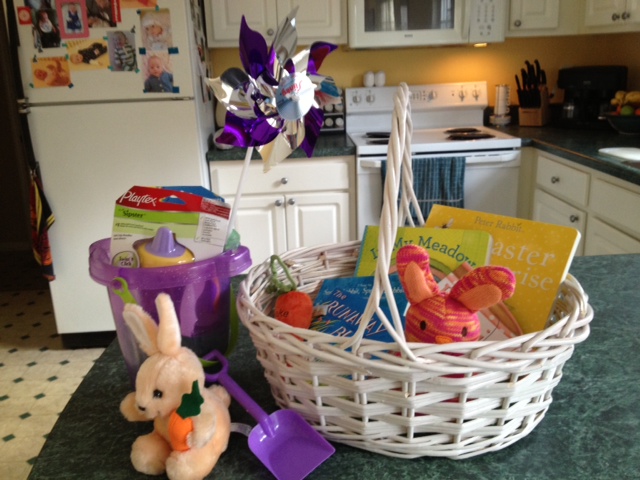
Easter Baskets

Well, Peanut’s first Easter was nowhere near as relaxing and low-key as her first Christmas was.  In fact, I’d say it was downright educational.

Hubby and I had been talking about making a trip up to my parents’ place in upstate New York for months, but had been putting it off, first because Peanut was too little and hadn’t had her full course of preemie shots (hence, we stayed at home for Christmas) and then later because we both found ourselves unable to take a few days off from work in mid-March.  The stars finally aligned for Easter, so we headed north and learned an important lesson: Peanut is a very good, very easygoing baby when she’s in her comfort zone.  When she’s out of it… hunger strike.

We drove up to New York on Saturday morning and spent the afternoon relaxing at my parents’ house.  My grandmama and my aunt M came over, as did some close friends who wanted to see the baby.  (My high school BFF had already met her, the weekend after she was born, but she was in an isolette then and she’s a very different kid now.  Peanut loved seeing her Aunt J again.)  We colored Easter eggs – my mom made sure hubby, Peanut and I each had an egg of our own – and had a delicious dinner of homemade shrimp bisque and salad with strawberries and Burrata.

On Sunday morning, Peanut woke up to discover that the Easter Bunny had been by with two baskets for her.  (The sand pail is for the beach this summer – it came with a stuffed bunny, sippy cup, bubbles and a pinwheel, which the Easter Bunny delivered with Peanut’s Nana acting as middleman.  I put the white basket together on behalf of the Bunny and filled it with a carrot rattle, a sherbet-colored stuffed bunny from Auntie Em, and bunny-themed board books – The Runaway Bunny, Snow Rabbit Spring Rabbit, Peter Rabbit’s Easter Surprise, In My Meadow, and the insanely adorable Bunnies for Tea, recommended by Katie, who is a genius.)  Since Peanut was on an incredibly loud hunger strike – screaming at the very sight of her bottle and taking maybe half of her formula at each feeding – hubby and I skipped church to stay home with her.  It was the first time I’d ever missed church on Easter and I was sad, but Peanut couldn’t go and I knew she needed her mom.

For Easter dinner, my parents invited my other grandmother – so Peanut got to meet both of her great-grandmothers this weekend; how lucky is she? – and our family friends to share a feast.  We had a delicious cold spread with way too many of my favorite foods – smoked salmon, pickles, deviled eggs, fruit salad – and our friends brought an amazing cake to finish off the evening.  Peanut wore a cute little pink and green dress and tolerated getting passed around for awhile before melting down and spending the rest of the evening clinging to me.  (Not gonna lie, I don’t love the meltdowns but I do enjoy clingy baby.  It’s nice to be needed.)

I’m glad that we made the trip, especially because one of my grandmothers isn’t really up for traveling so if we want her to see Peanut, we have to go to her.  But I don’t think we’re going to be traveling again for awhile!  Peanut really didn’t appreciate being taken out of her element – and I think she really missed her Auntie Em, or at least, she missed the routine Auntie Em enforces with military precision – and it was a trying weekend for all three of us.  Still, we packed the weekend with lots of family time, and that’s what counts.  And when we got back to Virginia, the magnolia trees had burst into bloom.  It’s spring!

National Poetry Month 2013

UK_10_21_2011_08_56_39

I’m not a great reader of poetry.  It has never been my favorite thing to read, and I eye-rolled my way through the poetry units in my high school English classes.  Still, I love to expand my horizons and there are a very few poets who have my bookworm heart captured – none more so than my all-time favorite, e.e. cummings.  Every April, we celebrate National Poetry Month, and last year I started the tradition of marking it by subjecting you all to an e.e. cummings poem.  In fact, I’ve shared several of his poems here – my favorite, to celebrate back-to-school, a lovely piece for Easter last year, and one to celebrate Christmas.  Since it wouldn’t be National Poetry Month without a little e.e. cummings, here’s another piece that I think is sweet and Easterly and a perfect kickoff to a month spent reading poems:

love is more thicker than forget
more thinner than recall
more seldom than a wave is wet
more frequent than to fail

it is most mad and moonly
and less it shall unbe
than all the sea which only
is deeper than the sea

love is less always than to win
less never than alive
less bigger than the least begin
less littler than forgive

it is most sane and sunly
and more it cannot die
than all the sky which only
is higher than the sky

~e.e. cummings (source: The Poetry Foundation)

I’ll be back on Wednesday with a recap of Peanut’s first Easter.  In the meantime… have a Cadbury egg on me, and read a poem!

The Babyfood Diaries: Sweet Potato

babyfood5

Well, the babyfood party is well underway, and we’re having so much fun.  Peanut is really enjoying the experiment – she has been having fun discovering some new flavors and textures, and I am having fun giving them to her.  So far, I’ve found it extremely easy to make her food.  It’s only been a few weeks, but we haven’t yet had to resort to prepared or packaged foods, and I’m thrilled about that.  There are some days when Peanut is less open to the experience than others, but that’s to be expected.  Still, I think I can say we’ve been very successful to this point.  (Finally, I can say that about something!)

Peanut’s first food was sweet potatoes.  I asked her pediatrician whether it was essential that we start with cereal grains, because I preferred not to if possible.  I didn’t believe there was much added nutrition in cereal grains, and the pediatrician confirmed that the only nutrition in baby cereal is iron, of which Peanut gets plenty through her preemie formula and vitamins.  Purees aren’t really about nutrition – they’re about introducing new flavors – and I don’t think grains taste like much if you don’t season them (which I wasn’t planning to do).  So I did some research online and in my new baby cookbooks to find a good vegetable to start Peanut on first, and after considering a few different options I settled on sweet potato.  So – are you ready?  Let’s whip up some sweet potato puree!

babyfood1

There are a few different possible ways to cook the sweet potatoes before you puree.  I checked out both of my cookbooks: one recommended chopping and steaming the potato, and the other recommended roasting.  Since I think roasting brings out flavors better, and I was not planning on putting any seasoning into the puree, I decided to roast.

Preheat your oven to 400 degrees Fahrenheit and lay two extremely well-scrubbed, small-to-medium sized, sweet potatoes on a baking sheet.  Prick all over with a fork, then roast for 45-50 minutes, until cooked through.  (Times may vary, depending on your oven.)

babyfood2

Mmmmm, roasted deliciousness.  Using a serrated knife, slice each sweet potato lengthwise and scoop the flesh out with a spoon.  (The skin is for you, mama.)  Place the flesh into the bowl of a food processor or heavy-duty blender.  (I used my VitaMix with fantastic results – the silky puree is as smooth as store-bought.)

babyfood3

Puree until the potatoes reach the consistency your baby prefers, thinning as necessary with formula, breast milk or water – whatever you have handy.  (I used formula.)  Recipe adapted from The Baby and Toddler Cookbook, by Karen Ansel and Charity Ferreira.

Feed to your baby while giggling uncontrollably and snapping tons of pictures:

babyfood6

This recipe will make about twelve ounces of sweet potato puree, give or take (and depending on the size of the potatoes you use and how much liquid you add).  I divided the puree into one-ounce portions and froze them in Oxo Tot babyfood storage containers (pictured above).  We’ve been feeding Peanut around 8:30 each morning, and I take a new jar out of the freezer and place it into the fridge for the next day, at that time.  I like to leave the food out for about 20 minutes on the counter before giving it to Peanut, just to take the chill off, but I do not microwave it.  Microwaving can cause hot spots and burn baby’s mouth – ouchie!  If absolutely necessary, defrost by floating the closed jar in a cup of warm water – but the fridge is better.

babyfood4

Enjoy!

THE SCARLET PIMPERNEL

The Scarlet Pimpernel(Source)

If you’ve been avoiding The Scarlet Pimpernel because you thought it was some kind of sequel to The Scarlet Letter, hide no more.  The Scarlet Pimpernel is a silly, rowdy, wacky good time.

The time: 1792.

The place: Paris.

The outrage: Entire families of aristocrats, sentenced to the guillotine, are escaping the jaws of Paris, through the most crowded, frequently-used city gates, under the very nose of the French military.

The rescuer: The Scarlet Pimpernel, a mysterious, swashbuckling avenger who sweeps would-be victims practically from the mouth of the guillotine and spirits them to safety in England through a combination of cunning, dashing disguises, and “demned cheek.”

Who is the Scarlet Pimpernel?  He’s a figure of mystery who has captured the imaginations of the entire British people, the hopes of the French aristocracy, and the ire of the bloodthirsty Committee of Safety – who hate losing victims almost as much as they hate being embarrassed.  The French government hatches a brutal plan to capture their No. 1 enemy: they dispatch agent Chauvelin to England to blackmail a certain lady into helping him.  Marguerite St. Just, now Lady Blakeney, is widely known to be a revolutionary sympathizer.  Her brother, however, once a revolutionary himself, has had second thoughts and is now aiding the aristocrats.  Chauvelin gives Lady Blakeney a choice: help him unmask the “demned elusive Pimpernel” or her brother will suffer a traitor’s fate.  Marguerite experiences a momentary pang on behalf of the dashing stranger, but there’s no question: she’ll save her brother.

Until she makes a disturbing discovery: the Scarlet Pimpernel is none other than Sir Percy Blakeney, widely regarded as an indolent but amusing moron, and Marguerite’s husband.  Sir Percy’s mask is so opaque that even Marguerite bought into his disguise and is perhaps more shocked than anyone else to learn of her husband’s double life.  And she learns too late – Sir Percy is off to Calais to rescue an aristocrat whose family he has already led to England, and  in choosing to save her brother from the guillotine, Marguerite has unwittingly sent her husband into a trap.  Marguerite takes off in a panic, running pell-mell in the direction of France, determined to warn Sir Percy of his peril before it’s too late.  Chauvelin, meanwhile, gleefully lays the net he plans to cast around the Pimpernel… Sir Percy will need all of his wits and his “demned cheek” to accomplish his mission and slip from the grasp of the revolutionaries once again.

I don’t know what took me so long to get around to The Scarlet Pimpernel.  It was a riot from the first page to the last.  Laugh-out-loud funny and edge-of-seat exciting, I couldn’t put it down.  Highly recommended, with the caveat that the pivotal scene is a touch racist, so you need to keep in mind the times in which the book was written – but still a fun romp, well worth a read.

The Scarlet Pimpernel, by Baroness Emmuska Orczy, available here (not an affiliate link).

On Authors and Conversation

DSC_0031

It’s 2013, and the world has shrunk to the size of a microchip, and in many ways, that’s a great thing.  There have never been so many conversations as there are going on right now, at this very moment.  It has never been so easy to connect with others, at least on a superficial level.  (Getting to know someone – really know them, inside and out – is a very different matter, but that’s a topic for another day.)  And for the first time in history, thanks to the miracle of Twitter, it’s never been so easy to strike up a conversation with an author.

I’ve had the experience of getting tweets from several authors I admire, and it hasn’t yet stopped being excruciatingly cool.  On a few occasions, I’ve tweeted my #fridayreads and received a response from the author.  Alex George, for instance, told me I made his day when I praised his novel A Good American on the mini-blogging site.  (Well-deserved praise, by the way.  A Good American is incredible.  If you haven’t read it yet, what are you waiting for?)  Alex George telling me that I “made his day” pretty much made my month.  And when I tweeted during a Friday lunch hour that I was enjoying a salad and Mrs Queen Takes the Train, William Kuhn shot back a charming tweet that Mrs Queen prefers walnuts on her arugula, leaving me grinning for the rest of the day.

I started thinking about authors and their various levels of engagement with their fans when Amal posted this interesting take on a Bryan Garner article she read.  While I agreed with her critiques of Garner (and she formed them much better than I would, so go read her post), I had to chime in with a comment noting that he was extremely gracious to his fans.  My best friend, unlike me, is a huge Garner fan.  While serving as a civilian U.S. government employee in a war zone that I personally would find pretty terrifying, R got into a debate over an esoteric point of grammar with her colleagues and emailed Garner to get his opinion.  He responded with a very kind email in which he answered her question, thanked her for her service, and asked her where he could send her some free books.  Since she’s basically the guy’s biggest fan, you can imagine how excited she was.

When I told Amal that story, via comment (and you can see our exchange in the comments section of her post), she responded that it was nice to hear that Garner took more of a “Dr. Seuss” attitude in responding to fans, and then linked me to a letter that a “grumpy” E.B. White once sent to a young fan.  The acclaimed author answered his little admirer’s request for another book by suggesting that the child start a national movement dedicated to NOT sending letters to E.B. White until he produces another book.  The response wended its way to the recipient’s librarian, who wrote to White to complain about his tart response, which he answered with a long letter explaining the demands that fan mail places on him.  While he made some good points – what a time-consuming effort it must be to answer thousands of fan letters personally – I still give the side-eye to his sarcastic response to a young child who probably wasn’t capable of grasping the snarky point, and who was just excited about Charlotte’s Web, anyway.  I think he probably just snapped after too much time spent trying to be gracious in fan responses and not enough time doing what he really wanted to do, which was writing, and I do sympathize.  But still.  There’s no need to get huffy, especially not when the recipient is a young child.  (If my Peanut received a letter like that from an author she admired, you can bet I’d be dashing off a reply of my own.)

The exchange between the author, the child and the librarian was a very interesting one to read, and I was grateful to Amal for pointing it out to me.  It also got me thinking about the things that writers must do to earn their incomes – aside from just writing, that is – and wondering whether the profession has gotten more demanding in recent years.  E.B. White bridled at answering fan letters.  Well, nowadays there’s the book tour, which can mean weeks on the road if you’re an author with bestseller potential.  (Have you seen John and Sherry Petersik’s posts about their Young House Love book tour?  Yowza.)  There’s the added work of “networking” on Facebook and Goodreads, maintaining your own blog or website as many authors do, and tweeting at starry-eyed fans like me.  On the one hand, the Internet makes it easier for authors to reach many more fans at once, just by updating their Facebook pages or putting up 140 characters.  On the other hand, when it’s easier to do, people demand that you do more.  If authors feel compelled to respond to every fan tweet, when exactly do they have time to write?  After all, we all know that the Internet can suck away hours of the day.  (Ever logged into Pinterest and lost two hours of your life?)

The relative ease of online communication has emboldened fans to insist on more contact with their heroes.  And I expect it’s probably added work for the writers who depend on readers to buy their books.  They now have to “sell” to readers online, or risk losing a reader to an author who is more engaging toward fans.  E.B. White-style reticence just doesn’t work in the Internet age, and an author who snaps back that fans should stop tweeting him if they want another book is probably going to alienate a few people.  (There are plenty of cases of Authors Behaving Badly that have enraged the book community – usually when an author responds angrily to a blog review.  I’m not even going to get into those sticky situations.)

It’s a tricky balancing act.  On the one hand, I like tweeting my favorite authors and seeing their responses.  I get excited at the thought of making contact, however superficial that contact is, with a writer whose work I admire.  And I also like giving credit where credit is due: if I really enjoyed a book, I want to tell people that I enjoyed it and congratulate the author on a job well done.  If I was a published author, I can’t imagine I would ever get tired of hearing from people who enjoyed my hard work.  But maybe we readers, as a group, need to back off a little bit.  Maybe we need to give our favorite authors some space to do what they do best: write books.

I’m not going to stop tweeting about the books I like, or telling the authors how much I enjoyed their work, because I know that if I had written a book I’d really want to hear from the people my words touched.  But when I tweet or blog about authors I like, I don’t expect a response from them.  I don’t expect them to take time out of their schedules to engage me in conversation.  When they do, though, it makes my day.

And with that, I’ll leave you with my absolute favorite quote about fan mail, from the great Maurice Sendak:

Once a little boy sent me a charming card with a little drawing on it. I loved it. I answer all my children’s letters — sometimes very hastily — but this one I lingered over. I sent him a card and I drew a picture of a Wild Thing on it. I wrote, “Dear Jim: I loved your card.” Then I got a letter back from his mother and she said, “Jim loved your card so much he ate it.” That to me was one of the highest compliments I’ve ever received. He didn’t care that it was an original Maurice Sendak drawing or anything. He saw it, he loved it, he ate it.”