Reading Round-Up: May 2013

Reading is my oldest and favorite hobby.  I literally can’t remember a time in my life when I didn’t love to curl up with a good book.  Here are my reads for May, 2013…

The Chalice (Joanna Stafford #2), by Nancy Bilyeau – The second in what I believe is going to be a trilogy starring aristocratic young nun Joanna Stafford finds the monasteries dissolved, Joanna and her friends trying to live in the real world again, and Henry VIII in search of wife number four.  When some high nobility come to Dartford and sweep cousin Joanna off to London with them, she will become embroiled in political intrigues and be forced to assume her role in a prophecy that promises to change the course of history.  Just like its predecessor, The Crown, this was a quick, engaging and fluffy read – especially if you don’t mind the occasional typo or historical inaccuracy (which, I admit, do bother me).  This would make for a good beach read, as long as you don’t expect too much from it.

Fire in the Blood, by Irene Nemirovsky (audiobook) – I loved Nemirovsky’s unfinished masterwork, Suite Francaise, so I snatched this up at the library when I came across it on the audio shelf.  It’s in far rougher form than Suite Francaise, but with some beautiful writing and fascinating characters.  I loved the portrayal of Silvio, a French hermit who wishes nothing more than to be left alone with his wine and his thoughts, but who is constantly dragged into family dramas.  His musings on life and love were masterful.  I think I would have enjoyed the print version very much, but the narrator of the audiobook was superb.  He was Silvio.  Highly recommended.

The Return of the King (Lord of the Rings #3), by J.R.R. Tolkein – Finally, finally, I’ve completed the long trek that is the Lord of the Rings trilogy!  I’ve been meaning to get to this for ages, and while I enjoyed each volume, The Return of the King was my favorite.  It was nonstop action, thrilling and exciting, and so very satisfying to finish.  I’m planning a bigger post on my impressions of the series later this month.

The Iron King (The Accursed Kings #1), by Maurice Druon – Is this month King-themed, or something?  I had never heard of the Accursed Kings series, which were published in the 1950s in France, until I read an article about their recent reissue.  The book opens with a great drama: the Grand Master Templar and three of his compatriots are being burned at the stake.  As he dies, the Grand Master levies a curse on the Iron King, Philip the Fair, and his line.  The curse begins to take effect almost immediately: Philip’s three daughters-in-law are suspected of adultery, and his ineffectual sons can’t seem to control their wives.  Meanwhile, Philip’s cronies drop one by one, and his hot-blooded daughter Isabella, the unhappy Queen of England, is plotting against her sisters-in-law.  The series covers the Hundred Years’ War and this account of the beginnings of the war was exciting, well-plotted, and historically accurate.  My favorite kind of historical fiction!  I’m now waiting for the next book in the series to come out, and I’ll be snatching it up ASAP.

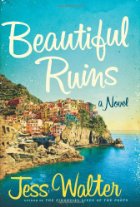
Beautiful Ruins, by Jess Walter – This would make a phenomenal not-too-fluffy beach read.  A beautifully written story, spanning some fifty-odd years and the space from Italy to Hollywood, Beautiful Ruins introduces a cast of lovably broken characters and follows their life stories.  A dying Hollywood starlet, an idealistic young Italian hotelier, a grizzled veteran turned writer, a Hollywood producer and his disillusioned assistant drift through their own life movies, bumping into one another as they go.  Lovely story and beautiful writing.  Fully reviewed here.

Billy Lynn’s Long Halftime Walk, by Ben Fountain – The book jacket described this book as “Catch-22 for the Iraq War,” and it got so much good press that I had to check it out.  File this one under “incredible but uncomfortable.”  Ben Fountain holds a mirror up to the American media culture as he depicts a squad of soldiers, the heroes of a battle in Iraq, on the last stop of their victory tour.  They are mobbed by well-meaning citizens who thank them for their service in kindly but clueless ways and are forced to rub elbows with the Dallas Cowboys owner and his cronies, all of whom want a piece of the glory – which, for Bravo squad, isn’t really glorious at all.  Ben Fountain perfectly captured the fawning media attention and opened a window into a soldier’s mind.  I squirmed, but they were worthwhile squirms.

The Lightning Thief (Percy Jackson and the Olympians #1), by Rick Riordan (audiobook) – I wanted something light and fun and Potter-esque for my drives to work this month, because things have been kind of overwhelming, so I grabbed the first two Percy Jackson books.  I’m not wild about the audio production, but the story is gripping and such fun.  Percy and his friends are half-bloods, or demigods – sons and daughters of a Greek god and a mortal.  The gods are still very much alive and active and causing trouble.  When the book opens, Percy doesn’t realize his true parentage, although it’s obvious to the reader from the very beginning who his dad is.  (I won’t give it away, for those who haven’t read the book, but the symbol of the series makes it pretty obvious even before you crack the spine.)  I’m already halfway through the second in the series – on audiobook again – and Percy and pals are making my commutes so much more fun.

Most of May, I thought, was pretty slow on the book front.  But looking back, I’ve done some good reading – even despite some long workdays and some weekends given over to entertaining this month.  In addition to these, I’ve been working my way through Villette for the #villettealong, but as of May 31st I hadn’t finished it, so it will appear in my June round-up.  The beginning of June looks much the same as the month of May – lots of work hanging over my head, so reading time is at a premium.  But once I get past this week, I think things will quiet down for awhile, and I’m anticipating some good, relaxing bookish afternoons ahead.  I have a big library stack to get through, so I’ll need them.

#Villettealong: Volume III

Villette (Source)

“Lucy, I wonder if anybody will ever comprehend you altogether?” asks Paulina in Volume III of Villette.  Indeed, for most of her acquaintances, Lucy is content to remain an enigma.  But even an enigma needs some lovin’ – and that’s the lesson of Volume III.

The Story

By now, Lucy has realized what she probably knew all along: she and Dr. John are not meant to be.  While he has shed his first, less fortunate infatuation, Dr. John has found a new angel to idolize, and Lucy finds it within herself to approve of his choice.  Meanwhile, Lucy is undergoing a love metamorphosis of her own, finding herself more and more attracted to M. Paul.  Where he once put her off with his appearance, now she finds him pleasant to look at.  Where she once was irritated, dismayed, or upset by his irritable mood swings, now she finds him ready to be soothed and consoled.  She grows to appreciate his intellect and to overlook his possessive, imperious side.  But alas – forces outside the two of them see that Lucy and M. Paul are growing closer, and deem any kind of match completely unsuitable, because Lucy is a Protestant (and vocal about it, too).  M. Paul, guided by his teacher, Pere Silas, first attempts to convert Lucy to Catholicism.  When she refuses to go along with him, M. Paul must decide whether to accept Lucy as she is – reforms and all.  And even if he so decides, what of the “three-headed Basilisk” that wants to keep them apart?

Concluding Thoughts

Lucy never gives us a peek into her past; there is no explanation given for how she came to develop the character that stands before the reader, coolly setting forth events, throughout Villette.  Nor, irascible as she is, will she humor us with any kind of closure about the future.  Lucy demands that the reader fill in the blanks about both her past and her future.  While most of the sub-plots are neatly wrapped up for the reader, Lucy makes us work for resolution to the main story.

I liked Volume III the best out of the three volumes.  Perhaps it was because I had fallen back into a rhythm with Charlotte Bronte’s prose – Jane Eyre is my favorite book, it’s true, but it’d been awhile since I’d last read it – and found Lucy’s voice more readable.  Then, it was in Volume III that I recognized more Bronte style in the prose and in the plot: a heroine determined to be independent but to welcome love should it come her way; a leading man who grows on the reader as slowly as he grows on the protagonist; lots of weather, too.  No one does the old-grouch-with-a-heart-of-gold bit as well as Charlotte.

Overall Impressions

Obviously, I was going to compare Villette to Jane Eyre and… I’ve got to say… while I enjoyed Villette immensely, Jane Eyre still holds the prime place in my bookworm’s heart.  I think, however, that Jane and Lucy would have gotten along famously.  Both forced to make their own ways in the world, both not much to look at but with deep wells of emotion beneath their calm exteriors.  And both would agree on what, I think, is the central concern of each of their stories, articulated so beautifully by Lucy:

The love born of beauty was not mine: I had nothing in common with it: I could not dare to meddle with it, but another love, venturing diffidently into life after long acquaintance, furnace-tried by pain, stamped by constancy, consolidated by affection’s pure and durable alloy, submitted by intellect to intellect’s own tests, and finally wrought up, by his own process, to his own unflawed completeness, this Love that laughed at Passion, his fast frenzies and his hot and hurried extinction, in this Love I had a vested interest; and for whatever tended either to its culture or its destruction I could not view impassibly.

Thank you, Beth, for hosting this read-along and giving me the excuse to finally pick up a book I’ve long meant to read.   Everybody else: if my spoilery posts didn’t completely give things away and put you off (a thousand sorries), you can buy the book here (not an affiliate link) or from your local indie bookstore.

Mo’ Books, Mo’ Problems

Mo Books Mo Problems

So, um, remember how I said I wasn’t going to go crazy at the library this month?  Well…  Well.  I swear I didn’t.  The crazy just… sort of… happened.  This sort of thing has happened before, and I never, ever learn.

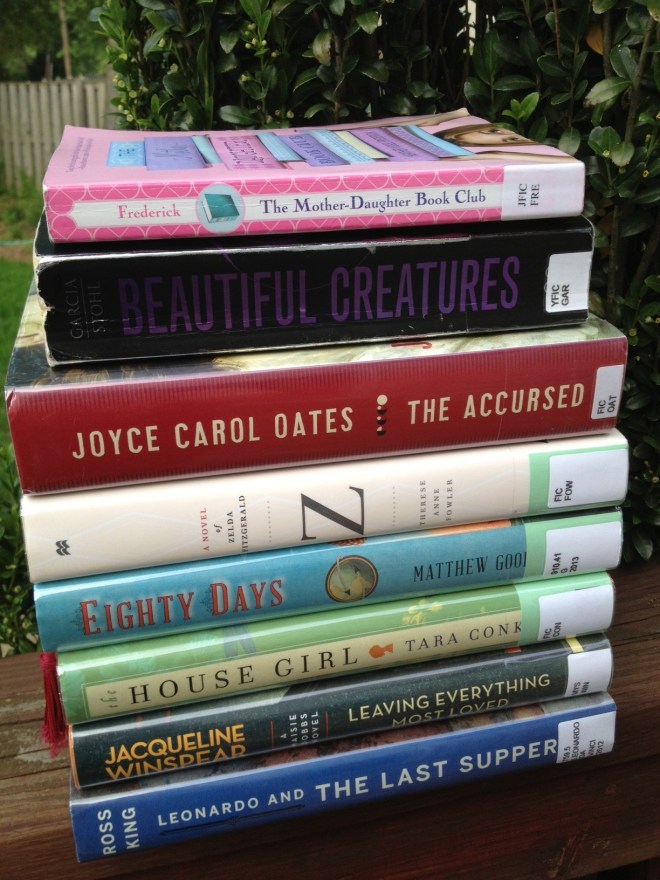
What goes down is this: if I see a book that looks interesting, either on a book blog, or Goodreads, or in the Shelf Awareness newsletter, I head on over to my library website and reserve a copy.  If it’s a new release – as they often are – I end up on the waiting list.  Which is fine, except that various books have different numbers of people waiting for them, and sometimes it happens that I reach the top of the list for five or so… or more… books at the same time.  Oops.  And then when I do things like decide I’d rather finish the Lord of the Rings trilogy, or sign up for a Villette readalong, the situation just gets more dire as I pretend the library stack doesn’t exist.  And then more books pop up on the holds shelf, and eventually you have… the library apocalypse.

Here’s the status:

Due back June 3rd:

Z: A Novel of Zelda Fitzgerald
The Accursed

Due back June 8th:

Eighty Days
Beautiful Creatures
The Mother-Daughter Book Club

Due back June 18th:

Leaving Everything Most Loved
Leonardo and the Last Supper
The House Girl

Somewhere in there, I also need to make time to keep up with the #villettealong.  Oh, and there’s the little matter of raising a baby and holding down a job.  Man, it was so much easier to keep up with my reading when I was on maternity leave.  I miss maternity leave.

Here’s the plan:

1) I probably will return The Accursed without reading it and download a copy for my Nook.  It’s really long, and it looks incredible, so I think there’s a chance I might re-read it, and it’s worth a purchase for that reason.  Normally I like to read a book before buying it, but desperate times call for desperate measures, and if I can’t get to all of these before they need to go back, this is the one I think I’m most likely to want to own.

2) I’m already into Z and I think I can get it out of the way before the deadline, since it’s been reading quickly… IF I get reading time this weekend, that is.  I also have to balance it with Villette, but a good Peanut nap or two and a pot of tea will help.

3) Among the June 8th books, I’ll tackle Eighty Days first.  I’m most excited to read that one, anyway.  Besides, I can return Beautiful Creatures and get back on the wait list, and I’ll have it back in no time, since the list is short.  (I’m not even sure if I’ll enjoy Beautiful Creatures, but I promised R that I’d give her new favorite book a chance.)  And I can renew The Mother-Daughter Book Club: there’s no wait list for it, but my branch didn’t have a copy, so I had to reserve it.

4) Maisie Dobbs is always a quick read, so I’ll get Leaving Everything Most Loved out of the way next and then move on to Leonardo and The House Girl.

Last time this happened – last time I had an avalanche of holds books fall on my head all at the same time – I was determined to get through them all.  I made it my mission, and it meant some weekend days were entirely spent with book in hand, but I did it.  This time, I really don’t think I can get through this entire stack, and I’m not going to drive myself crazy trying.  I’m just going to do my best to get through as many of these as possible before they’re due back, and prioritize the ones I most want to read first, and be okay with getting back on a wait list or two.  And someday, maybe, I’ll actually be able to read one of the books from the stacks I already own.

(Pssst – speaking of reading piles of books, I’ve updated the “Books” page.  It’s now current with all of my monthly Reading Round-Ups, longer book reviews, and Peanut’s Picks.  Go check it out!)

BEAUTIFUL RUINS

Beautiful Ruins(Source)

Porto Vergogna in 1962 is a tiny, backward fishing village on the Ligurian coast in Italy.  No one comes here.  It’s a forgotten place, neglected, mocked by its flashier neighbors – the five tourism-driven villages of the Cinque Terre.  The only visitor is one Alvis Bender, an American World War II veteran who comes for two weeks each year to work on his novel.  After eight years, he has still only finished one chapter.  But Pasquale Tursi, the young proprieter of Porto Vergogna’s only guest house, the Hotel Adequate View, believes that his town could be the next big destination for American tourists.  Pasquale is determined to turn Porto Vergogna into a world-class resort.  He plans a beach, and a tennis court hewn from the rocky cliffs overlooking the ocean.  And it’s in working on his beach that Pasquale is engaged when a boat pulls up carrying the most beautiful woman he’s ever seen.  Dee Moray is an American actress, cast as a lady-in-waiting to Elizabeth Taylor in Cleopatra, which is currently filming in Rome, and she is dying.  She has come to Porto Vergogna to wait for a man, and Pasquale takes her on as a guest at the Hotel Adequate View.

Some sixty years later, an old Italian man turns up at the Hollywood studio of Michael Deane, a famous producer, looking for the beautiful woman who stayed in his hotel many years ago.  What happened in 1962, and between times, and now, is the subject of this gorgeous, atmospheric novel.

I realize I’m late with this, because Beautiful Ruins has already made the rounds of the book blogs, and been praised from here to kingdom come.  But I’ve only just gotten around to reading it, so I want to talk about it now, and now’s as good a time as any and better than most because this would make a fantastic beach read.  The settings: primarily the sun-drenched Italian coast in 1962, and the perpetual summer of present-day Hollywood, are hot and beachy.  And the writing will immediately pull you in, and you’ll feel the warm sea water lapping around Pasquale as he heaves rocks to create his beach, and the sun pounding down on Pasquale and Dee as they hike into the hills, and the heat shimmering off the stones of Rome as Pasquale searches for Michael Deane on Dee’s behalf. 

It’s not just the setting, either.  You will share Pasquale’s hopes and dreams as he tries to fulfill his late father’s greatest wish: to make Porto Vergogna into a destination.  You will chuckle as Dee, ignorant of Italian, politely thanks Pasquale’s Aunt Valeria as Aunt Valeria heaps insults on her in Italian.  You will shake your head at Michael Deane, but you will also recognize present-day Hollywood in him and his disillusioned assistant.  You will fall headlong into this world that Jess Walter has created.

Let me also say one thing about the writing: it’s brilliant.  It’s atmospheric and lovely, yes, but also insightful.  The theme of the book is the stories that we create in our own lives.  For instance, Alvis Bender – who loves to lecture – tells Pasquale:

“Stories are people.  I’m a story, you’re a story… your father is a story.  Our stories go in every direction, but sometimes, if we’re lucky, our stories join into one, and for awhile, we’re less alone.”

“But you never answered the question,” Pasquale said.  “Why you come here.”

Bender pondered the wine in his hand.  “A writer needs four things to achieve greatness, Pasquale: desire, disappointment, and the sea.”

“That’s only thee.”

Alvis finished his wine.  “You have to do disappointment twice.”

All of the characters in this novel could be writers.  They all experience desire, disappointment, the sea, and disappointment.  And in a sense, they are all writers, because they’re constantly crafting their own life stories, even while they wait, as Dee would say, for their movies to start.  And fortunately, Jess Walter must have also experienced desire, disappointment twice, and the sea, because Beautiful Ruins is a great achievement.

Buy the book here, or support your local indie bookstore!  (Not an affiliate link.)

#Villettealong: Volume II

Villette

Well, here we are two-thirds of the way through the Villette read-along, and the story is certainly heating up.  Last week, I posted before I was quite done with Volume I – I had a chapter and a half to go, but didn’t want to be late to the link-up – and those last fifteen pages were eventful.  Lucy discovers the object of Dr. John’s admiration, and let’s just say it does him no credit.  Nor does his attribution to Lucy of “motherly” feelings toward the insipid girl (what 22-year-old wants to hear that about a younger potential rival? ouch).  Personally, I’d have slapped him, but Lucy is quicker-thinking, and she lays some well-deserved, blistering sarcasm on the doctor.  After this high note, the school breaks up for summer vacation.  With nowhere to go, Lucy stays at the school, virtually alone, and suffers a nervous breakdown.  And that brings us to Volume II.

The Story

Volume II begins with a major revelation: Lucy has been rescued while insensible from her nervous breakdown, and is recovering in the home of Dr. John, who turns out to be a figure from her past.  (Lucy claims to have known Dr. John’s true identity for months, but I’m not entirely sure that’s not just face-saving.)  Eventually, Lucy recovers and returns to Madame Beck’s, and she enjoys a few letters from her old friend, the doctor.  When the letters abruptly stop coming, Lucy struggles with her feelings of abandonment, loneliness and jealousy.  Eventually, Dr. John’s mother reaches out and draws Lucy back into the fold, and she re-kindles her friendship with the doctor.  While on an outing together, they encounter another old friend and, once again, Lucy discovers the old friend’s identity before the rather opaque Dr. John.  As their groups converge, Lucy speculates on the difference between her friends’ personalities, and seems to be forming some definite opinions about the doctor’s prospects for happiness.  Meanwhile, Lucy has several bizarre encounters with another teacher, M. Paul Emmanuel, whose strange manners make it impossible for her to decide whether she has feelings of friendliness or antipathy for him.

Thoughts Thus Far

Toward the end of Volume II, Ginevra Fanshawe asks, “Who are you, Lucy Snowe?” and I must confess, I’m wondering the same thing.  We still know next to nothing of Lucy’s backstory.  She is obviously an educated person, and someone who knows how to behave in the highest circles.  Yet she’s forced to work for a living at a time when gentlewomen didn’t do so, and she never mentions her family.  Lucy is just as much an enigma in Volume II as she was in Volume I; perhaps she’s even more so.  She has reservoirs of deep feeling and I want to smack Dr. John for considering her nothing more than “quiet Lucy Snowe . . . an inoffensive shadow.”  To my mind, Lucy is obviously worth ten of the prissy dolls Dr. John is attracted to, yet he doesn’t seem to see this.  Meanwhile, I’m also wondering about M. Paul, and what his story is, and what his true feelings toward Lucy might turn out to be.  I suppose this will all become clear in Volume III…

Overall Impressions

Volume II moved along at a much faster clip than Volume I.  We’re done with backstory and into the meat of the novel.  Some things are clear, and some things are still mysterious.  I’m growing very attached to Lucy and frustrated with those who don’t seem to see her merits as clearly.  (Of course, Bronte treats the reader to a view inside Lucy’s head, so it’s easier for us to comprehend how wonderful she is than for the other characters, since Lucy is very reserved with them and only displays her wild, passionate nature in her internal monologues.  Her struggle between Reason and Hope was particularly wrenching.)

I started the book off hoping that Dr. John would fall for Lucy, but I’m beginning to care less if he does or not, since he doesn’t strike me as worthy of her.  He’s a nice enough character, pleasant and good-natured, but he doesn’t recognize Lucy for the ardent spirit that she is, so I think she could do better and probably will.  I expect Bronte is setting the reader up to care less about Dr. John’s prospects so as to introduce a stronger depth of feeling between Lucy and another character – M. Paul being the other contender – and I’m interested to see how she’ll go about doing that, since for the first half of the novel, M. Paul has been nothing short of obnoxious.  Still, I’m already rooting for him a little bit, given how frustrated I am with Dr. John.  Although as a matter of fact – and romantic that I am, I almost never feel this way – I’m rooting even more for Lucy to end up single and independent.  We’ll see.  Onward to Volume III.

Let Us Not To The Marriage Of Two Geeks Admit Impediments

We were discussing our Twitter feeds – oh, our family lives in 2013, all right – and hubby mentioned that he had been following Levar Burton.  And then this happened.

Me:  I didn’t know you followed Levar Burton.  Why’d you follow him?

Hubby:  Because he was on “Star Trek: The Next Generation.”

Me:  He was?

Hubby: How can you follow Levar Burton and not know that?

Me:  I’ve never seen “Star Trek.”

Hubby:  No, not “Star Trek” – “Star Trek: The Next Generation.”

Me:  That one either.

Hubby:  Well, then, why do you follow Levar Burton?

Me:  “Reading Rainbow.”

Hubby:  Of course.

Me:  But don’t take my word for it.

Peanut: Nine Months

8mos7

He’s housebroken. I’m not.

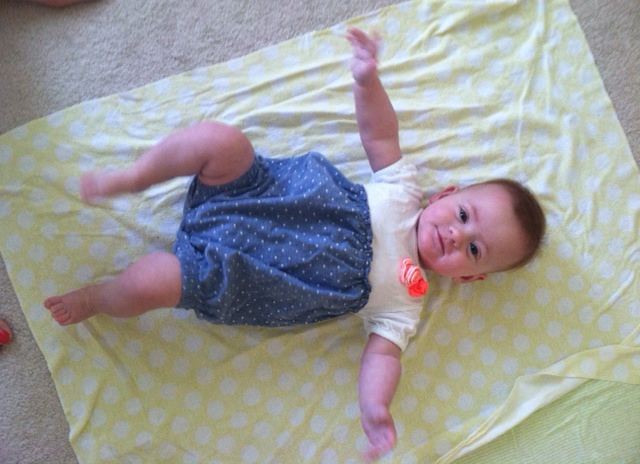
Nine months.  Nine months.  Nine months?!?!?!  How is my sweet little peanut baby nine months old?  Where did this head full of hair and this chatty personality come from?  I feel like I blinked, and she’s a kid.  I said as much to a friend with a four-year-old, and he told me not to rush it… and I’m not, I’m really not.  But when I think back on the wee little nugget that she used to be – only 2 pounds, 9 ounces when she was born – and then I look at this big, beautiful girl, she just seems so grown up to me.  Don’t get me wrong, though, she’s still very much a little lady baby.

8mos1

Actually, I just applied for social security.

We’ve had another eventful month.  Peanut was out and about and collecting lots of coos and stares all month.  She went to church on Mother’s Day and again the following week, where she was baptized and participated in the “baby parade,” where the newly baptized kids are walked around and introduced to the congregation in an epic march of cuteness.  And a couple of weeks ago, we walked in the northern Virginia edition of the March for Babies, to raise money to support the March of Dimes’ research and support for NICU families.  We walked on our NICU’s team and raised over $400 for the cause, so we felt great about that.  Peanut mostly snoozed through the walk, but there was about a half-mile that she did in my arms – she was fussing in the stroller – and she discovered something new: KIDS!  There were two little girls running back and forth on the trail where we were walking, and Peanut was obsessed with them.  She stared at them, babbled at them, and practically tried to climb out of my arms to get to them.  Little one just wanted to play with the big girls.  Someday, Peanut, someday.

How about today?

How about today?

See above?  Peanut is sitting… sort of.  We call this Baby Tripod.  She’s working on her sitting and rolling skills, and she’s getting pretty good at rolling.  She rolls from back to front and front to back with almost equal ability.  On her birthday, she did five big rolls in a row for me… methinks it’s time to baby-proof the house.  (Yeah, I haven’t done that yet.  I didn’t see the point until Peanut showed signs of getting mobile.  Well, she’s showing signs… so we’ll be engaged in a big baby-proofing adventure very soon.)

8mos3 Ripping out eyeballs is how I show my love.

Peanut also spent some quality time with her aunties this month.  Aunt R drove up to be Peanut’s godmother.  (Is she a lucky baby or what?) Peanut thanked her by caressing her cheek and then trying to rip her face off.  She also enjoyed a visit from Aunt G.  They laid on the floor together and mugged for the camera.  Peanut has the open-mouth smile down, but she hasn’t quite mastered the crazy eye yet.  Good thing she has her aunt to teach her.

Be afraid.  Be very afraid.

Be afraid. Be very afraid.

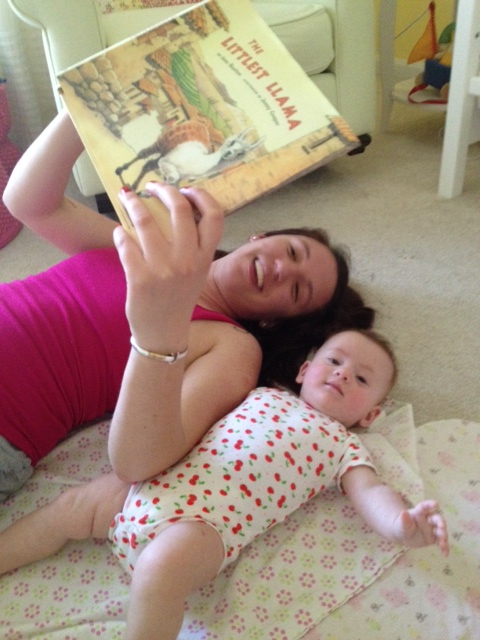
It was her last month with Auntie Em nannying for her, so she soaked up plenty of snuggles, songs and stories (with the books held high out of reach so that Peanut can’t eat them).  Auntie Em leaves for grad school at the end of this week, and Peanut is really going to miss her.

Bring that book closer, will ya?  I... uh... can't see the pictures.  Yeah, that's right.

Bring that book closer, will ya? I… uh… can’t see the pictures. Yeah, that’s right.

Peanut at Nine Months:

Adjusted Age: 7 months

Weight: 15 pounds, 0 ounces

Clothing size: Just moved into 9 month clothes.  Babies have the best deal ever.  A new wardrobe every three months… how do I get a piece of that action?

Sleep: Pretty good.  We had a big weekend last weekend, with some resulting fuss when Peanut got overtired and had a hard time remembering how to go to sleep.  But overall, bedtime is going well, and so are naps.  Knock wood.

Likes: Soccer!  Her grandparents discovered that if you roll a ball to her, she will kick it.  Actually kick it: she plants one little foot on the ground and swings the other at the ball.  And then she lifts up her foot, grabs it with her hand, and holds it out proudly as if to say, “Did you see this foot?”

Dislikes: We’re still struggling with bottles.  Sometimes, she eats with no fuss, but most of the time, it takes a good deal of… persuasion… to get the formula into the tummy.  And by persuasion, I mean: singing songs, walking up and down the hall, jiggling, shushing, and sometimes begging.  I have a whole bag o’ tricks, and I need them ALL.

Favorite Toys: These days, my little reader is all about the written word.  Or… okay… that’s not really true.  What she likes is to gnaw on the corners of the books.  But she’d rather play with a book than pretty much anything else.  If I hand her a toy and then open a story to read, the toy loses all appeal and she MUST HAVE THE BOOK, NOW, MOMMY.  She turns the pages, studies the cover, and then jams it into her mouth.  I’m calling it a win.  Little reader!

Milestones: Rollin’… rollin’… rollin’ on the blanket!  (Sung to the tune of “Proud Mary.”)

Quirks: Still in love with faces, but the love has gotten quite aggressive.  See above: she tried to tear out her godmother’s eyeball, she has also attempted to rip my lips off my face and to pull out chunks of her godfather’s beard.  Love shouldn’t hurt, Peanut.

Bring those sweet lips down here, Mommy.

Bring those sweet lips down here, Mommy.

#Villettealong: Volume I

Villette

Well, this Sunday ended the first part of the Villette readalong, hosted by Beth over at Too Fond.  We were to read Volume I of the novel, which introduces the characters and spends a little time placing them into their setting.  (My edition of the book – part of a volume collecting the complete novels of Charlotte and Emily Bronte – inexplicably doesn’t break the story down into volumes, so I looked up the table of contents on the Internets, and the Internets told me that Volume I corresponded to chapters 1 through 15.  I hope I didn’t get fed a line.)  I had a tough time making time to read this week, between three nights of working late during the week and hosting the grandparents, two aunts, and two godparents for Peanut’s Baptism over the weekend.  So I didn’t quite get through the end; I’m up to about midway through chapter 14.  But I promised you a Villette post today and I don’t want to be late for the link-up, so I’ll give you the story and my thoughts as far as I’ve gotten.

The Story

In the first part of Villette, we meet most of the important characters, including the main protagonist, Lucy Snowe.  Lucy is something of a mysterious character.  She seems to be in reduced circumstances, although just how reduced isn’t clear.  (She seems to be better off than Jane Eyre – she’s not quite as destitute as Jane, and her childhood is rather friendlier.)  The story opens with the young (age 12 or 13, most likely) Lucy staying at her godmother’s pleasant home in quiet Bretton.  Lucy’s godmother, Mrs Bretton, has a son slightly older than Lucy, and she soon takes on another houseguest: the precocious child Polly Home.  Polly’s mother has recently died and her father, to whom she is devoted, is traveling.  Polly at first is bereft, but soon comes to idolize Graham Bretton, the son of the house.  Graham, for his part, enjoys the attention little Polly lavishes on him, but doesn’t seem to realize the depth of the sensitive child’s feelings.

The party at Bretton breaks up, we jump about eight years forward in time and Lucy has moved on, eventually spending one chapter tending to a sick old woman, Miss Marchmont, and it is here that we learn that Lucy is more or less penniless and friendless – although she still doesn’t seem to have been as cruelly handled as Jane Eyre was.  Lucy and Miss Marchmont develop a tentative bond, and Miss Marchmont shares her tragic love story.  When Miss Marchmont dies, Lucy takes her remaining salary and strikes off for parts unknown – first London, where she shows herself around, and then to the continent, to try to land herself work as an English governess (or anything else).  On the ship to the continent, Lucy meets a spoiled young woman named Ginevra Fanshawe, who babbles on about her uncle and godfather, M. de Bassompiere, and her destination: Madame Beck’s, a school for young ladies in the posh city of Villette.  After dawdling in the port city, Lucy decides to head for Villette herself.

Lucy arrives at Villette in the dark and the rain, only to find that her luggage has been left behind.  A young Englishman gives her directions to an inn, but through an accident of luck, she finds herself at Madame Beck’s door instead.  In the dark and the rain of the late night, Lucy knocks on the door and talks herself into a job as governess to Madame Beck’s three children.  Madame Beck is a formidable character, who hires and fires at will, snoops in her employees’ possessions, and rules the school with her whims.  It is through one of these whims that Lucy finds her comfortable governess job snatched from her, and a terrifying post as the school’s English teacher thrust upon her.  After a rocky start, she finds herself at least respected by her students.  She also re-makes the acquaintance of the helpful Englishman who directed her (unintentionally) toward Madame Beck’s: he turns out to be a doctor who attends to Madame Beck’s children in the absence of their regular physician.  Lucy is shy around “Dr. John,” and he doesn’t seem to notice her at all – but she thinks he might have feelings for someone at the school.

The school is an odd garden for Lucy to bloom.  She doesn’t share the other students’ or teachers’ Catholic faith and she’s naturally more reserved and serious than most of her pupils – including the spoiled Ginevra Fanshaw – and colleagues.  This point is brought home when a little box is flung from the window of a neighboring building into Madame Beck’s garden and Lucy picks it up.  It contains a love note, clearly meant for someone at the school, and referring to the “dragon” of an English teacher  Dr. John arrives moments later and takes the box from Lucy, promising to hand it over to Madame Beck.  Does Dr. John know who the letter-writer is, or who the intended recipient is?  Is he himself the letter-writer?  Lucy ponders these mysteries while Madame Beck snoops around and listens in on her conversations.  Meanwhile, the school prepares for its annual fete of Madame Beck and Lucy finds herself swept up into a more central role in the preparations than she had hoped for.

Thoughts Thus Far

After Volume I (or, at least, most of it) there’s still a great deal that we don’t know about Lucy.  How did she come to be so alone in the world?  Her childhood, while not exactly grim – I keep comparing her to Jane Eyre, who did seem to have it worse – was not exactly idyllic, and in her adulthood, she finds herself in the position of having to earn her own living by constantly proving her worth to strangers.  I expect Bronte is withholding the details of Lucy’s early life – while giving us just enough so that we know who we’re dealing with – because she wants the reader to take Lucy as she is, at least for now.

On Twitter, I mused that Lucy is quite brave when she has nothing to lose – departing for London, and then Villette, on a whim when she knows no one in either city – but timid when she is asked to give up a comfortable position.  Left to her own devices, it’s possible that Lucy would have happily spent years tending to Madame Beck’s children.  Instead, she finds herself an English teacher, interceptor of love notes, and play-actress.  Lucy rises to these challenges reluctantly, but rise to them she does.

Madame Beck is another interesting character.  My twenty-first century American sensibilities were offended by her spying and her snooping through Lucy’s personal effects.  Indeed, Lucy shrugged off Madame’s multiple violations of her privacy far more easily than I did.  Perhaps it’s a personality quirk of Lucy’s – that she’s able to forgive and forget (well, forgive) Madame’s spying – or perhaps it’s the times, and employees expected their employers to take liberties with their possessions, or perhaps it’s just that Lucy can’t afford to irritate Madame because if she does, she’ll be “out on her ear” with no money, no reference and nowhere to go.  At the moment, Lucy and Madame are working together a bit uneasily.  I could see the relationship developing into that of great allies or great rivals.

Then there’s Dr. John.  The household staff is convinced that Madame is in love with him and Lucy believes that, if he has feelings for anyone at the school, Madame would be the recipient of his affections.  But Madame is older, likely older than Dr. John, and rather formidable.  I’m not so sure that Dr. John comes to the school so frequently out of some feeling for Madame.  Lucy also speculates about the household staff.  Rosine, the portresse, seems a likely possible recipient of the love note Lucy intercepted.  And Dr. John was on the scene promptly when Lucy picked up the note.  He had a simple explanation – he was attending a patient in another house, saw a handkerchief wave from the school and a box drop from a window – but Lucy doesn’t seem to be completely convinced by his story.  There’s another one to watch.

Overall Impressions

Villette is a more complicated novel than Jane Eyre.  There are more characters to keep straight and more mystery; in Jane’s sphere, things are relatively black and white, but Lucy’s world is populated by ambivalent characters with unclear motives.  Lucy herself is an enigma.  Clearly, she’s got a past, but she’s not telling.  Reading Villette is something of an exercise in filing away clues and anecdotes because I’m convinced they’ll become important later.  It’s almost like solving a fun mystery.

It’s been a tough week for reading.  I have another huge library stack to contend with – more on that later – a big, stressful project at work, and family in town.  There were times over the weekend when Peanut was napping and I wanted nothing more than to curl up with Lucy and friends – but I couldn’t, because I was “hostessing.”  I’m looking forward to life getting back to my nice normal, quiet pace this week, and I expect to make up ground on Villette as soon as it does.

Ranting in Three… Two… One…

It’s only Wednesday morning, and already it’s been one tough week.  I like to keep this space positive and not use it for complaining or venting – that’s what calls to best friends are for.  But there’s been stuff that has been getting me down this week (warning: most of them are traffic-related) and I just want to get it out.  So.

Dear fellow commuters:  When you see a space of about a car length in front of me, please don’t assume that it was put there for your use.  It’s called a “cushion of air,” and in case your driver’s ed teacher wasn’t as good as mine, let me explain: it’s so I don’t hit the car in front of me, which until a moment ago was not you.  I’m generally a nice driver and I probably let more of you in than other drivers, but dang if you’re not taking advantage of me with this cutting-off business.  And that’s just not cool.  I have places to be, too.  Also, green means go.

Dear left lane lurker:  Are you trying to enforce your own brand of speed limit vigilante justice, or are you just clueless?  The left lane is for passing.  If you’re not passing, MOVE OVER.

Dear rubberneckers:  Why do people do this?  Seriously, I’ve never understood it, so please explain it to me.  First of all, the people on the side of the road are probably having one of the top five worst days of their life, and you staring at them isn’t making it any better.  Remember, there but for the grace of God go you.  How would you like it in their place?  And there is a line of cars behind you that would prefer to just get home at the end of a long workday, rather than stopping to stare at a car accident.  So can we please stop gawking at these poor people and just go about our business?

Dear cyclists:  Look, I’m a big fan of bikes.  I’m not one of those drivers who resents your presence or who refuses to share the road.  I have a road bike myself, and I would totally ride it to work if I lived even a little bit closer (as things stand now, it would take me two hours each way).  But some of you don’t seem to understand that you have to follow the rules of traffic, and that sharing the road goes both ways.  That means that when I’m driving through a green light and you’ve got a red light, you’re supposed to stop.  Breezing through the intersection – causing me to have to come to a screeching halt with a line of cars behind me – and then flipping me off (?!?!?!?!) is most uncool.  You’re making all cyclists look bad, and as a cyclist myself, I don’t appreciate that.  If we want to be taken seriously by drivers, we need to obey the rules that are put out there for our protection, ya follow?

Dear rat race:  I know, I know.  I know I just have to accept you, since I can’t escape.  I really do like my job.  I enjoy what I do, and I work with nice people.  And I also understand – and completely accept – that there are going to be days when I have to stick around the office after-hours to get something done (or work on a weekend) and I’m perfectly okay with that.  I make good money, and if I made any more, it would come with serious sacrifices of family time, so I’m happy with the balance I’ve struck.  But when Monday and Tuesday both keep me in the office late – Monday so late that I just barely pull into the driveway in time to tuck the baby into bed – well, my heart breaks a little bit.  Being a working mom stinks sometimes.  I know it could be worse.  I only have one job, and it’s a good one.  But I miss the baby all day, every day, and it’s not getting any easier.

Dear 24-hour day:  My house is a mess, I barely have time to cook, I have guests coming into town, and you keep ignoring my requests to add another couple of hours.  What gives?

Ahhhhhhh.  I feel better.  Thanks for indulging me.  Back to our regularly-scheduled geeking out about books on Friday.

Damn it feels good to be a gangtsa.

Damn it feels good to be a gangtsa.

Mother’s Day 2013

DSC_0294_01

My first Mother’s Day was sort of the most perfect day ever.  Actually, it was a whole perfect weekend.

Saturday started off with a late brunch at Fontaine, a French creperie in Old Town Alexandria that I love.  We hadn’t been there since before Peanut was born and I have been really, really wanting to go.  Hubby and I did a few test runs at our favorite pizza place and Peanut was relatively good (there was some carseat-related fussing) so I thought she’d be okay to eat at a nicer restaurant, and I’ve missed Fontaine.  It’s a small place and there isn’t really room for a carseat, so she’d have to sit in my lap and I expected that she’d fuss less in my lap.  I was right: she sat happily in my lap for the entire meal, playing with a toy and occasionally making a grab for my fork.  I had the “Parisienne” crepe (roast chicken, ratatouille and Brie) and hubby had the “Norwegian” (smoked salmon, crème fraiche and caramelized onions).  Delish.

That was that for Saturday; we’re trying not to overwhelm Peanut with activities, especially since she’s being baptized next weekend and that requires going off schedule a bit.  So the rest of the day was spent playing with Peanut, reading some of Winnie-the-Pooh for quiet time, and reading to myself (The Iron King, by Maurice Druon, which is great so far) or knitting (I’m working on a little baseball-style raglan tee for an acquaintance’s baby, also a NICU kid) while Peanut took her afternoon nap.  We did take a family walk before dinner, which was wonderful.

On Sunday we got all dressed up and went to church (the pic above was taken on our deck after).  Peanut was a huge hit, especially with the old ladies and another family with an even littler guy.  She sat on my lap, threw toys on the floor and talked the entire service.  Seriously.  You put the girl on the phone with her grandparents and she clams right up, but church was a constant stream of babble (when she wasn’t looking around at the new surroundings or playing peek-a-boo with the lady behind us).  I spent most of the service trying to listen in between mouthing “Sorry!” to people, but no one seemed to mind the noise in our corner.  We’ve lucked into a church that seems to love babies, even when they’re being loud.  (Note: Peanut wasn’t crying or discontented; if she’d been upset or people seemed to be annoyed I would have whisked her out of there and to the nursery.)

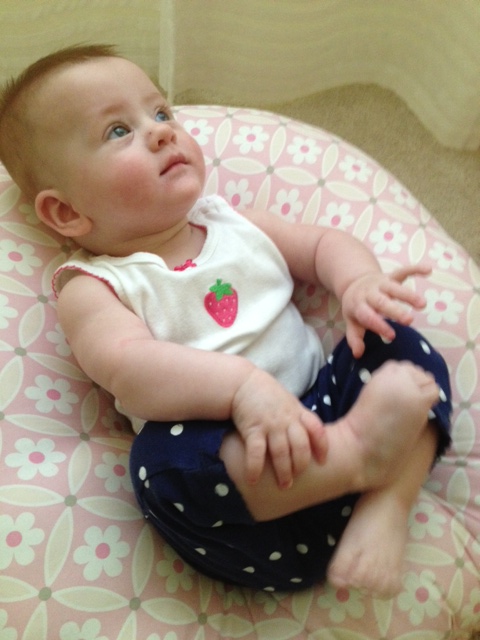
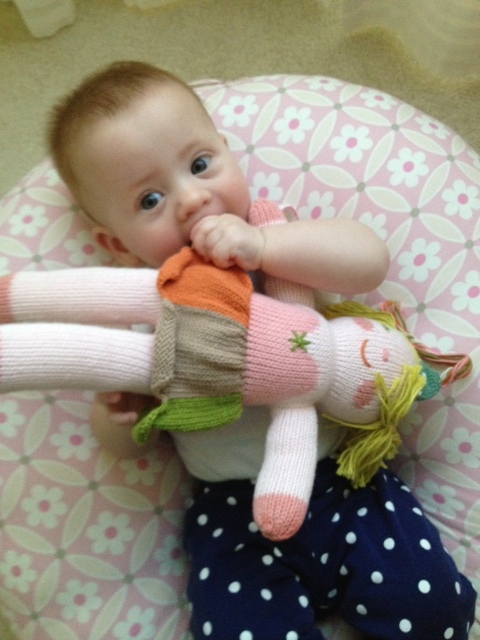
After church we settled in for a day of napping, a bath for Peanut (and subsequent mopping of the kitchen by hubby, since Peanut has discovered that if she kicks her feet, water goes everywhere, wheeeeeee!) and plenty of reading and relaxing time for Mom.  We finished the weekend with a photo shoot in the Boppy lounger, which as a present to me, Peanut tolerated:

Moms Day 3

Moms Day 4

Moms Day 5

Moms Day 6

Love.