Rather another slow reading week – oof. I suspect they’re going to be like this for awhile – at least another few weeks, if not longer. It was another busy one at work, and long days of working until after 8:00pm left me with very little energy to spare for anything else, including reading. This is going to be another busy week, but I have to find ways to balance it out a little better, so I’ll be working on that.
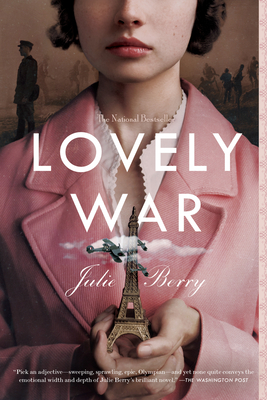
But about the reading I did do. I finished up Death on the Down Beat early in the week and absolutely loved it – such a fun format (I always enjoy an epistolary novel) and a great premise. I didn’t guess whodunit, and it was fun to be surprised. I’d thought I would finish it on Monday night (or even Monday morning over my coffee) but it took me until Tuesday; see above, crazy work week. Then I turned to Sylvia’s Lovers, another one off my Classics Club list and the final Elizabeth Gaskell novel I had yet to read (unless you count The Life of Charlotte Bronte, which was pretty heavily fictionalized… I haven’t read that yet, either). My edition is 460 pages, so I felt that was very doable over the course of a week. But again, crazy work week – and add that to a lot of dialect, and it’s a recipe for slow reading. I’m about a third of the way through now, and cherishing ambitions of finishing it up this week. For that to happen, I’ll have to find a way to balance out my energy levels a bit better. And finally, I started Lovely War on Audible – a World War I love story narrated by Greek gods, how can you go wrong? I’m about two hours into the audiobook and loving every minute.
This week – well, it all kind of depends on how week I do with grabbing a little time to myself around another busy work week plus all the usual demands of parenting. It would be great to finish up Sylvia’s Lovers and after I do, I have my eye on a Tove Jansson book set in October. Well, one thing at a time.
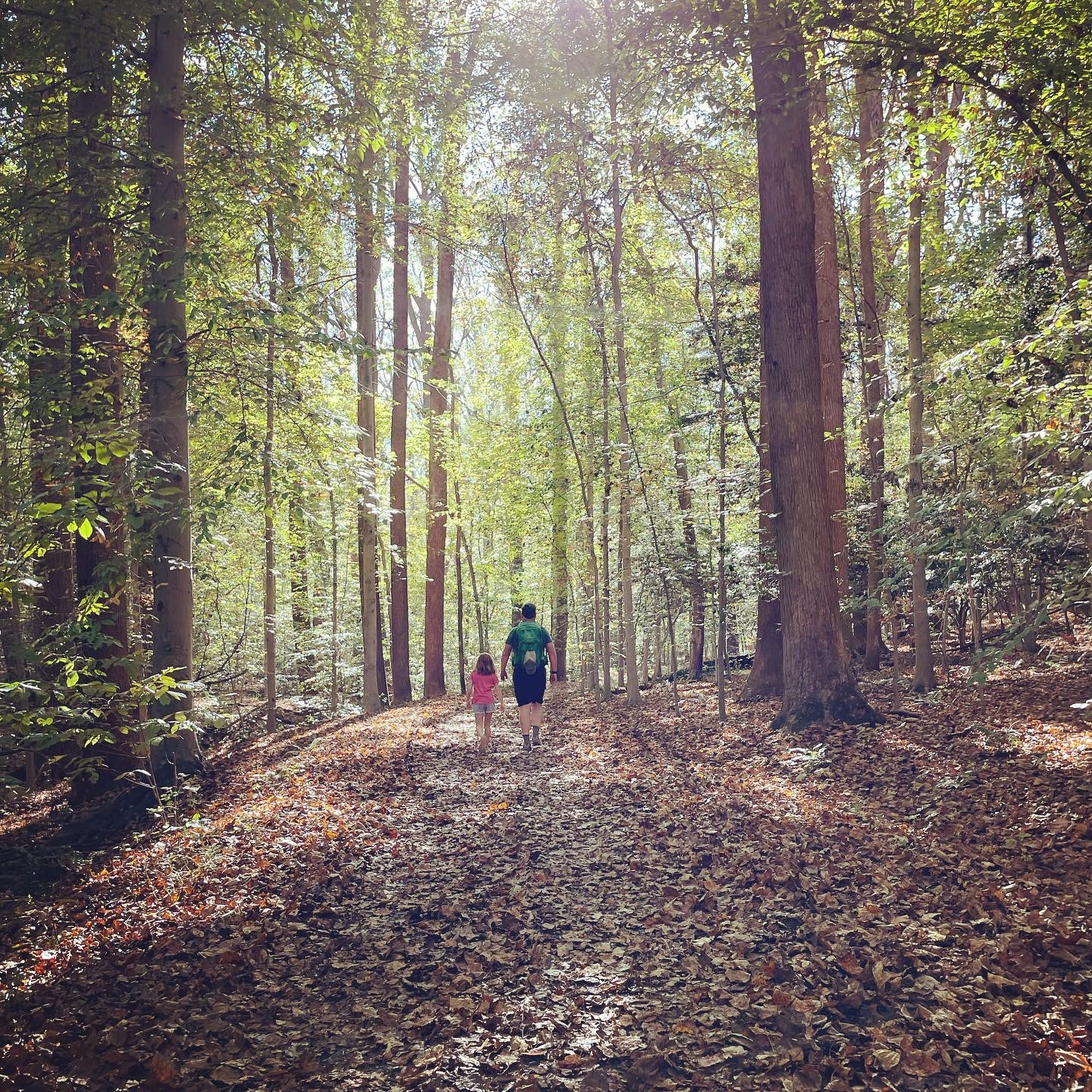
Saturday was a perfect bluebird fall day, just the hiking weather we love on a weekend!
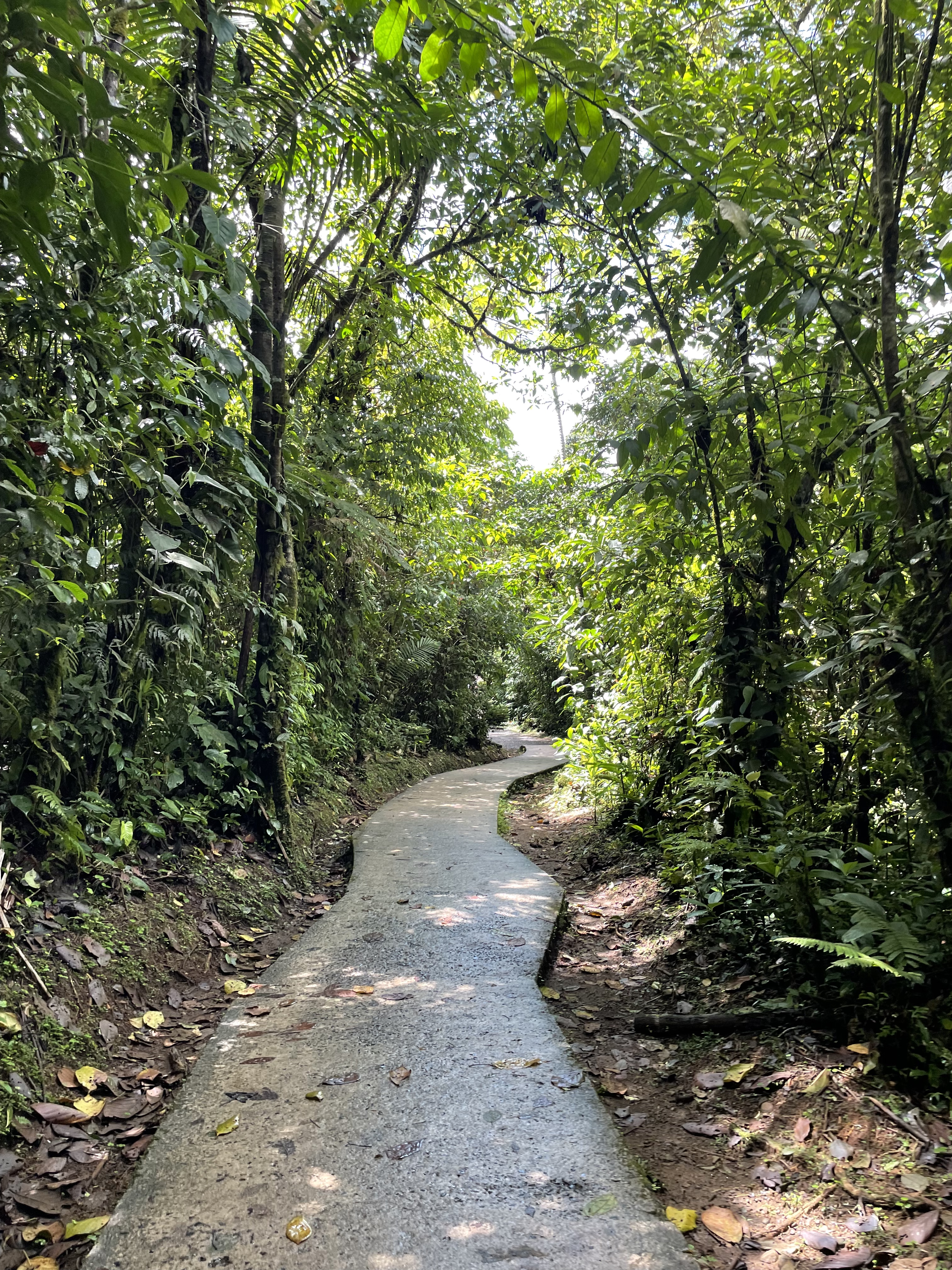
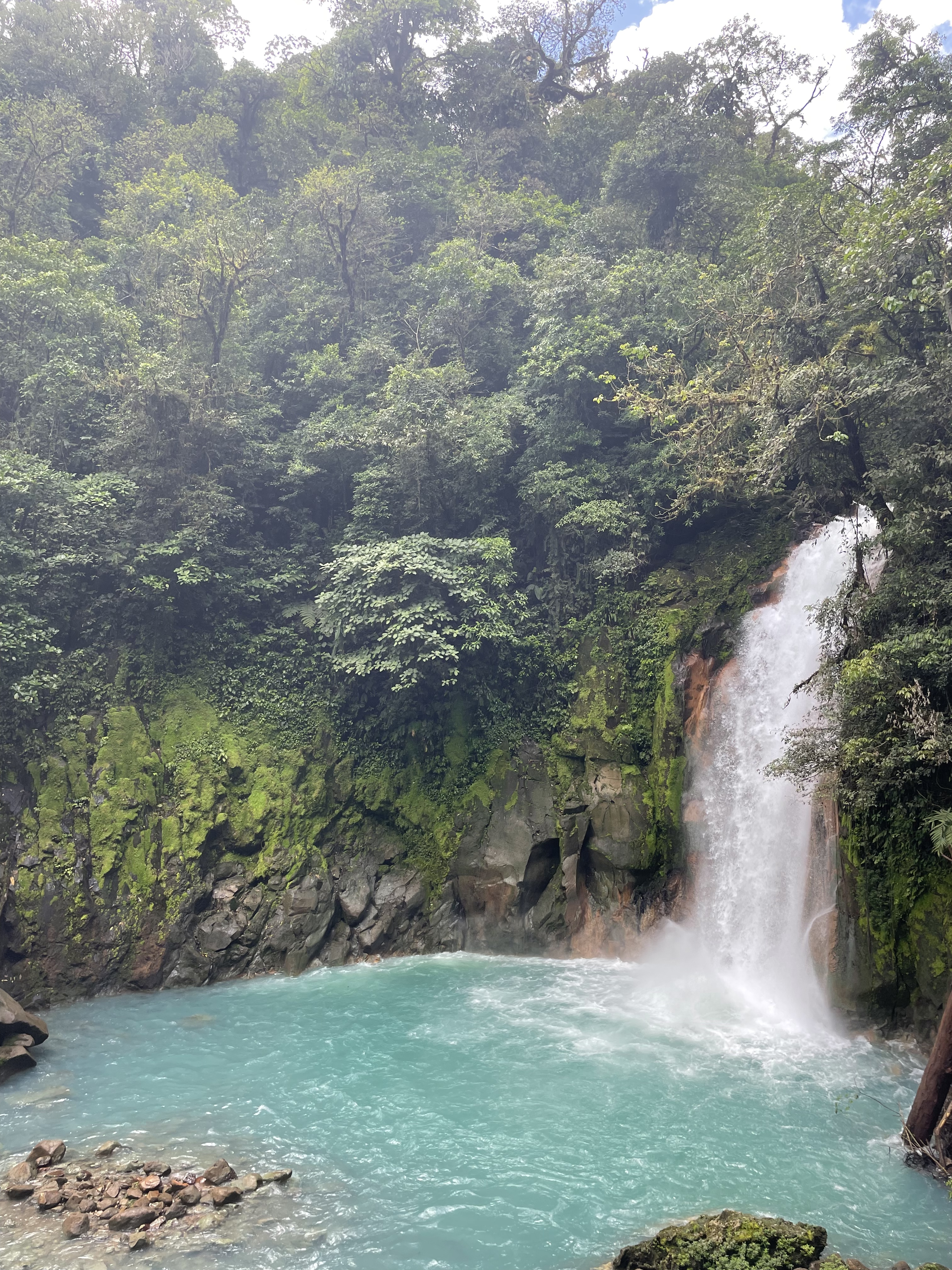
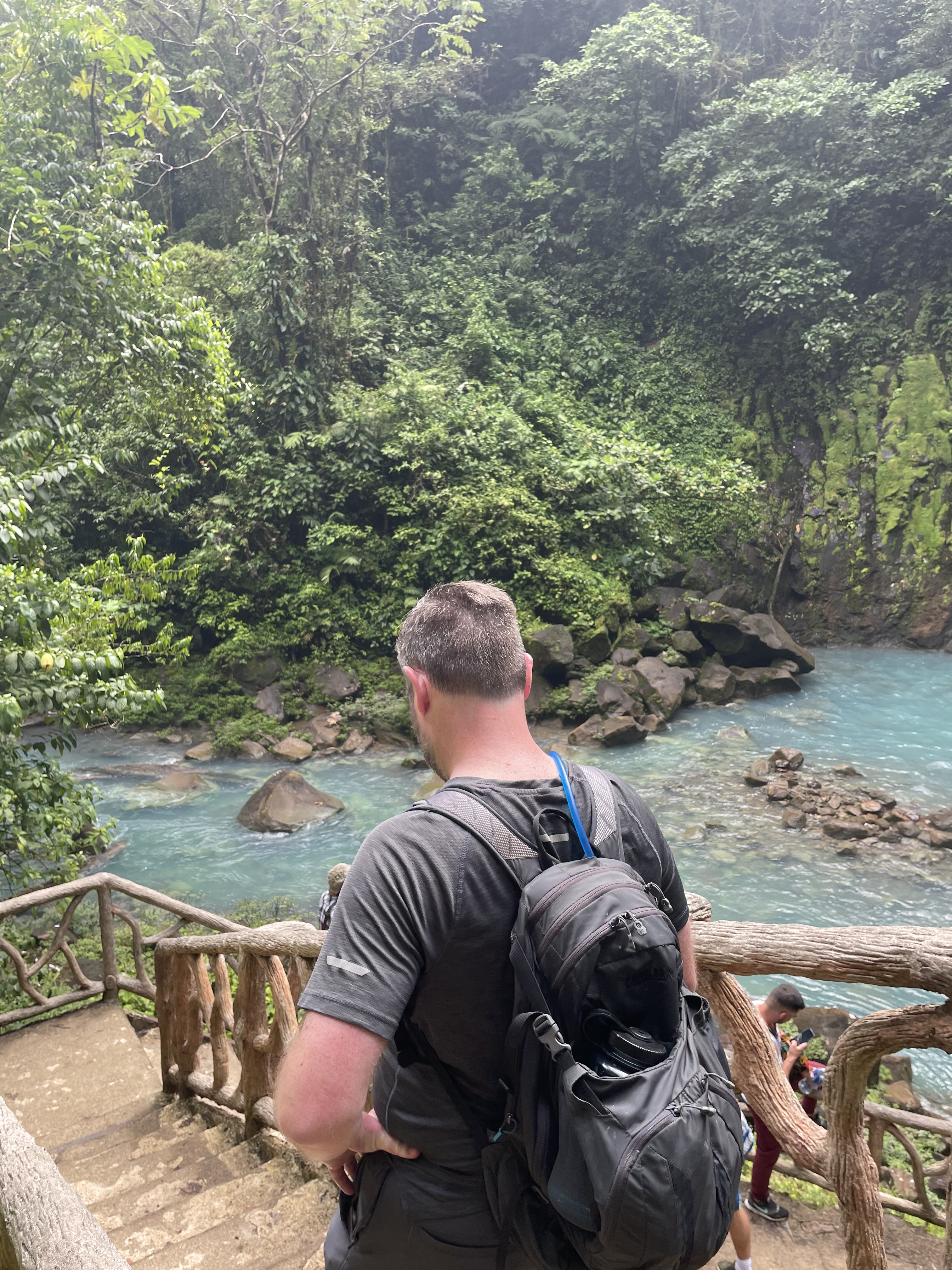
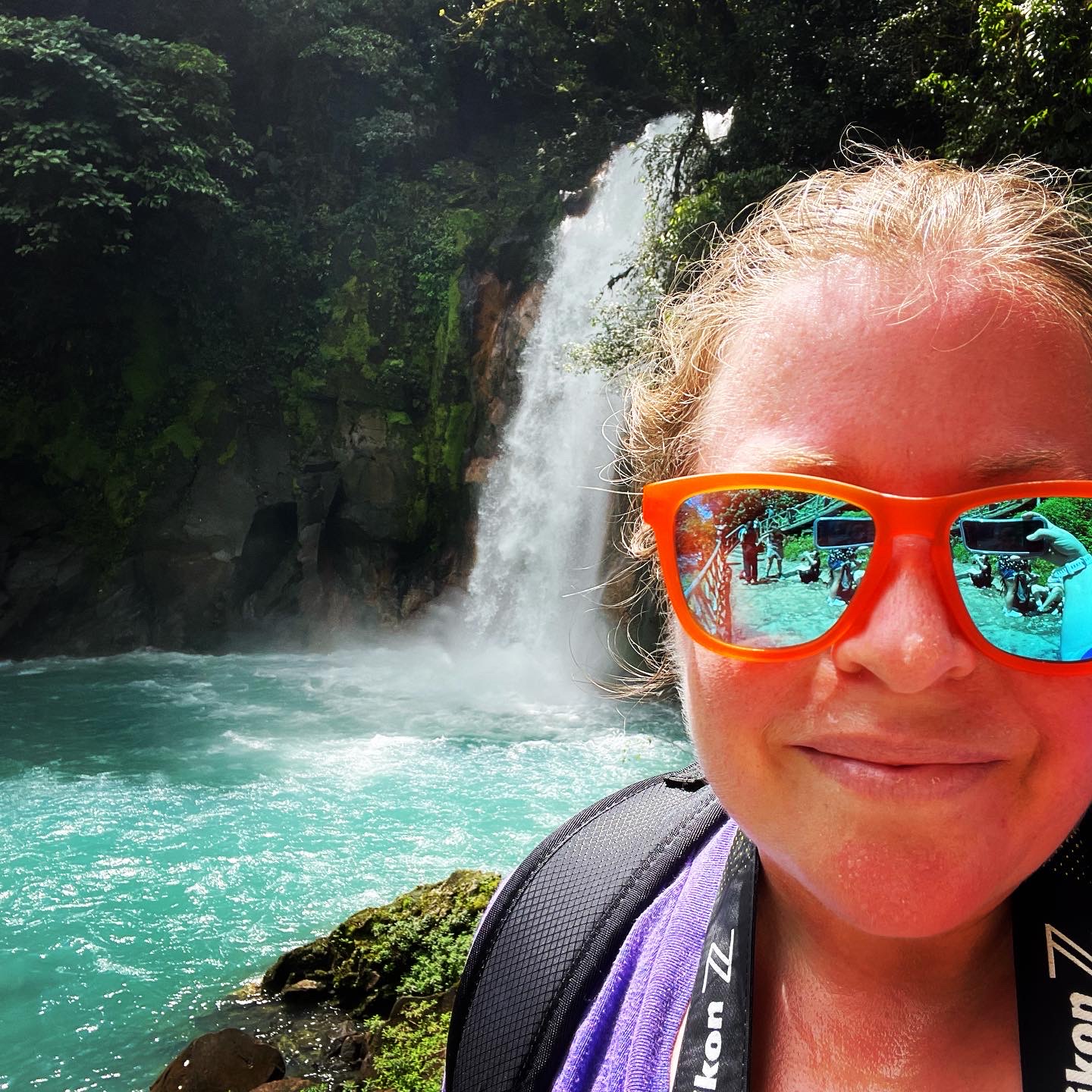
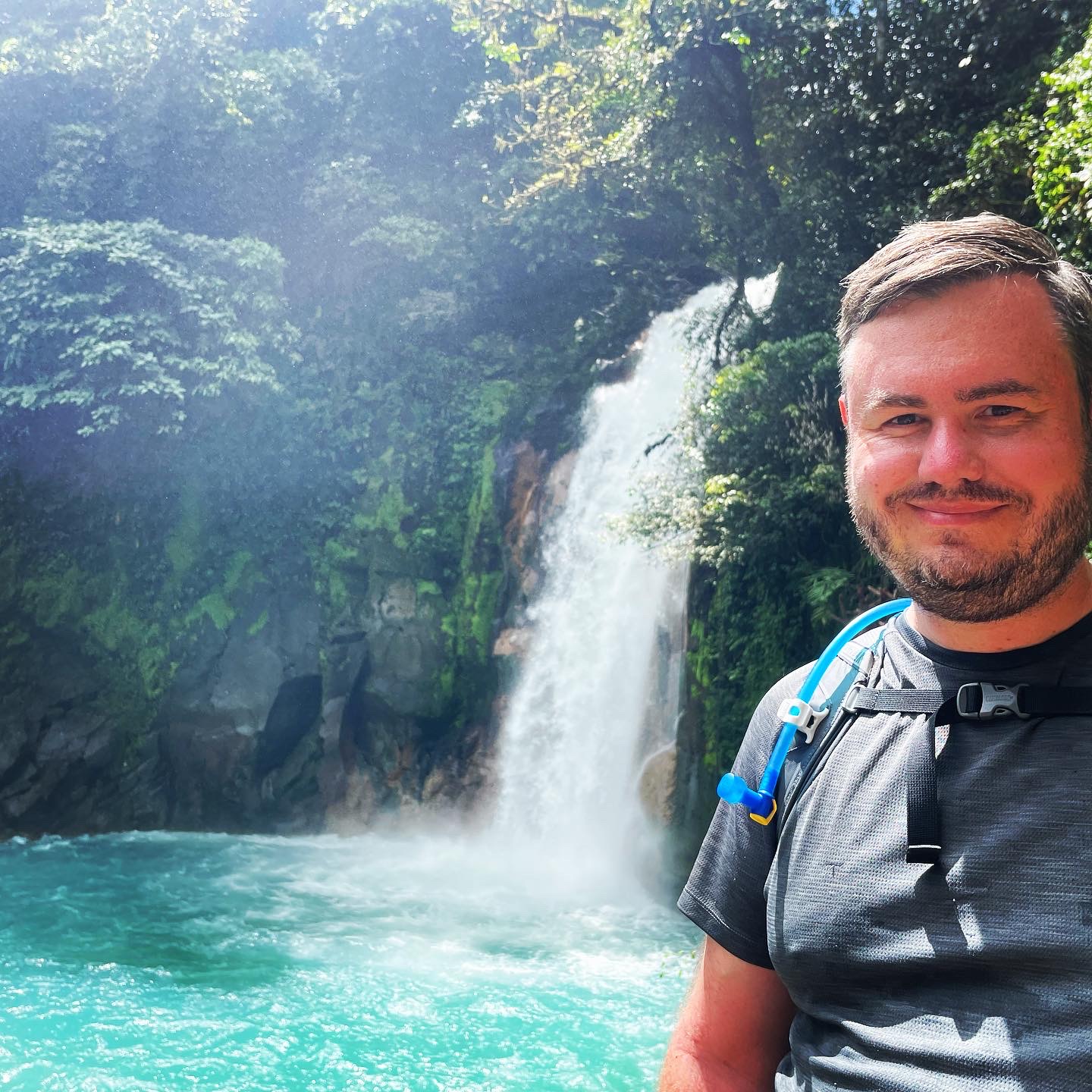
Wrapping up our time in Monteverde, Steve and I hit the road to head to our final destination in Costa Rica: the Arenal volcano region. Since it was a drive of a few hours, we looked around for something to break up the travel time, and I immediately hit upon visiting another of Costa Rica’s gorgeous national parks: Parque Nacional Volcan Tenorio, home of the spectacularly beautiful Rio Celeste. It was a hot day, and we waited in line in full sun for over two hours to get into the park – fair warning to aspiring travelers – but it was well worth it. Once we finally made it through the park gates, we struck off on a shady trail that climbed up, up, up, and then WAY down to this:
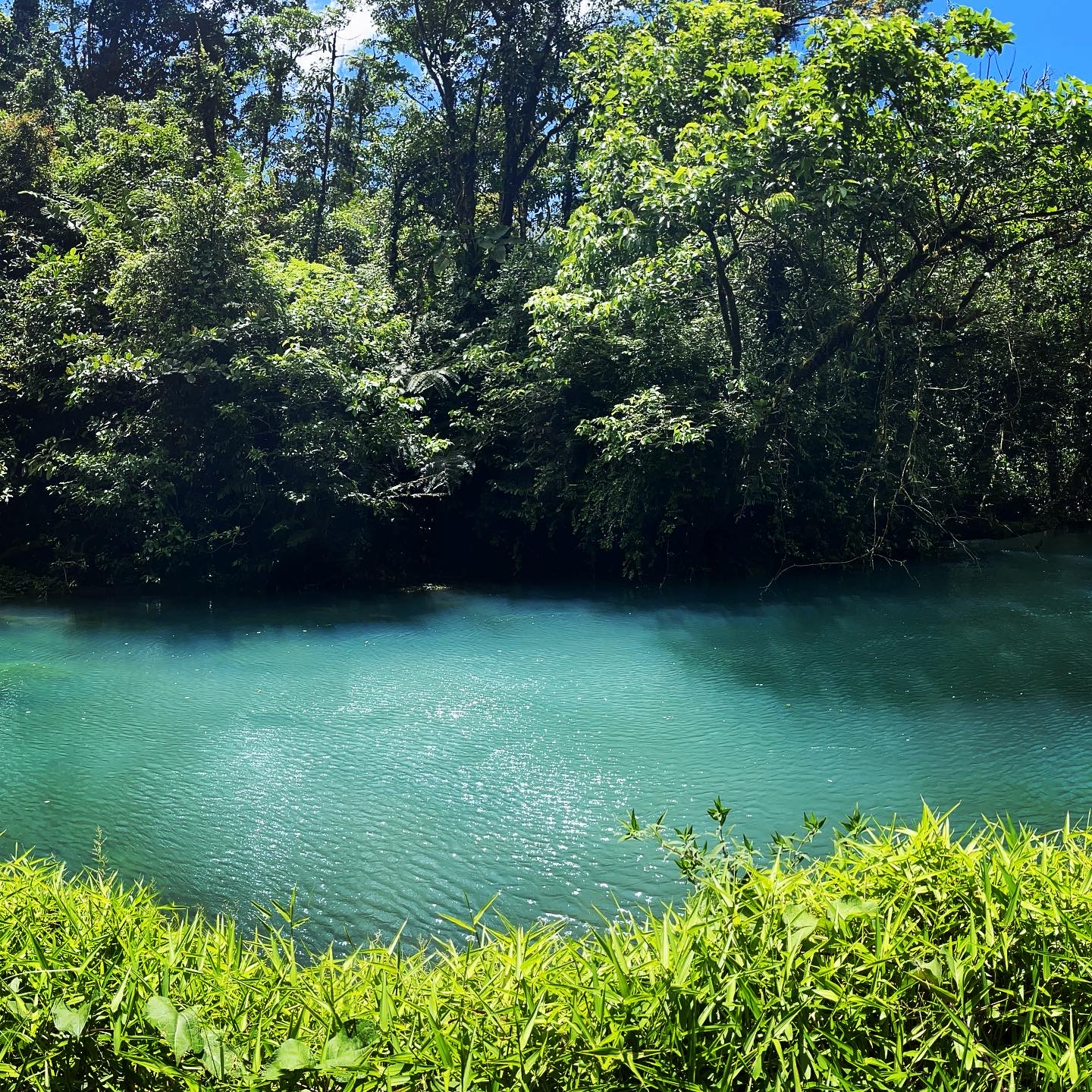
Catarata Rio Celeste pours into a milky, electric blue, pool surrounded by mosses and overhanging trees and spilling out onto a rocky streambed – absolutely enchanting.
Full disclosure: the hike to the waterfall was surprisingly tough. We are experienced hikers and I think we’re decently conditioned to the trail, but this one was actually quite difficult. There were quite a few long staircases – including the last one to get down to the waterfall (and then back up when you were done gorging on beauty) – and sections of sticky mud and uneven rocks and roots. And yet the trail was crowded with Sunday walkers hiking along in delicate sandals and seeming to have an easier time of it than we were. I wonder if it was the altitude? The maximum altitude of the park is over 6,500 feet, and I don’t know how high up this trail was – it did climb a fair amount. So I’m going with altitude. That’s definitely what it was.
I mean. Look at that.
According to my guidebook, local legend holds that when God finished painting the sky, He washed His paintbrushes in Rio Celeste. It definitely checks out.
The scientific explanation is that it’s a mineral in the water, composed of aluminum, silicon, and oxygen, that gives the water that milky, but bright, blue color. (I have to say I like the God’s paintbrushes explanation better…) Well, whatever the reason, it’s stunning.
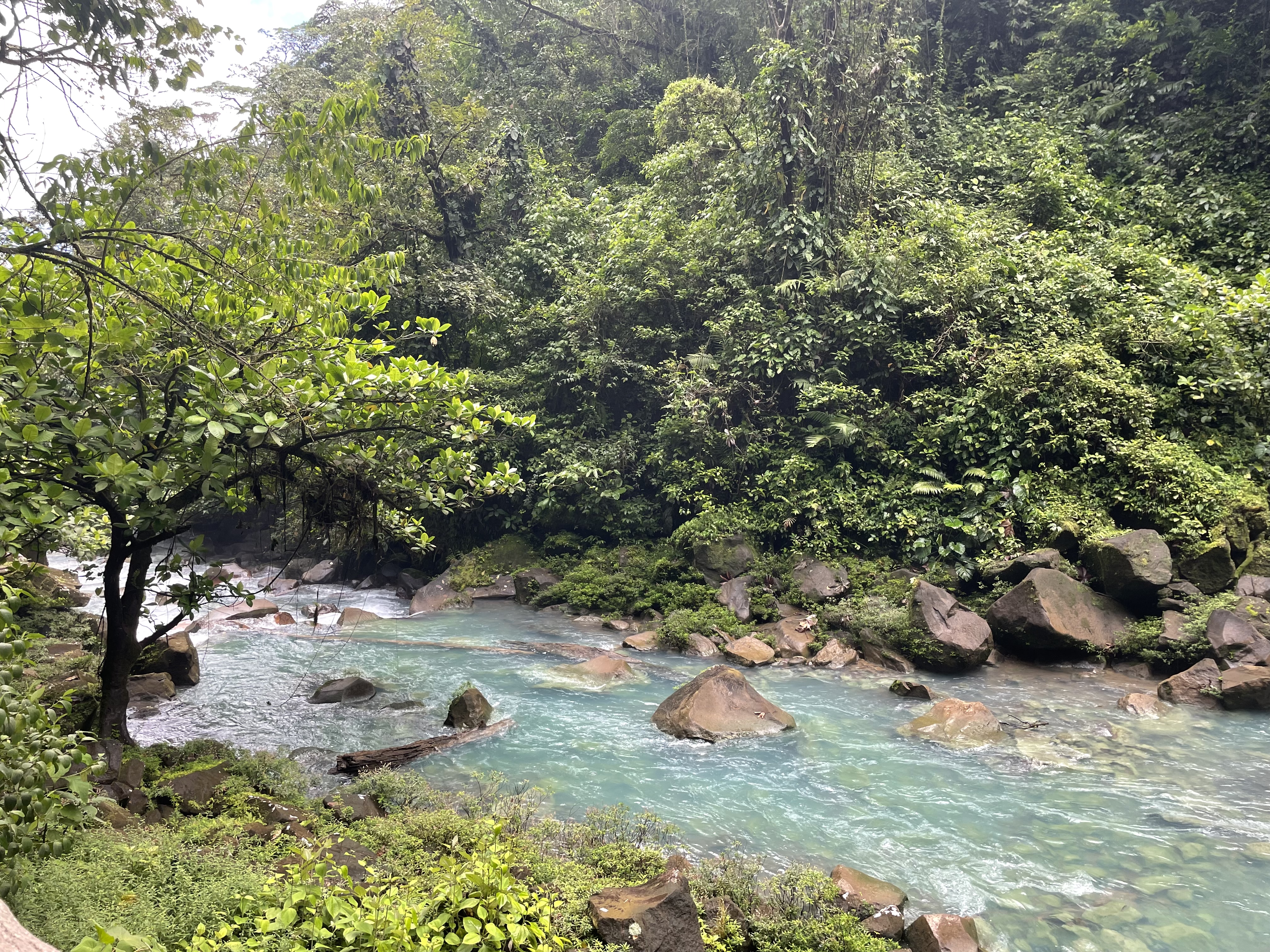
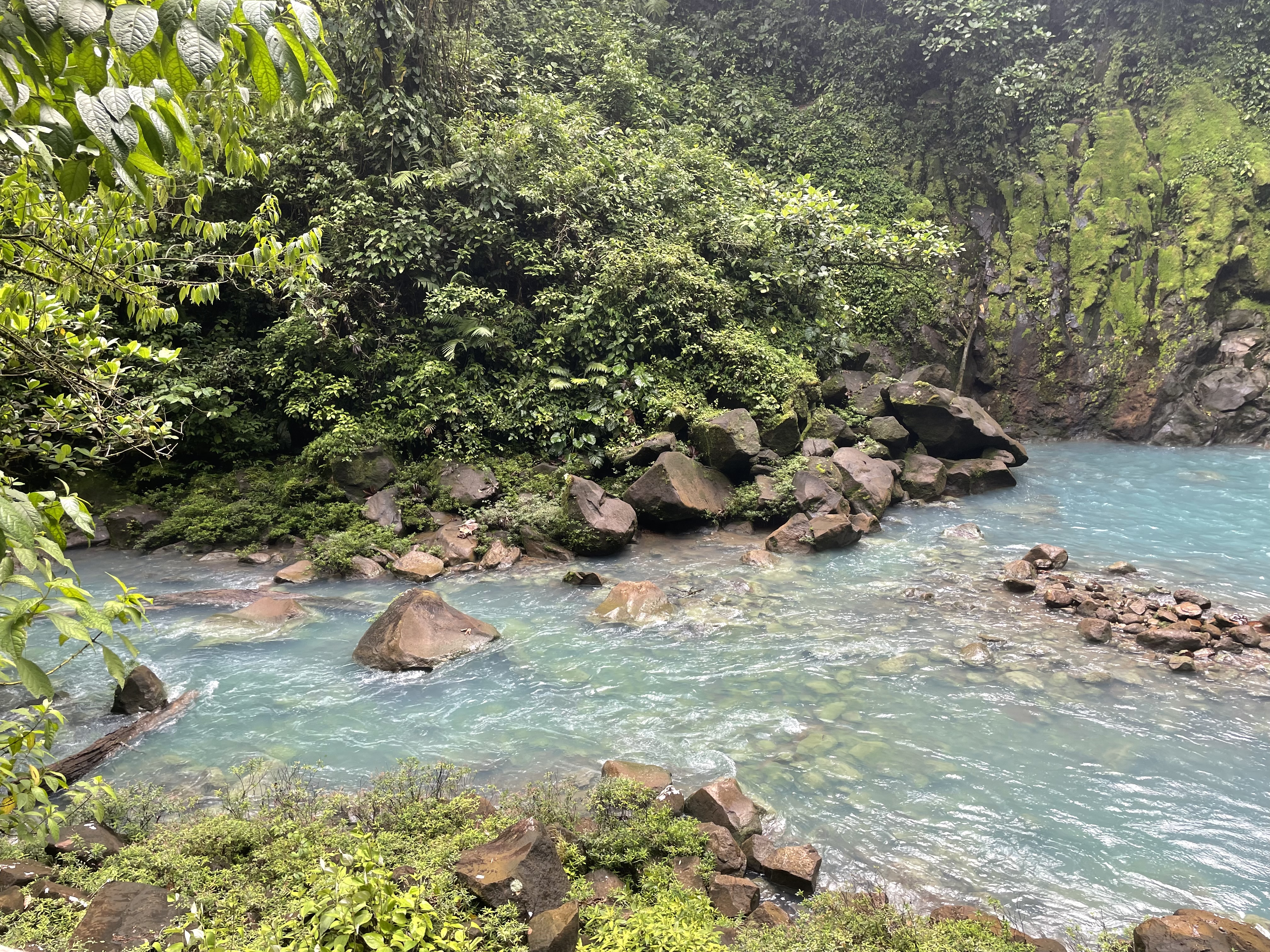
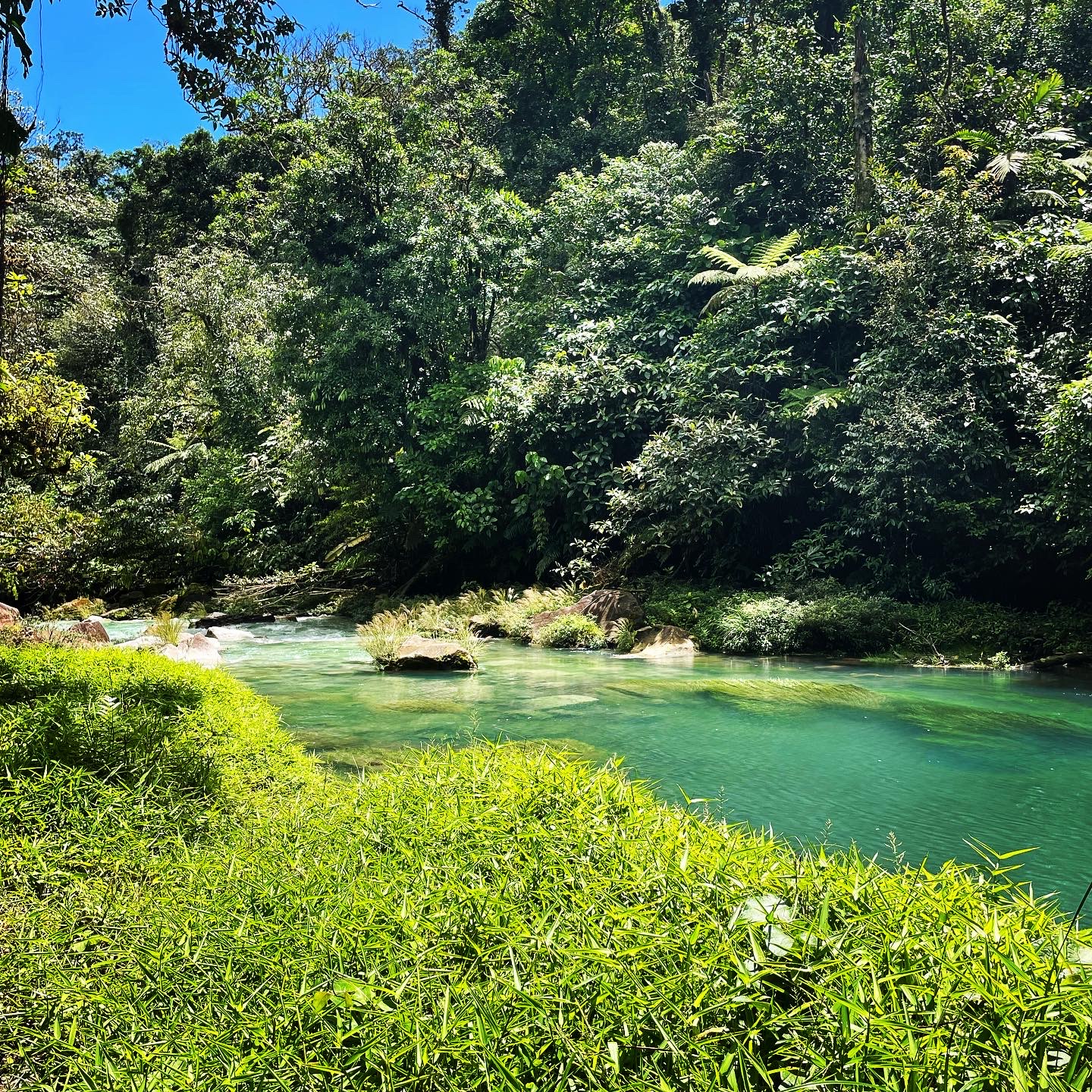
The water continues cascading down the rocky streambed. It’s so beautiful it doesn’t even look real – but I assure you, it is.
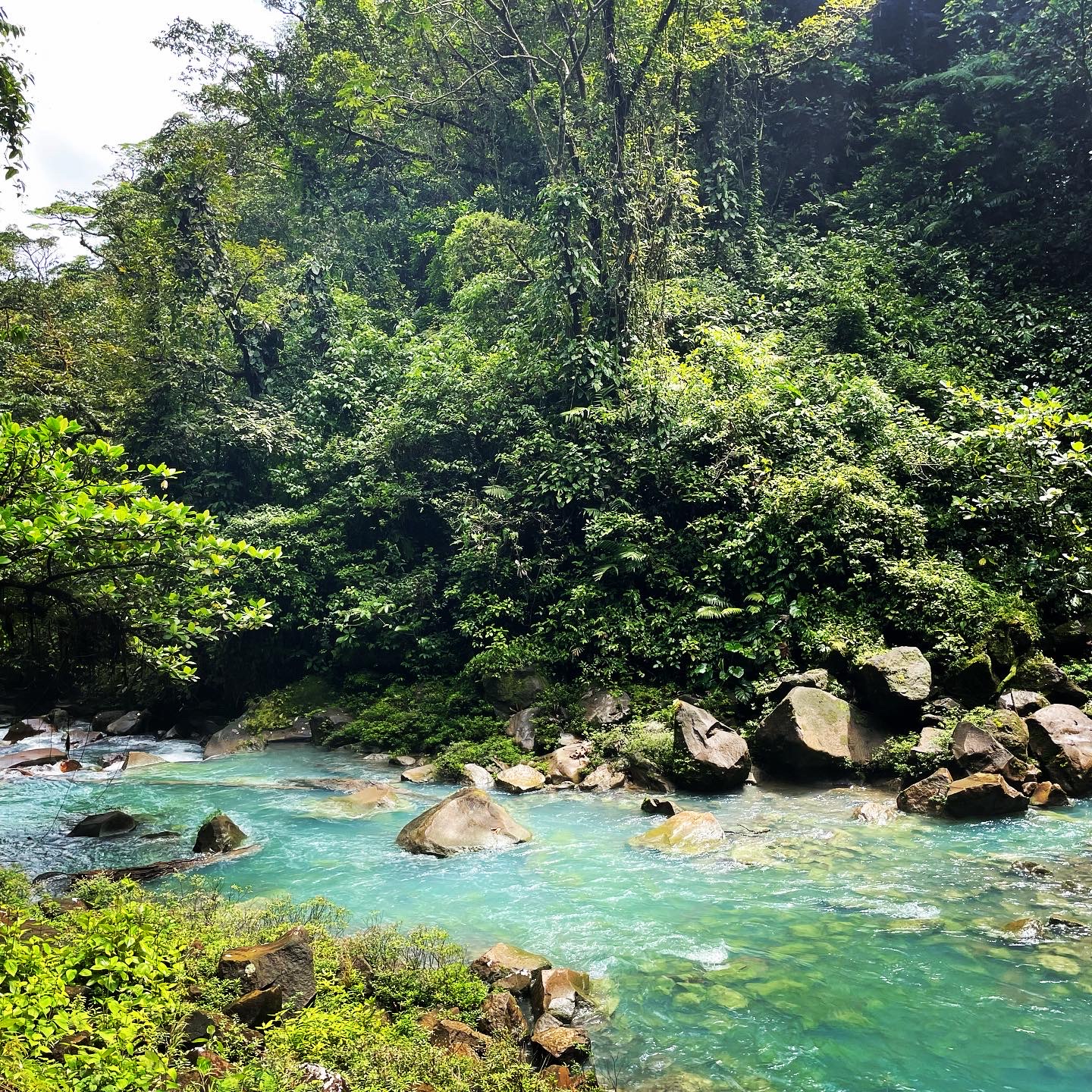
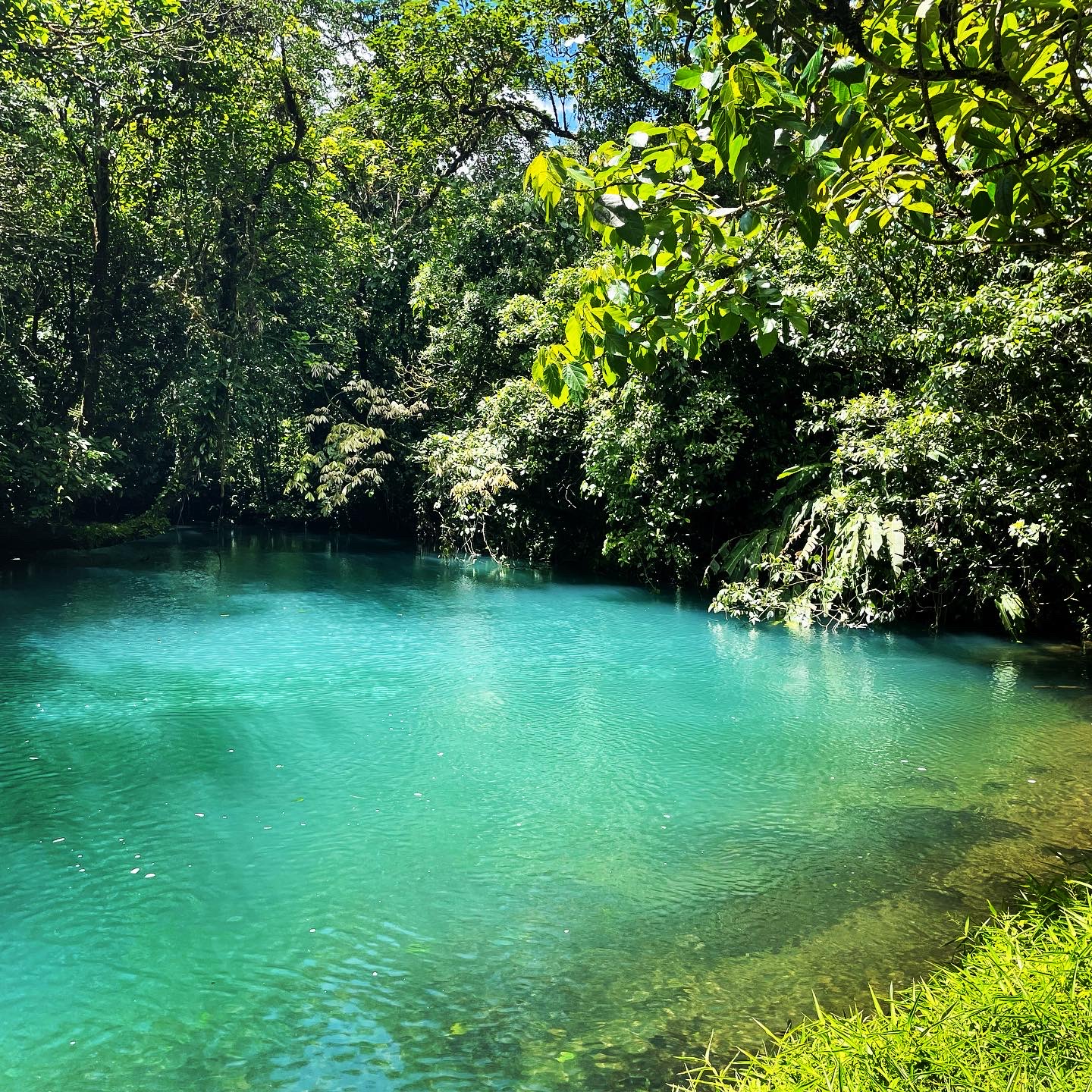
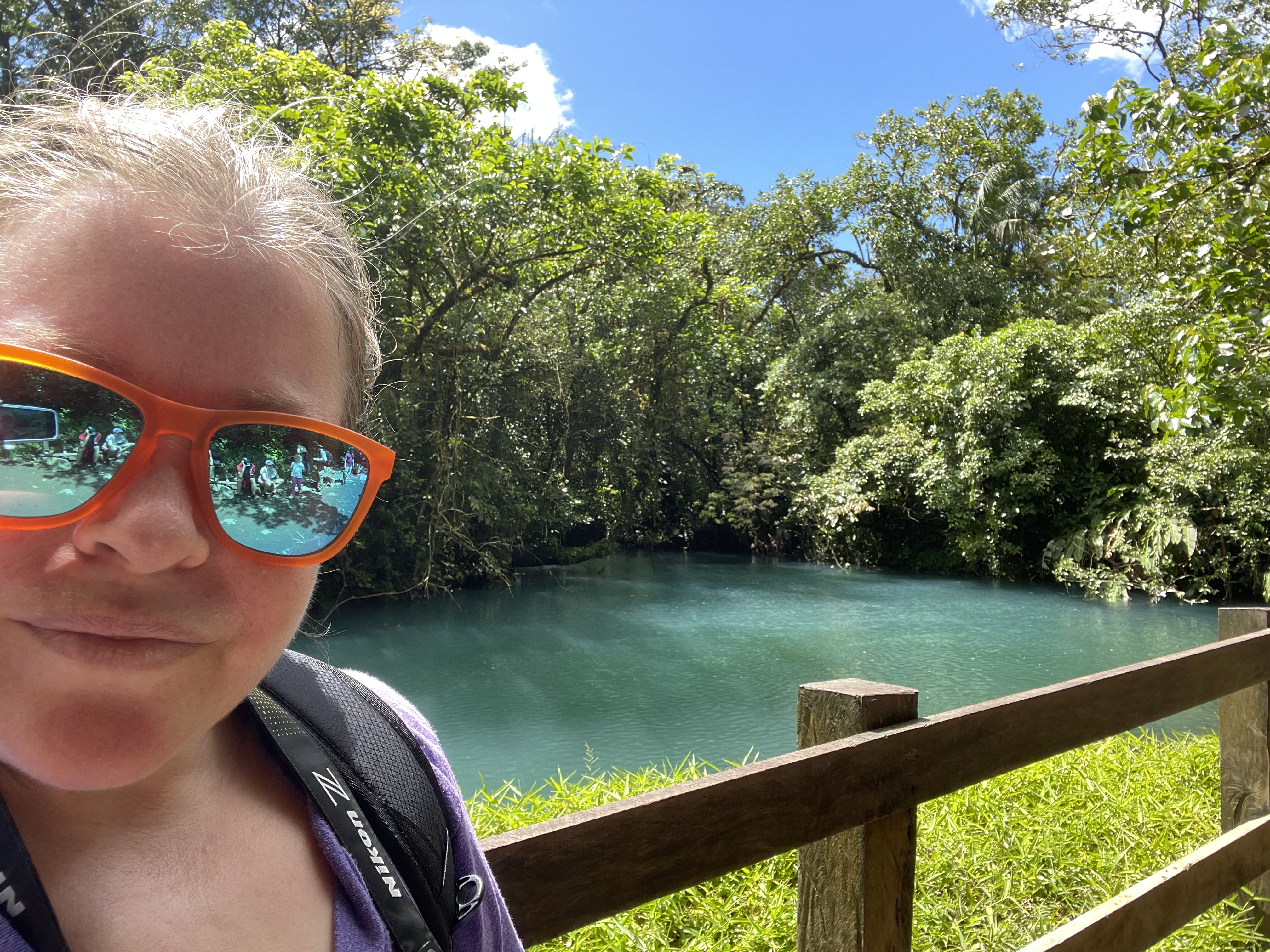
After we’d stood and drunk in the view for awhile, we turned and began the agonizing climb back up the stairs (oof) and then had a decision to make. The trail continues on for miles through the forest, past multiple beautiful landmarks – we could keep following it, or we could turn back (having seen the main view we came for). The next stop on the trail was Laguna Azul, which was only a little more than half a kilometer onward. Now, how could we resist a blue lagoon? Clearly we had to keep going, at least to that point. The mud and uneven ground and climbing continued – if anything, the trail got more intense (but less crowded, so that was something). Was it worth it? See for yourself:
Laguna Azul was cool to see because it’s actually the point where the waters from upstream mingle with the first introduction of minerals, and you can actually see the water changing from clear to milky blue. It was hard to capture, because the camera angle was not good – but look at the far right of the picture above. See how the water is clear, and then it hits the minerals in the lagoon, mingles, and turns opaque? Amazingly cool to see.
Just super, super fascinating and beautiful.
From the blue lagoon, the water continues off downstream – headed for Catarata Rio Celeste, the beauty spot we’d just hiked up from.
I’d have loved to stay and explore more along this captivating trail, but we were hot, tired and hungry – and we had a long road ahead to Arenal. It was time to turn back, and catch one more glimpse from way above Catarata Rio Celeste as we moved on to our next stop. This was just a short interlude, but about as memorable as they come.
Next week: we eat some Costa Rican food! Pura vida!
The back cover of my copy of Invisible Man (which was actually Steve’s copy, from college) characterizes the story as a “nightmare journey across the racial divide” – it checked out. The 1952 novel opens with the nameless narrator describing his life as an invisible man; he squats in a basement and siphons power off the city grid in order to light his room, blindingly, with dozens or perhaps hundreds of lights, secure in his knowledge that he’ll never be caught and brought to account because he is invisible. But the narrator didn’t always know that he was invisible, and his journey to that knowledge is the compelling story that follows.
The narrator turns back to his childhood and to the moment when his dying grandfather cursed him. His grandfather had – as far as the family could tell – been a subservient, quiet and obedient Black man, in short, everything the white men who ran their Jim Crow-era Southern society wanted. But the grandfather tells the narrator that he has actually been subversive, a double agent in effect, and the narrator will be the same. He just doesn’t explain how, and the narrator will spend the rest of his life wondering about this. As a young man, still puzzling over his grandfather’s curse, the narrator writes and delivers a speech about race that garners him an invitation to a gathering of the white city fathers – where he is roped into participating in a “battle royal” with other Black youth, a barbaric ritual that reduces the young men to a humiliating spectacle. He then delivers his subservient speech and is rewarded with a scholarship to a nearby Black college.
At college, the narrator works hard and earns the esteem of his instructors and college administration, and is rewarded with a plum task: driving one of the white donors around on a tour of the campus and surrounding countryside. Matters quickly get out of hand, and the narrator ends up introducing the wealthy donor to a local farmer who the college would prefer to keep hidden (as one who has committed a horrifying crime against nature) and then taking him to recover at a rambunctious local bar, where a brawl promptly breaks out. This disastrous day is – spoiler alert – the end of the narrator’s college career, and he is promptly dispatched to New York City to make his own way. The narrator arrives, starry-eyed, in Harlem – only to discover that his college President has sabotaged his chances of a responsible white-collar job. Instead, he ends up in a paint factory, where he lasts one day before being injured in a workplace accident and spending an unspecified amount of time in a very strange hospital, where he apparently has some kind of bizarre procedure done (to be honest, that section was wildly confusing to me – as I expect it was meant to be).
Emerging from the hospital after some unspecified time, the narrator finds new lodgings and a new lease on life as a celebrated speaker with a Communist organization. He believes that he has found his place and secured an important, responsible job – just as he hoped for after leaving college – but outside forces attempt to warn him that the white men who run the organization do not view him as an equal and won’t hesitate to punish him if he steps out of his prescribed place. Meanwhile, he begins to experience the sensation of being anonymous in a large city – his first taste being a taste, quite literally, of a yam from a cart. The narrator buys a hot yam with syrup, a messy meal he wouldn’t dream of eating in public in his Southern hometown, and discovers that no one in Harlem cares that he is eating on the street.
I took a bite, finding it as sweet and hot as any I’d ever had, and was overcome with such a surge of homesickness that I turned away to keep my control. I walked along, munching the yam, just as suddenly overcome by an intends feeling of freedom–simply because I was eating while walking along the street. It was exhilarating. I no longer had to worry about who saw me or what was proper. To hell with all that, and as sweet as the yam actually was, it became like nectar with the thought.
The narrator, who describes himself as invisible in the opening pages, is also blind to his circumstances. He believes the Communist organization – a shadowy concern known as “the Brotherhood” – considers him an expert on Harlem and an important asset; he fails to recognize that while he has an exalted status as their trophy speaker, they have no interest in hearing his opinions. And indeed, as an anonymous “friend” warns him, the moment he begins to assert himself he is promptly sidelined: sent off downtown to speak on “The Woman Question.” While the narrator is away, Harlem slips from the Brotherhood’s grasp and another trophy Black member and speaker, Brother Tod Clifton, falls from grace and disappears. When the narrator encounters Clifton again, he is selling racist caricature dolls on the street and is shot by police while resisting arrest. The narrator watches, helpless, as his friend and colleague’s life is snuffed out – a cataclysmic event that sets off the chain of events that concludes with the narrator finally realizing that he is “invisible.”
Why had he turned away? Why had he chosen to step off the platform and fall beneath the train? Why did he choose to plunge into nothingness, into the void of faceless faces, of soundless voices, lying outside history? I tried to step away and look at it from a distance of words read in books, half-remembered. For history records the patterns of men’s lives, they say. Who slept with whom, and with what results, who fought and who won and who lived to lie about it afterwards. All things, it is said, are duly recorded–all things of importance, that is. But not quite, for actually it is only the known, the seen, the heard and only those events that the recorder regards as important that are put down, those lies his keepers keep their power by.
The entire narrative does have a dreamlike – or nightmarish – quality, with strong magical realism effects throughout. The narrator seems to swim through an increasingly opaque soup of circumstances, and is nearly always in the dark. At the beginning of the book, he describes himself as living in a blinding light box, which he likes – having spent so much time in darkness. (He’s referring to his sewer escape, but the reader knows the darkness is symbolic, too.) But this light is more than just the literal lighting arrangement in the narrator’s room, and is more than just a reaction to time he spends hiding in a sewer at the end of the book; it’s a metaphor for his transition from wilful blindness as a striving college student and “Brother” to an embracing of his own invisibility, and his own existence as a personality outside of recorded history. The light the narrator surrounds himself with symbolizes the dawn of his own consciousness that these organizations that purport to uplift him are actually reliant on him staying quiet and remembering “his place” – and that as soon as he steps outside of his prescribed roles, he will be immediately punished and sentenced to obscurity, or to put it another way – invisibility.
I could go on and on and on… and on… about this book. The edition I read was over 580 pages and there was something thought-provoking on every page; it could be material enough for an entire college course and there’s no way to do justice to the book in one blog post, however long-winded. I found myself focusing on the elements of illumination and darkness; transparency and opaqueness; visibility and invisibility, that swirled in a confusing cloud throughout the book. It was a fascinating read, and I can see myself returning to it again to see what else is there that I missed on this first round.
Have you read The Invisible Man? What did you think?
Late post this morning, sorry about that! Just another (Mon)day in paradise – what can I say? The to-do list grows longer and time seems to fly faster and faster, with limited time for reading and even less time for writing about reading. But I still power through.
It was actually a pretty decent reading week, last week – pretty productive and very mysterious. I absolutely loved Death in Captivity, by Michael Gilbert, and found myself feverishly turning pages because I just had to find out what was going to happen, but at the same time dreading the last page because then it would be over and I would have to say goodbye to the characters. Next I moved on to Miss Pym Disposes, to which I’d been looking forward but which proved disappointing – the plot was slow and plodding, which wouldn’t have been a huge problem but for the casual racism displayed by many of the characters. (I will allow for a book being “of its time” and consider dated language as a drawback and a moment for reflection on social progress, but there was more of it than usual in this one and it was upsetting.) I’m not giving up on Josephine Tey, since I’ve loved her other books, but I may not return to this one for quite some time.
Finally picked up Death on the Down Beat, the latest release from British Library Crime Classics – and this is very exciting! My birthday was last week and as part of a great deal of spoiling, Steve got me a year’s membership to the British Library Crime Classics Subscription. New BL Crime Classics delivered to my door every month – does it get better than that? Death on the Down Beat was the October release and my first subscription book, and it came with a bookmark and some extra materials – a seating plan for the orchestra and a segment of score, both of which are relevant to the mystery of who shot a provincial orchestra conductor in the middle of a performance. Intrigued, aren’t you?! Bonus – this is an epistolary novel, which is one of my favorite formats. I have been flying through it and am about forty pages from the end, and still deliciously baffled.
Next up, I think I’ll probably turn back to my Classics Club list – I have my eye on Sylvia’s Lovers, which is the last Elizabeth Gaskell on the list. Watch this space!
Weekend hike at one of my favorite spots – I love a good wetland! The autumn colors were out in force and so beautiful.
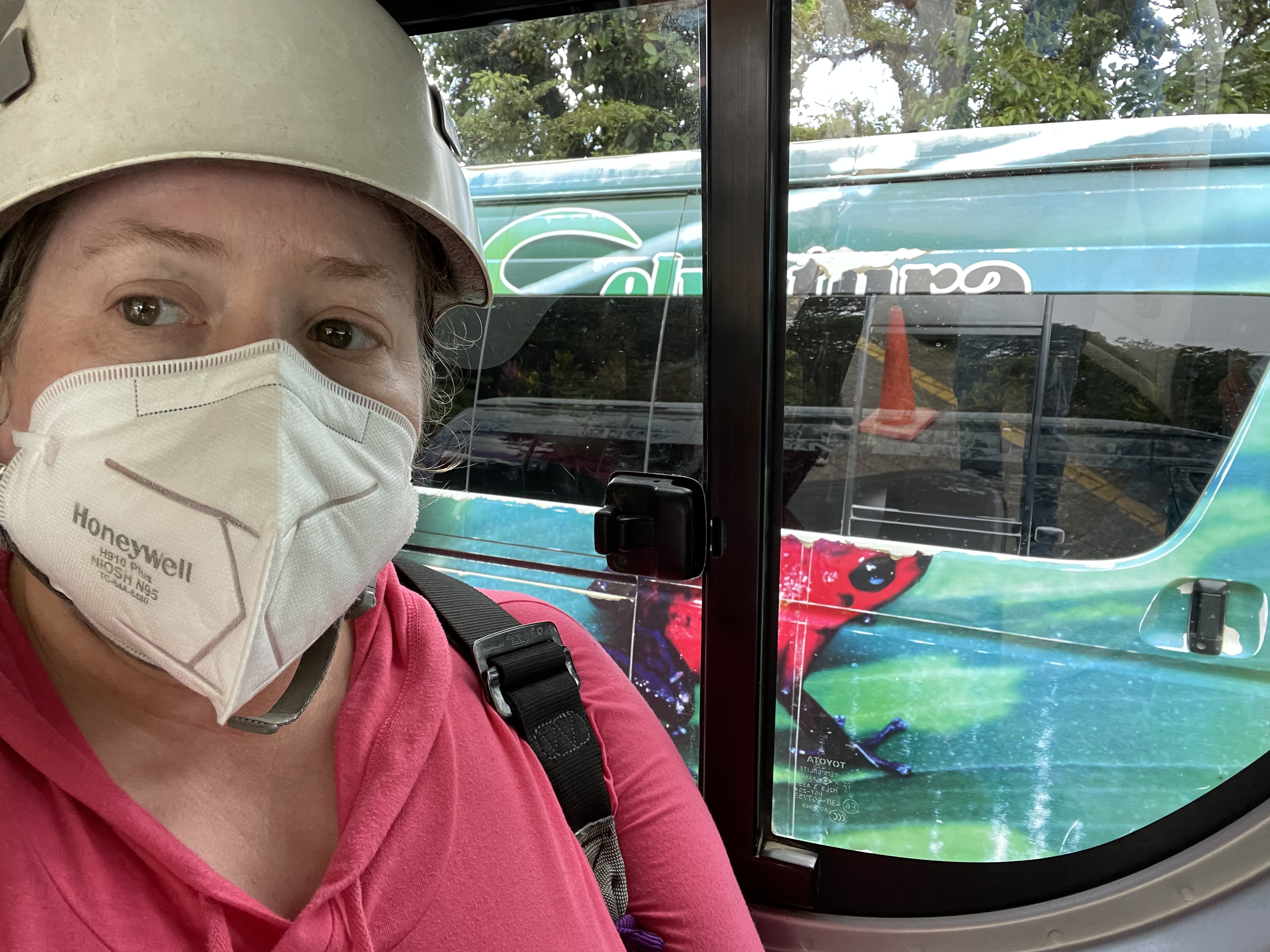
On our last afternoon in Monteverde, I had a solo adventure planned – ziplining! Steve had no interest in joining me, but I didn’t want to leave the home of ziplining without putting on a harness and finding out for myself what it feels like to fly. At first, I was thinking of doing the Original Canopy Tour, which I had heard was the very first recreational ziplining experience anywhere in the world and is still in operation today – but after chatting with a few different people (including our dive buddies from Osa, Garry and Donna) it seemed like Selvatura Adventure Park, another option, was the most popular. So I booked it, and when the time came left Steve relaxing at the hotel and waited anxiously for a bus to pick me up and drive me to Selvatura.
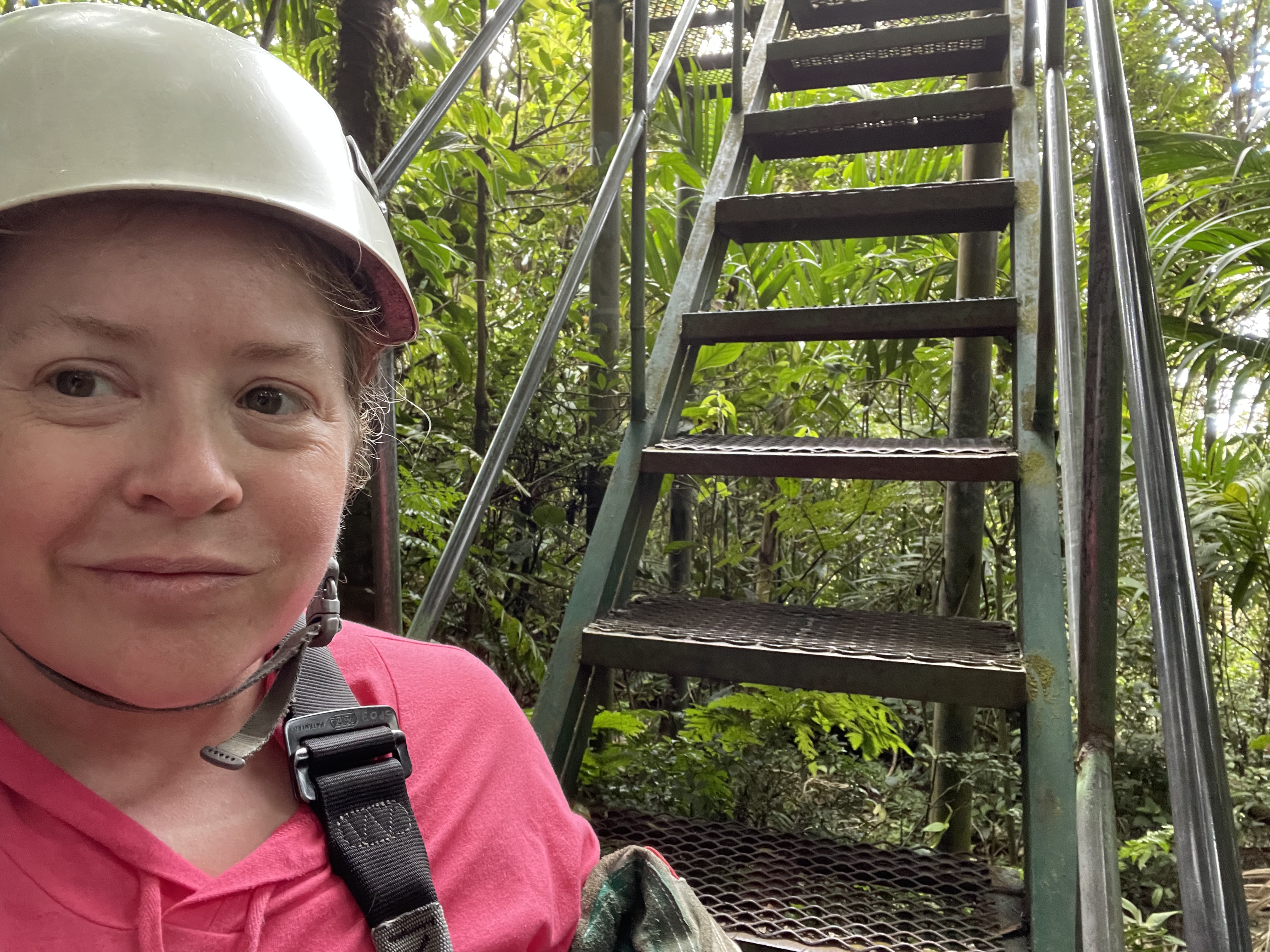
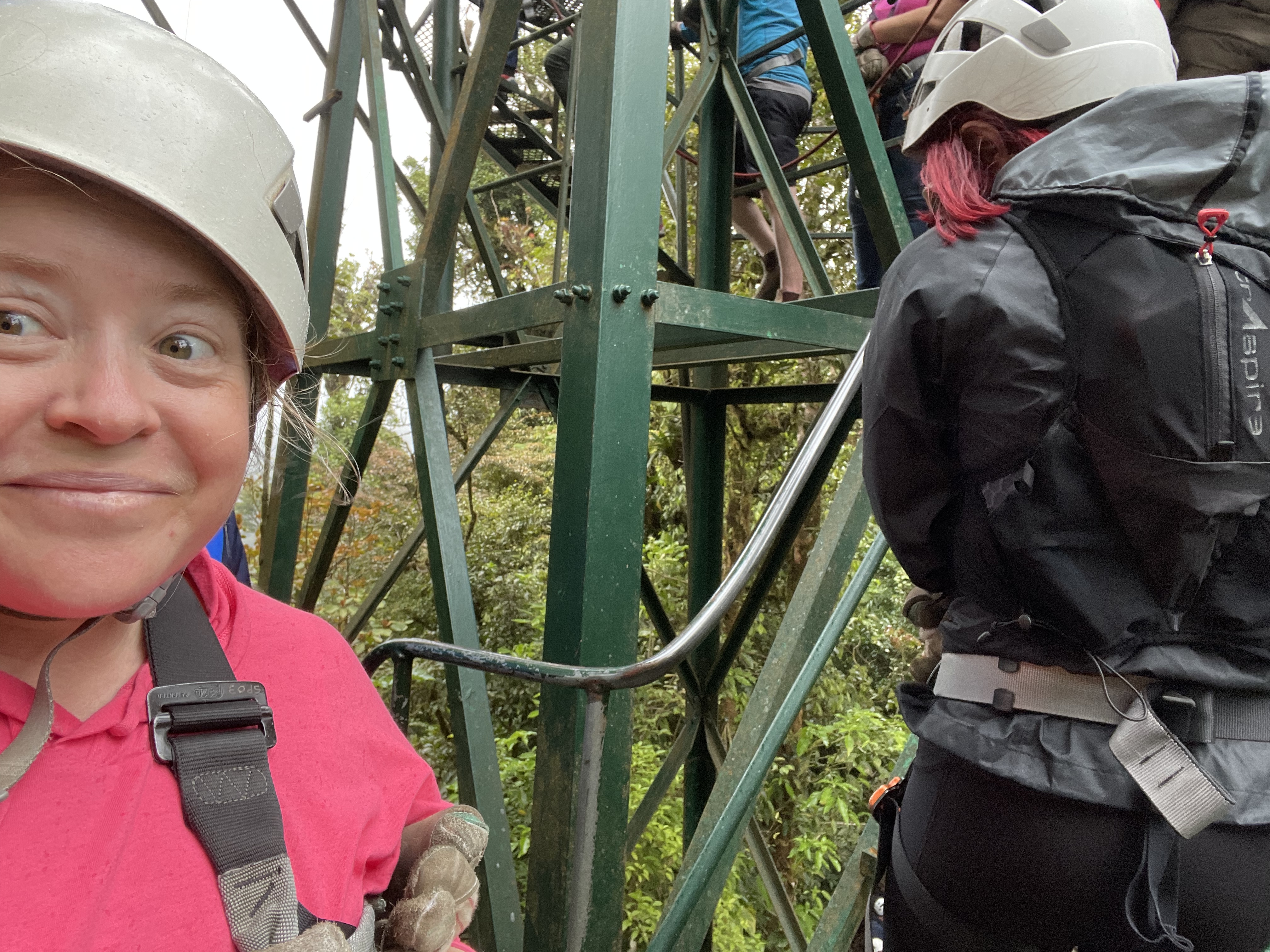
I got to the park, went through an equipment fitting and briefing, and then hopped into another bus to be driven to the first zipline. Along with about twenty other people in my group, I watched two park employees perform a demonstration and before I knew it – it was time to climb the stairs and try it out for myself.
What have I gotten myself into?
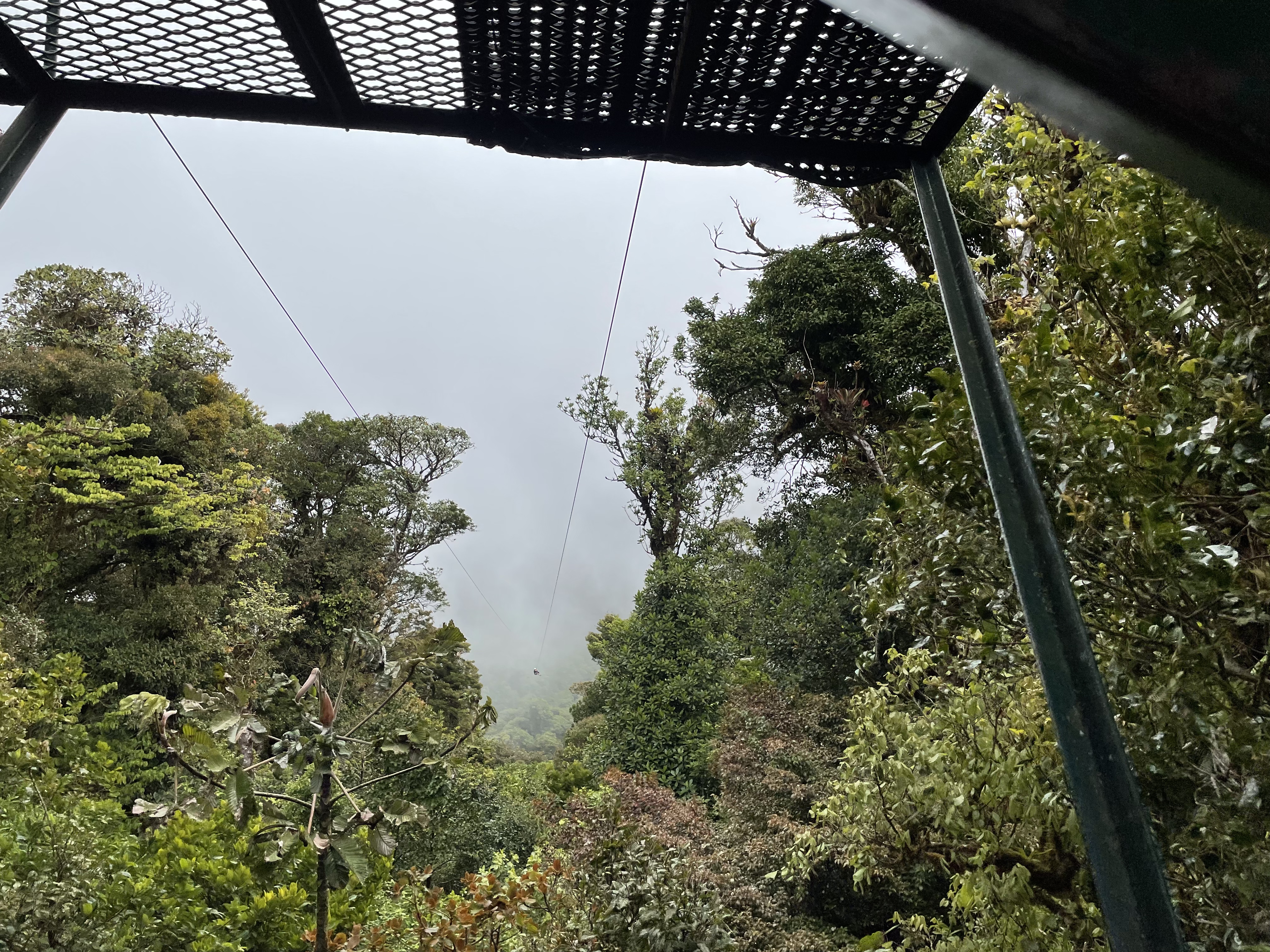
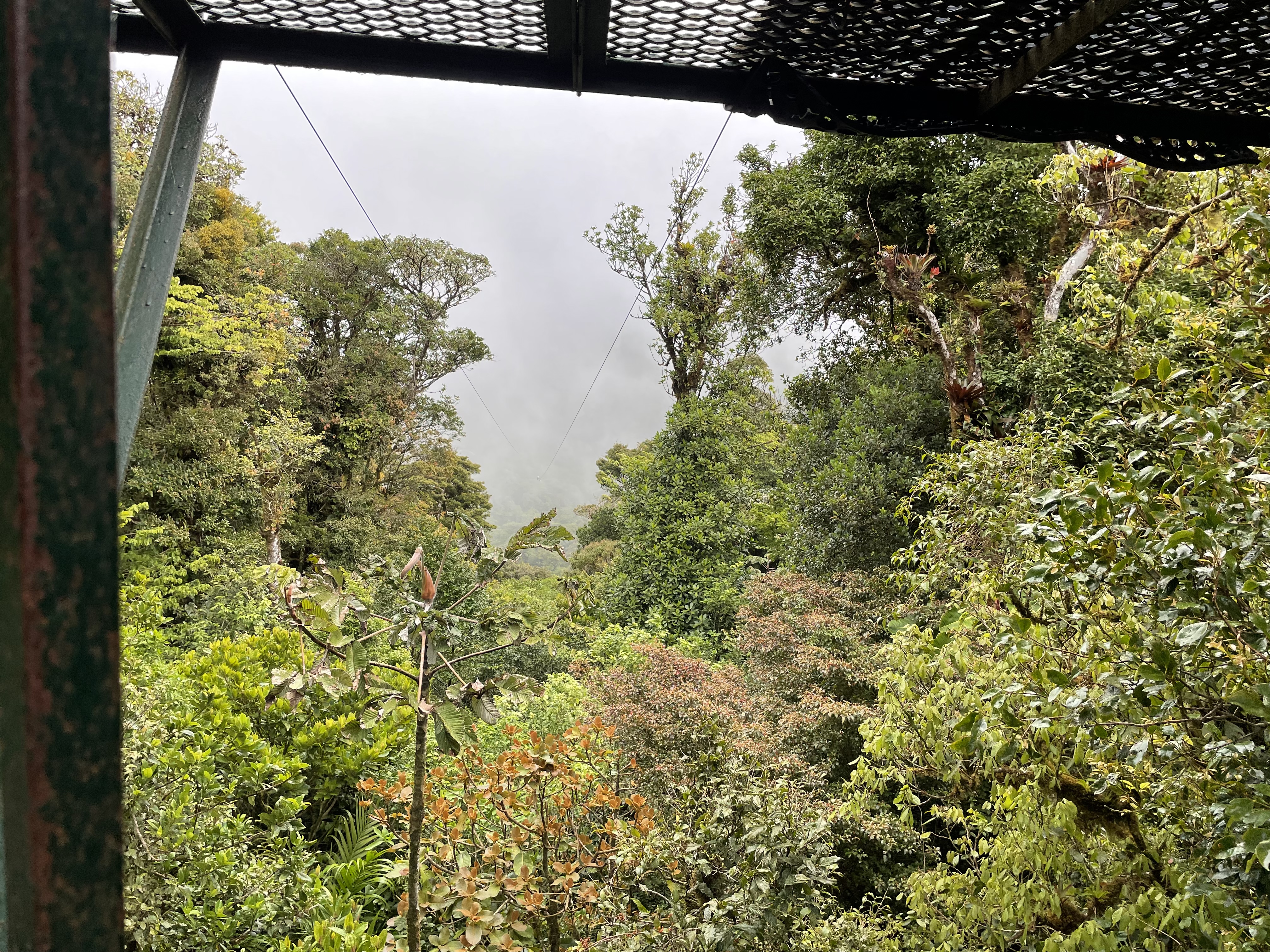
There were thirteen (lucky!) ziplines in all, and the final line – pictured above – was a whopping one whole kilometer long. What a rush!
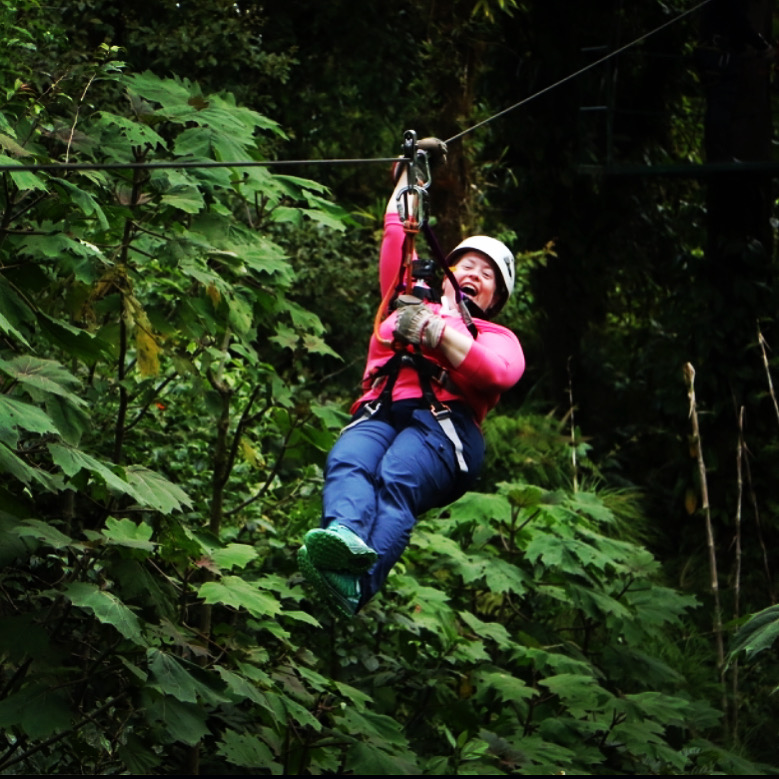
Clipped in and ready to go!
WOO-HOOOOOOOOOOOOOO!
What an experience! I loved it – did not find it at all scary; it was totally exhilarating and even meditative at times, as I soared over treetops and valley floors, hundreds of feet in the air at times, on the longest of the lines. Really the only thing that would have made the experience better would have been to share it with someone – especially on the longer ziplines, which require two people to zip together; being by myself, I had to go with a park employee and that was a bit weird. But it was 100% worth it, and I’m so glad I had this experience. I’ve always wanted to try ziplining, and in my younger days I would have just sat it out (and been disappointed) because Steve didn’t want to do it. These days, I am more sure of myself and more willing to go out and have an experience that I want, and I’m fine if it means I have to go it alone. (I’m glad that most of my adventures are shared experiences, though – Steve is the world’s best hiking partner and dive buddy.)
Zip on, Monteverde!
Have you ever been ziplining? Did you love it or were you terrified or both?
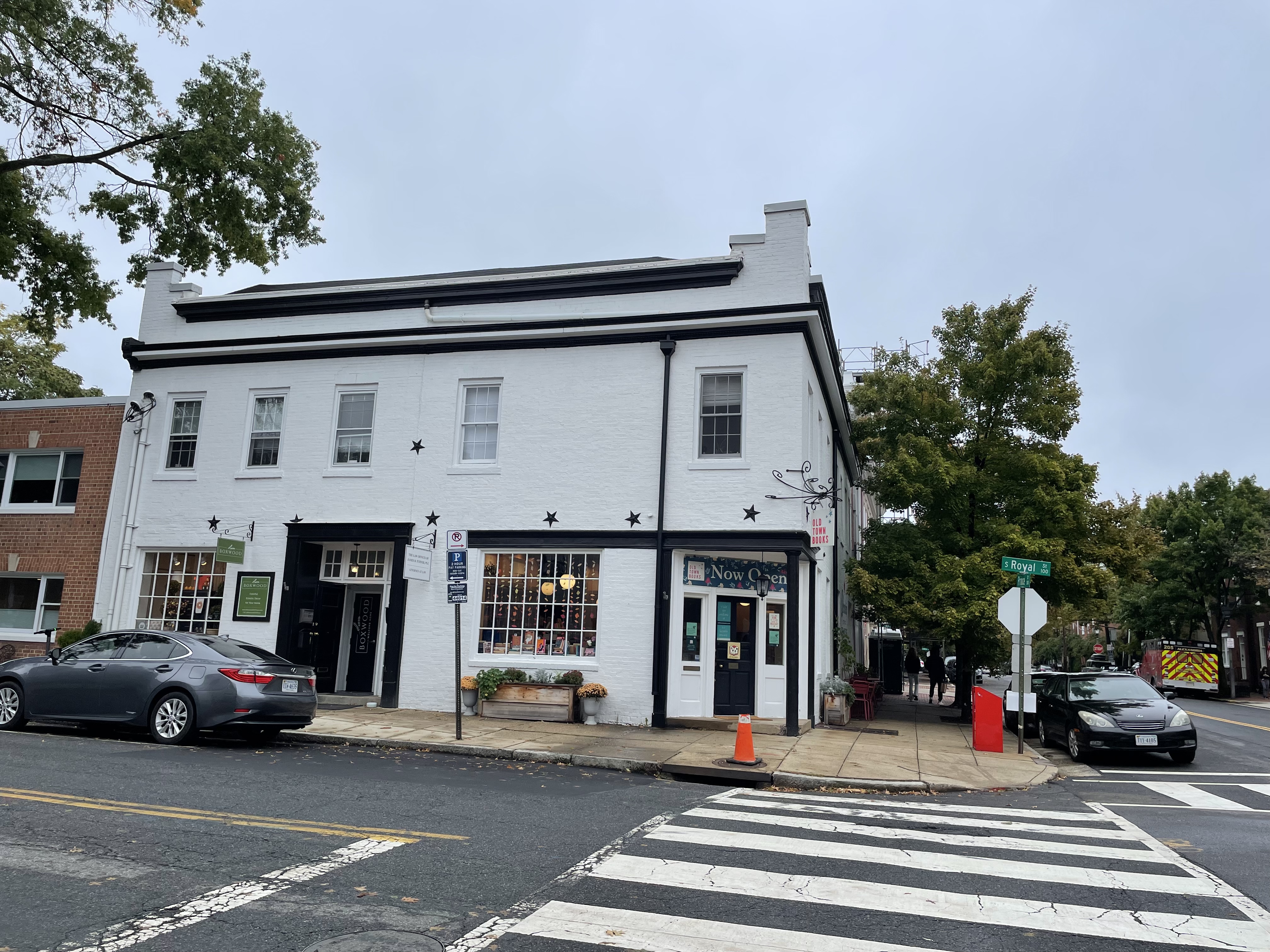
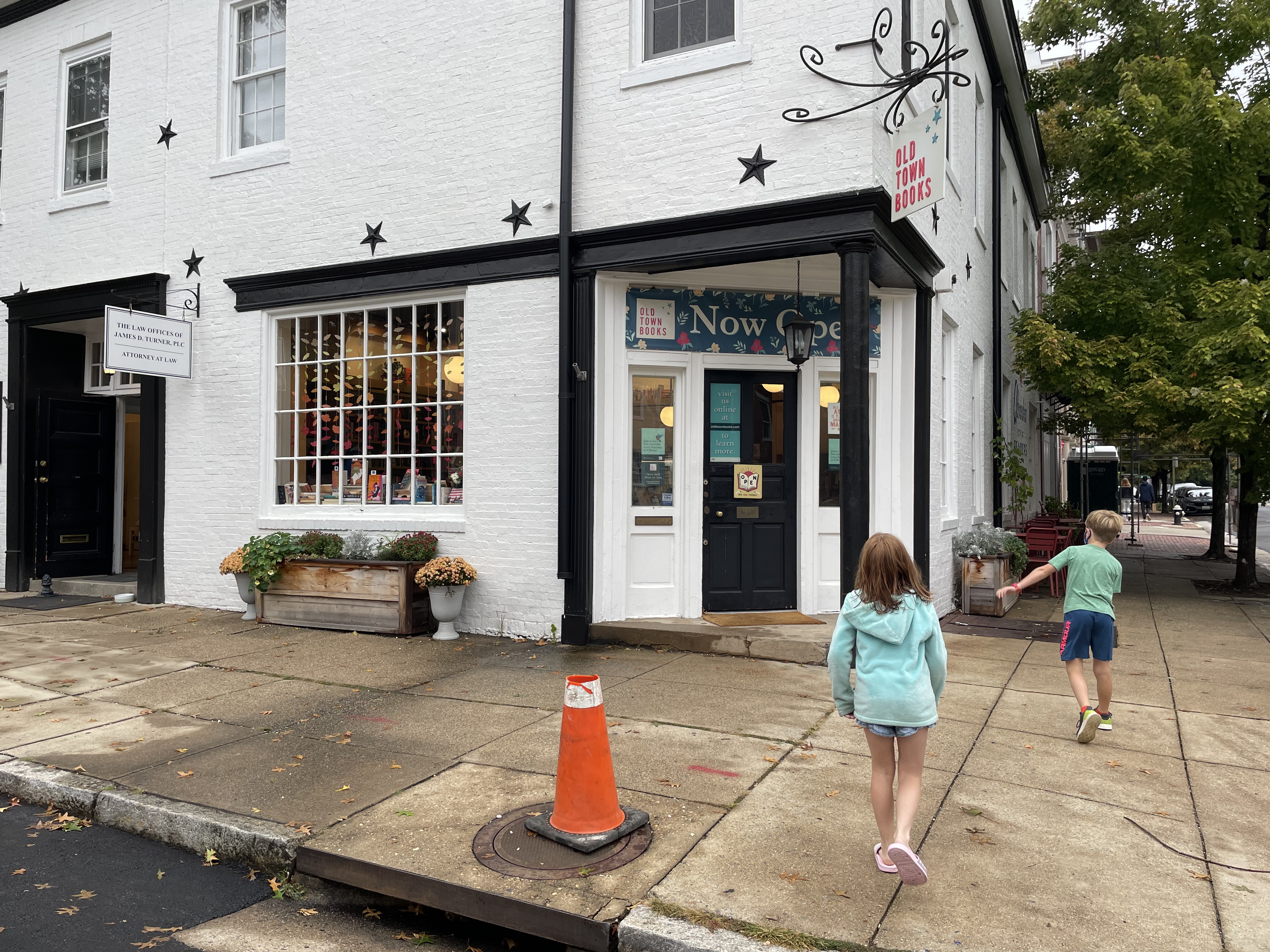
When we first moved to Old Town Alexandria in the summer of 2016, my one big wish for the neighborhood was a good general purpose indie bookstore. Don’t get me wrong; there were bookish riches to go around: we had a beautiful children’s bookshop (with a small but well curated adult section) just around the corner from us, a treasure trove of a used bookstore across the street, and a gorgeous public library branch all within walking distance. But a general indie was missing, and I thought it seemed like an opportunity. I wasn’t the only one who thought so; about a year before we moved out to the exurbs, Old Town Books opened – first in a beautiful, but small, pre-Revolutionary building down by the waterfront. More recently, the shop expanded to a bright and airy space a few blocks up from the river. Naturally, I was delighted. While I no longer live within walking distance of Old Town Books, I still consider it my home bookstore.
A few weeks ago, we had plans to drive back to Old Town to get the kids’ hair cut. (Yes, we drive 35 minutes for kids’ haircuts. We love their sweet stylist, Lety, that much.) As a reward for good behavior in the car and at the Hair Cuttery, I promised the kids a trip to Old Town Books. To be perfectly honest, they did not behave that well and really didn’t earn books. But a little bird – that is to say, Instagram – had whispered in my ear that there were signed copies of the new Elizabeth Strout to be had, and I wanted one.
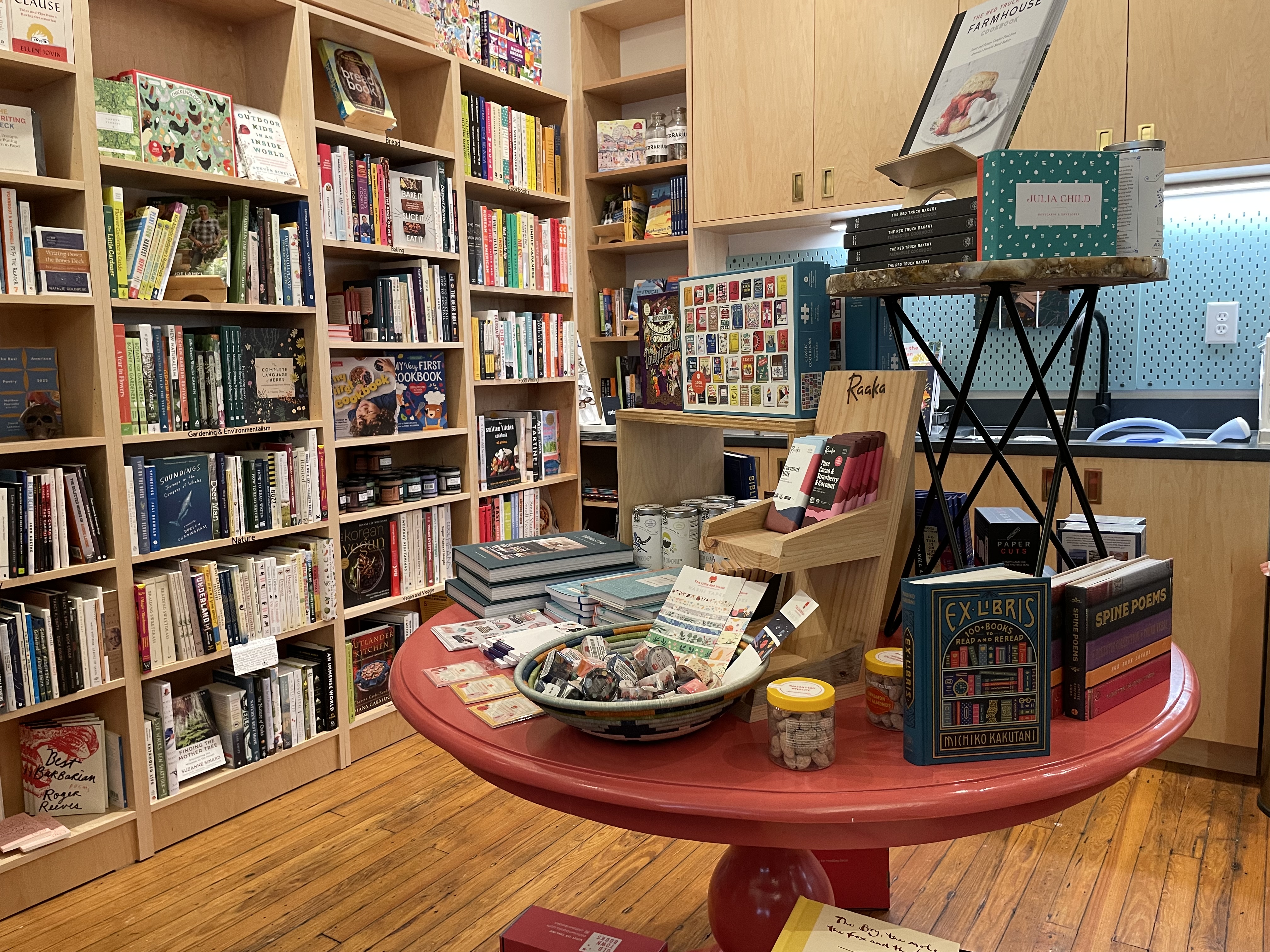
The front of the store contains general fiction, classics, mysteries, literary fiction and more. I had no trouble at all locating the signed editions of Lucy by the Sea and immediately snatched one for myself. (There were six, so there was no rush. But I couldn’t leave anything to chance, could I? Also, if you’re local to DC or NoVA, there might still be copies available.)
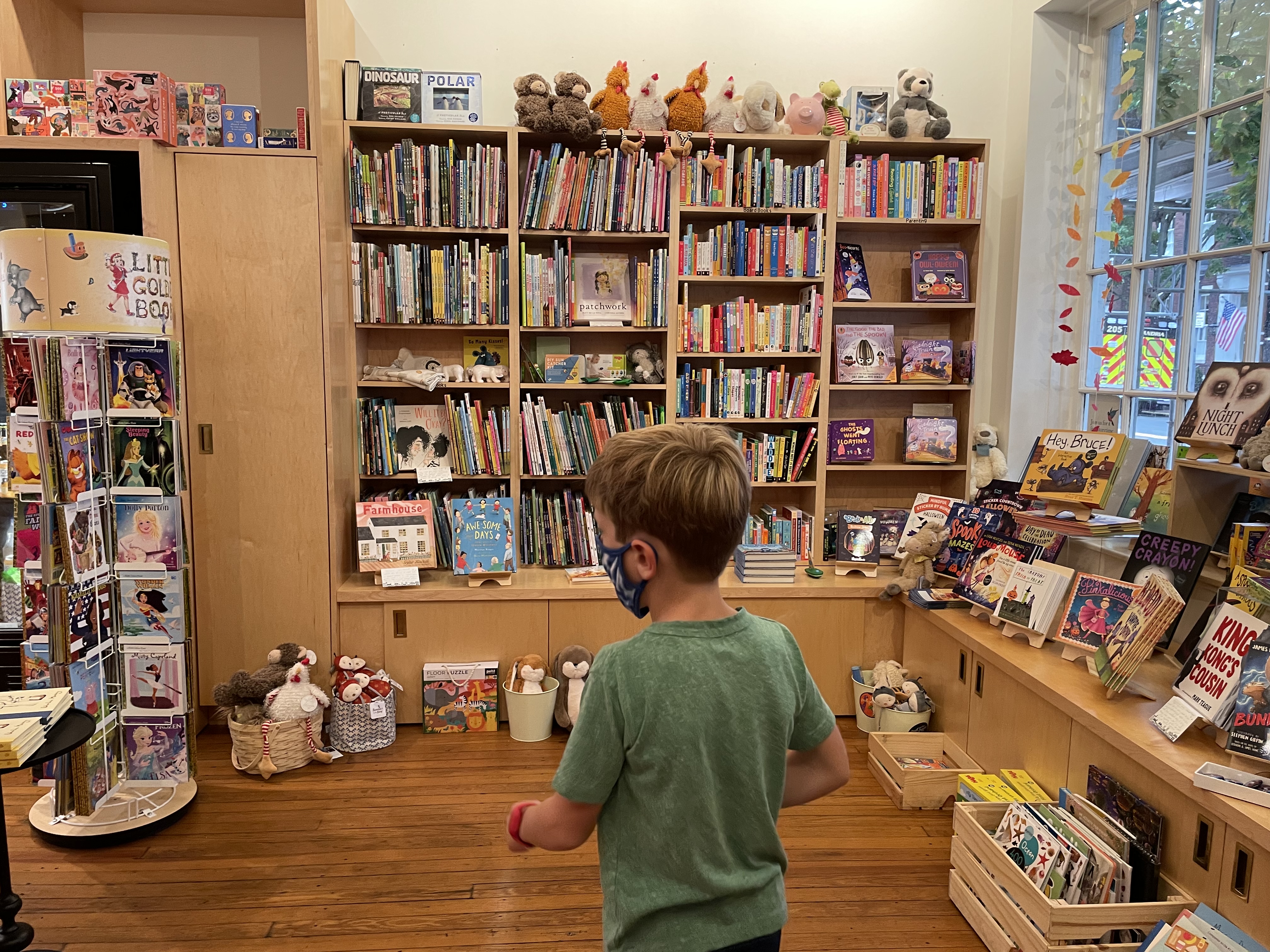
The kids had their own business to attend to. Is this not the most inviting children’s section you’ve ever seen? They were under strict orders to choose one book and one book only, and not to ask me for a toy. (Usually I’m a softer touch than this, but they were real jerks all morning.)
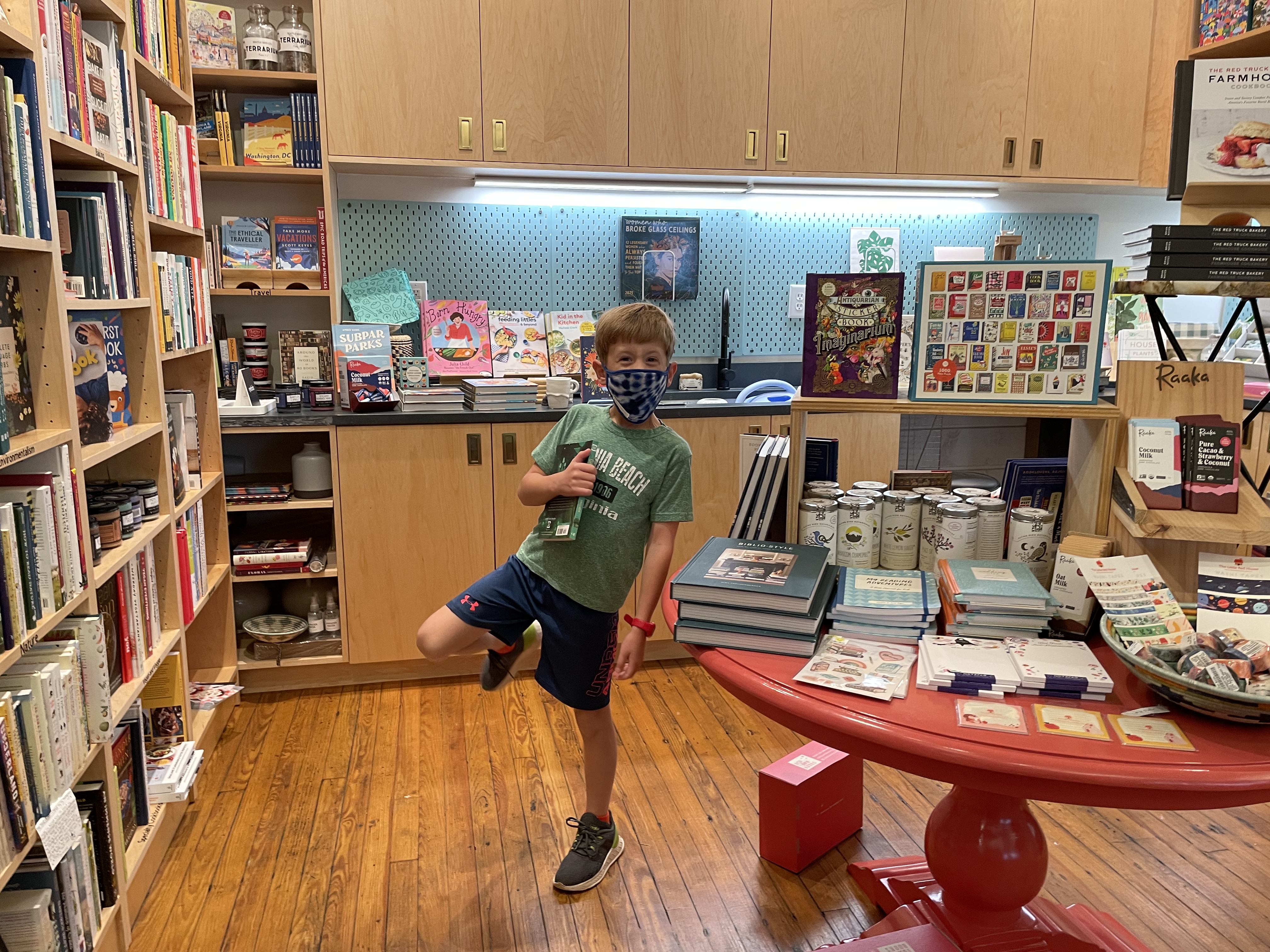
Nugget chose Garlic and the Witch, and Peanut got The Cupcake Diaries. And I was, obviously, drawn in by this beautiful gift table. (I was able to resist the chocolate, but really should have grabbed a tin of tea. What was I thinking?) The cookbook section is back here too, and is always an extreme temptation.
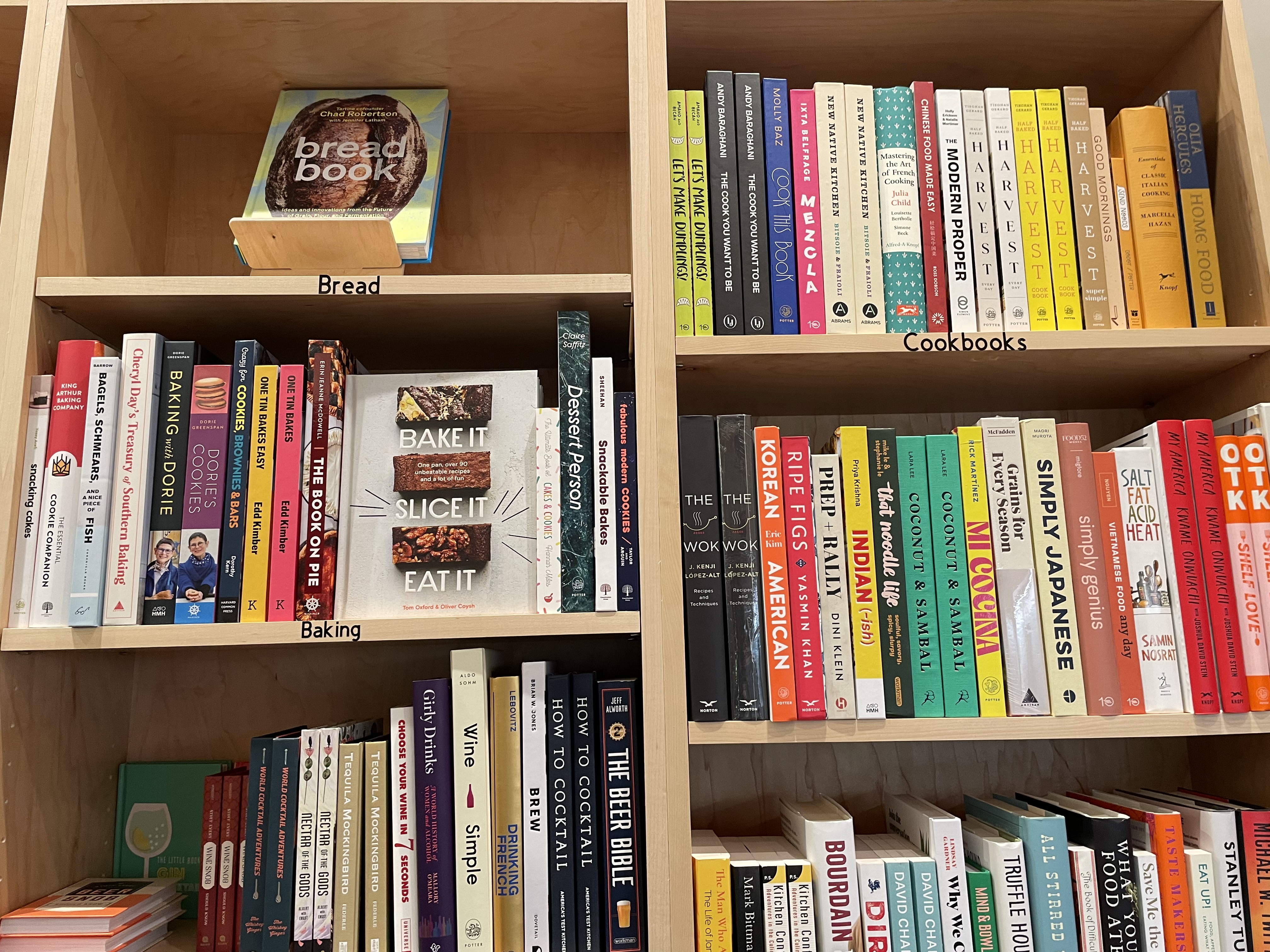
See what I mean? I could have spent hours just browsing this shelf. The Half Baked Harvest cookbooks look stunning, and so does Simply Japanese. (Another PSA for local folks: there’s a new thirtieth anniversary edition of Marcella Hazan’s Classics of Italian Cooking on there! I would have grabbed it if I didn’t already own a copy, but I do, so it’s still there – more lucky you.)
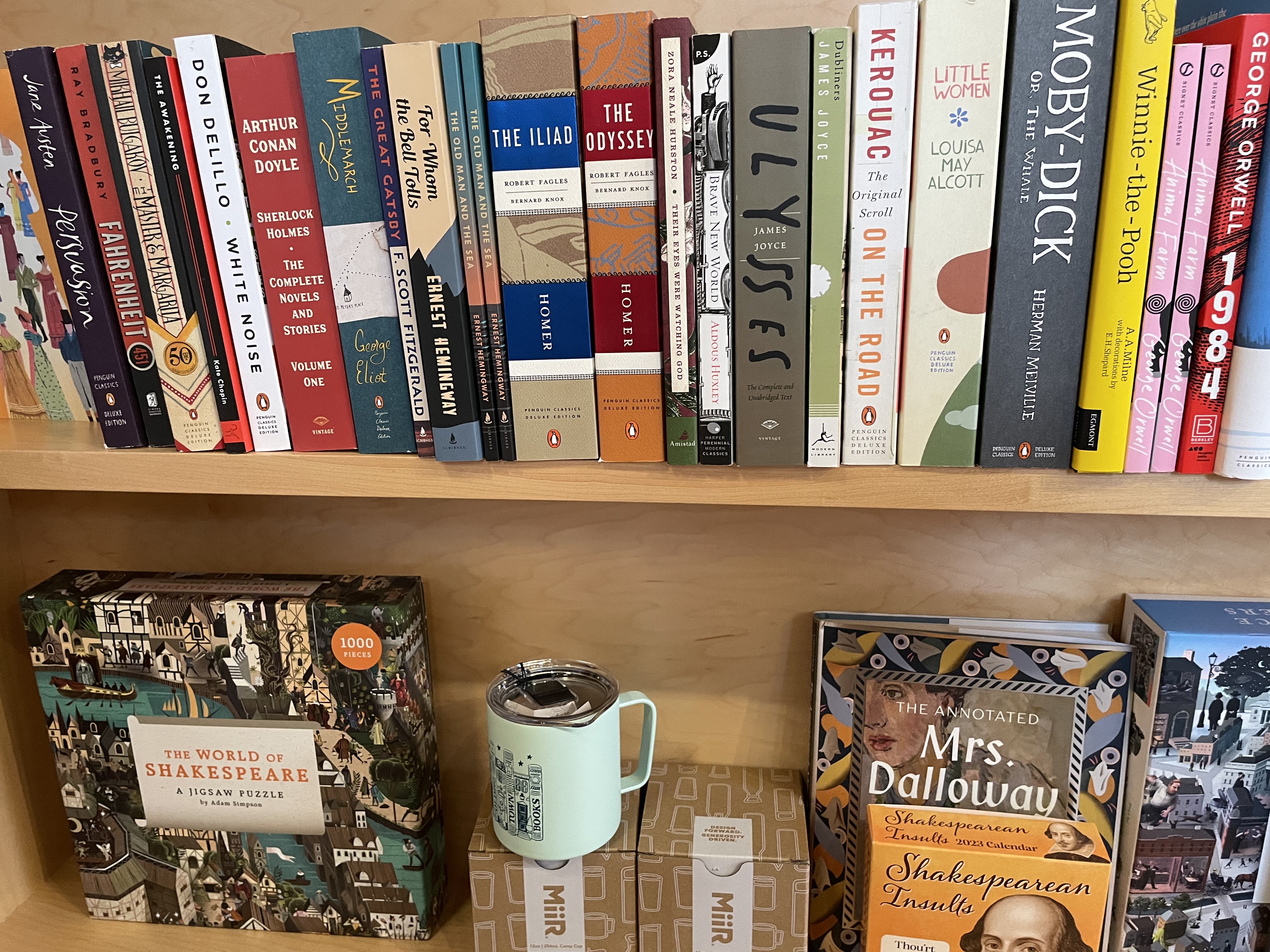
My favorite section – the classics, of course! I do wish this section was bigger, but I wish that at every bookstore I visit. And I can always find something I want… this time, I grabbed that copy of A Bedside Companion for Book Lovers, but I’ve had my eye on the annotated classics and the gorgeous editions of Little Women and Pride and Prejudice pictured above, so – something for the next visit.
(I did buy that travel teacup, of course. And next time I go, I’m snagging the Shakespeare puzzle!)
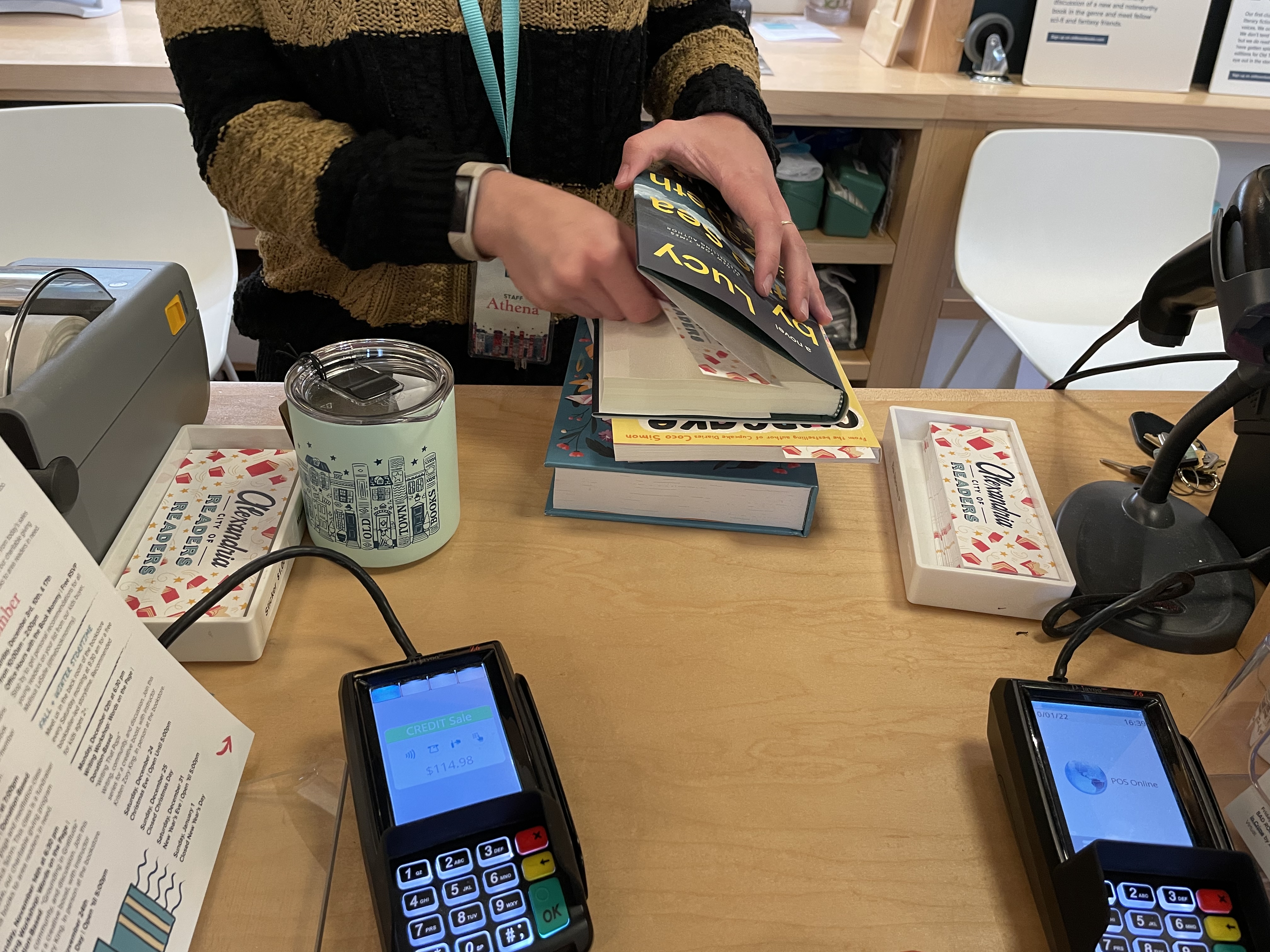
The haul! Signed Lucy by the Sea, and The Bedside Companion for Book Lovers – plus that teacup – for me; The Cupcake Diaries for Peanut, and I can only assume Nugget already had Garlic and the Witch in his hot little hands.
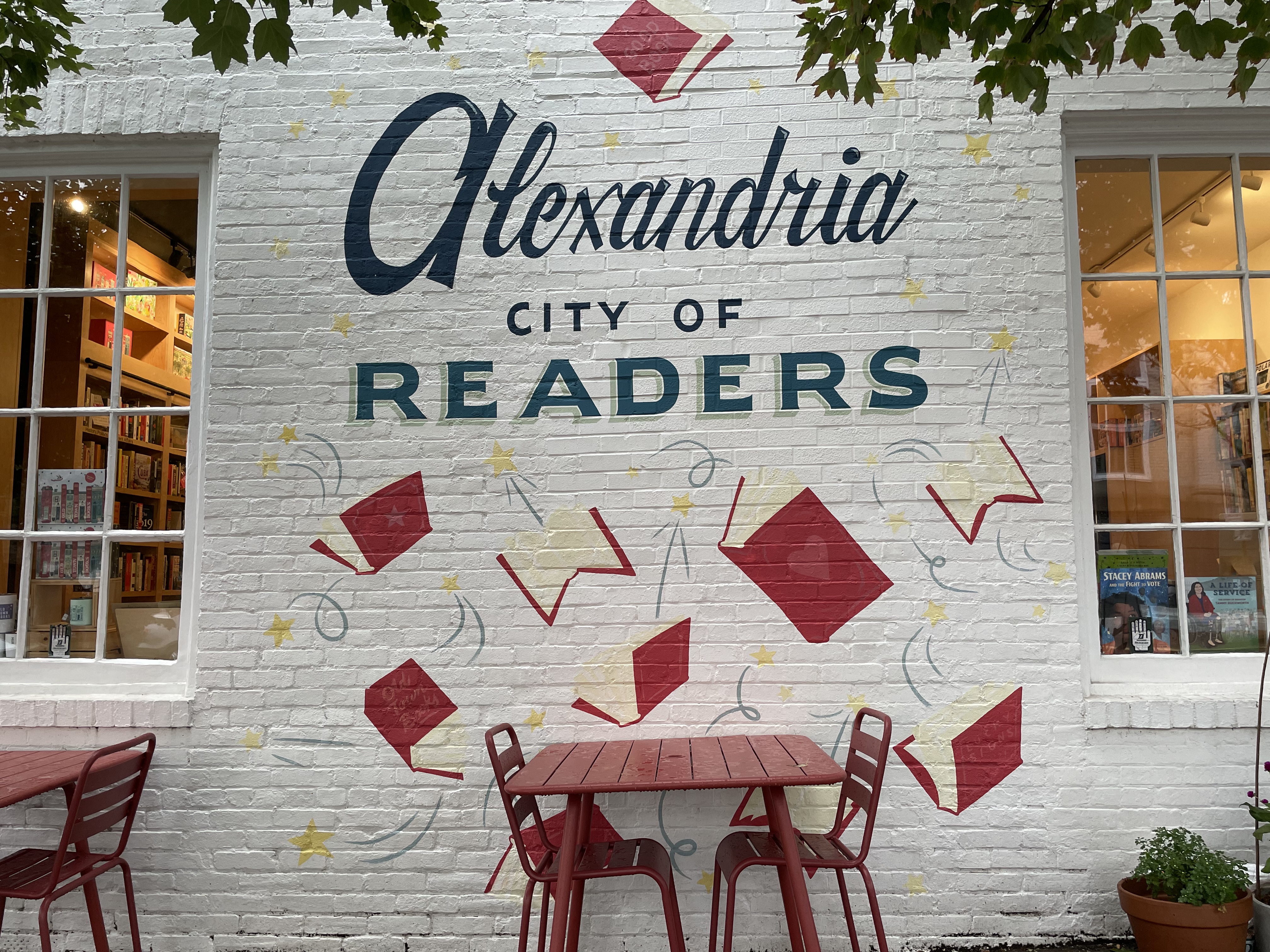
It was a gloomy, rather chilly, day – so there was no sitting outside and reading at the charming red tables like we otherwise might have. But I always have to stop and look at the mural.
Neighborhood bookstores don’t get better than this!
What’s your home indie bookstore? Should I come visit?
Slooooooooooow reading week last week – my goodness. I spent the entire week over Invisible Man, only finishing it up on Sunday evening (late, nearly 9:00 p.m.!) and turning with great relief to the mystery novel that had been calling to me for days. I think there were three contributing factors that slowed down the reading speed:
I really struggled to get through Invisible Man, largely – I think – because of the magical realism elements, which I can never quite get my arms around. I’m most comfortable reading in the realm of realism, but I can get on board with a completely fantastic realm (like Hogwarts, Narnia, Middle-earth, Fillory, etc.). Magical realism, though, always seems to flop for me – unless it’s really short, like Gabriel Garcia Marquez’s Chronicle of a Death Foretold. At 577 pages, Invisible Man was a doorstopper and the magical realism elements were just rough. I did love the writing style, but I plodded through the book.
Work has been especially hectic lately. I took on some new responsibilities recently and last week was the first week of that transition. It’s exciting stuff but definitely left me a bit spent by the end of the workday.
I hosted my parents and their friends for dinner on Saturday and a fun day out on Sunday, and that ate into reading time a bit – between preparing for guests and then all the fun we had hiking at Great Falls Park and walking Embassy Row. No regrets!
I am hoping for a more productive reading week this week. To start, I’m really excited about Death in Captivity – a murder mystery set in an Italian POW camp during World War II, interwoven with a story of an escape plot. I’m only about fifty pages in (see above, just started it late yesterday evening) but it’s already so exciting and I’m enjoying it tremendously. I think I’ll still be in a mystery mood for a little bit longer, too – fall is always a good season for mystery reading, although really, every season is mystery season in my library – and I have my eye on a couple of Josephine Tey novels next. And then who knows – the bookshelves are my oyster.
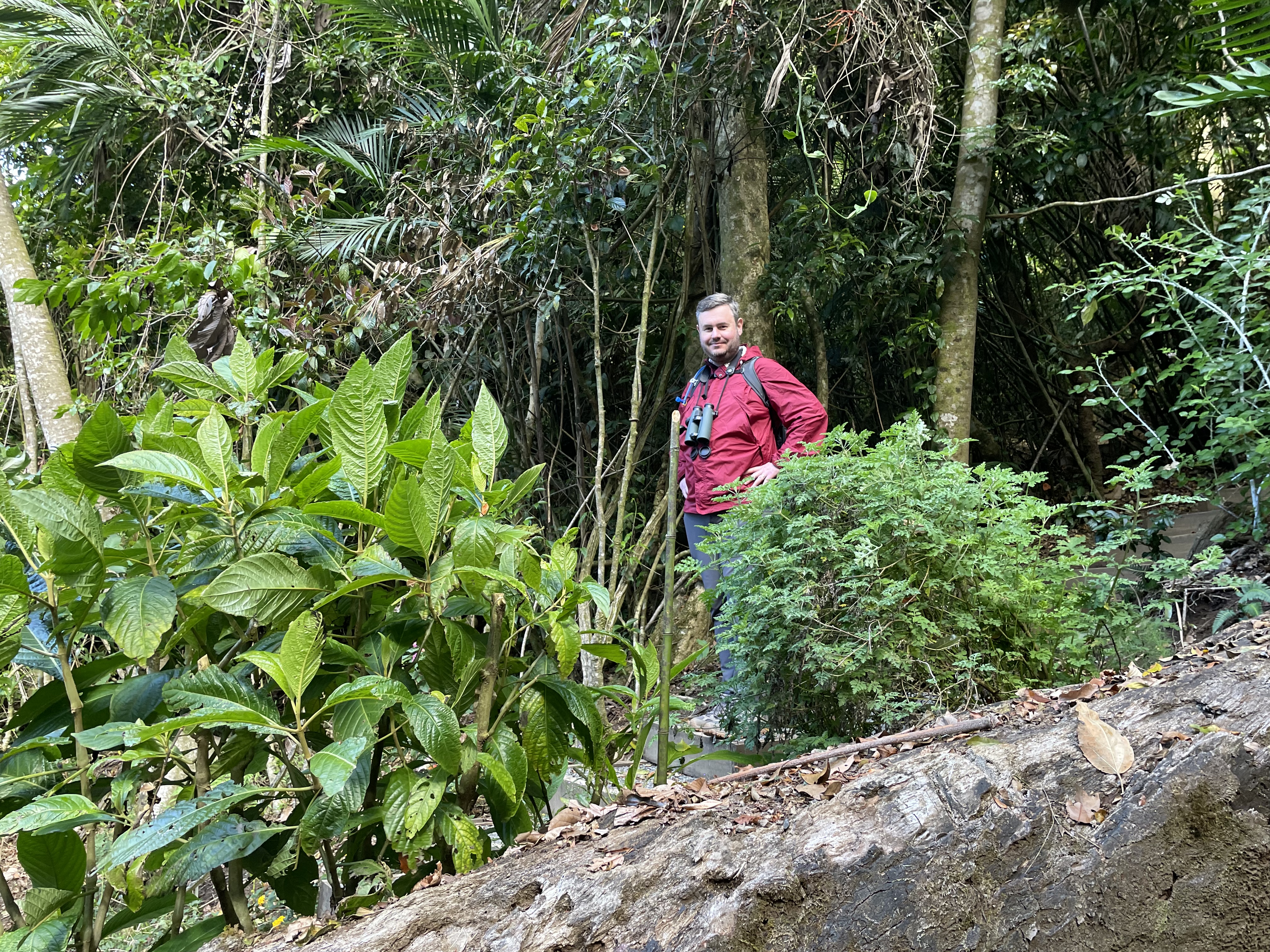
For our second day in Monteverde, I planned the adventures – starting with an early morning hike with breakfast, tea, and hopefully some more exciting avian sightings. The hike was guided, and arranged through our hotel, so we were in the lobby waiting at 6:00 a.m. sharp.
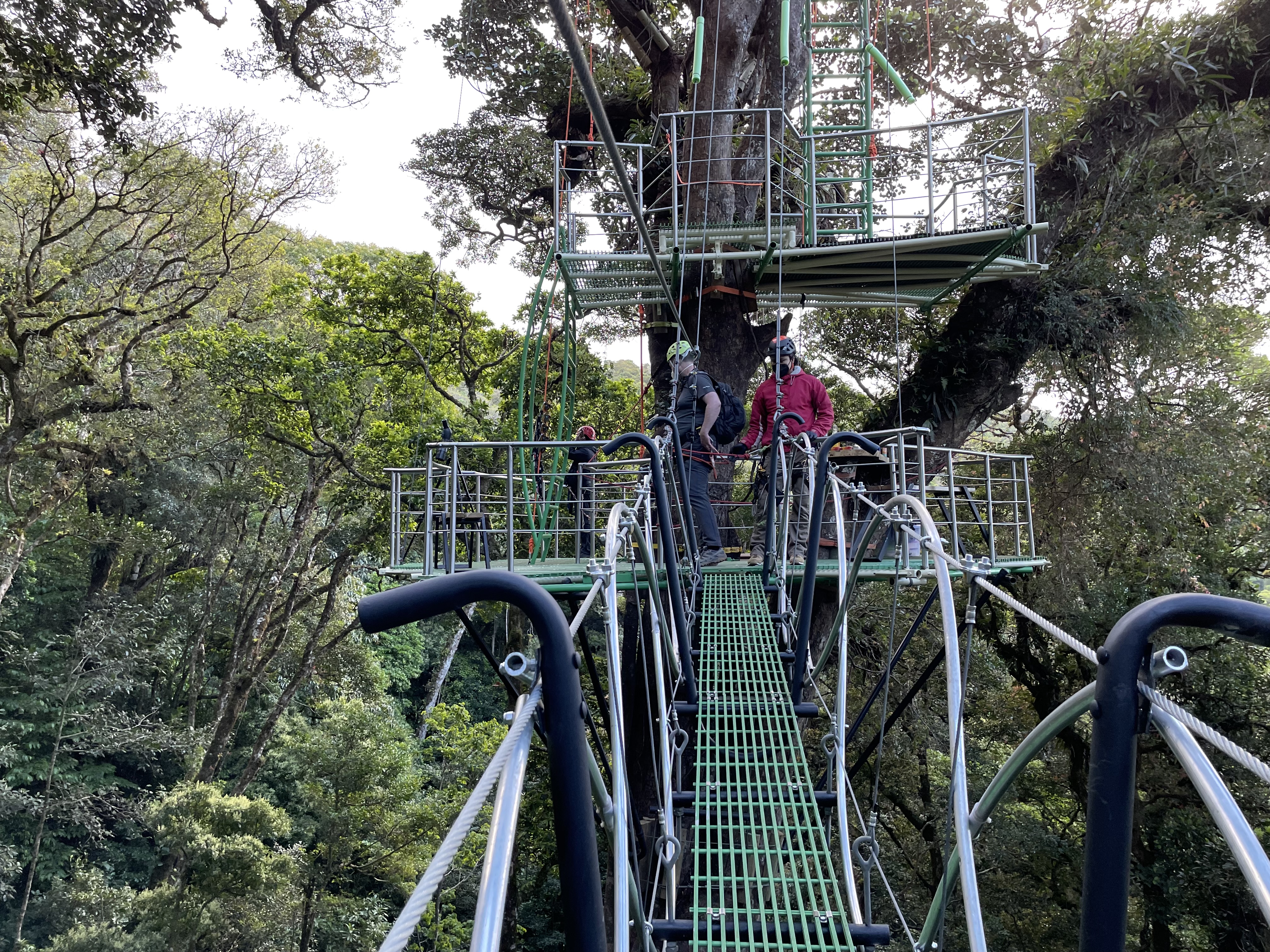
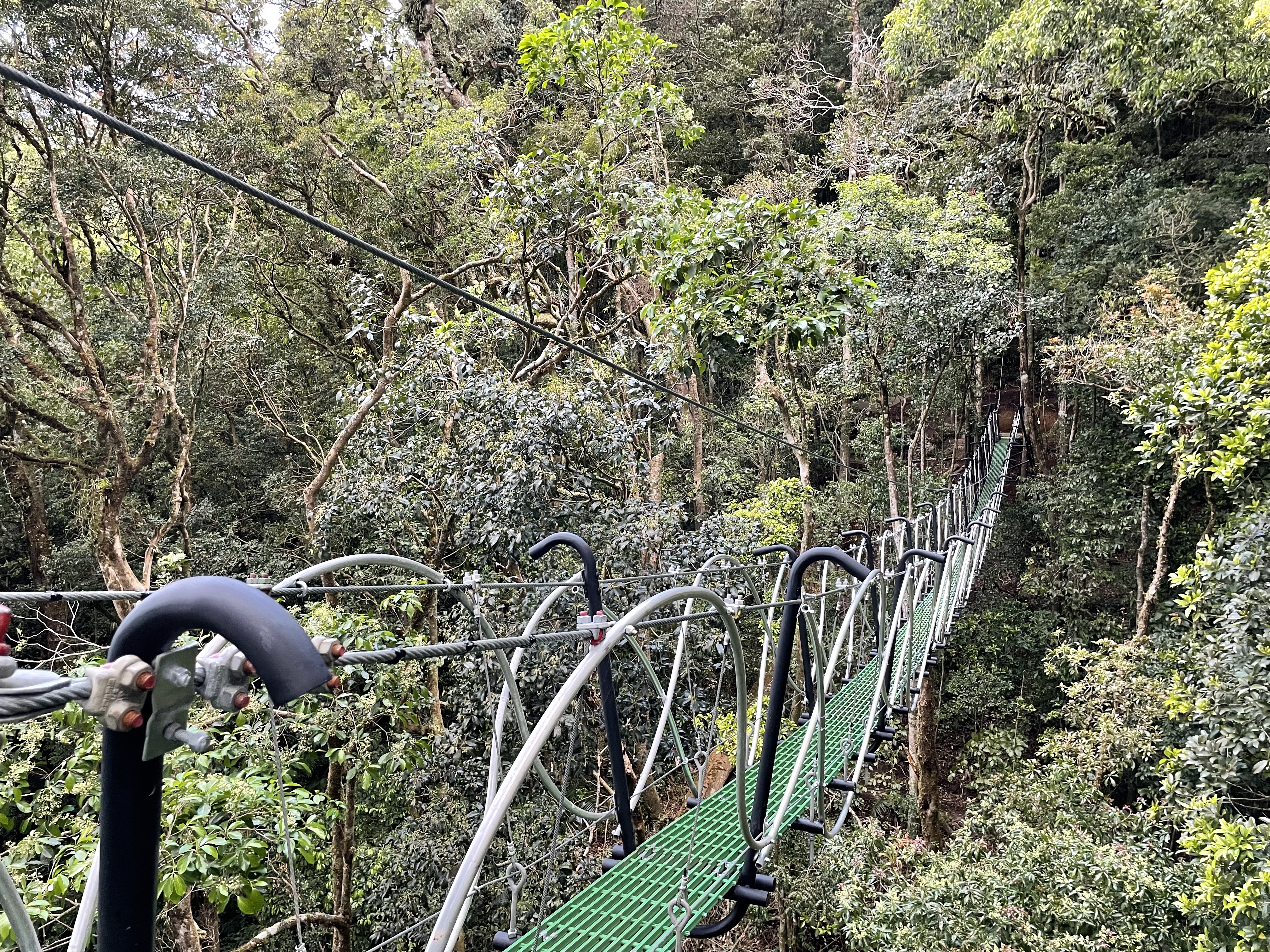
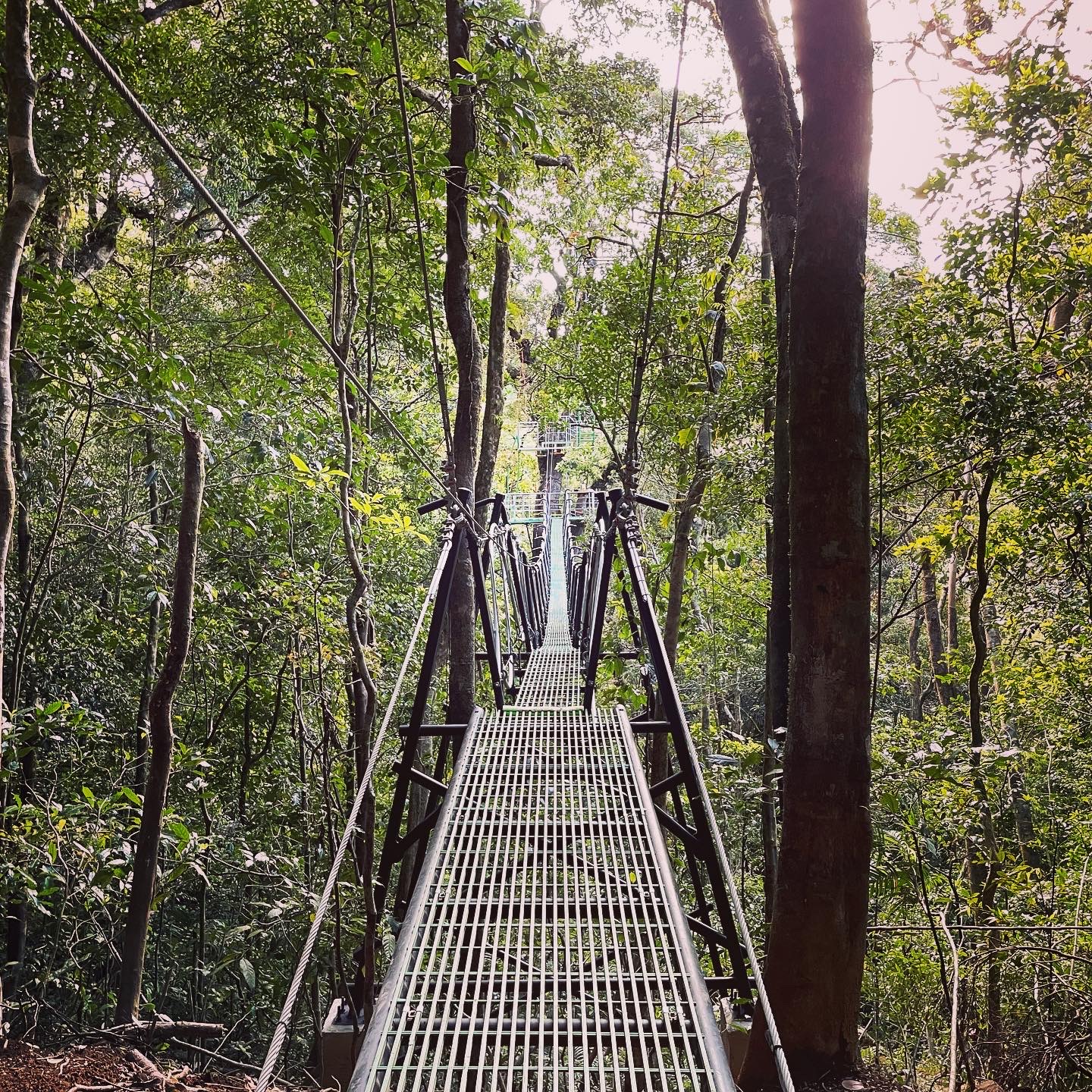
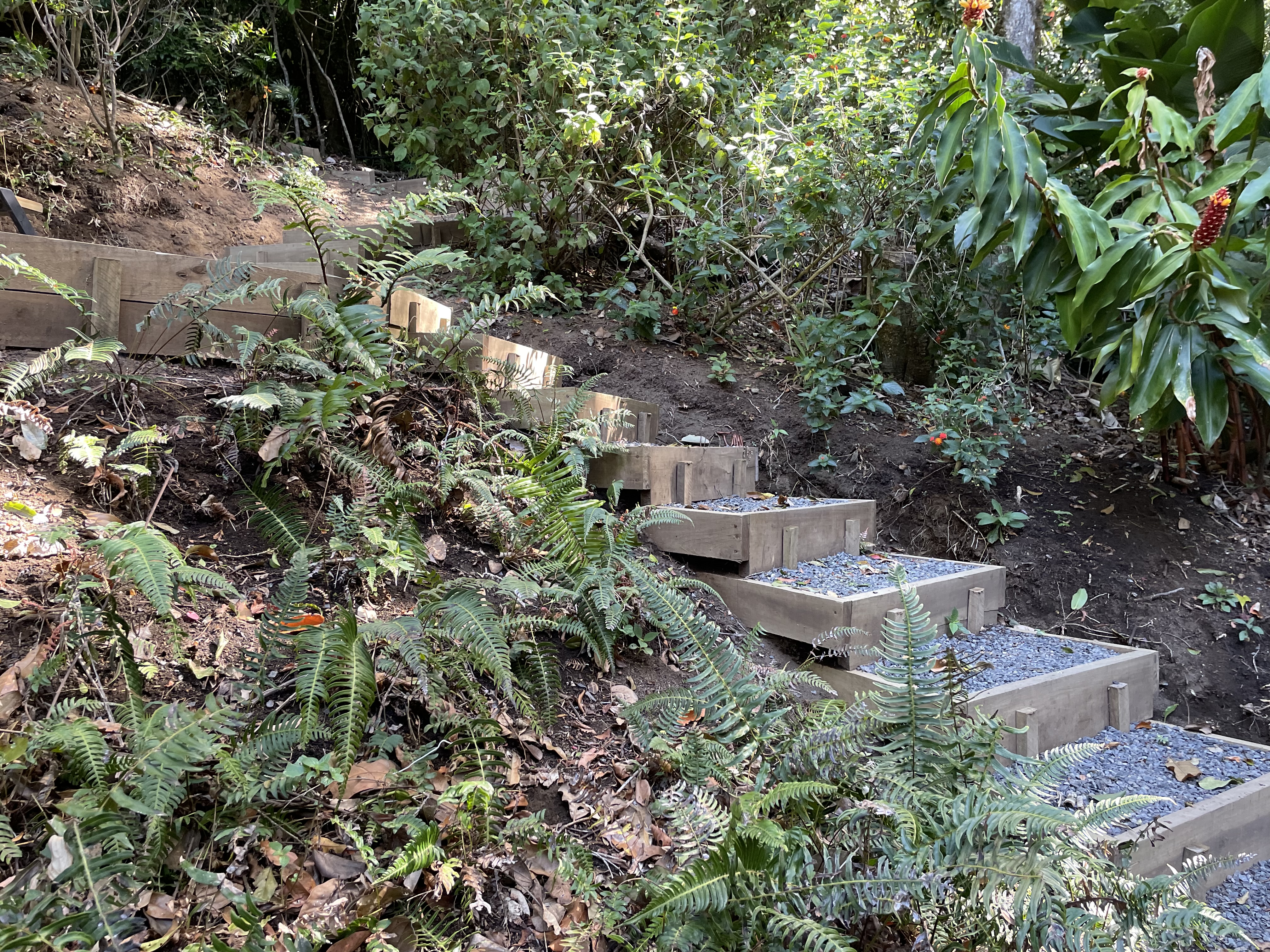
It was a small group – just us, one other couple (who were from San Francisco and adding a few days in Monteverde after a two-week Ayurveda retreat; we hit it off immediately) and the driver and guide. We drove a mile or so, still on hotel property, and then set out for our walk. Almost immediately, we heard a quetzal calling – but weren’t lucky enough to see one two days in a row. (We were still walking on air from the previous day’s sighting, though, so it was okay.) Our guide led us through the woods, pointing out the occasional bird, and soon we approached our breakfast destination: a platform built into the trees, sitting almost on top of the Continental Divide.
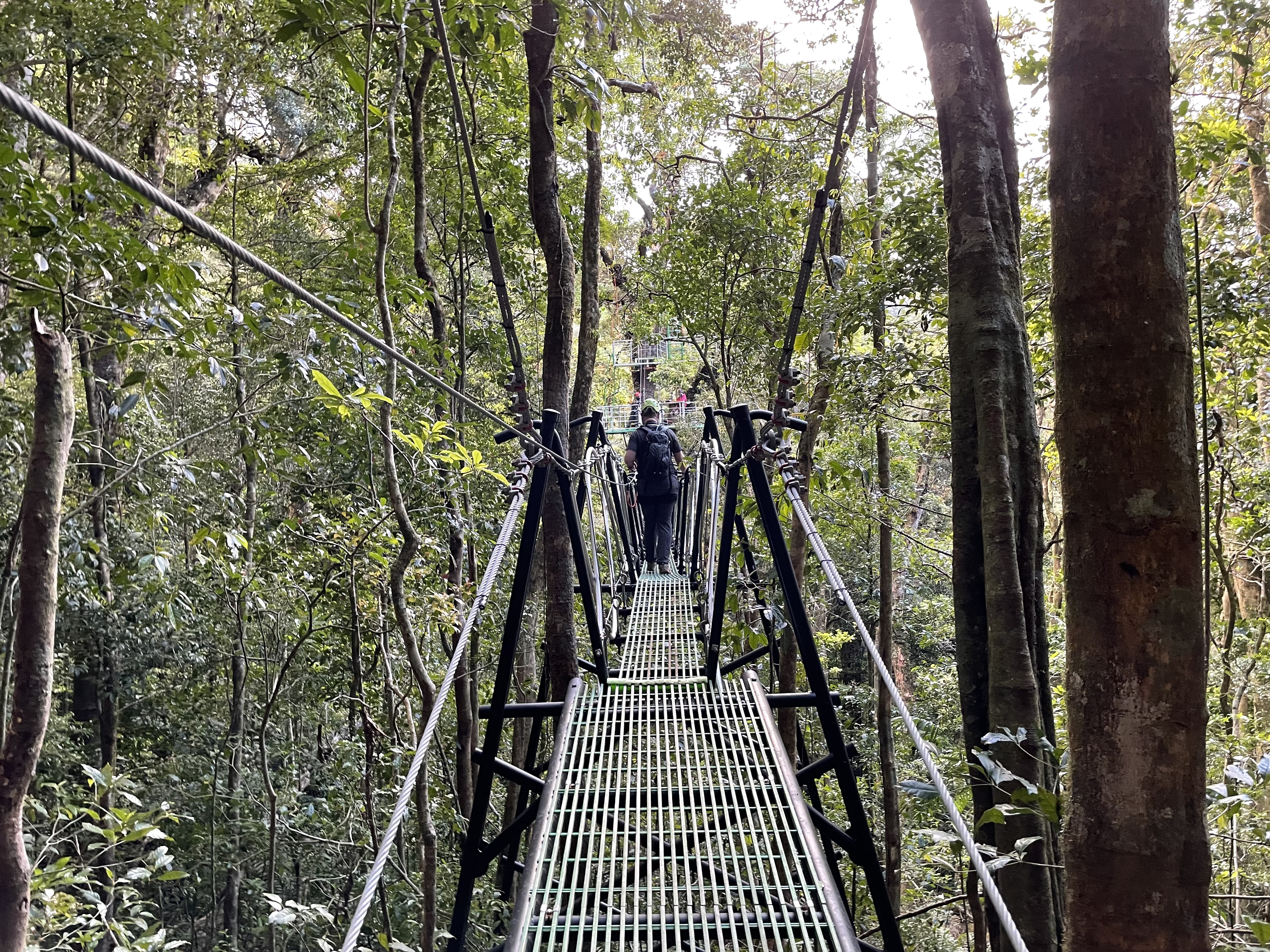
A few hotel employees had arrived ahead of us and set up a delicious looking spread, but in order to get to it we had to cross a hanging bridge. Not a big deal at all for me – I’m very comfortable with heights and had been hoping to get my feet onto one of Monteverde’s famous hanging bridges. But Steve has vertigo and a strong fear of heights, and he was not happy. He made the crossing, but realizing that it wasn’t necessary to get to the next part of the hike, he quickly grabbed his breakfast and hightailed it back to solid ground.
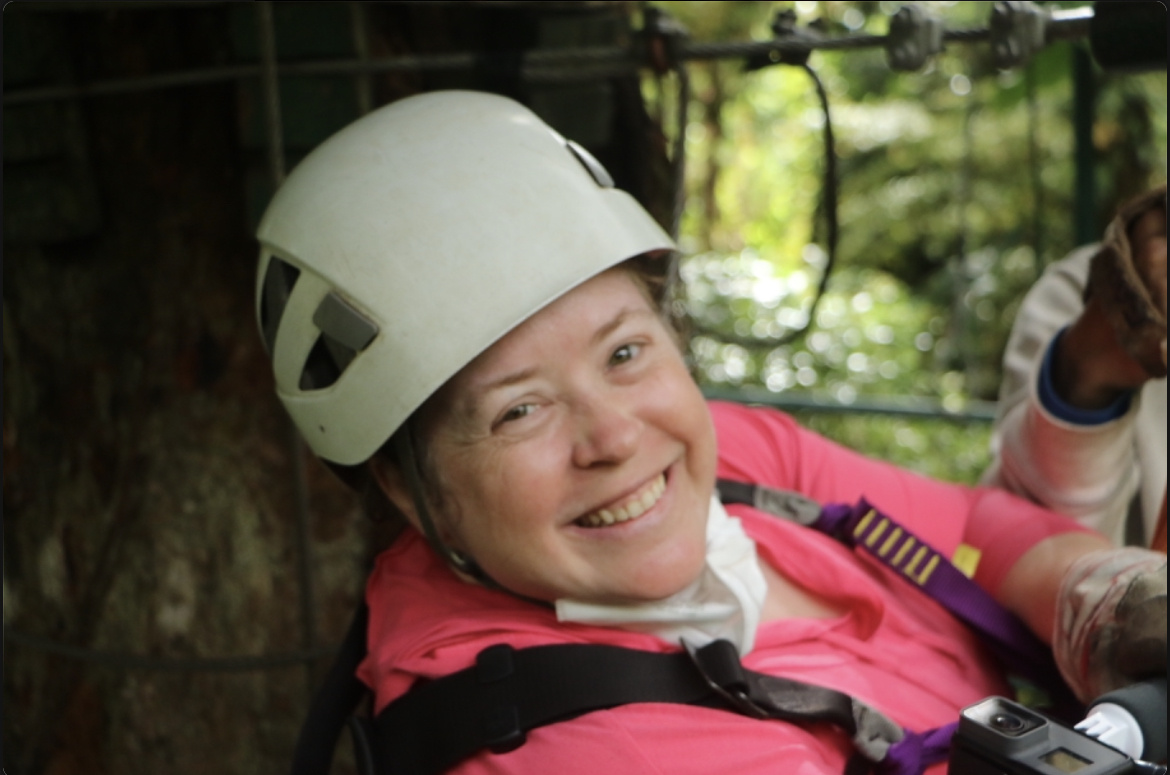
No such scruples for me! Roped in and ready to go.
I had way too much fun. Give me a harness and a helmet and I’m happy. (I’ve often suspected that I missed my calling and should have been a window washer.)
Breakfast! There were three ham sandwiches (for Steve and the other couple) and one turkey (for me – I don’t eat four legged friends). The ciabatta bread was delicious, and I loved the little sprig of rosemary tucked into the wrapper, a very nice touch. The breakfast included fruit kebabs, juice and fabulous Costa Rican coffee, too.
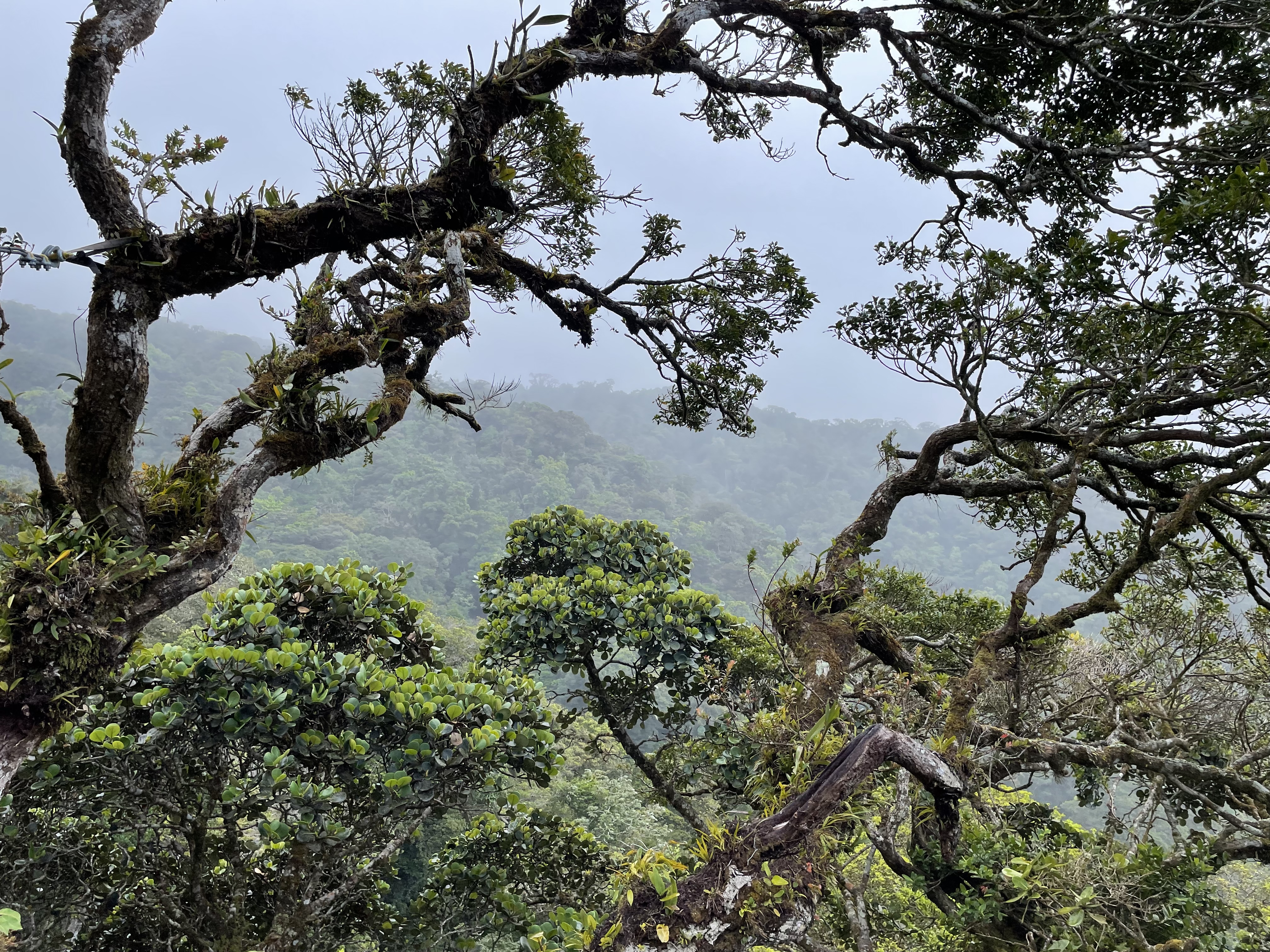
Also, how can you argue with breakfast in the treetops right on the Continental Divide? The mists were rolling in over the cloud forest and it was just beautiful. I felt a little bad about staying on the platform to eat while Steve was back on the trail, but I figured it would be okay, since how often do I get to have a meal a hundred feet above the ground?
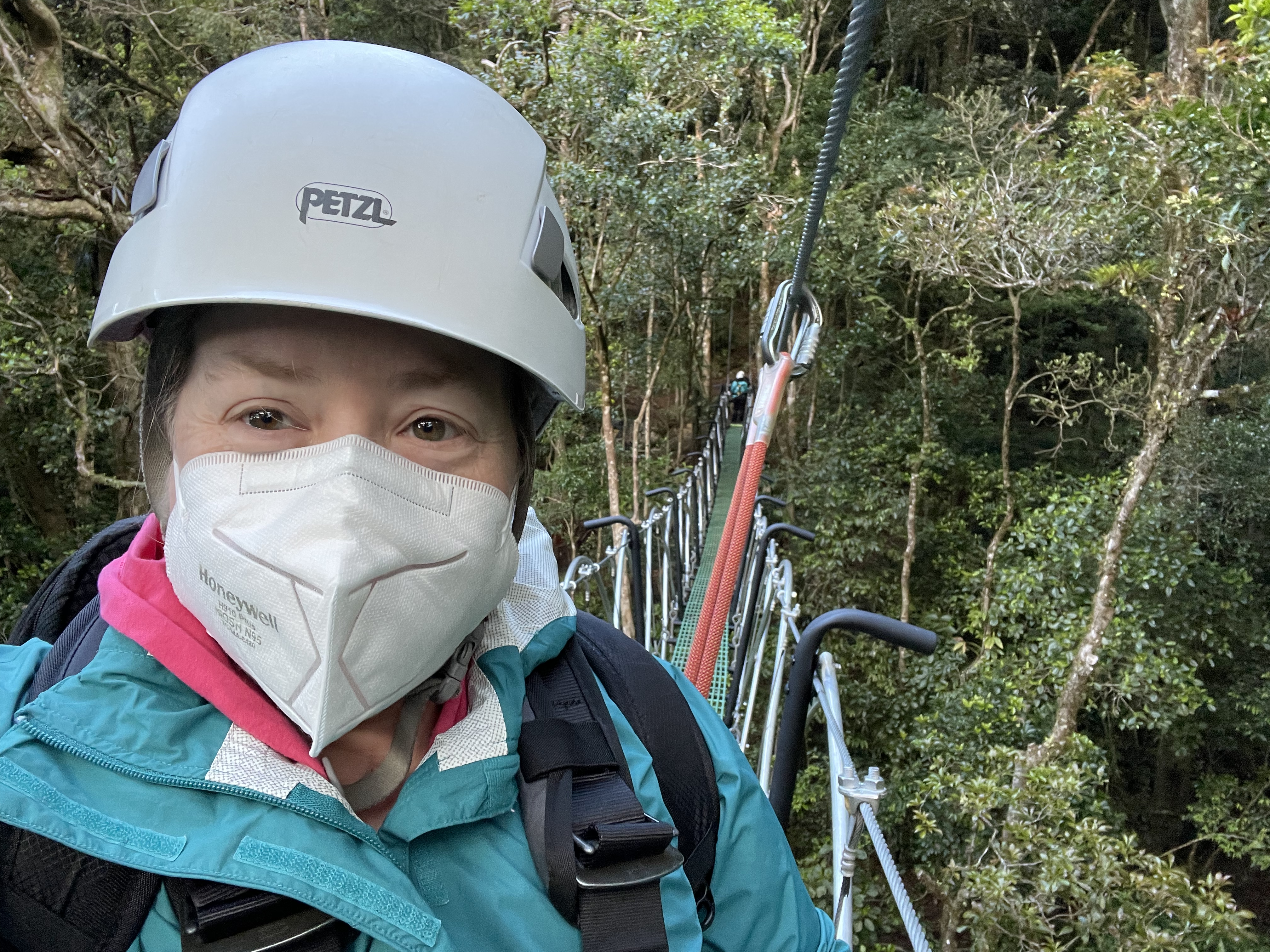
Pretty happy!
(Thanks to the nice other couple for taking this picture of me. Why didn’t I take off my mask?)
While I ate breakfast, I checked out the flora around me in the treetops and watched the skies clear. What a beautiful spot!
So cool. After we’d all had our fill of the giddy air in the treetops, it was time to clip back in, cross the hanging bridge, and continue on our way. (Steve had a long list of the birds he’d seen while he waited on solid ground.)
The next brief stopover (for water and restroom) was this little hideaway, tucked into the woods. We looked at an exhibit about the insect life, hydrated, and moved on.
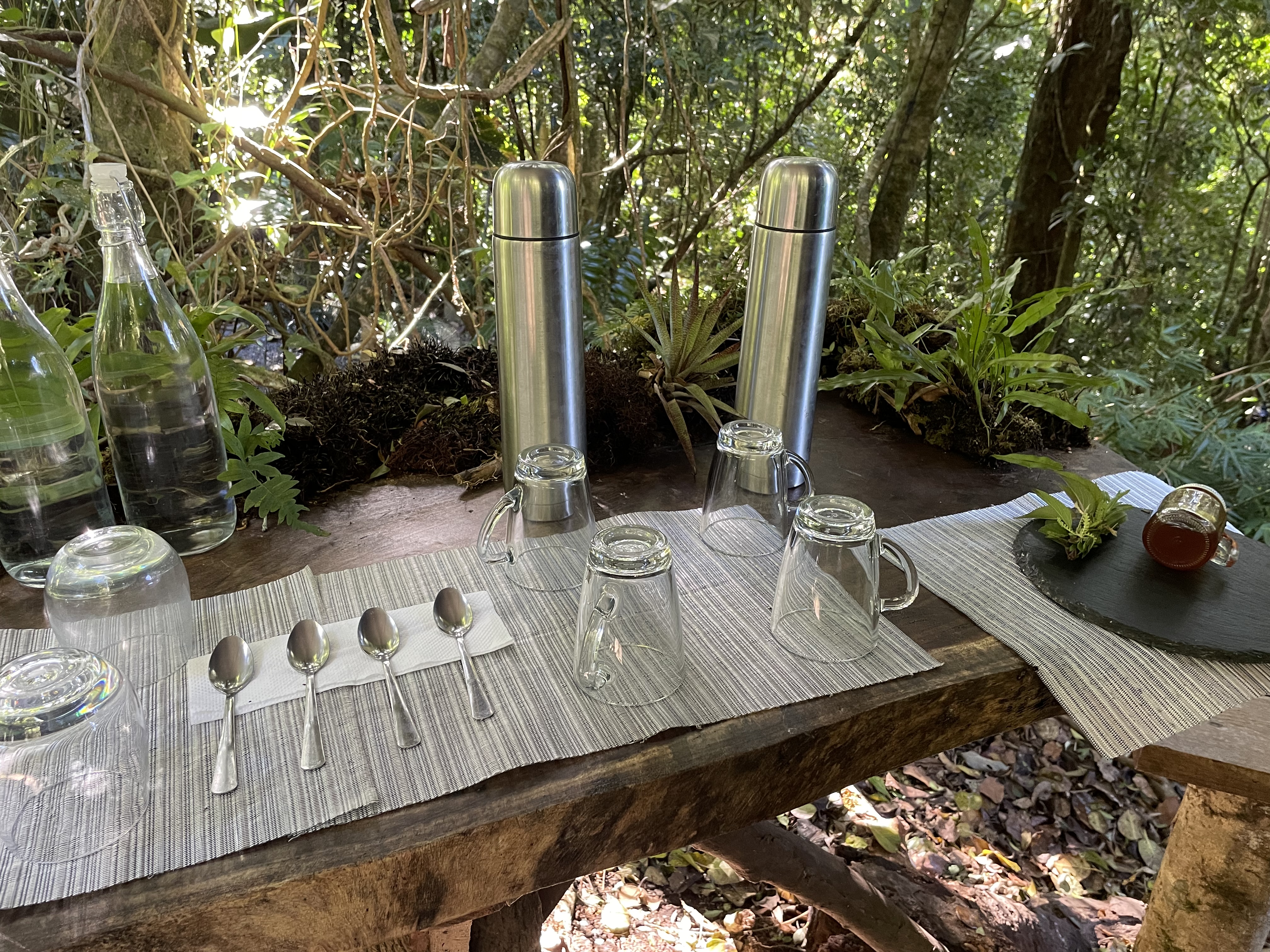
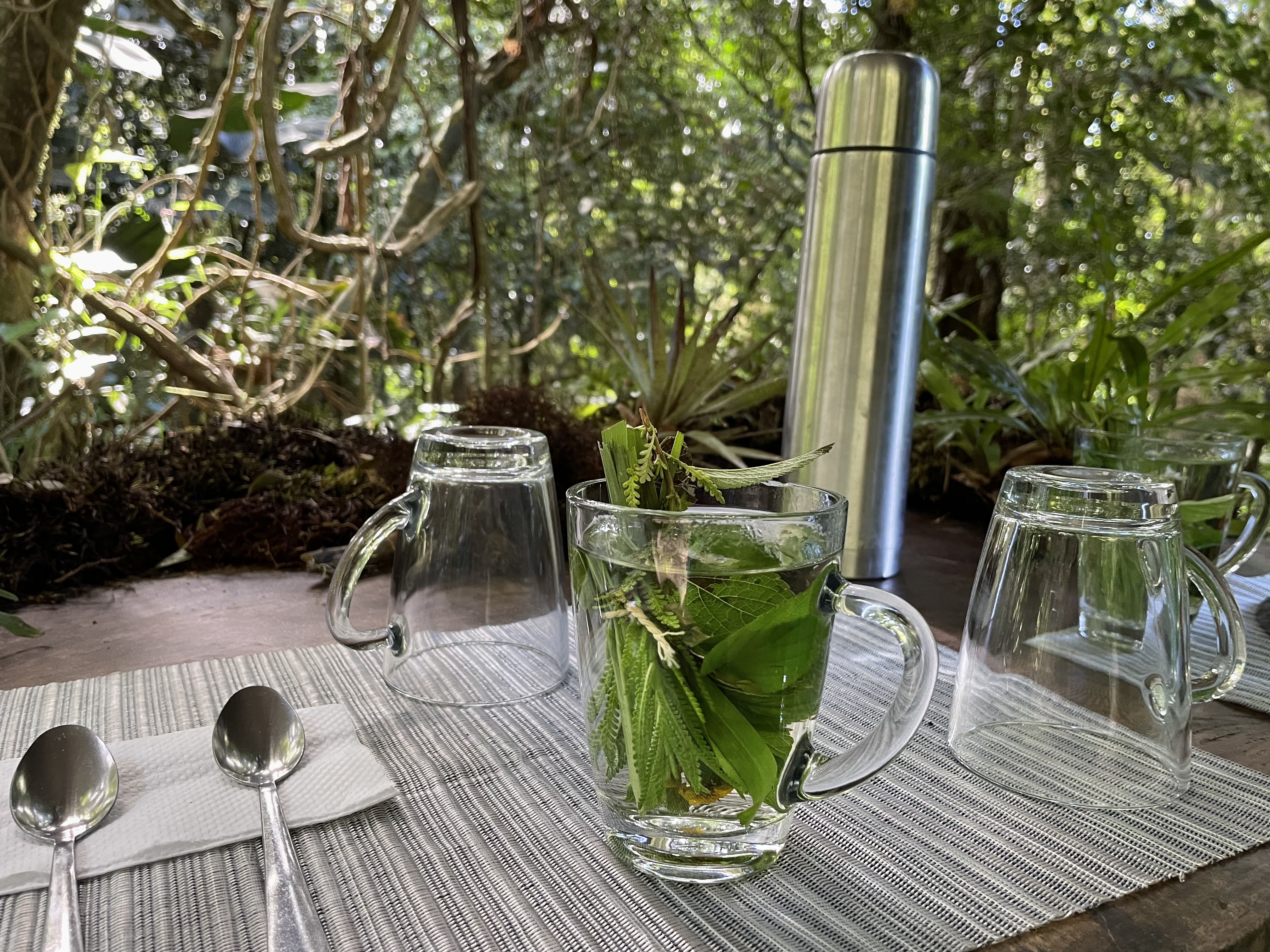
Our ultimate destination was a garden, tucked away in an out-of-the-way corner of the hotel property. It was packed full of flowers, herbs, and enchanting little corners. The hotel staff had set up a table with homegrown herbal teas for us, and we were treated to a crash course in the benefits of each herb (all of which I have now forgotten, but it sure did taste amazing).
After tea, we were turned loose to explore the garden. I couldn’t get enough of the flowers. Considering the wintery landscape we’d escaped back in D.C., this was paradise indeed.
I could have stayed and taken in these flowers for ages, but we had to move on eventually – we had more stops to make. Our guide explained that if we drove a little further into the countryside, we could possibly see the bellbird – another iconic Costa Rican species, and one that Steve and I had not spotted on our treks through Monteverde Cloud Forest Reserve or Reserva Curi-Cancha the day before. We all agreed eagerly, and after a bumpy car ride (at one point, I grabbed the side handle in order to scoot away from the other woman on the tour – we were crammed together in the backseat and I didn’t know her well, so wasn’t that keen on snuggling – and our guide got the impression that I was scared of the road and advised, “We call it a Costa Rican car massage. Just sit back and let it happen to you.” LOL!) we arrived at the spot where our guide thought we may see a bellbird.
Bellbird check! I wish I could show you a video – this bird really did sound like a ringing bell. We hiked a little ways along the road into the countryside and it sounded like bells were ringing all around us. Just magical.
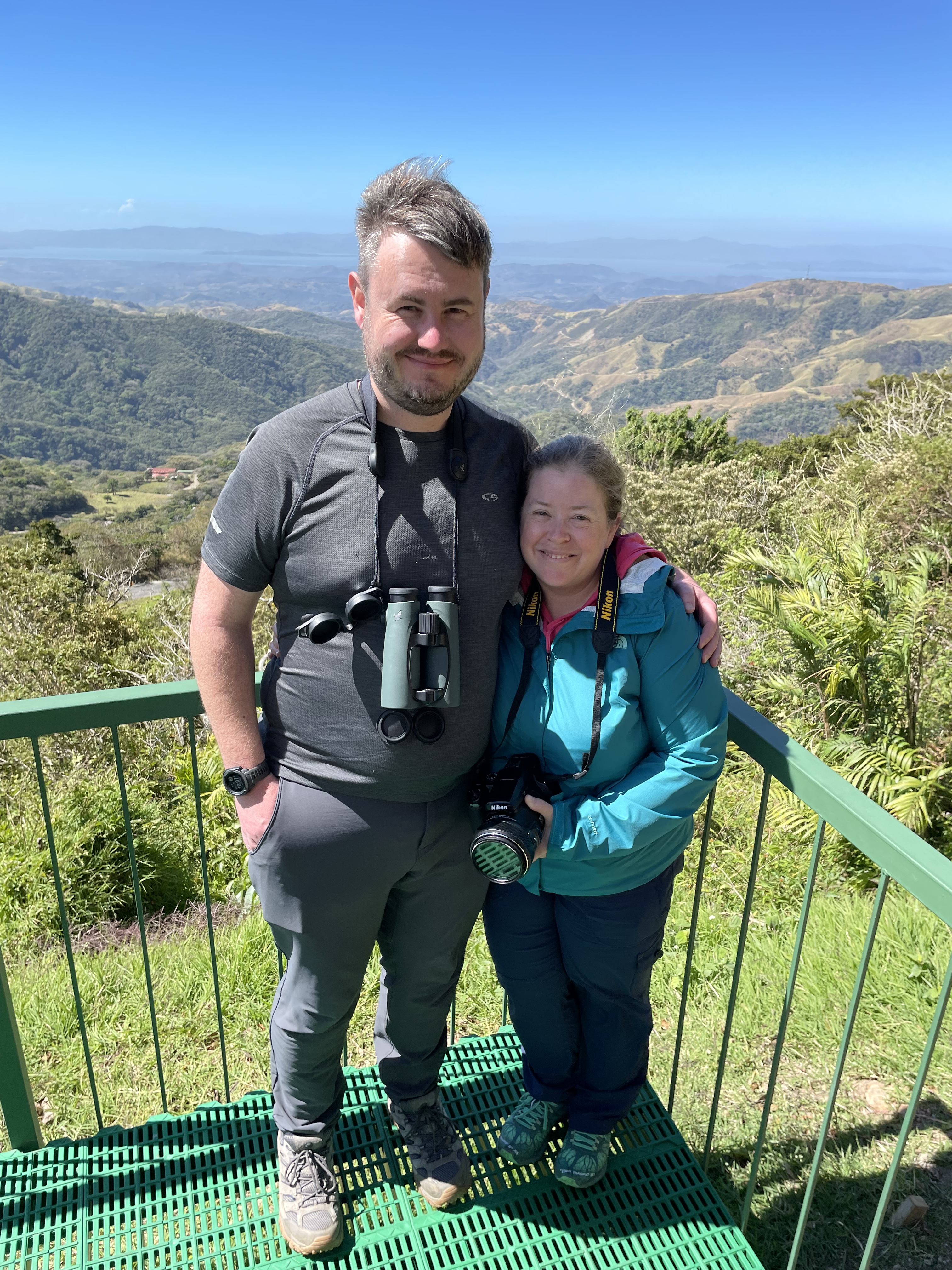
Ended the morning at a beautiful overlook, drinking in the sight of rolling hills and the Pacific Ocean rolling into the Gulf of Nicoya. Gorgeous!
Next week: my afternoon’s activity involved a little more adrenaline…
Reading is my oldest and favorite hobby. I literally can’t remember a time in my life when I didn’t love to curl up with a good book. Here are my reads for September, 2022.
Summer Pudding, by Susan Scarlett – I’ve been wanting to try Susan Scarlett – Noel Streatfeild’s pen name for when she wrote novels for adults – for ages, so I was beyond excited when Dean Street Press brought out a whole collection. Janet Brain (terrible name, but what can you do) joins her frail mother and selfish sister in the countryside after she loses her job due to bombing in the Blitz. Hijinks and miscommunications ensue! Summer Pudding was a total delight – refreshing, absorbing, and such fun for a few late summer afternoons.
Going Solo (Roald Dahl’s Autobiography #2), by Roald Dahl – This is the second time I’ve read the second installment of Dahl’s memoirs (and still have never read the first installment, Boy), and I enjoyed it every bit as much as the first time around. This time, I listened to the incomparable Dan Stevens (better known as Matthew Crawley!) read the audio version, and it was fabulous.
Nella Last’s War, by Nella Last – Another one that had been on my list for ages and rocketed to the top of the pile when a favorite small press (Slightly Foxed, this time) brought out a reprint. I loved the wealth of detail in this very ordinary, everyday account of a housewife’s activities during World War II, but I must agree with the introduction – her husband was just infuriating.
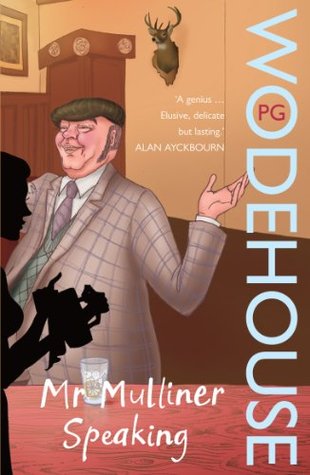
Mr Mulliner Speaking (Mr Mulliner #2), by P.G. Wodehouse – Another audiobook; it’s really fun to listen to the Mulliner stories on audible – rather like you are sitting in the Angler’s Rest with the rest of the clientele, listening to Mr Mulliner discourse on the fascinating lives of his seemingly inexhaustible stash of nephews and cousins. Roberta Wickham – that most mischievous and hilarious of Bertie Wooster’s love interests from the Jeeves books – makes an appearance in several stories, which made this even more fun.
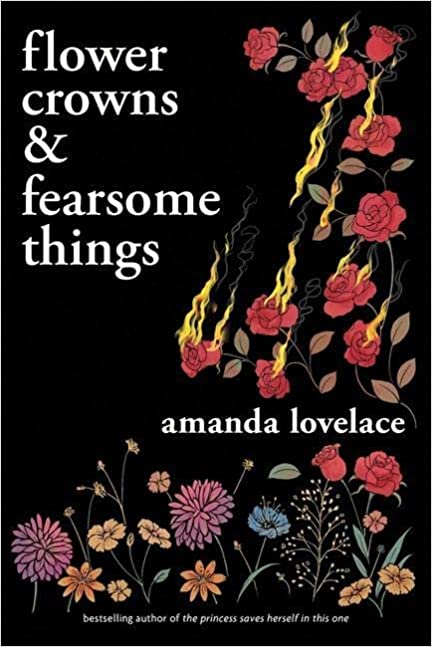
Flower Crowns & Fearsome Things, by Amanda Lovelace – The best poetry is both so universal and so personal that it seems to have been written just on purpose for the immediate reader, and Amanda Lovelace’s poignant, powerful and galvanizing poems read in exactly that way. I loved this collection and can see myself returning to it again and again.
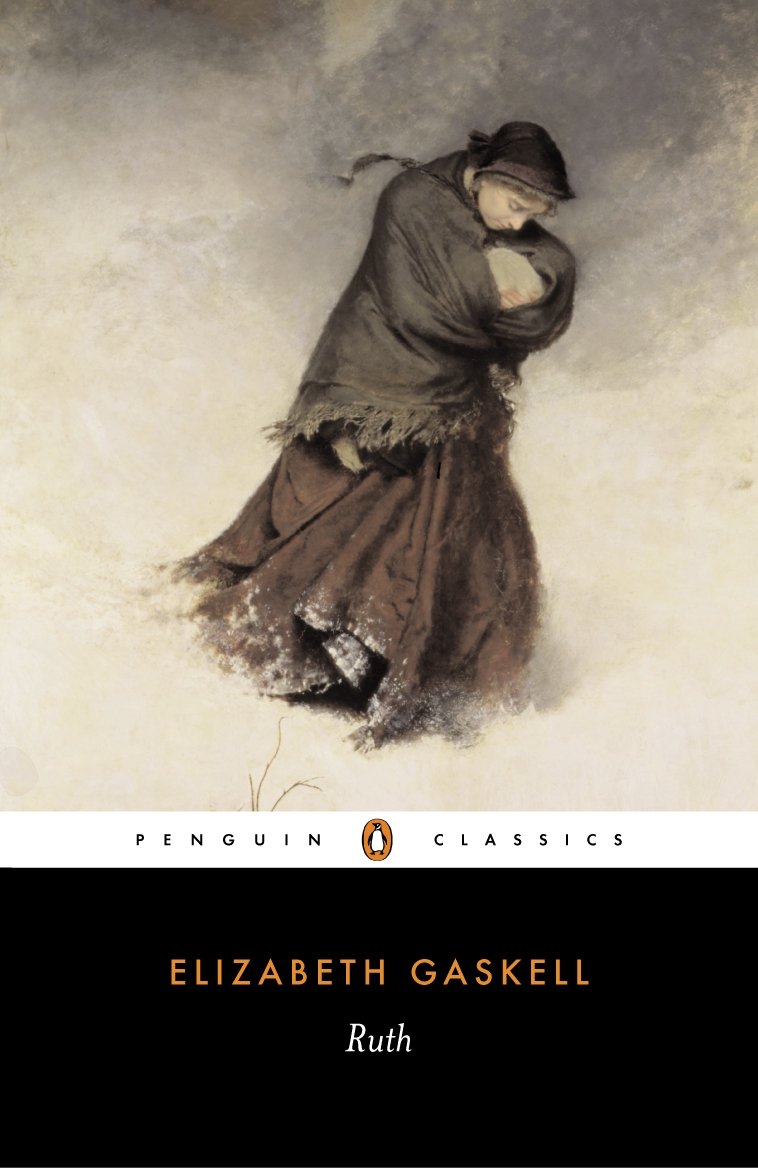
Ruth, by Elizabeth Gaskell – Fully reviewed here, for the Classics Club Challenge. While Ruth will never be my favorite Elizabeth Gaskell novel – so far that honor still belongs to Cranford, with Wives and Daughters a close second – I really did find Gaskell’s novel of society’s cruel treatment of a “fallen woman” an absorbing and thought-provoking read.
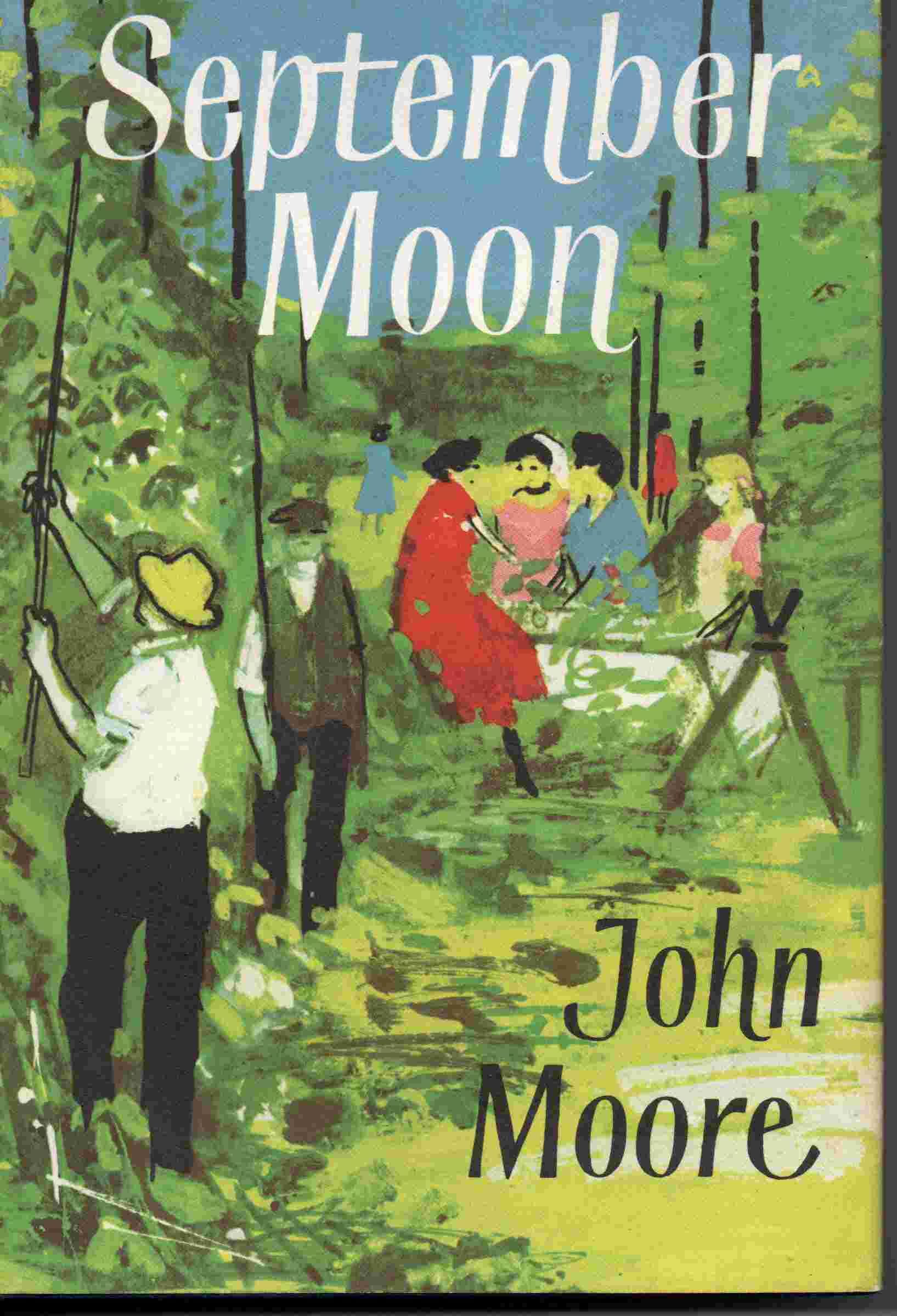
September Moon, by John Moore – After reading and loving Moore’s three volume memoir of life in rural England between the wars, I was excited to get an early edition of one of his novels. It’s early September and hop-picking season is about to begin. Tim, only son of a prosperous yeoman farmer, finds himself drawn to Marianne, daughter of his ne’er-do-well neighbor – it must be the hop moon. This was fun and light, although the references to gypsies were quite dated and there was some casual racist language that is all too common for books of this era and always jarring to read. So, trigger warning on that front.
Just William (William#1), by Richmal Crompton – I don’t know what took me so long to get to this very slim collection of linked short stories about a young troublemaker and all of his misadventures. I read it in two sittings, cackling the entire time. William’s adventures in babysitting were definitely my favorite part.
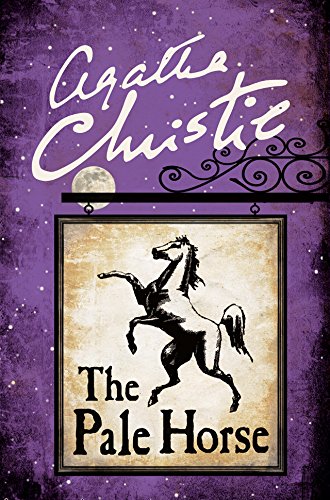
The Pale Horse (Ariadne Oliver #5), by Agatha Christie – Another audiobook to close out the month! I was trying to save The Pale Horse for October – spooky season – but couldn’t wait. The novel focuses on Mark Easterbook, a London-based writer who becomes intrigued with a list of names, found in the shoe of a murdered priest. Who are the people on the list, and how are they connected to the village of Much Deeping and to three self-proclaimed witches who purport to be able to kill with psychology – and seances? This is supposed to be one of Christie’s weakest novels, and I guess it is, but it certainly kept me engaged.
The Lark, by E. Nesbit – This is more of a summer read than a fall, but I closed out September with a real gem – one of E. Nesbit’s final novels, and one of her only novels for adults. Jane Quested and her cousin Lucilla Craye are gently reared young ladies when, just after World War I, they are plucked from school and given the hard news that their guardian has spent their inheritance and fled the country. Whoops! Left with only a cottage and five hundred pounds to get on with, Jane and Lucy set about to earn their living. In the process, they acquire a big house, make a lot of business mistakes, and meet a few handsome young men – as one does. Total comfort, total fun.
Whew! What a month. Three audiobooks! This is a feature of being just about done with my months-long podcatcher cleanout effort, and I’m really enjoying mixing audible into my listening time. “Going Solo” was a highlight, just like the last time I read it, and I also really enjoyed listening to “The Pale Horse.” As for reading of the ink and paper variety of reading, the light and frothy reads definitely made up the highlights of September – especially “Summer Pudding,” “Just William” and “The Lark.” Looking ahead to October, I’ve got my eye on a few fun autumnal reads and am planning to knock out a couple more classics, including – if I have time – the last Elizabeth Gaskell novel I’ve not yet read. Watch this space!
Busy week on the work and home front translates to slower week on the reading front. The recent standard pattern – slow and sporadic during the workweek, sustained and productive on the weekend – held true again, although this time the weekend was devoted to a tome. But one thing at a time.
I spent most of the workweek over The Lark, which was absolutely delightful, lovely and fun. And as has felt par for the course lately, very odd that it took almost a full week to finish, but I chalk that up to fitting it in around everything else during the week. I just don’t have the attention or the time reserves from Monday through Friday. But I did wrap this up early on the weekend and absolutely loved it. And a relaxing, restful read like The Lark set me up nicely to tackle a tome from my Classics Club list – Ralph Ellison’s Invisible Man. After devoting ample reading time to it over the weekend, I’m just about halfway through and feeling motivated. (Right away, I thought to myself, I can see how this book must have been a huge influence on Colson Whitehead – the magical realism elements are strong.) Not sure what’s next, since I still have a few hundred pages left to read in Invisible Man and I don’t want to get too ahead of myself, but it will be something comforting, I think.
No Instagram photo this week! My weekend was nothing to write home about – rain, rain, more rain, and some errands.

























 covered in flour