So, Guess What I’m Doing?

My first read-along!

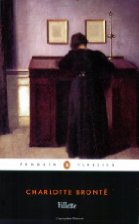
Villette (Source)

I can’t believe I’ve never done one before.  It always seems that either I don’t find out about the read-along until it’s halfway over, or else it’s a book I’ve already read or don’t want to read, or I’m too swamped with other books and won’t be able to keep up.  But when I saw Amal’s tweet about the Villette read-along, hosted by Beth of Too Fond, the stars aligned.

A read-along that hasn’t actually started yet.  A book I want to read.  A library stack that I can safely ignore (for a little while).  I’m so there.

I count Jane Eyre as my favorite book, and I consider myself a Bronte fangirl – despite not having read any of Charlotte’s other works.  (I’ve read Jane Eyre more times than I can count, though, and Emily’s Wuthering Heights , which I didn’t especially like, and both of Anne’s – Agnes Grey and The Tenant of Wildfell Hall, which I loved.)  Still, no self-respecting Bronte fangirl can get by on only one Charlotte , so it’s time for me to conquer the mountain that is Villette.

If you want to join in, Beth’s sign-up post can be found here.  We’ll be reading over three weeks: Volume I from May 12th-19th; Volume II from May 20th-26th; and Volume III from May 27th-June 2nd.  Sounds do-able, right?  Beth will be re-capping the week’s reading on Sundays, but I’ll put my own thoughts up here on Mondays, since that makes more sense with my blog schedule (and gives me a day to catch up, if I need to).

I’ll also be participating in the Twitter conversation about the book.  We’re using the hashtag #villettealong – so jump right into the discussion, if you’d like.

I’m so excited.  Bring on the Bronte!

You Know You’re A Bookworm When…

DSC_0031

~ You look up and realize that you got on the wrong subway train, because you were reading.  And that you’ve gone several stops past the last transfer point, because you were reading.  And now you’re going to have to turn around and retrace your path back, and it’s going to add an hour to your commute, and the first thing you think upon discovering all of this is, “Yay!  More time to read.”

~ You have spent, cumulatively, about a week of your life combing Etsy for vintage books, book crafts, book jewelry and accessories and especially, especially bookmarks.

~ You own a magnet with an alien flashing a peace sign and the words “Take Me To Your Library” and you’re contemplating a matching totebag.

~ You have an entire Pinterest board dedicated to libraries, bookshelves and reading spaces.

~ Your daughter owns a t-shirt that says, “I Have My Own Mr. Darcy: His Name Is Daddy,” and you’re wondering if it would be too nerdy (or just nerdy enough to be awesome) to dress her in it on the day you wear your own Pride and Prejudice tee.  You’re leaning towards just nerdy enough to be awesome.

~ You are considering a bubble bath, but you decide against it because you’re reading a library book and you can’t get it wet.

~ You secretly enjoy long car rides… and long flights… and sometimes even flight delays, because you love getting “borrowed time” when you can read for hours without feeling guilty that you’re not cleaning or working.

~ You miss your old library so much, it hurts sometimes.

~ You are nostalgic for summer vacations, not because of the weather or the cookouts, but because you had no responsibilities that got in the way of reading all night long.  On that note…

~ When purchasing a new flashlight, your main criteria is that it be light enough to hold up for hours while reading under a pile of blankets.  Even if you don’t do that anymore.  Because… well… you never know.

~ You have the devil of a time finding a “dressy” handbag because hardly any of them are big enough to hold even a mass market paperback.

~ You own at least one literary guide to a foreign country and are actively attempting to persuade your significant other to make it the theme of a vacation.  (Come on, hubby, you’ll love a Jane Austen tour of southern England.  I promise.)

~ On the day you find out that your baby-to-be is a girl, you immediately start shopping not for baby clothes, but for a fancy edition of Anne of Green Gables.

~ If you don’t read every day, you get a twitch.  A real, honest-to-goodness, physical twitch.

 What makes you a bookworm?

On Authors and Conversation

DSC_0031

It’s 2013, and the world has shrunk to the size of a microchip, and in many ways, that’s a great thing.  There have never been so many conversations as there are going on right now, at this very moment.  It has never been so easy to connect with others, at least on a superficial level.  (Getting to know someone – really know them, inside and out – is a very different matter, but that’s a topic for another day.)  And for the first time in history, thanks to the miracle of Twitter, it’s never been so easy to strike up a conversation with an author.

I’ve had the experience of getting tweets from several authors I admire, and it hasn’t yet stopped being excruciatingly cool.  On a few occasions, I’ve tweeted my #fridayreads and received a response from the author.  Alex George, for instance, told me I made his day when I praised his novel A Good American on the mini-blogging site.  (Well-deserved praise, by the way.  A Good American is incredible.  If you haven’t read it yet, what are you waiting for?)  Alex George telling me that I “made his day” pretty much made my month.  And when I tweeted during a Friday lunch hour that I was enjoying a salad and Mrs Queen Takes the Train, William Kuhn shot back a charming tweet that Mrs Queen prefers walnuts on her arugula, leaving me grinning for the rest of the day.

I started thinking about authors and their various levels of engagement with their fans when Amal posted this interesting take on a Bryan Garner article she read.  While I agreed with her critiques of Garner (and she formed them much better than I would, so go read her post), I had to chime in with a comment noting that he was extremely gracious to his fans.  My best friend, unlike me, is a huge Garner fan.  While serving as a civilian U.S. government employee in a war zone that I personally would find pretty terrifying, R got into a debate over an esoteric point of grammar with her colleagues and emailed Garner to get his opinion.  He responded with a very kind email in which he answered her question, thanked her for her service, and asked her where he could send her some free books.  Since she’s basically the guy’s biggest fan, you can imagine how excited she was.

When I told Amal that story, via comment (and you can see our exchange in the comments section of her post), she responded that it was nice to hear that Garner took more of a “Dr. Seuss” attitude in responding to fans, and then linked me to a letter that a “grumpy” E.B. White once sent to a young fan.  The acclaimed author answered his little admirer’s request for another book by suggesting that the child start a national movement dedicated to NOT sending letters to E.B. White until he produces another book.  The response wended its way to the recipient’s librarian, who wrote to White to complain about his tart response, which he answered with a long letter explaining the demands that fan mail places on him.  While he made some good points – what a time-consuming effort it must be to answer thousands of fan letters personally – I still give the side-eye to his sarcastic response to a young child who probably wasn’t capable of grasping the snarky point, and who was just excited about Charlotte’s Web, anyway.  I think he probably just snapped after too much time spent trying to be gracious in fan responses and not enough time doing what he really wanted to do, which was writing, and I do sympathize.  But still.  There’s no need to get huffy, especially not when the recipient is a young child.  (If my Peanut received a letter like that from an author she admired, you can bet I’d be dashing off a reply of my own.)

The exchange between the author, the child and the librarian was a very interesting one to read, and I was grateful to Amal for pointing it out to me.  It also got me thinking about the things that writers must do to earn their incomes – aside from just writing, that is – and wondering whether the profession has gotten more demanding in recent years.  E.B. White bridled at answering fan letters.  Well, nowadays there’s the book tour, which can mean weeks on the road if you’re an author with bestseller potential.  (Have you seen John and Sherry Petersik’s posts about their Young House Love book tour?  Yowza.)  There’s the added work of “networking” on Facebook and Goodreads, maintaining your own blog or website as many authors do, and tweeting at starry-eyed fans like me.  On the one hand, the Internet makes it easier for authors to reach many more fans at once, just by updating their Facebook pages or putting up 140 characters.  On the other hand, when it’s easier to do, people demand that you do more.  If authors feel compelled to respond to every fan tweet, when exactly do they have time to write?  After all, we all know that the Internet can suck away hours of the day.  (Ever logged into Pinterest and lost two hours of your life?)

The relative ease of online communication has emboldened fans to insist on more contact with their heroes.  And I expect it’s probably added work for the writers who depend on readers to buy their books.  They now have to “sell” to readers online, or risk losing a reader to an author who is more engaging toward fans.  E.B. White-style reticence just doesn’t work in the Internet age, and an author who snaps back that fans should stop tweeting him if they want another book is probably going to alienate a few people.  (There are plenty of cases of Authors Behaving Badly that have enraged the book community – usually when an author responds angrily to a blog review.  I’m not even going to get into those sticky situations.)

It’s a tricky balancing act.  On the one hand, I like tweeting my favorite authors and seeing their responses.  I get excited at the thought of making contact, however superficial that contact is, with a writer whose work I admire.  And I also like giving credit where credit is due: if I really enjoyed a book, I want to tell people that I enjoyed it and congratulate the author on a job well done.  If I was a published author, I can’t imagine I would ever get tired of hearing from people who enjoyed my hard work.  But maybe we readers, as a group, need to back off a little bit.  Maybe we need to give our favorite authors some space to do what they do best: write books.

I’m not going to stop tweeting about the books I like, or telling the authors how much I enjoyed their work, because I know that if I had written a book I’d really want to hear from the people my words touched.  But when I tweet or blog about authors I like, I don’t expect a response from them.  I don’t expect them to take time out of their schedules to engage me in conversation.  When they do, though, it makes my day.

And with that, I’ll leave you with my absolute favorite quote about fan mail, from the great Maurice Sendak:

Once a little boy sent me a charming card with a little drawing on it. I loved it. I answer all my children’s letters — sometimes very hastily — but this one I lingered over. I sent him a card and I drew a picture of a Wild Thing on it. I wrote, “Dear Jim: I loved your card.” Then I got a letter back from his mother and she said, “Jim loved your card so much he ate it.” That to me was one of the highest compliments I’ve ever received. He didn’t care that it was an original Maurice Sendak drawing or anything. He saw it, he loved it, he ate it.”

In Which I Ponder Genre-Bending

DSC_0029

Like many readers, I love to look back at what I’ve read over the course of a month, a year, or even more.  (There are other readers who do this, right?  Please tell me I’m not the only one.)  I make lists in my email and on my blog, I track my reads on Goodreads, I assign book superlatives, and I make pie charts

When I sat down to look over my 2012 books and make my pie charts, I spent a lot of time agonizing over what genres to assign to certain books.  (Yes, I said agonizing.  I realize that’s melodramatic, and I don’t care.)  Here’s the chart I ended up with for my fiction books:

Download Your Pie Chart

It’s likely no one would notice or remark upon this next fact except for me, but: the chart shows that I only read one historical fiction book in 2012.  That would be Elizabeth I, by Margaret George (which was fabulous, by the way).  But Elizabeth I is not the only hi-fi I read in 2012.  I’ve always been one to read books set in other time periods, and 2012 was no exception.  So why does my pie chart say I only read one hi-fi book last year?  Well, because the chart only shows what I considered the “primary” genre of each book, and poor hi-fi got stripped as those books dropped more neatly into other genres.  Like what, for instance?  Well, there were the Maisie Dobbs books, which were set in the late 1920s in London and which relied heavily on historical detail to inform their storylines.  They’re mysteries, so they slotted into the mystery genre, but I could easily make a case for them as historical fiction.  Then there were books like The Snow Child, by Eowyn Ivey, and Wolf Hall and Bring Up The Bodies by Hilary Mantel, which were certainly historical fiction (The Snow Child is about early Alaskan settlers, and the Wolf Hall novels are set during the reign of Henry VIII) but their strong prose pushed them into the literary fiction category.  (Hmmm, now that I’m thinking about it, Elizabeth I was very well-written, too.  Should I have called that lit-fic and completely raided the hi-fi category?  And what makes something lit-fic instead of general fiction or hi-fi, anyway, and who decides?  These are the things that keep me up at night.)  Then there were books like The Hobbit, which could have been considered children’s lit (or fantasy, a genre which didn’t even make it onto my chart) but instead landed in classics, a genre that tends to be whatever people say it is.  Or the Fairacre books, which could have populated a genre of gentle fiction, but instead got plopped into classics, too – because I say so.

I realize that this pie chart is not important to anyone but me.  But it’s fun for me to look back and see what I read the previous year, and I like my reads to be neatly organized.  Cross-referencing genres, or thinking about how I should have cross-referenced genres, really drives home the point that I read a lot of genre-benders.  And this past month has been a perfect example of that.  While I was flying through The Midwife’s Tale – for example – I stopped to scratch my head and wonder whether I would categorize it as a mystery (since it is a murder mystery with a classic whodunit plot) or historical fiction (since the setting of York in 1644 is so important to the plot, and so richly detailed too).  I’ll probably call it a mystery, but then, there’s an argument the other way too.  And there was The Song of Achilles – hi-fi, clearly, since it’s set during the Trojan War, but the beautiful, alluring, almost poetic prose is certainly going to tip the scales in favor of this one going in the lit-fic bucket.  And poor hi-fi gets raided again.  Then there’s the Lord of the Rings trilogy, which I’m working my way through (I’ve already read the first two this year) – fantasy?  Or classic?  On balance, I think classic.  But again, a case could be made in the opposite direction.

When I’m not lying awake at night debating these things because my life is apparently too easy, I’m pretty happy to be reading all of these genre-benders.  A mystery with strong historical fiction elements?  A lit-fic offering that nods to an age-old classic?  A classic fantasy?  How could I go wrong with any of these?  I’m not going to stop reading genre-benders anytime soon.  I’m having too much fun with these books that pick and choose from among different genres and refuse to be pigeonholed.  And at the end of the year… well, I guess I’ll have to come up with some system for cross-referencing.

This may call for more pie charts.  Oh, darn.

Scholastic’s 2012 Kids and Family Reading Report is Here!

lets read

Last week, Scholastic released its 2012 Kids and Family Reading Report, and it’s chock-a-block full of interesting information.  This is the fourth time Scholastic has prepared the report, which comes out every two years, and it’s the first time that it was at all on my radar screen.  I immediately downloaded the report and read the entire thing (not hard to do; it’s a lot of graphics).  As a new mom myself, I was very interested to read what Scholastic (a company I remember fondly from my school years) had to say about today’s kids and their reading behaviors.  Much of the report focuses on e-books, which promise to become more prevalent each year, and most of the findings were not particularly earth-shattering, at least not to me.  My thoughts:

On Parenting a Reader

Even before Peanut was born, I was thinking about how I’d go about bringing her up to be (I hope) an avid reader.  I posted here about my plans to be a Reading Mom, and later told you about Growing a Reader from Birth, a fascinating book I read back in November.  I was not at all surprised to find that a large part of Scholastic’s study focused on how parents can help to bring up little readers.

Unsurprisingly, of the parents that Scholastic polled, almost half (49%) believed that their children did not spend enough time reading books for fun.  Meanwhile, many parents believed their children spend too much time in front of screens – watching TV, playing video games, surfing the internet and Facebook – and texting on their smartphones.  As kids become more technologically adept, and have more choices for their screen time, I expect to see the numbers rise – more and more parents will be of the opinion that their kids spend too much time in front of screens, and not enough time reading.  (One of my few criticisms of the report was that while it looked at kids’ time spent reading and doing sedentary activities in front of screens, it didn’t address kids’ time spent playing outdoors or participating in sports.  I understand the report can’t address everything, but I’d like to have seen physical activity included, since I think that it’s very important for kids to be active outside.  I would have loved to see what parents thought about their kids’ time spent being active; it didn’t surprise me at all that most parents felt their kids spent too much time in front of screens and not enough time reading, but what were parents’ views on, say, soccer?  If the study wanted to look at reading time in comparison to time spent doing other activities, I felt that omitting outdoor activity left a big hole.)

That said, there are things that parents can do to encourage reading, and they start very early – from birth, in fact.  The study found that the three most effective things that a parent can do to encourage kids to read are to (1) set a good example by reading frequently yourself; (2) provide a home environment with an abundance of books; and (3) spend lots of time reading to your children.  I thought Scholastic’s finding here was fascinating, because it proves that you don’t need lots of money to grow a reader.  Any parent, regardless of how much money the family makes, can encourage their child to read: time spent reading with your child is more effective than money laid out.  Books purchased on the cheap from library sales (or even borrowed from the library – FREE!), thrift shops or bargain sales won’t set you back much, but they’re worth their weight in gold when it comes to encouraging kids to read.  And time spent cuddling with your kids and reading stories together costs nada, but will pay out huge dividends when it comes to growing a reader – and can you think of a more precious memory?  Along with this encouraging news goes the – frankly, kind of surprising – finding that there’s absolutely no correlation between household income and frequency of reading among kids.  Scholastic collected information about family income of frequent readers and infrequent readers and there was almost no difference at all – the median was $71,000 for frequent readers and $70,000 for infrequent readers, a negligible difference.  It debunks the conventional wisdom that kids from high-income families read more than kids from low-income or middle-income families.  (And I think, by extension, it shows that kids from low-income families aren’t doomed to struggle academically.  Caring teachers and parents who make the time to read with their kids and use the resources at their disposal to encourage reading mean far more than paychecks.  Isn’t that awesome?)

storytime

On E-Books

Jonathan Franzen, deal with this: e-books are here to stay.  Much of Scholastic’s study was devoted to questions about kids and e-books, and that makes perfect sense, since they’re the new wave of reading.  I know there are plenty of paper devotees and book purists, and that’s great and all, but the fact remains that kids are attracted to e-books, now more than ever.  Scholastic found that the numbers of kids reading e-books on various devices (including dedicated e-readers like Kindles or Nooks, desktop computers, tablets such as the iPad, or smartphones) has increased across the spectrum since 2010.  The percentage of kids who have read an e-book has almost doubled in the last two years, and among kids who read e-books, 20% say they now read more for fun (especially boys).  Most e-book reading happens at home, but more schools are offering the opportunity to their students, and half of kids ages 9-17, who have read at least one e-book, say they would read more for fun if they had more access to e-books.

There are plenty of reasons for this, according to Scholastic.  For one, e-readers help kids who lack self-confidence, perhaps because they’re slower readers than their peers, who might not want to tote around a below-grade level book that their friends can see (and mock).  Many kids said that part of the lure of e-readers is that their friends can’t see what they’re reading.  (This holds true for moms, too.  I know there are plenty of ladies out there who claim to be reading Anna Karenina but are really reading Fifty Shades of Grey.  C’mon ladies, Count Vronsky isn’t making you blush like that.)  I think there’s another reason too, one that Scholastic didn’t explore much (other than vague allusions) – kids like technology, they like the new hot thing, and e-readers and devices are cool and of-the-moment.  My kid is five months old, so her interest in my Nook doesn’t extend beyond wanting to put it in her mouth, as she wants to put everything in her mouth.  But when she is old enough to read to herself, I’ll let her read in any format she wants, and I might even get her an e-reader of her very own when she’s reading longer books.

Still, print books aren’t going anywhere.  Although kids are fascinated by e-readers, they still love to turn pages.  80% of frequent readers (who have read an e-book) say they still primarily read print books for fun.  And parents of younger children prefer print to e-books by a large margin.  Makes sense to me; Peanut’s books wouldn’t look nearly as good on my Nook as they do in print.

I think there are several lessons here.  First, we all need to make peace with e-books (if we haven’t already; I personally love my Nook for its convenience, especially when traveling, and wouldn’t dream of getting rid of it, although I still primarily read print books too).  They’re here and they’re not going away.  Second, if e-books will encourage kids to read, we should get them e-books.  You don’t have to have boatloads of disposable income to make e-books available to your children.  Many classics are in the public domain and available to download for free, and you can read them on a desktop computer, which many families own even if they can’t afford a fleet of other devices.  Again, I think Scholastic’s report is wonderfully encouraging in that it proves, over and over again, that there are plenty of low-cost ways to encourage reading, and you don’t have to be rich to raise a reader.

On Boys and Girls and Books, Oh My!

It’s been the conventional wisdom since time immemorial that girls read for fun more than boys do.  I have lots of thoughts about why this might be.  For one thing, I think that as a society, collectively, we haven’t done the best job of encouraging boys to be avid readers.  There are more good choices for girls’ reading material, and many of the children’s classics – like The Secret Garden, A Tree Grows in Brooklyn, Anne of Green Gables, Betsy-Tacy, and A Little Princess to name just a few – seem to be geared towards girls.  (That’s not to say boys can’t read those books too, and maybe there are boys that do, but I don’t believe as many boys are attracted to them.)  Of course, there are classics that appeal to boys, too – like The Wind in the Willows, Frog and Toad, The Hardy Boys, but I think the difference is that those books appeal to both boys and girls, where the girls’ classics really appeal only to girls, with few exceptions.  And then there’s the fact that little boys have, for generations, been encouraged to be rough-and-tumble, and reading has been considered somewhat less than manly, and as a result I believe that society has missed many opportunities to instill a love of reading in both sexes.  (It’s not impossible – as I mentioned in my post Are readers born or made?, my brother was not an avid reader – although he always loved to be read to – until my mom found him a series of young adult books set in the “Star Wars” universe, which he loved, and now today he reads more than any other guy I know.)

However, according to Scholastic, boys are catching up to girls in the love-of-reading department.  The number of boys reporting that they consider it important to read for fun, and that they enjoy and spend a lot of time reading for fun, has increased slightly since 2010.  Yay!  But… there’s bad news too.  The number of girls reporting they consider it important to read for fun, and that they enjoy and spend a lot of time reading for fun, has decreased slightly since 2010.  No!  It’s true.  Girls are leveling or dropping off in their enjoyment and pursuit of reading (although they still read for fun at higher numbers, and more frequently, than boys).  What this finding says to me, as a mom of a girl, is that we can’t afford to neglect girls’ reading and assume that they’ll come to reading naturally; girls need to be encouraged too.  Parents and educators often focus on the question “how do we get the boys to read?” because girls, as a group, often seem to have their reading habits ingrained without much effort from the adults.  But we can’t ignore the girls!  I think it’s a mistake to assume that girls will love reading just because they’re girls, and I will put just as much effort into encouraging Peanut to read as I would have if she happened to be a boy.

The good news for adolescents is that many of most popular the young adult books on the market seem to appeal to boys and girls equally.  (Twilight is the exception.)  Scholastic polled kids on the last book they read for fun, and the most popular responses were books that appealed to both boys and girls.  The Diary of a Wimpy Kid series won the 9-11 set (and came in a close second to Junie B. Jones among 6-8s), and the Harry Potter series and the Hunger Games trilogy had the 12-17 market cornered.  I don’t know if there are more choices now that both boys and girls can enjoy equally, or if they are just getting more press, but either way, I like it.

These are just my random thoughts from the 2012 Kids and Family Reading Report.  There’s a lot more food for thought in there!  Download it and see for yourself – and if you do, I’d love to hear your impressions.

Have you read the 2012 KFRR?  What did you think?  Parents, do you agree or disagree with the report’s conclusions?

2012: A Year in Books

DSC_0460

When I was sixteen, I set a goal to read 50 books in a year.  They had to be books that I wasn’t reading anyway for a class assignment, books I’d never read before, and books that I would be proud to show to my favorite English teacher.  I kept a list all year and I recently came across it again – my mom saved it and slipped it into the back of my baby book, which she gave to me along with a blank one to fill in when Peanut was born.  Looking back over the list, it appears that I was on a major Agatha Christie kick that year.  But I also fit in Jane Eyre, Emma, Tess of the d’Urbervilles, Walden, Wuthering Heights and Anna Karenina and a handful of Eugene O’Neill plays.  I had a major “thing” for Eugene O’Neill in high school.  Oh, and sixteen-year-old Jac also found time to read a book on college applications and a bio of my favorite band, R.E.M.  (Some things really haven’t changed.)  Looking back at my 1998 book list, I remembered what fun it was to go over my reading at the end of the year.  In fact, I think I’ve done something of the sort most years since.

This year I’ve managed to squeeze in plenty of reading time, even with some busy times at work, not to mention pregnancy and a NICU journey and a newborn.  Reading has always been my escape and my leisure.  So here’s 2012, by the numbers.

In 2012, I read 98 books (82 fiction and 16 non-fiction), and a total of 31,491 pages.

Here’s a more detailed breakdown:

Download Your Pie Chart

Download Your Pie Chart

Of course, it wouldn’t be a proper reading wrap-up post if I didn’t tell you my favorites, would it?  Here, in no particular order, are my top ten favorite books read in 2012:

Wolf Hall, by Hilary Mantel – I loved this 2009 Man Booker winner, which focused on the trials and tribulations of Thomas Cromwell as he bends the law to allow Henry VIII to divorce Katherine of Aragon and marry Anne Boleyn.  Fascinating story (even though I knew how things ended, for Henry and Katherine and Anne, it was still interesting to read a version with Cromwell as the main character) and gorgeous prose.

Quiet: The Power of Introverts in a World that Can’t Stop Talking, by Susan Cain – As someone who has always tried to overcome my introverted tendencies (berating myself for being boring when I wanted to stay home with a book instead of go out and party, and always, always trying too hard to be bubbly and chatty) I loved reading about “mah people.”  Susan Cain explains how American society came to embrace an “extrovert ideal” and how introverts can capitalize on their own personalities to succeed professionally.  Fascinating mix of social science and cheerleading for those of us who’d rather recharge with some alone time than in a crowd.

Freddy and Fredericka, by Mark Helprin – I laughed my way through this royal farce.  A spoof Charles and Di are sent to re-conquer the United States for Great Britain.  Traveling incognito across America, they learn to love one another.  Silly, sweet, and just what I wanted to read after long days in the NICU.

Shine Shine Shine, by Lydia Netzer – I was captivated by this tale of a marriage of two outsiders.  Sunny and Maxon bonded over being different.  But when Sunny became pregnant, she decided she didn’t want to be different anymore.  Now Maxon, an astronaut, is stranded on a broken-down rocket and Sunny must decide if she wants to abandon her quest for conformity and save her marriage.  But will she be too late?  Loved the writing and I was glued to the story.

The Hobbit, by J.R.R. Tolkien – I’d been meaning to get around to this one for quite some time, and I finally did.  I loved the sweet, fun story of Bilbo Baggins and how he goes from being a stay-at-home hobbit to an adventurer.  One of these days I might even get out to see the movie, although I doubt it will bring me quite as much joy as the book did.

A Good American, by Alex George – Oh, my goodness.  I can’t stop gushing about this gorgeous book.  The story of an immigrant family over several generations (and about a century), it has become my gold standard by which I measure all future family sagas.  I laughed and I cried and I tweeted the author to tell him how much I enjoyed his work (and he tweeted me back!).

The Snow Child, by Eowyn Ivey – I love when I read a book for the characters and get swept away by gorgeous prose.  The Snow Child was everything a book should be – as crystal clear and evocative as a photograph, emotional, gripping, and beautiful.  Just a stunning, stunning book all around.

11/22/63, by Stephen King – My first Stephen King novel was so much fun.  I couldn’t put it down; I loved the descriptions of life in the 1950s as Jake/George learned to navigate a new decade and love again after his divorce.  And time travel novels are my weakness, so I knew I’d be a fan.

The Mapping of Love and Death, by Jacqueline Winspear – I read all the Maisie Dobbs mysteries this year, and this one was my favorite.  Maisie is a lovable, if sometimes exasperating, heroine, and her cases are always fraught with emotion and danger.  The Mapping of Love and Death was, in my opinion, the best book out of a really remarkable series.

Bring Up The Bodies, by Hilary Mantel – It’s not cheating to name two books from a trilogy to my top-ten-bests, because Bring Up The Bodies ALSO won a Man Booker.  So if the Man Booker awards committee can double up on the Hilary Mantel, so can I, amirite?  In this installment, Cromwell finds himself undoing all his previous work (in a sense) – after spending all of Wolf Hall trying to install Anne Boleyn on the throne, he spends all of Bring Up The Bodies trying to dislodge her and sub in Jane Seymour.  Again, I knew how it would turn out, but loved seeing how the events unfolded from Cromwell’s perspective.

All in all, I’m happy – but not thrilled – with my reading in 2012.  I’d like to have read more classics (I counted the Fairacre books as classics – since I think they are – and they inflated my totals) and more literary fiction, and a little less general fiction.  I got very swept up in hyped new releases this year (explaining my excesses at the library) and I wish I had spent more time reading through my TBR and the books I already had on my shelves.  Had I done that, there’d have been more classics on the list, for sure, and more literary fiction too.  But I enjoyed my reading immensely in 2012, and I think that qualifies as a success.

How was your 2012 reading?  What are your goals for 2013 reading?  (I’ll be sharing mine next week.)

Holiday Hits: Bookworm Bests

Since shopping is such a blast, I’m back with one more bonus list of gift suggestions for the holidays!  Now, if you’ve been reading this blog for more than… I don’t know… thirty seconds or so, you’ve probably figured out that I love to read.  I love pretty much everything there is about books.  Reading is my primary hobby, and I’m a huge fan of anything that celebrates reading and books.  So if you have a similarly obsessed bookworm in your life (or if you are a similarly obsessed bookworm and want to get a treat for yourself), here are some bookish gift ideas.  These are all things that I already have (Santa, I’ll write you separately) and love.  Speaking for my people, I can tell you that pretty much any of these things would be a huge hit with your word-loving pals:

Eclectic vintage typewriter key  bracelet  book worm(Image Source)

Vintage typewriter jewelry.  Yep, you read that right.  I am particularly obsessed with the offerings of Lizzy Bleu on Etsy.  I have this “Book Worm” bracelet, but there are plenty of other choices in this Etsy shop – you could get yourself a pendant with your initial or any one of her many bracelets made from vintage typewriter keys.  I love this stuff – not only is it a nod to my love of words and writing, but it’s eco-friendly to boot (I’m on a huge upcycling kick).  And the quality is great.  Typewriter jewelry is a fun, quirky way to advertise one’s love of words.

Jane Austen Bookmarks - Set of 6(Image Source)

Unique bookmarks.  Hubby got me these Jane Austen bookmarks for my birthday this year and I’m in love with them (and him too, obviously).  They worked for me on multiple levels – for one thing, I’m crazy about Jane Austen.  She might be my favorite author… but don’t hold me to that; I don’t want to be tied down.  And for another, y’all know I love bookmarks.  But if your bookworm isn’t into Jane Austen, just a quick search for the name of the recipient’s favorite author and “bookmark” in Etsy is practically guaranteed to yield you some great finds.  For example, I typed in “Tolkien bookmark” and found this gorgeous hand-stamped copper bookmark that would be a fantastic gift for a Lord of the Rings enthusiast.

Lavender Bookmark & Sachet Set(Image Source)

Scented bookmark.  That’s right, ish just got real.  You know that I can’t get enough lavender.  (Or maybe you didn’t.  Anyway, it’s true.  I can’t.)  Well, this is the extent of my mania: I have TWO lavender bookmarks.  As in, fabric bookmarks stuffed with dried lavender.  I got the first one from a lavender booth at the Union Square Greenmarket in New York.  Hubby and I were on our babymoon the week before Peanut was born (well, we didn’t know it was the week before Peanut was born, but that’s how things turned out) and we were wandering through the market when I ground to a halt in front of, basically, my mothership.  This booth had all things lavender and I wanted everything, but I had intentionally packed a small bag and I was saving room for a trip to the Strand, and then I saw the bookmarks and very sweetly said “I need this, it’s really important.”  And then, because I can’t leave well enough alone, I bought another lavender bookmark on Etsy later.  Look, I love the scent of book as much as the next girl, but sometimes you just want your reading material to smell like France, amirite?

READ Sign wooden wall art cottage decor - word sign - library sign - SLATE GRAY(Image Source)

Wooden “read” sign.  I think this would be a fantastic gift for a reader: a wooden sign proclaiming their favorite hobby!  I have one of these signs in my reading nook and I love it; it reminds me of one of my favorite activities and makes for some cool decor.  Plus, you get the good feeling that comes with supporting an independent artisan.

(Image Source)

Penguin Clothbound Classics.  Books!  What a novel idea!  (Hee hee.)  But here’s the thing – buying books for a bookworm can be a tricky business.  Yes, we love ’em.  But it’s easy to end up with repeats.  I love giving books as gifts, but I always worry that the recipient already has a copy of the book.  But when the books are this pretty, I personally don’t mind having more than one copy and many bookworms would probably agree.  I collect Penguin Clothbound Classics and keep them together on a shelf in my bedroom.  They publish some of my favorite classics in gorgeous editions.  There are other collections, put out by other publishing houses – this just happens to be the collection that I particularly like and am therefore dedicated to acquiring.  I can practically guarantee these will be a hit – even if the bookworm in question already has a copy of, say, Pride and Prejudice, it’s hard to take issue with a pretty printed cloth cover.

Pride and Prejudice book cover t-shirt(Image Source)

Nerdwear.  I love my Pride and Prejudice shirt from Out of Print Tees, and my Reading is Sexy shirt from Buy Olympia, both of which I wear un-ironically.  Seriously – cute, comfortable, and a message I can totally get behind (and I’m talking about both shirts here).  Of course, there is a danger here: you don’t want to buy your bookworm a shirt advertising a book they hate.  But if the recipient’s favorite book is available, they’ll love a fun new library-going outfit.

Mug: White Diner(Image Source)

Bookstore Swag.  Bookworms have bookstore radar.  It’s true.  We’re drawn to bookstores; it’s our nature.  And most bookworms have a favorite bookstore.  A place that they dream about.  For me, that place is the Strand in New York City.  I love that place.  Forget Disneyland – the Strand is the happiest place on Earth.  I’d totally live there, except that I don’t want to move to New York.  I own a not-embarrassing amount of Strand-logo merchandise, including the above mug.  And a few tote bags.  And some bookmarks.  But if your bookworm dreams about a different bookstore – maybe Powell’s, or City Lights, or Politics & Prose – you can make him or her very happy with a cool mug or bookmark or t-shirt proudly announcing his or her personal affinity.

Nerd alert – I really like all this stuff.  And that’s cool, because it’s cool to be who you are and… stuff.  So.  Nobody paid me to write this post, and nobody gave me anything free.  Like I said, I just really, genuinely like everything I’m recommending.

What do you buy for the bookworms on your list?  Anything worth making a collect call to Santa over?  Spill.

Shelf Study

Like many book lovers, I look forward to getting my Shelf Awareness for Readers newsletter every Tuesday and Friday.  (In fact, when I’m not on maternity leave, Tuesdays are my least favorite day of the week – all that Monday motivation is spent but Friday is oh-so-far away – and my Shelf Awareness email is sometimes the only thing that gets me through those days.)  I always read the introduction, sometimes read the author features, and skim the reviews for books that I think sound particularly intriguing.  But my favorite thing about the Shelf Awareness newsletter is when it links to bookish articles and features elsewhere on the web.  Last Tuesday’s Shelf did just that, pointing readers to a feature in which Geraldine Brooks (who wrote the Pulitzer Prize-winning March, which I loved) describes the whimsical way in which she organizes her bookshelves: alphabetical by author, but within that system she pays attention to how the authors would get along at a dinner party.  Heh!

I am not, I’m sorry to say, quite that whimsical.  In my kitchen, I have things sorted on a loose system of how-much-do-I-like-this, which drives hubby crazy and befuddles friends and family members who try to cook in my house.  But on my bookshelves, I’m pretty straightforward: I organize my books by genre and within genre, roughly by size.  I have a few idiosyncracies; for instance, within my classics collection I have a shelf and a half of books published by Barnes & Noble, and those are pretty much sorted geographically (English, Russian, American, and so on and so forth), but also by color (the older cream covers on the left, newer black colors on the right).  It’s all about what my eye finds appealing, within a system that generally makes sense.

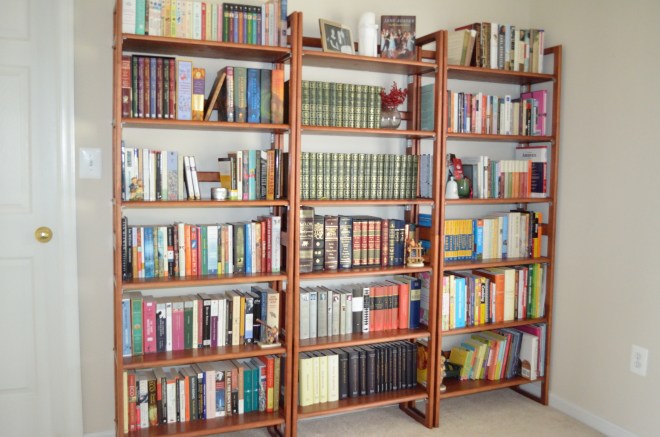
Here’s how I sort my shelves:

Left Shelf

Top: mystery novels (Agatha Christie and Dorothy L. Sayers) on the left, children’s and young adult on the right.
Second from top: more children’s books
Third from top: literary fiction
Third from bottom: literary fiction
Second from bottom: classics, mostly trade paperback (some small hardcovers)
Bottom: classics, mostly trade paperback (some small hardcovers)

Middle Shelf

Top: Sentimental (pic of my grandparents, unity candle from my wedding, Jane Austen book hubby gave me when we were dating)
Second from top: Complete Charles Dickens (handed down from my grandmother)
Third from top: Complete Charles Dickens (handed down from my grandmother)
Third from bottom: Other leatherbound classics and nice hardcover classics
Second from bottom: Trade collection hardbound classics
Bottom: Barnes & Noble hardbound classics

Right Shelf

Top: Biographies and more literary fiction
Second from top: More literary fiction
Third from top: Comedy (David Sedaris, P.G. Wodehouse, my beloved Jon Stewart) and my bookmark collection
Third from bottom: Travel books (Rick Steves and Rough Guides as well as travel memoirs)
Second from bottom: Cookbooks
Bottom: Knitting

When I write it all out like that, it seems kind of weird.  But I swear it makes sense in my head and appeals to my eye, and since I’m generally the only one who goes looking for books on these shelves (hubby has his own shelves, in his den) I’m cool with it.  What about you – how do you organize your bookshelves?

Bookish Birthday Treats

So.  Last Saturday was my birthday, and it was great.  I got the one present I wanted more than anything else – the chance to snuggle at home as a family of three, because Peanut came home from the hospital in time!  But because I’m a lucky lady all around, I got other treats too, some of which were delightfully bookish.

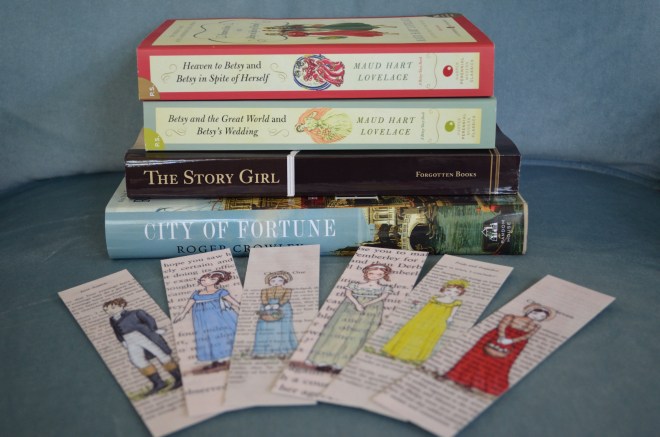
Hubby got me the last two Betsy-Tacy volumes I didn’t already own (Heaven to Betsy/Betsy in Spite of Herself and Betsy and the Great World/Betsy’s Wedding) by Maud Hart Lovelace.  (I first learned of the series from Katie, and I don’t know how I missed it all these years!)  He also got me a newly-published edition of The Story Girl, by L.M. Montgomery.  (I loved it when I was a little girl, but my copy has been lost for years.  This version is published by Forgotten Books, who print facsimiles of old versions of little-known classics.  They just put The Story Girl out this year.  Lucky me!)  And he also got me a set of Jane Austen bookmarks from the Castle on the Hill Etsy store.  Oh, and if I wasn’t already spoiled enough, my in-laws sent along City of Fortune, a history of Venice by Roger Crowley, which looks fascinating.  I’m a lucky bookworm!

(In addition to my bookish gifts, I was further spoiled – hubby also got me earrings, my parents bought me a watch, my in-laws had several meals delivered from a catering service, and my sister-in-law got me a gift card to a local yoga studio.  So while I’m busy reading, I’ll also be wearing pretty things, eating well, and taking time for myself.  Those are some good birthday reminders for a new mama!)

Checking One Off The TBR

One Hundred Years of Solitude by Gabriel…

(Image Source)

Most avid readers I know have a TBR (“To Be Read”) list, whether they call it that or something else.  I have a long one, and I’ve written before about how insane it gets.  Sometimes books cycle on and off my TBR quickly – especially when they’re new releases that I read about on a book blog, reserve at the library, and then have to finish in one borrowing period because they have wait lists attached.  Other times, they sit.  And sit… and sit… and sit.  Staring me in the face.  Making me feel guilty.

Umberto Eco books are particularly good at staring me in the face and making me feel guilty.  But not as good as the ultimate TBR-sitter, which in my case is One Hundred Years of Solitude, by Gabriel Garcia Marquez.  Really, really, I have no excuse for not reading this book sooner.  I’ve been meaning to get to it for years.  It’s a Nobel Prize winner, everyone seems to love it, and heck, even Oprah found the time.  It’s been at the top of my Goodreads “to-read” list forever, and every time I log in there and check out the books I’m planning to read, it mocks me.

So, I finally checked it out of the library.  Didn’t get around to it, so I renewed it.  Again, didn’t get around to it, so I renewed it again.  And now I’m on my third renewal period, which is all that’s allowed for one book.  (Don’t worry – my library branch has multiple copies.  I’m not preventing anyone from checking out One Hundred Years of Solitude, I promise, and if I don’t finish it on this renewal period I can check out another one of the five copies on the shelf.)  But I think I’m really going to get through it.  I finally made myself sit down and crack the spine, and now I’m halfway through and really enjoying it so far.  The imagery is beautiful – at one point, early in the story, a character looks out a window and sees a soft rain of yellow flowers coming down.  Can’t you just picture that?  Don’t you just wish it rained flowers where you live?

I’ve spent a much-needed lazy weekend on the couch with Garcia Marquez, and I’m just sorry that I didn’t get around to One Hundred Years of Solitude earlier.  Full review coming when I finish it (soon, I’m sure), and in the meantime, I’m just proud of myself for finally tackling the book after meaning to for so long.

What books are sitting on your TBR?  Pick an old one and tackle it this week!