
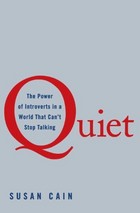
 I’ve been looking forward to reading Quiet: The Power of Introverts in a World That Can’t Stop Talking since it was released. But I had to wait awhile, because there was a looooooong holds queue at the library. Apparently there are a lot of introverts in Fairfax County, and we all have library cards.
It took me a long time to recognize and embrace my introvert tendencies. As the child of two very extroverted parents and the product of a school system that pushed group work and socialization, I got used to “faking extrovert” at a young age. By the time I was in high school, I had completely internalized the “Must be bubbly and chatty!” compulsion, but it never stopped feeling like work. Hard work. Especially in college. Every time I left a party early or skipped a social event to read, I mentally berated myself for being boring.
Still, I was shocked when I took the Myers-Briggs Type Indicator (for a class in college) and my results came back “INTJ.” I had been faking extrovert for so long that I had even convinced myself that I was an extrovert – just a really, really bad one – so seeing that “I” for “Introvert” was a big surprise. Even knowing that there was a reason I preferred books to keggers and downtime to party time, though, I still continued to push myself out the door to the frat parties. I’m a slow learner, I guess. It wasn’t until I started dating hubby – who is decidedly introverted – that I experienced the sweet, sweet relief of not having to force myself to loud parties every weekend. We bonded over dinners out as a duo and long quiet hikes in the state park around our campus. It was nice to finally feel like I could relax and stop trying so hard.
Of course, that didn’t mean that I completely embraced my introverted personality. I went into law – a profession that would seem to attract introverts but requires a certain degree of extroversion if you want to build a client portfolio. I’ve forced myself to get involved in community activities as part of my career-building efforts. But networking and schmoozing do not come naturally to me. My dad was shocked when I told him I hated networking. “But you’re so good at it!” he said, shaking his head. I explained that, yes, I am pretty good at networking – that’s the result of a LOT of hard work and practice and making myself do things (like attend big events) that don’t necessarily appeal to me and even stress me out. (And I learned a technique that changed my networking life: zero in on the other uncomfortable-looking introvert standing in the corner and latch onto them.) I won’t stop forcing myself to interact with people, but I don’t expect it to ever come as easily to me as formulating an argument or a tackling a research problem does.
Quiet is a book for and about people like me. It starts by explaining that our modern society is set up to reward extroverts. From an early age, kids in school are socialized in the most extroverted ways possible. Desks are arranged in pods, and group work is pushed at all education levels. I always hated group work, mainly because I was usually the only one in the group actually doing any work. My group government project in high school slapped me with a C because the teacher said it looked like it was done by one person. It was: me. In college, my International Human Resource Management professor assigned a group project but let me opt out and work alone… which led to an “A+++ I can’t believe you did this by yourself!!!” on my paper. To which I said: it was easy when I didn’t have to pull three other people along with me.
Introverts are considered unappealingly shy, even anti-social, while extroverts are favored. But introverts aren’t necessarily shy and anti-social – I don’t consider myself shy, although it takes me awhile to warm up to new people and I don’t care for large groups. And while I might prefer a book to a big party, I’m not anti-social. I have a group of close friends that I love spending time with, and I have a great marriage. There’s NOTHING wrong with my personality.
Quiet goes on to discuss the biology of introversion, how introverts might train themselves to excel in the professional world, and how to love an introverted partner or raise an introverted child. It’s a fascinating mix of social science, anecdotes, and encouragement for those of us who need our downtime more than most. Some have criticized the book for being too “rah rah introverts!” but I say it’s about darn time someone cheered us. We’re not all creepy loners. Just because my perfect Friday night is a glass of wine and a book, or a quiet dinner with my husband, doesn’t make me weird at all. It makes me… well, me. It’s just who I am.
Read it: Quiet: The Power of Introverts in a World That Can’t Stop Talking, by Susan Cain (not an affiliate link)

 covered in flour