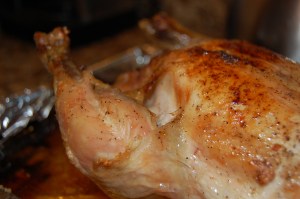
Maple Roasted Chicken

DSC_0785

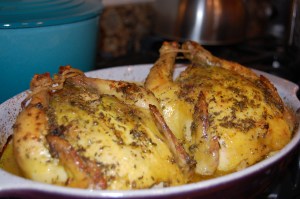
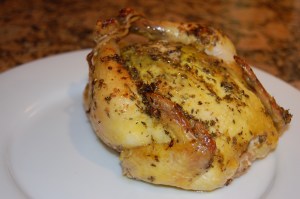
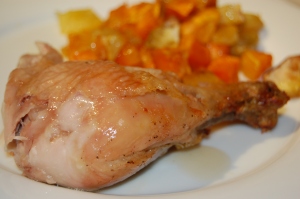
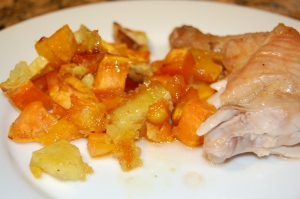
Apologies for the lack of updates recently!  It’s been extremely hectic around here for the last week or so, and I haven’t done all that much cooking.  How about I make it up to you with some chicken?  (Isn’t chicken the best way to make up?  I think so.  Wouldn’t you agree?  Anyone?  Anyone?  Bueller?)  For the longest time, I shied away from making roast chicken.  It seemed to be very complicated – it’s not – and I didn’t think that hubby and I could finish a whole one – we can’t, but I was forgetting about the magic of leftovers.  This is a particularly autumnal way to eat roast chicken, with a sweet and smoky maple glaze ,and it’s especially good with some caramelized roasted squash and sweet potatoes on the side.

For this recipe, I decided to try a new technique, which I read about in good old Cook’s Illustrated.  Basically, the toughest (pardon the pun) thing about achieving perfect roast chicken is that the breast often cooks to the consistency of an old shoe before the legs and thighs have actually cooked through.  To remedy this, the folks over at America’s Test Kitchen suggested the ingenious method of starting the chicken roasting breast-side-down, to give the dark meat a chance at the high heat, then turning the chicken over to finish cooking breast-side-up for that crispy skin effect.  I’d never tried this before and my roast chickens generally come out fine, but I wanted something outstanding this time, since my hungry sister-in-law, the lovely Emma, was going to be eating this chicken after a long, rainy drive from the Deep(ish) South.  Well, I’ve got to hand the ATK team some credit – this method definitely worked.  The chicken breasts were by far the moistest (is that a word?) I have made, and the dark meat was perfectly done as well.  ATK?  More like A+TK!  Sorry, I had to do that.

Here, have some chicken.  It’ll help, I promise.  Chicken cures all bad jokes.
DSC_0791

Maple Roasted Chicken

1 small to medium sized roaster chicken
olive oil, salt and pepper
maple syrup

  • Preheat oven to 400 degrees Fahrenheit.
  • Remove the organs from inside the chicken.  (Side note: Anyone seen the Thanksgiving episode of the first season of “Dharma and Greg”?  “Awww, look, his mom packed him a lunch!”  Honk if you find that line hilarious too.)
  • Rinse the chicken well and pat dry.  Season the inside of the cavity with salt and pepper.  Place upside down on a foil-lined baking sheet, which you have prepared by spraying it with cooking spray ahead of time.  (Don’t skip this step or the chicken will be VERY difficult to dislodge from the pan in 30 minutes.  As the Pioneer Woman would say, don’t be like me.)  Season the bottom of the chicken with salt and drizzle with a little olive oil.
  • Roast breast-side-down for 30 minutes, then remove pan from the oven and, using two pairs of kitchen tongs or two large forks and some brute force, flip the chicken over to breast-side-up.  Drizzle with a little olive oil, season generously with salt and pour maple syrup over the top.  Don’t skimp – get it into all the nooks and crannies, using a pastry brush if you need to.  The key to this chicken is a really caramelized maple flavor, so now is not the time to be stingy.  Finish the chicken off with some freshly ground black pepper.  If desired, now is a good time to insert a digital meat thermometer into the area between the leg and the breast – this is the coolest part of the chicken, so when it’s done you will know the rest is done.
  • Return the chicken to the oven and roast another 45 minutes.  About 20 minutes in, give the chicken a quick basting with some more maple syrup, then continue to roast.  Keep an eye on your meat thermometer, of course, but 45 minutes should just about do it.  If you don’t have a digital meat thermometer, after 45 minutes insert a standard meat thermometer and check the temperature.  When the thermometer reaches about 165 degrees, take the chicken out of the oven and tent with foil.  It will continue to cook.  (Alternatively, to tell when the chicken is done, pierce the thigh with a small knife.  When the juices run clear, the chicken is done.)
  • Allow the chicken to rest for at least 10 minutes, longer if desired.  This will give the juices a chance to redistribute so they stay in the meat and don’t run out all over your cutting board.  Gross!  After the chicken has rested, carve and serve!
DSC_0787

Source: Covered In Flour

Yield: Serves 6-8 with sides.

Wine Notes: In honor of my birthday (yes, I’m still in my twenties, thank you for asking) we corked a bottle of Hillsborough “Opal” from Hillsborough, VA.  “Opal” is a blend of Petit Manseng and Chardonnay (my beloved Chardonnay, so misunderstood – just like me!) and is a lovely medium-bodied white.  It’s a perfect wine for fall, not only because Opal happens to be October’s birthstone, but because its creamy mouthfeel and delicate flavor create a perfect complement to fall’s hearty vegetable pastas and roasted or baised meats.  Happy Birthday to me!
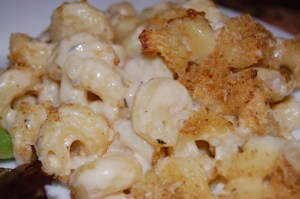
Baked Macaroni & Cheese

DSC_0742

Cheesy, creamy, crunchy, chewy.  That’s what the best macaroni and cheese brings to the table.  I’m not talking about the out-of-the-box stuff – no way.  I’m talking about homemade macaroni and cheese.  I’m talking about beer-infused white sauce and freshly grated cheddar and gruyere.  I’m talking about crispy Parmesan and bread crumb topping, and baking the whole thing until it’s golden and bubbly.  It takes longer, and it dirties more pots (hey,when have I ever complained about a mess?), but it’s soooooo worth the time.  Especially when your hungry brother is in town.  Because if you’re a baker who likes to make a mess, your hungry brother deserves the best boy food you can make!

Baked Macaroni & Cheese

1/2 package cavatappi (or other fun-shaped) pasta
1 small shallot, minced fine
1 cup skim milk
1 cup half-n-half
1 dried bay leaf
1 1/2 teaspoons dried thyme
2 tablespoons butter
2 tablespoons flour
1/3 cup beer
cheddar (1 cup grated)
gruyere (1 cup grated)
salt and pepper

  • Preheat oven to 350.  Butter a souffle dish or other large baking dish and set aside.
  • Fill a large stockpot with water and boil for pasta.  When water is boiling, season generously with salt and add cavatappi.  Cook until al dente according to package directions.
  • While the pasta cooks, place the minced shallot, milk and half-n-half in a small pot.  Add the bay leaf and thyme and warm over medium heat.  When the mixture is warm-hot, take off heat and allow to stand.
  • Drain the pasta and place pasta in a large bowl; set aside.  Return the pasta pot, empty, to the stovetop and melt the butter.  When the butter is melted, stir in the flour and cook briefly.  Add the infused milk mixture and the beer and turn heat to low.  Allow to cook for three to five minutes, stirring occasionally, until thickened.
  • Meanwhile, grate the cheese.  When the sauce has thickened, stir in the cheese.  Season to taste with salt (if necessary – the cheese is pretty salty) and pepper.  Pour cheese sauce over pasta and stir to combine.  Spoon pasta into baking dish.
  • If desired, make bread crumb topping – stir together 1/4 cup breadcrumbs and 1/4 cup grated Parmesan and toss with a tablespoon of olive oil.  Sprinkle evenly over the top of the pasta and drizzle additional olive oil, if desired, over.
  • Bake 40 minutes, until cheese sauce is bubbly and top is golden brown.

DSC_0738

Yield: Serves 4-6.

Source: Adapted from Williams-Sonoma Savoring America

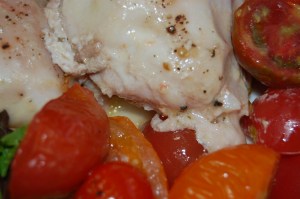
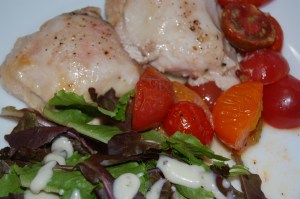
Baked Chicken and Tomatoes

DSC_0009

This is a wonderfully simple, flavorful dish, and a perfect way to showcase summer tomatoes.  Baked chicken is easy, but can sometimes dry out in the oven; not in this dish.  The chicken bakes under a smattering of cherry tomato halves, which give up their juice to keep the chicken most and tender.  When it’s done, simply scoop the chicken pieces out of the roasting pan, top with the wilted, spent tomatoes and serve it alongside a green salad.  An end-of-summer tray bake at its finest…

Baked Chicken and Tomatoes

1 package skinless, boneless chicken thighs, or skinless, bone-in breast halves
1 pint cherry tomatoes, halved
1/4 cup flour
extra virgin olive oil
1/2 teaspoon kosher salt
1/4 teaspoon fresh black pepper

  • Preheat oven to 375 degrees Fahrenheit.
  • In a small bowl, mix together flour, salt and pepper.  Lightly dredge chicken pieces in flour mixture and set in 8-by-8 inch baking pan.  Nestle half of the cherry tomato halves around chicken pieces, and scatter the remaining half over the top.
  • Bake for 30-35 minutes, until chicken reaches an internal temperature of at least 165 degrees.  (If you are using chicken breasts, be sure to watch the temperature closely.  The bone will help to keep them moist, as will the tomatoes, but it’s still very important that you are vigilant and don’t leave the chicken in the oven too long.  Chicken breasts can go from being moist and delicious to being tougher than an old shoe in the blink of an eye.)

DSC_0011

Yield: Serves 4.

Source: Covered In Flour.

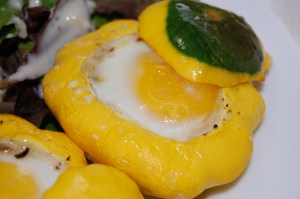
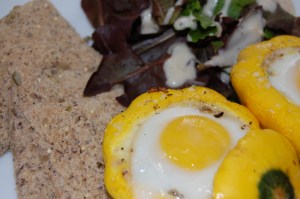
Eggs Baked in Pattypan Squash

DSC_0012

I first saw this on TheKitchn and knew immediately that I had to make it.  First of all, who doesn’t love pattypan squash?  They’re like little flying saucers!  It had never occurred to me to bake eggs in them, but wow, what a genius idea!  And the taste – oh, man, out of this world.  (Pardon the joke.  Sometimes I just can’t stop myself.)  The sweet roasted squash, caramelized shallots, and creamy baked eggs combine to form a perfect union of flavors and textures.  The folks over at TheKitchn are right; this would make an excellent vegetarian brunch entree.  But we ate it for dinner and you know what?  It was pretty darn good then, too.

Eggs Baked in Pattypan Squash

4 medium pattypan squashes
4 eggs
2 shallots
extra-virgin olive oil
kosher salt and black pepper
chives, for garnish (optional)

  • Preheat the oven to 375 degrees Fahrenheit.  Cut tops off pattypans and scoop out the insides with a spoon; discard.  Arrange pattypan shells and tops on a foil-lined baking sheet and drizzle olive oil over.  Season with kosher salt and black pepper.  Roast 20-25 minutes.
  • While pattypans are roasting, slice shallots into rings.  In a nonstick pan, saute shallots with a litle olive oil and salt until golden.  Turn off heat and allow shallots to sit.
  • Remove pattypans from oven.  Set tops aside, leaving shells on baking sheet.  Spoon equal parts sauteed shallots into pattypan shells and top with one egg in each shell.  (Be careful; the egg whites might overflow a little.  It’s not a big deal, but if you know your eggs are too big to fit into the shells, open them over a bowl and allow some of the white to run into the bowl before adding the rest of the egg to the shell.)
  • Sprinkle with more salt and pepper, if desired.  Return to oven and bake for an additional 15-20 minutes, until whites are set.  (The yolks will be about half-set at this time.  If you want your yolks completely runny, like a soft-boiled egg, make it closer to 15 than 20.)
  • Remove from oven; garnish with pattypan tops and, if desired, with chopped chives.  Serve with toast points and green salad.

Yield: Serves 4 for brunch with sides, or 2 for dinner.

DSC_0008

Source: Adapted from Sunset Magazine, originally seen on TheKitchn.

Orzo with Sausage, Peppers and Tomatoes

DSC_0002

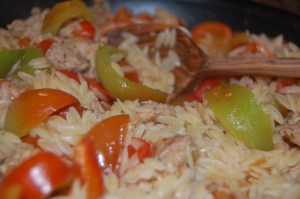
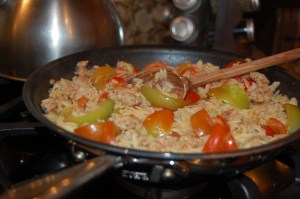
This dish encompasses some of my very favorite things: adorable pastina, chicken sausage, and peppers.  It’s also easy… ridiculously easy.  You just start browning the sausage at the same time as you put the orzo’s water on to boil, and by the time the orzo is done, you have your sauce ready to go.  It doesn’t get much simpler than that, and the flavors are unbelievable, with sweet, crisp-tender peppers, tart fresh cherry tomatoes, and spiced sausage bits in every bite.

Orzo with Sausage, Peppers and Tomatoes

1/4 box orzo
1 package fresh sausage (I used garlic and tomato chicken sausage)
2 peppers, cut into strips
1/2 package cherry tomatoes, halved or quartered (depending on size)
salt and pepper

  • Start water to boil for the orzo.  When water is boiling, season with kosher salt, add orzo and cook according to the package directions.
  • Meanwhile, begin browning the sausage in a nonstick pan.  If the sausage is still in its casing, squeeze it out so that it is in a mass in the pan.  Break it up with a wooden spoon and distribute it so it browns in small chunks.
  • While the sausage is browning, cut the peppers into strips and prepare the cherry tomatoes.  After the sausage has made some good progress, add the peppers and tomatoes and stir to distribute them.  Continue to cook the sausage, peppers and tomatoes together, keeping a careful eye on the orzo.
  • When the orzo finishes cooking, drain it and add it to the pan with the sausage and vegetables.  Mix together and serve.

DSC_0003

Yield: Serves two or three for a main course, four to six as a side.

Source: Adapted from Giada’s Kitchen, by Giada de Laurentiis

Note: The original recipe actually called for roasted red peppers in a jar, cut into strips.  This is usually a standard pantry item for me, so I didn’t even give it a second thought when I made my grocery list and it turned out that when I went to look for them in my pantry or fridge, I was out – who’d have thought?  Instead, I used sweet Hungarian peppers from my farmer’s market.  However, I think this recipe would work equally well with sauteed red, orange and/or yellow bell peppers, or with roasted red peppers from a jar.

Wine Pairing: Hubby and I are trying to work through the bulk of our wines these days, because we are preparing for a trip to Napa in about a week and a half, and we’re going to be bringing quite a bit home!  For this dinner, we poured Pinot Grigio from Doukenie Winery in Purcellville, Virginia.  Doukenie is our favorite winery in the region – we are actually members of the wine club there, which requires simply that we buy twelve bottles per year (easy; their wines are delicious).  Pinot Grigio is normally not my choice.  I once received a bottle as a gift and it had oxidized.  Ever since then, I have been turned off by Pinot Grigio and will almost always choose Sauvignon Blanc or a more obscure white instead.  But Doukenie’s PG is very nice, crisp and yet smooth, with mellow fruit aromas.  It’s making headway toward changing my mind about Pinot Grigio, and I think it worked well with this dish.  I’d also recommend a northern Italian white, or a lighter-bodied Italian red such as Barbera d’Asti.  If you substitute pork sausage for the chicken or turkey, you could pair it with Chianti and it would be delightful.  Enjoy!

Tomatillo Chicken with Black Beans

DSC_0002

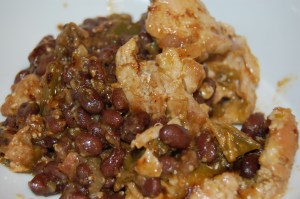
The addition of black beans to a recipe for tomatillo chicken was complete serendipity.  True to form, I planned to serve the tomatillo chicken over brown rice and then forgot to actually make the brown rice.  (I think this is my subconscious self reminding me that I think brown rice is a huge, ever-lovin’ hassle.)  The tomatillo chicken, in and of itself, was not going to be enough for dinner – especially not with my hubby in the house – so in an effort to quickly fill out the dish I popped open a can of black beans and tossed them in.  They added a wonderful creamy texture and, happily, more protein without much fat.  (Not that the dish was hurting for protein…)  I’d still recommend serving this over brown rice if you can remember it – I can’t – and if you did, this dish could stretch to a main course for 4 instead of just 2.

Tomatillo Chicken with Black Beans

4-6 boneless, skinless chicken thigh pieces
1/2 white onion or 1 whole large shallot, diced
1 poblano pepper, diced
8 tomatillos (approx), husks removed
kosher salt
ancho chili powder
1 can black beans, drained and rinsed

  • In a medium Dutch oven over medium-high heat, warm a glug of vegetable oil until shimmering.  Season the chicken thigh pieces and lay them in the oil to brown, turning over once.  When the chicken thigh pieces are browned, remove them to a plate.
  • Meanwhile, whir the tomatillos in a food processor until pureed.  Reserve for later.
  • Add the onion and poblano pepper to the oil, season with kosher salt and cook until softened and slightly caramelized.  Pour the tomatillo sauce into the pot and stir around to coat the peppers and onions.
  • Return the chicken to the pot, nestling each piece into the tomatillo sauce and turning to coat.  Cover the pot and simmer on medium-low heat for 20-25 minutes, until the chicken is cooked through.  (How long you cook this will depend on how thick your chicken pieces are.  If you use bone-in thighs or breasts, adjust the cooking time accordingly.)
  • Drain and rinse the black beans.  Add them to the pot and stir everything together.  Continue to simmer until the beans are warmed through.  Season with more ancho chili powder if necessary and serve, alone or over brown rice.

DSC_0001

Source: Adapted from Everyday Food, September 2009

Note: As you can probably tell from the references to poblano pepper and ancho chili powder, I like warmth but not a four-alarm fire on my dinner plate.  Feel free to play with the heat-adding elements in this dish, substituting a couple of jalepenos for the poblano, for example, if you want something spicier.  My palate is simply not made to tolerate really hard-core chili action, but if yours is, by all means, go nuts.

Tamale Pie

DSC_0014

Growing up, I was never much of a television watcher.  Partly, that was because I just didn’t have that much time with all of my extracurricular activities, and partly it was because I really preferred reading.  Yes, I was one of those.  These days, I still prefer reading, but I have recognized that there are certain joys to collapsing on the couch and turning your brain off for an hour or so, especially after a long day of reading LEXIS printouts.  I still don’t have that much time, though, so a show has to really capture my attention for me to actually invest in it.  When a show succeeds in getting my undivided attention, I find that I want to know everything about the characters.  I check out websites… read news articles… and (confession time) I even bought The Desperate Housewives Cookbook.  (What can I say?  I enjoy the show enough to want to make Bree’s Basil Puree and Gabrielle’s Black Bean Soup.  Don’t act like you don’t have your own guilty pleasures.)

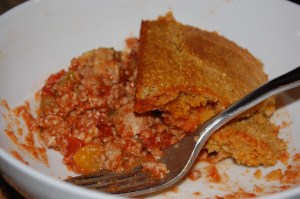
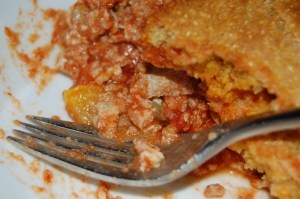
Recently, I discovered “Big Love” – an HBO show about a modern polygamist family.  It’s a great, well-written show starring some very big names – Bill Paxton, Jeanne Tripplehorn, Chloe Sevigny and Ginnifer Goodwin – and I’m totally invested in the characters.  So when I found a fictional blog on the HBO website, “written” by Ginnifer Goodwin’s character Margene, I had to check it out.  And of course, when “Margene” posted a recipe for “Barb’s Tamale Pie” (Barb being the first wife, played by Jeanne Tripplehorn)… well, I absolutely had to make it for myself.  And I’m glad that I did!  The filling was savory and the cornbread topping was crisp and made the perfect counterpoint.  I’m considering stopping by the Henricksons’ for dinner… if they have room for me at the table.

DSC_0015

Barb’s Tamale Pie

1 package lean ground turkey
1 shallot, minced
1 yellow pepper, chopped
2 teaspoon ancho chili powder
1 teaspoon cumin
1 28-ounce can of diced tomatoes in juice
1 poblano pepper, minced
1/3 cup golden raisins
1 cup grated sharp cheddar cheese
1 cup grated Monterey Jack cheese
1/3 cup chicken stock
1 package boxed cornbread mix (I used Bob’s Red Mill, but Jiffy is fine too) and other ingredients called for to make cornbread

  • Preheat oven to 375 degrees Fahrenheit.
  • Heat canola oil in a large skillet over medium-high and brown chopped shallot, yellow pepper and turkey.  Season with salt and pepper and add chili powder and cumin.
  • Drain any excess fat and transfer to a large heat-proof bowl.  Mix in cheese, minced poblano, canned tomatoes, chicken broth and golden raisins.  Stir together.
  • Pour mixture into a lightly oiled large baking dish and spread into an even layer.
  • Prepare cornbread mix according to package instructions.  Spread over meat mixture.
  • Bake 40 minutes, until top is browned.

Yield: Serves one polygamist, three wives and eight kids.  If your family isn’t quite that big, feel free to halve the recipe or resign yourself to leftovers.

Source: Adapted from Margene’s Blog

Garlic and Citrus Roasted Cornish Game Hens

DSC_0029

Cornish game hens have a lot going for them.  First of all, and most importantly, they are delicious.  You don’t get too far without that.  Second, and almost as important, they are absolutely adorable.  Who wouldn’t want their own little individual-sized bird?  It’s like a miniature chicken!  Perfect for a special occasion, because we all know that serving things in individual portions makes them gourmet.  I’m joking, of course, but where there’s smoke…  I served Cornish game hens to my ham-loving parents for Easter and they were charmed.  And I served them to my husband for our anniversary after a long day at the office.  In fact, I’m thinking seriously about hens instead of a turkey for Thanksgiving.  It’s the cuteness.  It’ll bend your mind, man.

DSC_0031

Garlic and Citrus Roasted Cornish Game Hens

2 Cornish game hens
1/4 cup extra-virgin olive oil
zest of one lemon (plus the lemon)
2 tablespoons chopped fresh mint
2 tablespoons chopped fresh parsley
kosher salt and fresh pepper
1 cup orange juice

  • Situate a rack in the lower third of your oven and preheat to 450 degrees Fahrenheit.
  • Rinse the hens – including the cavity; I know it’s gross, but you need to do it, okay?  Okay?  Why?  Because I said so, that’s why!  Dry them off with paper towels.
  • In a small bowl, mix together the olive oil, zest, and chopped fresh herbs.  Season with salt and pepper.  Rub 3/4 of the mixture over the hens.  Stuff the rest under the skin.
  • Cut the lemon (which you zested previously) in half.  Cut a head of garlic in half as well.  Shove half of each into the cavity of each hen.  Tie the legs with kitchen twine.
  • Place the birds into a medium baking pan and pour the orange juice around them.   Drizzle a little more olive oil over each hen – this will help them to brown. Roast 30-35 minutes (or more, if your oven runs cool like mine does) until the juices run clear.

Yield: Serves two.

Source: Adapted from Giada de Laurentiis, with some inspiration from Giada’s Family Dinners, also by Giada.

Wine Pairing: We paired this dinner with a luscious Napa Chardonnay from Cakebread Cellars, one of my favorite wineries, which I am looking forward to visiting next month!  The wine was delightful (tasting notes coming soon, as previously promised) and was a perfect match with the game hens – rich enough to stand up to them, but with some refreshing fruity notes.  If you can’t lay your hands on some Cakebread, I’d recommend any lightly-oaked white wine, nice white Burgundy, or Chablis.  I also think this dish would be nice with Gruner Veltliner, but I think everything is nice with Gruner Veltliner.

Balsamic Roasted Chicken

DSC_0008

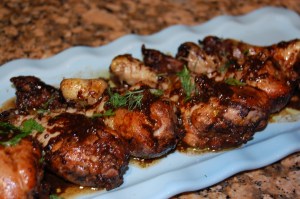
I’ve said it before, and I’ll say it again: Bless Giada.  She always comes through.  This weekend the hubs and I had some family in town and I was asked to cook dinner.  I’m always happy to oblige!  This balsamic roasted chicken was perfect for the type of dinner I had in mind – something casual, yet delicious, which I could throw together in the morning to marinate while I spent the day out and about in DC.  It came together in just a few minutes of morning prep and spent a low-maintenance 45 minutes in the oven, and for that minimal amount of effort I got to serve moist, deeply flavorful chicken legs to our guest, who gave the meal an “A+” – not too bad at all!

DSC_0012

Balsamic Roasted Chicken

1/2 cup balsamic vinegar
juice of 1 lemon
1/4 cup country grain or Dijon mustard
2 garlic cloves, minced
1 teaspoon salt
1 teaspoon fresh black pepper
1/2 cup extra-virgin olive oil
6 drumsticks
1 tablespoon chopped fresh Italian parsley

  • In your baking dish, whisk together the vinegar, lemon juice, mustard, garlic, salt and pepper.  Whisk in the oil in a slow drizzle to create an emulsion.  (It won’t last, but just make the offering to the kitchen gods, okay?)  Add the chicken pieces and turn them over a few times to coat with the marinade.  Cover and refrigerate, turning the chicken pieces occasionally, for at least 2 hours and up to a day.
  • Preheat the oven to 400 degrees Fahrenheit.  Roast the chicken uncovered for 45 minutes.  Transfer the chicken to a serving platter and pour the leftover marinade into a small saucepan.  Spoon off the oil from the top, then boil until the liquid reduces by half and thickens – about 8 minutes.
  • Sauce the chicken, sprinkle with parsley and serve.

Source: Adapted from Everyday Italian, by Giada de Laurentiis

Wine Pairing: Try it with an herbal, refreshing Pinot Grigio, or lighten up with Prosecco.

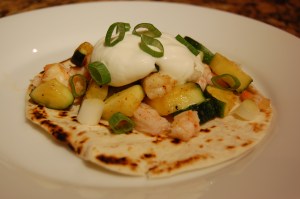
Shrimp and Zucchini Tostadas

DSC_0005

This is a great weeknight summer dinner – sweet shrimp, slightly caramelized zucchini, and the mild bite of ancho chili powder served over tortillas.  Using pre-cooked shrimp helps when you are pressed for time, but if you’d like to cook your shrimp from raw, by all means do.  The heat from the chili powder and the cool of the light sour cream are a wonderful dichotomy on a summer evening.

DSC_0006

Shrimp and Zucchini Tostadas

4 burrito-sized flour tortillas
1 zucchini, cut into medium dice
1 pound shrimp, already cooked and chilled
pinch of salt and pepper
pinch of ancho chili powder
light sour cream and scallions for garnish

  • In a dry skillet over medium-high heat, toast tortillas until lightly golden; set aside.
  • Add canola oil and zucchini to the skillet; season with salt and pepper.  Saute zucchini until they are golden brown and crisp-tender.
  • Roughly chop shrimp (or, if you prefer, leave them whole).  Add them to the zucchini once the zucchini has finished cooking and saute just long enough to warm them through.
  • Season with a good pinch of ancho chili powder (which is NOT balancing for pitta, but everyone needs to live a little!).
  • Spoon shrimp and zucchini onto prepared tortillas.  Top with a dollop of sour cream and some chopped scallions.

Source: Adapted from Everyday Food, May 2009

Zucchini on Foodista

Wine pairing: This would go well with a young, grassy white wine such as New Zealand Sauvignon Blanc or Gruner Veltliner.