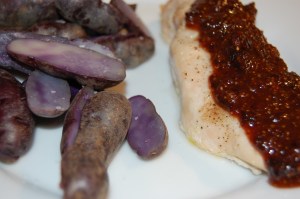
Tilapia with Citrus Bagna Cauda

I realized just how behind I am on posting – this move threw me all off, but I’m back now, I swear – when I saw that this dish, hubby’s and my Valentine’s Day entree, was still in draft form.  And that’s a shame.  I hate to think I’ve waited so long to share this with you all, because it’s wonderful.  Tilapia is one of my favorite – perhaps my all-time favorite – kinds of fish.  Although I do love tuna.  And halibut, and sole, and really good salmon.  Anywho.  This tilapia is wonderful, gently sauteed and coated with a bright, fresh-tasting sauce of citrus and herbs.  It was easy to make, too – bonus!  I’m definitely not going to wait for next Valentine’s Day to make this again.

Tilapia with Citrus Bagna Cauda

For the Bagna Cauda Sauce
1 tablespoon unsalted butter
1 tablespoon extra-virgin olive oil
1 anchovy fillet, minced (yum!)
1 clove garlic, minced
1 tablespoon orange juice
1 teaspoon chiffonaded fresh basil (or chives)
1/2 teaspoon lemon zest
1/2 teaspoon orange zest

For the Fish
1 teaspoon extra-virgin olive oil
2 tilapia fillets
salt and pepper

  • To make the bagna cauda sauce, combine the oil, butter, and anchovy fillets in a nonstick saute or fry pan and warm until the anchovy melts.  Add the garlic and cook 30 seconds, until fragrant.  Remove from heat and add the juice, herbs and zest.  Season to taste with salt and set aside.
  • Wipe out the fry pan with a paper towel and add additional olive oil.  Season the fish with salt and pepper and saute until just opaque and still tender – approximately 3 minutes per side.
  • Plate fish and dress with the bagna cauda sauce.
  • Optional – garnish with chives.

Yield: Serves 2.  I reduced the recipe, which originally served 6.  For the original proportions see…

Source: Adapted from Giada’s Family Dinners, by Giada de Laurentiis

Spaghetti alla Puttanesca

I think this just may be my new favorite spaghetti sauce.  It is simple to make, inexpensive, tangy from the olives and capers, with a subtly spicy kick from the red pepper flakes.  Making puttanesca sauce from scratch is barely more effort than opening a jar of Prego, but it’s much tastier – not to mention, you control the quality of the ingredients and there are far fewer preservatives.  Plus, saying “spaghetti alla puttanesca” is fun.  Now, who can argue with that?

Spaghetti alla Puttanesca

2 tablespoons extra-virgin olive oil
1/2 yellow onion, medium-diced
kosher salt
1 tablespoon tomato paste
1 clove garlic, minced
1 teaspoon minced anchovy
1/2 teaspoon red pepper flakes
1 teaspoon oregano
1 can crushed San Marzano tomatoes in juice
1/4 cup green olives, sliced (substitute black olives)*
1 tablespoon non-pareil capers, rinsed
whole wheat spaghetti

  • In a heavy stockpot over medium-high heat, heat olive oil until shimmering, then add diced onion and season generously with kosher salt.  Stir frequently until onion is slightly caramelized, 12-15 minutes.
  • Add tomato paste, garlic, red pepper flakes and anchovy, and stir until anchovy has melted and garlic is golden, about 1 minute.  (Your kitchen now smells amazing, by the way.)
  • Boil water for spaghetti – I prefer whole wheat – and prepare spaghetti according to the package directions.
  • Add crushed tomatoes, oregano, olives and capers.  Stir to combine all ingredients, then turn heat down and allow sauce to simmer while pasta finishes cooking.
  • Divide pasta into bowls and top with sauce.  Add a sprinkle of extra oregano if desired and serve.  Couldn’t be easier!

Yield: Serves 2 for dinner, with leftovers.

Source: Adapted from Williams-Sonoma

*The original/traditional recipe calls for black olives, but I can’t stand them, so I substituted green.  Feel free to experiment with different olives, or go back to tradition if you actually like black olives.

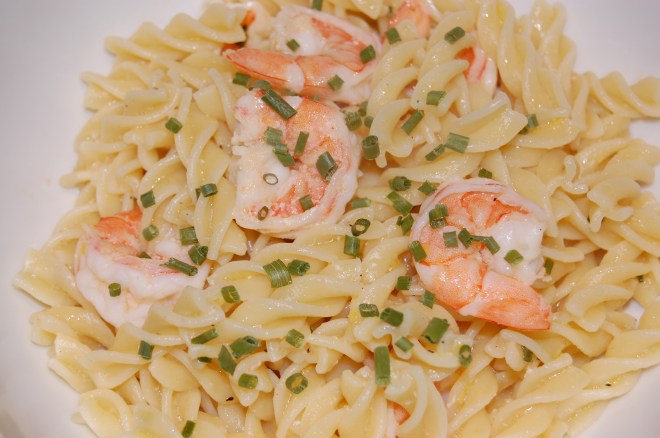
Lemon-Buttered Pasta with Shrimp

Bring your appetite to this dinner.

I’ve mentioned before that hubby and I love to hike.  What I failed to mention, is that we are certifiably insane and we will quite literally hike in all kinds of weather.  And when I say all kinds, I mean all kinds.  Sure, we like to hike on those nice, pleasant, 70-degrees-and-sunny kinds of days.  But we’ve also hiked in the rain (Buttermere in the English Lake District) and the mist (Isle of Skye, Scotland) and in the snow.  We got a few inches in the DC suburbs on Saturday, and hubby and I decided to take advantage of it by throwing on the Smartwool socks and the hiking boots and the snowpants and going traipsing through our favorite neighborhood woodlands at Great Falls National Park.  Aside from the park rangers and one other crazy hiker, we were the only ones on the trails – well, with the exception of a huge flock of geese and one rather cold-looking heron (who let us get very close, since he was either too cold or too blase to fly away).  After about three hours of wading through the freshly fallen snow, hubby and I were: (1) freezing, and (2) ravenous.  We hurried home to this dinner, which took care of both the cold and the hunger in one shot.

Lemon-Buttered Pasta with Shrimp

1/3 package pasta, any shape (I used fusilli)
3 tablespoons butter, separated
1 tablespoon extra-virgin olive oil
1/2 pound raw shrimp, peeled and deveined
zest of 1 lemon
juice of 1/2 lemon
4-5 shakes Tabasco sauce
black pepper
chopped chives (optional)

  • Boil a pot of water for pasta.  When water is at a rolling boil, salt liberally and add pasta.  Cook pasta according to package directions.
  • In a non-stick or cast-iron skillet or pot, heat 1 tablespoon of butter and 1 tablespoon of extra-virgin olive oil until butter has just melted.  Add shrimp and saute, tossing constantly, until shrimp turn pink.
  • When shrimp are cooked through, melt in the remaining butter.  Add lemon zest, juice, Tabasco sauce and pepper, and stir to incorporate all the flavors.
  • When pasta is finished cooking, transfer pasta with a slotted spoon over to the shrimp and sauce.  Toss pasta to coat completely.  If desired, sprinkle chopped chives (either fresh or freeze-dried) over pasta.  Serve immediately.

Source: Covered In Flour

Roasted Halibut with Salsa

If you’re looking for ways to eat light-n-healthy in 2010, here’s a great tip: roast fish slathered in salsa.  I saw this trick on “Get Fresh with Sara Snow,” or “that hippie show,” as hubby likes to call it.  Fish is tricky to cook – you certainly don’t want it underdone, unless you’re serving sushi!  But in the effort to make sure that fish is cooked through, I (and probably many others) often end up with fish that’s so dry as to be virtually inedible.

Salsa is a great way to solve that conundrum and add some wonderful flavor and nutrients without many calories.  The salsa keeps the fish moist and flavors the fish throughout, while the fish still cooks through.  Now, in the interests of full disclosure, I made this dish with halibut steaks.  If you choose to use fillets, as I may very well do in the future – hubby isn’t a fan of bones in fish – you will want to adjust the cooking time downward, as the fillets will cook (and dry out) more quickly than most steaks.  I’d check fillets after 10 minutes, unlike these steaks, which I checked at 20 minutes and found they weren’t quite done.  This is a versatile recipe – not only can you substitute fillets for steaks, but you could substitute other types of fish as well.  I think this would be delicious with salmon or tilapia and would be a wonderful way to dress up cod as well.  That’s the best part about this recipe, in my book – for someone who loves salmon, like hubby does, or for someone who generally prefers white fish, like me (I like salmon too, but I’ve had so much of it since meeting the hubs that I’m starting to burn out)… it’s equally good.  No matter what kind of fish you choose to make, moist and flavorful are good characteristics.

Roasted Halibut with Salsa

2 halibut steaks (or fillets)
2 tablespoons store-bought salsa
kosher salt and black pepper

  • Preheat oven to 400 degrees Fahrenheit.
  • Season halibut steaks with salt and pepper.  Spread salsa over steaks in an even layer.

  • Roast for 20-25 minutes, until cooked through (you can tell if the fish seems sturdy when you poke at it).

Source: Adapted from Sara Snow.

Simple Coq au Vin

Coq au vin is a fantastic dish to make for company.  For one thing, it’s easy and you don’t need to pay all that much attention to it – leaving you more time with your guests.  For another thing, it sounds fancy because it’s French.  Coq au vin is a traditional French dish of chicken braised in red wine (or Riesling, for a fun Alsatian variation).  It is a wonderful, warming, rustic and filling dinner – one of my favorite things to eat in the fall and winter.  Because of the intense flavor of the sauce and the braised chicken, it is also a good meal to prepare for someone who is cutting back on their salt intake.  I recently served coq au vin to several of my family members, including one person who is on a low-sodium diet.  Most dishes are bland and boring without salt, so I turned to coq au vin as a dish that packs enough flavor to make salt almost superfluous – and it worked!  The salt-free coq au vin was so flavorful that the whole family ate the dish without salt and didn’t miss a thing.  Cooking salt-free can be a challenge, but if you keep a recipe for coq au vin in your back pocket, you’ll never be short on flavor.

Coq au Vin

3 tablespoons extra-virgin olive oil
1 chicken, cut into 6-8 pieces
kosher salt (optional) and pepper
2 pints cremini or baby bella mushrooms
3 carrots, cut thinly into rounds
20 pearl onions
1 clove garlic, minced
1 750-ml bottle red wine (Burgundy or American Pinot Noir)
1 cup low-sodium chicken broth
1 bay leaf
2 sprigs fresh thyme (optional)
3 tablespoons flour

  • In a large French oven over medium-high heat, warm olive oil until shimmering.  Season chicken pieces with salt (if using) and pepper, then brown both sides in the oil.  Remove chicken to a paper towel-lined dish.
  • Add mushrooms, carrots, onions and garlic to pot and saute until golden and beginning to soften.  Add half the bottle of wine and cook over high heat for 8-10 minutes.
  • Return the chicken to the pot.  Add the remaining wine, broth and herbs and allow mixture to come to a boil.  Reduce heat to a simmer, cover, and allow to cook for 45 minutes.
  • Remove bay leaf and thyme sprigs.  Transfer chicken and vegetables to a serving bowl, using a slotted spoon.  Add 3 tablespoons of flour.  Return mixture to a boil and whisk frequently until sauce thickens slightly.  Pour sauce over chicken and vegetables and serve.

Source: Adapted from Epicurious.com.

Yield: Serves 6.

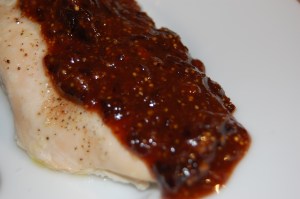
Roasted Chicken Breasts with Fig Sauce

I’ve often seen the recipe for pork loin with fig sauce in Everyday Italian and thought to myself, “hmmm, that fig sauce looks tasty.  Too bad I don’t eat pork.”  As a result, I’ve never made this fig sauce before… until recently, when it occurred to me that chicken and pork are very similar.  Both can be a bit bland unless you dress them up with other flavors, and both marry well with the same flavors – although I think that chicken, if anything, can be even more versatile than pork.  I realized that this fig sauce would go just as well with chicken as it would with pork.  Don’t ask me why it took me several years to discover that there was nothing stopping me from making Giada’s fig sauce.  I’m obviously not the brightest bulb in the shed.  Fortunately, hubby likes me anyway.

As Giada herself points out, this is an incredibly versatile sauce.  Sure, it’s great with chicken – or pork, for that matter – but it’s also sweet enough to serve for dessert.  Giada suggests having it over ice cream.  I also think it would be perfect as a sauce for a simple vanilla bean pound cake.  I can even see incorporating it into a galette with fresh figs.  But in my opinion, the best thing about this sauce is that it’s made with dried mission figs, so fig-lovers like me don’t have to wait until the very short fig season to enjoy it.  Mangia!

Roasted Chicken Breasts with Fig Sauce

Ingredients

For the fig sauce…
1 cup port or other sweet red wine*
2/3 cup reduced-sodium chicken broth**
8 dried black Mission figs, chopped coarse
1 sprig fresh rosemary
1 cinnamon stick
1 teaspoon honey
1 tablespoon unsalted butter
pinch salt
pinch pepper

For the chicken…
2 medium chicken breasts
kosher salt and black pepper to season
extra-virgin olive oil

  • Preheat your oven to 425 degrees Fahrenheit.  While the oven is preheating, prepare the chicken breasts – simply season them generously on each side with salt and pepper, place on a foil-lined baking sheet, and drizzle with the olive oil.  Roast at 425 for approximately 15 minutes, or until a meat thermometer shows an internal temperature of 165 degrees.  Remove from oven and allow to rest.  (They will continue to cook while resting.)
  • Meanwhile, make the fig sauce: combine the port, chicken broth, chopped figs, rosemary, cinnamon and honey in a saucepan and boil over medium-high heat until the sauce reduces by half, about 15-20 minutes.  Remove the cinnamon stick and rosemary sprig.  Transfer fig mixture to a food processor or blender and puree to desired consistency.  Stir in butter, salt and pepper.
  • Serve the chicken breasts with fig sauce on the side, or simply pour it right over!  Mmmmm…

Yield: serves 2

Source: adapted from Everyday Italian, by Giada de Laurentiis

*The original recipe calls for port.  I did have port on hand, but I also had an open bottle of Schnebly Redlands passion fruit wine from Florida, so that’s what I used.  Port and figs are a classic combination, so I’m sure that’s what I’ll normally use, but feel free to experiment if you have a different dessert wine on hand – especially if you are planning to use this sauce in a dessert anyway.

**Just because the idea of chicken broth in a dessert is pretty strange, if I were making this as a dessert sauce instead of to serve with roasted meat, I’d probably substitute water.  Do as you see fit.

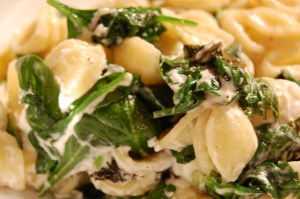
Oricchiette with Greens and Goat Cheese

This is one of my favorite pasta dishes.  It’s easy to make – a matter of tossing a few ingredients together – and the creamy, tangy goat cheese is the perfect complement to the soft pasta and wilted greens.  A perfect, light weeknight dinner, the work of 15 minutes or less.  Now that’s what I call an instant classic!

Oricchiette with Greens and Goat Cheese

1/3 box oricchiette pasta (or substitute other short pasta)
2 ounces goat cheese, such as Laura Chenel
2 cups mixed salad greens
1/4 cup olive oil
salt and pepper

  • In a pot of boiling, salted water, cook the pasta until al dente, according to the package directions.  Drain the pasta, but don’t do too thorough a job – you need a little water still in the pasta, to loosen up the sauce.
  • Crumble the goat cheese into the drained pasta, turn the heat on low, and toss until the cheese melts and coats the pasta.  Add the greens and toss until they wilt.  Drizzle the olive oil over – no more than 1/4 cup – and season to taste with salt and pepper.
  • That’s it!

Source: Adapted from Everyday Pasta, by Giada de Laurentiis
Farfalle with Broccoli

When I was a kid, I hated broccoli.  H-A-T-E-D it.  The smell, the taste, the frightening green color… broccoli made me shudder.  Then, as often happens, I grew up.  And – who’da thunk? – now I adore broccoli and green is my favorite color.  But still, as much as I love broccoli now, I don’t reach for it in the grocery store.  I’ll load my plate up with it if someone else cooks it, but for some reason, it doesn’t occur to me to actually buy broccoli and cook it myself.  It’s as if my subconscious mind is still stuck in my childhood, at least at 8:00 on Saturday mornings when I’m at Wegmans.  Or I’m just too busy putting five English cucumbers into my cart… I’m not sure which it is.

Since it seems stupid to love a vegetable so much but never cook it, I have embarked on a quest to find and cook broccoli recipes.  I like to roast broccoli, sure – I’ll roast any vegetable I get near – but I think that broccoli deserves a special treatment.  After all, what better way can there be to make up for all those years of demeaning and disparaging broccoli than to find some creative and exciting ways to cook it now?  Here’s one way – saute/steamed, with a rich sauce and Parmesan cheese, tossed with farfalle pasta.  Look, Mom, I’m eating my broccoli!

Farfalle with Broccoli

1/2 pound farfalle pasta
2 tablespoons unsalted butter
2 tablespoons olive oil
2 cloves garlic, minced
4 anchovy fillets, minced
2 heads broccoli, chopped into florets
1/2 teaspoon red pepper flakes
grated Parmesan, to taste (optional)

  • Cook the pasta to al dente according to the package directions.
  • While the pasta is cooking, melt the butter into the olive oil in a medium saute pan (with a cover) over medium-low heat.  When the butter and olive oil are melted and blended together, add the garlic, anchovy fillets and red pepper flakes and allow to cook for 5 minutes, until fragrant.
  • Add the broccoli to the butter sauce and toss to coat.  Cover the saute pan and allow the broccoli to steam until the pasta is done cooking.
  • When the pasta is finished cooking, toss it with the broccoli and sauce in a large serving bowl.  If necessary, add a little pasta water to thin and evenly distribute the sauce.  Finish with grated Parmesan to taste, if desired.

Yield: Serves 4 for a main course or 8 for sides

Source: Adapted from Everyday Pasta, by Giada de Laurentiis

Cranberry Bean and Spinach Risotto

DSC_0866

Risotto is one of my all-time favorite fall and winter dishes, and I’ve experimented with so many different recipes over the few years that I’ve been cooking.  Sausage, tomato and spinach risotto, mushroom and pea risotto, champagne risotto with lobster… these have all made repeat appearances on my table, some on special occasions and some on chilly weeknights.  Risotto is simple to make, yet it never fails to impress.  It has become a staple in my kitchen… so I can’t believe it took me this long to try risotto with beans.  I mean, I love risotto, and I love beans.  Put them together and it’s how-come-I-didn’t-think-of-this-sooner good.

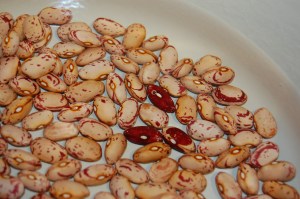
This recipe calls for cranberry beans, which are an heirloom bean varietal that I order online from Rancho Gordo.  I’d strongly encourage you to seek out heirloom cranberry beans for this recipe, whether it is through Rancho Gordo, your local farmers market or co-op, or another source.  However, if you are really at a loss for cranberry beans in your neighborhood, and you don’t want to order online, you can substitute dried pinto beans from the supermarket.  Under no circumstances, however, can you use canned beans!  Please trust me on this one.  The key to this risotto’s unbelievable deliciousness is the rice absorbing all of the beans’ pot liquor, which is what bean people call the magical substance that the bean water turns into after the beans have been cooking for a couple of hours.  The pot liquor absolutely makes this dish, and you won’t get it from canned beans.  I’m not saying that canned beans don’t have their role to play – believe me, if that was the case I wouldn’t have to dodge falling cans of cannellini beans every time I open up my crammed pantry.  But canned beans just don’t belong in this dish.  It’s as simple as that.

Cranberry Bean and Spinach Risotto

1/2 cup dried cranberry beans (or pinto, in a pinch)
1 tablespoon butter
1 tablespoon extra-virgin olive oil
1 shallot, medium-diced
1 cup arborio rice
1/2 cup dry white wine
4 cups (approx.) low-sodium chicken broth
2 cups baby spinach
1/3 cup Parmeggiano Reggiano

  • Start soaking the beans 12-24 hours in advance.  Place the beans in the pot in which you plan to cook them, cover with about an inch of water, put the lid on the pot and allow the beans to soak.  (The longer you soak the beans, the less time you will have to spend cooking them.)

DSC_0859

  • After the beans have been soaking for a ridiculous length of time, start cooking them: just crank up the heat, bring the beans to a boil, then reduce down to a simmer for an hour or two hours or more.  How long you will cook the beans depends on how fresh they are (yes, there are variations in freshness, even amongst dried beans) and how creamy you like them.  You can tell the beans are done when the entire kitchen smells magical.  Test a bean for doneness periodically, if you think they might be getting close.  Once the beans are cooked through, season them with salt; don’t rush this step.  Seasoning the beans before they are done cooking will make them tough.  So really, wait until the beans are done before you go tossing in a handful of salt.
  • When the beans are cooked through and the pot liquor is aromatic, pour in four cups of chicken stock and allow the mixture to come to a simmer.
  • Meanwhile, melt a tablespoon of butter with a tablespoon of olive oil in a large Dutch oven over medium heat.  Add the shallot, season with salt and pepper, and cook until softened.  Add the arborio rice and toast until shimmering.
  • Pour in the wine and stir the rice until it absorbs the wine.  Working a ladleful or two at a time, continue adding liquid from the broth and bean mixture, adding more when the previous addition has absorbed.  (Nota Baker: It is an urban legend that you have to stir risotto constantly.  You don’t.  I have never made a risotto that I stirred constantly.  You do, however, have to keep an eye on it and stir it often enough that the rice doesn’t stick to the bottom of the pot.  I like to stick around and clean the kitchen while I make risotto; that way I am on the premises to stir it plenty, but I am not obsessing.  The bottom line is, you do need to stir and stir often, but you don’t have to spend 30 minutes hunched over the stove stirring obsessively.)
  • When you have ladled the majority of the liquid in and it’s mostly beans left in the bean pot, begin ladling the beans in at a bit of a faster clip.  Allow any liquid that came over with the beans in each ladle to absorb before the next ladle.
  • Once all the beans have moved over to the risotto – it will have taken on a beautiful burnished golden color; that’s from the pot liquor – add the spinach and stir until wilted.  Finish the risotto off with some grated Parmeggiano Reggiano cheese, or any other cheese/cream/butter routine that you typically do for risotto.  Serve with a little extra cheese grated on top, if desired.

DSC_0863

Source: Adapted from Heirloom Beans, by Steve Sando

Chinese Cashew Chicken

DSC_0878

I love Chinese food.  Part of what I love about it, I can’t deny, is the convenience – there are some days when I’m working late and I know that I am going to get home at the end of the dinner hour, maybe 8:30 or so, still hungry but much too tired to start cooking.  On those kind of nights, having Chinese takeout waiting for me is one of the ways that my hubby shows me he loves me.  Still, it’s not the healthiest option there is, especially when you add spring rolls to the equation.  I always feel a little bit guilty…

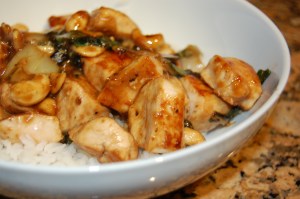
I do love the flavors of Chinese food, both the high-end restaurant food and our little takeout place, but I always wonder what’s in it that makes it taste so good.  Making a Chinese-style entree at home has been on my list for awhile; I’ve been hoping to trim the fat a little and find out more about those flavors that I enjoy.  This Cashew Chicken is perfect for that.  It is quickly sauteed, instead of breaded and deep fried, so it’s lighter than a takeout entree by far.  And I modified the original recipe to include wilted bok choy for some green – so much the better!  Next time you are in the mood for Chinese food, don’t reach for the phone.  Reach for the cashews instead, and whip up this lighter treat.

Chinese Cashew Chicken

1 1/2 pounds (or thereabouts) skinless, boneless chicken breasts, cubed
2 tablespoons dry sherry
2 teaspoons grated fresh ginger
3 1/2 teaspoons cornstarch
kosher salt
1/2 cup low-sodium chicken broth
2 tablespoons soy sauce
1 tablespoon brown rice vinegar
2 teaspoons light brown sugar
1 tablespoon plus 2 teaspoons vegetable oil
1 garlic clove, minced
1/2 cup unsalted cashews, toasted briefly
1 head bok choy, in ribbons
1 recipe cooked white rice, for serving

  • In a medium bowl, combine cubed chicken with sherry, ginger, 1 1/2 teaspoons cornstarch, and salt to season.  Marinate the mixture in the refrigerator 30 minutes.
  • Meanwhile, in a small bowl, combine chicken broth, vinegar, soy sauce, brown sugar and 2 teaspoons cornstarch.  Set aside.
  • When the chicken is finished marinating, heat 1 tablespoon of vegetable oil until shimmering in a large non-stick skillet over medium heat.  Add the chicken and saute until golden brown and completely cooked (in batches if necessary so as not to crowd the pan) and transfer to a plate.
  • In the same skillet, add another tablespoon of oil and wilt the bok choy.  When the bok choy is completely wilted, add the cashews and grated garlic; cook about 30 seconds while moving the garlic around constantly with your spoon.  Return the chicken to the skillet and pour the sauce over.  Toss everything together about 30 seconds, until the sauce thickens.
  • Serve over cooked white rice.

DSC_0871

Source: Adapted from Everyday Food, October 2009