They’re Called Classics For A Reason

Have you ever curled up with Pride and Prejudice and swooned over Mr. Darcy, with his smouldering, passionate declaration of love for Lizzy Bennet?  Have you jumped at the smallest noise after reading Wuthering Heights’ terrifying description of the ghostly Cathy knocking at the window?  Laughed like a Florentine noble at the bawdiest tales in Bocaccio’s Decameron?  Or kept a sad vigil with Natasha at Prince Andrei’s bedside in War and Peace?  No?  Then you’re missing out.

But they’re boring, you insist.  I had to read that in tenth grade.  It was awwwwwwwful.  Barely even readable.  Too many people have had their reading experiences ruined by a stern teacher or a rigid curriculum.  And it’s true that no one likes a book that they’re forced to read.  But I’ll bet if you dust off one of the “classics” and approach it with fresh eyes, you’ll find a whole world there, full of romance, joy, sadness, adventure, desperation, fright… a whole range of human emotions.

There are many different definitions for what makes a book a classic.  No one definition is controlling, but most generally agree that to be considered a classic, a book has to have attained critical and popular success for a substantial period of time.  (Liz Foley, Vintage Classics Editorial Director, has a good commentary on the topic over on the Man Booker Prize website.)  Let’s think about that for a moment.  Ask yourself this – can a book really attain critical and popular success, and sustain it for decades, even centuries, if it’s boring?  I guess anything’s possible, but it doesn’t seem terribly likely to me.  Classics are books with staying power… and they have staying power because they speak to people.

I’d be lying if I said I liked every classic.  The Scarlet Letter did nothing for me, nor did The Secret Agent.  But when I pick up a classic novel, I don’t expect it to be dry and boring and dull.  I expect to enjoy it immensely – like so many people who’ve read them before me.  I expect to be swept into new worlds of romance, adventure, excitement, and fun.  I expect to identify with the characters, to laugh with them, and to be moved to tears by their stories.  Most of the time, the classics that I read fulfill those expectations.

And it’s not just that.  Reading classic works enriches my daily life and my travels.  When I watched the Changing of the Guard at Buckingham Palace in 2008, I was thinking about Christopher Robin.  Seeing Place Saint-Michel in Paris brought to mind barricades, street fighting and Les Miserables.  Traveling through England this fall, I’ll be thinking of the second Mrs. de Winter shivering near the cliffs and coves of Cornwall… of Tess Durbeyfield stretched out across an ancient altar at Stonehenge… of Catherine Moreland navigating the Bath social scene…

I’m not saying that I don’t read magazines, or new releases, for that matter.  I like a glossy issue of Bon Appetit as much as the next girl.  And if I skipped the new releases I’d have missed out on The Night Circus, which was perhaps the best book I read all year.  But I’ll never abandon those piles of old favorites.  Jane Eyre is still thrilling and romantic.  War and Peace is epic, tragic and uplifting all at once.  Pride and Prejudice and Emma are pure, unadulterated fun.  Rebecca is suspenseful and mysterious.  The Decameron is hilarious, and kind of dirty (in parts).  Who would want to skip any of that?  If you haven’t picked up a “classic” novel in awhile, try again.  Give yourself the gift of reading the “great works” without a strict teacher breathing down your neck.  After all, they’re really, really good.  That’s why they’re classics.

Reading My Way Through England


The Tower of London.  Scary!

I’m an Anglophile.  Even before I went to Great Britain for the first time in 2008, I considered myself an Anglophile.  I’m not sure how others come to love a country before they’ve even stepped foot in it, but for me my Anglophile tendencies were awakened by certain special people.  Jane Austen and Will Shakespeare, to start.  Agatha Christie, Daphne du Maurier, Charlotte Bronte, and Thomas Hardy.  Then, when I already knew I loved Great Britain, Anne Bronte, P.G. Wodehouse, Dorothy L. Sayers and Charles Dickens confirmed it.  My introduction to England came between the pages of books.  And while I can read and love a book from anywhere in the world, my heart belongs to English literature.

When I travel, I like to take with me books that call to mind the particular place I’ll be exploring – either because they’re specifically set there or just because they’re reminiscent of the area.  In 2008 I was headed north – to Yorkshire, to start – so I brought Wuthering Heights with me.  This time I’m traveling with a Nook, which means that I have the luxury of “packing” as many English novels as my heart desires without worrying that my backpack’s zipper will break.  So, while hubby has been concerning himself with things like GPS coordinates and hiking socks, I’ve been brainstorming a book list that will cover every stop in our upcoming circuit of southern England.  (I probably won’t download all of these.  But it’s still fun to think about the characters that I’ve loved as I’m walking in their footsteps.)

Bath – For the first stop on our trip, I’ll be in full-on Jane Austen mode.  Austen lived in Bath periodically and the town currently houses the Jane Austen Centre.  Although Rick Steves only recommends it for “fans,” I’m a rabid Jane Austen fangirl and hubby is stuck to me, so we will certainly be visiting and paying homage to the giant Colin Firth poster.  Obviously.  So for a visit to Bath, the books of choice are clearly Jane Austen!  I’ll be taking Persuasion, and possibly Northanger Abbey, since Bath is a major setting in both books.

Stonehenge – On the way from Bath to our next stop, Cornwall, we’re planning to stop at Stonehenge.  When we do, I’ll be thinking of poor, mistreated Tess from Thomas Hardy’s tragic Tess of the d’Urbervilles, one of my high school favorites.  In the climactic scene, Tess stretches out across a Druid altar at Stonehenge and makes a terrible confession.

Cornwall – I’ve been wanting to visit Cornwall ever since I first read Daphne du Maurier’s Rebecca.  It’s still a favorite, and I recommend it to everybody.  The brooding estate of Manderley, still haunted by the outsized personality of its late mistress, Rebecca de Winter, and the Cornish coast where she met her demise have called to me since I read the iconic first line, “Last night I dreamt I went to Manderley again.”  For more Cornwall, pick up any other du Maurier novel – I also love Rule Britannia and Jamaica Inn.  Or, if you want to be really ambitious, try Le Morte d’Arthur by Sir Thomas Malory.  (King Arthur is believed to be a Cornish king, and the castle of Tintagel – which we’ll be visiting – is considered by many as the seat of Camelot.)  But if you bring Malory along with you, don’t expect to read anything else!  900 pages of Ye Olde English is quite the commitment.

The Cotswolds – This is the quintessential storybook England, of thatched-roof cottages and rambling rose gardens.  While in the Cotswolds, I plan to treat myself to some of the quintessential English sense of humor… through P.G. Wodehouse.  Wodehouse wrote some 90+ novels, many of them focusing on two of my favorite literary characters of all time, the dopey aristrocrat Bertie Wooster and his devoted and brilliant valet, Jeeves.  Bertie often finds himself sent out of London to the country by various domineering aunts, for the purpose of proposing to wealthy young women whom he can’t stand, or stealing bits of china or silver from his unwitting hosts.  Bertie invariably ends up either engaged, on the run from the law (sometimes in the form of his old pal Stilton Cheesewright, sometimes the bumbling Constable Oates), or both.  But not to worry: Jeeves always gets him out of his scrapes.  Although the generic countryside of the Wooster and Jeeves novels isn’t identified as being the Cotswolds, with town names like Steeple Bumpleigh, Totleigh-in-the-Wold and Market Snodsbury, it can’t be anywhere else in my imagination.  My favorite Wodehouse novel is The Code of the Woosters, where Bertie is sent to pinch a cow-creamer from his Uncle Tom’s arch-nemesis, Sir Watkyn Bassett, and finds himself dodging the dippy daughter of the house, Lady Madeline, as well as Sir Watkyn’s aspiring dictator friend Roderick Spode.  Good stuff.

Stratford-Upon-Avon – While in the Cotswolds, we’re going to nip over to Stratford for a day-trip to see Shakespeare’s birthplace.  Yes, I know it’s touristy.  No, I don’t care.  I love everything Will has done (except for Titus, yuck).  I’ll be giddy all day, thinking about my favorite Shakespeare plays – Macbeth, Hamlet, The Taming of the Shrew and especially A Midsummer Night’s Dream.  In high school I participated in a Shakespeare competition and recited one of Helena’s monologues – good enough for second place, wheeee!  Later, for my sixteenth birthday, some friends got me tickets to see Midsummer on my birthday.  We sat on stage and I recited along with the actors.  Happy times.  So yeah, I’ll be excited to see Will’s pad!

Oxford – There’s plenty to choose from when it comes to Oxford lit.  You could try Mr Verdant Green: Adventures of an Oxford Freshman, which I picked up in London in 2008 when I ran out of books to read on the plane home.  Or you could go with A Discovery of Witches if you want something more recent and bestsellery.  But my favorite Oxford book has to be Gaudy Night, by Dorothy L. Sayers.  I love the Lord Peter Wimsey mysteries – especially the ones that include Lord Peter’s paramour, the mystery writer Harriet Vane, and Gaudy Night is almost all Harriet, as she visits her alma mater and helps solve the mystery of who is sending “poison pen” letters to the Oxford faculty.  Such fun!

London – As befits a big city, there are so many choices!  You could try the Sherlock Holmes mysteries – I’ll be downloading those for sure.  Or if you want some children’s lit, how about Peter Pan?  When you finish it, you could drop by the statue of Peter Pan in Kensington Gardens and see if he’ll fly off to Neverland with you.  Or drop by King’s Cross Station to visit Platform 9 3/4 and think of Harry Potter… or stop to watch the Changing of the Guard and recite A. A. Milne’s poem “Buckingham Palace.”  (“Do you think the King knows all about me?”  “Sure to, dear, but it’s time for tea,” says Alice.)  And you can shop for books vicariously with 84, Charing Cross Road.  On this trip, I’m planning to pay tribute to London with some Dickens – Great Expectations, probably, or maybe Bleak House.

Where do you like to travel via literature?

Reading Round-Up: September 2011

Reading is my longest-standing, and also my favorite, hobby.  I literally can’t remember a time in my life when I didn’t love to curl up with a good book.  Here are my reads for September, 2011…

The Tiger’s Wife, by Tea Obrecht – I finally got around to reading this one and it certainly lived up to the hype in my opinion.  Beautifully written, with a gripping story and evocative language – I couldn’t put it down.  I found the plot about the tiger’s wife to be the best part of the book, but I also loved the grandfather’s stories about the deathless man.  The “modern” characters – Natalia, Zora, and the diggers – were less interesting to me, but overall it was a wonderful book and completely worth reading.

The Magicians, by Lev Grossman – I probably wouldn’t have picked this up if I hadn’t heard amazing things about the sequel, The Magician King.  And in fact, if I had read The Magicians when it first came out – before The Magician King was released to widespread acclaim – I don’t know that I would bother to continue with the series.  The Magicians was okay, humorous in parts, but not particularly creative.  I felt that it piggy-backed on other, better books in its genre.  Still, it was not a bad read and I liked the underlying thesis that you need to be whole and happy yourself, and that “magic” isn’t going to fix your problems for you.  I’m looking forward to reading The Magician King, and we’ll see if my opinion of The Magicians changes after I read the sequel.

The Soldier’s Wife, by Margaret Leroy – Lush and moving story of a Guernsey islander who falls in love with a German soldier during the Occupation from 1940-45.  I didn’t care for the protagonist at first, but she grew on me as she became stronger and more committed to her values.  The ending was a tear-jerker and beautifully written.

Anna Karenina, by Leo Tolstoy – This is an old favorite, but the first time I read the translation by Richard Pevear and Larisa Volokhonsky.  I love their work and was impressed, as always, with how readable they make the Russian classics.  The story of the forbidden love between Anna and Count Vronsky, and the counterpoint socially acceptable (but no less real) love between country squire Levin and his wife Kitty, is sweet, sad and moving.

In the Garden of Beasts: Love, Terror and an American Family in Hitler’s Berlin, by Erik Larson – Profoundly disturbing account of the American Ambassador to Germany, William Dodd, and his family, and what they observed in Berlin in the early 1930s, right after Hitler’s ascension to power.  There are times when you are shocked at the Dodds’ naivete – but trying to keep in mind that the reader has the benefit of 20-20 hindsight – and times when you’re proud of them for standing up for what is right, especially when they start to realize that not only is the Germany of the 1930s a scary place, but it’s a serious threat to peace.  This account is particularly interesting in the way that it shows how it was possible for Hitler to establish his hold over Germany without anyone stepping in and intervening.  Highly recommended, especially for history buffs.

I had a little bit lighter of a September in terms of the pure number of books I read, but Anna Karenina is quite the chunkster.  I started it earlier in the summer and kept putting it down to read other books – usually library books that couldn’t be renewed, because they had a waiting list.  I finally was able to finish it (although it wasn’t my first time through), but it took a chunk out of my September reading time.  Worth it, though!  I probably spent the same amount of actual time reading – had another long train trip! – but read fewer, longer books.  It was a great month of reading – I enjoyed everything I read this month, particularly toward the end of the month.  Looking forward to plenty of reading time in October!

Banned Books Week 2011

In this day and age, it’s pretty shocking that censorship and book banning still go on.  But they do.  With a little perserverence, people can find something to complain about in even the most innocuous book.  I mean, Harry Potter promotes devil worship?  Really?  To quote John Cage, “Say it with me, people: pleeeeeeeease.”

But the fact remains – books are challenged every day by people who don’t agree with their messages.  I sometimes wonder why people challenge books.  As a former kid, I will tell would-be censors what they should already know: there’s no more effective way to make people want something than to tell them it’s forbidden.  And by extension, there’s no better way to publicize a book than by challenging or banning it.

Many book bloggers are celebrating Banned Books Week by reading their favorite banned or challenged book.  I’m not, for the simple reason that I have a stack of library books that I have to get through – since they came from the holds shelf and can’t be renewed, I don’t have the luxury of laying them aside and reading something else first.  But I am currently reading a book that I think embraces the spirit of banned books week by calling the dangers of censorship to attention: In The Garden of Beasts: Love, Terror and an American Family in Hitler’s Berlin, by Erik Larson.  Larson’s book is a non-fiction account of the brief time spent in Berlin by Ambassador William Dodd and his family during the early years of the Nazi regime.  Censorship isn’t the prime focus of the book – it’s about how the Dodds came to see Hitler and his fellow thugs as a threat to world peace and their attempts to communicate their observations to the State Department in the early 1930s, when most of America was turning a deaf ear to the increasingly frightening reports coming from Europe.  But censorship is present in the book, in its references to book-burnings, the exodus of artistic talent from Germany in the 1930s, and the intense government pressure on those writers who chose to stay in the country.

Censorship is so dangerous.  It’s a slippery slope when an entity decides to tell writers what they can and can’t say.  Freedom of expression, and freedom of the press, are part of what makes the United States a great country – and have been since the First Amendment was passed.  I believe that taking a stance against censorship of ideas and words is one of the most important things that Americans can do to promote our country’s values.  Reading banned books is just the beginning.  Speaking out against censorship not only protects us as readers and writers, but it protects the freedoms we value.  So that’s why, in celebration of Banned Books Week, I’m reading a book that contains vivid reminders of the damage that censorship does to a society.  And even keeping in mind the challenges that we face in the United States right now, I’m thanking my good luck that I was born in a country – and a family – that believes in books, and in reading.

I was also curious to see how my personal library stacks up against the American Library Association’s list of banned or challenged classics.  (Books I’ve read are in bold.)  Not too shabby…

 The Great Gatsby – read in high school

The Catcher in the Rye – read in high school

The Grapes of Wrath – read in high school, college, and adulthood (a personal fave)

To Kill a Mockingbird – read more times than I can count (another fave)

The Color Purple

Ulysses

Beloved

The Lord of the Flies – read in high school

1984 – read in high school

Lolita

Of Mice and Men – read in high school

Catch-22 – read in high school and adulthood

Brave New World

Animal Farm – read in high school

The Sun Also Rises

As I Lay Dying

A Farewell to Arms

Their Eyes Were Watching God

Invisible Man

Song of Solomon

Gone With the Wind – read first at age 9, and many times since

Native Son

One Flew Over the Cuckoo’s Nest – read in high school

Slaughterhouse-Five – read in adulthood

For Whom the Bell Tolls

The Call of the Wild – read in childhood

Go Tell It On the Mountain

All the King’s Men – read in adulthood

The Lord of the Rings

The Jungle – read in college

Lady Chatterley’s Lover – read in high school

A Clockwork Orange

The Awakening – read in adulthood

In Cold Blood – read in high school, college, law school and adulthood

Satanic Verses

Sophie’s Choice

Sons and Lovers

Cat’s Cradle

A Separate Peace – read in high school and college

Naked Lunch

Brideshead, Revisited

The Naked and the Dead

Tropic of Cancer

An American Tragedy

Rabbit, Run

 Looking through the list, I clearly read a lot of my banned books in high school.  (Rebel, much?  Okay, not so much.)  Some were assigned and others I read on my own time – I had a lot of reading time in high school; more than college or law school, certainly.  Others on this list – Brave New World, A Clockwork Orange, and Brideshead, Revisited, particularly, are very high on my to-be-read list and I’ll probably be hitting all of those within the next few months as they’ve cycled upward.

 Resist censorship!

One Reader’s Beginnings

I’ve been a reader for as long as I can remember.  I mean that literally.  I cannot recall a time when books were not a huge part of my life.  On the first day of kindergarten, I remember sitting at my table and wondering when we were going to learn to read.  Now, I already knew how to read – my mom taught me when I was in preschool – so I’m not sure what I expected.  To be inducted into some sort of secret society, perhaps.  A secret society of readers.  Or maybe some kind of turning point where I officially became a book person.  Which I already was, and had been practically since birth.

There was never a time in my reading life where I had to learn to love reading and books.  That came naturally to me.  Turning pages, scanning printed words, imprinting stories upon my memory and imagination – those things took no effort.  So most of my reading life has been spent honing my tastes… figuring out what I like, and what I don’t like… in short, forming an identity as a reader.  For me, just identifying as a reader doesn’t go quite far enough.  Of course I’m a reader.  The question is, what kind of reader?  That is something I’ve been figuring out all my life.

In elementary school and middle school, I read wide varieties of “young adult” fiction, although I’m not sure that’s what anyone called it.  I read good stuff and junky stuff indiscriminately.  I was just as likely to be glued to a book from the Sweet Valley series, or especially The Baby-Sitters Club, as I was to a copy of Anne of Green Gables or From the Mixed-Up Files of Mrs. Basil E. Frankweiler.  I think the turning point for me, the point at which I started to think about content and get picky, came the summer after eighth grade.  I don’t remember now what I did (probably mouth off), but my parents were punishing me for something.  I was a weird kid, and normal punishments like taking away television or phone privileges had next to no effect on me – I barely watched television anyway and I’ve never been a phone person.  So I suppose my parents had to get pretty creative when it came to discipline, and the punishment they dreamed up on this particular occasion was this: no books, except for “classics.”  Functionally, that meant no Baby-Sitters Club.  Oh, the humanity.

It was a week of enforced good taste.  Not reading was obviously not an option.  So I picked up a book that no one could argue with or take away: To Kill a Mockingbird.  I still remember sitting on the couch with my book and my parents occasionally coming into the room to ask me, accusingly, what I was reading.  My response, emphatic and defensive, was always: “To Kill a Mockingbird!  It’s a CLASSIC!”  Take that, parents.  As it turned out, when the summer ended and I started ninth grade Honors English, I was glad to have already read To Kill a Mockingbird.  By then, it had become one of my favorite books – I’d already read it twice by the time it was assigned in the spring semester – and I was able to delve more deeply into the characters and the story.  For a class project, I wrote a journal from the perspective of Atticus Finch and my very demanding, altogether wonderful teacher was thrilled with it.  She said I became Atticus.  Looking back, I owe quite the debt of gratitude to To Kill a Mockingbird.  Not only was it the catalyst for a change in my reading life, but Atticus Finch is one of the reasons I became a lawyer.

Ninth grade changed my reading life beyond To Kill a Mockingbird.  I read Jane Austen for the first time – Sense and Sensibility was my introduction into Regency England; I identified with serious, pragmatic Elinor and rolled my eyes at dreamy Marianne.  My English teacher – the same one who assigned To Kill a Mockingbird – encouraged me to read Eudora Welty.  I read my first Shakespeare play.  By the end of the year, I was a full-on book snob.  By the end of high school, all of my Baby-Sitters Club books were in the basement, replaced on my shelves by meticulously organized, scrupulously chosen classics.  For years, my criteria for any book I read was that I had to be proud to tell my ninth grade English teacher that I was reading it.  If it wasn’t a book I would want to show to her, I wouldn’t touch it.  In 1997, I set a goal to read 50 books, all books that I hadn’t read before, that were not assigned for school, and that I would be proud to show that particular teacher.  I met that goal, but I was reading up until about 9:00 p.m. on December 31st to make it – and book 50 was actually an epic poem, which I wasn’t sure should really count, but desperate times and all that.  In 2007 I set the same goal, only this time I had to read 100 books, all books I hadn’t read before.  But the other criteria was the same – I had to be proud of each and every book if I happened to see my English teacher.

I never stopped “reading for fun,” even when life got very busy.  My college major, Industrial and Labor Relations, was notoriously heavy on reading assignments.  It was a campus joke to refer to ILR as “I Love Reading” – in fact, I remember my grandparents dropping me off for accepted students’ weekend in March of my senior year in high school.  We bumped into some upperclassmen, who asked what school I would be in.  I told them ILR and they laughed, “Oh, I Love Reading!”  My grandparents – coming to my defense – said seriously, “She really does love reading.”  The campus joke was right on; ILR kept me busy with reading assignments.  I probably had quadruple the books on my windowsill – maybe even more – in comparison to my roommate, a nutrition major.  Still, I still found time to squeeze non-labor books in (just not too many; I did have a G.P.A. to think about in light of my looming law school applications).  If I ever fell off the book bandwagon, it was in law school, especially second and third year when every moment of every day was accounted for.  But I always caught up during the summers.  And then came my first job – a government job, with enforced maximum hours and a handful of new friends who happened to be as book-obsessed as I was.  My reading life exploded into activity (hence the 100-books-in-2007 challenge).  And I haven’t slowed down since.  Sometimes I’m asked how I can read and write all day – which, indeed, I do: cases and contracts and briefs, oh my! – and then go home to curl up with a book all evening.  I can’t really explain it, except to say that I have yet to bump up against my limit when it comes to words I can stand to read or pages I can stand to turn.  And legal writing is very different from the fiction I favor in my off hours.  I don’t feel overloaded at all.

I’ve been a reader for more than two decades now.  (I don’t know how long, precisely, because as I said I don’t remember not being able to read.)  In that time, I’ve read good books and bad books, and a very few books that I had to stop midway through because they were just awful.  I’ve discovered what I don’t like: science fiction, most fantasy (except for my beloved Harry Potter), most dystopia, and most “young adult” fiction.  And I’ve honed a description of what I do especially like: classics (especially English literature), new literary fiction, well-researched historical fiction with strong characters, travel memoirs, and British mysteries.  More than just knowing my likes and dislikes – which was a long process – I feel that I have finally assembled my identity as a reader: I am mainly a fiction reader with a preference for both historical classics and new literary fiction with well-drawn characters, but I will read non-fiction books that evoke a sense of place or personality.  I favor simple but evocative language and tight plots.  I’ll give most books a chance, especially in my preferred genres, but in order to earn a spot on my permanent shelf a book has to engage me from the beginning, give me relatable characters and a well-drawn plot, and reward me with a satisfying ending.  My preferences may change over time – in fact, I’m sure they will – but I’m sure I’ll always have strong opinions about books.

What about you – what kind of reader are you?

For September, An Old Favorite

School is starting.  It’s that magical time of year when pencils and yellow buses and new-old textbooks are a novelty and the daily routine hasn’t lost its luster yet.  There are kids gathering on street corners at ungodly hours in the morning, with backpacks and lunch boxes that haven’t yet gotten dirty and stinky.  And even though hubby and I haven’t gone back to school in years – and even though the only thing that changes in September for us now is that the traffic is a little heavier – I’m not immune to the excitement. 

I’ve had the same favorite poem since I was sixteen years old.  (In fact, hubby and I used the final three verses on our wedding programs.)  My favorite poem, “if everything happens that can’t be done,” reminds me of back-to-school – maybe it’s the mentions of leaves and books.  So, for a little back-to-school treat, here’s my favorite poem in its entirety.

if everything happens that can’t be done, by e.e. cummings

if everything happens that can’t be done
(and anything’s righter
than books
could plan)
the stupidest teacher will almost guess
(with a run
skip
around we go yes)
there’s nothing as something as one

one hasn’t a why or because or although
(and buds know better
than books
don’t grow)
one’s anything old being everything new
(with a what
which
around we come who)
one’s everyanything so

so world is a leaf so tree is a bough
(and birds sing sweeter
than books
tell how)
so here is away and so your is a my
(with a down
up
around again fly)
forever was never till now

now i love you and you love me
(and books are shutter
than books
can be)
and deep in the high that does nothing but fall
(with a shout
each
around we go all)
there’s somebody calling who’s we

we’re anything brighter than even the sun
(we’re everything greater
than books
might mean)
we’re everyanything more than believe
(with a spin
leap
alive we’re alive)
we’re wonderful one times one

Happy September!

Reading Round-Up: August 2011

Reading is my longest-standing, and also my favorite, hobby.  I literally can’t remember a time in my life when I didn’t love to curl up with a good book.  Here are my reads for August, 2011…

Molotov’s Magic Lantern, by Rachel Polonsky – Being interested in all things Slavic, I was intrigued by this travel-history-biblio-memoir by a British journalist who discovers upon moving into an apartment in Moscow that she is living directly below the apartment of one of Stalin’s most prominent henchmen.  Molotov was responsible for sending countless numbers of writers and intellectuals to the Gulag, but he was also an “ardent bibliophile” who collected the works of those same writers.  Polonsky explores several towns in Russia and describes their histories, their contributions to Russian intellectual life, and their connections (if any) to Molotov.  Interesting, if a bit dry at times.

Catching Fire, by Suzanne Collins – I got the second volume of the Hunger Games trilogy from the library and was almost as blown away as I was by the first.  Katniss was just as brave and Peeta was just as wonderful as in The Hunger Games.  When the insane cliffhanger ending arrived I realized I simply couldn’t wait for my name to come up in the library queue (I was around 120 on the list) so I downloaded…

Mockingjay, by Suzanne Collins – The final volume of the Hunger Games trilogy wasn’t as strong as the first two, but it provided plenty of food for thought and great dramatic tension.  Not enough Peeta for me though!  I always want more Peeta!

The Oracle of Stamboul, by Michael David Lukas – Loved, loved, LOVED this charming and sweet story of a little eight-year-old girl who stows away on her father’s business trip to Stamboul during the waning days of the Ottoman Empire and winds up impressing the emperor with her sage political advice.  The language was so evocative that the story was like gazing at a tapestry of color and texture – beautiful.

Faith, by Jennifer Haigh – This was a profoundly disturbing, yet also sensitive and compelling, story of the aftershocks in the family of an Irish Catholic priest accused of child abuse during the 2002 Boston archdiocese scandals.  I found the subject matter difficult, but fascinating, and the book was written in a compassionate way.  Loved it.

My Love Affair With England, by Susan Allen Toth – This was a re-read, and I don’t even know what number it was.  I’ve had this travel memoir since high school and I pull it out whenever I want to sink knee deep into one of my favorite countries.  As an avowed Anglophile, I can’t get enough afternoon tea, the Tube, Stonehenge, walks along National Trust paths… Since I’m preparing for my next big vacation to England, I pulled out this old favorite and, as always, it didn’t disappoint.

 A Discovery of Witches, by Deborah Harkness – I wasn’t sure what to think of this book.  I went back and forth.  At first I loved the descriptions of Oxford (I’ll be there in October!), and the character’s haunts in the Bodleian Library and Blackwells, and all the tea she drinks.  Then the romance started up and I found it pretty saccharine, and the main characters grated on me rather.  I finished the book and thought, “Well, I guess I really am immune to vampires.”  Then a weird thing happened… I kept feeling compelled to pick up the book and flip through it again.  And the vampire grew on me too.  Very strange.  I guess I did really like this book after all.

Notes From a Small Island, by Bill Bryson – There were laugh-out-loud hilarious bits sprinkled throughout this travel memoir, but it started to wear thin by the end.  Still, Bill Bryson clearly loves England and the English people, including their quirks and foibles.

I had a good August in books.  Some really wonderful books read, and no major flops.  Faith, The Oracle of Stamboul and A Discovery of Witches were highlights.  Three very different books, but all compelling in their own ways.  As always, to see a complete (or as close to complete as possible) list of my books read since 2007, or for full reviews of the books listed here, feel free to follow me on Goodreads.  Happy reading!

Are readers born or made?

Can you teach someone to love reading?  According to an article in The Chronicle of Higher Education, the answer is no.  In “We Can’t Teach Students To Love Reading,” Professor Alan Jacobs hypothesizes that the group of people who truly enjoy “deep attention” reading – that is, getting lost in a book for hours on end – are and will forever remain a small fringe of the population.

 Professor Jacobs’ article is fascinating, even if I don’t completely agree with it.  He traces the history of deep attention reading, from St. Augustine to the present day.  It probably doesn’t come as much of a surprise that the teaching of literature in schools and universities is a modern phenomenon.  Until just a few hundred years ago, very few people could read at all, and books were prohibitively expensive until the printing press changed history.  In fact, education itself was a luxury.  When the printing press made books far more available and inexpensive in the 1600s, many scholars worried about information overload – that people had so many sources of information now available to them that they were simply overwhelmed and could not choose between sources.  Sound familiar?  (Asks the blogger…) 

 Still, the numbers of people pursuing higher education, where they were expected to not only practice deep attention reading, but enjoy it, are a phenomenon of the latter half of the 20th century.  In 2005, sociologists theorized that “while there was a period in which extraordinarily many Americans practiced long-form reading, whether they liked it or not, that period was indeed extraordinary and not sustainable in the long run.”  So basically, what that means is that we should be seeing, or should expect to see soon, a normalization of reading, where fewer and fewer people practice deep attention reading for pleasure.  And ultimately, “extreme readers” (Jacobs’ words, not mine) will return to the fringe of society, only coming out of the woodwork to insist that War and Peace is NOT boring.  (Again, Jacobs’ words, not mine, but I assure you that War and Peace is most certainly not boring.  I guess you can pinpoint the fringe group to which I belong, yes?)

 Since I first saw this article on Twitter, thanks to Rebecca Joines Schinsky of The Book Lady’s Blog, I’ve been ruminating on it.  Can readers be made?  Or do they have to be born?  Is there some sort of gene that predicts whether a particular individual will be a reader?  (By which I mean, will read for pleasure and enjoyment with the attention span to focus for extended periods of time… not someone who simply has the ability to read.)  I don’t have personal experience of being molded, myself, into a reader.  I belong to the “born reader” subset.  From a very young age, I have been one to read anything I could get my hands on.  If it has words, I will read it (although I have my preferences, like anyone).  But I’ve been known to read the back of cereal boxes… or even shampoo bottles… just to have something to read.  In middle school I read my entire 7th grade history textbook (including captions) in one sitting.  In high school, I frequently told my parents “I don’t have any homework tonight – just reading.”  Reading, even reading a science textbook, could not be considered homework.  Reading was not work.

 But I have seen a reader made – my brother.  My brother was a very smart kid, and is currently a very smart guy, but he didn’t love reading with the level of obsession I did.  This drove my mother crazy.  As a teacher, she wanted him to love to read.  And we had plenty of books lying around – both mine (and no, I didn’t read all girly books – Encyclopedia Brown, anyone?) and those she brought home from school.  But my brother was lukewarm at best.  He would flip through them, because he was easygoing.  But he wasn’t crazy for books the way I was… until my mother slipped a Star Wars book in front of him.  Not one of the originals, mind you, but one of the “young adult” chapter books about Han and Leia’s kids.  My brother devoured it and requested more.  Soon he had entire shelves dedicated to Star Wars spinoff fiction.  That turned to other kids’ adventure fiction… which led to Harry Potter and eventually J.R.R. Tolkien, and a reading monster was born.  These days, he is largely a non-fiction reader.  The little kid who read Star Wars spinoffs in one sitting now reads books like Freakanomics, biographies, and books about current events.  He asks for and receives just as many books as I do on Christmas morning.  (In fact, he will probably unwrap more paper books than I will on Christmas Day in 2011, now that I have a Nook.)  And he loves to give books as gifts.  My brother is a perfect example of a “made” reader – someone who just needed the right book to open up a whole world of words.

 But there’s one important detail that shouldn’t be overlooked.  My brother was “made” a reader at a very young age.  He was still in elementary school when my mother figured out how to unlock his love for reading.  What about people who grow up ambivalent toward books, reading only when forced to by a stern teacher?  Can they be lured into our cozy little fringe group of extreme readers as adults?  Does it just take the right book, or are they destined to be stuck in the non-reader camp?  I don’t know.

 I do think that the right book can awaken people to the joys of reading.  The multitudes of Potterheads and Twihards prove that.  There are just too many of them to all have come from the ranks of extreme readers.  (And yes, I am a proud Potterhead.  But not a Twihard.  Sparkly vampires just don’t do it for me.)  And I think that the right book will open the door to further reading… to a certain extent, at least.  So many grown-up Potter fans, bereft after the series ended, turned to Twilight or The Hunger Games to ease their pain.  But where from there?  Does anyone draw a line from Harry Potter and the Deathly Hallows to Jonathan Strange and Mr. Norrell to Charles Dickens?  You could, but most people don’t.  In looking for a successor to a book they loved, people often look for more of the same, rather than allowing themselves to grow and expand.  Hey, I’m not arguing against searching out books with a similar feel or geared toward a similar audience as those you loved.  I read The Hunger Games.  (Team Peeta!)  But I do think it can be too easy to stagnate.

 So, to sum up this long-winded narrative, yes, I do think readers can be made as well as born.  Especially if you catch them young, when they are more likely to be open-minded about genre after finishing that perfect gateway book.  Adults are trickier.  There’s plenty of people out there who have the capacity to practice and enjoy deep attention reading when there’s a dragon tattoo involved, or who would gleefully tape up their glasses and draw a lightening bolt on their foreheads to attend a Harry Potter midnight release party.  (Again, not proud of this, but I once dressed up as a member of the Gryffindor quidditch team to attend a release party.)  But when the book is done, they melt back into their busy lives, rushing from work to errands to the gym to home and collapsing in front of a screen – television or computer, it doesn’t really matter – when it’s all done.  Those people could be “extreme readers.”  They have the ability to love reading, if the right book comes along.  But they need to be won over again and again.  They might not step out of the genre that first attracted them to read other types of writing, but they will be ready to snap up the next sensation.  Every so often, one of them might branch out and discover that there is so much out there to read.  An adult who has not looked beyond the bestseller list since graduating from college might find that gateway book that leads to the Brontes, or Tolstoy, or Jane Austen, or Salman Rushdie, or David McCullough, or any author.  They might start developing preferences beyond dragon tattoos.  They might become an extreme reader.  And then there will be more of us, and eventually we will take over the world.

Reading Round-Up: July 2011

Reading is probably my longest-standing hobby.  Other interests tend to come and go, but there has never been a time in my life (that I can remember) that I haven’t loved to curl up with a book.  And I don’t think there will ever be a time when I don’t read.  I have read steadily throughout my entire life, through good times and bad, as an escape and as a way to connect with others.  My relationship with words, books, and reading is a relationship that I’ve cherished almost as long as I’ve been alive, and one that I will never abandon.  As part of the book chatter around here, I’m planning to post monthly “Reading Roundups” where I share what I’ve read for the past month.  So, here’s July!

All The King’s Men, by Robert Penn Warren – It took me awhile to get into this book, but once I did I was astonished by the beautiful language and the marvelous characterization.  Characters are the single most important element of a book for me (even more than plot) and this book was rich in wonderful characters.

Beowulf on the Beach: What to Love and What to Skip in Literature’s 50 Greatest Hits, by Jack Murnighan – This was a great synopsis of some of the greatest books in the history of literature, why you should read them, and what parts you can skip when you do.  (Although I’ll admit that, the first time I read a book, I’m a read-every-word person and I don’t think this book will change that.)  I got some great suggestions for books to read, was inspired to go back and re-read some old favorites, and as a result my to-be-read list is now even more obscenely long than it was.  I was disappointed in the conspicuous lack of some of my all-time favorites though – To Kill a Mockingbird was missing, as was The Grapes of Wrath.  I didn’t think every book that made the list of 50 necessarily belonged there, and the absence of those two was shocking to me.

The Painted Veil, by W. Somerset Maugham – I loved this story of a young English doctor’s wife who is forced to accompany her husband into a cholera epidemic when he discovers her infidelity.  The language was simply beautiful and the story was completely absorbing.  It’s a testament to the author that I cried at the end, even when the protagonist was possibly the single most unsympathetic protagonist I’ve ever read.

I, Claudius, by Robert Graves – I really enjoyed this dry, witty fictionalized autobiography of Roman Emperor Tiberius Claudius’s rise to Imperial power.  “Poor Uncle Claudius” was such a well-drawn character that he seemed almost alive and I loved reading about his deliciously vile, manipulative family (and you thought yours was bad!).  Highly recommended.

The School of Night, by Louis Bayard – I didn’t care for this “intellectual thriller” much at all.  From the beginning it felt contrived, the characters were dull (and all had ridiculous names – I mean, Alonzo Wax?  Amory Swale?  Halldor?)  It felt as though it was written with the bestseller list in mind, and there was a plot twist every other page.  I like a good mind-bender as much as the next girl, but things just got ridiculous.  That said, if you’re looking for a “beach read” that won’t tax you intellectually AT ALL, this could be the 2011 book of the summer for you.

The Hunger Games, by Suzanne Collins – WOW.  Wow wow wow wow wow.  I’m not into YA fiction and I usually don’t care for dystopia (I’m more of a Jane Austen, comedy of manners kind of girl), but I just could not put this book down.  I simply had to know what was going to happen to Katniss and Peeta.  I can’t wait until my name comes up on the library waiting list for the sequel!

The Uncoupling, by Meg Wolitzer – This was a fast, fun read about a group of women who fall under a spell when the new high school drama teacher starts rehearsing a production of Lysistrata, a Greek comedy about a group of women who go on a sex strike to end a war.  The women find that they suddenly, and inexplicably, lose interest in their husbands and boyfriends.  The Uncoupling touched on a number of topics relevant to 2011 – like the war in Afghanistan and the way teenagers communicate through texts and online worlds – and timeless topics as well, like the changing nature of desire in marriage.  It was a quick read, but very thoughtful.

July was a great month!  I had a couple of deliciously long train and car rides that I was able to devote to reading and I enjoyed almost all of the books I read this month.  To see my whole book list and full-length reviews, follow me on Goodreads.  Happy reading, friends!

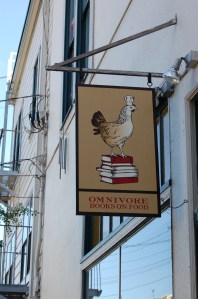
Omnivore Books On Food

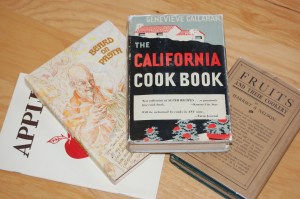
This unique bookstore was on my “must-see” list when hubby and I were in San Francisco.  I mean, really, a whole bookstore devoted to cookbooks?  Antique cookbooks, vintage cookbooks, rare cookbooks, new cookbooks?  Sign me up!  I knew I had to check this place out.  So hubby and I fortified ourselves with a good breakfast, hailed a cab, sharpened our elbows, and got ready to fight tooth and nail for the best deals.  As it turned out, cookbook collectors are pretty peaceable people – who knew?  (I once went to a wool festival and came home black and blue after a little scuffle near the cashmere – which I did NOT start, by the way – so I’m now ready for anything.)  I spent a blissfully happy hour or so thumbing through some fabulous old cookbooks while hubby waited patiently nearby (imagining the treats in store for him, no doubt) and I scored some pretty amazing deals.  Behold my haul…

In no particular order…

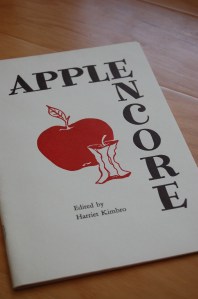
Is this 1976 limited-printing booklet called “Apple N Core” or “Apple Encore”… ?  I’m not sure, but I know one thing: it’s a hoot!  This booklet was limited to 500 copies and this here is a first (and only, so far as I know) edition.  It has recipes for everything from apple cake to apple barbeque sauce, with other tidbits like apple history, bios of famous apple-philes, and instructions on how to make an apple doll.  Like I said, an absolute hoot.

I don’t really know how this cookbook found its way home with me…  You see, I was just flipping innocently through the “California” shelf and I happened to notice that this 1949 Third Edition boasts the “debut” of Green Goddess dressing!  I love Green Goddess dressing, and to me it simply screams California.  So, I let it jump into my basket as a special souvenir of my California trip.

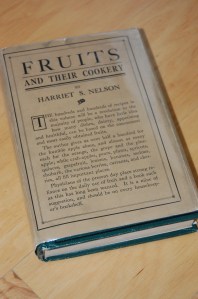
Here is a real treasure… a 1921 first edition cookbook dedicated solely to fruit.  The cover promises medicinal benefits to be obtained from the “commonest and most easily obtained fruits” – a revelation to the cooks of the 1920s, it seems!  The cookbook features classics such as “Dutch Apple Pie” and “Peach Cobbler,” adorably vintage-sounding dishes such as “Pineapple Delight” and “Apricot Ice For An Invalid,” and some recipes that read avant-garde even in the foodie culture of 2009, such as “Blackberry Vinegar.”  Expect to see some of Harriet S. Nelson’s fruity concoctions on here before long… but not before I do a bit of tweaking.  Harriet was enthusiastic about fruit, to be sure, but she wasn’t as big on prosaic things like measurements or oven temperatures or cooking times.  I plan to do a bit of updating and tinkering with this one and I’ll be sure to share my discoveries with you.

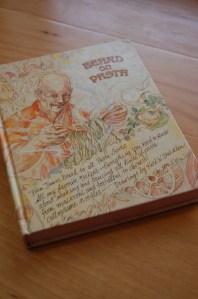
Hurray!  I’ve wanted my own copy of Beard on Pasta since I read Molly Wizenberg’s ode to braised onion pasta sauce.  Alas, it’s out of print.  But now, here it is, my very own treasure of a cookbook… and a first edition, no less!  The pasta gods are clearly smiling on me.

Omnivore Books On Food also sells new cookbooks, some of which are on my wish list and did look tempting.  Still, I consciously steered myself toward truly unique, special books that I couldn’t get on Amazon, with the resulting bounty. Stay tuned for recipes!