

Have you heard of the “1001 Books You Must Read Before You Die” list? It’s a list of… well, what it says: 1001 books that the list-makers have decreed everyone should read during their lives. I’ve been aware of the list for a few years now and it floats around the periphery of my mind when I’m deciding what to read next. I alternate between thinking “What a fun challenge!” and “That’s nuts, it would take my entire life to read all of these and I’d never be able to read anything else, and anyway, why should I listen to some random stranger about what to read?”
Last weekend I decided it would be fun to just have a look-see at the list, and figure out how many of the books I’d already read. And oh, friends, it wasn’t pretty. Here are the titles I’ve read from the 1001 Books list:
2000s
Saturday – Ian McEwan
The Curious Incident of the Dog in the Night-Time – Mark Haddon
Atonement – Ian McEwan
Life of Pi – Yann Martel
1900s
The God of Small Things – Arundhati Roy
The Virgin Suicides – Jeffrey Eugenides
The Things They Carried – Tim O’Brien
The Remains of the Day – Kazuo Ishiguro
The Child in Time – Ian McEwan
The Cider House Rules – John Irving
The Handmaid’s Tale – Margaret Atwood
White Noise – Don DeLillo
A Confederacy of Dunces – John Kennedy O’Toole
The Hitchhiker’s Guide to the Galaxy – Douglas Adams
The Master and Margarita – Mikhail Bulgakov
In Cold Blood – Truman Capote
The Bell Jar – Sylvia Plath
One Day in the Life of Ivan Denisovich – Aleksander Solzhenitsyn
Pale Fire – Vladimir Nabokov
Catch-22 – Joseph Heller
To Kill a Mockingbird – Harper Lee
The Talented Mr. Ripley – Patricia Highsmith
Lord of the Flies – William Golding
The Catcher in the Rye – J.D. Salinger
Love in a Cold Climate – Nancy Mitford
Animal Farm – George Orwell
Cannery Row – John Steinbeck
The Pursuit of Love – Nancy Mitford
Loving – Henry Green
The Grapes of Wrath – John Steinbeck
Rebecca – Daphne du Maurier
Of Mice and Men – John Steinbeck
The Hobbit – J.R.R. Tolkien
Out of Africa – Isak Dineson
Gone with the Wind – Margaret Mitchell
Thank You, Jeeves – P.G. Wodehouse
Cold Comfort Farm – Stella Gibbons
To the Lighthouse – Virginia Woolf
The Murder of Roger Ackroyd – Agatha Christie
The Great Gatsby – F. Scott Fitzgerald
The Trial – Franz Kafka
Billy Budd – Herman Melville
Siddhartha – Herman Hesse
The Age of Innocence – Edith Wharton
Night and Day – Virginia Woolf
The Voyage Out – Virginia Woolf
Ethan Frome – Edith Wharton
The Secret Agent – Joseph Conrad
The Jungle – Upton Sinclair
1800s
The Awakening – Kate Chopin
Tess of the d’Urbervilles – Thomas Hardy
The Picture of Dorian Gray – Oscar Wilde
The Adventures of Huckleberry Finn – Mark Twain
Anna Karenina – Leo Tolstoy
War and Peace – Leo Tolstoy
The Moonstone – Wilkie Collins
Little Women – Louisa May Alcott
Notes from the Underground – Fyodor Dostoyevsky
The Woman in White – Wilkie Collins
Walden – Henry David Thoreau
The Scarlett Letter – Nathaniel Hawthorne
The Tenant of Wildfell Hall – Anne Bronte
Wuthering Heights – Emily Bronte
Agnes Grey – Anne Bronte
Jane Eyre – Charlotte Bronte
Dead Souls – Nikolai Gogol
The Charterhouse of Parma – Stendhal
Oliver Twist – Charles Dickens
Ivanhoe – Sir Walter Scott
Northanger Abbey – Jane Austen
Persuasion – Jane Austen
Emma – Jane Austen
Mansfield Park – Jane Austen
Pride and Prejudice – Jane Austen
Sense and Sensibility – Jane Austen
1700s
Candide – Voltaire
Gulliver’s Travels – Jonathan Swift
By my count, that’s 77 out of 1001 books. Not even ten percent. Ouch. It doesn’t seem like a coincidence to me that the vast majority of my books are from the 1900s, with the 1800s coming in as a close second. (This is the “original” list, by the way – it gets revised periodically. Keeping up with the revisions seems to me like a good way to drive yourself off the deep end, so I wouldn’t bother with it.)
So, do I want to go after the 1001 Books list? Meh. There are a lot of books on the list that I’d been wanting to read anyway, and I’m sure I’ll get to those sooner or later. And I definitely think it would be fun to keep tracking my progress against the list. But am I going to make it an official goal? Or decline to read other books because they’re not on the list? Nope. Still, I’m going to pay a bit more attention to the list and see what kind of progress I can make on it. I do have a lifetime to get through it, after all.
Have you ever tried to read through a pre-determined list of titles? Are you tackling the 1001 Books list? Spill.
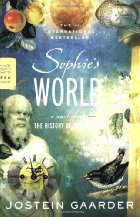 Sophie’s World: Already mentioned, of course. Sophie is a young girl who finds a letter in her mailbox one day, enrolling her in a correspondence class on the history of philosophy. The book alternates between telling Sophie’s story and detailing the history of philosophy through the letters that Sophie receives. The end of the book is truly mind-boggling (but I’m not going to spoil it for you; you’ll just have to read). Sophie’s World is probably the most difficult to read of all Gaarder’s works – just because it’s dense – but it’s a gateway drug.
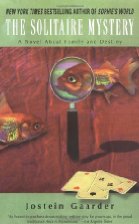 The Solitaire Mystery: This was the second Gaarder book I got my hands on, and to this day it’s my favorite. Young Hans and his father set off on a road trip through Europe to search for Hans’ mother. On the way, Hans receives a deck of cards and a magnifying glass. When Hans examines the cards, he finds that each card is a chapter in a fantastical tale about a group of playing cards who come to life and inhabit a magical island. It’s a colorful, mystical book.
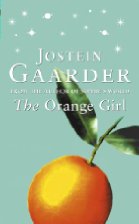 The Orange Girl: “If I’d chosen never to the foot inside the great fairytale, I’d never have known what I’ve lost. Do you see what I’m getting at? Sometimes it’s worse for us human beings to lose something dear to us than never to have had it at all.” This one is heart-wrenching. Georg receives a letter from his dead father, in which his father details his search for a young girl who sells oranges in Seville and Oslo. Again, as is typical of Gaarder’s work, the typeface changes as the story alternates between Georg’s life and the letter.
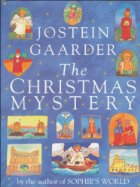 The Christmas Mystery: It’s become a tradition of hubby’s and mine to read The Christmas Mystery out loud, one chapter each day starting on December 1st, until Christmas Eve. The book is structured like an Advent calendar, and it is in fact the story of a boy who acquires a magic Advent calendar. Each morning, Joachim opens his calendar to find a new chapter in the fantastical story of a young girl, Elisabet Hansen, who disappeared from his town fifty years before. Elisabet’s magical Christmas journey will touch the lives of Joachim, his family, and several other residents of their town. I love-love-love The Christmas Mystery, and my holiday season isn’t complete without it.
 Raise your hand if you have crushed on a fictional character.



 covered in flour