Peanut’s Birthday Book Haul

I can’t believe it’s been almost a month, and I’ve neglected to show you the book haul Peanut pulled in over her birthday week!  I have to say, she did extremely well for herself.  In my quest to raise a reader, I’ve showered her with books from day one (I buy her plenty as just-because presents, since I don’t want her to grow up thinking that we only get books to read on birthdays and Christmas), but even I can see that I went a leetle bit overboard this time.  And you can add that to the fact that she’s surrounded by family and friends who also love to read and give books, and… well… she’s got enough reading material to last her at least until Christmas.  Maybe.

books1

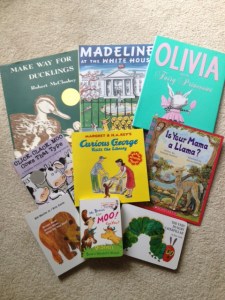
Books from Family and Friends:

Make Way for Ducklings
Madeline at the White House
Olivia and the Fairy Princesses
Click Clack Moo: Cows that Type
(n.b. This book is AWESOME!)
Curious George Goes to the Library
Is Your Mama a Llama?
Brown Bear, Brown Bear, What Do You See?
Mr. Brown Can Moo!  Can You?
The Very Hungry Caterpillar

books2

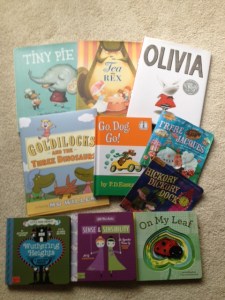
Books from Mommy and Daddy

Tiny Pie
Tea Rex
Olivia
Goldilocks and the Three Dinosaurs
Go Dog Go
Indestructibles: Frere Jacques
Indestructibles: Hickory Dickory Dock
Wuthering Heights: A BabyLit Weather Primer
Sense and Sensibility: A BabyLit Opposites Primer
On My Leaf

I’m sort of obsessed with Tea Rex.  And Tiny Pie.  And the BabyLit books.  And…

What is your favorite children’s book?

Bookish A to Z Survey

AtoZsurvey-1017x1024-297x300

I saw this posted on Friday, on Kim’s blog, Sophisticated Dorkiness.  (Originally, it came from Jamie of The Perpetual Page-Turner.)  I love surveys, and this one looked especially fun and creative, so here goes:

Author you’ve read the most books from: L.M. Montgomery, for sure.  Eight Anne books, three Emily books, two Story Girl books, and a smattering of others.  I’ve read them all multiple times.  I’ll never get enough Maud.

Best Sequel Ever: Like Kim, I’m not sure I can crown a “best ever.”  But I did think that Bring Up the Bodies (Wolf Hall Trilogy, #2), was spectacular.

Currently Reading: Savoring Jane Eyre for #Septemb-Eyre, and I’m also in the middle of Anne of Windy Poplars, the fourth book in the Anne of Green Gables series, which I’m re-reading (and loving as much as ever).

Drink of Choice While Reading: Tea, most of the time.  Occasionally I’ll curl up with a book and a glass of red wine in the evening.

E-reader or Physical Book? Most of my reading is done with physical books, and I do like the sensation of turning pages (and the ability to flip ahead and see how far I have to go in a chapter… yes, she says shamefacedly, I do that).  But I love my Nook for traveling.

Fictional Character You Probably Would Have Actually Dated In High School: Hmmmm, this one’s tough.  I think for sure I’d have felt drawn to the teenaged Sirius Black, but would he have been interested in me?  Not sure.  I’d probably have ended up with Lupin.

Glad You Gave This Book A Chance: I resisted for awhile, but by the time Harry Potter and the Goblet of Fire was released, I was tired of being what felt like the only one not in the loop, so I picked up the first in the series and never looked back.

Hidden Gem Book: I feel like no one reads Time and Again, by Jack Finney, and everyone should.  It’s so much fun.

Important Moment in your Reading Life: The summer before ninth grade, my parents grounded me for something and forbid me to read any books except for “classics,” for one week.  I had to read, obviously, so I picked up To Kill a Mockingbird.  That was the book that taught me that I could hang in there with an adult classic, learn something, and have a wonderful time.  I started gravitating toward classic literature after that (and away from the Baby-Sitters Club, although I still love and re-read my true childhood favorites, like L.M. Montgomery’s Anne, Emily and Story Girl books, or Laura Ingalls Wilder’s Little House series).

Just Finished: Oryx and Crake, by Margaret Atwood.  I couldn’t be the only person out of the loop on the MaddAddam trilogy.

Kinds of Books You Won’t Read: I don’t really go for science fiction, in general (although I’ll make exceptions for classic dystopia), for new adult romance, or for horror (although, again, I’ll make exceptions for a true classic).

Longest Book You’ve Read: I’m not sure, exactly, but I think probably War and Peace, by Leo Tolstoy.  The translation by Richard Pevear and Larissa Volokhonsky.

Major book hangover because of: The Hunger Games, by Suzanne Collins.  I really couldn’t figure out what to read after that.  (The first one.  After reading the cliffhanger ending in Catching Fire, I knew exactly what I had to read next: Mockingjay.)

Number of Bookcases You Own: Nine (counting the two built-ins in our current rental), but they’re not all in use at the moment.  We’re only planning to be in this house for a year, before we intend to buy something.  So I’ve done some major culling of the book collection and only kept out my absolute favorites – enough to fill the two built-ins and my “Librarie shelf” from Ballard Designs (formerly in my reading nook), and nothing more for me.  Between those and the library, I should be fine for a year.  Peanut also has her bookshelf set up.

One Book You Have Read Multiple Times: Jane Eyre, by Charlotte Bronte – my favorite book of all time.  I’m re-reading it (again) right now for #Septemb-Eyre.

Preferred Place To Read: It was the seating alcove in my old bedroom, which I turned into a reading nook.  But sadly, it’s now someone else’s seating alcove.  I suppose my current preferred reading location is on the couch, snuggled up with a cup of tea or a glass of wine while hubby is watching football next to me, and Peanut is snoozing happily upstairs.

Quote that inspires you/gives you all the feels from a book you’ve read: Professor Dumbledore is always inspiring.  He has so many quotes about choices: for example, “It  is our choices, Harry, that show what we truly are, far more than our abilities.”  I think we would all do well to keep that one in mind.

Reading Regret: I thought the Tunnels series was going to be great, so I asked for a copy of the first book several Christmases ago.  What a waste of time.  And a waste of hubby’s money on a hardcover book I donated at the first opportunity.

Series You Started And Need To Finish (all books are out in series): I need to get through the second and third books in the MaddAddam trilogy.  Oryx and Crake was incredibly disturbing and upsetting, but I’m hooked now.

Three of your All-Time Favorite Books: Jane Eyre, by Charlotte Bronte; Pride and Prejudice, by Jane Austen; The Master and Margarita, by Mikhail Bulgakov.  There are more – many more – but these are probably the top three.

Unapologetic Fangirl For: Jane Austen.

Very Excited For This Release More Than All The Others: The third novel in Hilary Mantel’s Wolf Hall trilogy, for sure.

Worst Bookish Habit: I always mean to read more books from my own shelves, but then I go crazy at the library.  I’m like a kid in a candy store at that place.  I have no willpower.

X Marks The Spot: Start at the top left of your shelf and pick the 27th book: Just So Stories, by Rudyard Kipling.

Your latest book purchase: Everyman’s Library omnibus edition of Flaubert’s Parrot and A History of the World in 10 1/2 Chapters, by Julian Barnes.  Purchased from Kramerbooks in Washington, D.C.

ZZZ-snatcher book (last book that kept you up WAY late): Oryx and Crake, by Margaret Atwood.  So weird and disturbing, but I had to know what was going to happen.

That was fun!  Thanks for coming up with the survey, Jamie, and thanks for posting, Kim!

Septemb-Eyre: Chapters XII-XXI

jane_eyre_large

Another week gone by!  How has everyone’s reading been?  This was an eventful installment, so I’ll get straight to it.  (Warning: spoilers ahead.)

Synopsis

When we left Jane, she was just settling into life at Thornfield, teaching young Adele by day and making small talk with the kindly housekeeper, Mrs. Fairfax, in the evenings.  Already, however, Jane is getting restless.  She had hoped that Thornfield’s proximity to a larger town would bring her some change or interest, but she’s just as much a recluse there as she was at Lowood – that is, until one day when she decides to walk to the post office and encounters a large dog and a man on horseback.  The man rather awkwardly falls off his horse and then questions whether Jane is a woodland fairy who spread the ice beneath his horse’s hooves.  (Answer: NO.)  This rather clumsy, awkward gentleman turns out to be none other than Mr. Rochester, master of Thornfield.

Jane and Mr. Rochester quickly establish a bond.  Mr. Rochester, for his part, seems to enjoy Jane’s company.  He likes to talk, and she likes to listen, and he enjoys her bluntness – when asked whether she finds him handsome, for example, she quickly (and unthinkingly) responds, “No, sir.”  Jane’s feelings for Mr. Rochester rapidly change from polite interest to warmth and then to love – or at least, infatuation – one night.  Jane awakens in the night to hear the weird, demonic laughter that she has periodically observed, and which Mrs. Fairfax has told her is the household seamstress, Grace Poole.  The laughter, this time, is not coming from the attics, but from the hallway right outside Jane’s room.  Fearing some danger, Jane rushes to Mr. Rochester and finds his bed ablaze.  She wakes him up and he escapes the flames unharmed, gives Jane one compliment on her eyes, and she’s in love.

The morning after the fire, Jane is astonished to discover two things: Mr. Rochester is gone, and Grace Poole still works there.  Mr. Rochester has made her promise not to mention anything about Grace in connection with the fire, and she’s as good as her word.  Meanwhile, Jane’s infatuation for her employer grows in his absence, until he returns with a large party of local ladies and gentlemen, including the tall, striking, and snobbish Blanche Ingram, believed by everyone to be his intended bride.  Mr. Rochester asks Jane to join the group in the evenings and she does so – even while being snubbed by the women and feeling heartbroken at the prospect of seeing Mr. Rochester married to Miss Ingram.

On one of the last nights of the party, a stranger named Richard Mason arrives at Thornfield and asks to see Mr. Rochester.  He’s not there, having gone off “on business” to a nearby town and returned in disguise as a gypsy woman to have some sport of the ladies.  Jane, suspecting a trick, is guarded in what she says to the “gypsy.”  She’s shocked to find that the “gypsy” is Mr. Rochester, however – she’d been expecting Grace Poole to reveal herself – and further heartbroken by hearing the “gypsy” Mr. Rochester give credence to the rumors that he plans to wed Miss Ingram.  Jane will, however, have another opportunity to prove her devotion and discretion that night, when Mr. Mason is viciously attacked.  Believing his assailant to be the murderous Grace Poole, Jane keeps a silent vigil at Mr. Mason’s bedside while Mr. Rochester rides for a surgeon.  Mr. Mason is smuggled out of Thornfield the next morning, and Grace Poole remains at her post.

Jane leaves the estate shortly thereafter, having been summoned back to Gateshead at the request of Mrs. Reed, who is dying.  (And John Reed, he of the book-throwing, is already dead, and mourned by no one except his mother.)  Jane arrives at Gateshead to a frosty welcome from her cousins Eliza and Georgianna and waits some time before Mrs. Reed is coherent enough to speak with her.  When she finally gains her audience, Jane learns that three years prior, Mrs. Reed had received a letter from one of Jane’s Eyre relations, who had made his fortune and wished to adopt Jane.  Rather than seeing Jane comfortable and cherished, the spiteful Mrs. Reed informed Mr. Eyre that Jane had died in the typhus outbreak at Lowood.  Jane, proving herself (again) to be made of better stuff than her aunt, forgives Mrs. Reed and comforts her on her deathbed.

Thoughts Thus Far

What a week of reading!  This set of chapters brought one event after another.  The entry of Mr. Rochester on the scene – Jane falling in love – two attempted murders – a large party – a deathbed confession.  My head is spinning, as it always is when I get to this part of the book.  It makes quite the change from the early chapters, in which nothing seems to happen and in which Bronte ruminates on one day or one event for chapters at a time.

A couple of things that I’d like to mention: first of all, Mr. Rochester’s appearance is one of my favorite entrances by a leading man in all of literature.  No striding confidently into a room for he.  No, and no smoldering glances by the fireside, either, while the heroine catches her breath in her throat in the doorway.  No, this literary hero makes his grand and dramatic entrance by… falling off a horse.  I love that.  Let no one accuse Charlotte Bronte of being humorless.

Of course, the hero’s clumsy entrance also serves to humble him a little bit, so that the reader isn’t completely incredulous at how quickly Jane becomes his companion – his “little friend,” as he calls her.  A governess normally wouldn’t find herself sitting beside the master of the house for hours on end, listening to him ruminate about his various failings (a favorite topic of Mr. Rochester’s).  But then, Thornfield is a small establishment – it’s a big house, but run by a small group of servants since the master is so rarely present – and as a result, Mr. Rochester fits right into the tight-knit little group.  At least, he does until Miss Ingram and company arrive, and then Jane is quickly and sharply reminded of her real status.

Another thing I noticed on this reading was how quickly Jane becomes infatuated with Mr. Rochester.  For his part, he seems entertained by her and he certainly trusts her.  But after one dramatic evening (okay, she did save his life) and one compliment about he eyes, Jane believes herself to be in love.  Is she really?  I doubt it.  At this point, I think she’s just infatuated.  To put it bluntly, she’s got quite the crush.  But I think it’s the effect of her emotionally starved childhood that causes her to mistake a crush for love, and one compliment for the possibility of reciprocation.  Of course, we still have plenty to read…

Have you been reading along with Septemb-Eyre?  Did you enjoy this whirlwind set of chapters?

Septemb-Eyre: Chapters I-XI

jane_eyre_large

Phoebe: Okay, all right, so Jane Eyre: First of all, you’d think she’s a woman, but she’s not.  She’s a cyborg.
Rachel:  A cyborg?  Isn’t that, like, a robot?
Phoebe: Yeah, this book was lightyears ahead of its time.

And the Friends quotes continue!  Okay, before I get into the story, I just want to say: thanks, everyone, for the sweet comments that you all left on my Septemb-Eyre introductory post.  I loved them, I have now approved and replied to them all, and I’m working on getting to everyone’s blogs to leave comments in return.  I really appreciate all of your patience – this move has not gone quite as smoothly as I would have liked it to, and it took me a few days to get my computer up and running.  Even now that I have internet access back, I am finding it hard to get online much, because I’m spending most of my time either entertaining the baby or unpacking.  But I will get around to reading everyone’s introductions in good time, and I can’t wait to see what the rest of my reading buddies thought about the first week’s reading.  I can already tell that this read-along is going to be a lot of fun!

Okay, so, to my thoughts on the first eleven chapters.  (Warning: spoilers abound.  If you’re not participating in Septemb-Eyre and you don’t want to ruin the story, be advised.)

Synopsis

When the book opens, we meet young Jane, a child of around nine or ten years, friendless ward in the home of her late uncle Reed.  Mrs. Reed, her guardian, and the three Reed children are unfriendly, even cruel, to the sensitive heroine.  When Jane finally rises up against her bullying cousin John, she is blamed for the fit of temper he provoked and locked in “the red room,” the chamber where her uncle breathed his last.  Jane, an imaginative child, falls victim to a fit of hysterics when she dreams up her uncle’s ghost – and her fit leads to her being sent away to school, because Mrs. Reed can’t bear to have her around the house anymore.   (Before she leaves, Jane does manage to tell Mrs. Reed exactly what she thinks of the treatment she has received, in a stunningly mature reaming-out.)

Lowood, the school for orphans and friendless girls to which Jane is consigned, seems at first blush to be a harsh, cheerless place.  The food is inedible, and the wash-basin water is frozen.  The school is run by the hypocritical Mr. Brocklehurst, who preaches humility in both behavior and dress, going so far as to chastise one girl for having naturally curly hair, while his gaudy wife and daughters bedeck themselves in satins and ermines and ringlets.  Mr. Brocklehurst uses “Christian piety” to justify depriving the young girls of nutritious food and warm clothing – but the school isn’t completely desolate, despite its governor’s cruelties.  At Lowood, Jane finds a true friend in Helen Burns, and a steadfast, sympathetic heart in the school superintendent, Maria Temple.  The school itself becomes more habitable when a typhus attack decimates the population and causes the donors to demand reforms (and a reduced role for Mr. Brocklehurst).  Jane thrives at Lowood, even after consumption carries off her dear friend Helen, but eight years after arriving there, she decides to strike out on her own when her beloved Miss Temple marries and departs.  Jane advertises her services as a governess and is engaged by Mrs. Fairfax, housekeeper at the imposing Thornfield Hall, to teach young Adele Varens, the ward of the estate’s mysterious owner, Mr. Rochester.  At the close of this chapter in our read-along, Jane has just arrived at Thornfield to a hearty welcome from Mrs. Fairfax, and is getting on well with her young pupil.  But something isn’t quite right: Jane has heard strange, mirthless, tragic laughing in the attic.  Now what could that be?

Thoughts Thus Far

I’ve said many times that Jane Eyre is my favorite book, and that it had been too long since I’d re-read it.  In fact, I hadn’t spent time with Jane in several years.  So far, I’m happy to report, I love the book just as much as I always did – maybe even more.  This first section held new meaning for me now that I’m a mother.  On past readings, I’ve rushed through the first few chapters, blazing by Jane’s childhood and her education at Lowood to get to “the good part” – the part with Mr. Rochester.  (Sigh.)  But this time, I found myself taking my time over the young Jane, and I was heartsick at the way the Reeds treated her.

Since I became a mother, I’ve found myself infusing Peanut into any reading selection that involves a child.  Not so much casting her in a specific role, but thinking, “What if this was my daughter?”  (Anne of Green Gables, which I just finished re-reading, was a prime candidate for this.  I so wanted to gather Anne up in my arms and mother her.  But more on that later.)  I found that, in the case of Jane Eyre, I can no longer read the beginning of the book without feeling hot sparks of anger at the wanton cruelty of Mrs. Reed (what kind of person shakes off and abandons a clearly terrified child?) or the neglect of Mr. Brocklehurst (the fact that there are really people who profit from neglecting orphaned children disgusts me – it always has, but now more than ever).  And I’m even more grateful for the kindness and compassion Jane finds in Miss Temple, who proves herself not only caring, but also brave, and willing to stand up to Mr. Brocklehurst and demand better treatment for the girls.  (Hurray for Miss Temple!  She’s now one of my favorite minor characters in literature.)  My admittedly limited (my kid is one, after all) experience of motherhood is infusing all kinds of new colors and lights into this reading.

Now Jane is happily situated at Thornfield, looking to a brighter future, and I’m glad to be there too.  I’d forgotten the kind bustle of Mrs. Fairfax, and the sweet girlishness of Adele.  Oh, and the creeping chill of that horrible laughter coming from the attic…  And, if you’ll excuse me, I’ve got to get back to it.  It’s about time for one of my favorite literary leading men to ride onto the scene.  Come on, Mr. Rochester!

Are you reading (or re-reading) Jane Eyre this month too?  Are you loving it?

In Which I Have All The Thoughts About Percy Jackson

The Lightning Thief AudioEver since I put down Harry Potter and the Deathly Hallows, I’ve been looking for “the next one.”  You know, the next series that I could really get into, that would capture my imagination and inject a little magic into my days and maybe be my excuse for staying up nights to read.  First, I thought it might be the Tunnels books, but the first one of the series was one of the few books that I have really, honestly hated, and I never picked up any of the others.  Then, I thought it might be the Hunger Games trilogy, which was fantastic, sure, but it wasn’t what I’ve come to think of as Potteresque.  It was too dark, too violent.  (Oh, sure, Harry Potter books have their moments of darkness and violence – but not on Hunger Games scale.  And it’s okay; I did really like the Hunger Games books.  But they aren’t really in the Potter style.)
Then I found the Percy Jackson series.  These books had been on my radar for quite some time, but they kept getting bumped by other books.  Finally, I decided that the best way to get to them sooner rather than later was to listen to them on audio during my long commutes.  (This isn’t a post about the audio production, but I’ll just say this: I wasn’t a fan.  The narrator did that thing I hate, where he talked in a squeaky voice to represent a woman, and that just makes me gag.  Plus, he read some pretty strange and/or stereotypical accents into the characters.  Annabeth’s stepmom, who is described as having dark hair and being from San Francisco, got a pretty offensive “Asian” accent, as did half-blood Ethan Nakamura.  Some of the other half-blood campers were inexplicably read as being from Texas or Australia.  It was just weird.  But the story was good enough to get me past my frustration with the audio narration, even though I did plenty of eye-rolling at some of the voices.)

What I really want to talk about, though, is the story – which was fantastic.  At the beginning of The Lightning Thief, the first book in the series, sixth-grader Percy Jackson is on the verge of being kicked out of yet another school.  Percy has dyslexia and ADHD and can’t seem to stay on a teacher’s good side.  Trouble follows him wherever he goes.  Then one day, his nasty math teacher turns into an actual demon and tries to kill him, and his Latin teacher gives him a ballpoint pen that turns into a sword.  What the…?, you’re thinking.  That pretty much sums up Percy’s thoughts, too.  It turns out that Percy is a half-blood, or demigod.  He’s the child of an Olympian god and a mortal.  Since Percy knows who his mom is, it follows that his dad is the immortal parent.  Percy is whisked off to Camp Half-Blood, a summer retreat for other demigods, where he trains in fighting monsters (who follow half-bloods wherever they go).  But his stay at camp is short, because it turns out that someone has stolen Zeus’s master lightning bolt, and Percy is the prime suspect.  To clear his name, he’ll have to journey to the underworld and retrieve Zeus’s property.  And even if he manages to complete his quest, it’s just the beginning of his problems… because a new threat is rising that could spell the end of Mount Olympus.

That was a rather long introduction to the point of this post: what I found really compelling about these books.  There were a few things:

I loved the underlying mythology.  I’ll admit that Greek myths are one of the holes in my reading experience.  Greek mythology was a semester-long English class in my high school, but I didn’t take it.  It was the “Regents” level course, and I was in “Honors” English, so we had a different program of study.  So my knowledge of Greek myths is pretty much limited to a children’s book I haven’t read in over twenty years.  But from what I remember, the mythology in this series is sound.  Percy draws on the stories of old Greek heroes to help him in his quests, and Riordan nails the details of each story (at least, as far as my limited knowledge attests).  I’m sure he spent buckets of time researching Greek mythology, and it shows.  These books are silly and fun, but they’re also smart, and don’t think otherwise.

The characterization of the gods was spot-on.  Riordan takes the gods and makes them modern, but he keeps the essence of each.  Ares, the god of war, rides a motorcycle and calls everyone “Punk.”  Aphrodite is obsessed with her makeup.  Apollo tools around in a red convertible “sun chariot” and recites goofy poetry.  Artemis is a too-serious twelve-year-old girl.  Hephaestus is covered in motor oil and talks like he’s from New Jersey (one of the few accents in the audio production that I actually thought was funny), Dionysus is serving as camp director for 100 years after being ordered to dry out, Zeus is a slick executive in a pin-striped suit, and Poseidon wears a fishing vest and sports a terrific tan.  If the gods really were alive and active today, they’d be exactly as Riordan paints them.

The central conflict was… dare I say… COMPLEX.  So, these are YA books, and you’d think that as a result, they’d be pretty simplistic.  The stereotype is that YA adventures tell stories of good and evil struggling.  The good characters are definitely good, and the evil characters are clearly evil.  It’s my one critique of Harry Potter: there’s very little grey there – Voldy and his cronies are bad to the bone, and Harry is never tempted by their messages.  Sure, Sirius is a complex character and Harry deals with his realization that his dad bullied Snape, and of course there’s the big surprise about Snape at the end (oh, simmer down, if you haven’t read those books or at least seen the movies by now…) but there’s no question that the Order of the Phoenix is the right side to be on if you’ve got any kind of ethics.

Not so with Percy Jackson.  Early in the series, Percy discovers that Kronos is rising and planning a Titan takeover.  And the weird thing is, quite a few half-bloods are defecting from camp and joining the Titan cause.  Why?  If Kronos succeeds, Olympus will be destroyed and civilization as we know it will end.  Sounds like a pretty easy choice, right?  You should fight for Olympus.  And it is a pretty easy choice for Percy, because he has a good relationship with his dad (I won’t spoil the books by revealing Percy’s Olympian parent’s identity, but it’s pretty obvious from the first chapter who his dad is, and it comes out early in the first book, so).  But those half-bloods who’ve chosen to throw their lots in with the Titans don’t enjoy the trusting relationship that Percy has with his godly parent.  They feel unloved and abandoned by their parents, and it’s not too far a leap for them to rise up against them.  Or they’re the children of “minor gods” (like Ethan, a son of Nemesis) and have no place at Camp Half-Blood, and can you really blame them for being angry?

Sure, the Titans are, in general, pretty nasty pieces of work.  But the gods aren’t perfect.  They’re petulant, uppity, overly sensitive, and can be downright cruel.  At the end of the third book, just after Percy has saved Mount Olympus (again), they spend a chapter debating whether to kill him.  Bit of a disconnect there, right?  Percy’s loyalty doesn’t waver, but by the fifth book he seems to have begun to understand why some others might not be as steadfast in their support of Mount Olympus.  He learns more about his enemy Luke, and he comes to understand why Luke turned to Kronos – which is knowledge Percy will need when it comes time to confront Luke once and for all.  And as Percy – and the reader – gain more understanding of the legitimate grievances harbored by half-bloods on the other side, they are able to be more compassionate.  The question is, will their compassion lose the war for them?  I won’t tell you what happens – you’ll have to read the books – but I will tell you that The Last Olympian was one of the only books that’s ever prompted me to cry when one of the villains dies.  Because by the end, you can see clearly that the Olympian gods have lots of faults and have made some major mistakes, and while they may be the better alternative, they’re going to need to make some big changes in the future or else face another war. 

The Percy Jackson books were deceptively complex.  I finished The Last Olympian more than two weeks ago, and I’m still thinking about it.  I loved these books because they were funny and imaginative, but also because they were far more thought-provoking than the usual YA offerings.  And I’ll be going back for re-reads; I’m sure there were plenty of jokes I didn’t catch, and plenty of philosophy too.

Reading Round-Up: August 2013

Reading is my oldest and favorite hobby.  I literally can’t remember a time in my life when I didn’t love to curl up with a good book.  Here are my reads for August, 2013…

A Tale of Two Cities, by Charles Dickens – I had been working on this since February and was only about a quarter of the way through, because I was reading it on my phone.  (I downloaded it to read in coffee lines, but turns out, it takes FOREVER to get through a book when you’re only reading it in five-minute spurts.  Who knew?)  Anyway, I finally decided I was tired of seeing it mock me on my Goodreads “currently reading” shelf, so I pulled out my hard copy (one of the complete set that my grandmother gave me) and blew through the rest of the book.  Once I sunk into it, it was amazing.  And I was a soppy mess at the end.

Wild: From Lost to Found on the Pacific Crest Trail, by Cheryl Strayed – I had mixed feelings about this.  I wanted to love it, because I loved Strayed’s collection of Dear Sugar columns, Tiny Beautiful Things.  And I did think the description “like Eat, Pray, Love, except the woman has actual problems and is not annoying” was pretty apt.  But there were still times when I wanted to shake Cheryl and ask “What were you thinking?”  I’m glad she found herself on the trail, but she could have done so with less whining if she’d thought to break in her hiking boots or test out her backpack or, you know, prepare AT ALL.

Sixpence House: Lost in a Town of Books, by Paul Collins – This was a cute library find.  Paul Collins, his wife and their toddler son move to Hay-on-Wye, a Welsh town that is famous for its multitudes of used bookshops.  Cue musings on British life and arcane old manuscripts.  My eyes glazed over during some of the block quotes, but I really liked the parts about British snacks and TV.  And baby Morgan was too cute.

The Boys in the Boat: Nine Americans and their Epic Quest for Gold at the 1936 Berlin Olympics, by Daniel James Brown – I can’t recommend this highly enough.  This book was, in a word, outstanding.  I can’t remember the last time I gave a non-fiction book five stars on Goodreads, but this one deserved all five.  Brown’s retelling of the journey nine young men from the University of Washington took to the 1936 Olympics was captivating.  The glimpses into Hitler’s propaganda machine were chilling, but the main focus of the book – the life story of Joe Rantz, one of the nine, and his crewmates, and their rise from obscurity and adversity to become one of the greatest rowing crews of all time, was heartwarming and exciting.  At one point, I was on the edge of my seat and had to take a deep breath and remind myself that these races took place 100 years ago, and are not actually going on right now.  Brown’s writing took me right back.  WOW.

The Last Olympian (Percy Jackson and the Olympians #5), by Rick Riordan (audiobook) – Another great “read” for my commutes home!  I loved the final installment of Percy’s adventures with Annabeth, Tyson, Grover and Rachel.  Riordan’s characterization of the Olympian gods is such fun (and so spot-on!) and while I never really doubted that Percy would save the day, it was fun to go along for the ride.  I actually have a lot of thoughts about this series, so check in on Friday for a post devoted to Percy and pals.

Where’d You Go, Bernadette, by Maria Semple – I just loved this.  Bernadette Fox is a reclusive former architect who has become so antisocial that she outsources her life to a virtual personal assistant in India.  Her husband is worried and the other moms at her daughter’s private school are fed up with her.  But then, Bernadette disappears, and when she disappears, everything changes.  Bernadette’s daughter Bee is convinced that her mother wouldn’t just vanish, and she undertakes a wild quest to find her mom.  The book is an epistolary novel, made up of letters, emails, faxes and documents that “Bee collected,” with a little straight narration sprinkled in whenever Bee needs to fill in a hole in the story.  The result is a sweet, whimsical and uplifting novel about love and family and never giving up.  I’ll be buying a copy.

The Time Traveler’s Guide to Elizabethan England, by Ian Mortimer – Earlier this summer, I read Mortimer’s previous book, The Time Traveler’s Guide to Medieval England and this one was, if it’s even possible, more fun.  There’s lots to chew on here, and Mortimer doesn’t skimp on research, but his way of presenting the facts of daily life in Elizabethan England – as a travel guide for those interested in visiting the reign of Elizabeth I – is so creative and such fun.

Thrush Green (Thrush Green #1), by Miss Read – So, it was kind of hard to focus for the first fifty or so pages, because there was this voice in my head screaming NOT FAIRACRE!  NOT FAIRACRE!  NOT FAIRACRE!  But once I got over the NOT FAIRACRE!-ishness of it, Thrush Green was, as I knew it would be, a sweet read, perfect for a little comfort reading prior to the big move.

Stephanie Pearl-McPhee Casts Off: The Yarn Harlot’s Guide to the Land of Knitting, by Stephanie Pearl-McPhee (audiobook) – Another “travel guide,” heh.  I forgot I had this on audio and found it kicking around my car, so I decided to give it a quick listen during my last week of commuting to DC.  Fun, as everything the Yarn Harlot does is, and it made me want to knit.  I especially love the lists and quizzes she sprinkles in.

I sort of thought that I was having a slow reading month.  We traveled to Buffalo one weekend, another weekend I spent entertaining guests for Peanut’s birthday party, and much of my so-called “free time” got eaten up by packing this month.  But in looking over the list, I still managed to get through quite a few books, and two in particular stand out as being absolutely outstanding reads.  The Boys in the Boat is my non-fiction pick of the year thus far, and Where’d You Go, Bernadette was utterly captivating.  This month, I’m looking forward to Septemb-Eyre, which will be the perfect excuse to re-read my all-time favorite book.  As for the rest of the month, I’m thinking I’ll indulge in some good comfort reading by finally making that return to Avonlea I keep saying I’ve got planned.  One thing’s for sure: I’ll actually be reading books from my own shelves for the bulk of September!  Or at least, for the first week or so, until I get a Buffalo library card.  Which is, naturally, tops on my agenda.

Septemb-Eyre: But Also the Robots

jane_eyre_large

Rachel: Umm, well, what struck me most when reading Jane Eyre was uh, how the book was so ahead of its time.
Teacher: If you’re talking about feminism, I think you’re right.
Rachel: Yeah, well, feminism, yes, but also the robots.

Okay.  Now that I’ve gotten that out of my system.  I’d promise it won’t happen again but… I can’t.

So, this month Kerry from Entomology of a Bookworm is hosting Septemb-Eyre, in which the internet will devote itself to my favorite book of all time, Jane Eyre.  (Side note: Did you know that Jane Eyre was my favorite book of all time?  Did I, like, ever tell you that?  Or, like, did I ever make you read my Jane Eyre scarf?  Because that’s some awesome stuff right there.)

In all seriousness, when Kerry proposed hosting a read-along of Jane Eyre, I had an uncomfortable realization: despite the fact that I regularly proclaim that it’s my favorite book (oh, and it is), it’s been years since I read Jane Eyre.  This spring I read Villette, along with Beth from Too Fond and Amal from The Misfortune of Knowing, and had a grand time.  And the whole time I was reading Villette, I kept thinking to myself, “I really need to re-read Jane Eyre.  I must get around to that.”  Then I realized that Penguin Drop Caps’ “B” choice was Bronte, and since I’m in love with Penguin Drop Caps, and with Charlotte Bronte, and since my only other copy of Jane Eyre is in a hefty one-volume collection of all of Charlotte’s works, with Emily’s Wuthering Heights thrown in for good measure, I obviously bought the new, flame-orange edition.  Because, flames.

It’s possible that I might be getting a teensy bit off track in this post.  Sorry ’bout that.  Anyway, as far as introductions go:

Me: I’m Jaclyn.  I live in Buffalo, New York, as of this past weekend.  Most of my books are still in boxes, but I made sure to specially label the one with my new copy of Jane Eyre inside so I could get right down to the business of neglecting unpacking and reading instead.  If you’re popping over here from the Septemb-Eyre linkup and don’t know me, here’s a brief synopsis: I’m 31, married, mom to a one-year-old, addicted to books in general and English literature in particular, Anglophile, travel fiend, tea-holic, hiker and Sabres hockey malcontent/fan.

The Readalong: Kerry dreamed up Septemb-Eyre to provide an excuse for readers everywhere to neglect their housework.  (Right, Kerry?  That’s why we’re doing this?)  Okay, joking aside, this is the introductory post to a fun and frolicsome month of reading Jane Eyre and then discussing it with like-minded nerds.  The schedule is as follows: on September 9th we’ll post about Chapters I-XI; on September 16th, Chapters XII-XXI; on September 23rd, Chapters XXII-XXIX; and on September 30th, Chapters XXX-End.  My daughter might get in on the action too with a Peanut’s Picks post at some point during the month.

Why I’m Reading: Why not?  Okay, for reals, I have loved Jane Eyre since I first read it, back in high school, and it’s been way too long since my last re-read.  I was probably going to re-read this anyway, soon, and I had so much fun with the Villette readalong that I jumped at the chance to examine Jane Eyre through another virtual book club.  That’s really it – no big revelations here.  I love this book, and I just want to read it again.

Are you participating in Septemb-Eyre?  Do you love Jane Eyre too?

The Classics Club Monthly Meme: August 2013

DSC_0031

So, part of the Classics Club deal involves responding to monthly memes.  The question for August, 2013 is: “Do you read forewords/notes that precede many classics?  Does it help you or hurt you in your enjoyment/understanding of the work?”

Not to be all nerdy or anything (oh, who am I kidding?) but yes, I do read the forewords or introductions for many of the classics that I tackle.  Not all, but many.  If it’s a re-read, or a classic that I think I can appreciate and enjoy without much help, I might skip the introductory words altogether or read them later as desired.  But with most classics, I find that reading the introduction helps me to catch more references, understand the text better, and get more jokes, and I consider that a valid trade-off for the occasional spoiler.  And if it’s a very old, very long, very obscure, or Russian book, I consider the introduction mandatory.  I won’t lie – reading the introductions, especially looooooong ones, can slow me down and occasionally I start skimming or quit the intro and skip right to the book.  But I at least give the introduction a shot most of the time, because I do find that it helps me personally appreciate a classic work more than I otherwise would.

Your turn: do you read the introduction before starting Chapter One of a classic?

In Which I Don’t Understand the Popularity of a Jane Austen Quote

UK_10_09_2011_11_31_53

Being an avid bookworm, I am constantly looking for ways to beat other people over the head with my hobby.  I do this by wearing bookish clothes (like my Pride and Prejudice tee from Out of Print) and jewelry (like my Penguin Classics necklace)… displaying bookish home decor items (like my reclaimed wood “read” sign)… carrying a bookish tote bag… and pretty much walking around every day with my nose stuck in a book.  Books are my biggest vice.

Another one of my vices?  Etsy.  I love to surf the site looking for cool, one of a kind items with which to adorn myself, my baby, and my house.  And when those items are bookish?  Well, that’s when everything converges into a heaping helping of happy.

But in the course of my scrolling through endless pages of necklaces, coffee mugs, throw pillows and tote bags emblazoned with quotes from my favorite books, I keep coming across one that makes me scratch my head.  It’s from Mr. Darcy:

“In vain I have struggled.  It will not do.  My feelings will not be repressed.  You must allow me to tell you how ardently I admire and love you.”

Awwwwwww!  So romantic, right?  Who wouldn’t want that quote on her coffee mug… sweatshirt… bracelet… pillow… wall…?

Me.  I wouldn’t.  Because here’s the thing about that quote.  If you’ve read Pride and Prejudice, you know that it’s the beginning of Mr. Darcy’s first, failed marriage proposal to Elizabeth.  You know the one.  The one where he tells her that he loves her in spite of her personality, her lack of funds, and her embarrassing family.  The one where he sticks his foot deeper into his mouth than, possibly, any other character in literature.  Oh, and as you can imagine, the proposal goes over like a lead balloon with the lady.

I don’t understand the popularity of this quote.  It’s completely out of context, and if you read the chapter in which it originated, Darcy comes across as an arrogant jerk.  Of course, read on, and you learn that what looks like arrogance at first is really shyness and awkwardness – hence, why the book was originally called First Impressions.  But I have to wonder: when people buy coffee mugs that say “In vain I have struggled” on them, do they intend to make a statement about giving people the benefit of the doubt or looking below the surface of someone’s words to see their true self?  Or do they just not realize that this quote isn’t from Darcy’s second proposal, which goes a lot better, and they think it’s the grand sweeping romantic moment of the book?  Why do people always seem to gravitate to this moment and not to Darcy’s second, successful, proposal?

Maybe it’s because the true romance of Darcy’s second proposal isn’t in the words.  It’s in everything that leads up to them – in Elizabeth finally beginning to discover all of the areas where her first impression of Darcy was incorrect; in Darcy struggling with the fact that his bumbling attempts at courtship may have cost him his chance at love; in Elizabeth’s amazement at finding Darcy’s hand behind the rescue of her sister’s reputation; in Darcy’s discovery from the unlikeliest of sources that his love for Elizabeth is not unrequited after all.  Once all of that happens, the words of the proposal almost don’t even matter, because the reader already knows that these two characters are simply meant for each other.

It’s too bad you can’t fit all of that on a coffee mug.  Now that’s a mug I’d buy.

More Musings on Introversion

The Introvert's Way: Living a Quiet Life in… (Image Source)

Last week I finished The Introvert’s Way: Living a Quiet Life in a Noisy World, by Sophia Dembling.  It was a slim little book and didn’t really include much information that I hadn’t already come across elsewhere.  But it was a fun read and wonderfully affirming, since it was mostly focused on encouragement of the “Your personality is FINE!” variety.  In my reading round-up from last month, I mentioned that I had nodded so much while reading this book that I felt like one of Dwight Schrute’s bobbleheads.  There were so many places of recognition.  For example…

The Introvert’s Pet Peeve

Don’t you absolutely hate it when strangers shout “Smile!” at you?  Scarcely anything bugs me more.  First of all, stranger, I don’t know you, so why should I grin at you like an idiot?  If I’m going to give myself smile lines, it’s going to be for people I actually know.  Second, this is my face’s natural position.  I look serious.  Do I screech at you things like “Why so giddy?”  No.  Simmer down.

The “Dog and Pony Show”

Dembling frequently visits the topic of her “dog and pony show” – what she calls her efforts to be social in a crowd.  I recognized this too, except I call mine “my game face.”  The dog and pony show, or the game face, is an essential introvert skill – that is, unless you want people to think you’re a hermit.  But when you’re good at it, people come to expect it all the time, not realizing how completely draining it is.  After I’ve had my game face on for awhile, I need to retreat somewhere silent, not talk, not listen to anything, to read or even simply be.

And another thing about the dog and pony show – when you’re really good at it, people inevitably express surprise to hear that you’re an introvert.  It’s flattering, because it means you come across as engaging and social, but hearing “No way!” over and over does get a bit wearying.  Dembling spreads the word that introverts are perfectly capable of being social when called upon to do so, but it’s a tiring endeavor for us.

Introvert-Extrovert Relationships

Dembling spends a good deal of time discussing relationships between introverts and extroverts.  Usually, she is referring to marriages or romantic relationships, which would be an interesting dynamic, but not one with which I’m familiar.  Hubby and I are both introverts, so we both understand the other’s need to unwind with quiet time.  I’m not offended when hubby says that he’s going to stay downstairs for a bit after a long day because he needs to unwind – I understand exactly how he feels.  So I simply read upstairs until I’m tired, then turn the lights out, and he’ll go to sleep when he’s ready.  It works.

But I am familiar with the dynamic between parents and children of opposite personalities.  My mom is introverted, but my dad is very extroverted.  When I was living at home as a teenager, I often worried that I was a disappointing kid because I’d rather stay in with a book on Friday night than go out riding all over town with other kids.  My dad would make suggestion after suggestion: “Why don’t you call so-and-so?” “Why don’t you see if Jane Doe wants to hang out?”  I know now – and really, I knew then – that he was just trying to be helpful, and that a big gathering of friends would be exactly the way he’d like to unwind after a long week, so he figured I’d feel the same way.  I didn’t, though.  I was tired from school and from having my “game face” on for five days straight, and I wanted to retreat to a quiet place and recharge.  He was probably worried that I wasn’t having fun, while I couldn’t figure out how to let him know that I was having fun, in my own way.

Over the years, I learned to pre-empt any suggestions by making my own plans on Friday and Saturday nights.  I’d make arrangements to hang out with one or two friends, at quiet places where we could actually have a conversation.  And once I got married, I could just go on a “date” with my husband – problem solved.  I also learned, however, that it’s important for parents to recognize that, well-meaning as they might be, it doesn’t help to try to compel a kid to fit into a particular mold.  I’m never going to be the Friday night party girl.  I’m okay with that.  But you know who might be?  Peanut.  She’s too young to have introvert or extrovert tendencies (although she might be an extrovert, given her efforts to befriend people at other tables whenever we go out to restaurants) but someday she will.  And if she turns out to be an extrovert, I may not understand some of the things she thinks are fun, but I’ll try to respect her wishes as to how and with whom she spends her time.  (With the caveat that she’s not going to be allowed to do anything dangerous or illegal, of course.  As long as she’s safe, I will let her tell me what will make her happy.)

Tips for Introverts

Dembling’s got plenty of experience navigating social situations as an introvert, and she’s happy to share what she’s learned.  A few good ones:

  • Be selective in how you spend your energy.  You don’t have to say “yes” to every invitation.  Attend the parties and events that are really important to you, and politely decline the others.
  • Ignore people who call you a “party pooper” or tell you that the party won’t be fun anymore if you leave early.  If you want to go, go.  However, if your presence is important or the host really needs your support, grit your teeth if necessary and pull out the “dog and pony show.”  Your true friends deserve your support.
  • Feel free to arrange social encounters on your own terms.  (This is a tip I’ve been applying for years.  For example, I hate loud bar settings.  I don’t find myself in them often these days, but I get extremely tense in a noisy environment where I have to shout to be heard.  So for years, if I wanted to catch up with friends, I’ve planned to meet them for tea, or at a park for a walk – somewhere quiet, where we can really talk.  And then I’m happily asleep at 11:00 when others are shouting themselves hoarse in a bar.)
  • Guard the quiet time in your schedule.  Dembling describes a revelation she had when planning her schedule for a conference: she decided not to attend any events after 7:00 p.m.  At that time, when others were out fighting crowds at parties, she was relaxing in her hotel room.  And the next day she was refreshed, recharged, and ready to network her way through the day.  As someone who attends my fair share of conferences, I thought this was brilliant.

Are you an introvert?  Do you have a game face that fools people, too?  What are your pet peeves and favorite tips?