#Middlemarch13 – Vol. VII and VIII, and Finale

Middlemarch

Whew!  Here we go – the final two volumes, and the epilogue (“Finale” as George Eliot calls it) of MiddlemarchWarning: spoilers abound, and I’m going to tell you the ending.   If you’re planning to read Middlemarch yourself and don’t want it ruined, skip this post and come back on Wednesday!

Volume VII – Two Temptations

I almost thought this volume was misnamed, because it seemed to me that there were many more than just two temptations.  People were being tempted left and right!  Fred Vincy was tempted to go back to the gambling parlor, just to see what was going on with his old crowd.  Farebrother, upon learning that Fred might be up to his old tricks (he wasn’t) was tempted to let Fred backslide and then claim Mary Garth for himself.  But the main two temptations of the volume involved Lydgate and Bulstrode.

First, Lydgate.  The good doctor’s marriage is continuing to deteriorate, as he tries to convince Rosamond to adopt some austerity measures to stop their financial bleeding.  Rosamond is convinced that Lydgate is in the wrong – anyone who opposes Rosamond is necessarily in the wrong – and takes it upon herself to hinder his attempts to get their money situation under control, in any way she can.  Lydgate realizes two things simultaneously: his wife is determined to get in his way at every opportunity, and he is personally incapable of consciously doing anything that will make her unhappy.  Since she has made it clear that it would make her unhappy if Lydgate moved them to a more affordable house or sold off some of their luxurious furniture to pay down their creditors, Lydgate tries to get the money he needs in other ways.  He starts gambling, wins a bit, then begins to lose.  Fortunately, before things can really go downhill, Fred Vincy saves the day by dragging Lydgate out of the gambling den.  (And then gets roundly chewed out by Farebrother for being there in the first place… but it’s a good thing he was, since he managed to save Lydgate from himself.)  Lydgate, out of desperation, appeals to Bulstrode for a loan.  Bulstrode coolly and unsympathetically suggests that Lydgate declare bankruptcy.  Thanks for nothing, Old Nick.

Speaking of Bulstrode, he’s the other victim of temptation in this volume.  He’s been trying to keep his reputation secure from Raffles’ tale-telling, and not entirely successfully, as Caleb Garth comes to him and resigns his post as Stone Court’s manager.  Looks like Raffles got to Garth… but fortunately for Bulstrode, Garth is an ethical man who has no intention of spreading Raffles’ story around Middlemarch, even if he himself doesn’t feel comfortable working for Bulstrode any longer.  Soon after this encounter, Bulstrode learns that Raffles has been taken ill (alcohol poisoning, big shock there) and is lying insensible at Stone Court.  Bulstrode summons Lydgate to attend his tormentor and sits up with the good-for-nothing himself, resolved to carry out Lydgate’s instructions for saving Raffles’ life even while he contemplates how useful it would be if Raffles would die. Worried that Raffles will do some ranting and raving in front of Lydgate, Bulstrode reconsiders his position on Lydgate’s loan request and quickly writes a check for one thousand pounds.  Lydgate gratefully accepts without thinking too much about the possible reasons behind Bulstrode’s sudden change of heart.  Lydgate leaves and Bulstrode retires to bed, leaving Raffles in the care of the housekeeper, who questions Lydgate’s orders not to administer any alcohol to the patient.  Without telling the housekeeper to do one thing or the other, Bulstrode lets her know where the brandy is located in the wine cellar.  She goes ahead and gives Raffles brandy, and he dies.

Bulstrode and Lydgate enjoy a brief period of happiness – Bulstrode is thrilled that Raffles has gone to the grave and, presumably, taken his tale with him, and Lydgate pays off his debts with much relief.  But soon both men can’t fail to notice that folks are avoiding them.  Together, they attend a town meeting to discuss efforts to improve sanitation and prevent cholera… but the meeting quickly turns into a condemnation of Bulstrode, for his actions (looks like Raffles spread the word after all), and Lydgate, for presumably accepting a bribe from Bulstrode and either concealing or perhaps colluding in the efforts to speed along Raffles’ demise.  All of Middlemarch gangs up on Bulstrode and Lydgate, and everyone believes them guilty as sin… except for one person.  Dorothea Casaubon.  And if there is one person you’d like in your corner, it’s Dorothea.

Volume VIII – Sunset and Sunrise

Dorothea ends Volume VII determined to clear Lydgate’s name.  She likes him personally, she knows he’s a friend of the Farebrothers, and she believes wholeheartedly in his work with the fever hospital.  But she’s hindered in her detecting efforts by the well-meaning cabal of Mr. Brooke, Sir James, and the Cadwalladers, who advise her against getting involved.  Dorothea listens for a little while, but finds that she has the perfect opportunity to find out what happens when Lydgate visits her to explain that he is planning to leave Middlemarch and will not be continuing his work with the hospital.  Dorothea admits that she has heard the gossip about Lydgate and Bulstrode and asks him to tell her, in his own words, what happened.  Lydgate, overwhelmed by the first expression of support he’s heard since the scandal breaks, confesses everything about his marital difficulties, his financial woes, and the circumstances of his treatment of Raffles and acceptance of Bulstrode’s loan.

True to form, Dorothea has a plan.  She first advances Lydgate one thousand pounds, enabling him to return Bulstrode’s money and get out from under the taint of supposed bribery.  She then spreads the word to her uncle, Mr. Farebrother, and the other men of her acquaintance that Lydgate has told her his side of the story and that she believes him.  Next, Dorothea undertakes a visit to Rosamond, to assure her that her husband still has friends who support him in Middlemarch.  Unfortunately, Dorothea stumbles onto a scene she immediately wishes unseen: the sight of Rosamond throwing herself at Will Ladislaw.  Dorothea stumbles out, blinded by misery, and doesn’t witness the next part: where Will scathingly rejects Rosamond and manages to throw the first verbal darts ever to lodge in that absurdly thick skin of hers.

Dorothea passes a miserable night, but resolves to return to Rosamond’s home the next day and finish her business of assuring her of local support for Lydgate.  When she is announced, Rosamond is terrified, wondering what this woman she has wronged has come back to say or do to her.  Dorothea is grace itself and the two women cling to each other in their sorrow.  Meanwhile, Rosamond confesses that she was the one to put the moves on Will, and that Will’s heart is entirely Dorothea’s.  Dorothea is intensely relieved and she urges Rosamond to look back to her own husband for love and affection.  Will, upon learning that Rosamond has explained things to Dorothea, rushes to his love’s side and they are immediately engaged.  Dorothea convinces Will that she doesn’t mind giving up her wealth – Casaubon’s money is nothing but a weight on her.  (And, anyway, it’s not like they’ll be destitute; Dorothea does have her own personal fortune still.)  She promises that she’ll learn to economize… and one expects she will be a darn sight better at it than La Rosamond.  Of course, Dorothea’s family and “friends” (the Chettams and Cadwalladers) are shocked and dismayed at the engagement, but Uncle Brooke feels himself powerless to stop it.  And so Dorothea has her intellectual companion at last.

Finale

The quick finale gives us a brief glimpse of the main characters’ future.  Fred Vincy and Mary Garth live a long, happy, noisy, child-blessed life together.  Rosamond is happier than she deserves to be, with Lydgate leaving Middlemarch after all and becoming a wealthy, successful doctor in London and at a resort on the Continent, but Lydgate feels deeply his failure to accomplish what he set out to do with his hospital, and dies young.  (Don’t worry about La Rosamond.  She remarries, more money this time.)

As for Dorothea and Will, they live a simple, happy life together.  They have a son, who provides the means of reconciling Dorothea to her family.  (Celia can’t resist a baby.)  Will enters politics and Dorothea’s life is quiet, but she gets to be the helpmate she always wanted to be.

Thoughts on Middlemarch

My one regret about reading Middlemarch is that it took me so long to finally open this book.  It’s been sitting on my shelf for years, and on my “to-read” list for even longer than that.  I was intimidated by the length of the book (silly, since I blazed through some Tolstoy chunksters with no issue), by the setting in a time period that isn’t especially familiar to me, and by the multiple complex story lines.

When I finally started it, I found something out: Middlemarch is an easy read.  Oh, it’s beautifully written and meticulously plotted and absolutely deserves its place in the canon.  But here’s the thing.  The characters are real.  Dorothea, Casaubon, Lydgate, the Chettams, the Vincys, the Garths and Farebrothers, the Bulstrodes, and all the supporting characters who make up the texture of Middlemarch – they’re all real.  And Middlemarch itself is a layered, complicated, oh-so-real place.  And that makes this book very easy to read.  It only takes a few sentences to hook you and pull you in, and you find yourself sinking deeper and deeper into Eliot’s rich world.  And that’s how you find yourself turning page after page until you realize you’ve read 150 pages straight and haven’t actually seen or heard anything in “the real world” for hours.  This is that kind of book.

I already know I’m going to re-read Middlemarch.  Not right away, because I want to let it sink in a bit more, since I’ll never again have the pleasure of reading it for the first time.  But I’m going to re-read it.  And then I’m going to re-read it again.  And again.  And again and again for the rest of my life.  This is now one of my favorite books.

Buy it!  Middlemarch, by George Eliot, available here (not an affiliate link) or support your local indie bookstore.

I’m submitting this post as my review of Middlemarch for The Classics Club.  Thanks for coming along on this journey, and Beth, thanks again for hosting this readalong!
#Middlemarch13 – Vol. V and VI

Middlemarch

Volume V – The Dead Hand

The fifth book, “The Dead Hand,” focuses mainly on Dorothea and Casaubon’s marriage, which is continuing to deteriorate.  When the volume opens, Dorothea has decided to seek out Lydgate and find out exactly what he has told Casaubon about the nature of his illness.  Dorothea presents herself at Lydgate’s house, where she does not find the doctor, but she does find his wife entertaining Will Ladislaw.  Confused and dismayed, wondering how many other women (aside from herself and Rosamond Lydgate) have entertained Ladislaw alone, Dorothea flees to the fever hospital, where she finds Lydgate.  Lydgate confirms that he has given Casaubon the full information about his condition, and then solicits a donation to the hospital from Dorothea.

Knowing that Casaubon is aware of his condition, Dorothea devotes her attention to keeping the old windbag as calm and serene as possible.  Casaubon, for his part, has decided that he must involve Dorothea more fully in his work if he is to have a chance of completing his Key to All Mythologies before he goes to see for himself which mythologies are true.  He keeps Dorothea busy, even waking her up in the middle of the night to read and make notes for him.  One night, Casaubon is oddly energized.  He asks Dorothea to promise him that after he departs this life, she will not do anything which he finds “repugnant.”  Basically, he wants to tie her down even as a widow.  Dorothea balks at giving this promise in the middle of the night and assures Casaubon that she will answer him the next day.  She believes that he intends to extract a promise from her that she will carry on his work after he is gone.  Dorothea has started to doubt the genius of the Key to All Mythologies, and she has no interest in being yoked to the project for the rest of her life – even if she would have happily helped a living Casaubon with it as long as necessary.  (My personal feeling is that Casaubon was thinking of Will Ladislaw when he asked for this promise – but such a thought doesn’t enter Dorothea’s somewhat naïve mind.)

The next morning, Dorothea still doesn’t feel ready to give her answer.  Casaubon informs her that he is going for a walk and she can come to find him when she’s ready.  Pitying the old grump, Dorothea decides that she will promise Casaubon whatever he wants.  She hurries out to the yew tree walk, where she finds her husband, but (spoiler alert!) it’s too late for her to promise him anything.

Going through Casaubon’s will, Sir James and Uncle Brooke discover that he recently added a codicil stating that all of the property he was leaving to Dorothea would be forfeit upon her marriage to Will Ladislaw… but not anyone else.  Sir James and Mr. Brooke are shocked and disgusted by the codicil, which they consider ungentlemanly.  They worry that Dorothea’s reputation will be compromised by the imputation, which all Middlemarch will take, that there is something inappropriate between her and Will Ladislaw.  Dorothea, when she learns of the codicil, is shocked as well, and dismayed that Casaubon hid this jealousy from her.  As for marrying Will… well, that hadn’t occurred to Dorothea.  (I’ll bet it will now.)  Will, for his part, feels he can’t marry Dorothea unless he makes something of himself.  So… nothing to worry about?  (Famous last words.)

There are a few side trips in this volume, mainly discussing Mr. Brooke’s continuing political aspirations, which serve as a platform for George Eliot to discuss the economic issues of the day (whilst adding a little bit of humor) and Lydgate’s problems with the medical establishment in Middlemarch.  Lydgate’s well-meaning but thoughtless comments about doctors who run up big bills for “cures,” read as harsh criticism by the newcomer, and the local doctors don’t appreciate it – pitting Lydgate and Bulstrode against the rest of the community, and potentially jeopardizing the fever hospital unless they can drum up some more donations and some more visiting physicians.  Oh, and speaking of Bulstrode, he’s purchased Stone Court from Mr. Rigg Featherstone, and seems to be sitting pretty… until Rigg Featherstone’s stepfather, one Mr. Raffles, appears and seems to have something on Mr. Bulstrode.  What kind of damaging information he possesses, I can only begin to speculate… but I’ll bet we find out soon, because Raffles doesn’t seem the type to let go.

Volume VI – The Widow and the Wife

Volume VI sees Dorothea returning to Lowick to take up her role as single mistress of the estate.  She spends the beginning of her widowhood with her sister, Celia, until she can’t stand to spend any more time ogling Celia’s baby.  Meanwhile, Sir James, Mrs. Cadwallader, and the local gentry scheme to marry Dorothea off to a suitable aristocrat.  Their plotting comes from a good place – Casaubon’s unwarranted suspicion, memorialized in his obnoxious codicil, could compromise Dorothea’s reputation and the sooner she gets married again – and to someone appropriate – the better.  Dorothea, for her part, assures Celia that she has no intention of marrying anyone ever again.

Meanwhile, Fred Vincy is in search of a future, too.  Fred’s hopes of marrying Mary Garth appear to hinge on his finding an appropriate career.  Mary has told him, in no uncertain terms, that she will never marry him if he becomes a clergyman – the career his father has sent him to university for – because, let’s face it, we all know that Fred would be an absolutely abominable clergyman.  Fred asks Mr. Farebrother, a Garth family friend and the new Vicar of Lowick, to find out if Mary has any feeling for him whatsoever, regardless of his career – unwittingly putting the poor Vicar in a very uncomfortable position, because he had cherished hopes of making Mary “Mrs. Farebrother” one day.  Mary, also not realizing Farebrother’s feelings for her, admits that she does have feelings for Fred.  That’s all Fred needs to get himself up and on the job market… and he ends up convincing Mary’s father, Mr. Garth, to hire him and teach him the land management business.  Fred’s family is dismayed, thinking he’s chosen a position that will bring him down in the world, but Fred doesn’t care.  As long as he has the hope of winning Mary, he could dig ditches.  (Am I the only one who is kind of starting to root for Fred and Mary?)

Meanwhile, Rosamond Vincy, who married “up” to become Mrs. Lydgate, is going through a bumpy patch.  While entertaining one of Lydgate’s aristocratic relatives, she goes out riding (against Lydgate’s wishes) and ends up losing her pregnancy as a result.  Lydgate waits until Rosamond has recovered before giving her more bad news: they’re deeply in debt and will have to sell off some of their household furnishings.  Rosamond has a not-very-becoming temper tantrum over this.  When I started this book, I was all set to sympathize with Rosamond, but she is seriously bugging me.  I just have no patience with risky pregnancy behavior.  Rosamond, you are dead to me.

Another Middlemarcher who’s having some serious trouble in this volume?  Mr. Bulstrode.  We finally find out the secret that Raffles has been using to blackmail the banker (spoilers ahead!): back in the day, when he was very young, Bulstrode married a wealthy widow and managed to contrive inheriting all of her property, by hiding the fact from her that her runaway daughter was still alive.  (What a jerk!)  He justified this by casting Sarah, the daughter, as an unrighteous enemy of God, and convinced himself that it would be serving God to keep Sarah’s rightful inheritance from her.  Lovely!  /sarcasm.  Turns out, Sarah had a son, and Raffles knows about him, too.  Bulstrode decides that the only way to protect his righteous tush is to bring Sarah’s son in on it, give him some money (although he has “no legal claim” as Bulstrode repeats over and over) and hope he’s satisfied.  But there’s a little wrinkle: Sarah’s son wants nothing to do with the money.  His inheritance came from the proceeds of a business that was, maybe, on the wrong side of the law, and was certainly unsavory, and this young man doesn’t feel that he could preserve his honor or his reputation as a gentleman if he takes this dirty money.  The name of this principled guy?  Will Ladislaw.

Poor Will.  It’s one thing after another for him.  He’s already miserable enough when La Rosamond lets slip the gossip about Casaubon’s codicil – news to Will.  Given these new developments, he decides that he can’t delay leaving Middlemarch anymore, but he feels he has to see Dorothea one more time, to assure her that he’s never done anything blameworthy.  Will and Dorothea are thrown together when she unexpectedly turns up at Uncle Brooke’s house while Will is searching for something in the library, and they both leave the interview pretty discontented.  Will says more than he is really willing to say about his true feelings for Dorothea, and Dorothea (true to form) misinterprets his statements.  She thinks that maybe Will is saying he cares for her… but he could just as easily be talking about Rosamond Lydgate.  Both feel the gulf widening between them (ah, young love and its inability to just say what it really means!) and the volume ends with Dorothea returning to Lowick and Will quitting Middlemarch – forever, he believes.

Thoughts Thus Far

Ugh, Casaubon.  What a creep!  It’s bad enough that he made Dorothea miserable while he was alive – he has to control her from beyond the grave, too?  Jerrrrrrrrk.  As I tweeted, the lawyer in me immediately started brainstorming ways that Dorothea could get around the codicil.  (“Gift” Will all the property, and then marry him?)  Too bad I don’t know anything about the justice system in 1830s England.  And too bad those two can’t seem to just say what they mean to each other.

And double ugh, Rosamond!  I want to pity her – after all, she’s never known anything but indulgence, so why should she be expected to immediately grasp the necessity of budgeting?  But I just can’t get on board with this spoiled brat.  Rosamond’s selfishness has too many consequences – plunging Lydgate into debt, causing her to lose a pregnancy because she capriciously went riding with Mr. Rich Relation – for me to feel for her.  Even though Lydgate is partially to blame for his financial problems, he has my hearty sympathies for being stuck with this harpy.

Are you following along with #Middlemarch13?  What did you think of Volumes V and VI?  Lots of action here!  Stay tuned for the conclusion of the readalong, coming next Monday.

#Middlemarch13 – Vol. III and IV

Middlemarch

Back for another installment of the Middlemarch readalong!  This week, we read through Volumes III and IV of George Eliot’s masterpiece.

Volume III – Waiting for Death

Volume III focuses on the health woes of two old dudes: Mr. Casaubon and another member of the country gentry, Mr. Peter Featherstone.  When Volume III opens, Mr. Casaubon suffers an attack of some sort; it’s unclear which, but it’s either a heart attack or a stroke.  Dorothea is beside herself, and Mr. Lydgate is called in to consult on the case.  Lydgate immediately recommends that Casaubon dial back the hours he spends in the library, and of course, that suggestion doesn’t go over well with Casaubon.  He withdraws further from Dorothea, who continues frustrated in her earnest wish to be helpful.  (Dorothea does get some good news in this volume: Sir James Chettam is going to be her brother-in-law after all!  Yay for a James-and-Celia marriage!)  Dorothea and Casaubon’s marriage is going from bad to worse when Will Ladislaw reappears as a guest of Dorothea’s Uncle Brooke.

Meanwhile, elsewhere in the locality, old grump Peter Featherstone is dying.  Featherstone is uncle to Fred and Rosamond Vincy and the popular supposition around Middlemarch is that Fred Vincy will inherit Featherstone’s estate and title, along with a good wad of money.  Fred himself believes this, and Featherstone has never disabused him of this notion, despite Fred’s (possible – he denies it and it’s never proven) use of his expectations as Featherstone’s heir to obtain loans for his gambling. Fred has had to borrow money from Caleb Garth, a local business man who hasn’t been entirely successful, and after a disaster with a horse, finds himself unable to pay Caleb back.  This is doubly uncomfortable because not only are the Garths old friends of the Vincy family, but Fred would very much like to marry Caleb’s daughter Mary.

Meanwhile, Rosamond continues to scheme for the purpose of winning Lydgate’s affections.  The town matrons start to put two and two together, and Rosamond’s Aunt Bulstrode rather forcibly reprimands her for throwing herself at Lydgate, and also gives her some tough love on the unsuitability of such a match (even if the intended groom actually wanted it).  Aunt Bulstrode’s efforts have the opposite effect of what she hoped, because Lydgate, who at first was induced to avoid the Vincys’ house, stops by one day (not realizing that Rosamond is alone in the house) and she’s so prettily distressed that, quite without intending to, he leaves the house an engaged man.

Featherstone dies at the last, in the presence of his employee Mary Garth.  With his dying breaths, he tells Mary that he has two wills, and he wants her to destroy one of them.  Mary, concerned about imputations being drawn against her if she agrees, refuses to do so.  The consequence is that when the wills are read, quite a few parties – including Fred Vincy – are left in a state of limbo and disappointment.  Meanwhile, the biggest bombshell from the will reading: Featherstone had an illegitimate son, and it is he who will inherit the land and title, although not the lion’s share of Featherstone’s riches.  Drama!

Volume IV – Three Love Problems

While Middlemarch is in upheaval over Mr. Featherstone’s will, several of the country gentry gather to discuss another problem: one of their own and his political ambitions.  Mr. Brooke is known to have reforming ideas and has recently purchased a newspaper and installed Will Ladislaw as editor.  Now, it seems, Mr. Brooke intends to run for office.  Sir James, the Cadwalladers, and Mr. Farebrother scheme to dissuade Mr. Brooke from standing for election.  Among the objections: Mr. Brooke’s seeming hypocrisy, preaching reform while his tenants live miserably.  Sir James decides to enlist Dorothea to help talk her uncle off the ledge – but even Dorothea isn’t successful.

Will is becoming more and more entranced by Dorothea, who for her part is starting to like the guy better and better.  He reports that Uncle Brooke has offered him a job; Dorothea passes the information along to Casaubon, who sends Will a pompous letter telling him that if he accepts the job he will no longer be welcome in the Casaubons’ home.  Will thumbs his nose and the old windbag (yeah!) and takes the job anyway.  Will isn’t the only one with a new job: Caleb Garth gets the good news that he is wanted as the manager of Sir James and Mr. Brooke’s estates (he had once managed Mr. Brooke’s estate, years before, but had been fired) and he can now afford the financial hit he took in lending Fred Vincy money.  Mary Garth, for her part, no longer has to look for another job… so it looks like she’ll be around for Fred to continue to pine after.

Money is causing problems elsewhere, too.  Mr. Vincy is beginning to regret his hasty blessing of the union of Rosamond and Lydgate, but Rosamond is making plans to take on and furnish a big house.  The wedding expenses are getting out of control, and Mr. Vincy – the mayor of Middlemarch, as it happens – is not as flush as he once was.  There are some good jokes at Rosamond’s expense – particularly Mary Garth’s remark that Rosamond would not be able to get married unless she had a round dozen handkerchiefs, “because then there would only be eleven.”  Lydgate has totally come around to the idea of marriage and wants to give his intended bride everything she wants, but methinks he doesn’t quite realize what an expensive proposition that will be.  Meanwhile, the new owner of Stone Court, Joshua Rigg Featherstone, is considering selling the property to Mr. Bulstrode when he receives a visit from his abusive stepfather who, unbeknownst to Joshua, takes away one of Mr. Bulstrode’s letters with him.

Book IV closes with Casaubon summoning Lydgate for a consultation.  He wants to know the truth about the attack he suffered back in Book III, and Lydgate reluctantly confirms that Casaubon has heart disease.  He might live another fifteen years or longer, or he might drop dead at any second.  Casaubon is distressed for two reasons: one, he fears he will never be able to finish his life’s work, The Key to All Mythologies, and two, he is convinced that once he’s gone, Will will lose no time in marrying Dorothea (now Casaubon’s heiress as well).  Such a marriage, according to Casaubon, would be “fatal” to Dorothea, although he never quite explains why.  (Team Will!)  Dorothea has already proven herself susceptible to Will’s words; after learning of his grandmother’s unjust disinheritance, she begs Casaubon to make Will his heir instead of herself.  Casaubon is jealous and pulls away further from his young wife, causing her to resent him even more.  Still, she’s not ready to give up on the marriage, and the book ends with her waiting up for her husband and sweetly holding his hand.

Thoughts Thus Far

In the first two volumes of Middlemarch, I was enjoying the story but was still getting into it.  There are a lot of characters to keep straight and it was a bit of a challenge to map out everyone’s relations to one another.  By Volume III, though, I had a handle on the main players and the overarching plot, and now I’m completely captivated.  George Eliot has created a whole world here.  There is texture and drama and one person’s life is connected to another in a myriad of ways, not all of which are apparent on the surface – just like reality.  I can sink into this story and not see or hear a thing for hours while I read, and that’s just what I love – a book that captures my imagination completely and immerses me in its universe.  I can’t believe my luck, that I’m only halfway through this reading experience!

One thing, though, that I think would have helped me enjoy this experience even more, would have been if I was better acquainted with the social and political issues of the era.  1830s England is not a place I know well.  I read the Introduction before beginning the book, but all it really taught me was that I was going to miss out on a lot of references that would have been clear as day to George Eliot’s contemporaries.  Reform, the economy, the “Catholic Question” – all these historical issues are at play in the characters’ lives throughout Middlemarch, and if I understood the history better, I know I’d get more out of the book.  I’m already anticipating a re-read, after I’ve had the chance to better acquaint myself with the overarching issues that drive Eliot’s story and inform this world.

Stay tuned, because Vols. V and VI are on deck for next Monday!

Are you reading along with Middlemarch?  Enjoying it as much as I am?  Have any information that might enlighten me about the socioeconomic and political references that are going clear over my head?

#Middlemarch13 – Vol. I and II

Middlemarch

It’s the mooooooooooost wonderful tiiiiiiiiiiiiiiiiiiiiiiiime of the yeeeeeeeeeeeeeeeeeeeeeeeeeeear!

No, not Christmas.  Well, yes, Christmas, but also… READALONG TIME!  I can’t believe that before 2013, I’d never participated in a readalong, and now this one will be my third.  (Last spring, I read Villette along with Beth and Amal, and this fall I joined in Kerry’s readalong of Jane Eyre.)  Beth is ending 2013 on a high note, hosting a readalong of Middlemarch, and when she proposed the idea, I immediately knew I wanted in.  After all, Middlemarch has been on my to-read list for years, and how could I find a better reading buddy than Beth?

Here’s the plan for the readalong: Middlemarch is a gigantic tome, so we’re reading it all month long.  Today we’ll be talking about Vol. I (“Miss Brooke”) and Vol. II (“Old and Young”).  Next Monday I’ll recap Vols. III and IV, the week after that, Vols. V and VI, and finally, on December 30th, Vols. VII and VIII as well as the “Finale.”  If you want to join in and geek out over George Eliot in real time, there are several of us on Twitter discussing the book using the hashtag #middlemarch13.  (I’m @backyardyogini.)  So, them’s the rules, and now let’s get to the book chatter.

Volume I: Miss Brooke

Volume I of Middlemarch introduces the primary characters we’ll be following: intense, spiritual Dorothea Brooke; old grouch Edward Casaubon; young artist Will Ladislaw; idealistic doctor Tertius Lydgate; and blazing beauty Rosamond Vincy.  And, of course, there’s another character: the town of Middlemarch, itself.  Lydgate and Rosamond don’t appear much in this volume; as one might expect from the title, we’re more concerned with Dorothea.

When the novel opens, Dorothea is a young heiress living with her uncle Brooke and her younger sister Celia.  Dorothea is, as I noted above, incredibly intense and spiritual.  She’s highly intelligent and longs to live a life of intellectual rigor.  Dorothea, being well-born, beautiful, and an heiress, is considered quite the catch among the gentlemen of Middlemarch.  The baronet Sir James Chettam, in particular, is determined to make her Lady Chettam – but Dorothea has no interest in this sporting, affable chap.  (Poor Sir James.  As I tweeted, he seems like such a nice fella.  I’m rooting for him to end up with Celia, who I like rather a lot.)  Dorothea proves to be quite dense, believing Sir James to be interested only in her sister – and when Sir James proposes to take up Dorothea’s plan to build improved cottages for his tenants, she privately congratulates herself on having found such a sterling future brother-in-law.  Of course, Sir James doesn’t want to be Dorothea’s brother-in-law, and when Celia breaks the news that Sir James is actually courting Dorothea, our heroine is shocked and appalled.  Oh, Dorothea.

Of course, Dorothea does have her eye on someone: one Edward Casaubon.  Casaubon, an associate of Uncle Brooke’s, is a pompous clergyman who is working on a “Key to All Mythologies,” and Dorothea considers him to be the key to her future intellectual life.  She is convinced that Casaubon alone can usher her into the higher realms of thought.  He’s pushing fifty (and Dorothea herself is not quite twenty), but he’s rich, so Uncle Brooke doesn’t feel he has a leg to stand on when it comes to forbidding the match.  Nonetheless, most of Middlemarch is kind of grossed out when they learn of the upcoming wedding between the flower of local society and the crusty old clergyman.  Dorothea, however, can’t be dissuaded, and by the end of Vol. I she is Mrs. Pompous Casaubon.  Yuck.

Volume II: Old and Young

At the end of Volume I, the Casaubons leave for their honeymoon in Rome, and we turn our attention to the other main character: Tertius Lydgate.  Lydgate, who was introduced only briefly in Volume I, is a newcomer to the area.  A doctor bent on reform, he quickly falls in with the local banker, Mr. Bulstrode, who he considers to be a key ally in building an improved local fever hospital.  Bulstrode is as pompous, in his own way, as Casaubon is – as evidenced by his dealings with the Vincy family (relations through Bulstrode’s wife).  Lydgate, for his part, likes the Vincys – especially the daughter of the house, the stunningly gorgeous Rosamond.  Still, there’s a difference between admiring a decorative girl and wanting to get married, and Lydgate has too much to accomplish before he gets married.  He isn’t planning to walk down the aisle for at least five years.  Little does Lydgate know, Rosamond has plans for him.  Oh, does Rosamond ever have plans for him.

There’s an interesting interlude in Volume II, in which Lydgate gets to know the Rev. Mr. Farebrother, a friend of the Vincy family.  Farebrother has been the chaplain of the local hospital, but Bulstrode wants to replace him with a different clergyman, a Mr. Tyke, whose spiritual doctrine more closely matches Bulstrode’s own.  The general consensus among the hospital movers and shakers seems to be that Farebrother is a nice guy and everyone likes him better, and it seems unfair to pluck the position away from him right when it will begin carrying a salary, but Bulstrode has his way in the end – in part, because Lydgate votes with him.  Although Lydgate likes Farebrother very much, and although he personally scorns local politics, he feels he has no choice but to go along with Bulstrode if he wants his fever hospital – and Lydgate does want his fever hospital.  I can see Lydgate’s dealings with Bulstrode becoming a more important plot piece in the future, but in the meantime, it was interesting just to have a glimpse into the inner workings of the Middlemarch elders.  It was also rather ironic to see how quickly Lydgate, for all his wanting to stay above the fray, was dragged into the machinery of local politics and forced to get his hands dirty like everybody else.

Volume II ended with a quick glimpse of the new Mrs. Casaubon on her honeymoon… which she is very much not enjoying.  Casaubon is using his honeymoon as a research trip, leaving his young bride to fend for herself most of the day.  When they do spend time together, Casaubon and Dorothea argue as he misinterprets her well-intentioned questions to be harsh criticism of his work.  In Rome, Dorothea becomes better acquainted with Casaubon’s much-younger second cousin, Will Ladislaw, who she met briefly before her wedding.  Will, who had originally believed that anyone crazy enough to marry his cousin must be intensely unpleasant, soon revises his opinion of Dorothea and finds himself appalled that his cousin would, after having the good fortune to marry this “adorable creature,” leave her alone for long stretches, and on their honeymoon no less!  Will and Dorothea quickly become friendly, and Casaubon isn’t over-thrilled with this development – but he’s too full of himself to be really threatened by Will.

Two volumes in, I am really enjoying Middlemarch.  George Eliot is at her best in the dialogue, and it’s fun to be a fly on the wall as these characters all get to know one another.  Each of Eliot’s characters has a distinctive voice, distinctive, you know.  (See what I did there?  I’m Mr. Brooke!)  Even in the non-dialogue segments, there are so many nuggets of sentences that the whole book feels like digging in an exceptionally rich gold mine.  At first – like Will – I didn’t much care for Dorothea but already, only about a quarter of the way through the book, I find myself pitying her horrible marriage and wishing happiness for her.  (I still think she would have been better off marrying Sir James, but I’m hoping for a James-and-Celia union soon.  Please, George Eliot?)

Stay tuned for my next recap, of Volumes III and IV, coming next Monday!

Reading Round-Up: October 2013

Reading is my oldest and favorite hobby.  I literally can’t remember a time in my life when I didn’t love to curl up with a good book.  Here are my reads for October, 2013…

Her Royal Spyness (Her Royal Spyness Mysteries #1), by Rhys Bowen – Lady Georgianna Rannoch (Georgie to her friends) is in an impossible position.  Thirty-fourth in line for the throne, she’s an impoverished royal who Queen Mary expects to either marry an odious foreign prince or accept a position as lady-in-waiting to an elderly relative.  Georgie doesn’t like either of these scenarios, so she flees her family seat in the Scottish Highlands for London, where the Queen immediately enlists her to spy on David, the Prince of Wales, and his entirely unsuitable (married! American!) flame, Wallis Simpson.  Georgie is trying to balance her new spying role with an incognito job as a maid when a horrible Frenchman – who is trying to steal Castle Rannoch away from her family – is found dead in her bathtub, and her brother Binky is the prime suspect.  Now Georgie must race against the clock to find the killer and clear Binky’s name.  This was a cute, silly, fun mystery set in the between-the-wars period in England.

MaddAddam (MaddAddam Trilogy #3), by Margaret Atwood – The conclusion to the sweeping dystopic MaddAddam Trilogy was the best yet.  This volume focused mainly on the shadowy backstory of Zeb (a.k.a. “Spirit Bear” in MaddAddam parlance) as told to Toby and, through Toby, to the Crakers.  (The chapters in which Toby relates Zeb’s story to the Crakers are the best of the entire trilogy, in my opinion.  I laughed out loud every time I read the words, “Yes, good kind Crake.  Please stop singing.”)  Meanwhile, the Crakers have taken refuge with the MaddAddamites, who are rushing to muster defenses against another Painballer attack and, they hope, find their leader Adam One in the process.  I was hooked on this trilogy from early on, and MaddAddam was a wonderful conclusion.  Outstanding.

Anne of Ingleside (Anne of Green Gables #6), by L.M. Montgomery – This sixth volume of the Anne books is the first that focuses more on Anne’s children than on Anne herself.  Each of the kids – Jem, Walter, Nan and Di, Shirley and Rilla – gets a chapter or two dedicated to his or her adventures.  Anne, however, hovers in the background as the children’s beloved mother.  A sweet addition to the series, but not my favorite.

Attachments, by Rainbow Rowell – Oh, my goodness, I just LOVED this.  I’ve been hearing so much about Rainbow Rowell since her most recent novel, Eleanor and Park, was released to general acclaim, but I thought Attachments sounded more my speed, so I grabbed it.  It’s the story of Lincoln, an “internet security officer” who finds himself, rather than fighting against online vice, writing reports every time one of the employees at the newspaper for which he works forwards an inappropriate joke.  In his “red-flagged” folder, Lincoln often finds email exchanges between Jennifer, a copy editor, and Beth, an entertainment reporter, who know that someone is reading their email but still share every aspect of their lives with one another.  Lincoln can’t bring himself to report Beth and Jennifer, because he finds himself liking them both and looking forward to reading their emails.  But soon Lincoln realizes he might have deeper feelings for Beth.  This book was SO sweet, and so much fun.  I read it in a day and loved every word.

Rainbow Valley (Anne of Green Gables #7), by L.M. Montgomery – Anne’s children are in that magical stage of childhood, and their active imaginations dream up all kinds of adventures in their favorite haunt, Rainbow Valley (named by Walter).  When a new minister’s family, the Merediths, moves into the manse on the other side of the Valley, the Blythe children take the Merediths into their hearts.  A runaway named Mary Vance rounds out the little crew (and introduces the occasional bit of friction).  I love all of these kids, but bright, spirited Faith Meredith is my favorite.  (The scene in which she marches into the home of a notorious curmudgeon and orders him to return to church and contribute to her father’s salary is priceless.)

Rilla of Ingleside (Anne of Green Gables #8), by L.M. Montgomery – The final volume of the Avonlea books is the first in which the external world really encroaches on our dear Prince Edward Island.  When the book opens, international conflict is simmering, but everyone is shocked when full-blown war erupts.  Soon Jem Blythe and Jerry Meredith have left for the front, and more of the youth of Glen St. Mary are to follow – including my beloved Faith (by now, Jem’s fiancée!) who goes off to drive an ambulance.  Rilla, the youngest Blythe, is coming of age at home.  She turns from a flighty, boy-crazy girl into a serious woman who has been touched by tragedy.  This is one of the best books of the entire series – by turns heart-wrenching and uplifting.  Love.

The Tao of Martha: My Year of Living, or Why I’m Never Getting All That Glitter Off the Dog, by Jen Lancaster – This was my first Jen Lancaster book, and it was cute, but not as laugh-out-loud hilarious as I expected.  I mostly read it because I love Martha, and I did get a good giggle at Jen’s bumbling attempts to live according to “the Tao of Martha.”  And the Halloween chapter was pretty hilarious.  (I also have to agree with Jen that there are “Martha people” and there are “Oprah people.”  In fact, the only real argument that my BFF, R, and I ever had was a stupid disagreement over who’s better, Martha or Oprah.  I said Martha, she said Oprah.  Ultimately, we decided to agree to disagree, but it was tense for a week or so.)  Anyway, this was cute, but not as fabulous as I thought it would be.

A Royal Pain (Her Royal Spyness Mysteries #2) – Georgie is back and the Queen has another assignment for her.  She is to play hostess to Princess Hannelore of Bavaria, in hopes that Hanni will draw Prince David’s eye away from the odious Mrs. Simpson.  But Hanni turns out to be more of a handful than Georgie expected, and Georgie finds herself working overtime to cure the Princess of her embarrassing habits of shoplifting and speaking in phrases culled from American gangster movies.  Then when Georgie and Hanni stumble across a body in a bookstore, ish gets real.  Another cute, fluffy mystery, and I loved Hanni.  (“I have some moonshine, please?”)

The Tent, by Margaret Atwood – This slim volume was outstanding.  Atwood’s collection of fictional essays, illustrated by her own hand, was creative and thought-provoking.  (I especially loved the Chicken Little piece, a call to action on climate change.)  I only wish I’d taken my time with this book.  I blazed through it in a day, but I should have taken a month, and read one story each day, and really let it percolate – because I think I missed a lot.  I’d like to read Good Bones, a similar Atwood book, and I’ll try that approach next time.

Fangirl, by Rainbow Rowell – Cath Avery is a fish out of water in her new life at college.  Between avoiding her surly roommate, Reagan, and Reagan’s boyfriend Levi, worrying about her party-girl twin, Wren, and keeping tabs on their lonely dad, Cath has next to no time for herself.  But she escapes into the world of online fan-fiction, where she is a popular writer of “fic” based on a Harry Potter-esque series of books.  But Cath will have to learn to navigate the real world eventually, as Wren and their dad spiral out of control and her friendship with Levi deepens.  Still, will she ever be as comfortable with reality as she is with her fictional world?  This was a sweet read, and although I didn’t love it as much as I loved Attachments, I was still fully invested and rooting for the characters.

The Devil and Miss Prym, by Paolo Coelho – I’ve been meaning to read this one for a long time.  One day, a stranger arrives in a mountain village and offers a bargain: if anyone in the village is murdered within a week, the entire village will receive a fortune in gold.  Coelho provides plenty of food for thought as the villagers debate whether to take the stranger up on his offer and, if they do, who should die.  This wasn’t my favorite Coelho (The Alchemist still beats all for me) but it was interesting.

Royal Flush (Her Royal Spyness Mysteries #3), by Rhys Bowen – After an embarrassing attempt to earn a living as a dinner and theatre companion, Georgie is shipped unceremoniously back to Castle Rannoch in Scotland, where she must negotiate the demands of her horrid sister-in-law, Fig, and their even more horrid houseguest, Wallis Simpson.  And Georgie has another mission, too: someone is trying to kill off the heirs to the throne.  All three princes have had near-fatal accidents, and even Georgie’s brother Binky, the Duke of Rannoch (thirty-second in line) is laid up after getting his foot caught in a suspicious trap.  Who could want to bump off the royal family?  Georgie is going to find out.  Cute, as usual, and I’m enjoying Georgie’s exploits more and more.

It may not seem like it from this list, but I actually hit a reading slump this month, for the first time in a LONG time.  All of these books, with the exception of Royal Flush, were finished by October 18th or earlier.  The second half of the month, I just couldn’t seem to focus my attention on a book for anything.  I read plenty of magazines, and watched more TV than usual.  But I think I’ve finally snapped out of it and I’m enjoying Donna Tartt’s massive new book, The Goldfinch – more on that next month.  I expect I’ll have a better, more bookish November.

Reading Round-Up: September 2013

Reading is my oldest and favorite hobby.  I literally can’t remember a time in my life when I didn’t love to curl up with a good book.  Here are my reads for September, 2013…

The Weed that Strings the Hangman’s Bag (Flavia de Luce #2), by Alan Bradley – I love Flavia!  This second installment in the mystery series about an eleven-year-old diabolical chemist who helps the police solve murders (whether they like it or not) was such fun.  It was even better than the first (The Sweetness at the Bottom of the Pie), because there was no need to spend time introducing the characters.  Even so, Bradley takes his time setting up the mystery.  This might be irritating in another series, but I just enjoyed the ride here, chuckling over Flavia’s antics and her spats with her older sisters.  Of course, once the murder took place, the pace of the story picked up accordingly.  This was a perfect choice for moving weekend – light and funny reading over an emotional, tiring few days.  I’m looking forward to picking up the next in the series soon.

Anne of Green Gables (Anne of Green Gables #1), by L. M. Montgomery – Ah, Anne.  How I love thee.  Let me count the ways: your fiery red hair and your temper to match; your flights of imagination; your penchant for giving “poetical” names to every place you encounter; your talent for getting into “scrapes”; your thirst for pretty clothes; your energetic rivalry with Gilbert Blythe… Anne is an old, old friend from my childhood and I’ve been meaning to visit with her again for a very long time.  I’m working my way through the series, so look for posts about each of the eight Anne books coming soon.

Anne of Avonlea (Anne of Green Gables #2), by L. M. Montgomery – Oh, what fun.  Anne is teaching at the Avonlea school, struggling with her pupil Anthony Pye, who is convinced that a “girl teacher” can’t possibly be any good.  Anne is determined to make Anthony love her, even though the rest of Avonlea advises her not to waste her time – he’s a Pye, after all.  But other than her travails with Anthony, Anne’s life is sweet.  She’s enjoying her old friends (Diana) and new (Gilbert) alike, she’s found kindred spirits in little Paul Irving (another one of her students) and Miss Lavender Lewis (a recluse who lives in a quaint stone house).  And she and Marilla have adopted a pair of twins – no, Anne can’t get away from twins.  But these twins, Davy and Dora Keith, are full of sweetness (both) and mischief (just Davy), and they bring all kinds of additional joy to Green Gables.  Anne of Avonlea is, I think, my second favorite installment in this series.

Oryx and Crake (MaddAddam Trilogy #1), by Margaret Atwood – I couldn’t be the only person out of the loop when it comes to this trilogy, and with the third volume (MaddAddam) just released, I decided now was the time to get with the program.  Oryx and Crake opens with a scene of its main character, Snowman, sleeping in a tree.  As far as Snowman (who used to be called Jimmy) knows, he’s the only human being left on the planet after a plague has wiped out his species.  He’s surrounded by prowling animals – pigoons, wolvogs and rakunks – and has been cast in the role of protector of the Children of Crake, a tribe genetically engineered to replace humanity.  In need of supplies, Snowman travels to the Paradice Dome, the one-time domain of his erstwhile friend Crake, and Oryx, the beautiful, elusive woman beloved of both Snowman and Crake.  As he travels, Snowman reflects on his memories of Oryx and Crake and the chain of events which led to the near-extinction of humanity.  So.  That’s a long recap, but it’s a weird book, so it’s necessary.  This being Margaret Atwood, it was incredibly well-written and incredibly disturbing.  Atwood’s point is that we don’t know what will be the consequences of our current rage for scientific “improvements,” and she sprinkles in enough reality to make this a recognizable – and therefore scarier – world.  It was a page-turner, and I was up late reading it.  My only complaint: I could have done without the scenes of child abuse.  They weren’t necessary to the story, in my opinion.  (I understand the point she was trying to make: humanity was so desensitized, at this point, that it was normal.  But she could have stuck to the descriptions of televised violence that she also included, and made the point just as strongly.)  Anyway, I knew it was coming, so that helped a little (and if you want to read this book, be forewarned: you can’t avoid these parts), but it was still upsetting.  I guess that means Atwood did her job, but… Anyway, the rest of the book was just scary-disturbing enough, and provided plenty of food for thought, so I did like it.  It would have been a five-star book for me, but for the child abuse.  Prospective readers, beware.

Anne of the Island (Anne of Green Gables #3), by L. M. Montgomery – Now this one is my favorite book in the Anne series, and always has been.  Anne’s been working hard and saving her pennies for the last two years, and she finally gets to go to Redmond College!  With old friends Priscilla Grant and Gilbert Blythe, and new friend Philippa Gordon by her side, Anne learns to navigate the college scene.  She feels countrified and out of place at first, but she soon puts “soul-roots” into her new abode, and the result is four years of friendship, achievement, and… romance!  Loved every moment.

Anne of Windy Poplars (Anne of Green Gables #4), by L. M. Montgomery – In this volume, Anne has taken on the position of principal of Summerside High School, where she plans to serve three years during (spoiler alert!) her engagement to Gilbert Blythe.  She gets off to a rocky start, because the prickly Pringles, “the royal family of Summerside,” oppose her appointment as principal and decide to make her life miserable.  But thanks to kindness and a little bit of confidential information (which never hurts) Anne wins over the Pringle clan and everyone else in Summerside.  She spends three happy years under the roof of “the widows” of Windy Poplars, bantering with their housekeeper Rebecca Dew, communing with the cat, and meddling in other people’s love affairs (sometimes with good results, sometimes not).  And at the end, Anne has a store of memories to take with her into married life.

Jane Eyre, by Charlotte BronteJane Eyre has been my favorite book since I first read it, back in high school, and this read-through was no exception.  I noticed so many more things about the book than I did in previous reads.  For more, see my posts from the Septemb-Eyre readalong, hosted by Kerry of Entomology of a Bookworm, here: Chapters I-XI; Chapters XII-XXI; Chapters XXII-XXIX; Chapters XXX-End.

The Year of the Flood (MaddAddam Trilogy #2), by Margaret Atwood – I’m now completely hooked on the MaddAddam trilogy (I have the third volume, MaddAddam, out from the library right now, because I’ve got to know how this ends).  I actually liked The Year of the Flood better than its predecessor, Oryx and Crake.  It’s not a sequel so much as a companion volume; many of the events of The Year of the Flood take place simultaneously with the events of Oryx and Crake, and while the main characters differ, there is some overlap.  (Characters from Oryx and Crake that appear in The Year of the Flood include Brenda, a.k.a. Ren; Jimmy, a.k.a. Snowman; Glenn, a.k.a. Crake; Amanda; Bernice; Jimmy’s mom; Zeb, a.k.a. Spirit Bear; and Oryx, briefly.)  The Year of the Flood focuses on the God’s Gardeners, a religious sect that was mentioned a few times in Oryx and Crake.  The Gardeners, led by kindly Adam One, have long predicted a “waterless flood” that will wipe out humanity.  Now the flood has happened: a plague has all but obliterated the human race.  A few survive, however, including Toby, a God’s Gardener sheltering in the AnooYoo Spa-in-the-Park, and Ren, a trapeze dancer locked inside a quarantine zone in Scales & Tails, a high-end men’s club.  Both Ren and Toby must figure out how to make their ways through this strange new “garden” they find themselves left in.  Fascinating; still pretty violent, but without the upsetting child abuse from Oryx and Crake, and extremely chilling.  I liked The Year of the Flood much better than Oryx and Crake, and I can’t wait to read the conclusion of the trilogy!

Lexicon, by Max Barry – What a mind-bender… in a good way!  I grabbed this off the “new materials” shelf at the library and read it in just over 24 hours… couldn’t put it down.  It’s two stories going on simultaneously: that of Emily Ruff, who is snatched off the San Francisco streets and sent to a secretive high school, where she learns to “persuade” people using “word voodoo” and where the best students graduate as “poets,” take on a new name and go to work for an anonymous, but very powerful organization; and that of Wil Parke, who is brutally ambushed in an airport bathroom, jabbed in the eye, and told that he is an “outlier” immune to “segmentation” and the key to a shadowy conflict between the organization and its ex-poets.  Wil and his captor, T.S. Eliot, dodge assassins sent by Virginia Woolf.  The reader is left to piece together clues to try to determine the relationship between Eliot and Woolf, and who is really the villain.  Is it Woolf?  Eliot?  Someone else?  Nobody?  Everybody?  I kept telling hubby that I had no freaking clue what was going on in this book, but it was an awesome ride.

Anne’s House of Dreams (Anne of Green Gables #5), by L. M. Montgomery – Some of these later Anne books, I don’t remember as well.  When I was a kid, I loved the first few – telling the story of the young adult Anne – and the last, Rilla of Ingleside, about Anne’s daughter as a young woman.  I didn’t remember much of Anne’s House of Dreams, but now I think it’s going to take its place alongside Anne of the Island as one of my favorites.  There is so much in this book – humor, romance, Island atmosphere, and tragedy.  I was laughing out loud, turning pages feverishly, and soaking tissues multiple times while reading this book.  Loved.

The Rathbones, by Janice Clark – Hmmmm.  I was intrigued by the description of this novel as “The Odyssey by way of Edgar Allan Poe,” but in the end, I wasn’t as blown away as I expected to be.  The story of the Rathbone family’s fall from prominence, which mirrored the gradual disappearance of the sperm whales the Rathbone men hunted, and of the journey that young Mercy Rathbone and her cousin Mordecai take, was very well-written and intensely atmospheric, but it wasn’t as captivating as I had expected it to be.  Liked, but didn’t love.

So, there’s September for you!  I made plenty of time to read this month – even when I should have been unpacking – and I have quite a list to show for it.  Septemb-Eyre took up part of the reading schedule and was time very well spent; I still love Jane Eyre with all my heart.  But I also dove into some other, equally compelling, worlds – the Prince Edward Island of my dear old kindred spirit, Anne Shirley, and the post-apocalyptic world of Margaret Atwood’s Oryx and Crake and The Year of the Flood.  In October, I’m looking forward to cracking open MaddAddam and finishing out the trilogy, and to continuing my blissful stroll through the Anne books.  Fall 2013 is shaping up to be a very good reading season, indeed.

In Which I Ponder What My Bookshelf Says About Me

Last week, the bookish internet erupted in the biggest scandal since that Miami mayor tried to close all the libraries.  If you weren’t watching, book reviewer Emily M. Keeler published an article consisting entirely of quotes (long ones, not short-out-of-context quotes capable of being misinterpreted) in which acclaimed Canadian author David Gilmour essentially revealed himself to be a racist misogynist.  I’m not going to go into detail about what he said, but under cover of giving a tour of his personal library, essentially he stated that he only teaches his University of Toronto students books by heterosexual white men, since that’s what he loves and he can only teach what he loves.  (LOLWUT?)  Gilmour disdains other Canadian writers, women, and inexplicably, the Chinese.  (I repeat: LOLWUT?)  Gilmour also, confusingly, explained that he prefers to teach books by heterosexual men, real guys’ guys – which is why he teaches one short story by Virginia Woolf (such a man!), as well as works by Truman Capote and Marcel Proust (so heterosexual!) and F. Scott Fitzgerald (such a guy’s guy!).  (Interestingly, he doesn’t give even a mention to Ernest Hemingway, which is who I think of when I think of heterosexual guy’s guy white male writers.)

Gilmour then made a bad situation worse by issuing an “apology” that in no way apologized.  Instead, he just repeated all of the offensive things he said to begin with, claimed that the (female) reporter was “trying to make a little name for herself,” and then grudgingly concluded that he was sorry if people were offended.  (One more time: LOLWUT?)  Book Riot, one of my favorite bookish websites, published a few responses to this crazy escapade: a hilarious GIF-filled response by Amanda Nelson, and a thoughtful, well-reasoned piece by Brenna Clarke Gray, who incidentally has a Ph.D. – which Gilmour doesn’t – in Canadian literature.  Boom.

It’s Gray’s piece that inspired this post.  In her post, amongst several thought-provoking questions (like: isn’t it interesting that the article was published by Random House, which is not Gilmour’s publisher, a mere two weeks before the short lists are announced for a major Canadian literary prize in which Gilmour is up against several Random House writers?), Gray makes the following statement:

Here’s the thing: David Gilmour has unsavory, but not uncommon, views about literature. I know lots of people who would never voice these opinions but whose bookshelves tell a similar story.

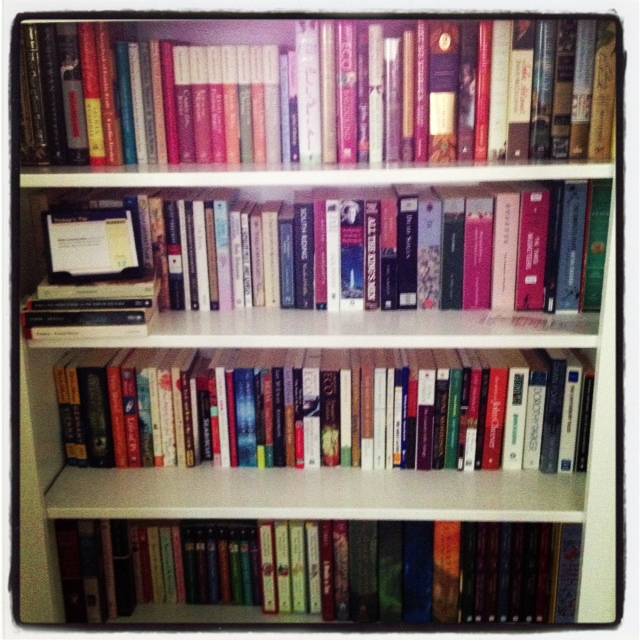
Hmmm.  Amidst a very intelligent, thought-provoking piece, this is probably the sentence that provoked the most thought from me.  I stopped gagging over Gilmour’s sexist philosophies and ran straight to my bookshelf to see what story it would tell, stopping only to snap two Instagram photos of my current shelves (I’m working with the built-ins in my current rental), exactly as they were in that moment, to force me to be honest with myself.  Observe:

Bookshelf 1

(Please ignore the baby toys.  They were just there.  They’re not part of this experiment.)

This is my “fancy bookshelf.”  Meaning: this is the shelf where I keep my prettiest hardcovers.  The forest-green leather Dickens; the complete works of Shakespeare, Austen, and two of the Brontes, and the hardcover classics from Barnes & Noble, Modern Library and Everyman’s Library.  (And a few well-loved mysteries.)  Most of this shelf is given over to English literature: the aforementioned Dickens, Austen, Shakespeare and Brontes, plus Winston Churchill, Sir Arthur Conan Doyle, and Agatha Christie.  But I’ve got some other stuff in there too: Americans (Edith Wharton, Herman Melville, Nathaniel Hawthorne…), Russians (Tolstoy, Dostoevsky) and some world lit, like Murasaki Shikibu’s The Tale of Genji (which I haven’t read, but am itching to – it’s long, and that’s all that’s delayed me) and Isak Dinesen’s Out of Africa and Seven Gothic Tales.

Bookshelf 2

Here’s the other built-in.  Comedy on the top left; children’s on the bottom; a mix of non-fiction, paperback classics and literary fiction.  A glance at the shelf reveals a mix of male and female authors (maybe a few more women than men, but I think pretty balanced overall) from the following locales (this is just a sampling):

  • England – Daphne du Maurier; Virginia Woolf; Ian McEwan; Anne Bronte; J.K. Rowling
  • The United States of America – Harper Lee; Dorothy Parker; Toni Morrison; Maya Angelou; Henry James (American-British); Maud Hart Lovelace; Madeleine L’Engle
  • Canada – Margaret Atwood; Yann Martel; L.M. Montgomery
  • Ireland – Edna O’Brien
  • Russia – Leo Tolstoy; Anton Chekhov; Nikolai Gogol; Mikhail Bulgakov
  • France – Collette; Alexandre Dumas
  • Italy – Umberto Eco
  • China – Dai Sijie (actually Chinese-French); Sun Tzu
  • India – Salman Rushdie (British-Indian)
  • Portugal – Jose Saramago
  • Czech – Franz Kafka
  • Brazil – Paolo Coelho

Okay, that’s just at a glance; I’m sure there are more nationalities and ethnicities represented, but I’m squeezing this post into naptime.  I learned two things from this quick exercise: (1) my reading tastes are pretty diverse, and (2) they could be more diverse.  I could do with more African literature (other than Isak Dinesen, who isn’t actually African although she lived in and loved Africa), more books about the African-American experience (I have that experience represented a little bit through Maya Angelou, who I’ve loved since high school, and Toni Morrison, who I have on my shelf but who’s still in the to-read pile), and more books from Asia, the Middle East, and Latin America.  I do tend to read a disproportionate number of American, Canadian, and European writers – as a British lit lover, I’ve always known I had that tendency.  But I’m quite proud that I’ve branched out beyond Austen and the Bronte sisters.  I can do better – we all can – but now I’m not worried that I’m only giving lip service to diversity in reading tastes while my bookshelf speaks otherwise.

I haven’t read any of David Gilmour’s work.  And I’m not saying I never will.  I’ll try to do what Margaret Atwood (a FEMALE, CANADIAN writer!) would advise, and separate the person from the literature.  (He’s not high on my to-read list, though; I have a lot of other books to get through before Gilmour would cycle to the top.)  But I’d encourage anyone who considers him- or herself to be an avid reader to take a look at your bookshelves, do a little soul-searching, and ask yourself: Am I open to new perspectives and experiences in my reading?  And whatever your response is, work on doing a little bit better… because while some of us (cough) can do a lot better, we can all do a little better.

Septemb-Eyre: Chapters XXX-End

jane_eyre_large

Rachel: I can’t believe you let me go on and on like that!
Phoebe: I’m sorry.  It was just so funny when you started comparing Jane Eyre to Robocop.

Heh.  I had to allow myself one last giggle.  Okay, straight to it, and as always, a warning: for those who have not read Jane Eyre and don’t want to know what happens, beware!  Major plot spoilers ahead – like, I’m going to spill the beans on the ending.

Synopsis

When we left Jane, she had been taken in, sick and starving, by the residents of Moor House, an isolated but welcoming place.  As she recovers her health, she gets to know the inhabitants – St. John Rivers, a clergyman, and his two sisters Diana and Mary – and the better she knows them, the more she likes them.  Diana and Mary soon regard her as a close friend and St. John is impressed enough with Jane’s various accomplishments that he offers her the position of mistress of the village school.  Jane accepts the job and begins her new post immediately.  At first, she doesn’t care for the work of teaching “rustics,” but she and her students soon develop a connection, and Jane is happy.

Jane’s mental quiet doesn’t last long, however.  A moment of thoughtless doodling on her part leads St. John to discover her real identity – which she has previously concealed – and he then drops a bombshell: Jane’s uncle in Madeira has died and left her his entire fortune, some twenty thousand pounds.  Oh, and more – St. John, Diana and Mary are her cousins, the other nieces and the nephew of the deceased uncle, who have been cut out of the will.  Jane’s sense of justice won’t allow her to inherit a fortune while her cousins receive nothing, so she persuades them to allow her to split the fortune into four equal parts – five thousand pounds for each of them.  (Still a lot of money, but not a crushing burden of wealth the way twenty thousand would have been.)  Jane then moves out of the school house and back to Moor House, where she is determined to have a nice vacation with Diana and Mary.  St. John, however, has other ideas.  (Evidently, vacations are sinful!)  Although he is in love with the local heiress Rosamond Oliver, he proposes to Jane, who in his view was built for labor, not love, and would therefore make an ideal missionary’s wife.

Jane’s passionate nature abhors the idea of marrying without love.  She offers to accompany St. John on his planned mission to India, but as his sister or curate – not his wife.  St. John refuses the offer and says she can only come with him as his wife.  Jane insists that she’d be happy to become a missionary, but that she cannot marry him.  St. John presses the issue and makes a bit of a pest of himself (in my opinion), but Jane is on the verge of yielding when she hears a voice calling out to her: “Jane!  Jane!  Jane!”  The voice… is Mr. Rochester’s.

Jane has tried to bury her feelings, but even so, she continues to feel anxiety over Mr. Rochester.  Has he succumbed to temptation and gone back to the Continent to drown his sorrows in mistresses, as she was afraid he would do?  Jane decides to go herself to Thornfield and make inquiries, since her letters have all gone unanswered.  Only when her mind is at ease concerning Mr. Rochester’s fate can she decide whether to marry St. John or not.  Jane rushes back to Thornfield, but… she finds it a ruin of ashes and stone.  The great hall has been destroyed in a fire, and the inhabitants are nowhere to be seen.  Jane hurries to the Rochester Arms inn and asks what happened.  The publican gives her the whole story, in which she herself plays a villain’s role, not realizing that it is “the midge of a governess” to whom he speaks.  The answer, then: crazy Bertha escaped her guardian, Grace Poole (who, it turns out, likes a sip of gin now and then) and set fire to the place, then threw herself off the roof.  No one else was killed, but Mr. Rochester – now a widower, incidentally, and eligible to remarry – lost a hand and one eye, and was blinded in the other eye.  He’s living at his damp and desolate hunting estate, Ferndean, with only two long-time family servants.

Jane rushes to Mr. Rochester’s side.  At first, she seems to have a hard time convincing him of her corporeality.  But he soon accepts that she’s real, she’s present, she’s not marrying St. John Rivers, and she wants nothing more than to become Mrs. Rochester after all.  And so, Reader, she marries him.  And, if you have any doubt in the happy ending: he gets his eyesight back, and a baby son into the bargain.  And they all live happily ever after.

Thoughts

If the last two sections of the book have been action-packed, this final section, until the very end, seems to slow back down to the pace of the childhood and school section in the very beginning.  Jane’s tenure at Moor House is probably my least favorite aspect of the book; it drags for me, just a little bit, and while I adore Diana and Mary, St. John is cruising for a bruising.  But it all comes out right in the end!  St. John goes off on his mission, without Jane, Diana and Mary get married and are loved and remain close to Jane all their lives, and Jane gets to be happy, finally, with Mr. Rochester.

It’s really only the end of the book where I think that Jane and Edward (I can use his first name now, because Jane can) have really found love with each other.  Before, as I’ve said, there’s a great deal of infatuation on Jane’s part, and Edward all but admits that he mostly wanted to marry Jane as a change from the crazy witch he’s been locked up with for fifteen years.  But when Jane returns to Edward, a rich and independent woman, and is in the position of choosing her role as his helper, and when Edward has had a taste of what it’s like to be the dependent one, they can actually love each other as equals for the first time – and they do.  Jane needs to taste independence before she can really love another person (more subversiveness!) and Mr. Rochester needs to come down a peg or two before he’s capable of knowing what he has.  In their case, absence certainly does make the heart grow stronger, and it puts them in a position of enjoying a marriage of equals, which is what they both need.

I’ve always said that Jane Eyre is my favorite book, but that it had been too long since I’d read it through.  Well, after reading it again with fresh eyes for Septemb-Eyre… it’s still my favorite book.  In fact, I love it more than ever.  I love Jane’s independence, her resolute determination to do the right thing not because society expects it of her, but because her own self-respect demands it.  I love Mr. Rochester’s flaws and his faults and the deep love he comes to feel for Jane.  I love kindly Mrs. Fairfax and effervescent Adele and the wonderful Diana and Mary Rivers.  I love all of these characters, and I love the setting – the brooding Thornfield Hall, with its split lightning-struck tree and its serene, otherworldly orchard where so much romance happens.  Yes, Jane Eyre is still my favorite book… and I won’t let so many years pass between this and the next re-read.

If you’ve been reading along with Septemb-Eyre, I hope you’ve enjoyed yourself as much as I have!  Kerry, thanks for hosting; this was a great way to spend my reading time this month.  I’m submitting this post as my “review” of Jane Eyre for the Classics Club.

Jane Eyre, by Charlotte Bronte; buy the book here (not an affiliate link) or support your local libraries and indie bookstores.

Peanut’s Picks: JANE EYRE

Peanuts Picks Lets Read

So, there are a lot of things that adults do that I don’t understand.  Like, for example, why does Mommy walk around all day drinking out of a cup and then when I try to share, she snatches it away and says, “No, honey, that’s too hot!” – what is that about?  If it’s too hot, then why are you drinking it?  And if it’s not too hot, then why aren’t you sharing?  Sharing is caring, remember?  I share with you every time I lick my hand and then wipe it on your face.  Would it kill you to practice what you preach?

Another thing I don’t understand: why does Daddy watch that show for hours every Sunday?  You know the one I mean?  The one where everyone is always running around on the striped grass and clunking heads and falling down?  And it lasts for, like, a month and a half?  I don’t get it.  (Mommy doesn’t get it either.)

But one thing that Mommy does that I do understand is reading books over and over again.  I always like to read my books over and over again.  Especially my favorites, like Tumble Bumble (I like the part about HOORAY!) and Bear Snores On (I like when the bear sneezes SPOILER ALERT).  I especially like it when Mommy lets me turn the pages.

Anyway, Mommy’s favorite book is Jane Eyre.  I know this because I have my own copy that we read ALL. THE. TIME.

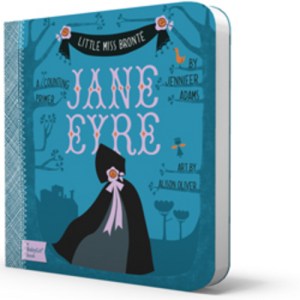
BabyLit Jane Eyre

This is a very interesting book.  It is about one governess (Jane) who has two trunks.  She lights three candles, which is dangerous.  (Mommy won’t explain why, though, because she says it would take too long.  Silly Mommy.  If it takes too long I’ll just cry or go to sleep on you, whatever.)  She lives in a place called Thornfield Hall, which has four towers.  I forget the rest.

storytime

This is me when I was little. LOOK AT ME READING.

Oh, right, and she teaches Adele with six chalkboards, which seems excessive to me.

Anyway, I really like this book because I like that there is a bird on every page and Mommy points to them for me and then I get to turn the pages, which is great.  But I noticed that my Jane Eyre book doesn’t look like Mommy’s Jane Eyre book.  Like, where are the bird pictures in Mommy’s book?  There are no pictures in Mommy’s book.  And she won’t let me turn the pages.  What gives?  Mommy says that we’re both reading Jane Eyre, but I think she’s just pretending.  LOL, Mommy pretending.

E Reading JE

Lesson for parents: My book is better than yours.

Mommy says that if you want to buy the book, you can get it here or support your local indie bookstore.  Also, make sure you get the one with pictures, because the other one is boooooooooooring.

Septemb-Eyre: Chapters XXII-XXIX

jane_eyre_large

I’ve been following along with others’ progress on Twitter and via other blogs, and it’s gotten harder and harder to keep mum about the big surprises in this book, especially because the more I read, the more I remember all the reasons why Jane Eyre is my all-time favorite book.  And this section reveals the biggest plot twist of all… so let’s get right to it.  (Warning, as always: spoilers ahead.  If you haven’t read Jane Eyre and don’t want to be exposed to major plot spoilers, come back on Wednesday for a non-Jane post.)

Synopsis

Jane stays at Gateshead for a month, first at the request of her cousin Georgiana, and then at the request of her cousin Eliza.  Once Eliza and Georgiana have both departed to their own futures, Jane is free to return to Thornfield and she does so, reflecting on the way that she has never had the experience of coming “home,” before, and she feels great joy at returning to Thornfield, even though it is not really her home, or it won’t be for long – since she remains committed to her plan of seeing Adele off to school and then departing herself for another situation as soon as Mr. Rochester marries Miss Ingram.

But maybe Thornfield is to be Jane’s home after all!  Shortly after her return, one evening, Mr. Rochester tracks her down in the orchard and professes his love for her.  This is one of my favorite scenes in the book – even knowing what’s to come – because it includes so many of my favorite quotes.  So many of Mr. Rochester’s smoldering, wildly romantic declarations, and so many of Jane’s spirited declarations of independence, even as all of her dreams are nearing fulfillment and she is finally allowed to believe that she may one day become Mrs. Rochester.

The next day, Mr. Rochester takes Jane shopping and attempts to shower her with jewels and expensive dresses, betraying that he doesn’t yet quite understand her personality.  Still, Jane’s happiness extends a full month, as the wedding preparations are made.  In that time, she endeavors to bind Mr. Rochester to herself – her real self – mainly by teasing him.  (It seems to work.)  Only one encounter mars her serenity: one night, shortly before the wedding, she awakens after two nightmares to find a ghoulish figure in her chamber.  The figure looms over her, leering, and rips Jane’s expensive wedding veil in two.  It is a figure Jane doesn’t recognize – it’s not anyone she has seen in Thornfield Hall before.  When she reports the incident to Mr. Rochester, he convinces her that the intruder was Grace Poole – despite Jane’s proclamation that it was a stranger – and that Jane’s vision of a large, ghoulish figure was actually the result of a nightmare assigning Grace features she doesn’t have.  Jane accepts Mr. Rochester’s explanation, but she is still uneasy and has a difficult time envisioning herself as “Jane Rochester.”

On the morning of the wedding, Mr. Rochester rushes everyone off to church and the ceremony begins amid inexplicable haste.  The hurry is soon explained, however, when two men stand up and declare an impediment to the marriage.  {Major plot spoiler!}  Mr. Rochester, it seems, is already married.  His wife, the sister of his “friend” Mr. Mason, is a lunatic that he has confined in his attic.  Mr. Rochester first attempts to deny his marriage, but in the face of proof, he concedes that, legally speaking, he is married.  The group returns to Thornfield, heads up to the attic, and confronts the monstrous Mrs. Rochester, who has been guarded all this time – although sometimes not very securely – by Grace Poole.  Mr. Rochester appeals to the pity of his witnesses, and admits that he wanted to marry Jane, mainly, as a change from the rage-fueled maniac the law considers his wife.

After processing the situation, Jane realizes that she must leave.  Mr. Rochester obtains one final conversation, in which he pleads with her to stay and live with him, or to live in one of his French villas, or anything other than leave him – but Jane is firm.  As much as she cares for Mr. Rochester, she cannot stay and be his mistress against the laws of the land, society, and her religion.  He points out that she has no friend or relation who will worry or feel offended if she chooses to follow her heart in defiance of the law – and then comes one of my favorite parts, and please excuse me for quoting it:

This was true: and while he spoke my very conscience and reason turned traitors against me, and charged me with crime in resisting him.  They spoke almost as loud as Feeling: and that clamoured wildly.  “Oh, comply!” it said.  “Think of his misery; think of his danger – look at his state when left alone; remember his headlong nature; consider the recklessness following on despair – soothe him; save him; love him; tell him you love him and will be his.  Who in the world cares for you? or who will be injured by what you do?”

Still indomitable was the reply – “I care for myself.  The more solitary, the more friendless, the more unsustained I am, the more I will respect myself.  I will keep the law given by God; sanctioned by man.  I will hold to the principles received by me when I was sane, and not mad – as I am now.  Laws and principles are not for the times when there was no temptation: they are for moments such as this, when body and soul rise in mutiny against their rigour; stringent are they; inviolate they shall be.  If at my individual convenience I might break them, what would be their worth?  They have a worth – so I have always believed; and if I cannot believe it now, it is because I am insane – quite insane; with my veins running fire, and my heart beating faster than I can count its throbs.  Preconceived opinions, foregone determinations, are all I have at this hour to stand by: there I plant my foot.”

In that moment, Jane makes the decision that even if no one else loves her, she loves herself enough not to enter into a relationship that would degrade her.  (Yeah, Jane!)  But she pays for that decision – because along with it comes her conviction that she has to leave Thornfield as soon as possible, before her will is tested beyond her capacity to resist.  She steals away in the night, spends all her money on a coach ride as far from Thornfield as she can get, and is reduced to begging for food.  Turned away everywhere, starving nearly to death, she finally collapses at the doorstep of a house, and the residents – St. John Rivers and his two sisters, Mary and Diana, take her in and nurse her back to health.

Thoughts Thus Far

Sorry for the long recap, but a lot happens in this installment!  First of all, the biggest surprise of the book: it turns out that Miss Ingram is the least of the obstacles to Jane’s happiness with Mr. Rochester, because the creep is already married!  Okay, when you hear his story, it’s easy enough to sympathize with him – forced into a marriage he doesn’t want, with a woman whose family manages to conceal their tendency toward mania, he at least tries to do something right after his wife goes off the deep end four years into their already-unhappy marriage.  Rather than abandoning Mrs. Rochester, or condemning her to death by dampness at one of his less-well-kept homes, Mr. Rochester keeps her alive and as safe as he can in his attic.  (LOLWUT?)  Of course, while Mrs. Rochester might be safe, no one else is while she’s under his roof – setting people’s beds on fire, biting and stabbing visitors (like her brother), and taking out her rage on helpless wedding vows.  So, yes, I do feel kind of sorry for Mr. Rochester.  But not so sorry that I would want Jane to stay with him in this situation.

What I really want to talk about, though, is the subversive nature of so many of Jane’s revelations in this section.  She’s already declared herself to be the equal to or the superior of Miss Ingram (and, of course, when it comes to matters of intellect and ethics, she’s completely correct on that point).  In accepting Mr. Rochester’s marriage proposal, she also bluntly tells him that she’s his equal – regardless of the difference in their “stations.”  (Mrs. Fairfax brings Jane back to earth with a thud when she reminds her that “Gentlemen of his station are not accustomed to marry their governesses.”)  It is Jane’s ambiguous class (educated, daughter of a clergyman, well-read and well-spoken, but still a governess and an economic dependent) that allows her to make these observations of the relative stature of classes, but it’s easy to see how this could have gone over like a lead balloon to certain elements of nineteenth-century British society.

Then, there’s Jane’s attitude toward God and religion, which is equally subversive.  For example, she refuses to disobey “God’s law” and become, in effect, Mr. Rochester’s mistress.  But she doesn’t come to this decision because she has any fear of society’s judgment, nor does she accept “God’s law” as infallible just because it is “God’s law.”  Rather, she observes the law because it is what her own self-respect requires of her – not out of any deference to the society that laid down the law.  And her position on houses of worship is no better: during her flight from Thornfield, Jane stops to ponder how much more spiritual she feels when surrounded by nature than in a traditional church setting (and, again, please pardon the quote, but it’s so good I have to show you):

We know that God is everywhere; but certainly we feel His presence most when His works are on the grandest scale spread before us; and it is in the unclouded night-sky, where His worlds wheel their silent course, that we read clearest His infinitude.

I can’t imagine that view was all too popular with the clergy back in 1847 either.

When I’ve read this book in the past, it’s always been for the romance.  Mr. Rochester’s smoldering gaze, his declarations of love for Jane (on this reading, I’m thinking that although she may be infatuated and he may be attracted to and entertained by her, neither of them has quite experienced real, lasting love yet), and the tragic obstacles that spring up between them – these were the things that stood out to me.  This time, it’s the subversiveness of the book: Jane’s quiet determination to act in accordance with her personal ethics, her refusal to enter into a relationship that compromises her self-respect, her disdain for her “social betters” if she they are not her intellectual or ethical equals.  I just keep coming across passage after passage like this, and remarking to myself, “No wonder this book upset so many people!”  I’ve always loved Jane for her spunk and determination, but it’s only on this re-read that I’m really reading slowly enough to ponder the social obstacles she faced or the potential costs to her in adhering to her personal ethics.  Her individualism and courage are what’s speaking to me this time, and I’m loving the book even more for it.

Are you reading along with Septemb-Eyre?  What did you think of this section?