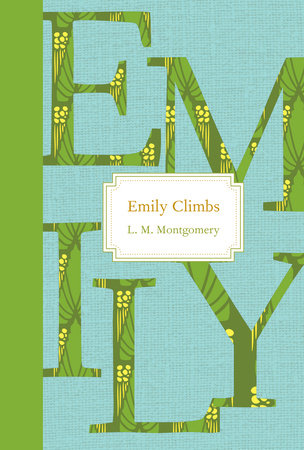
Emily of New Moon opened with its heroine having her life pulled up by the roots – and Emily Starr is a particularly rooted character, one who forms deep attachments to both the people she lives with or near, but also to the places she lives. When the trilogy begins, young Emily loses her beloved Father, and then her beloved home, in the span of just a few weeks. Suddenly orphaned, she is sent to live with her Aunt Elizabeth, Aunt Laura, and Cousin Jimmy at New Moon Farm – a place she’s never heard of, let alone seen.
Eventually Emily’s grief at her father’s death loses some of its sharp edge, life holds some interest again (or tang, as Emily might say) and she begins to fall in love with New Moon. She makes friends – wild Ilse Burnley, sweet Teddy Kent, and ambitious Perry Miller (oh, and that old creeper Dean Priest). She finds true sympathy in Cousin Jimmy and steadfast love in all the older residents of New Moon, and she begins to make the region of Blair Water her new home, granting picturesque names – just as her literary sister Anne would – to the landmarks around the farm.
Emily Climbs sees Emily on the move again, this time to attend Shrewsbury High School and board with her horrid (well, maybe…) Aunt Ruth. Unlike her first move, this time, Emily does truly want to go. She desperately craves an education, which she hopes will equip her for her life’s goal of climbing “the Alpine Path” and writing at its summit “a woman’s humble name.” And her friends are going – Ilse, Teddy and Perry have all found their ways of getting to Shrewsbury High School. Aunt Elizabeth, who initially refuses Emily’s plea, eventually relents (after extracting a promise from Emily that she will not write any fiction during her three years in Shrewsbury) and Emily is off. But Emily discovers that even a move you wanted can mean homesickness.
“This room is unfriendly–it doesn’t want me–I can never feel at home here,” said Emily.
She was horribly homesick. She wanted the New Moon candle-lights shining out on the birch trees–the scent of hop-vines in the dew–her purring pussy cats–her own dear room, full of dreams–the silences and shadows of the old garden–the grand anthems of wind and billow in the gulf–the sonorous old music she missed so much in this inland silence. She missed even the little graveyard where slept the New Moon dead.
“I’m not going to cry.” Emily clenched her hands. “Aunt Ruth will laugh at me. There’s nothing in this room I can ever love. Is there anything out of it?”
She pushed up the window. It looked south into the fir grove and its balsam blew into her like a caress. To the left there was an opening in the trees like a green, arched window, and one saw an enchanting little moonlit landscape through it. And it would let in the splendour of sunset. To the right was a view of the hillside along which West Shrewsbury struggled: the hill was dotted with lights in the autumn dusk, and had a fairy-like loveliness. Somewhere near by there was a drowsy twittering, as of little, sleepy birds swinging on a shadowy bough.
“Oh, this is beautiful,” breathed Emily, bending out to drink in the balsam-scented air. “Father told me once that one could find something beautiful to love everywhere. I’ll love this.”
I’ll love this. Emily forms one of her deep connections to the fir grove, which she names the “Land of Uprightness,” and where she goes to walk, study, dream and write for the next three years. (Aunt Ruth cannot understand this at all, and is convinced that Emily must be up to something devious.)

I’ll love this. Like Emily, I have moved a fair amount. Some of the moves – like my most recent move home to northern Virginia – have been joyously welcomed. Others, like our purchase of a house in Elma, New York, back in 2014, brought a sense of relief and hopefulness. Still others, like the original move to Buffalo – I was dragged kicking and screaming, more or less. But everywhere I’ve lived, starting from when I first read Emily Climbs and took Douglas Starr’s advice into my heart just as his daughter did – my first order of business has been to find something to love, and then to exhale and say, just as Emily did, I’ll love this.
I have loved outdoor places – like the windswept vista, above, that was the view from my living room in Elma. Or the little, fussy, landscaped garden behind my rental house in Buffalo. I’d have preferred a small yard – there was no green space appropriate for Peanut to play in, so we had to walk to a nearby park to get her antsies out – but I spent many an evening sitting on the back porch, sipping tea and watching the shadows play in the corners of that pocket-sized garden.
I have loved indoor places – the white built-in bookshelves in Buffalo, which I filled with all my friends… the dreamy kitchens in Mount Vernon and in Elma, where I cooked and baked to my heart’s content… the nursery corners in multiple houses in multiple states, where I rocked my babies to sleep more times than I can count.
Only once did I never find anything to love – unless you count the aforementioned rocking chair corner. From January to July of 2016, we lived in a non-descript townhouse in an apartment complex in Williamsville, while we worked out the details, planned and carried out our move back to northern Virginia. I couldn’t love anything there – not the miniscule kitchen, not the strange floor plan, not the way our furniture jutted out at odd angles all over the apartment, not the early-90s fixtures, not the bland view from the back deck. It was the first place I’d ever lived where I was unable to find anything about which to say I’ll love this. Still I had dreams of making the place a home, filling it with laughter and memories during the short time we lived there – but in the end, it was just a waypoint. Even with the great relief that I felt to leave the place for the last time, I turned on my way out the door and said a silent thank you to the apartment for sheltering my family and keeping the rain off our heads while we figured out what our future held.
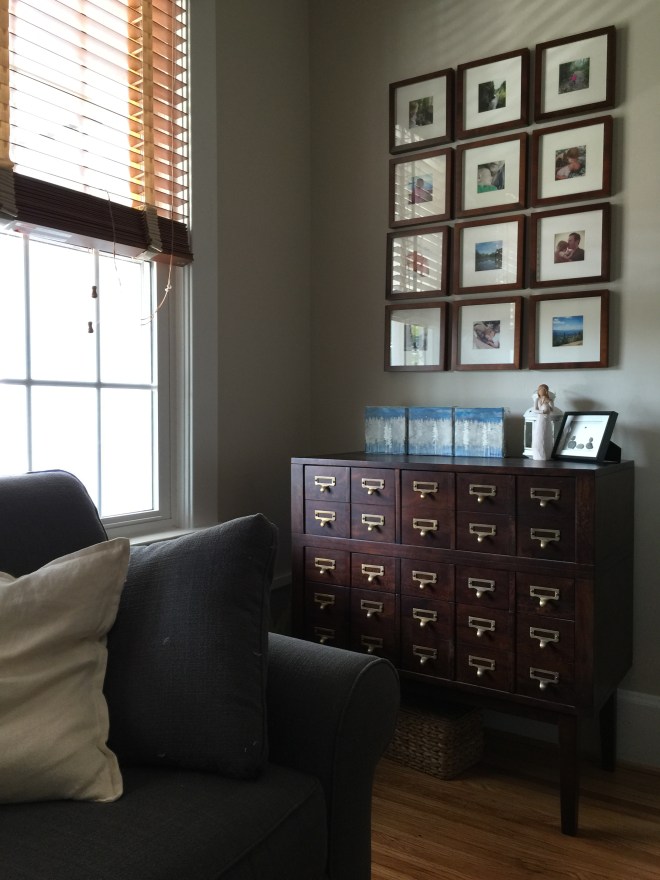
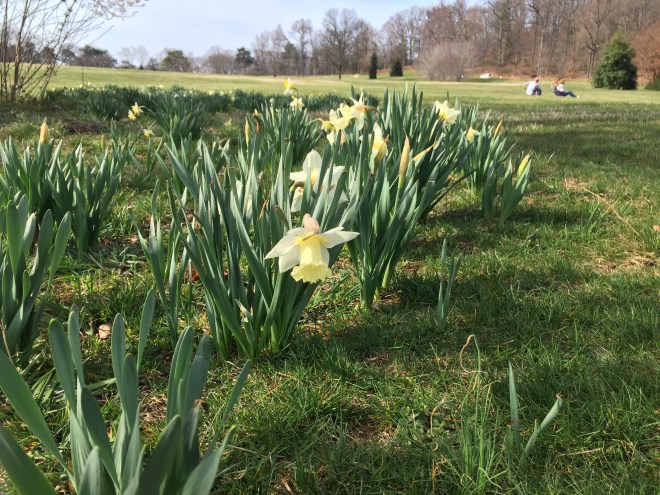
Now I’m in another rental, but one that couldn’t be more different. This place, too, is just a waypoint – although we will stop here longer, a few years at least – before we move (what I hope will be) one final time, to our forever house. But there is so much I can love here. I love the little white flowers that I saw peeking up at me from the slope of our tiny front lawn just this week… I love the breezy white kitchen, where I pack lunches, scramble eggs, make tea, jump out of the path of a careening giraffe scooter… I love the little corner in the living room, where I have set up my console table and arranged my favorite family photos in a grid on the wall above… I love our alley, and I love wondering about the lives being lived behind each of the friendly lighted windows… I love the twinkling lights in the trees, which I can just see over the top of a row of houses. I’m not sure that Emily would feel quite at home in my urban environment, but I do know that she would find things to love about this house.
I’ll love this. There are many scenes in the Emily trilogy, which made great impressions on me as a child – but none quite as much as Emily’s first disappointed look around her room in Shrewsbury, her squaring her shoulders, turning to the window and saying those three words in Emily Climbs. If you were to ask me, as a young reader, to describe one scene from the Emily books – the one scene that was most memorable, most important – I’d have described that, and I’d have quoted you Emily’s decision that “I’ll love this.” I had no idea how important those three small words would be over the years – how important they still are – but even as a young reader who had never moved (when I first read Emily Climbs, I was still living in the charming little house my parents owned when I was born) something in my heart extended to Emily in that scene, more than any other, and said, “Oh, yes, I recognize you. I also need something to love.”
This post is my contribution to Naomi‘s #ReadingEmily readalong. For more thoughts on Emily Climbs, check out the #ReadingEmily hashtag on Twitter.





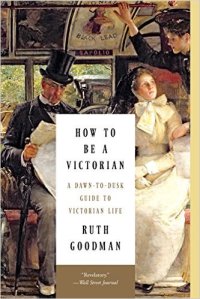
 How to Be A Victorian, by Ruth Goodman – I’ve been feeling more sparks of interest in the Victorians than I usually do, and this fascinating and fun non-fiction look into a Victorian day definitely hit the spot. I love histories that focus on the quotidian, like Jane Austen’s England or The Time Traveler’s Guide to Medieval England, and this was a good example. Starting with rising from bed and working all the way through every ritual of the day, Goodman gives attention to every social class and walk of life, and leaves no large issue or trivial matter undiscussed. History nerds, don’t miss this one.
 Code Talker: The First and Only Memoir of One of the Original Code Talkers of WWII, by Chester Nez – Another historical non-fiction pick. I’ve been fascinated by the Navajo Code Talkers and their role in winning World War II for a long time, and even more so after visiting the International Spy Museum and hearing the code for myself. It’s such a fascinating, thrilling story and I loved reading Nez’s life story and about his war experiences. I was amazed at how readily he and the other Code Talkers volunteered, and how deeply they cherished their country, even after the U.S. government had put them and their families through terrible tragedies. (Nez witnessed the massacring of his family’s livestock, which wiped out generations of wealth and became one of the great tragedies of the Navajo people.) Truly, they are American heroes.
 The Hopefuls, by Jennifer Close – It’s 2009, Barack Obama has just become President of the United States, and Beth has just moved to Washington, D.C. from New York with her husband Matt, a native Marylander who has taken a job in the White House Counsel’s office. Beth struggles to find her way inside the Beltway but feels a fish out of water – until she and Matt meet Jimmy and Ashleigh. Jimmy works for the White House, too, and Ashleigh and Beth become fast friends. But as Jimmy rises through the political ranks, jealousies threaten the friendship in several ways. So – I liked this. One of my pet peeves is D.C. novels that get D.C. details wrong – this didn’t do that. You can tell that the author lives in D.C. and actually knows the city. (In fact, she teaches writing at GW, where I went to law school.) But the characters sort of frustrated me. Jimmy seemed like a slimeball, Matt got obsessed with work (and a little bit with Jimmy), and Beth just seemed very passive. I felt sorriest for Ashleigh. I could tell (spoiler alert) that something was going to happen between Jimmy and Beth when the author started painting Ashleigh as an insipid gossip, which seemed clearly designed to turn the reader to Beth’s side. That line doesn’t really work on me; I just ended the book feeling that Ashleigh was the only adult in the room – and that certainly wasn’t how I started it.
 American Born Chinese, by Gene Luen Yang – After reading Yang’s Boxers and Saints duology, and loving it, I was very interested to pick up more of his work. American Born Chinese follows three characters – the Monkey King, Jin, and Danny – until their stories intersect in a bit of magical realism… or maybe just magic. It was a fun and quick read, and I can imagine that Yang’s work must mean a lot to young readers from Asian-American families, looking for representation in literature and graphic novels.
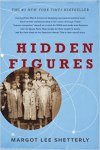 Hidden Figures, by Margot Lee Shetterly – Until Hidden Figures came out, I, like most people – I believe – had never heard the story of the black women who worked as “computers” at NASA’s Langley facility, or of their amazing contributions to the World War II victory and to the fledgling space program. It was a fascinating history of a group of unsung heroes – heroines, as a matter of fact – and their fights to be recognized as equals in the workplace, to be given the proper accolades for their work, and to advance on the career ladder as white men simply expected to do. It was wonderful, I loved every second, and now I want to see the movie.
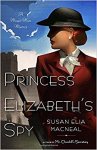 Princess Elizabeth’s Spy (Maggie Hope #2), by Susan Elia MacNeal – Maggie Hope, erstwhile secretary to Mr. Churchill, has basically flunked out of spy school because she’s physically wimpy. Not to worry, because MI-5 has a special job for her (which won’t require her to run or jump over fences or climb walls). Maggie is placed at Windsor Castle where she is posing as maths tutor to young Princess Elizabeth, after the spy agency receives intelligence that she might be the target of a kidnapping plot. I am really enjoying this series and watching Maggie grow in her skills and confidence.
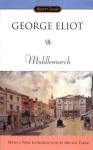 Middlemarch, by George Eliot – I have been listening to the audiobook version of Middlemarch, on and off, since last summer – and I finally finished it! I read the print version a few years ago and was blown away by George Eliot’s intricate world and her breathing characters, and all that shines through on audio as well – thanks in no small part to Juliet Stevenson’s perfect narration. Stevenson really amplified all the best things about the book; I found Mr Brooke a comic delight, Mary Garth an absolute joy, Dorothea a heroine, and Celia surprisingly funny. At 35 hours, the audiobook was a major commitment, but as with the print version I found I sunk into it and looked forward to my listening sessions as a return to what is now a beloved place.
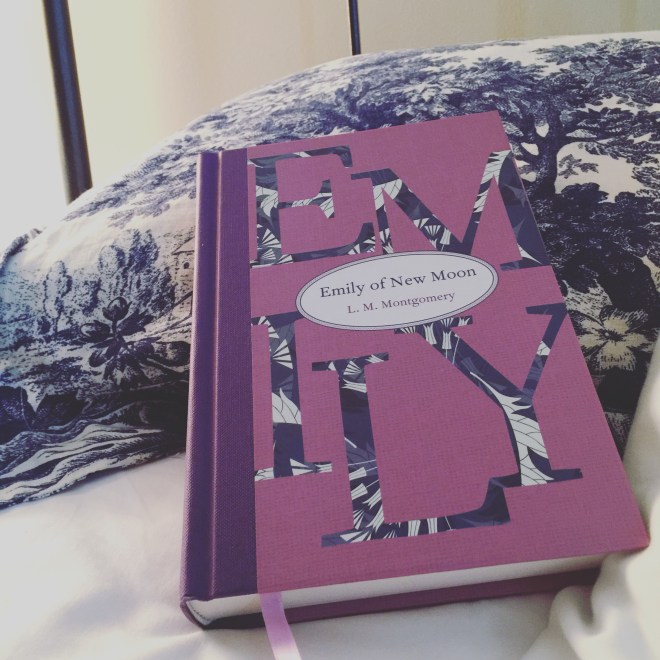
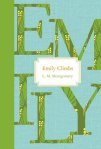 Emily Climbs (Emily #2), by L.M. Montgomery – I’m still loving contributing to the #ReadingEmily hashtag on Twitter, and reading several new blogs I’ve found through the best readalong ever (thanks again,
  Chronicle of a Death Foretold, by Gabriel Garcia Marquez – I picked this very slim volume up for the Book Riot Challenge of 2017 (read a book with a Central or South American setting, by a Central or South American author) and I found it engaging and well-written, but not quite up to the standard of One Hundred Years of Solitude. It probably still isn’t, but I revised my opinion when I read some critical commentary suggesting that it was an allegory of Jesus and the Passion – I’m a bit dense about religious themes in literature; I can follow them if someone tells me they’re there, but I rarely spot them myself – and after I discovered that, I appreciated the story much more. At only 120 pages, it’s a very short time commitment and definitely worth the read.
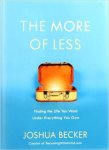 The More of Less, by Joshua Becker – As part of my ongoing effort to right-size my life (a very slow process indeed) I have been seeking out writings from self-identified minimalists, and Becker is a great example. I read his book, Simplify, to start off the year, and have made my way through his blog archives. The More of Less, I listened to on audio, read by the author, and I found it useful and enjoyable. Becker shares more practical tips than he does in Simplify or on his blog, and I found the book to be a good mix of those tips, more general inspiration, and Becker’s own minimalist story. I think I’m going to have to chart my own minimalist path, but I do like Becker’s laid-back approach and his realistic acknowledgement of the challenges of being a minimalist with kids in the house.







 covered in flour