2018: A Year In Books, Part II — Top Ten

This is always one of the most challenging posts to write – how do I narrow an entire year’s worth of reading down to just ten highlights?  Every year, there are a select few that I know – even at the time of reading – are going to be on the list, but beyond those standouts, I read so many good books, that it’s almost impossible to choose just ten favorites.  But because I love you guys, I buckle down and get it done.  So, here, in no particular order, is the list of my top ten books of 2018:
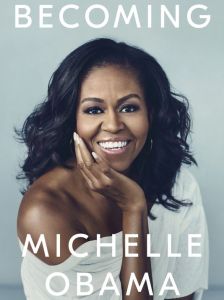
Becoming, by Michelle Obama – Somehow, I knew this one would make my top ten list, even before I read it.  Michelle Obama’s writing is so evocative that I could feel the hot Chicago sun as she wandered down the sidewalks eating ice cream on one of her first dates with Barack and the oppressive silence inside the walls of the White House.  I was completely swept away and loved every moment.

Period Piece, by Gwen Raverat – I’ve long had a soft spot for Victorian childhood literature, and Raverat’s memoir is one of the best.  Raverat grew up as Gwen Darwin, granddaughter of the legendary Charles, and spent her childhood knocking about Cambridge and the Darwin family estates.  Her beautifully-written memoir would be a treat in and of itself, but it’s delightfully illustrated with Raverat’s own work – she grew up to become a renowned woodcut artist and one of the first women to make a living as a professional book illustrator.
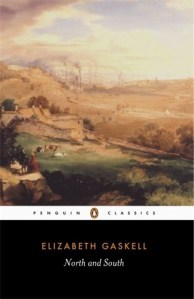
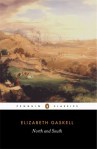
North and South, by Elizabeth Gaskell – I’ve been meaning to read this classic for a long time, and I ended up reading it in the early days of grieving for a close family member who had loved it.  Sad as I was while reading, I loved it too.  Gaskell’s classic story of love and labor unrest will be an enduring favorite – I can already tell.

Space Opera, by Catherynne M. Valente – Valente’s books are unlike anything else I’ve read, and Space Opera was no exception.  The story of a washed-up glam rocker who finds himself drafted into an intergalactic battle of the bands with the fate of humanity hanging in the balance was so much fun.  (Also: Chapter 29!  If you’ve read it, you’ll understand.)
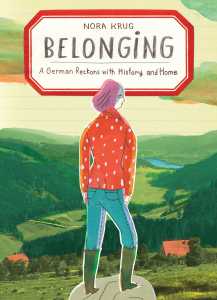
Belonging: A German Reckons with History and Home, by Nora Krug – This was another one that I knew would be in my top ten as I was reading it.  Krug compiles a family history that is part scrapbook, part graphic memoir, and completely fascinating, as she unpacks her grandparents’ role – or not – in World War II.
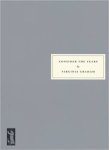
Consider the Years, by Virginia Graham – I really loved this equal parts poignant and funny collection of poetry from the World War II era and immediately after.  It was a slim little volume, but utterly lovely.
The Blue Field, by John Moore – I enjoyed every volume of the Brensham Trilogy (published in sweet little clothbound hardback limited editions by Slightly Foxed) but the third and final installment was my favorite.  Moore’s whimsical and evocative portrayal of the quirky little village of Brensham really hits its stride in this last volume – I felt like I knew these people.  Most of the book was uproariously funny – but oh, the fox-hunting scene.  SOB.
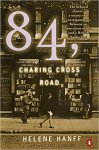
84, Charing Cross Road, by Helene Hanff – People have been urging me to read this for years, and I finally got around to it in 2018, and about time!  The correspondence between Hanff and the London booksellers who keep her in used books is such a treasure.  It starts out strictly business, but Hanff’s enthusiasm for her purchases soon wears down the British reserve of her correspondents across the ocean, and watching their friendship blossom is a total joy.
Northanger Abbey, by Jane Austen – My conscience is pricking me a little bit, because Northanger Abbey was a re-read, not for the first time, and has probably even been on one of my top ten lists before.  But I decided that I don’t care, because it’s one of my favorite books and it was one of the ten best reads of the year – as usual.  Any time spent with Catherine Morland and Henry and Eleanor Tilney is time well spent.

A Country Doctor’s Commonplace Book, by Philip Rhys Evans – My last read of the year was also one of the best.  I found A Country Doctor’s Commonplace Book – a collection of funny, interesting or amusing tidbits that the author has collected over the years – under the Christmas tree and read it in one day, laughing my face off the whole time.  The snippets of hilariously misspelled or badly written parish announcements was my favorite part, but really, it was all great.

I did it!  Somehow I’ve managed to narrow a year’s worth of excellent reading down into ten favorites.  2018 was an immensely satisfying year in books, as you can see.  Next week: my book superlatives, and then onward to more great reads in 2019!
2018: A Year In Books, Part I — By The Numbers

I always seem to be running behind in January – this is where my Monday, Wednesday, Friday posting schedule really makes things challenging.  But I’m not willing to give up any of my New Year’s content, so here I am in the middle of January just getting ready to start my three-part 2018 reading retrospective.  These are some of my favorite posts to write.  I love looking back on the year in books, thinking about the things I read, and wondering what’s ahead of me.

Enough prelude – here’s my 2018 in books, by the numbers.

30,000 Foot View

According to my reading trackers, I read 113 books in 2018, for a total of 29,844 pages.  Considering I was hoping to read fewer books last year – I’d set a goal of 52 books, in hopes of getting to some of the dense or long classics I’ve been wanting to read – 2018 didn’t exactly go according to plan.


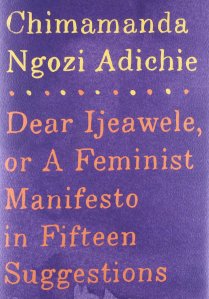
The longest book I read in 2018 was Angle of Repose, by Wallace Stegner, which clocked in at 569 pages.  (That’s a light one for me.  I usually have at least one 800+ page chunkster.)  The shortest book was Dear Ijeawele, or A Feminist Manifesto in Fifteen Suggestions, by Chimamanda Ngozi Adichie, at a slim 63 pages – but what a punch those 63 pages packed.

Who Gets The Big Piece?

Pie chart time!  Please bear with me.  I love geeking out about my past year in reading, and making pie charts is the geekiest geeking out I can think of to do.

Fiction/Nonfiction

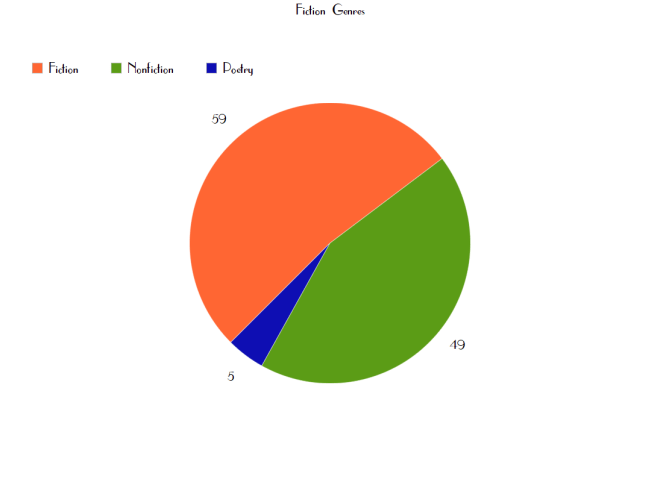
Starting with the simplest chart: in 2018, out of 113 books read – 59 were fiction, 49 were nonfiction, and five were poetry.  I don’t have too much to say about this chart, except that I apparently read a lot of nonfiction this year.  I enjoy well-written nonfiction, but I’m usually much more of a fiction reader, so I was a little surprised to see how close they were to even this year.  (I suspect that 2019 will be a reversion to my usual splits, and next year’s pie chart in this category will be a lot more lopsided towards fiction.  It’s just what I’m craving at the moment and I don’t anticipate that changing much.)  Also – five books of poetry, who dis?


Format

This one was less of a surprise: my reading was heavily weighted toward physical books this year.  I like my kindle, but I just don’t reach for it all that much, and I almost never read on my phone – it gives me terrible headaches.  This chart would be even more heavily weighted toward physical books if I hadn’t broken out journals and graphic novels, all of which were physical bound volumes as well.  Finally, only two audiobooks – I guess I was really more into podcasts this year.  That will probably change in 2019, because I’m going to have to drive to work when the metro closes down for several months this summer, and I predict several audiobooks during that time.


Source of Book

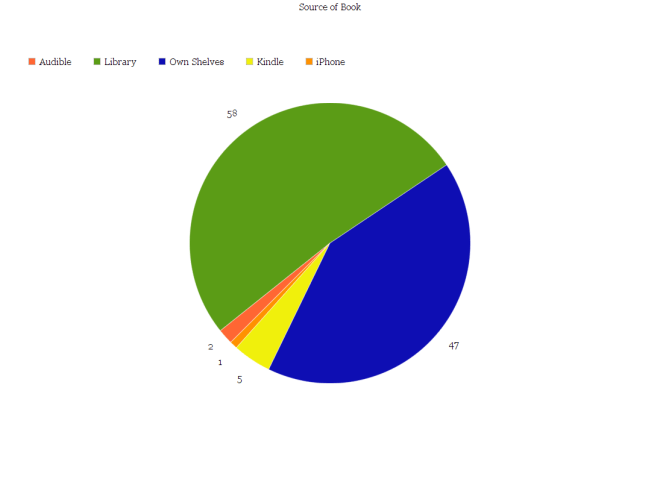
Here’s another one that surprised me with how even it was.  In 2018, apparently, I read 58 books from the library and 47 from my own shelves (and a handful of others that I sourced from Audible, kindle, and one lonely iPhone app book – which I believe was poetry, so I could dip in and out of it and not have to stare at the phone for long periods of time).  I’m normally a very heavy library user, so it is quite surprising – and gratifying – to discover just how much I read from my own shelves in 2018.


Fiction Genres

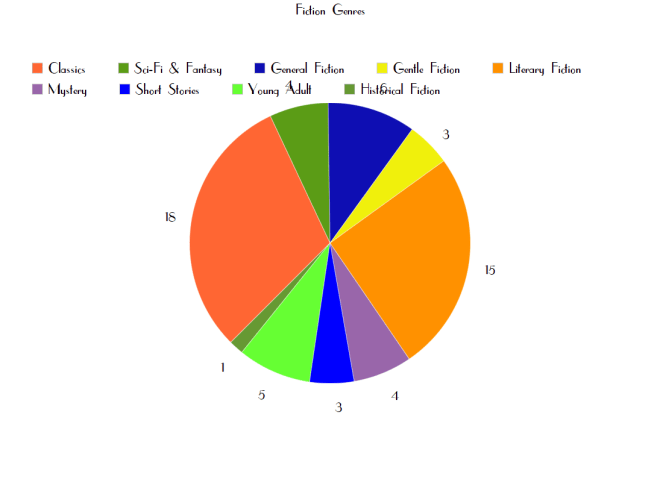
Always a busy chart!  I read a lot of different fiction genres this year, as usual.  And as usual, my heaviest categories are classics (my favorite) and literary fiction.  For good measure, I tossed in some gentle fiction, some general fiction, a few mysteries, some short stories and YA, some science fiction and fantasy, and one lonely historical fiction book.  (I’m always shocked at how small the historical fiction category is.  I think the explanation is that I read a lot of books set in the past, but most fit into another genre or category, and I always seem to lump them in the other genre.  There are very few pure historical fiction genre books in my reading in a given year.)

Nonfiction Genres

Another wide-ranging category.  I read some great nonfiction this year!  As usual, memoir was my biggest category, but I’m gratified to see books about books in second place!  I also read a lot of essays this year, it appears, and quite a few books about history and current events – not surprising, given how crazy the world is right now.  Next year I’d love to see the nature category grow – I really enjoy nature writing, and I would like to read more of it.

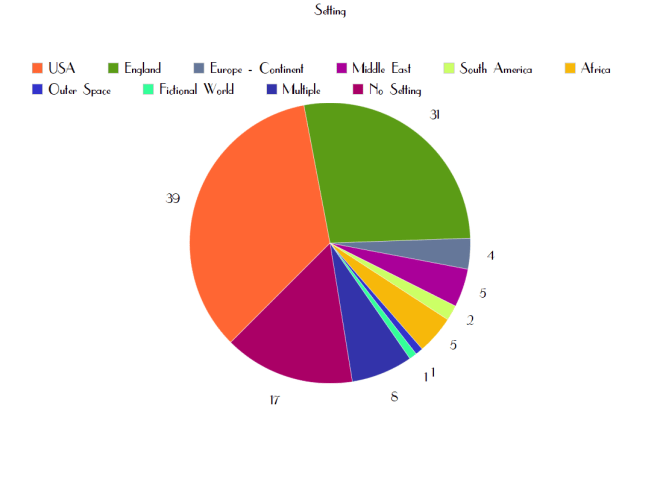
Settings

This chart looks pretty typical for me.  Every year, the USA and England are fighting it out for top billing on my settings chart – this year, the USA won, but England was a fairly close second.  Everything else is way behind, but I did range over a fairly wide swath of territory in my reading this year – all over Africa (I read books set in South Africa, Egypt, Rwanda, Nigeria and a collection of short stories with writers hailing from all over the continent), some in South America, some in the Middle East, some fictional words and – again – one lone book set in outer space.  (That would be Space Opera, by Catherynne M. Valente, which will be on my top ten list on Friday – spoiler!  I considered putting Rocket Men in the outer space category too, since part of the book does take place on Gemini and Apollo spacecraft, but since most of the action takes place in the United States, it’s in the USA slice of the pie.)

Sex of Author

As usual, I read mostly women – 70 women, compared with 33 men.  And you know what?  I’m A-Okay with that and 100% plan to keep it up.  (The third category is “various authors,” and comprised mostly of Slightly Foxed quarterlies, plus a couple of short story collections to which both men and women contributed.)

Diversity

For the third year in a row, I tracked diversity in my books.  Ever year, I am looking for 33% or more of my books to come from diverse or underrepresented groups or “own voices.”  This year I read 41 diverse books out of a total of 113 – so I squeaked past my goal with 36% diverse books.  Not quite as good as last year, but a decent effort.  It’s become second nature to me, after three years of tracking diversity in my reading, to seek out books by people of color, disabled people, religious minorities, and LGBTQ+ authors, and I am so glad I have taken this effort on.  I’m actually not going to track diversity in 2019, because I want to just drift through my shelves and read whatever looks good in the moment without worrying about totals of any kind.  But I suspect that my reading will still be fairly diverse, because I’ve grown so used to seeking those voices out.

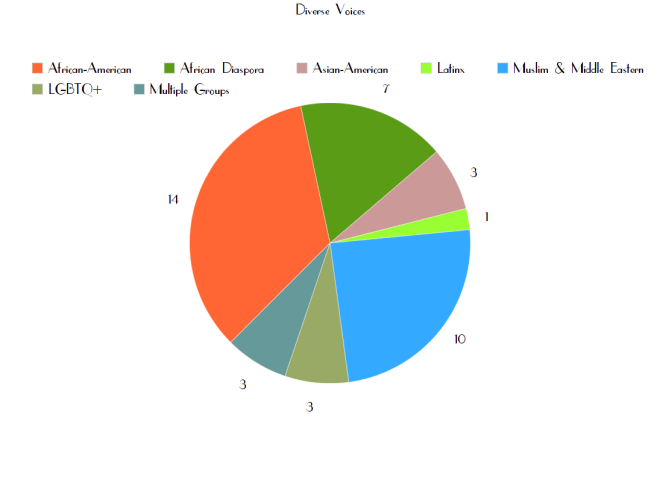
Diverse Groups

As usual, out of the diverse books I read, the majority were by African-American authors, with a large chunk that I’ve called “African Disapora” – meaning, people of African descent living elsewhere in the world, whether in African countries, in Europe, etc.  Those seem to be the voices I gravitate to the most.  A few other observations: I didn’t read any books by Native Americans or First Nations authors this year, which is disappointing.  And the LGBTQ+ category is bigger than it appears, since quite a few of the books in the “multiple” category are books in which either the author is both LGBTQ+ and a person of color, or they are collections of essays or short stories with authors from all different groups, including LGBTQ+ people.  I always pay attention to that community, because it’s really important to me to be a good ally – I want to be a good ally to everyone, of course, but I have a lot of friends in the LGBTQ+ community and I try extremely hard to support them.

There we have it!  A darn decent year of reading, if I do say so myself – even if I failed miserably in my attempt to read fewer books in 2018.  We all knew that was a pipe dream, didn’t we?  Coming up on Friday, my top ten books of 2018.  It’s going to be hard to choose, because I read so many good ones last year!

How did you do on your reading goals in 2018?

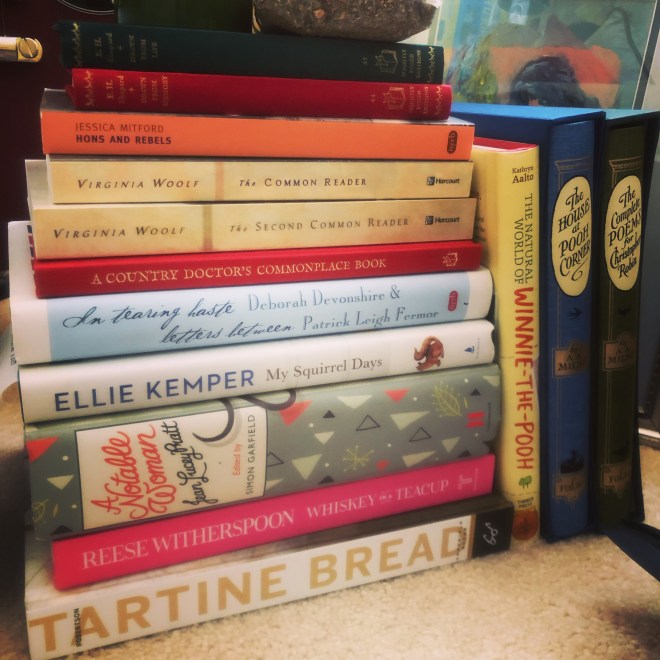
My 2018 Christmas Book Stack

I know, I know, I haven’t recapped the actual holiday yet – next week!  But what I really want to show you is the stack of books I unwrapped on Christmas morning – because, to be honest, that’s always what I want to know about other people’s holidays: what books did you get?  Isn’t that terrible of me?  Oh, well.  Here’s what I received…

From Steve:

  • Drawn From Memory and Drawn From Life, both by E.H. Shepard and Slightly Foxed Editions No. 44 and 45.  I thought I had all the SFEs I wanted, then they rolled out two new releases I simply had to add to my collection, just in time for Santa to swing by Hoxbury Square, London, and toss them in the sleigh.  For those of you scratching your heads over E.H. Shepard’s familiar name – he’s the illustrator behind the classic depictions of Winnie-the-Pooh.
  • The House at Pooh Corner and The Complete Poems for Christopher Robin, both by A. A. Milne, in gorgeous Folio Society editions.  I’ve already got Winnie-the-Pooh in the same edition and these are going to be a beautiful addition to my children’s classics shelf.
  • Hons and Rebels, by Jessica Mitford.  Santa was shopping my Amazon wish list!  It was funny, because I had just discussed Hons and Rebels with my friend Susan over lunch, not two weeks before Christmas, and she was telling me how wonderful it is.  It was probably already winging its way to Steve for wrapping by then!
  • The Common Reader and The Second Common Reader, by Virginia Woolf.  Woolf isn’t normally my cup of tea, try as I do to like her experimental style.  But these books of her essays about authors, reading, and books sound great, and I added them to the Amazon wish list just in time for Santa’s snooping.
  • A Country Doctor’s Commonplace Book, by Philip Rhys Evans.  My first reaction to seeing this in the Slightly Foxed catalogue was a decided “meh,” but then I read the delightful and hilarious snippets and snatches that formed the little book’s preview, and I was completely charmed.  I look forward to laughing over this book in the very near future.
  • In Tearing Haste: Letters Between Deborah Devonshire and Patrick Leigh Fermor.  It’s a very Mitford Christmas for me, apparently – I have been reading Nancy’s Christmas Pudding, received Jessica’s memoir (above) and will also get to peek into Debo’s correspondence.  I find the Mitfords absolutely fascinating, and Patrick Leigh Fermor is an illustrious figure in his own right, of course, so I can’t wait to tear through this.
  • A Notable Woman: The Romantic Journals of Jean Lucey Pratt.  I’ve got a weakness for diaries and primary source materials that breathe life into different eras – an ongoing obsession since I first pulled L. M. Montgomery’s five volumes of diaries off my grandmother’s bookshelf and curled up with them in her overstuffed armchair, many years ago.  These were another Amazon wish list item, and I’ve been not-so-secretly admiring them over on Jennifer’s blog and Instagram.  I’m excited.
  • Tartine Bread.  I always tease Steve that his cookbook gifts are half self-serving – because while I’ve been wanting Tartine Bread for years, and especially lately since I finally learned how to bake bread somewhat reliably for myself, let’s be honest: he’ll be the one eating most of the results.  But y’all?  I’m going to enjoy this book.

From my mom:

  • Whiskey in a Teacup, by Reese Witherspoon.  I probably wouldn’t have bought this for myself, but I’m sure excited to have it – so thanks, Mom!  My BFF Rebecca really enjoyed it and kept texting me snippets of Lady Reese’s wisdom – especially the part about how children belong at weddings.  (Longtime readers may recall that Peanut was Rebecca’s flower girl last year, and Nugget rocked the cutest gingham bow tie at her wedding.)
  • My Squirrel Days, by Ellie Kemper.  My mom has a tradition of giving me a comedienne’s memoir every Christmas.  I’ve received books by Mindy Kaling, Amy Poehler, and Lauren Graham – and Ellie is this year’s addition.  I love these smart, hilarious women’s voices and I’m sure I’m going to enjoy this.  And when I’m done, Ellie can keep company with her Office co-star Mindy, and the other funny ladies, on my nonfiction shelf.

From my brother:

  • The Natural World of Winnie-the-Pooh, by Kathryn Aalto.  It was a very Hundred Acre Wood Christmas for me, huh?  I actually already owned this one, so I’ll probably exchange it for something I don’t have yet.  But it’s delightful – my brother and sister-in-love clearly know what I like.

There it is – quite a respectable book haul!  Books were really all that I wanted this year, so I was happy to find so many of them under the tree.  And I foresee some really excellent reading this winter…

If you were celebrating a holiday this December, did you receive any books?  Do share!

Top Ten Books of 2018 (So Far)

Well, it’s only August!  The summer is flying by – as usual – and it just occurred to me that I haven’t done a “top ten books of the year so far” post.  I’ve been seeing similar posts pop up on other blogs over the past few weeks, so maybe we’re all running late?  In any event, completely unscientifically and vaguely in chronological order, here are my ten favorite books read in the first – errrrr – seven months of the year.

Period Piece: A Cambridge Childhood, by Gwen Raverat – Steve and the kids gave me an absolutely gorgeous edition of Period Piece for my birthday in 2017, and it was a lovely reading experience to start off the year.  Raverat grew up as Gwen Darwin, granddaughter of Charles, in Victorian Cambridge, before becoming an woodcut illustrator and marrying Jacques Raverat, himself a well-known artist.  Raverat is one of the first professional female artists to gain reknown, and Period Piece, her charming memoir of her childhood, is illustrated with her own work.  I love woodcut illustration, and I love Victorian childhood lit, so basically I was here for all of it.

Consider the Years, by Virginia Graham – Graham was a genteel, upper-class lady, married and moving in the best social circles, when the world came crashing down in the form of the Blitz.  Consider the Years is her collection of poetry from the beginning of World War II to just after the war’s end.  It’s beautiful, sad, sometimes funny (oh, Nanny!) and altogether wonderful.

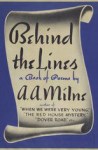
Behind the Lines, by A.A. Milne – Somehow, despite reading his Winnie-the-Pooh books more times than I can count, and despite being well aware that Milne also wrote many books for adults, I’d never read any of his work not set in the Hundred Acre Wood.  That is – until I saw Behind the Lines on another book blog and scrambled to obtain a copy for myself (it’s out of print).  Milne’s Home Front poetry is witty, funny, poignant and delightful – much like When We Were Very Young and Now We Are Six, except with newspapers and barometers.

84, Charing Cross Road, by Helene Hanff – People have been telling me to read this book for literally years and I finally got around to it (and in great style, in the form of a fire engine red Slightly Foxed Edition – so pretty).  Hanff is a Manhattan bibliophile who writes to a London bookstore in search of some inexpensive used books to complete her self-assigned course of education and personal enrichment.  She gets the books – lots and lots of them – but something better as well: cross-Atlantic friendships with the store’s entire staff, all of whom write to her at various points.  The letters they exchange are hilarious, chatty, and sometimes sad as Hanff details the financial woes that prevent her from coming to London and having a cuppa with all of them in person.

Space Opera, by Catherynne M. Valente – Eurovision in space?!  What’s not to love?  Valente is one of my go-to preorders; I think she’s one of the most original authors writing today.  Her latest novel was such a fun romp.  Decibel Jones is a washed-up and aging glam rocker who finds himself in the unusual position of being the only hope for the survival of humanity after a blue birdlike alien arrives and informs everyone that unless Decibel and the remnants of his long-dispersed band manage not to come in dead last in an intergalactic singing competition, Earth will be obliterated.  No pressure, D!

Northanger Abbey, by Jane Austen – My choice for the first read of my new book club wasn’t very popular, sadly.  But Northanger Abbey is one of my favorite Austens, and every time I read it I remember just how much I love it.  I adore naïve Catherine, sweet Eleanor, handsome Henry, and even the clueless Mrs Allen.

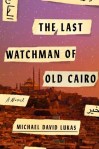
The Last Watchman of Old Cairo, by Michael David Lukas – I’d have picked this one up for the cover alone (I mean, does it get more beautiful?) but I had read and loved Lukas’ debut novel, The Oracle of Stamboul, years ago and was eagerly awaiting his sophomore effort.  This didn’t disappoint – it was just as richly imagined, gorgeously written, evocative and absorbing as its predecessor.  I got it from the library, but I might need to buy a copy, because I loved it so much.

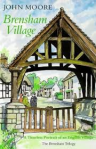
Brensham Village, by John Moore – The second volume of the Brensham trilogy, a lightly-fictionalized memoir about English country life from the Edwardian days to World War II, was a definite highlight.  (I also read the first volume, Portrait of Elmbury, which was excellent, but included one very jarring paragraph with a couple of racist sentences.  I wouldn’t throw out the baby with the bathwater, but Brensham Village pulls ahead by being more charming in every respect and also, no racism.)  I have copies of each book in the trilogy in gorgeous blue and green Slightly Foxed Editions, and I look forward to returning to the world of cricket on Brensham Green, followed by pints in the Horse Narrow, very soon.

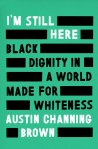
I’m Still Here: Black Dignity in a World Made For Whiteness, by Austin Channing Brown – I have been trying to stay abreast of the important memoirs about the experiences of people of color, and while there are many standouts, I’m Still Here has been my favorite.  Brown’s writing is elegant and compelling, and her life experiences well worth reading about.  I devoured it in a day.

North and South, by Elizabeth Gaskell – This classic is a must-read that has been on my list for a long time, but I finally picked it up to get me through the grief of losing a loved one too soon.  The family member we lost had loved this book and encouraged me to read it, and now I finally have.  The first few chapters may be a bit splotchy with dried tears, but I was able to close the book with a smile and think to myself, you were absolutely right, of course.

Some good reading so far this year!  I always gravitate to classics, but I did so this year more than most, as you can probably tell from this list.  There’s just something so comforting about a big cup of tea, a warm woven blanket, and a classic novel when the winter winds are howling outside (or really, anytime throughout the year, although I might pass on the blanket in the August heat).  I also think that as the world outside gets scarier and more unpredictable, my bookshelves become more and more of an escape.  Everything else is moving so fast – I just want to take things slowly and keep it simple at home, and that probably shows in the reading I most enjoyed in the first half-ish of 2018.

Time For A New Classics Club List

Grinding the gears on the way-back machine, back in August of 2013 (can it really be that long ago?) I joined The Classics Club.  The basic idea behind the Classics Club challenge is this: choose 50 (or more) classics – they can be books you’ve never read or old favorites that you want to re-read – and pick a date five years in the future, by which point you will have read and written about every book on the list.  Sounds fun, yes?  Well – in August of 2013 I was a stay-at-home mom with one easygoing baby, who slept regularly and was a breeze to care for.  I’m sure you see where this is going.

Why settle for fifty when I could read one hundred classics in five years?  It seemed perfectly doable.  I tend to read about 100 books per year no matter what I do – sometimes 102, sometimes 98 – and over five years, that would average out to 20% of my reading being devoted to classics.  Considering I love classics, 20% seemed easy.  And 2018 seemed so far away.

For whatever reason, I didn’t manage to pull it off.  My five year deadline is coming up, and I have barely scratched the surface of my classics list.  I’m not actually sure why not.  Over the course of new jobs, moves, another pregnancy and newborn days I’ve kept up a steady pace of reading, yet for some reason I haven’t read the books on the list.  I can’t explain it.  So I have to admit failure on this challenge.  But I love the Classics Club community, and I want to try again.  So here we go – a new list, targeted for completion by July 27, 2023.

  • Doctor Thorne, by Anthony Trollope
  • Framley Parsonage, by Anthony Trollope
  • The Small House at Allington, by Anthony Trollope
  • The Last Chronicle of Barset, by Anthony Trollope
  • The House of Mirth, by Edith Wharton
  • Sanditon, by Jane Austen
  • Wives and Daughters, by Elizabeth Gaskell
  • Mary Barton, by Elizabeth Gaskell
  • Ruth, by Elizabeth Gaskell
  • Sylvia’s Lovers, by Elizabeth Gaskell
  • Invisible Man, by Ralph Ellison
  • A Passage to India, by E.M. Forster
  • Washington Square, by Henry James
  • Queen Lucia, by E.F. Benson (re-read)
  • Miss Mapp, by E.F. Benson
  • Lucia in London, by E.F. Benson
  • Mapp and Lucia, by E.F. Benson
  • The Worshipful Lucia, by E.F. Benson
  • Trouble for Lucia, by E.F. Benson
  • The Garden Party, by Katherine Mansfield
  • Mrs. Dalloway, by Virginia Woolf
  • Beloved, by Toni Morrison
  • Song of Solomon, by Toni Morrison
  • East of Eden, by John Steinbeck
  • The Greek Myths, by Robert Graves
  • The Three Musketeers, by Alexandre Dumas
  • Their Eyes Were Watching God, by Zora Neale Hurston
  • Silas Marner, by George Eliot
  • Daniel Deronda, by George Eliot
  • Romola, by George Eliot
  • The Pickwick Papers, by Charles Dickens
  • Great Expectations, by Charles Dickens
  • The Song of the Lark, by Willa Cather
  • Everything that Rises Must Converge, by Flannery O’Connor
  • Delta Wedding, by Eudora Welty (re-read)
  • The Iliad, by Homer
  • The Odyssey, by Homer
  • Three Men on the Bummel, by Jerome K. Jerome
  • The Professor, by Charlotte Bronte
  • Shirley, by Charlotte Bronte
  • Agnes Grey, by Anne Bronte (re-read)
  • The Tenant of Wildfell Hall, by Anne Bronte (re-read)
  • The Floating Admiral, by the Members of the Detection Club
  • The Color Purple, by Alice Walker
  • Moby-Dick, by Herman Melville
  • The Silmarillion, by J.R.R. Tolkien
  • Things Fall Apart, by Chinua Achebe
  • Where Angels Fear to Tread, by E.M. Forster
  • The Priory, by Dorothy Whipple
  • The Village, by Marghanita Laski

And there it is!  Only time will tell whether this attempt goes any better than the last.  If only I could figure out where my roadblocks were for the past five years – it’s not like I haven’t read 100 books, or a bunch of classics.  Maybe I just picked the wrong one.  So – anyway – here goes nothin’.

Do you participate in reading challenges?  Which ones?  (Like I need more…)

My Blog Name In Books

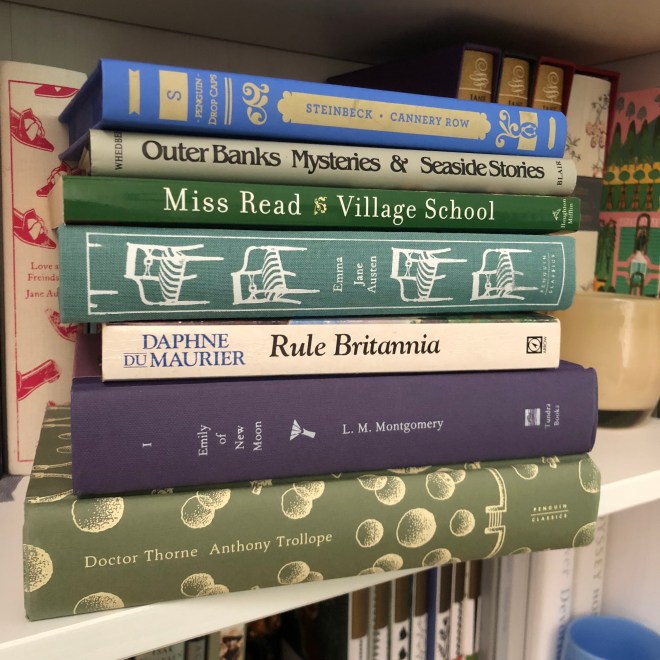
I don’t know how this got started, but I am seeing posts pop up all over the book-blogging world, listing book titles that spell out the blog’s name, and I think it’s such a fun exercise – naturally, I wanted to join in so I raided my bookshelves to see what I could come up with.  I’ve got a tough blog name to spell out, but I did my best–

C – Cannery Row, by John Steinbeck.  This is my favorite Steinbeck, and I’ve actually been to Cannery Row!

O – Outer Banks Mysteries and Seaside Stories, ed. Charles Harry Whedbee.  Growing up, my family vacationed on Hatteras Island almost every summer, and one of my favorite vacation traditions was attending a campfire on the beach in which the Cape Hatteras National Seashore Rangers would play their guitars, sing songs and tell ghost stories from a series of books edited by OBX resident Judge Whedbee.  I loved the stories and collected the whole set of five books – for sale in the Hatteras Light gift shop – over multiple summer trips.

V – Village School, by Miss Read.  Miss Read is one of my favorite comfort authors and I’ve turned to her in good times and bad.  Village School was the first Miss Read I ever picked up, and it’s such a delight.

E – Emma, by Jane Austen.  There was going to be an Austen in here.  I’m on record as saying Emma is not my favorite of her books (and I know some view that as sacrilege) but any Austen is better than not-Austen.  And I do love me some Mr Knightley.

R – Rule Britannia, by Daphne du Maurier.  This is my old, somewhat battered, copy from high school, when I was on a serious du Maurier kick.  I still love her, and chose to spend my thirtieth birthday in Cornwall because of du Maurier.

E – Emily of New Moon, by L.M. Montgomery.  Another mandatory author!  Emily of New Moon was my childhood favorite book (so much so that I named my daughter after the heroine, although sometimes I joke that, had I known she’d grow up to be a redhead with a wild imagination and a fiery temper, I’d have named her Anne).  I still love it and re-read it regularly.

D – Doctor Thorne, by Anthony Trollope.  I haven’t read this one yet, but it’s high on my list, because I loved the first two novels in the Barchester series (this is the third) and I’m itching to watch the television adaptation but won’t until I’ve read the book.  I hear great things and if it’s even half as good as Barchester Towers, I know I’m in for a treat.

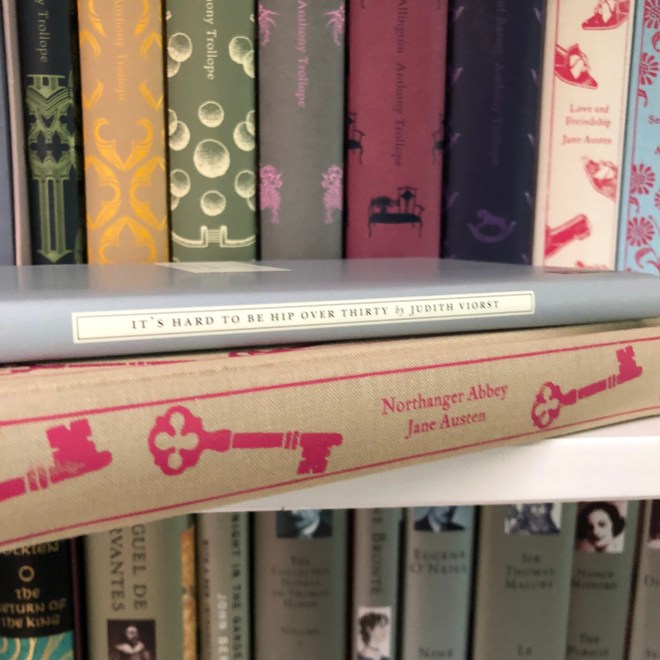
I – It’s Hard To Be Hip Over Thirty, by Judith Viorst.  A recent purchase (and read), I did really enjoy this witty book of poetry about married life in the 1950s and 60s.  A bit sour sometimes, but then I’m a bit sour sometimes.

N – Northanger Abbey, by Jane Austen.  Another Austen!  Can never have too many Austen novels, can we?  (If only there were more than six.)  Northanger Abbey is one of my favorites, and I recently made my book club read it.  Not everyone finished, but we all enjoyed trashing the Thorpes and drinking wine at the next meeting.

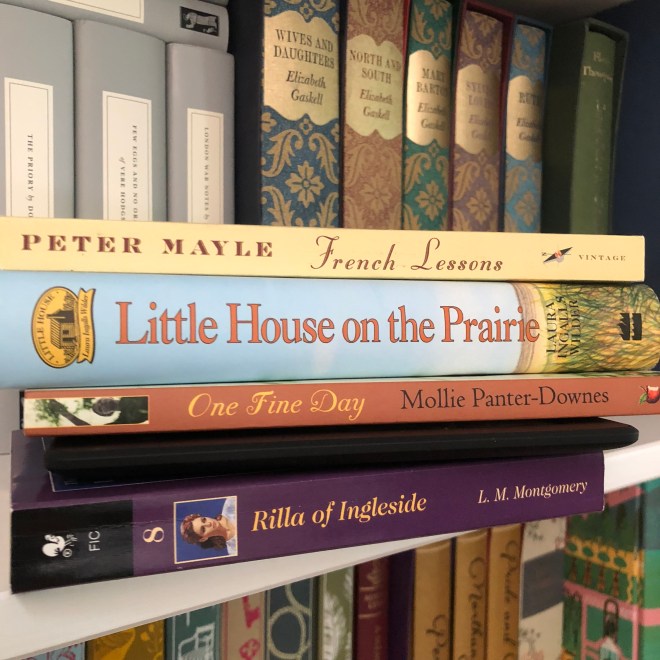
F – French Lessons, by Peter Mayle.  This is another one I haven’t read – I’m saving it, because I’ve read most of Mayle’s Provence books and I adore them so much.  I don’t want to live in a world in which I’ve run out of Peter Mayle books, so I am rationing.  I’m probably not going to be able to wait much longer to tear into this one, though.

L – Little House on the Prairie, by Laura Ingalls Wilder.  Another formative childhood book.  I was obsessed with the pioneer life as a child (and even dressed as Laura Ingalls for two Halloweens in a row – I had a gorgeous costume, hand-sewn by my grandmother).  I know that there are some problematic elements to the Little House books, but I still love them for their spirit and vivacity and the picture of a bygone way of life that is so foreign to me.

O – One Fine Day, by Mollie Panter-Downes.  Another one I’ve not yet read, although I loved (and savored) Panter-Downes’ war correspondence in London War Notes.  I’ve heard wonderful things about this slim little volume and I can’t wait to curl up with it.

U – Under Wildwood, by Colin Meloy and Carson Ellis.  I’m cheating a bit, because although I went through my bookshelves with a fine-toothed comb, I couldn’t find a book title beginning with U on there.  So this is my kindle, since I have Under Wildwood in electronic format.  (I’d like to collect the Wildwood Trilogy in hardcover, though.  All in good time.)

R – Rilla of Ingleside, by L.M. Montgomery.  Another Montgomery, of course!  I have a whole shelf dedicated to Maud, so it shouldn’t surprise you to see multiple picks on this list.  Rilla is one of my favorites of the Anne series (not quite at the level of the first three, but up there).  I have fond memories of lying on my stomach in my bedroom loft, (spoiler alert!) flooding the house over Walter.

There you have it!  COVERED IN FLOUR – in books!  That wasn’t easy – particularly the V and U.  (I’ve occasionally considered changing my blog name now that this is no longer a cooking blog, and maybe I should have.)  What books spell out your blog name?  Will you join in?

You Have No Compassion For My Poor Nerves: Austenite Mothers

The business of her life was to get her daughters married; its solace was visiting and news.

Recently, my friend Susan and I were discussing the subject of mothers in Jane Austen.  I’m not sure how the particular topic of mothers came up, since our friendship is one extended conversation about all things Janeite – but it may have been that we both (independently) finished re-reading Northanger Abbey recently.

At some point in the conversation, I mused that I had been trying to suss out a theme in Austen’s portrayal of mothers.  It seemed a bit of a stretch, but the closest thing that I could find to a common thread was that none of Austen’s heroines can entirely rely upon their mothers for wisdom or guidance.  Some don’t have mothers in their lives at all; others have mothers somewhere in the deep background, but none of them are overly helpful to our heroines.  Witness:

  • Anne Elliot‘s mother is deceased.  She has a surrogate in Lady Russell, but that good lady’s advice isn’t always particularly good, since it was her meddling that drove Anne and Captain Wentworth apart originally; one wonders if, had Lady Elliot been living, Anne would have had her happily-ever-after when she first fell in love with Wentworth, instead of having to wait eight years.
  • Emma Woodhouse‘s mother is also deceased.  The closest to a mother that Emma comes is “poor Miss Taylor” – her governess, who becomes “poor Mrs Weston” and departs the house in the beginning of the book.  Mrs Weston plays a role in bringing Frank Churchill to Hartfield and is otherwise distracted by marriage and pregnancy – hardly available to guide Emma through her growing pains.
  • Fanny Price lives apart from her mother, under the arch eye of two unpleasant aunts.  Even from afar, Fanny can’t rely on her mother – worn down by poverty and a drunken husband, she’s just trying to get through the days.
  • Elinor and Marianne Dashwood have a living mother in the same household, and she’s generally okay, but not a particularly solid source of relationship advice – she thinks Willoughby is a delightful young man, after all.  (Which makes sense, because she’s basically Marianne, twenty years on.)  And she fails to recognize the distress that Elinor is in for most of the novel.  I may be a bit hard on Mrs Dashwood, but Elinor Dashwood is one of my favorite Austen heroines, and every time I read Sense and Sensibility I am frustrated anew at Mrs Dashwood’s enabling of Marianne’s diva tendencies and her demand that Elinor enable them too.
  • Catherine Morland has probably the best (most decent, non-embarrassing) mother in the Austen landscape, but even bustling and kindly Mrs Morland isn’t much help to her daughter – she is too distracted by the other members of her brood and, likely, by the demands of being a rector’s wife.  Catherine spends most of the book out of her parents’ presence – first in Bath with the Allens and then at Northanger Abbey, seat of the Tilney family – and the Morland parents are a benign offstage presence, mostly forgotten, for the bulk of the book.
  • Elizabeth Bennet, I saved for last, because I have feelings about Mrs Bennet.  She’s clearly meant for a comic character in the book (“You have no compassion for my poor nerves!”) and Jane slyly pokes fun at her repeatedly – but I’ll champion her.  Mrs Bennet is an excellent mother.  She had a hard job to do with very high stakes – marry off five daughters (five!) to ensure their comfort once their parents are no longer living.  (Austen is very clear about what happens to women who do not marry in her universe.  They become Miss Bates, ridiculed by her community and very probably at least a little bit hungry.)  Mrs Bennet has no choice – she has to marry those girls off, or they could legitimately end up miserably poor, and she has to do it without any help from their father, who it’s clear mismanaged their estate and takes no interest in his daughters’ future comfort.  And she succeeds – boy, oh boy, does she succeed.  Jane married to Bingley (rich); Lydia to Wickham (hey, she’s out of the house at least); and Lizzy married to Darcy (super rich, owner of a great estate, descended from aristocracy).  Kitty is “much improved” by spending more time with Lizzy and Jane after their marriages and makes a good match with a clergyman near Pemberley, and we are told that even Mary finds a man, eventually.  Mrs Bennet may be ridiculous, but you can’t argue with the fact that she has one job to do, and it’s a difficult job with a high cost for any failure – and she is wildly successful.  I’d make the case that Mrs Bennet is a far better parent than laissez-faire Mr Bennet (as much as we love his dry quips), that she’s much savvier than she gets credit for, and that her daughters’ comfort in later life owes much more to her than to their father.  Shouts to Mrs Bennet!

This does seem to be the common thread.  All of the heroines have to muddle through their young womanhood without much – or any – help from their mamas.  Some have sisters they can rely on (Jane Bennet is the best example, but Elinor Dashwood is a stand-up sister too and seems to take great comfort in her close relationship with Marianne, for some reason).  Others have female role models that they look to with varying degrees of success – Mrs Weston, Mrs Allen, and Lady Russell come to mind.  And poor Fanny Price just has to go it alone.  I wonder what that says about Austen’s view of mothers in general.  Superfluous?  Perhaps I’m biased – being a mom to a daughter – but I believe that a constant, steady, reliable mother figure would have smoothed the path of any of the Austen heroines.  Maybe that’s why all the mothers are in the background, if they’re there at all – it makes better reading when the heroine has to struggle, after all.

Who do you think is the best Austenite mother?  Would Lady Elliot have encouraged Anne to marry Wentworth to begin with?  And how underrated is Mrs Bennet?

Happy Mother’s Day to all my friends!  I hope you have a lovely day celebrating with the moms in your life.

Poetry Friday: “The Old Churchyard,” performed by Offa Rex

A bit of a departure from the past few weeks, but music is poetry too, and I can’t stop watching this video so I thought it would be a good way to wrap up National Poetry Month.  Just try watching it only once and without crying – especially the last verse: “I rest in the hope that one bright day / sunshine will burst to these prisons of clay / and old Gabriel’s trumpet and the voice of the Lord / will wake up the dead in the old churchyard.”  Go on, I dare you.

Poetry Friday: “Weather Report,” by A. A. Milne

WEATHER REPORT

The home thermometer last night
Went down to 4 and stayed,
Doing all this by Fahrenheit
And not by Centigrade;
Subtracting 4 from 32
One estimates with ease
We had a frost the whole night through
Of 28 degrees.

The war has spoilt a lot of things;
We’re full of “rights” and “wrongs;”
And almost everybody sings
The most appalling songs;
But what infuriates me most
Is simply that I’ve lost
The opportunity to boast
About my “second” frost.

For in the happy days of old
One scanned the news to see
If Littlehampton were as cold
Or Looe as hot, as we.
But now comparison is gone–
Not least of Hitler’s crimes
Is that he put the kybosh on
The weather in The Times.

Ah me! those spirited reports
(“Sunny A.M., but cool”)
From all the popular resorts–
E.g., from Pontypool.
How much allure a breakfast lacks
Unable to begin
With temperatures min. and max.,
Particularly min.

I crack the still unrationed egg,
I carve the rationed ham,
I know it’s cold in Winnipeg
And cold in Amsterdam.
I munch the sparsely-buttered toast,
I stir the tasteless tea,
But know not (what intrigues me most)
The min. at Brightlingsea.

The home thermometer went down
To 4; it really did.
Can Colchester or Camden Town
Produce a lower bid?
Thermometers at Heckmondwike
Of similar design–
Can they show mins. remotely like
This minimum of mine?

Penarth and Peebles, what of them?
They have their frosty spells;
And doubtless it is “cold A.M.”
At Troon and Tunbridge Wells;
It may be that Aldershot
A heat wave has begun.
I doubt it.  But it matters not–
The war has spoilt the fun.

So, just to keep the record right,
I’ll mention it once more.
The home thermometer last night
Went firmly down to 4.
Which 4 must stand alone.  Ah, me!
The triumph I have missed with
No hopeful 5 from Bridge of Dee,
No 6 from Aberystwyth!

 ~ A. A. Milne, 1940

I have been on a bit of a World War II poetry jag – if you can call two books of war poetry a jag.  One of the two was A. A. Milne’s Behind the Lines, a sort of memoir-in-verse of the first nine months of the war.  Milne structures the book as a book entirely of poetry, with some end notes – no more than a paragraph – after each poem, in case the reader wants to know what was on his mind when he was writing the verses in question.  (In the introduction, Milne helpfully points out that if one is in a hurry, one can skip the explanations.  Because sometimes you just HAVE to get to the next poem, amirite?!)  Anyway, “Weather Report” is my favorite of the bunch, because it strikes me as The Most English Thing Ever, to take things like rationing and blackouts in stride but to draw the line at not being able to engage in forecast-related one-upsmanship with the next village over.  Don’t worry too much about Milne, though.  In his notes after “Weather Report,” he gleefully notes that he has two thermometers that often show different readings (which he speculates might be due to one being closer to sea level? or newer?) so he is still able to talk temperatures with the gardener.  I know you were concerned.

Poetry Friday: “i am a little church,” by e.e. cummings

i am a little church

i am a little church(no great cathedral)
far from the splendor and squalor of hurrying cities
–i do not worry if briefer days grow briefest
i am not sorry when sun and rain make april

my life is the life of the reaper and the sower;
my prayers are prayers of earth’s own clumsily striving
(finding and losing and laughing and crying)children
whose any sadness or joy is my grief or my gladness

around me surges a miracle of unceasing
birth and glory and death and resurrection:
over my sleeping self float flaming symbols
of hope, and i wake to a perfect patience of mountains

i am a little church(far from the frantic
world with its rapture and anguish)at peace with nature
-i do not worry if longer nights grow longest;
i am not sorry when silence becomes singing

winter by spring,i lift my diminutive spire to
merciful Him Whose only now is forever:
standing erect in the deathless truth of His presence
(welcoming humbly His light and proudly His darkness)

~e.e. cummings

I’ve posted this before but I can’t resist posting it again, because it’s a favorite of mine, and it contains the line I love best of all the poetry I’ve read (which, admittedly, is not much): “i wake to a perfect patience of mountains.”  There are plenty of articles and books and blog posts that analyze this one; I’m not going to do that.  I’m just going to say that I think this poem comes closer to saying all that needs to be said than pretty much anything else ever written.