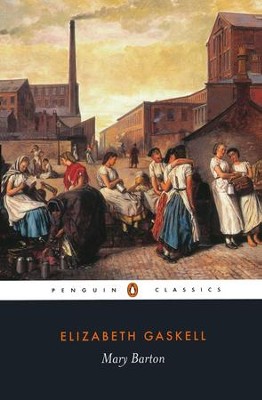
The Classics Club Challenge: Mary Barton, by Elizabeth Gaskell

The early trains for Liverpool, on Monday morning, were crowded by attorneys, attorneys’ clerks, plaintiffs, defendants, and witnesses, all going to the Assizes.  They were a motley assembly, each with some cause for anxiety stirring at his heart; thought, after all, that is saying little or nothing, for we are all of us in the same predicament through life; each with a fear and a hope from childhood to death.  Among the passengers there was Mary Barton, dressed in the blue gown and obnoxious plaid shawl.

Mary Barton was Elizabeth Gaskell’s first novel – not as polished as North and South (arguably her most famous) or Wives and Daughters (her final, unfinished work), it’s still a poignant, marvelous read.  The novel’s origins are sad: mourning the death of her nine month-old son, Gaskell was contemplating distracting herself with a writing project.  She was planning a historical novel, but was overcome by the idea of the hidden romances and sorrows behind the blank faces that pushed by her in the Manchester streets.
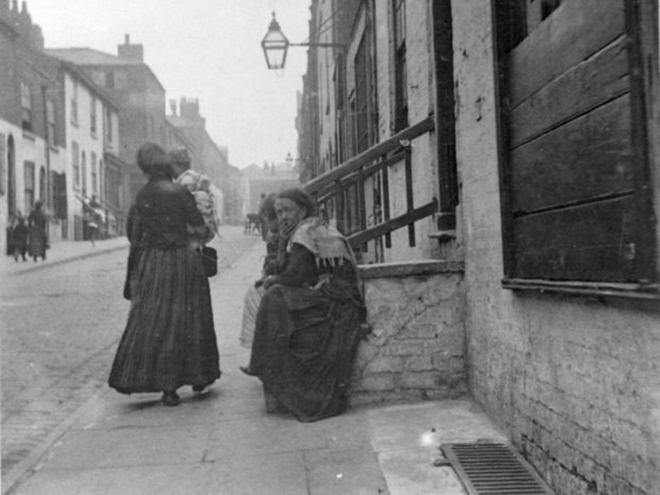
(Image source: The Independent)

It is a pretty sight to walk through a street with lighted shops; the gas is so brilliant, the display of goods so much more vividly shown than by day, and of all shops a druggist’s looks the most like the tales of our childhood, from Aladdin’s garden of enchanted fruits to the charming Rosamond with her purple jar  No such associations had Barton; yet he felt the contrast between the well-filled, well-lighted shops and the dim gloomy cellar, and it made him moody that such contrasts to exist. They are the mysterious problem of life to more than him.  He wondered if any in all the hurrying crowd had come from such a house of mourning.  He thought they all looked joyous, and he was angry with them  But he could not, you cannot, read the lot of those who daily pass you by in the street.  How do you know the wild romance of their lives; the trials, the temptations they are even now enduring, resisting, sinking under?

This quote, more than any other, explains why Gaskell chose to write the story of Mary Barton instead of the historical narrative she was planning.  But the novel is also revolutionary: it was one of the first novels to feature a working-class heroine (instead of an upper middle-class or gentry heroine).  Gaskell’s narrative stood for the idea that working-class people have stories that are worth telling.

When the novel opens, times are good.  We first meet Mary with her family – her father, John Barton, and mother, Mary Barton Sr. – on a soft spring day.  The family is out in nature (a contrast with the sooty city life they lead in Manchester) enjoying a rare day of leisure with their good friends, the Wilsons.  The teenaged Mary is blooming like one of the spring flowers they are out enjoying, and the Wilsons’ eldest son, Jem, is captivated by her – but Mary couldn’t be less interested in Jem.

The good times don’t last forever.  Manchester’s textile works lead a volatile existence, and their fates are tied to “the masters” — the mill employers, who set wages and hours, and with that, make the difference between surviving and starving (or “clemming,” as the workers call it).  This being an Elizabeth Gaskell novel, the bad times descend quickly and most of the combined Barton-Wilson clan is in the grave by the time the first half of the book is over.

Meanwhile, both Mary and Jem are growing up.  Jem gets a job in a foundry and works his way up to a supervisory position; Mary finds a place in a dressmaker’s shop.  Her father is determined that she will not become a factory girl, and Mary has no interest in that life.  Yet at the same time, John Barton worries that Mary will become dissatisfied with her life and end up like her mother’s sister Esther, who vanished one evening and broke her family’s hearts.  Mary, however, is young and thoughtless, a flirt, and she soon attracts the attention of a rich young man – the son of her father’s employer.

Yes! Mary was ambitious, and did not favor Mr Carson the less because he was rich and a gentleman.  The old leaven, infused years ago by her aunt Esther, fermented in her little bosom, and perhaps all the more, for her father’s aversion to the rich and the gentle.  Such is the contrariness of the human heart, from Eve downwards, that we all, in our old Adam state, fancy things forbidden sweetest.  So Mary dwelt upon and enjoyed the idea of some day becoming a lady, and doing all the elegant nothings appertaining to ladyhood.

Mary finds herself deeper and deeper in with young Harry Carson, and relying on his good will, she declines a marriage proposal from Jem.  After all, Harry’s mother was a factory girl, and the elder Mr Carson worked his way up to become a mill owner.  Harry is not so above Mary in stature that it’s impossible to consider he might genuinely fall in love with her; money is the main thing that divides them, but their family backgrounds are more similar than it would appear at first blush.  So Mary indulges her fantasies of becoming Mrs Carson and playing Lady Bountiful to her former near neighbors.  But it soon becomes clear that Mr Carson’s intentions are hardly honorable – and Mary discovers that she actually had feelings for Jem all along.  Whoops!

(Image source: Manchester Evening News)

Meanwhile, as Mary works through her romantic tribulations with the dubious help of her similarly inexperienced friend Margaret, John Barton is being swept up in a more macro struggle – that age-old divide (and favorite topic of Gaskell’s) between labor and capital.  Barton is active in his union, and when work at the mills dries up he is impacted by the poverty and misery of his compatriots.  When the employers rebuff the union representatives in their efforts to negotiate, the union decides to take a drastic step – an assassination of someone associated with the employers.

John Barton’s overpowering thought, which was to work out his fate on earth, was rich and poor; why are they so separate, so distinct, when God has made them all?  It is not His will that their interests are so far apart.  Whose doing is it?

The victim is Harry Carson – son of the mill owner.  Mary is secretly a little relieved, because Harry’s attentions had become intolerable to her.  But her relief turns to agony when suspicion immediately falls on Jem Wilson, who was overheard arguing with Harry – over Mary, as it turned out – just a few days before the murder.  Jem is arrested on suspicion, and Mary throws herself into proving his innocence when even their mutual friends are convinced of his guilt.  (I won’t give away the verdict, although if you read the table of contents, you’ll know how the trial turns out even before you read the first line – thanks for that, Liz G.)

Having read other Gaskell works, I can certainly tell that Mary Barton is an earlier effort.  It lacks the balanced complexity of North and South and the humor of Cranford or Wives and Daughters.  It also takes longer to get off the ground than the other Gaskell novels – the action doesn’t really take off until midway through the book (although Gaskell starts killing off characters earlier than that; she’s worse than J.K. Rowling that way).  But once things get going, they really get going – by the time Jem was charged with murder, I was so into the book that I stayed up feverishly turning pages until midnight.

All in all – I loved the fourth Gaskell I’ve read as much as I loved the first three.  With only two novels left (I don’t count the sanitized Life of Charlotte Bronte) I am starting to think I’d better ration.

What’s your favorite Elizabeth Gaskell novel?  I have loved them all, but I think I’m still partial to Cranford.

Reading Round-Up: August 2020

Reading Round-Up Header

Reading is my oldest and favorite hobby.  I literally can’t remember a time in my life when I didn’t love to curl up with a good book.  Here are my reads for August, 2020

Mary Barton, by Elizabeth Gaskell – Elizabeth Gaskell’s first novel sets the stage for her later works – especially North and South – and fixes on one of her favorite themes: the conflict between labor and capital, between the working classes and their employers.  It’s a revolutionary novel in that its heroine, Mary Barton, is a working-class girl; the novels of the time did not lend much credence to the romances, loves, pain, or joy of laborers and their families.  It’s also vintage Gaskell: a whole mess of people bite it, and if only everyone would just sit down and have tea together, labor and capital could solve all of their problems, I mean, really.  Heh… I really did enjoy this; it was slow-moving for the first half or so, but really picked up speed about midway through the novel, when it turned into a courtroom drama.  Full review (for the Classics Club) to come, so I’ll save the rest of my thoughts for that.

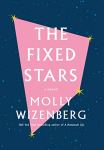
The Fixed Stars: A Memoir, by Molly Wizenberg – I had such mixed feelings about this one.  On the one hand, Molly’s writing is as elegant as ever and I flew through the book.  But on the other hand, this felt too personal, to the point that reading it felt voyeuristic.  I know that she put these words out in the world, and that she wanted people to buy her book and read it, and that she got royalties (or at least credit toward her advance) from my purchase of the kindle version, but – still, actually reading about the demise of her marriage, and her sexual awakening as a queer woman, a part of my brain kept nagging me, “This is private.  This is not for you.”  (A separate part of my brain knows it’s important that queer stories are out in the world, and also that no one forced Molly to write and publish this particular book, and she no doubt wanted people to purchase and read it.)  Molly acknowledges that memoir is something of an act of violence to the people in the memoirist’s life, but it also struck me as topsy-turvy that the only “main character” who got to keep some privacy was “Nora,” Molly’s problematic first girlfriend, who gets the coverage of a pseudonym while Molly, Brandon, Ash, and June are all out there with their real names.  (I know it wouldn’t be possible to give Brandon and June pseudonyms; anyone who has read Molly’s other writing already knows about them.)  Molly is clearly holding back a lot of details about her relationship with Ash (understandably, and I think rightfully); Brandon doesn’t always come off very well, but he is an adult who agreed to and supported the project.  But I do wonder how her daughter will feel in ten years, having the demise of her parents’ marriage and these very personal details in print for all of her classmates to read.  Having a blog myself, I have given a lot of thought to how I portray my children; they are a part of my life and so they’re around this space, but I intentionally don’t use their real names or show recent photos of their faces, and I don’t share details (either about them or about myself) that might cause them pain or embarrassment later.  Everyone is different, obviously – what I’m comfortable with isn’t the “right” way or what everyone has to do, and I get that.  I’m not going to clutch my pearls and shout “Think of the children!” – and Molly is clearly a very thoughtful person, who I’m sure considered the ramifications to June of having her parents’ personal tumult in print for all to read, and balanced them against her need to write the story.  Still, permission notwithstanding – I felt a bit like I was pressing my nose against a window, looking in at a family’s pain that didn’t concern me, and I just felt vaguely wrong and weird about that.

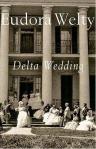
Delta Wedding, by Eudora Welty – It had been a long time – years – since the last time I re-read Delta Wedding, which was one of my favorite books in high school.  I was definitely worried that it wasn’t going to hold up with my “2020 vision” – would I love it as much as I remembered, or would it be full of cringeworthy moments and dated words about characters of color?  Being a 1923 book, it was of its time, certainly – but race is not the focal point of the story (class is – something I realized for the first time on this read-through) and while Welty’s characters behave like a white Southern landowning family in the 1920s, it could be much worse.  The descriptions of nature and the telescopic focus on a few family members makes this book what it is – a series of gorgeous vignettes, still a wonderful read years after I first picked it up.

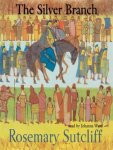
The Silver Branch (The Dolphin Ring Cycle #2), by Rosemary Sutcliff – Having loved The Eagle of the Ninth, I had high expectations for the second novel in Rosemary Sutcliff’s classic series about Roman – and later Saxon and Norman – Britain, and they were met and exceeded.  The events of The Silver Branch take place about 200 years after The Eagle of the Ninth and focus on two young Romans – Flavius, a Centurion (and descendant of Marcus Flavius Aquila) and his cousin Justin, a Cohort Surgeon.  When the young men uncover a plot to overthrow the Emperor of Britain, they quickly find themselves neck-deep in intrigue and adventure.  Yay, plotting!  Yay, intrigue!  Yay, battles!  Yay, danger!

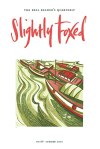
Slightly Foxed No. 66: Underwater Heaven, ed. Gail Pirkis and Hazel Wood – Figured I’d better get around to the current issue of Slightly Foxed before the autumn issue comes out!  I always enjoy this journal and often come away with a long TBR after reading writers on their favorite books and authors.  I didn’t feel a great compulsion to pick up any of the books that were profiled in the summer issue, this time, but it occurred to me that the journal is almost stronger when that’s the case – because if I’m not interested in the underlying book but still find the essays in the journal to be wonderful reads, worth enjoying for their own sake, the journal must be impressive indeed.

And that’s a wrap on August.  It looks like a light month of reading, but what you don’t see is that I spent considerable time with two Victorian doorstoppers last month.  When I started the month, I was partway into Mary Barton, and that took up a good two weeks to finish.  (So good, though!)  Then I cruised through a few shorter books before picking up The Pickwick Papers.  As of the publishing of this post, I am nearly done with it, so it will appear on September’s (hopefully longer) book list.  But it ate up a lot of reading time in August and into September.  Everything I read in August was well-written and engaging, but there were definite highlights.  The Silver Branch was, I think, my favorite book of the month, and I am so stoked that Slightly Foxed is continuing to publish the series.  Mary Barton was wonderful, too, and I don’t even want to think about the fact that I have only two unread Elizabeth Gaskell novels left.

How was your August in books?

Themed Reads: In Case You Need More Politics

Well, for those of us in the U.S.A., politics season is in full swing – with less than 75 days to go until the election, the onslaught of news coverage and candidate outreach has begun.  I’ve donated to a few different campaigns and requested my absentee ballot, so I’m on my way.  I’m also looking around for some volunteer opportunities that I can do safely.  With all this political activity, of course, comes waves and waves of nonsense on Facebook (and Twitter, I know, but I’ve deleted Twitter and couldn’t be happier about that).  I’m trying to steer clear of the vitriol, and if you are too, but you’re still looking for some engagement – or if you just loved that speech by President Obama at the Convention and want to wallow in memories – might I suggest an Obama staffer memoir?

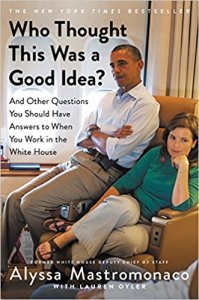
First of all, the classic – Who Thought This Was a Good Idea? And Other Questions You Should Have Answers to When You Work in the White House, by Alyssa Mastromonaco, was the first Obama staffer memoir I read, and might still be my favorite.  Mastromonaco combines memories of her time as a senior advisor to President Obama with a manual on leadership for women, and it’s everything.  I listened to it on audio, read by the author herself, and that enhanced the reading experience.  (There is that kind of out-of-place chapter about her cats, but you know, Mastromonaco devoted a lot of her life to her White House job and if she wants to tell me about her cats, I’ll listen.)

Another serious one, and an especially good read for the foreign policy wonks among us, The World As It Is, by Ben Rhodes, is a great reminder that once upon a time, we had normal relations with other countries.  And maybe one day, we can have that again!  In the past few years, I’ve taken great comfort in one of Rhodes’ metaphors: he writes that U.S. foreign policy is like a massive cruise ship (or was it an aircraft carrier? in any event, a really big boat) – you can’t just turn it on a dime, the course is pretty much set and it’s mostly going to chug along.  When I think about how abnormal the past few years have been, I am reassured by that idea.

Whew.  Women and leadership, and foreign policy – two heavy subjects.  If you need something lighter after that, and somehow have not already read Thanks, Obama: My Hopey, Changey White House Years, by David Litt, you are in for a total delight.  Litt was a speechwriter on President Obama’s staff and quickly rose to become the funny guy in the room.  Meaning: when President Obama made a joke, it was probably Litt’s work.  Litt describes his rise to comedy speechwriting, explaining how some of his lines fell flat, but he eventually got a handle on President Obama’s sense of humor and was able to harness it for some spectacular zingers.  If a political memoir can be fun, this one is.

Of course, you may be overwhelmed with all the politics already, and just not into any of it: fair enough.  Living in the D.C. area, I’m both steeped in politics and out of it.  I’ve got relatives who often ask me to share all of my inside political information with them, and I am forever explaining that I don’t have any – I get my news from NPR and the Washington Post, like lots of people, and I don’t know any more than a reasonably informed citizen anywhere in the country; I’m not an insider.  While I’m often frustrated and made late for appointments because of motorcades, that’s really the extent of the D.C. experience.  But at the same time, living here is often like living in a churning stew of opinions – you can’t ever really forget what’s going on, because at any moment you might look up and see Marine One buzzing along overhead or see a recognizable face walking down M Street.  This is a weird place to live, for sure.  And I mostly just try to inform myself and then live my life.  But every now and again, it’s good to remember a normal time – and Obama staffer memoirs are just the balm for that.

Reading Round-Up: July 2020

Reading Round-Up Header

Reading is my oldest and favorite hobby.  I literally can’t remember a time in my life when I didn’t love to curl up with a good book.  Here are my reads for July, 2020

Lumberjanes, Vol. 14: X Marks the Spot, Campfire Songs, and Bonus Tracks, by various authors – Finishing up my lumber-binge (at least until later this month, when Volume 15 comes out) I enjoyed X Marks the Spot – because everyone loves a good treasure hunt story, especially when it has a Greek myth component.  The ‘Janes embark on a treasure hunt and find a broken statue, which they reassemble (of course) and which immediately threatens to drain all of the magic from the camp (of course).  Diane makes an appearance, and hijinks ensue.  Good fun!  Campfire Songs and Bonus Tracks are two volumes of short “stories.”  As with all short story collections, there were some that I really enjoyed and some that didn’t speak to me quite as much – to be expected.  The contribution by Faith Erin Hicks (can’t remember which volume) was a highlight.  All in all – not as complex or fun as the standard ‘Janes material, but a nice way to spend more time in the world of Hardcore Lady-Types.

Sword of Bone, by Anthony Rhodes – After a month and a half of reading nothing but comics, I felt ready for some regular ol’ words on a page, and I turned to another tried-and-true slump-breaker – a memoir.  I’ve been meaning to get to Sword of Bone, one of the classic forgotten memoirs in the Slightly Foxed bibliography, for quite some time.  After all, who can resist a book described as an “amusing” book about Dunkirk?  Not me.  And it was amusing – if you’ve never chuckled at a description of the Maginot Line, go get this – and the Dunkirk chapters at the very end were absolutely gripping.  Slightly Foxed hits it out of the park every time, and this volume was a fabulous read.

Tory Heaven, or Thunder on the Right, by Marghanita Laski – As I meander through my own shelves, I’ve just been following whatever strikes me as a reading craving.  As I finished up the last few chapters of Sword of Bone, I got a hankering to read Tory Heaven, one of the newer Persephone releases.  It’s a sort-of-dystopian imagination of post-war England and I was here for all of it.  James Leigh-Smith, antihero, has been marooned on a desert island for several years.  Upon being rescued, he hears the distressing news that the Socialists have swept to nationwide power in England.  Oh noes!  Fortunately for James, that’s old news, and he arrives to find a Tory utopia in which classes are rigidly assigned to strata – A through E.  James – public school gentleman, son of landed gentry – is an A, naturally, and delighted with his new status.  But all is not as it seems, of course!  I don’t want to tell you any more and spoil it, but this was tense, dramatic, and good fun.

Wigs on the Green, by Nancy Mitford – Guess I was on something of a midcentury English right wing nutjob kick?  Wigs on the Green is Nancy Mitford’s irreverent send-up of British fascists in the 1930s.  Mitford herself suppressed the publication of the book for a long time, because her family – including sisters Unity and Diana – did not universally appreciate being mocked on the page.  The mocking was relatively gentle (Mitford could have been tougher on her Diana character, and the Unity character was straight-up lovable and funny – my 2020 reader’s eye, with its 20/20 hindsight, disapproved) but it was an interesting read for sure.

Only six books in July… that’s partly due to the fact that after Wigs on the Green, I picked up Mary Barton.  Elizabeth Gaskell novels are always something of a time commitment – although not as much so as, say, George Eliot.  August will probably be “light” for the same reason.  But it was a good month of reading, even if not a particularly packed one.  I enjoyed everything I picked up and it was a nice change to just follow my bliss, so to speak, and just read whatever happened to be calling to me in the moment.  I’ll definitely continue that trend into August, I think.

How was your July in books?

Themed Reads: Still At Home

Well, here it is July and things don’t seem to have gotten much better, at least not ’round these parts.  We all tried cautiously poking our noses out of our front doors, only to go scurrying back inside.  Multiple states have issued travel advisories – including Massachusetts, which has effectively scuttled my summer vacation plans – and Steve and I are just waiting for the next all-in stay-at-home order to drop.  As we watch our summer plans evaporate – always mindful of the fact that there are so many people out there who have it worse – even armchair travel is starting to feel frustrating.  Since it looks like we’re going to be staying home for awhile yet, here are three books about staying home, to remind you that… I don’t know… it could be worse, even if we’re all bored as we sit around watching Disney+ and working on the butt divots in our couches.

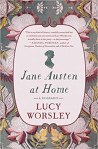
Jane Austen at Home, by Lucy Worsley, literally explores Jane Austen’s work through the lens of her homes.  The reader is treated to a progression through Austen’s life, starting with the Steventon parsonage and moving with the Austen family, first to and around Bath, to various seaside spots, to Chawton, and finally to Winchester.  Worsley has plenty to say about decor, about social customs, and about the many colorful characters who wended their way into and out of Austen’s life.  And it’s worth noting: as tempting as a trip to Chawton sounds these days, it seems it wasn’t the most comfortable place to live back in Jane’s day.  I, for one, am glad to be watching Netflix in the air conditioning and not sweltering in the damp or shuddering with the walls every time a stagecoach drives past my house (which, realistically, happens exactly never).

If Chawton sounds damp and noisy, the Claremont is dreary.  Mrs. Palfrey at the Claremont introduces the reader to the titular lady as she is on her way to a new home at London’s Claremont Hotel.  The Claremont doubles as a respectable lodging for aging ladies and gentlemen, although, as Mrs. Palfrey remarks to a new friend, “We’re not allowed to die here.”  The reader follows Mrs. Palfrey as she cautiously dips her toe into the social life of the Claremont’s parlor and gets caught up in a web of deception.  Hate when that happens!  So here’s another plus to being stuck in our own houses: at least we’re not stressed about maintaining the lie of a fictional grandson while we drink our mediocre wine.

Okay, so we’re not sweating in a swamp like Jane or yawning away life like Mrs. Palfrey, and we can probably also check off “hiding in one room literally on the other side of a wall from a nest of Nazi soldiers” as another situation that is worse than what we’ve got.  I Was A Stranger, General Sir John Hackett’s memoir of his time hiding in the home of a Dutch family while recovering from his wounds after the Battle of Arnhem, might be the perfect book to read during this time.  Gen. Hackett literally couldn’t leave the house except to go for super-short walks under cover of darkness, and sometimes not even that.  And when surprise inspections happened, he had to either hide in a cubby or stay in bed pretending to be a sick relation.  At least the rest of us get to visit the backyard, right?

So, there we have it.  This was originally supposed to be a post about books showcasing the joys of being at home.  I’m sure those exist, but actually – at the moment, this is the best I can do.  There but for the grace of Artemis go I, and that sort of thing.  You can relate, right?

What are your favorite books about being stuck at home?

The Classics Club Challenge: Where Angels Fear to Tread, by E. M. Forster

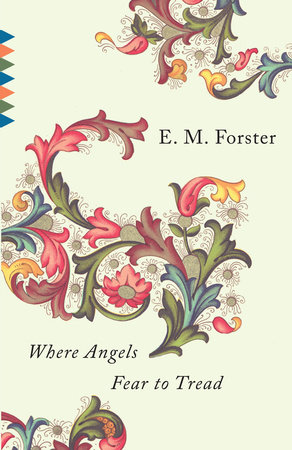
It’s taken me a minute, but I am finally making some time to review Where Angels Fear to Tread, which I read way back in – March?  E.M. Forster’s first novel is less polished than his later efforts – especially my favorite, A Passage to India – but it explores many of the same themes of travel, Imperialism, and culture clashes between wandering Britons and the people they encounter in other countries.

Where Angels Fear to Tread opens with a comedic scene at a train station: Lilia Herriton, a flighty young widow, is heading off to explore Italy.  Her in-laws have mixed feelings about this: on the one hand, Lilia is about as spacey as they come, and the conservative Herritons are worried that she might get carried away and embarrass the family.  But on the other hand, they never liked her to begin with and they’re not overly sad about getting rid of her temporarily, especially because she is leaving her young daughter in their care, to be raised as befits a child of the house of Herriton.  To guard against the possibility of bad behavior, Lilia is accompanied by a local friend, Caroline Abbott, who is both substantially younger than Lilia and substantially (allegedly) smarter.

I’m sure you see where this is going.  Caroline Abbott’s influence is either overstated, or unequal to the task of restraining Lilia’s impulses, or both – because the next the Herritons hear from either young woman, Lilia is engaged to be married to an Italian nobleman several years her junior.  This cannot happen.  Lilia the flaky daughter-in-law is bad enough.  Lilia the Italian Countess is untenable.

Philip Herriton, Lilia’s brother-in-law, is dispatched to talk sense into the bride and groom and stop the wedding.  Philip views himself as a man of the world and is eager to fall in love – but not too in love – with Italy.  His first view of Monteriano, scene of Lilia’s folly, reveals the complexities of the landscape:

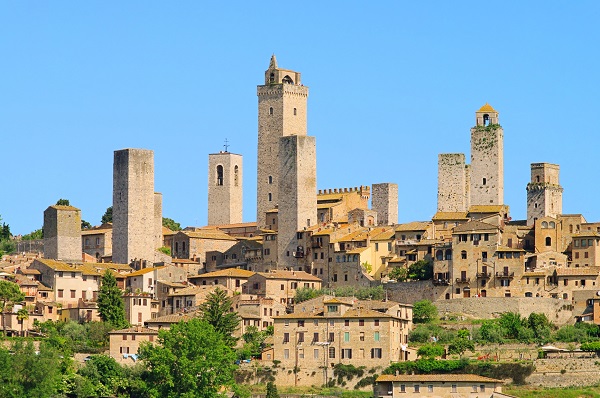
They were among olives again, and the wood with its beauty and wildness had passed away.  But as they climbed higher the country opened out, and there appeared, high up on a hill to the right, Monteriano.  The hazy green of the olives rose up to its walls, and it seemed to float in isolation between trees and sky, like some fantastic ship city of a dream.  Its colour was brown, and it revealed not a single house–nothing but the narrow circle of the walls, and behind them seventeen towers–all that was left of the fifty-two that had filled the city in their prime.  Some were only stumps, some were inclining stiffly to their fall, some were still erect, piercing like mass into the blue.  It was impossible to praise it as beautiful, but it was also impossible to damn it as quaint.

***

(San Gimignano, Italy – model for Monteriano – image sourced from Life in Italy.)

Spoilers ahoy!

When Philip arrives in Monteriano, charmed by the village and its towers, he immediately sets to work persuading the groom to back off.  Unfortunately for his efforts – it’s too late.  When Lilia wrote to inform her in-laws that she was engaged… she was actually already married.  Oh, and it gets worse!  The “Count” is actually the son of a dentist – there’s not a drop of aristocratic blood running through his veins.  Philip is dismayed, but at the same time – he can’t deny that there’s something magnetic about Gino, Lilia’s non-aristocratic Italian husband.

Needless to say, Philip leaves without accomplishing his objective of breaking up the relationship – and then everything gets super sad.  The marriage is not a success; Lilia and Gino immediately find themselves at odds and in constant tension, brought about mainly by their cultural disconnect and – as a result – very divergent expectations for the relationship.  Lilia produces a baby and then promptly dies, of course.  With Gino left alone with his new son, the Herritons turn their attention to concealing the baby’s existence from his half-sister.

Meanwhile, everyone is wondering how exactly the situation got so out of control.  What happened to the supremely sensible Miss Abbott, dispatched to Italy to ensure that her older but dumber traveling companion didn’t do something regrettable?  Philip grills her and discovers that the serene neighbor has unsuspected depths and grievances:

“I hated Sawston, you see.”

He was delighted.  “So did and so do I.  That’s splendid.  Go on.”

“I hated the idleness, the stupidity, the respectability, the petty unselfishness.”

“Petty selfishness,” he corrected.  Sawston psychology had long been his specialty.

“Petty unselfishness,” she repeated.  “I had got an idea that everyone here spent their lives in making little sacrifices for objects they didn’t care for, to please people they didn’t love; that they never learnt to be sincere–and, what’s as bad, never learnt how to enjoy themselves.  That’s why I thought–what I thought at Monteriano.”

“Why, Miss Abbott,” he cried, “you should have told me this before!  Think it still!  I agree with lots of it.  Magnificent!”

(If you’re wondering, the answer is yes: Philip really is unbearably self-congratulating and pompous, and he really does think he is the most interesting man in the world.)

Ultimately, like all plans laid by the Herritons, the plan to conceal the baby’s existence from Lilia’s daughter goes awry.  Gino himself spills the beans.  Some quick strategic realignment later, the plan shifts from pretending the baby doesn’t exist to trying to adopt him so that he can be raised in a manner befitting the half-brother of a Herriton.  (The apple doesn’t fall far from the tree.  All of the Herritons are as generally awful as Philip – in fact, he’s probably the most open-minded, least irritating one out of the whole clan.)  A “rescue” party is dispatched to Monteriano to convince Gino to part ways with his son – because convincing him not to marry Lilia went so well. /sarcasm

And, of course, the entire “rescue” party falls under Gino’s spell immediately.

So this strenuous day of resolutions, plans, alarms, battles, victories, defeats, truces, ended at the opera.  Miss Abbott and Harriet were both a little shamefaced.  They thought of their friends at Sawston, who were supposing them to be now tilting against the powers of evil.  What would Mrs. Herriton, or Irma, or the curates at the Back Kitchen say if they could see the rescue party at a place of amusement on the very first day of its mission?  Philip, too, marvelled at his wish to go.  He began to see that he was enjoying his time in Monteriano, in spite of the tiresomeness of his companions and the occasional contrariness of himself.

(Image of San Gimignano sourced from Lonely Planet.)

Miss Abbott, too, had a wonderful evening, nor did she ever remember such stars or such a sky.  Her head, too, was full of music, and that night when she opened the window her room was filled with warm, sweet air.  She was bathed in beauty within and without; she could not go to bed for happiness.  Ha she ever been so happy before? Yes, once before, and here, a night in March, the night Gino and Lilia had told her of their love–the night whose evil she had come now to undo.

Forster is at his best in describing the romance and delight of Italy, which he clearly loves.  One by one, the characters succumb to its joys.  Monteriano becomes less dreary, Gino less embarrassing of a connection.  And it also becomes clear that Gino actually loves the baby and doesn’t want to give him up, shocking the party from England into a rash action that brings about the climax of the story.  I won’t tell you what that action is, nor will I give away the ending, but this is E.M. Forster, so that should tell you what you’re letting yourself in for.

As I mentioned above, the classic Forster themes are all there.  You see beautiful travel writing, complex characters (there are no heroes or villains in a Forster novel, just characters of varying degrees of sympathy) and culture clashes generally brought about by British travelers attempting to impose their will on people they can’t understand.  You can see the seeds of both A Room with a View and A Passage to India beginning to germinate in Where Angels Fear to Tread, which is fun.  I love to read earlier works to see how an author’s powers mature, and there is a clear progression in Forster’s novels – but Where Angels Fear to Tread is worth reading on its own, even if it is not the pinnacle of his writing career.  (I think most readers would say that’s Howard’s End, which I did think was wonderful, even if I loved Passage more.)

Have you read E.M. Forster?  Which one is your favorite?

Reading Round-Up: June 2020

Reading is my oldest and favorite hobby. I can’t remember a time in my life when I didn’t love to curl up with a good book. Here are my reads for June, 2020

Well, this is a new one – literally all I read in June was Lumberjanes.  That’s it.  Nothing else AT ALL.  I cruised through ten volumes of the collected trade paperbacks, and in a month that was nothing short of globally and personally turbulent, it was what I needed to read.  Between the ongoing pandemic, heartbreaking reckonings with our nation’s history of systemic racism, and on the personal side a house move, two kids who are at each other’s throats constantly, and a crazy workload – I just don’t have the attention span for anything more.

So, impressions – other than this being the respite my brain needed, I did really enjoy this monthlong lumber-binge.  The quality of both the writing and the art is a little variable – Noelle Stevenson left the team partway through the fifth volume, and neither the art nor the story is as good without her.  But every collection was fun, enjoyable, and made me smile.  There are mermaids, time shenanigans, Greek mythological monsters, and roller-skating sasquatches.  So how can you go wrong?  I preferred the issues in which the art was a little sharper and less cartoony, but all in all, this series is solid from the first page to the last.

And that’s all I have to say for myself this month!  My focus was elsewhere, but the heavy classics and Victorian doorstoppers will be there for me when I’m ready.  In the meantime, Lumberjanes made for a welcome escape when I was mentally exhausted from the slog of trying to be both a working parent AND an American in this heartbreaking time.

What did you read in June?  Any recommendations for good escape reads for me?  Nothing too mentally taxing, please – I’m not up for it yet.  But I’m working on getting there.

Reading Round-Up: May 2020

Reading is my oldest and favorite hobby. I can’t remember a time in my life when I didn’t love to curl up with a good book. Here are my reads for May, 2020

The Old Farmer’s Almanac: Vegetable Gardener’s Handbook, by The Old Farmer’s Almanac – Trying to head off an impending reading slump, and to get a head start on planning (maybe?) a bigger vegetable garden for after I move, I dug into the latest edition of this gardening reference book with glee.  It was full of useful information but not very suited to reading cover-to-cover; I foresee myself getting a lot of use out of it as an occasional reference, though.

Where Angels Fear to Tread, by E. M. Forster – Another one from the Classics Club list (full review coming soon) – Where Angels Fear to Tread is not going to supplant A Passage to India as my favorite of Forster’s works, but it was a really worthwhile read.  This was his first novel and you can certainly see him working through the themes of travel and culture clash that he refines in later works like A Room With a View and A Passage to India.

Jane Austen at Home, by Lucy Worsley – This new Austen biography was on a stack of loaners from my friend Susan; I’m trying to read through them all before the pandemic ends and we are able to get together again, so I can hand them all back to her at once.  By the time I picked this up, I was in the throes of a full-on reading slump, and as a result it took me almost two weeks to get through – definitely unusual, because this is an engaging and fascinating work that I would normally tear through in just a couple of days.  I’ve read a few of Worsley’s books now and they’re always thoughtful, interesting, and approachable.

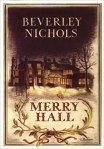
Merry Hall (Merry Hall #1), by Beverly Nichols – Nichols has been on my list to read for quite some time, and I definitely enjoyed my first encounter with him.  His garden and nature writing is sublime, and he had me laughing with his descriptions of encounters with local characters Oldfield (the gardener), Miss Emily, and “Our Rose.”  There are some cringeworthy moments for the modern reader, so do bear that in mind – but those are relatively few and far between.

The Boy Who Lost Fairyland (Fairyland #4), by Catherynne M. Valente – I’ve been very slowly reading through Valente’s Fairyland series and every volume is wonderful.  (I should probably not read quite so slowly, because I find myself forgetting what came before.)  The Boy Who Lost Fairyland is the only volume in the series that does not focus on main characters September and Saturday, although they do make an appearance – and as a result, I don’t think it’s my favorite.  Most of the action takes place in Chicago, following a changeling boy as he tries to understand and live in the human world, then finds an opening to get back to Fairyland.  It was a delight, but I’ll be glad to get back to the main storyline in the fifth and final volume.

Austentatious: The Evolving World of Jane Austen Fans, by Holly Luetkenhaus & Zoe Weinstein – Another loaner from my friend Susan; this time of one of her 2020 Christmas gifts!  (I’m loved, am I not?)  This is a series of essays that thoughtfully explores the online fandom culture surrounding Jane Austen in recent years.  Each was well-considered and engaging, but I particularly liked the essays that focused on meme culture; Clueless; and sexual orientation, respectively.

Lumberjanes, Vol. 1: Beware the Kitten Holy, by Noelle Stevenson – Battling what has become a full-on reading slump, I had a sudden desire on the last day of the month to return to Miss Quinzilla Thiskwin Penniquiqul Thistle Crumpet’s camp for hard-core lady-types.  Since I haven’t felt any excitement around reading for weeks, I clearly went with it, and it was just what the doctor ordered.  I’ve read the first two volumes of Lumberjanes before, so knowing the story already, I was able to catch more of the literary and pop culture references – which was extra fun.

Lumberjanes, Vol. 2: Friendship to the Max!, by Noelle Stevenson – This volume wraps up the storyline that begins in the first volume.  Lumberjane Scouts Jo, April, Mal, Molly and Ripley continue to attract danger and battle mythical monsters, much to the chagrin of their rule-following counselor, Jen.  (“Nerd counselor!  Read the star chart for me!”)  Between velociraptor attacks and an eventful game of capture the flag, not to mention a cave full of ancient boobytraps, the Lumberjanes have their hands full!  I wish my summer camp experience was as exciting…

So – eight books in May.  Considering that I’m battling a pandemic-induced and news-exacerbated reading slump, eight is a good number.  But May’s a long month and I’d have liked to read more.  It’s not just about numbers – I miss the joy that I usually get from picking up a book.  Some of that started to return at the end of the month, and I’m planning to keep reading Lumberjanes as long as it’s working for me, so expect a very summer-campy recap at the end of June.  I’ve got a big stack of trade paperbacks, graphic novels and YA books all set at Miss Quinzilla Thiskwin Penniquiqul Thistle Crumpet’s camp for hard-core lady-types, and they’re calling my name.  (Also, I realized that fully 50% of the books I read in May had at least one LGBTQ+ author, so that’s pretty cool.)  Other than Lumberjanes, the highlight of the month was Jane Austen at Home.  I love an Austen biography, and I love Lucy Worsley, so that’s a winning combination right there – even if my mental powers were so drained from three months of attempting to work at home while my kids climb on me that it took me thirteen days to finish.  Here’s hoping for a happier month of reading in June…

What did you read in May?

The Classics Club Challenge: Mapp and Lucia, by E. F. Benson

Photo credit: britishheritage.com

Four books.  I’ve been waiting four books for this: the first cataclysmic encounter between Emmeline “Lucia” Lucas, Queen of Riseholme, and Elizabeth Mapp, doyenne of Tilling.  E. F. Benson’s series is popularly known as “the Mapp and Lucia novels,” but the two principals don’t actually encounter one another until the fourth book in the series, Mapp and Lucia.  Well – not exactly.  In Mapp and Lucia we learn that our heroines (or villainesses, depending on your perspective) have met once before, when Miss Mapp visited Riseholme for a day and attended a social gathering at which Lucia was also a guest.  But that’s the extent of their contact prior to this book – although they will become much better acquainted soon.

When Mapp and Lucia opens, we find Lucia bereaved.  Peppino – dear Peppino! – Lucia’s indulgent husband, has passed away, leaving Lucia in mourning at The Hurst.  Lucia being Lucia, she does mourning in excess; one would expect nothing less.  But eventually the Riseholmites begin to worry, and Georgia Pillson, Lucia’s faithful deputy, is dispatched to bring her back to the life of the village.  He does so – only too well – by informing her that there is to be an Elizabethan fete and Lucia’s frenemy, Daisy Quantock, is to play Queen Elizabeth.  This will never do, but when Lucia is offered only a bit role in the festivities she decides it would be better to save face by clearing out altogether.  As luck would have it, she finds a perfect excuse – a house for rent in the nearby town of Tilling, listed by one Elizabeth Mapp.  And just as easy as the first movement of the Moonlight Sonata, Lucia has a change of scenery.

‘Well, Mapp, what luck?’ asked Irene.

Miss Mapp waited till Diva had shot in.

‘I think I shall tease you both,’ said she playfully with her widest smile.

‘Oh, hurry up,’ said Irene.  ‘I know perfectly well from your face that you’ve let it.  Otherwise it would be all screwed up.’

Miss Mapp, though there was no question about her being the social queen of Tilling, sometimes felt that there were ugly Bolshevistic symptoms in the air, when quaint Irene spoke to her like that.  And Irene had a dreadful gift of mimicry, which was a very low weapon, but formidable.  It was always wise to be polite to mimics.

‘Patience, a little patience, dear,’ said Miss Mapp soothingly.  ‘If you know I’ve let it, why wait?’

‘Because I should like a cocktail,’ said Irene.  ‘If you’ll just send for one, you can go on teasing.’

When Miss Mapp first receives Lucia’s inquiry, she considers it a coup.  Mapp is not vacating Tilling – just her house – according to an annual scheme by a handful of Tilling ladies to rent out their houses and move into one another’s homes for the summer, turning a tidy profit.  The success of the plan, year in and year out, depends on Miss Mapp, who has the largest house with the biggest rental income – Mallards.

Photo credit: gardenandtravelhub.com

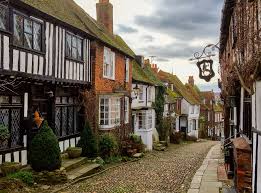
(Side note: can’t you just see Lucia queening it in that garden?)  Mallards was not-so-secretly modeled after Lamb House, possibly the most literary house in the literary town of Rye.  It was E. F. Benson’s house, and before that, belonged to Edith Wharton’s on-again-off-again bestie, Henry James.  In a town that is lousy with literary landmarks, Lamb House (a.k.a. Mallards) is the perfect writer’s residence: as Benson so appealingly describes, in addition to its charming gardens it has a large window overlooking the street, at which the writer – or social coordinator – can sit and observe everything worth noting that happens in the town.  Indeed, there are many – many – conspiracies unwound and plots hatched while Miss Mapp and Queen Lucia, respectively, watch furtively out the window and spin their wheels.

Miss Mapp rents Mallards out and moves into Diva Plaistow’s house, who moves into Quaint Irene’s cottage, and so on and so forth.  When Lucia expresses an interest in Mallards, Mapp is delighted – not only can she take the newcomer for all she’s worth (jacking up the rent without telling her neighbors, in order to keep a bigger profit margin for herself), but she can use Lucia to bolster her own social credibility.  Mapp plans to take Lucia under her wing and be responsible for introducing the most fascinating new temporary resident Tilling has hosted in recent memory.  And of course, with Lucia looking to Mapp for direction on the Tilling social scene, Mapp will be the undisputed queen of the landscape.

There’s just one problem: Miss Mapp has not reckoned on… Lucia.

She turned her thoughts toward Elizabeth Mapp.  During those ten days before Lucia had gone to Riseholme for the fete, she had popped in every single day; it was quite obvious that Elizabeth was keeping her eye on her.  She always had some glib excuse: she wanted a hot-water bottle, or a thimble or a screwdriver that she had forgotten to take away, and declining all assistance would go to look for them herself, feeling sure that she could put her hand on the item instantly without troubling anybody.  She would go into the kitchen wreathed in smiles and pleasant observations for Lucia’s cook, she would pop into the servants’ hall and say something agreeable to Cadman, and pry into cupboards to find what she was in search of.  (It was during one of these expeditions that she had discovered her dearest mamma’s piano in the telephone-room.)  Often she came in without knocking or ringing the bell, and then if Lucia or Grosvenor heard her clandestine entry, and came to see who it was, she scolded herself for her stupidity in not remembering that for the present, this was not her house.  So forgetful of her.

There’s immediate friction.  Miss Mapp frequently forgets that she has rented out her house – and therefore doesn’t have a right to walk in and out with impunity – and often comes barreling in on Lucia without invitation.  (A terrible habit for a landlord.  I speak from experience.)  Lucia fixes that situation cleverly and to great comedic effect… but the result is that Miss Mapp sours on her tenant, and soon they’re entirely at cross-purposes.
‘Things are beginning to move, Georgie,’ said she, forgetting for the time the impending tragedy.  ‘Nightmarches, Georgie, manoeuvres.  Elizabeth, of course.  I’m sure I was right, she wants to run me, and if she can’t (if!) she’ll try to fight me.  I can see glimpses of hatred and malice in her.’

‘And you’ll fight her?’ said Georgie eagerly.

‘Nothing of the kind, my dear,’ said Lucia.  ‘What do you take me for?  Every now and then, when necessary, I shall just give her two or three hard slaps.  I gave her one this morning: I did indeed.  Not a very hard one, but it stung.’
‘No! Do tell me,’ said Georgie.

There are skirmishes, even battles.  Lucia often prevails, but Miss Mapp scores her share of points, too.  (Mapp, it turns out, is a much more formidable opponent than Daisy Quantock.)  The characters in Tilling take sides, and it appears the entire town will soon be at war.  Miss Mapp has one consolation: she’s only rented Mallards for the season.  When August comes, Lucia will take herself, her piano-playing, her faux Italian speaking, and her eccentricities back to Riseholme.  Right?!?!

‘Mapp, there’s news for you,’ said Irene, remembering the luncheon-party yesterday.  ‘You must guess: I shall tease you.  It’s about your Lulu.  Three guesses.’

‘Not a relapse, I hope?’ said Elizabeth brightly.

‘Quite wrong.  Something much nicer.  You’ll enjoy it tremendously.’

A look of apprehension had come over Elizabeth’s face, as an awful idea occurred to her.

‘Dear one, give over teasing,’ she said.  ‘Tell me.’

‘She’s not going away at the end of the month,’ said Irene.  ‘She’s bought Grebe.’

Blank dismay spread over Elizabeth’s face.

‘Oh, what a joy!’ she said.  ‘Lovely news.’

But here, again, Mapp does not reckon on… Lucia.  After one final triumph in Riseholme (I won’t tell you what it is, because it’s absolutely delicious and you should read it for yourself) Lucia determines that she has no further heights to which she can aspire in Riseholme.  In short, she’s won.  And an energetic woman like Lucia is not content to simply rest on her laurels.  She needs something in which to interest herself – a challenge.  Having vanquished Daisy Quantock and conquered Riseholme once and for all, Lucia turns her attention to Tilling and Miss Mapp, and she decides to take up residence… permanently.

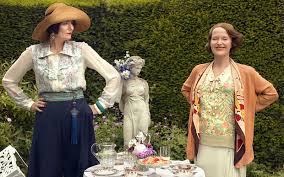
Photo credit: The Independent

(Fun fact: there is a recent – 2014 – TV adaptation of the books, in which Lucia is played by the fabulous Anna Chancellor, who memorably portrayed megabitch Caroline Bingley in the ultimate adaptation of Pride and Prejudice, the 1994 BBC miniseries starring Colin Firth, and who also happens to be a six-times great-niece of Jane Austen.  I have not watched it yet, because I want to read through all of the books first.  But it’s on my list.)

Hijinks ensue, as you can imagine.  Parties are given; plots are hatched; social calamity is skirted and averted.  (There is also an amusing side plot in which both Lucia and Georgie worry that the other is falling in love with them, unrequited.)  There are battles fought, won and lost, over that precious commodity – the recipe for Lucia’s famous Lobster a la Riseholme.  (It is Tilling custom to freely share recipes.  Lucia doesn’t seem to understand that, and Miss Mapp cannot, simply cannot, abide this failing.)

And the Lobster a la Riseholme proves to be very important indeed, as it prompts the ultimate calamity when Mapp sneaks into Lucia’s new kitchen to steal the recipe on the day after Christmas.  I won’t tell you what happens, except to say that it is both thrilling and slapstick.  And I’ll tantalize you with this tidbit, which is sure to intrigue:

Again Georgie uttered woe like Cassandra.

‘There’s something coming,’ he cried.  ‘It looks like a raft with its legs in the air.  And there are two people on it. Now it’s spinning round and round; now it’s coming straight here ever so fast.  There are two women, one without a hat.  It’s Them!  It’s Lucia and Miss Mapp!  What has happened?’

What, indeed?  You’ll have to read to find out, and to find out whether Mapp and Lucia ever bury the hatchet.  Whether they do or not, the reader knows they won’t be able to bury it very deeply.  And that’s lucky for us, because there are two more books in the series.  I, for one, cannot wait to return to Tilling and witness the next skirmishes in the Mapp vs. Lucia war.  Since we all have to choose sides, I’ll come forward and admit: I’m with Lucia.  But really, I’m just in it for a good show, and that’s guaranteed.

Luciaphiles, unite!

The Classics Club Challenge: Lucia in London, by E. F. Benson

I admit I was a latecomer to E. F. Benson’s Mapp and Lucia novels, and that the main reason I picked them up was I was curious about Benson’s hometown of Rye (and its portrayal as “Tilling” in the series) and that on my first go at Queen Lucia I wasn’t entirely enraptured.  I found Lucia grating and the rest of the characters tiresome (or “tarsome,” as Lucia’s once-loyal deputy Georgie Pillson would say).  Then I realized that was exactly what Benson was going for.  Once I recognized Queen Lucia for what it was – a lampooning of social snobbery in all its forms – I picked it up for a second time and enjoyed it immensely, then went straight on to Miss Mapp and enjoyed that even more.  And then I took a long break – too long of a break – from Lucia’s Riseholme and Mapp’s Tilling, always meaning to return.  Return I finally did, stuck in the house waiting for the COVID-19 situation to stabilize and in desperate need of something fun and lighthearted.  Lucia delivered, as I knew that she would.
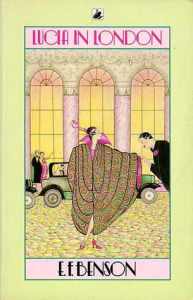
Lucia in London is the third in the Mapp and Lucia series, and the action is really beginning to pick up.  When the novel opens, Riseholme is all atwitter at the news that Peppino – that’s Lucia’s indulgent husband, Philip Lucas – has been left a handsome inheritance by his Aunt Amy.  Georgie Pillson and Daisy Quantock gather for a good gossip and speculation session and wonder how much Peppino has actually inherited.  There’s cash, a house in London, and the rumor of a string of fabulous pearls.  After they turn over all the possibilities, Georgie is dispatched to get the facts out of Lucia, who is putting on an excellent show of being bereaved.

‘Tell me,’ he said, ‘how much do you think it will all come to?  The money he’ll come into, I mean.’

Lucia also threw discretion to the winds, and forgot all about the fact that they were to be so terribly poor for a long time.

‘About three thousand a year, Peppino imagines, when everything is paid.  Our income will be doubled, in fact.’

Georgie gave a sigh of pure satisfaction.  So much was revealed, not only of the future, but of he past, for no one hitherto had known what their income was.  And how clever of Robert Quantock to have made so accurate a guess!

‘It’s too wonderful for you,’ he said.  ‘And I know you’ll spend it beautifully.  I had been thinking over it this afternoon, but I never thought it would be as much as that.  And then there are the pearls.  I do congratulate you.’

Lucia suddenly felt that she had shown too much of the silver (or was it gold?) lining to the cloud of affliction that had overshadowed her.

‘Poor Auntie!’ she said.  ‘We don’t forget her through it all.  We hoped she might have been spared to us a little longer.’

Eventually Lucia gives up her show of being grief-stricken (it’s an elderly aunt-in-law whom they almost never saw, after all) and divulges that they are going to keep the Brompton Square house in London – for Peppino, of course!  His memories, you know, of dear Auntie.  And then there’s the Royal Astronomers’ Society, just the thing for darling Peppino.  Of course it will be a sacrifice for Lucia, who cannot imagine life away from her beloved Riseholme, with its Elizabethan flair and Georgie just nipping across the green to play duets on her piano – dear Beethoven and Mozartino.  But to London Lucia will go.

And to London Lucia does go.  And dives straight into the life of the capital, to Riseholme’s astonishment.  She immediately starts appearing in the social columns – someone named “Hermione” has a beat on Lucia’s every movement – and never seems to miss an opportunity to dine with some luminary or another, even if Riseholme’s most famous part-time resident, the prima donna Olga Bracely, manages to dodge Lucia despite being her Brompton Square neighbor.  It’s not long before Lucia is the toast of London (so exhausting, darling, but think of dear Peppino) and brings a party of her smart new friends down to Riseholme for a weekend, where they proceed to snub the entire town, mock the new History Museum, and generally make asses of themselves.  Naturally E. F. Benson cannot let Lucia get away with this sort of behavior, so you can expect the weekend will devolve, hilariously, into disaster.  I won’t tell you how, exactly.  But suffice it to say: Lucia takes her medicine.

Already she had learned a lesson about that, for if she had only told Georgie that she had been coming down for a weekend, and had bidden him to lunch and dinner and anything else he liked, he would certainly have got Olga to pop in at The Hurst, or have said that he couldn’t dine with Olga on that fateful Sunday night because he was dining with her, and then no doubt Olga would have asked them all to come in afterwards.  It had been a mistake to kick Riseholme down, a woeful mistake, and she would never do such a thing again.  It was a mistake also to be sarcastic about anybody till you were sure they could not help you, and who could be sure of that?

Chastened, Lucia returns to London and to her glittering social circle there.  She has annexed some of the social grande dames, who (along with Hermione, whose identity is revealed during the disastrous Riseholme weekend) call themselves the Luciaphils, because they enjoy her so much.  But she’s not a complete success – her efforts to annex “dear Marcia,” the Duchess of Whitby, prove more challenging than anticipated.  Eventually even “dear Marcia” comes ’round, with the help of Adele, Lady Brixton, the chief Luciaphil.

‘Tell me some more about her,’ she said.

Adele clapped her hands.

‘Ah, that’s splendid,’ she said.  ‘You’re beginning to feel kinder.  What would we do without our Lucia I can’t imagine.  I don’t know what there would be to talk about.’

‘She’s ridiculous!’ said Marcia, relapsing a little.

‘No, you mustn’t feel that,’ said Adele.  ‘You mustn’t laugh at her ever.  You must just richly enjoy her.’

‘She’s a snob!’ said Marcia, as if this was a tremendous discovery.

‘So am I: so are you: so are we all,’ said Adele.  ‘We all run after distinguished people like–like Alf and Marcelle.  The difference between you and Lucia is entirely in her favour, for you pretend you’re not a snob, and she is perfectly frank and open about it.  Besides, what is a duchess like you for except to give pleasure to snobs?  That’s your work in the world, darling; that’s why you were sent here.  Don’t shirk it, or when you’re old yo will suffer agonies of remorse.  And you’re a snob too.  You like having seven–or was it seventy?–Royals at your dance.’

‘Well, tell me some more about Lucia,’ said Marcia, rather struck by this ingenious presentation of the case.

In another day and age, Adele would have been a lawyer.  That’s quite an argument (if rather patronizing) on Lucia’s behalf, and I’m sure I would have been powerless against it – were I not already a dedicated Luciaphil.

‘And then there are lots who will revel in Lucia, and I the foremost.  I’m devoted to her; I am really, Marcia.  She’s got character, she’s got an iron will, and I like strong talkative women so much better than strong silent men.’

‘Yes, she’s got will,’ said Marcia.  ‘She determined to come to my ball, and she came.  I allow I gave her the chance.’

‘Those are the chances that come to gifted people,’ said Adele.  ‘They don’t come to ordinary people.’

I revel in Lucia, too.  Yes, she is a snob, and she can be ridiculous at times – often, in fact.  That’s by design.  Lucia talks annoying baby talk and she thinks she has a right to control the lives of everyone around her, from darling Peppino to the grumbling Riseholmites.  But she is a “strong talkative woman” and much better to cheer her on than to grind her down.  You can’t help but love Lucia and you can’t help but root for her, whether she’s taking London by storm or wrenching control of Riseholme’s committees back from her frenemy Daisy Quantock.  Lucia suffers some humiliating defeats, to be sure, but she learns from her mistakes (which is more than many can say, isn’t it?) and she’s never down for long.  She is, in fact, an icon.

All hail the Queen.