Reading Round-Up: May 2013

Reading is my oldest and favorite hobby.  I literally can’t remember a time in my life when I didn’t love to curl up with a good book.  Here are my reads for May, 2013…

The Chalice (Joanna Stafford #2), by Nancy Bilyeau – The second in what I believe is going to be a trilogy starring aristocratic young nun Joanna Stafford finds the monasteries dissolved, Joanna and her friends trying to live in the real world again, and Henry VIII in search of wife number four.  When some high nobility come to Dartford and sweep cousin Joanna off to London with them, she will become embroiled in political intrigues and be forced to assume her role in a prophecy that promises to change the course of history.  Just like its predecessor, The Crown, this was a quick, engaging and fluffy read – especially if you don’t mind the occasional typo or historical inaccuracy (which, I admit, do bother me).  This would make for a good beach read, as long as you don’t expect too much from it.

Fire in the Blood, by Irene Nemirovsky (audiobook) – I loved Nemirovsky’s unfinished masterwork, Suite Francaise, so I snatched this up at the library when I came across it on the audio shelf.  It’s in far rougher form than Suite Francaise, but with some beautiful writing and fascinating characters.  I loved the portrayal of Silvio, a French hermit who wishes nothing more than to be left alone with his wine and his thoughts, but who is constantly dragged into family dramas.  His musings on life and love were masterful.  I think I would have enjoyed the print version very much, but the narrator of the audiobook was superb.  He was Silvio.  Highly recommended.

The Return of the King (Lord of the Rings #3), by J.R.R. Tolkein – Finally, finally, I’ve completed the long trek that is the Lord of the Rings trilogy!  I’ve been meaning to get to this for ages, and while I enjoyed each volume, The Return of the King was my favorite.  It was nonstop action, thrilling and exciting, and so very satisfying to finish.  I’m planning a bigger post on my impressions of the series later this month.

The Iron King (The Accursed Kings #1), by Maurice Druon – Is this month King-themed, or something?  I had never heard of the Accursed Kings series, which were published in the 1950s in France, until I read an article about their recent reissue.  The book opens with a great drama: the Grand Master Templar and three of his compatriots are being burned at the stake.  As he dies, the Grand Master levies a curse on the Iron King, Philip the Fair, and his line.  The curse begins to take effect almost immediately: Philip’s three daughters-in-law are suspected of adultery, and his ineffectual sons can’t seem to control their wives.  Meanwhile, Philip’s cronies drop one by one, and his hot-blooded daughter Isabella, the unhappy Queen of England, is plotting against her sisters-in-law.  The series covers the Hundred Years’ War and this account of the beginnings of the war was exciting, well-plotted, and historically accurate.  My favorite kind of historical fiction!  I’m now waiting for the next book in the series to come out, and I’ll be snatching it up ASAP.

Beautiful Ruins, by Jess Walter – This would make a phenomenal not-too-fluffy beach read.  A beautifully written story, spanning some fifty-odd years and the space from Italy to Hollywood, Beautiful Ruins introduces a cast of lovably broken characters and follows their life stories.  A dying Hollywood starlet, an idealistic young Italian hotelier, a grizzled veteran turned writer, a Hollywood producer and his disillusioned assistant drift through their own life movies, bumping into one another as they go.  Lovely story and beautiful writing.  Fully reviewed here.

Billy Lynn’s Long Halftime Walk, by Ben Fountain – The book jacket described this book as “Catch-22 for the Iraq War,” and it got so much good press that I had to check it out.  File this one under “incredible but uncomfortable.”  Ben Fountain holds a mirror up to the American media culture as he depicts a squad of soldiers, the heroes of a battle in Iraq, on the last stop of their victory tour.  They are mobbed by well-meaning citizens who thank them for their service in kindly but clueless ways and are forced to rub elbows with the Dallas Cowboys owner and his cronies, all of whom want a piece of the glory – which, for Bravo squad, isn’t really glorious at all.  Ben Fountain perfectly captured the fawning media attention and opened a window into a soldier’s mind.  I squirmed, but they were worthwhile squirms.

The Lightning Thief (Percy Jackson and the Olympians #1), by Rick Riordan (audiobook) – I wanted something light and fun and Potter-esque for my drives to work this month, because things have been kind of overwhelming, so I grabbed the first two Percy Jackson books.  I’m not wild about the audio production, but the story is gripping and such fun.  Percy and his friends are half-bloods, or demigods – sons and daughters of a Greek god and a mortal.  The gods are still very much alive and active and causing trouble.  When the book opens, Percy doesn’t realize his true parentage, although it’s obvious to the reader from the very beginning who his dad is.  (I won’t give it away, for those who haven’t read the book, but the symbol of the series makes it pretty obvious even before you crack the spine.)  I’m already halfway through the second in the series – on audiobook again – and Percy and pals are making my commutes so much more fun.

Most of May, I thought, was pretty slow on the book front.  But looking back, I’ve done some good reading – even despite some long workdays and some weekends given over to entertaining this month.  In addition to these, I’ve been working my way through Villette for the #villettealong, but as of May 31st I hadn’t finished it, so it will appear in my June round-up.  The beginning of June looks much the same as the month of May – lots of work hanging over my head, so reading time is at a premium.  But once I get past this week, I think things will quiet down for awhile, and I’m anticipating some good, relaxing bookish afternoons ahead.  I have a big library stack to get through, so I’ll need them.
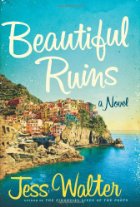
BEAUTIFUL RUINS

Beautiful Ruins(Source)

Porto Vergogna in 1962 is a tiny, backward fishing village on the Ligurian coast in Italy.  No one comes here.  It’s a forgotten place, neglected, mocked by its flashier neighbors – the five tourism-driven villages of the Cinque Terre.  The only visitor is one Alvis Bender, an American World War II veteran who comes for two weeks each year to work on his novel.  After eight years, he has still only finished one chapter.  But Pasquale Tursi, the young proprieter of Porto Vergogna’s only guest house, the Hotel Adequate View, believes that his town could be the next big destination for American tourists.  Pasquale is determined to turn Porto Vergogna into a world-class resort.  He plans a beach, and a tennis court hewn from the rocky cliffs overlooking the ocean.  And it’s in working on his beach that Pasquale is engaged when a boat pulls up carrying the most beautiful woman he’s ever seen.  Dee Moray is an American actress, cast as a lady-in-waiting to Elizabeth Taylor in Cleopatra, which is currently filming in Rome, and she is dying.  She has come to Porto Vergogna to wait for a man, and Pasquale takes her on as a guest at the Hotel Adequate View.

Some sixty years later, an old Italian man turns up at the Hollywood studio of Michael Deane, a famous producer, looking for the beautiful woman who stayed in his hotel many years ago.  What happened in 1962, and between times, and now, is the subject of this gorgeous, atmospheric novel.

I realize I’m late with this, because Beautiful Ruins has already made the rounds of the book blogs, and been praised from here to kingdom come.  But I’ve only just gotten around to reading it, so I want to talk about it now, and now’s as good a time as any and better than most because this would make a fantastic beach read.  The settings: primarily the sun-drenched Italian coast in 1962, and the perpetual summer of present-day Hollywood, are hot and beachy.  And the writing will immediately pull you in, and you’ll feel the warm sea water lapping around Pasquale as he heaves rocks to create his beach, and the sun pounding down on Pasquale and Dee as they hike into the hills, and the heat shimmering off the stones of Rome as Pasquale searches for Michael Deane on Dee’s behalf. 

It’s not just the setting, either.  You will share Pasquale’s hopes and dreams as he tries to fulfill his late father’s greatest wish: to make Porto Vergogna into a destination.  You will chuckle as Dee, ignorant of Italian, politely thanks Pasquale’s Aunt Valeria as Aunt Valeria heaps insults on her in Italian.  You will shake your head at Michael Deane, but you will also recognize present-day Hollywood in him and his disillusioned assistant.  You will fall headlong into this world that Jess Walter has created.

Let me also say one thing about the writing: it’s brilliant.  It’s atmospheric and lovely, yes, but also insightful.  The theme of the book is the stories that we create in our own lives.  For instance, Alvis Bender – who loves to lecture – tells Pasquale:

“Stories are people.  I’m a story, you’re a story… your father is a story.  Our stories go in every direction, but sometimes, if we’re lucky, our stories join into one, and for awhile, we’re less alone.”

“But you never answered the question,” Pasquale said.  “Why you come here.”

Bender pondered the wine in his hand.  “A writer needs four things to achieve greatness, Pasquale: desire, disappointment, and the sea.”

“That’s only thee.”

Alvis finished his wine.  “You have to do disappointment twice.”

All of the characters in this novel could be writers.  They all experience desire, disappointment, the sea, and disappointment.  And in a sense, they are all writers, because they’re constantly crafting their own life stories, even while they wait, as Dee would say, for their movies to start.  And fortunately, Jess Walter must have also experienced desire, disappointment twice, and the sea, because Beautiful Ruins is a great achievement.

Buy the book here, or support your local indie bookstore!  (Not an affiliate link.)

Reading Round-Up: April 2013

Reading is my oldest and favorite hobby.  I literally can’t remember a time in my life when I didn’t love to curl up with a good book.  Here are my reads for April, 2013…

News from Heaven: The Bakerton Stories, by Jennifer Haigh – I was already a fan of Jennifer Haigh’s work, having read her novels Faith and Baker Towers , and I was excited to return to Bakerton in this volume of short stories.  The stories didn’t disappoint: many of my favorite characters from Baker Towers reappeared and the writing was lyrical.  Fully reviewed here.

The Crown (Joanna Stafford #1), by Nancy Bilyeau – The first in a series (or trilogy? I’m not sure) starring Joanna Stafford, an aristocratic novice nun during the time of Henry VIII, this was a relatively engaging read.  It’s a plot-driven book that goes quickly and would make for a good summer read.  There were a few typos, which got to be a bit distracting.

Tiny Beautiful Things: Advice on Love and Life from Dear Sugar, by Cheryl Strayed – You might think you have problems in your life, and then you read the letters to Dear Sugar and the responses sent back by Cheryl Strayed, and you realize that you actually don’t have problems, after all.  The writing was beautiful, and the letters were searing.  If you’re going to read this one, have a box of tissues handy.

Honor, by Elif Shafak – I was excited to read this family saga, immigrant epic, and account of an honor killing in London in the 1970s, but it turned out I had a hard time getting into it.  The characters didn’t really engage me and some of the sub-plots just seemed extraneous.  Good writing, though.

The Sweetness at the Bottom of the Pie (Flavia de Luce #1), by Alan Bradley – I’ve been looking forward to starting the Flavia de Luce novels and I wasn’t disappointed.  Flavia, an 11-year-old diabolical chemist who lives in a manor house outside an English village in 1950, dedicates her life to studying poisons and tormenting her two older sisters (don’t worry, they give as good as they get).  So Flavia’s life is pretty tame – that is, until she stumbles across a body in the cucumber patch.  Armed with her extensive knowledge of chemistry and her trusty bike, Gladys, Flavia will help the police solve the crime whether they want her assistance or not.  Such fun!

People of the Book, by Geraldine Brooks – I loved March, and the premise of this book – tracing the history of a rare Haggadah back to its creation – fascinated me.  The historical parts of the book were extremely well-written and fascinating.  The present-day (well, 1990s) plot, focusing on the grating book conservator, her hyper-critical mother and her dysfunctional relationship with the rare-books librarian who rescued the Haggadah, was less engaging.  The characters were unrealistically accomplished and most of them were highly irritating.  Read it for the historical plots; skim the present-day plot.  (“Read” as an audiobook.)

Walking Home: A Poet’s Journey, by Simon Armitage – I threw this one across the room when I was finished.  Most of the book was good – funny in parts, with great descriptions of the scenery Armitage encountered while walking the Pennine Way backwards, from Scotland to the English Midlands.  But the ending was infuriating, and it made me hate the whole book.

Queen Victoria ’s Book of Spells: An Anthology of Gaslamp Fantasy, ed. Ellen Datlow – This one was spotty for me.  I enjoy the gaslamp fantasy genre (I’ve read and loved Jonathan Strange and Mr Norrell and The Ladies of Grace Adieu by Susanna Clarke, and The Night Circus, by Erin Morgenstern, all good examples of gaslamp) but not all of the stories in this collection hit my sweet spot.  Some did: the title story, “Queen Victoria’s Book of Spells,” was great, and I also loved “The Vital Importance of the Superficial,” “Estella Saves the Village,” and especially Catherynne M. Valente’s contribution, “We Without Us Were Shadows” – which set the young Bronte siblings in a magical world of their own creation and so obviously was going to be the crown jewel of the collection, for me.  Some of the other stories were engaging, but horrifying, and others fell completely flat.  Glad I read it, though – it was worth it just for the four stories I’ve named.

The Perfect Meal: In Search of the Lost Tastes of France, by John Baxter – It’s been awhile since I read a foodie memoir, and this one perfectly scratched the itch.  Learning that the UN has declared the traditional French repas, or banquet, to be a treasure of world cultural history, writer and Paris transplant John Baxter goes in search of the near-extinct French recipes, in an attempt to create the perfect repas in his mind.  Along the way he discusses coffee, bouillabaisse, moules, truffles and more.  I loved this, and highly recommend it with one caveat: DO NOT read the chapter “First Catch Your Elephant,” about what Parisians ate during the siege of 1870-71, while eating lunch.  Learn from my mistakes.

The Sunshine When She’s Gone, by Thea Goodman – It’s rare that I come across a book that I truly detest, but this was one.  First of all, it’s billed as a comedy: don’t be fooled.  There is nothing funny about this book.  The plot description grabbed my attention right away: a new dad, looking to give his exhausted wife a break, decides to take his baby daughter out to breakfast.  When the corner deli is closed, he hops on a plane to Barbados … as one does, I suppose.  Mom wakes up after having blissfully slept through the night to find Dad and the baby gone.  While Dad copes with being on his own with the baby for the first time, he dodges Mom’s calls and leaves her occasional voicemails lying about his whereabouts.  Meanwhile (spoiler alert), Mom promptly sleeps with her ex-boyfriend.  When Dad (spoiler alert) comes home, as we all knew he would, he’s pretty mad to discover Mom’s activities during his absence; angst ensues.  At that point, I felt like sitting the characters down and saying: “You’re an adulteress, and you’re a kidnapper.  You’re both disgusting. Can you just call it even?”  The book promised a fun romp with an underlying theme of two people learning about what it means to be first-time parents, and trying to hang onto a bit of their own identities outside the parent mold.  Well, it wasn’t a fun romp, and if your identity outside the parent mold is doing drugs and sleeping around… um, I can’t relate to that.  Skip this one.

Never Let Me Go, by Kazuo Ishiguro – I listened to this as an audiobook, and was thoroughly creeped out (in a good way) within five minutes.  Kathy H, the narrator, is recounting her life story, starting with her time at Hailsham, an exclusive boarding school in England .  However, there is something very dark, and very wrong, lurking behind Kathy’s seemingly idyllic childhood.  Almost immediately upon beginning the book, you know that there’s weirdness afoot, and it just gets weirder and weirder.  As Kathy describes life at Hailsham and her complicated relationship with her two best friends, Ruth and Tommy, the creeping sense of dread turns to full-on nightmare, made all the more nightmarish by Kathy’s matter-of-fact narrative style and the reader’s dawning realization that she doesn’t even question the “role” that she’s been groomed for.  There’s so much stuff here: stuff about coping with your own mortality, stuff about science and government and ethics.  Look for a full review to come, because WOW.  It’s not a comfortable read, but it’s amazing. (“Read” as an audiobook.)

At Knit’s End: Meditations for Women Who Knit Too Much, by Stephanie Pearl-McPhee – After listening to Never Let Me Go, I needed something lighter, and I also was out of library audiobooks, so I had to delve into my own very small collection.  (I have three: this and two Harry Potter books.)  At Knit’s End is short, sweet and funny.  I’ve read the book before, and I’d listened to the audiobook before, and it proved to be a good rest from the two intense books I listened to this month.  It’s a collection of quotations with related thoughts about knitting, and cute anecdotes from the Yarn Harlot’s life sprinkled throughout.  Fun and relaxing.  (“Read” as an audiobook.)

Akhmatova (Everyman’s Library Pocket Poets), by Anna Akhmatova – This collection of poems by Anna Akhmatova was one of my chosen ways to celebrate National Poetry Month.  (I also read a book of A.A. Milne poems to Peanut, subjected you all to another selection from my beloved e.e. cummings, and read Walking Home: A Poet’s Journey, which was… okay.)  I loved getting to know a new poet, and Akhmatova is a remarkable talent.  More thoughts on her, and one of my favorites from the selection, coming next week.

I’m sort of amazed at the reading I was able to accomplish this month.  For those who don’t know, hubby’s work schedule changed at the beginning of the month and I no longer have the luxury of someone else driving me to work – hence the audiobooks.  But between lunch, evening reading after putting Peanut to bed, and weekend stretches (during naps) I still managed to breeze through ten books, in addition to the three audiobooks.  My reading was spotty: I had a few books that I really enjoyed, like News from Heaven, The Sweetness at the Bottom of the Pie, and The Perfect Meal.  Others were uncomfortable, but good: Tiny Beautiful Things and Never Let Me Go jump to mind.  But there were other books that I enjoyed for stretches and disliked for stretches, and one that I truly hated.  Next month, I’m planning to show a little more restraint at the library and read some books I already own, and I’m pumped about the choices I’ve got set aside!

Ending My Journey (For Now) With Mma Ramotswe

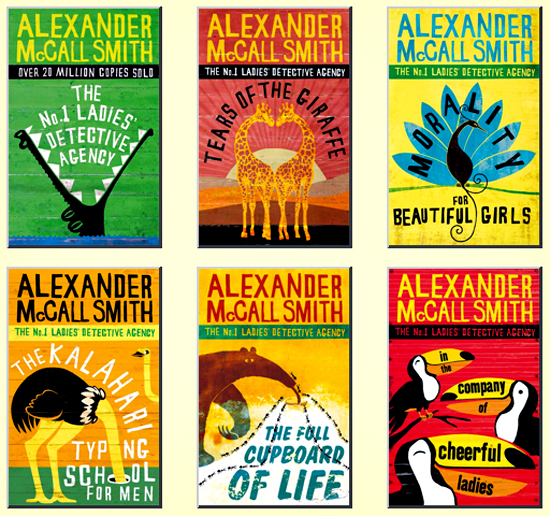
No 1 Ladies Detective Agency Books (Source)

Recently I wrapped up the thirteenth and final (for now) book in the No. 1 Ladies’ Detective Agency series, The Limpopo Academy of Private Detection and, in doing so, closed the book on a group of characters I’ve grown to love.  There’s Mma Precious Ramotswe, traditionally built lady, tea lover, and proprietress of the only private detective agency in Botswana.  Mma Grace Makutsi, her loyal (although sometimes a bit envious) secretary-turned-assistant-detective, and of course, Mma Makutsi’s pithy “talking” shoes.  Mr. J.L.B. Matekoni, the finest mechanic in Botswana, and Mma Ramotswe’s love interest.  And the side characters: Charlie and Fanwell, the two feckless apprentices serving under Mr. J.L.B. Matekoni; Mr. Phuti Radiphuti, Mma Makutsi’s love interest; the treacherous Violet Sephotho; sweet Motholeli and challenging Puso; mild Mr. Polopetsi; and of course, the indomitable Mma Potokwame.

The mysteries themselves are usually fairly mild, even a bit tepid – not nearly the intellectual puzzles expected from an Agatha Christie or Dorothy L. Sayers novel.  They’re background, more than anything else: they provide the stage on which the characters can act out their everyday dramas.  Indeed, the plots usually focus more on the lives of the characters, and their problems and encounters are far more interesting than the central mysteries.  When will Mma Ramotswe and Mr. J.L.B. Matekoni finally marry?  What about Mma Makutsi and Phuti Radiphuti?  Will Charlie ever show even the slightest bit of initiative – or will he forever be a stain on the good reputation of Tlokweng Road Speedy Motors?  And oh no, Mma Potokwame has brought by an entire fruitcake – what will she rope poor Mr. J.L.B. Matekoni into fixing for her now?

I have an odd little reading quirk: I’m a mystery monogamist.  I can’t seem to read two mystery series at the same time, so I’ll either wait to start a new series until I’ve finished the current one, or I’ll throw one completely over in favor of another.  (That’s what happened to Mma Ramotswe & co. when I discovered Maisie Dobbs.)  For a few weeks now, I’ve been itching to start reading the Flavia de Luce novels, but I was so deep into the No. 1 Ladies’ Detective Agency that I decided to finish those first, and now that I have, I’m a little bit sad.  These people have become friends, and I’m going to miss them.

I’m going to miss Mma Makutsi’s shoes and their snarky commentary, not to mention the way they call her “Boss.”  I’m going to miss Mr. J.L.B. Matekoni’s musings on all things mechanical, and the way Mma Potokwame is completely dedicated to the orphans in her care, and the spirited arguments between Mma Makutsi and the apprentices.  And I’m especially going to miss Mma Ramotswe’s “traditionally built” wisdom, her ruminations on the power of tea to cure all ills (we have that in common), her incessant references to Clovis Andersen and his book The Principles of Private Detection, and especially her penchant for adding the phrase “That is well known” to her own statements of opinion, or else attributing common-sense quotes – which she makes up on the spot – to Sir Seretse Khama.

I wish that I could meander down the Gaborone street and pop by the detective agency – on donut day, of course.  Or that I could sit with Mma Ramotswe on her porch, savoring a cup of red bush tea and looking out at the pumpkins growing ripe and round in her garden.  But it’s nice to imagine that, somewhere, my friends are living their full, busy lives.  Mma Makutsi is shopping for shoes.  Mr. J.L.B. Matekoni is fruitlessly trying to convince Mma Potokwame to replace a piece of vintage machinery at the orphan farm.  Charlie is cruising for dates, and he’s dragged poor Fanwell along with him.  And Mma Ramotswe is sitting at her kitchen table, helping Motholeli and Puso with their homework while a big pot of stew bubbles nearby, her hands curled around her thirtieth cup of red bush tea of the day.

Peanut’s Picks: WHEN WE WERE VERY YOUNG

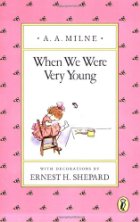
When We Were Very Young (Source)

My mom says it’s National Poetry Month and that this means I should share with you some poetry.  (Is it only a month?  Feels like it’s been about an eighth of my life.  Oh, wait…)  Anyway, I like poetry a lot.  It’s kind of like songs, except there’s no key for my mom to wander in and out of.  (Mommy, I love you, but let’s leave the singing to Auntie Em, okay?)

So for National Poetry Decade Month, Mommy and I decided to read a book of poems together.  Mommy let me pick (okay, that’s a lie) and I chose When We Were Very Young, by A.A. Milne.  Mommy says that was a good choice, because I am very young.  Mommy and I have been reading a few poems most days and then we discuss them and I ask questions like:

Where is Buckingham Palace?  Why have you not taken me there?

Can I have a puppy?

What is rice pudding?  It sounds terrible.

Why won’t the doctor just leave the dormouse alone?  NICU flashback!

What is a knight?  Is that another word for bedtime?

Can I have tea?

Then Mommy explains to me that Buckingham Palace is in England and I can’t go there until I learn to travel without going on hunger strikes (but that doesn’t sound fun), that no I can’t have a puppy (why not?!), that rice pudding is what it sounds like and not too terrible, that she doesn’t know why the doctor won’t leave the poor dormouse alone, that a knight goes on adventurers and that I’m too young for tea.  And more stuff too.  Mommy is very good at explaining poetry.

Also, she said I could pick a favorite poem from the book and share it with you.  Obviously, I picked Puppy and Me, because puppies!

Puppy and Me

I met a Man as I went walking;
We got talking,
Man and I.
“Where are you going to, Man?” I said
(I said to the Man as he went by).
“Down to the village, to get some bread.
Will you come with me?” “No, not I.”

I met a Horse as I went walking;
We got talking,
Horse and I.
“Where are you going to, Horse, today?”
(I said to the Horse as he went by).
“Down to the village to get some hay.
Will you come with me?” “No, not I.”

I met a Woman as I went walking;
We got talking,
Woman and I.
“Where are you going to, Woman, so early?”
(I said to the Woman as she went by).
“Down to the village to get some barley.
Will you come with me?” “No, not I.”

I met some Rabbits as I went walking;
We got talking,
Rabbits and I.
“Where are you going in your brown fur coats?”
(I said to the Rabbits as they went by).
“Down to the village to get some oats.
Will you come with us?” “No, not I.”

I met a Puppy as I went walking;
We got talking,
Puppy and I.
“Where are you going this nice fine day?”
(I said to the Puppy as he went by).
“Up to the hills to roll and play.”
I’ll come with you, Puppy,” said I.

Lesson for parents: I need a puppy!

When We Were Very Young (by A.A. Milne) is puppy-rific!  Buy a copy here!

NEWS FROM HEAVEN

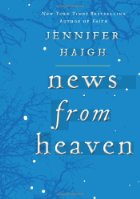
News from Heaven (Source)

Bakerton, Pennsylvania , could be Anywhere, USA .  It’s a coal-mining town that struggles to redefine its identity after a tragic accident and the 1970s strip away the business that has sustained the residents for decades, in Baker Towers (reviewed here).  It’s also home to dozens of families filled with complex characters: the Bernardis, the Lubickis, the Stusicks, and especially the Novaks, who were the novel’s main focus.

Baker Towers was a critically acclaimed novel that won Jennifer Haigh plenty of fans.  I was already a fan, having read her most recent novel, Faith, and enjoyed it immensely.  But I felt an even stronger connection to the characters in Baker Towers, and their story resonated with me in particular because of my academic background; I majored in labor relations, and the story of a blue-collar company town fraying at the seams during the recession of the 1970s was familiar.  So having felt at home in Bakerton before, I was thrilled to learn that the author had just released this collection of short stories set in, around, or in relation to my favorite fictional coal-mining town.  (By the way, it’s not necessary to have read Baker Towers in order to enjoy News from Heaven, but if you have, you’ll recognize many of the characters from the novel.)

The stories themselves are lovely, managing to be both gritty and luminous at the same time.  There’s the tale of Annie Lubicki, who moves to New York City to be a live-in maid to a Jewish family and forges an unexpected connection there; there’s a glimpse into the life of a lonely schoolteacher who rediscovers a little of her femininity while doing some Christmas shopping; there’s a redemptive story about a man who returns to attend his parents’ fiftieth wedding anniversary; there’s so much more.  And there are several stories featuring the Novak kids, and particularly practical Joyce, who was my favorite.  (How I identified with her overwhelming sense of duty and responsibility.)

News from Heaven only contains ten stories, but all ten will tug at the reader’s heartstrings.  I know these people.  Their lives seem small, but they’re rich and full and heartbreaking and inspiring.  Highly recommended.

News from Heaven, by Jennifer Haigh: available here, or support your local indie!  (Not an affiliate link.)

Reading Round-Up: March 2013

Reading is my oldest and favorite hobby.  I literally can’t remember a time in my life when I didn’t love to curl up with a good book.  Here are my reads for March, 2013…

The Miracle at Speedy Motors (No. 1 Ladies’ Detective Agency #9), by Alexander McCall Smith – Another sweet installment in the adventures of Precious Ramotswe & co.  Mma Ramotswe is busily investigating her latest case, that of a woman who is looking for her family but doesn’t know her name or where she was born.  Mma Makutsi, meanwhile, is negotiating another relationship hurdle: her wealthy fiance, Mr. Phuti Radiphuti, has bought her a bed but, inadvertently, it was left in the rain and ruined.  Should Mma Makutski come clean, or should she try to replace the bed on her own?  I’ve come to care about these characters, and I always enjoy visiting with them.

How the Light Gets In, by M.J. Hyland – Meh.  I read this book – about a troubled foreign exchange student – because it was on “Rory’s Book List” from Gilmore Girls, and I’ve been on a GG kick lately as my sis-in-law discovers Stars Hollow for the first time.  But I have to disagree with Rory on this one.  The writing was a little too Salinger-esque for me, but not in a good way (only Salinger himself can pull off that level of teen angst) and I just didn’t care about the protagonist.  I found her exasperating, irritating, and a whole mess of other things that end with -ing.  Not for me.

Mrs ‘Arris Goes to Paris, by Paul Gallico – Much better!  Mrs ‘Arris caught my eye on the “1001 Books to Read Before You Die” list because the title was so cute.  I’m so glad I discovered this one.  The jaunts of a London charwoman in Paris – where she has come to buy herself a Dior dress after two years of scrimping, just for the pure joy of owning something beautiful – were sweet, charming and uplifting.  I’ve been recommending this one to everybody, and I’ll recommend it to you, too.  It’s 150 pages, the work of an afternoon, and such a jolly romp.

Cloud Atlas, by David Mitchell – Another one from the “1001 Books” list, and WOW.  This book blew. my. mind.  Six stories, each remarkably different – different form, different style, different tone – all tied together via literary tricks and possible reincarnation.  The skill that went into this book is incredible, and the stories are each so captivating.  I don’t want to talk too much about the structure of the book, since that would be giving too much away, so I’ll just say that it was so fresh, so unique, and – I think – absolute genius.  Plus there were several twists that really shocked me (and I can usually smell a twist coming 100 pages away), including one absolute bombshell that left me on the floor.  Literally.  I fell out of my chair.

Tea Time for the Traditionally Built (No. 1 Ladies’ Detective Agency #10), by Alexander McCall Smith – Okay, I keep saying this, but I think this was my favorite Precious Ramotswe mystery yet.  Mma Ramotswe has been called upon by a football (soccer, for my American friends) magnate to find out what is wrong with his team.  They’re a good team, with plenty of talent, but they keep losing (sound familiar, Sabres fans? ugh, I don’t want to talk about it) and the owner thinks there’s a traitor in their midst.  Mma Ramotswe knows nothing about football, but she’ll get help from an unlikely assistant detective: her young foster son, Puso.  Meanwhile, Mma Makutsi has her own problems: the treacherous Violet Sephotho has gotten a job at the Double Comfort Furniture Store and is trying to poach the proprieter, Mr. Phuti Radiphuti, from his rightful fiancee.  Ultimately, Mma Makutsi will get her help from an unlikely quarter as well.  I loved this one.  Seeing Mma Ramotswe out of her depth at a football game was classic, and I loved that she teamed up with Puso to solve the football mystery.  And Violet Sephotho is a bad, bad lady.

The Girl Who Fell Beneath Fairyland and Led the Revels There (Fairyland #2), by Catherynne Valente – Back to Fairyland!  I read the first Fairyland installment over the summer and I’m so glad it’s a series, because I was certainly left wanting more.  This second jaunt was even better than the first: the language was less jarring after reading it all through the first book, the story was captivating, and the ending was sweet and hopeful, even more so than the first.  Just wonderful.  I hope there are many more to come!

The Double Comfort Safari Club (No. 1 Ladies’ Detective Agency #11), by Alexander McCall Smith – This was a particularly fun installment, as Mma Ramotswe and Mma Makutsi journeyed into the Okavango Delta to track down a safari guide who had received a bequest from a grateful past visitor.  The Okavango Delta hadn’t featured in the series before – most of the mysteries take place in Gaborone or the surrounding area, or around the Kalahari – and it was fun seeing Mma Ramotswe in a different place.  (The scene where Mma Ramotswe and Mma Makutsi take a water taxi to the safari camp might be the funniest image in the entire series.)  I looked up the Okavango Delta after reading this and WOW, beautiful.  I now need to plan a trip.

The Saturday Big Tent Wedding Party (No. 1 Ladies’ Detective Agency #12), by Alexander McCall Smith – Mma Ramotswe might just be in over her head this time.  She’s been asked to investigate some cattle killings by a gentleman who seems frightened, but might actually not be – and who, to make matters worse, could potentially be responsible for the crime.  Mma Makutsi is deep into her wedding preparations and, of course, her shoes are causing drama.  And then, as if this wasn’t enough, Mma Ramotswe is being haunted by the ghost of her tiny white van.  Sometimes, the truth isn’t always what it seems to be.

The Limpopo Academy of Private Detection (No. 1 Ladies’ Detective Agency #13), by Alexander McCall Smith – Lots of problems arise in this installment, and they hit close to home.  An unscrupulous businessman on the board of the Tlokweng orphan farm has engineered Mma Potokwame’s unceremonious dismissal from her post which, if you know Mma Potokwame, is unthinkable.  And Fanwell, the younger of Mr. J.L.B. Matekoni’s two apprentices, is in trouble with the law – and after the ladies only just managed to learn his name!  Mma Ramotswe needs all of her ingenuity to right these wrongs, but she has a secret weapon: a tall American stranger who has appeared in Gaborone and who introduces himself as none other than Clovis Andersen, author of The Principles of Private Detection, which Mma Ramotswe and Mma Makutsi can quote ad nauseum.  With Clovis Andersen’s help, Mma Ramotswe can do anything!

Well, I was busy this month.  My reading ran the gamut from a book I genuinely disliked – How the Light Gets In – to one that blew my mind – Cloud Atlas.  And there was Mrs ‘Arris, which was charming and sweet, the latest Fairyland installment, which was magical, and all the time I spent in Botswana with Mma Ramotswe and Mma Makutsi.  I’m now completely caught up on the No. 1 Ladies’ Detective Agency novels and, to be honest, a little sad about that.  I’ve grown to love the ladies and their cohorts – the garage staff, Motholeli and Puso, Phuti Radiphuti, and Mma Potokwame – and I’m going to miss them all.

THE SCARLET PIMPERNEL

The Scarlet Pimpernel(Source)

If you’ve been avoiding The Scarlet Pimpernel because you thought it was some kind of sequel to The Scarlet Letter, hide no more.  The Scarlet Pimpernel is a silly, rowdy, wacky good time.

The time: 1792.

The place: Paris.

The outrage: Entire families of aristocrats, sentenced to the guillotine, are escaping the jaws of Paris, through the most crowded, frequently-used city gates, under the very nose of the French military.

The rescuer: The Scarlet Pimpernel, a mysterious, swashbuckling avenger who sweeps would-be victims practically from the mouth of the guillotine and spirits them to safety in England through a combination of cunning, dashing disguises, and “demned cheek.”

Who is the Scarlet Pimpernel?  He’s a figure of mystery who has captured the imaginations of the entire British people, the hopes of the French aristocracy, and the ire of the bloodthirsty Committee of Safety – who hate losing victims almost as much as they hate being embarrassed.  The French government hatches a brutal plan to capture their No. 1 enemy: they dispatch agent Chauvelin to England to blackmail a certain lady into helping him.  Marguerite St. Just, now Lady Blakeney, is widely known to be a revolutionary sympathizer.  Her brother, however, once a revolutionary himself, has had second thoughts and is now aiding the aristocrats.  Chauvelin gives Lady Blakeney a choice: help him unmask the “demned elusive Pimpernel” or her brother will suffer a traitor’s fate.  Marguerite experiences a momentary pang on behalf of the dashing stranger, but there’s no question: she’ll save her brother.

Until she makes a disturbing discovery: the Scarlet Pimpernel is none other than Sir Percy Blakeney, widely regarded as an indolent but amusing moron, and Marguerite’s husband.  Sir Percy’s mask is so opaque that even Marguerite bought into his disguise and is perhaps more shocked than anyone else to learn of her husband’s double life.  And she learns too late – Sir Percy is off to Calais to rescue an aristocrat whose family he has already led to England, and  in choosing to save her brother from the guillotine, Marguerite has unwittingly sent her husband into a trap.  Marguerite takes off in a panic, running pell-mell in the direction of France, determined to warn Sir Percy of his peril before it’s too late.  Chauvelin, meanwhile, gleefully lays the net he plans to cast around the Pimpernel… Sir Percy will need all of his wits and his “demned cheek” to accomplish his mission and slip from the grasp of the revolutionaries once again.

I don’t know what took me so long to get around to The Scarlet Pimpernel.  It was a riot from the first page to the last.  Laugh-out-loud funny and edge-of-seat exciting, I couldn’t put it down.  Highly recommended, with the caveat that the pivotal scene is a touch racist, so you need to keep in mind the times in which the book was written – but still a fun romp, well worth a read.

The Scarlet Pimpernel, by Baroness Emmuska Orczy, available here (not an affiliate link).

A LONG LONG TIME AGO AND ESSENTIALLY TRUE

A Long, Long Time Ago and Essentially True…

(Source)

In the late 1930s, on top of a hill outside a Polish village called Half-Village, a young man nicknamed the Pigeon sees a beautiful girl for the first time.  He is stricken by the girl’s blonde hair, beautiful face, and the patient way she speaks to his developmentally disabled brother.  The Pigeon soon learns that the girl, who his brother calls “the Angel,” is Anielica Hetmanska, widely considered the most beautiful girl in the village – or any village, for that matter.  The Pigeon is poor and awkward, but he knows that Anielica must be his wife, so he presents himself at her father’s door and courts her using the only thing he has: his carpentry skills.  The Pigeon offers to renovate the Hetmanski family house for free and stone by stone, board by board he builds himself into Anielica’s heart and the Hetmanski family.  But World War II, and then Communism, conspire to delay the day when the Pigeon will finally call Anielica his wife – and even when that day comes, their troubles are far from over.

The story of Anielica and the Pigeon alternates with that of their granddaughter, Beata (nicknamed “Baba Yaga” after a Polish fairytale witch), who is trying to make her way in 1990s Krakow .  Baba Yaga’s Krakow is very different from the Krakow her grandparents discovered in the 1940s.  Energetic and a little frenetic, Krakow – like Baba Yaga – is deciding what it will be now that the future and the “New Poland” have arrived.  Baba Yaga drifts through her city life, buffeted on all sides by her cousin Irena, Irena’s daughter Magda, her coworker Kinga and her boss Stash, and others.  Where does Baba Yaga fit into this New Poland?  This is the question she will have to answer when tragedy strikes and a figure from the past appears without warning in her life.

Now, I would have been interested in this story no matter where it was set.  I’m all about the love-story-with-historical-background, in general.  (I’m referring to Anielica and the Pigeon, who were the stars of the book for me.  Baba Yaga gets more “airtime,” but I didn’t find her as compelling of a character as I did the Pigeon, and especially Anielica – at least, not until the end of the book, anyway.)  But being part Polish myself, I was especially interested, because I thought the book might give me some insights into that part of my heritage.  I don’t know much about Poland – I know that pierogis are delicious (and that I set kitchen fires when I try to make them); I also know that Poland gave the world amazing people like Chopin, Copernicus, and Pope John Paul II; and I’m fairly well-versed in Polish Christmas traditions.  But that’s basically it.  What I know about Polish history, I’ve mostly picked up from the occasional mention in AP Euro and more recently, from fiction (like The Winter Palace, which taught me more about the Polish government of the 1700s than history class ever did – sad, considering the entire novel was set in Imperial Russia).  Poland gets short shrift in fiction, generally, so I was happy to pick up Brigid Pasulka’s ode to the country that she loves.

And it was well worthwhile.  On top of learning more about Polish culture, history and tradition than I have from any source other than my grandmother, I loved the story.  Anielica and the Pigeon share a real, strong, beautiful love and their sad but hopeful tale was lovely to read.  Baba Yaga, too, won me over in the end (not that I ever disliked her – she just wasn’t as interesting to me).  The writing was elegant, but also rang true to the settings and the characters, and the cast of supporting characters (Anielica’s brother and his wife, Irena and Magda, Stash and Kinga, Pani Bozena, Magda’s friends…) were all well-drawn and complex.  I’ll definitely be looking for Brigid Pasulka’s next book.

A Long Long Time Ago and Essentially True, by Brigid Pasulka, available through IndieBound (not an affiliate link).

Peanut’s Picks: A BOOK OF SLEEP

Peanuts Picks Lets Read

Okay, adults, are you ready to talk about a very sad, sad book today?  Get your tissue box ready, because I mean this book is SAD.  I cry every time my mom reads me this book.  Because it’s so sad.

(Source)

The reason that this book is so sad is that at first you think it’s about a triumph of the human owlish spirit.  What happens is, it’s nighttime and everyone goes to sleep except for the owl.  I don’t know why but the owl doesn’t have a naptime or a bedtime or anything, which is SO COOL MOMMY.  Maybe the owl’s mom is just cooler than my mom.  Anyway, it’s night and instead of going to bed the owl PLAYS, OMG MOMMY.  She flies by all these other babies animals and they are all sleeping like chumps.  And the owl just says HA HA YOU GUYS YOU ARE SUCH LOSERS WITH BEDTIMES LOL.

I know what you’re thinking: what is sad about this?  This owl is the luckiest baby owl in the entire world, with NO BEDTIME MOMMY.  The baby owl probably had a bedtime once but she perservered and won and now she has NO BEDTIME MOMMY.  So that’s what pulls you in and makes you think that this is an inspirational book about a baby owl who beat all the odds and got rid of bedtime, which obviously we are all trying to do.

But then.  But then!  I don’t mean to give away the ending but I’m going to give away the ending.  What happens is that all the other animals wake up and the owl FALLS ASLEEP.  I know what you’re thinking: WUT?!?!?!?!  You are so inspiring to me, owl, or you were until you fell victim to NAPTIME.  What is that about?  I don’t know why, but I keep forgetting what happens and getting excited because someone finally BEAT THE NASTY BEDTIME and then the owl just falls asleep and I am crushed all over again by the tragedy of it all.

My mom really likes this book.  She likes the pictures and she likes showing me where the owl is (I humor her by looking because it seems really important to her) and she thinks that it’s some kind of relaxing book that is going to make me go to sleep.  Make me have nightmares, is what I say.  Nightmares about BEDTIME and NAPTIME and THINKING YOU HAVE OVERCOME BUT THEN YOU HAVEN’T OMG SO SAD.  But it is kind of funny that my mom thinks that this book will make me go to sleep.  She keeps on reading it and she likes to read it in a very soft voice that she thinks is soothing but really it just fills me with righteous anti-bedtime rage.  I know there are other babies whose parents are probably doing the same thing, so I would just like to say LOL, ADULTS, stop reading this book because if you really think this is going to put babies to sleep then I want some of whatever is in your bottle.

Lesson for parents: LOL this is a joke, right?

Also: I will never nap I will never nap I will never nap I will never…

Sleeping Angel

Psst, buy the book here if you must, but DOWN WITH BEDTIME.