2014: Bookish Year in Review, Part II

Knox3

If you missed Part I of my bookish 2014 wrap-up, check it out here.  Otherwise, onward to Part II – my top ten books of the year!  Even though I hit a major reading slump this year – a slump that’s still going, much as I try to claw my way out of the hole – I did read some really fantastic books.  Back in July, I shared the ten best books I’d read in the first half of the year, and some of those will be making their appearance on this list too, along with some from the second half of the year.  Read on to see my favorites from 2014, in no particular order:
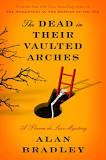
the dead in their vaulted arches The Dead in their Vaulted Arches (Flavia de Luce #6), by Alan Bradley – In the sixth installment of Flavia’s adventures, sleuthing takes a bit of a backseat as Flavia’s lost mother returns home.  Flavia spends a lot of the book learning many, many things she didn’t know about Harriet, and the book ended with the series poised to go in an entirely new direction.  I can’t wait to see what Flavia gets up to next, and I won’t have to wait long – the seventh volume is out this month and I’m already on the wait list for it at the library.
The Writing Class The Writing Class, by Jincy Willet – Another from the first half of the year, The Writing Class is Jincy Willet’s introduction to reclusive writing teacher Amy Gallup.  Amy is a washed-up curmudgeon (once a critically praised writer, her books are now all out of print) who makes a little cash by teaching at the local university extension.  Amy’s classes are unremarkable until one fateful semester, when the group is terrorized by a “writing class sniper,” a class member with a cruel pen, a razor-sharp wit, and a complete disregard for human life.
amy falls down Amy Falls Down, by Jincy Willet – This fall, I read Willet’s second novel featuring Amy Gallup.  Amy Falls Down is a completely different book from The Writing Class, and I loved it, maybe, even more.  In this volume, Amy trips in her backyard and hits her head on a birdbath shortly before she is scheduled to give an interview to a local reporter.  In her concussed state, Amy presents as a complete eccentric, and her bizarre interview launches her career in ways she couldn’t possibly have foreseen.  You don’t have to have read The Writing Class to enjoy Amy Falls Down, although there are occasional references to the earlier book.
henrietta's war Henrietta’s War, by Joyce Dennys – I have a thing for English fiction set between the wars, during, and immediately after World War II, and Henrietta’s War is a perfect example.  Henrietta is the wife of a hardworking Devonshire doctor, mother of two grown children, and penpal to her “dear childhood’s friend” Robert, who is off fighting for King and Country.  In this epistolary novel, Henrietta keeps Robert updated on all the goings-on in their sleepy town.  I fell in love with the characters – some eccentric, all loveable and staunch – and with Henrietta’s breezy, chatty, but sometimes bittersweet letters.
the golem and the jinni The Golem and the Jinni, by Helene Wecker – In 1890s New York City, a golem (a creature made of clay) and jinni (a creature made of fire) meet and become the unlikeliest of friends.  Although they are temporarily torn apart by a violent incident, ultimately, it is only their friendship that can save them from certain destruction.  I have grown to really enjoy the gaslamp fantasy genre, and this was a perfect addition to my reading list.  Wecker’s writing is rich and atmospheric, and the relationship between the golem and the jinni is complex and sweet.

the magician's land The Magician’s Land, by Lev Grossman – This final installment in Grossman’s Magicians trilogy was the best yet.  I liked The Magicians, really liked The Magician King, and LOVED The Magician’s Land.  Quentin Coldwater has been kicked out of Fillory – unfairly, but there it is – and is now trying to live his life on Earth again.  He’s got a new sidekick and a complicated spell to try, but Quentin can’t focus on any of that stuff.  He can only think of the dangerous mission he’s undertaken: to return his lost love, Alice, to life again.  (I’m not going to tell you if it works, because reading about Quentin’s efforts to bring back Alice, and the emotions that went along with that. were the best part of the book.)  Meanwhile, Janet and Eliot are ruling over Fillory, which is facing a crisis of its own.  The characters have all done a lot of growing up over the course of the series – I even liked Janet, which is saying a lot, and for the first time, I adored Quentin.  This conclusion to the trilogy was everything I could have hoped for: rich, satisfying, and perfect.

crocodile on the sandbank Crocodile on the Sandbank (Amelia Peabody #1), by Elizabeth Peters – Miss Marple meets Indiana Jones, is how I can best describe Amelia.  The indomitable Victorian Egyptologist’s first adventure – in which she travels to Egypt for the first time, makes friends, and confronts a mummy – is a fun, spirited romp.  I’ve still only read the first three in this series (of more than twenty!) but I’ll be following Amelia’s adventures for a long time.
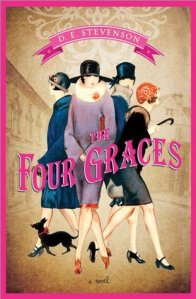
the four graces The Four Graces, by D.E. Stevenson – The British-between-the-wars-gentle-fiction genre is one of my particular reading vices, I’ll admit.  (Well, is it a vice?  Can something so entirely wholesome be a vice?)  So it’s kind of amazing that I’d never heard of D.E. Stevenson until recently.  I loved The Four Graces, the story of one eventful summer in the lives of the Grace sisters – bright Liz, quiet Sal, shy Tilly, and sociable Addie.  There’s romance, overbearing relatives, and a “best ankles” contest – what’s not to love?  There was nothing particularly earth-shattering about the book, but I loved every page.
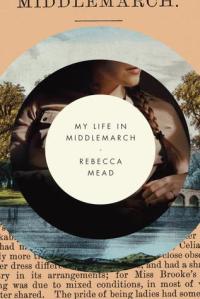
my life in middlemarch My Life in Middlemarch, by Rebecca Mead – Another genre vice: books about books.  I read a few this year, and My Life in Middlemarch was the best.  It’s part history, part memoir, part lit-crit, all delightful.  I loved reading about Mead’s journey through life, viewed through the lens of her favorite book.  And it made me want to re-read Middlemarch, which I last read in 2013 (and also loved, although Jane Eyre still holds the top spot in my particular reader’s heart).
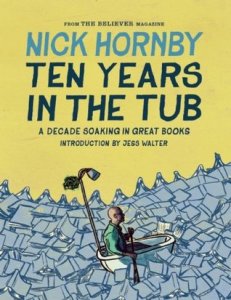
ten years in the tub Ten Years in the Tub: A Decade Soaking in Great Books, by Nick Hornby – One more from the books-about-books genre to close out the year.  I read Hornby’s collection of all of his columns for The Believer over the course of about two months, little by little.  (Fortunately, I was able to knock it out juuuuuuust when I ran out of library renewals.)  Hornby made me cry on just about every page – mostly from laughter, but his writing about his autistic son?  All.The.Feels.  (And sometimes cry-laughs, too, like when he says that his son doesn’t have any spectacular talents unless you count being able to hear a crisps packet being opened from several streets away – snort.  Hornby might be the only writer out there who can poke fun at his autistic kid, but do it so obviously lovingly that you just laugh along with him and wish you could hang out with them both every day.)

There you have it – my top ten!  Although I didn’t have quite the volume of books I’m used to this year, I did read some really wonderful things.  How was your reading year, and what were your favorite books read this year?  I’m working on a TBR for 2015, so please, do share.
Reading Round-Up: December 2014

Reading Round-Up Header

Reading is my oldest and favorite hobby.  I literally can’t remember a time in my life when I didn’t love to curl up with a good book.  Here are my reads for December, 2014

A Merry Christmas, and Other Stories, by Louisa May Alcott – I’ve said it before, Penguin Classics is killing it lately.  No sooner did I complete my Drop Caps collection (still looking for the perfect place to display them) did they introduce Penguin Christmas Classics, and obviously I needed all five.  (I only bought three, though – have to save something for next year.)  One of the gorgeous editions I brought home was Louisa May Alcott’s collection of Christmas stories.  The title piece, “A Merry Christmas,” was actually an excerpt from Little Women, so I’d read it before.  But the rest were new to me and were delightful reads in the Alcott mold – pretty stories of the Christmas spirit with an undertone of feminism and awareness of social inequalities.  I loved them and will be making this a holiday tradition.

No Holly for Miss Quinn, by Miss Read – Another holiday read of mine, for at least the past three years, I had to look in on Miss Quinn again.  I didn’t make time for Village Christmas this year, but I couldn’t let the month pass without a visit to Fairacre.  Quiet, introverted Miss Quinn is hoping for a solitary Christmas to finish painting her living room – but when her sister-in-law fall unexpectedly ill, she is pressed into aunt service.  It’s not the Christmas Miss Quinn was looking for, but what she finds is a holiday filled with the warmth and family joy she’s been missing (and a good dose of respect for what mothers deal with on a daily basis!).  This is one of my favorite Fairacre tales.

Gilead, by Marilynne Robinson – This slim but lovely volume has been on my to-read list for ages, and now that Robinson has just published a third book about the characters first introduced here, I felt I had to read it.  The Rev. John Ames is an aging, dying minister in the town of Gilead, Iowa.  Knowing that he will not be around to raise his young son, he writes instead a long letter filled with the wisdom he has acquired over his years.  It’s a story about love lost and found, and about the relationships between fathers and sons – between Ames’ father and grandfather, between Ames and his father, between his best friend Rev. Boughton and Boughton’s wayward son Jack, and even between Ames himself and Jack – and it is going to have to substitute for a relationship between Ames and his little boy.  It’s a lovely, compelling book and I’m glad I finally made the time for it.

Letters from Father Christmas, by J.R.R. Tolkien – The Amazon recommendations engine strikes again!  This is the second time Amazon has recommended a book to me that I’ve loved.  (I forget the first, but I know it’s happened before.)  I should probably be worried about a computer knowing so much about my reading preferences.  Anyway.  Christmas was a magical time in the Tolkien household, not just for the usual reasons, but because in addition to their gifts the Tolkien children always received a letter from Father Christmas, usually with silly asides from his assistant the North Polar Bear (who, from what I could tell, spent more time causing disasters than he did actually helping out or getting things done), and illustrated with fun, whimsical pictures of the calamities that seemed to hit the North Pole every year.  As the Tolkien children grew older, the letters became more and more elaborate (and on occasion, included goblin attacks!).  Getting to read all of the letters, collected from the 1920s to the 1940s in this little volume, was such a treat.  I can’t wait to share them with Peanut when she’s older.

Well, so ends another year of reading!  It started out well, but it was harder to keep up a good reading pace after returning to work, and especially this fall, when so many things seemed to go wrong all at once that it threw me into my first reading slump in years.  As you can see from the list of four relatively short books here, I’m not out of the slump yet, but I’m still trying.  I won’t make any predictions about what January’s reading will look like – just say that I enjoyed everything I read this month, and I’m so glad I finally got around to reading Gilead, which I’ve been meaning to pick up for a long while.  I hope you had a more productive reading month than I did (but that you had a nice, relaxing holiday) and send you best wishes for 2015 reading!

Reading Round-Up: November 2014

Reading Round-Up Header

Reading is my oldest and favorite hobby.  I literally can’t remember a time in my life when I didn’t love to curl up with a good book.  Here are my reads for November, 2014

The Penguin Book of Witches, ed. Katherine Howe – I started this volume of primary source material about medieval English and colonial American witch trials back in October with the goal of getting it finished by Halloween.  Life intervened and it took me into November to finish it, but I really enjoyed it.  Reading the primary sources was a new and fascinating endeavor – everything from newspaper accounts to letters from overzealous witch-hunting clergy and, my favorite, actual trial transcripts.  It was also sad – the primary source material made so plain how many lives were ruined (some ended) by spite and overactive imaginations.  Katherine Howe also added her own explanations before each item, which placed the historical texts in their proper context and illuminated some of the more opaque parts.  Highly recommended, especially to history nerds and anyone with an interest in the Salem witch trials (and similar witch hunts taking place around the country).

The Fairacre Festival, by Miss Read – I finally found my Fairacre books packed away from my move after hubby set up my bookshelves and I got the chance to dig into the book boxes.  I hadn’t read much all month, but I jumped right into this very slim (103 pages) Fairacre novella and loved re-reading the story of how the village bands together when disaster strikes their beloved St. Patrick’s church.  After an October storm destroys the belfry and part of the nave, Fairacre residents pull together a massive festival to raise funds to repair the church roof.  But the bill is steep and money is tight in all the Fairacre households – will they be able to raise enough money, or will they have to sell off a cherished piece of silver to pay for the repairs?  The Fairacre Festival is one of the shortest in the series, but it’s packed full of tension and drama, and with plenty of Miss Read’s signature dry witticisms sprinkled in – at the expense of Mrs. Pringle, mainly.  I always love a visit to Fairacre and nw I’m thinking of a re-read of the entire series.

Saddest. Round-Up. Ever.  What you see above is ALL I managed to finish in the entire month.  Oh, I started a few more books – The Railway Children on my phone, which I’m reading in bits and pieces, All The Light We Cannot See, which I had to return to the library so I bought a copy and then promptly laid it down, and Gilead, which I have been reading verrrrrrry slowly but which I will have to focus on before I have to return it to the library.  You’d think I’d have had more time, what with being snowed in for a week and all, but I just haven’t been able to focus.  Between catching up at work after the big storm, hubby’s absence earlier in the month and all the work I’ve been doing around the house, I just have not made the time to sit down and read.  (It’s also hard to read for extended periods of time because I’m at that stage of pregnancy – have been for weeks – where the couch is hideously uncomfortable.  I’ve started calling it Gitmo Couch and suggested torching it several times.  Since that’s where I do the bulk of my reading, it’s been tough.  I finished The Fairacre Festival while lying on my side on the floor, with the book over my face and one leg up on the coffee table.)  I am hoping for a more bookish December, what with Christmas reading and the fact that I’ve finally managed to unpack most of my favorite books… but I’ll settle for a slightly less pitiful effort.  

Reading Round-Up: October 2014

Reading Round-Up Header

Reading is my oldest and favorite hobby.  I literally can’t remember a time in my life when I didn’t love to curl up with a good book.  Here are my reads for October, 2014

The Golem and the Jinni, by Helene Wecker – This gaslamp fantasy novel has been on my to-read list since it was first released to widespread acclaim, and it didn’t disappoint.  Wecker’s story of a golem (a creature made of clay) and a jinni (a creature made of fire) who meet in 1890s New York City and become the unlikeliest of friends was enchanting.  Her rich language drew me right into the world she created, and her finely-drawn characters, from the kindly coffeehouse proprietress to the eccentric ice cream maker and the rebellious heiress, captured me entirely.  Loved, and highly recommend.

Anne of the Island, by L.M. Montgomery – As I’ve said before, I think fall is a perfect season to revisit my favorite of the Anne books.  So much happens in this volume – Anne goes away to college, sets up house with girlfriends old and new, falls in what she thinks is love, and falls in love for real.  The talk of books, and studies, and scholarships, and college friendships, is all so fall to me.  (Also, it seems like everyone and their mom is issuing beautiful new editions of L.M. Montgomery’s work, and I’m coveting in a bad way.)

The Four Graces, by D.E. Stevenson – This was my first D.E. Stevenson novel, bought because I love the charming reissues of her work (and proving that you can just a book by its cover; this story was just as lovely as the cover art).  Liz, Sal, Tilly and Addie Grace are the four daughters of a country parson who want nothing more than to enjoy the company of one another and their kindly father.  Unfortunately for them, a troublesome, meddling distant relation shows up uninvited for an extended visit and promptly turns the Grace household on its head.  Even if the Graces make it through the summer, life may never be the same.  I enjoyed the Graces very much – particularly spirited Liz and quiet Sal – and lucky me, I have three more beautiful reissued D.E. Stevenson books (the Miss Buncle books) in my den, if my books ever end up getting unpacked (working on it).

What We See When We Read, by Peter Mendelsund – This fascinating book (with pictures!) was part of my most recent Book Riot Quarterly box.  I was so excited to see it in there, because I’d been wanting to read it.  I don’t know that I would have bought it if left to my own devices, but it was a really interesting read and I enjoyed it very much.

Ten Years in the Tub: A Decade Soaking in Great Books, by Nick Hornby – I have been reading, and loving, this collection of Nick Hornby’s “What I’ve Been Reading” columns for The Believer magazine, since September, and I finally polished off the last one in late October.  I’d never read any of Hornby’s writing and I was blown away.  He could make me tear up (the way the man writes about his autistic son – and his other kids – such love) and crack up (oh, that rapturously intelligent Polysyllabic Spree!) on the same page, sometimes in the same paragraph.  Recommended to anyone who enjoys the books-about-books subgenre, and I’m now on the lookout for some of Hornby’s fiction, because I’m a big fan.

Amy Falls Down, by Jincy Willet – Another one that’s been on my TBR list for awhile, and I loved every word.  I read the first Amy Gallup book, The Writing Class, back in February, and adored it.  Amy Falls Down was completely different from its predecessor – almost a different genre, even, and I loved it all the more.  Everyone’s favorite washed up curmudgeon, Amy Gallup, has quite the turn-about in this book, starting when she falls down and hits her head on a birdbath in her backyard.  Within the hour, she has given a bizarre, eccentric interview that launches her career in completely unexpected ways.  I loved watching Amy flounder her way through her fifteen minutes (or maybe more?) of fame, and cheered for her as she started to get some of her mojo back.  And that’s all I’m going to tell you – go read it.

Reading slump or no reading slump, I had a fantastic October in books.  I didn’t read quite as quickly as I’ve been accustomed to do, but I’m starting to realize that this new, slower reading pace might be my new normal – at least for awhile.  (Maybe there’s a blog post there?)  Anyway, I’m calling October a successful month because I really enjoyed everything I read and three of the books – The Golem and the JinniThe Four Graces, and Amy Falls Down, may be three of my favorite reads all year.  I rarely have a month in which I can unreservedly recommend every single thing I read, but October was just such a month, and it felt good.  The slow reading speed has continued into November – I’ll be lucky to finish three books this month, with everything that’s been going on.  But that’s okay – I’m focusing on being kind and not demanding more of myself than I can reasonably give.  With a job, a toddler, a house just starting to come into order, and the holidays, it’s a day to day struggle to find any time to sit and just breathe, let alone read.  I’m muddling through.

Reading Round-Up: August 2014

Reading Round-Up Header

Reading is my oldest and favorite hobby.  I literally can’t remember a time in my life when I didn’t love to curl up with a good book.  Here are my reads for August, 2014

The Care and Management of Lies, by Jacqueline Winspear – I’d heard mixed reviews of this, but I wanted to read it because, Jacqueline Winspear!  Plus the premise sounded good – Kezia, a new bride, writes to her husband at the front during World War I, inventing dishes that she “cooks for him” to keep his spirits up, while Thea – Kezia’s best friend and Tom’s sister – struggles with her pacifist principles and eventually finds herself at the front as well.  But the truth is, I was kind of disappointed.  The beginning of the book was full of promise, but the second half just left me feeling flat.

Delicious!, by Ruth Reichl – Billie Breslin is a new assistant to the editor of the venerable Delicious! magazine, where she tries to hide from a tragic past.  But when Delicious! closes its doors and Billie is retained to maintain the Delicious! guarantee hotline, she discovers a treasure in the magazine’s library – letters from a young reader to James Beard during World War II.  I really expected to enjoy this, but again, something about it was a little off.  I loved Gourmet, the dear departed food magazine of which Reichl was editor-in-chief, and I did like the story, but for some reason I wasn’t overly impressed with the writing.  The foodie descriptions were good, but I found the dialogue rather forced.  Still, it was fun and light and a good read, even if the writing didn’t wow me as I’d expected it to.

Among the Janeites: A Journey Through the World of Jane Austen Fandom, by Deborah Yaffe – What fun!  As a confirmed “Janeite” since high school, I loved reading about the Tribe.  Deborah Yaffe dives deep into the world of Austen obsession – spending hundreds of dollars on a Regency dress and interviewing some of the most notoriously eccentric Janeites in the community.  I enjoy books about books, and this certainly satisfied.  Now I want to attend the JASNA convention and dance the night away in a Regency gown.

The Book of Life (All Souls Trilogy #3), by Deborah Harkness – So, I liked the first installment of the All Souls Trilogy, although I found it kind of silly.  I enjoyed the second book even more, and the third was the strongest of all.  Diana and Matthew have returned from 1591 to find that the shadowy creature world is fracturing at the seams.  Matthew dives back into his genetic research, racing against the clock to find a cure for vampire blood rage, while Diana devotes herself to tracking down the three missing pages and finally the Book of Life itself.  But time is running out – Diana is pregnant with Matthew’s twins, and their true enemy has just shown his face.  This was an absorbing and compelling end to a very creative trilogy.

The Magician’s Land (The Magicians Trilogy #3), by Lev Grossman – I liked The Magicians, loved The Magician King, and the final installment in the trilogy was… oh, my goodness.  I don’t want to say too much about it, because I hate to give anything away about these spectacular books.  Suffice it to say: Quentin has been kicked out of Fillory and is now trying to make his way through a world on the fringes of the magical community.  With a promising young magician named Plum by his side, Quentin works on two big projects – neither of which I’ll reveal; you’ll just have to read.  Meanwhile, Fillory is facing the end of the world, and Eliot and Janet depart on a desperate quest to save their beloved land.  READ THIS ASAP.  I kept gasping, “This is AMAZING!” and trying to convince hubby to pick up the series.  (He’s not convinced, so you’d better go read it right away so that my book missionary status doesn’t come into question.)

Misery Loves Company, by Rene Gutteridge – Jules Belleno is in deep mourning for her murdered police officer husband, her only contact with the world through her popular book blog.  But Jules’s blog life and her real life come crashing together when she puts up an unfavorable book review, goes to the grocery store, and ends up the victim of the most surprising kidnapper ever.  Obviously I couldn’t resist.  I almost abandoned the book in the first few pages, which were pretty upsetting, but I’m glad I stuck with it, because I ended up really enjoying it.

This was a weird reading month.  I had a couple of duds to start the month off, then ripped through several good books in a row – The Magician’s Land was a particular highlight and is going to end up on my “Best of 2014” list for sure – before falling off the book bandwagon altogether at the end of the month.  I got crazy busy with moving and work and wasn’t able to finish anything in about the last week.  Still, I was happy with the reading I did manage to get done during a month in which I was go-go-going almost nonstop.  Hoping for a quieter, more bookish September.

Reading Round-Up: July 2014

Reading Round-Up Header

Reading is my oldest and favorite hobby.  I literally can’t remember a time in my life when I didn’t love to curl up with a good book.  Here are my reads for July, 2014

The Girl With All The Gifts, by M. R. Carey – I don’t want to say much about this one for fear of giving the plot away.  I’ll leave it at this: it was a post-apocalyptic horror novel with plenty of twists and surprises.  Not my normal genre, but I found myself… if not enjoying it exactly… at least needing desperately to see what would happen.

To Rise Again at a Decent Hour, by Joshua Ferris – The latest from Ferris (whose debut novel, Then We Came to the End, I loved) was one of the first American-authored books nominated for the Man Booker!  Yeah!  The story of an atheist dentist whose identity is stolen and used to promote a little-known religious sect online was funny and thought-provoking.

Delancey: A Man, a Woman, a Restaurant, a Marriage, by Molly Wizenberg – I’m a fan of Molly’s blog, Orangette, I loved her first book A Homemade Life, and I followed Delancey’s progress with interest online, so I was eager to get my hands on this new book.  I enjoyed it – reading the inside scoop on how the restaurant came to be was interesting – and some of the recipes are must-tries.  I didn’t like this one quite as much as A Homemade Life, but still, worth reading for anyone into food writing or the restaurant business.

The Storied Life of A.J. Fikry, by Gabrielle Zevin – I really enjoyed this story of a cantankerous bookstore owner whose life is turned upside-down by a surprise delivery to his store.  It didn’t blow me away quite as much as I expected, given the rave reviews I’d seen on other blogs, but still, it was a sweet and lovely story.

The Queen of the Tearling (The Queen of the Tearling #1), by Erika Johansen – Blew through this fantasy novel set in a post-apocalyptic feudal society resembling the Middle Ages.  Kelsea Raleigh is living a quiet life hidden in a forest cottage with her two guardians, until the Queen’s Guard arrives to escort her to her rightful place on the throne.  The kingdom Kelsea inherits is torn and ravaged by a cruel treaty and has been run into the ground by Kelsea’s unscrupulous uncle.  Kelsea is surrounded by enemies who want her dead, but her spirit and sense of justice are winning her some allies, too.  I read some critiques of this book and they did make a few good points about inconsistencies in the plot, but I’m willing to suspend disbelief for a good story, which this certainly was.  It’s the first in a planned trilogy and I’m now anxiously awaiting the next installment.

That Summer, by Lauren Willig – Julia Conley has inherited the family seat outside London, much to her chagrin.  When she arrives, she finds the house a shambles, with family heirlooms scattered about and a possible pre-Raphaelite masterwork hidden behind a false panel in a wardrobe.  Julia embarks on a quest to discover the artist, while a parallel story unfolds from the 1840s, about how the painting came to be.  I liked this book, but wasn’t overwhelmed by it.  Still, if you like historical romances or stories about paintings, I’d recommend this.

God is an Astronaut, by Alyson Foster – When disaster strikes a Spaceco flight, Jess Frobisher’s husband Liam – a company executive – is implicated in the tragedy.  As Jess struggles to play the supportive wife in the face of her own doubts about Liam’s knowledge of a possible accident, she copes by sending emails to her favorite colleague, Arthur Danielson, on sabbatical after their relationship became too personal.  Jess’s emails are both witty and searing, and I love the epistolary format.  This one took me a little while to get into, but once I did I was hooked.

The Cloister Walk, by Kathleen Norris – This one had been on my list a long time.  Norris, a Protestant poet, writes of her time spent as an oblate in Benedictine monasteries.  I really enjoyed reading the parts of the book that focused on historical monastics, the liturgical calendar, and life for modern monastics.  But I glazed over a bit when Norris would detour into her own personal issues.  I took plenty from the book, though, and I’d recommend it to those with an interest in spiritual writing.

Not a bad month’s reading!  All library books, thanks to Library Summer, and all relatively new releases.  I’m getting itchy for some comfort reading off my own shelves, but I’m still in the throes of a library mishap so that’s going to have to wait.  I’ve slowed down a bit due to general tiredness and burnt-out-itude, but I’m hoping to get a few good nights’ sleep and pick up the pace again in August.  We have a big month with a lot of upheaval coming up (more on that soon) so I’m counting on some good reads to keep me grounded.

Reading Round-Up: June 2014

Reading Round-Up Header

Reading is my oldest and favorite hobby.  I literally can’t remember a time in my life when I didn’t love to curl up with a good book.  Here are my reads for June, 2014

Knitting Yarns: Writers on Knitting, ed. Ann Hood – This was a Christmas gift that I finally got around to picking up.  I expected something light-hearted and this was in places, but mostly it was actually quite dark.  Lots of essays – beautiful, well-written, moving essays – about how knitting got the writers through all kinds of tragedies and terrible situations.  The editor picked up knitting to deal with her grief after her five-year-old daughter died of strep throat.  There were occasional moments of comedy (loved the essay about the dog who loves clothes) and if you’re looking for lovely, heart-wrenching writing, you’ll find it here.  If you’re looking for comedy, stick to Stephanie Pearl-McPhee.

Frog Music, by Emma Donoghue – I didn’t read Donoghue’s first novel, Room, but was intrigued by the premise of this one.  In San Francisco, 1870, in the midst of a heat wave and a smallpox epidemic, Jenny Bonnet is shot dead in a railroad saloon.  Her companion and survivor, burlesque dancer Blanche Beaunon, thinks she knows who the killer is, but the authorities aren’t taking her seriously.  Blanche embarks on a dangerous search to find Jenny’s killer, who also has Blanche’s missing infant son.  The book was exceptionally well-written and very intense.  The sexual content was strong, though, so use caution if that bothers you.

The Steady Running of the Hour, by Justin Go – Tristan Campbell is an aimless young American trying to decide what to do with his future when he receives a potentially life-changing phone call from across the Atlantic: he might be the heir of a massive fortune.  Ashley Walshingham, a wealthy mountain climber who died on the slopes of Mt. Everest in 1924, left all his money in an eighty year trust to his beloved, Imogen Soames-Andersson, or her descendants.  The trust is about to expire, but if Tristan can prove that he is descended from Imogen – that his grandmother Charlotte was Imogen’s daughter rather than her niece as the family always believed – he will inherit the money.  But he only has a matter of weeks to make his case.  The story alternates between Tristan, racing around Europe searching for evidence, with Ashley and Imogen’s love story.  I loved the descriptive writing and the character of Ashley, but I rather thought he could do better than Imogen, and Tristan didn’t do much for me either way.  I’d heard the end was frustrating, which I can see being the case if you had bonded with the characters, which (aside from Ashley) I really didn’t.  The book is still worth reading, just for Ashley, though.

My Life in Middlemarch, by Rebecca Mead – Rebecca Mead first read Middlemarch as a precocious, bookish teenager in small-town England, and it came to symbolize for her everything she was seeking to learn and experience.  Over the years as she built a journalism career, she didn’t have much time to read, but she always came back to Middlemarch.  This book is a love letter to a favorite book, mingled with biographical details about the author and a discussion of the book in context with the times (both the times in which it was written and the times in Mead’s own life when she re-read it.  I loved reading about how her opinions of various characters changed as she aged (she gave a moving tribute to Casaubon), and she made me want to both re-read Middlemarch (which I read for the first time last year and loved) and pick up my own constant favorite, Jane Eyre.

I Am Having So Much Fun Here Without You, by Courtney Maum – Richard Haddon should be happy.  He is in the midst of his first solo art show, his paintings are flying out the gallery doors, and he has a beautiful, intelligent French lawyer wife and an adorable five-year-old daughter.  But Richard is despondent over the loss of his lover, Lisa, an American journalist who left him to get married.  He snaps out of his doldrums and decides to recommit himself to his wife Anne-Laure – right about the time she finds out how deep his affair actually went.  Richard embarks on one attempt after another to win Anne back.  Mostly, I loved this.  The characters are well-drawn (except for Lisa, who seems a bit of a caricature, but that could be intentional) and I had no trouble rooting for Richard and Anne’s marriage despite Richard’s profound idiocy and the fact that Anne was clearly way out of his league.  Richard made me laugh and cry.  My only  complaint was that the book was predictable – I knew exactly how Richard’s attempts were going to work out, how his new art project would go over, and I predicted the final result and the event that precipitated it about 40% of the way into the book.  Still, I think it would be a great choice for book clubs (with another warning about sexual content), with its meditations on the ups and downs of a marriage.

Lots of intense reading for me this June.  Between Knitting Yarns and Frog Music, and a really intense book I started at the end of the month, I will be looking for some more calming reads soon.  (Of course, I also have to deal with the consequences of my indiscretions with the library holds list.)  It was a bit of a slow month for me (again; that seems to be the norm these days) as house-hunting and starting marathon training took up most of my off-work free time.  I’m excited about the books I have in the stack for July, though, so here’s hoping for a good reading month to come.

THE HOUND OF THE BASKERVILLES

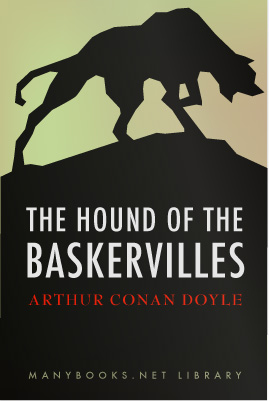
The Hound of the Baskervilles (Image Source)

One morning in London, Sherlock Holmes and Dr. Watson receive an intriguing visit.  Dr. James Mortimer, of Devonshire, has come to London to report strange happenings on Dartmoor.  First his friend, Sir Charles Baskerville, was found dead under suspicious circumstances – apparently frightened to death in his own yew walk, not a mark on the body, but mere feet away from the print of a giant hound.  Dr. Mortimer believes the baronet was haunted to his death by a spectral hound that has plagued the Baskerville family for generations – and now he fears for the safety of the heir, Sir Henry Baskerville, recently arrived in the country to claim his title.  Sir Henry has already experienced strange and mysterious circumstances – since arriving in London, he has been followed by a strange man, had two single boots stolen (and one returned), and received a cryptic warning.

Holmes is intrigued by the case, but he doesn’t believe for a moment in the ghost-dog theory.  He dispatches Watson to Dartmoor to guard Sir Henry and report his findings, and what Watson finds is a complicated web of intrigue surrounding the new baronet.  The danger seems to mount daily – will Holmes unravel the threads of the mystery in time, or is Sir Henry destined to meet the same fate as his uncle?

I really enjoyed my first visit with Holmes and Watson.  The mystery was absorbing, the characters intriguing, and the setting spooky.  This is one that has been on my list for some time, and I’m so glad I finally made time for it.  As a reader of both classics and mysteries, there was no excuse for my continuing unfamiliarity with Sherlock Holmes!  And after this delightful encounter, I’ll be seeking him out again very soon.

I am submitting this review to The Classics Club challenge.  Check them out here!

Buy The Hound of the Baskervilles, by Sir Arthur Conan Doyle, here (not an affiliate link) or support your local indie bookstore.

Reading Round-Up: May 2014

Reading Round-Up Header

Reading is my oldest and favorite hobby.  I literally can’t remember a time in my life when I didn’t love to curl up with a good book.  Here are my reads for May, 2014

Henrietta Sees It Through: More News From the Home Front 1942-1945, by Joyce Dennys – You may recall that I read and loved Henrietta’s War last month, and the first thing I did upon closing that volume was pick up the second installment of Henrietta’s letters to her “dear childhood friend” Robert.  Much is the same in the sleepy Devonshire village, but there are some changes.  Lady B has moved into smaller digs, Faith is finally married to the Conductor, and tempers are beginning to fray from the lengthy war effort.  These letters contain some bitterness about the restricted role of women in the war effort, and I think the bitterness is rather a good thing – it both tempers the sweetness and paints a realistic portrayal of what folks went through.  All in all, a lovely read and I have thoroughly enjoyed every moment I’ve spent with Henrietta.  Fully reviewed here.

The Pericles Commission (The Athenian Mysteries #1), by Gary Corby – Nico is training to follow in his sculptor father’s footsteps, and none too happy about it, when a dead body falls literally at his feet.  The body is that of Ephialtes, Athenian statesman and father of democracy.  Ephialtes’ friend Pericles engages Nico to investigate the killing and what Nico finds is an Athenian political landscape more treacherous than a pit of snakes.  To be honest, I wasn’t overly thrilled with this.  I found the language too much of an anachronism and I wasn’t over-fond of Nico, the hero, of Pericles, his boss, or of any other character.  I try to make allowances for the first novel in a mystery series because it can be difficult to introduce characters and plot arches while also putting forward an absorbing mystery, but even with those allowances The Pericles Commission fell flat for me.  I may or may not continue with the series but it’s not going to be high on my list.

Miss Hargreaves, by Frank Baker – Norman Huntley has a most distressing and surreal problem: the things he imagines come to be.  One day Norman and his friend Henry, on a lark, invent an eccentric old lady that they name Miss Hargreaves.  Taking the joke too far, they mail her a letter… and are shocked when she writes back and invites herself for a visit.  Norman is about to discover the kind of chaos an overactive imagination can create when his imaginary friend gets well out of hand.  This book was funny and clever, and Miss Hargreaves was a wonderful character (well done, Norman!) but the conclusion also left plenty of food for thought.  Highly recommended.

Yes, Chef: A Memoir, by Marcus Samuelsson – Marcus Samuelsson is a truly international chef.  Born in Ethiopia, he and his sister were adopted by a Swedish couple and raised in Goteburg, Sweden.  After a disappointment in his burgeoning soccer career left Marcus without a sport to play, he devoted himself fully to his other passion: food and cooking.  Soon Marcus was applying the lessons he had learned at his grandmother’s stove to his experiments building flavors in highly regarded restaurants in Europe, on a cruise ship, and finally in New York.  Marcus is best known as the former head chef of Aquavit, a Swedish restaurant in New York, as the winner of Top Chef and as a celebrated cookbook writer.  His memoir was a joy to read: honest and engaging, and full of the layers of flavor he adds to his foods.  Marcus is not perfect, but he readily admits to his mistakes and explains how he is trying to right any wrongs he has caused.  He’s a likeable writer and his love of food comes through in every page.  It’s no coincidence that I cooked dinner three nights in a row after finishing this book!

Inkheart (Inkworld #1), by Cornelia Funke – When Meggie was three years old, her father Mo, reading to the family, accidentally brought to life three characters from the book Inkheart.  One of those characters was the diabolical villain Capricorn, and another was his henchman Basta.  Capricorn and Basta have been wreaking havoc ever since.  Now Meggie and Mo must find a way to harness the evil Mo accidentally released and rid their world of Capricorn’s vengeful presence forever.  This book was entertaining, but went on a bit too long.  I did enjoy it and will most likely continue with the trilogy, but I didn’t find it quite as compelling as I’d expected to.

The Hound of the Baskervilles, by Sir Arthur Conan Doyle – Sherlock Holmes and Dr. Watson are surprised when they receive a visit from a Devonshire doctor with a tale of a giant spectral dog that hounded (excuse the pun) the Dartmoor baronet Sir Charles Baskerville to his death.  Even more distressing, the new baronet Sir Henry, recently arrived from Canada, is already being terrorized by strange events.  If anyone can solve this bizarre riddle, it’s Holmes and Watson!  I’ve been meaning to read Sherlock Holmes for some time now and I really enjoyed The Hound of the Baskervilles.  Full review to come on Friday.

May was a fairly slow reading month for me.  I had some events that took up time during the weekends and am still getting adjusted to my new, tighter schedule since returning to work.  But a smaller book count doesn’t mean a less enjoyable reading month, thankfully!  Henrietta continued to delight in early May, and I also particularly enjoyed my visit with Holmes and Watson.  Next month I expect another short stack, since between house hunting and marathon training my weekends are looking pretty hectic.  But I have a stack of bookish delights waiting for me so if quantity is low for a little while, quality will be high.  Stay tuned…

HENRIETTA’S WAR and HENRIETTA SEES IT THROUGH

Thon11

Henrietta Brown is the wife of a hardworking doctor in a sleepy Devonshire village.  Her days are filled with wedding the garden, participating in village functions, entertaining friends and navigating the thorny path of the doctor’s wife.  (You’re not supposed to know anything about your husband’s patients, but if you don’t ask them about their ailments when you meet them out and about, they’re instantly offended.  What to do?)  With World War II raging on the Continent, Henrietta has another role: that of correspondent to her “dear childhood friend” Robert, off fighting for King and Crown.  Henrietta writes delightful, newsy letters to Robert, keeping him up-to-date on all of the village happenings: Faith’s romantic conquests, Mrs Savernack’s latest project for securing the home front, and the irritation of the villagers – who are living in fear of a German invasion on their shores – when told by London refugees that they don’t really understand what war is like.

Henrietta’s War is breezy and fun, filled with snapshots of a village life that goes on much as it always has – notwithstanding the blackouts and the bombs falling in the next-door garden.  Lady B copes with the war by writing to Hitler every night “to tell him what she thinks of him” – and oh, how I wish some of those letters had been included in the book!  Faith dances around her faithful admirer, the Conductor, and Henrietta copes with her guilt over not doing more to help the war effort.  (Taking care of a busy doctor is a full-time job.)  Henrietta Sees It Through, the second volume of Henrietta’s letters to Robert, is a bit less breezy – but only a bit.  Tempers are beginning to fray as wartime stresses take their toll on even the most determinedly upbeat villager, and Henrietta spends a good number of pages lamenting the limited role of women in the war effort.  But there are still funny moments – such as when Henrietta plays the triangle in the village orchestra, and when she and Lady B spend a morning creeping about after an old gentleman they mistakenly believe to be a spy.  Henrietta chronicles it all – the difficult moments and the fun – with charming prose and delightful drawings, and I imagine Robert must have looked forward to every letter as a ray of sunshine from Devon.

I absolutely loved Henrietta’s War and Henrietta Sees It Through – I read them back-to-back, devoured them, and wished devoutly that they were longer.  The epistolary format worked perfectly, and I loved getting a glimpse at a village full of wonderful characters through the eyes of one of their own.  Fans of gentle fiction (especially Miss Read, of whom Henrietta constantly reminded me) and epistolary novels will enjoy diving into Henrietta’s letters.

Henrietta’s War and Henrietta Sees It Through, available here and here (not affiliate links), or support your local indie bookstore!