Reading Round-Up: June 2015

Reading Round-Up Header

Reading is my oldest and favorite hobby.  I literally can’t remember a time in my life when I didn’t love to curl up with a good book.  Here are my reads for June, 2015

The Anchoress, by Robin Cadwallader – Seventeen-year-old Sarah is an anchoress, a holy woman enclosed inside a sealed cell attached to a medieval church.  She became an anchoress in order to escape a harsh world – a world where her mother and sister both died in childbirth, and where the local lord’s cruel son is relentlessly pursuing Sarah’s hand in marriage.  But even shutting herself away can’t keep the world out of Sarah’s cell.  This was a stirring and fascinating novel.  I’d never heard of anchorites and anchoresses before, and I was enthralled (and also sort of horrified) by the idea.  I had some concern that a novel taking place almost entirely within a tiny enclosed room would be slow or dull, but it wasn’t.  The writing elevated this, and I couldn’t put it down.  Highly recommended.

It Starts With Food: Discover the Whole30 and Change Your Life in Unexpected Ways, by Dallas and Melissa Hartwig – Meh.  I’m a Whole30 enthusiast, as longtime readers may know, and I just recently finished my third time through the program.  I grabbed this book from the holds shelf to read during my most recent Whole30, thinking it would give me the motivation to finish strong, but to be honest, I wasn’t really convinced.  I found the folksy tone irritating and distracting, and the science unconvincing.  It’s odd, because I know that the Whole30 works well for me, so you’d think I would have had a more positive reaction to the book.  I’m glad I got it from the library instead of buying it.

The Five Love Languages of Children, by Gary Chapman – Hubby and I read the original The Five Love Languages years ago and really liked it.  We found it helpful to identify our love languages and apply them to our daily interactions, and we still talk about the love languages even eight years after reading the book.  So I had high hopes for some really good insight into applying the love languages to kids.  There was a bit of kid-specific insight, but I also found that there was a lot of repetition.  The most important takeaways I found were: (1) if your child is under 8 or so, you probably won’t be able to identify her love language, so you need to make the effort to speak all five; and (2) the reverse of your child’s love language is also very important – i.e. if your kid is a “words of affirmation” person, praise will be particularly meaningful to her, but harsh words will be particularly damaging, so watch your mouth!

Naptime is the New Happy Hour, and Other Ways Toddlers Turn Your Life Upside Down, by Stefanie Wilder-Taylor – I grabbed this from the library because Wilder-Taylor has a new toddler essay book out and I wanted to see what her writing was all about before I went to a big effort to get the newest.  This was mildly amusing, but nothing amazing.  I liked how Wilder-Taylor lampooned perfectionist moms, and I chuckled appreciatively a few times, but I could have skipped it and been just fine.

The Inner Circle (Culper Ring #1), by Brad Meltzer – Great literature it is not, but I found The Inner Circle to be decently fun.  I was a bit confused by some of the plot points (and I still don’t understand the cancer plot, that part just made no logical sense) but I liked the glimpse inside the Archives, and it was fun to make a fictional foray inside the Beltway.  I’ll probably continue with the series.

The Jesus Cow, by Michael Perry – On Christmas Eve, a calf is born inside Harley Jackson’s barn.  The calf has a perfect image of Jesus Christ on its flank, and Harley’s first reaction is to say, “Well, that’s trouble.”  Harley attempts to hide the calf, but word (of course) gets out and soon he has a Hollywood agent, a spiritual theme park, and hordes of pilgrims on his farm.  Hijinks follow, naturally, along with a good deal of cleverly buried philosophy.  This was a slim novel, but provided plenty of thought material wrapped up in a really clever premise.  Recommended.

Are You There, God?  It’s Me, Margaret, by Judy Blume – I really enjoyed the first book in the summer of #BlumeAlong, hosted by Kerry of Entomology of a Bookworm.  Margaret Simon does a lot of growing up in this iconic novel of bras, periods, and spiritual seeking.  Somehow I managed to get through young adulthood without reading this classic, so I’m glad I’ve rectified the omission.  For my full review, see here.

Love the Home You Have, by Melissa Michaels – Michaels, creator of the Inspired Room blog, presents a slim but encouraging volume about cultivating contentment and learning to love your current home, even if it’s not your forever home.  There was nothing particularly novel or earth-shattering about her advice, but it was a lot of what I need to hear right now.  I’m still homesick for Northern Virginia every day, and I’m feeling a bit overwhelmed by how much I have to do to update our current house.  More on this to come, maybe.  I appreciated Michaels’ gentle motivation, I’m trying to take her lessons to heart, and I think I may actually have a lot to say about this topic.  Stay tuned for possible future posts.

In the Unlikely Event, by Judy Blume – Two Blume novels in one month!  I must be on some kind of kick.  In the Unlikely Event is Blume’s first novel for adults in some seventeen years, focusing on real events that occurred in the winter of 1952 in Blume’s hometown of Elizabeth, New Jersey.  Blume was a teenager there when three planes plummeted from the sky in the span of just 58 days, leaving the entire community rocked and reeling.  Here, Blume revisits the tragedies through fictional Miri Ammerman, her family, and her friends, whose lives are all changed in big and small ways by the disasters.  I found the novel utterly riveting and more than a little bit distressing.  It was complex (lots of characters!), beautifully written, and I think it will be a popular book club choice.  Highly recommended!

Better than Before: Mastering the Habits of Our Everyday Lives, by Gretchen Rubin – I think I’m on something of a Gretchen Rubin kick.  In the past two months I’ve read her bestselling The Happiness ProjectHappier at Home, and now her latest.  I liked this one, and found that there was definitely some good thought material here, but I wasn’t as big of a fan as I was of the happiness books.  While she seemed funny and sweet (if a bit neurotic) in the happiness books, here Rubin comes across as a bit of a killjoy, and more than a little bit judgmental.  (I did enjoy the fact that her sister called her out on it, and props to Rubin for including that conversation in the book.)  Still, I did find myself making note of a few concepts that I want to explore more, so look for a blog post on that next week.  Recommended for Gretchen Rubin fans, but don’t expect this to be quite as inspiring as the happiness books.

What a month!  Nugget’s continuing preference for napping in my arms has meant that I’ve gotten quite a bit of reading done, and I’m not complaining about that AT ALL.  I cherish the hours we spend relaxing in his upholstered rocker while he snoozes and I lose myself between pages.  I’ll miss this when I head back to the office at the end of the summer, so I’m going to enjoy every moment now.  It was a pretty good month, content-wise, too.  The Jesus Cow and In the Unlikely Event were definitely the highlights.  I was a little underwhelmed by some of my other selections – and I actually abandoned another book, Disclaimer, some 120 pages in, which I NEVER do.  But overall it’s been a good month, and I’m looking forward to another good month to come… including some BEACH reading!  Can’t wait.
Summer of #BlumeAlong, Part I: ARE YOU THERE, GOD? IT’S ME, MARGARET

New-Jersey-You-God-Me-Margaret-Judy-Blume

Ahhhhhh, Judy Blume.  Probably one of the most prolific – and beloved – middle grade and young adult authors, well, ever.  She’s been all over the bookish news lately, as she just released her first adult novel in seventeen years (In the Unlikely Event, which I also read and loved this month).  In honor of Blume’s new novel, Kerry of Entomology of a Bookworm proposed a readalong featuring two of Blume’s all-time greats: Are You There, God? It’s Me, Margaret and Summer Sisters.  As I mentioned in my responses to Kerry’s kickoff questions, Blume was a big part of my reading childhood.  I believe – although my mom can correct me if I’m wrong – that my first forays into the Blume canon were the Fudge books, starting with Tales of a Fourth Grade Nothing.  (I haven’t thought about those books in years, but I do still have a soft spot for that trouble-making Fudge.  Hope my kids love the Fudge books as much as I did.)  I eventually moved on to the young adult novels, and my favorite was Just as Long as We’re Together.  (Apparently there’s a sequel, Here’s to You, Rachel Robinson.  How did I not know that?)  But one I missed, somehow, was Blume’s all-time classic, Are You There, God? It’s Me, Margaret.  So when Kerry suggested a readalong, naturally, I jumped on the chance to remedy that omission.

The Plot…

When the novel opens, Margaret Simon and her family are preparing for a move from New York City to New Jersey.  Although Margaret’s parents justify the move with reasons like fresh air – more space – better schools, Margaret suspects that they might also be trying to get her away from her grandmother.  Grandma is a devout Jew who would love for Margaret to join the religion – which makes Margaret’s agnostic parents uncomfortable.  Still, Grandma is a darn sight better than the grandparents on the other side.  Margaret’s mom was raised Christian, and her father was Jewish, and when they decided to marry, Mom’s parents cut them out of the family.  (The reader does well to remember that this book takes place in the 1970s; I don’t know that the story line would be as realistic if written today.  At least, I hope it wouldn’t.)

As Margaret settles into life in the suburbs, she finds herself swept into new friendships.  The gregarious Nancy Wheeler takes Margaret under her wing and invites her to join a secret club, the Pre-Teen Sensations, in which all members must wear bras and alert the others when they get their first periods.  And thus begins a year of growth in which Margaret convinces her mother to buy her a training bra and anxiously awaits her first period.  (Reading this book as an adult, all I wanted to say to Margaret was, “Oh, honey.  Trust me, bras and periods are not nearly as exciting as you think.  Don’t rush it!”)  Margaret immerses herself in junior high, with all its worries about friends and boys and reputations.  Meanwhile, she continues to spend time with Grandma and deals with more family drama as her other grandparents suddenly seem to want to be in her life.

It’s a lot for a Pre-Teen Sensation to handle, but Margaret has a confidante: God.  Although Margaret is “no religion,” she still keeps up a steady stream of conversation with God, pouring out all her hopes, dreams, and questions.  Why would Mom keep secret from Dad the fact that she sent Margaret’s grandparents a Christmas card?  And please, come on God, help a girl out in the bra department!  Also, while we’re at it, when is Margaret going to get that elusive period?  The other girls are shocked at Margaret’s non-religious family; how will she know whether she’s supposed to go to the YMCA or the JCC?  For a class assignment, Margaret spends the year attending various religious services, trying to figure out what religion would be her best fit – but none of the churches or temples seem right.  Margaret feels uninspired at best, and at worst, like a fish on the minister’s hook.  (She spends a lot of time counting hats.)  In the end (spoiler alert!) Margaret realizes that her relationship with God – personable, friendly and intimate – is exactly what she needs.  Especially when he finally obliges on that whole period thing.

My Thoughts…

Like I said, I loved Judy Blume’s novels as a kid.  So I’d bet that, had I read this at age 13 instead of 33, it would have really spoken to me.  (Except, maybe, the period stuff.  I don’t remember ever being so excited over that particular milestone.  More nervous that it would arrive at an inopportune time.)  Even now, I really enjoyed it, and I think my adult perspective shed light on certain aspects of the book that would have been completely lost on me as a pre-teen or young teenager.  (For example, I cringed at the casual cruelty the girls displayed toward Laura Danker, but I also recognized that their behavior was rooted in jealousy, which I think I would have missed twenty years ago.)

The best part of the book, for me, was watching Margaret’s evolving relationship with God.  When the book begins, God is a sounding board, a place to lob worries about friends and boys and seriously, God, when is Margaret going to get her period, I mean COME ON already.  (I particularly enjoyed one scene in which Margaret, getting ready for a party, decides to stuff her new bra with cotton balls and then says, in effect, see, God, I just need a little help here.)  Yet as Margaret attends different religious services, she comes to recognize that her personal relationship with God is more fulfilling than the rote recitation of lines she doesn’t even understand.  And that she doesn’t need to know whether she’ll go to the YMCA or the JCC, because what she has is deeper than the external trappings of religion.  While it’s true that, at the end of the book, God is still a sounding board for friend and boy troubles (although at least Margaret has her period now, thanks, God!) Margaret is much more comfortable with the idea of charting her own religious path.

All things considered, I really did enjoy this book.  There was an awful lot of bra-and-period talk, but it’s Judy Blume, so that’s pretty much a given.  There was also a lot of wisdom sprinkled in.  So – better late than never – I’m very glad I’ve finally gotten to know Margaret Simon.

Have you ever read Are You There, God? It’s Me, Margaret?  What did you think?

Reading Round-Up: May 2015

Reading Round-Up Header

Reading is my oldest and favorite hobby.  I literally can’t remember a time in my life when I didn’t love to curl up with a good book.  Here are my reads for May, 2015

Yes Please, by Amy Poehler – All the mavericks in the house put ya hands up!  All the mavericks in the house put ya hands up!  Oops, sorry.  I’ve been re-living my favorite Amy Poehler moments.  Knope We Can!  There I go again.  I’m a big Parks and Recreation fan, and I love Amy Poehler in general, so my mom had the inspired idea to get me Amy’s memoir for Christmas.  And oh, I really enjoyed it.  (Please don’t kill me for saying this, and remember, reading is inherently subjective… but I found Amy’s book to have more substance than Mindy Kaling’s Is Everyone Hanging Out Without Me? and to be funnier than Tina Fey’s Bossypants – and I love both Mindy and Tina almost as much as I love Amy, so.)  Amy sprinkles life wisdom in with memories of her childhood and career, and there’s so much gold with the jokes.  (When Amy describes how frighteningly much she loves her sons, I teared up, because it’s exactly how I feel about my kids.)  All in all, Yes Please is pure joy.  If you get a chance to read it, do say “yes, please.”

Best Easy Day Hikes: Buffalo, by Randi Minetor – I picked up this petite hiking guidebook at Wegmans, hoping to pick up a few possibilities for our twelve months hiking project.  There were a few hikes in here of which I wasn’t aware and which I think I’ll check out, but I found myself scratching my head at some of the inclusions and omissions.  For example, Tifft Nature Preserve, Times Beach Nature Preserve, Knox Farm State Park and Sprague Brook Park were all missing.  All of those parks are either in the city of Buffalo (in the case of Tifft and Times Beach) or less than a half hour’s drive from downtown (Knox Farm and Sprague Brook) – so why didn’t they merit inclusion?  Their absence was particularly mystifying given the inclusion of other trails that the author describes as “suburban” or even, in one case, “mangy.”  (Yikes.)  Still a worthwhile read, since it took me all of an hour to read cover to cover and gave me some good ideas for short, easy hikes to bring the kids on this summer.

William Shakespeare’s Star Wars: Verily, A New Hope, by Ian Droesscher – When I found myself looking for a new book to start on Star Wars Day (May the Fourth be with you!) I knew it had to be this mash-up of Shakespeare and George Lucas.  Oh, my goodness – this was so funny.  (“These are not the droids for which thou search’st.”)  Verily I say unto thee, as a fan of both the Bard and the Jedi, this book was a hoot and a half.  Recommended for bookish “Star Wars” geeks.

Emma: A Modern Retelling (The Austen Project #3), by Alexander McCall Smith – Hmmmmm.  I love the idea of the Austen Project (six authors retelling Jane Austen’s works in a present-day setting); I love the exploration of whether a timeless classic can translate to modern day without losing its essence or charm.  I enjoyed the first installment (Joanna Trollope’s retelling of Sense and Sensibility), but this Emma fell flat for me.  I am a fan of McCall Smith – I love his No. 1 Ladies’ Detective Agency series – but I didn’t like his portrayal of Emma.  In this version, Emma herself has all of the egotism, but none of the charm or good-heartedness, of the original.  McCall Smith also writes dialogue in a very distinctive style, and I didn’t think it worked for this story.  It did prompt thoughts about whether all classics, even classics I really enjoy (like Emma) can be called timeless.  Look for a blog post on that.

The Happiness Project, by Gretchen Rubin – I’ve long been meaning to read this yearlong project memoir, and I really enjoyed it.  Rubin approaches her project with an acknowledgement that, while she is in general happy, she could become happier.  She also wants to achieve greater happiness by making small changes, not large-scale changes, in her life.  (She’s happy with her spouse, job and location – no major life adjustments needed.)  I liked her approach and enjoyed reading about her triumphs and setbacks in her yearlong pursuit of enhanced happiness.

Northanger Abbey (The Austen Project #2), by Val McDermid – Yes, I read them “out of order,” so to speak; Emma was due back to the library in seven days so I had to get to that one first, and anyway, it’s not like this is a series that must be read in order.  Anyway, I liked McDermid’s handling of Northanger Abbey.  Catherine Morland is recast as “Cat,” obsessed with Twilight and all things vampire.  McDermid capably updates one of my favorite Austen novels – the story of a young woman away from home for the first time, who embarrasses herself by letting her imagination run away with her.  Fluffy and fun.

The Royal We, by Heather Cocks and Jessica Morgan – Oh, what fun.  What good, good fun.  Cocks and Morgan, the bloggers behind a popular fashion blog, have produced a wildly enjoyable novel based on the romance of the Duke and Duchess of Cambridge.  They don’t even attempt to disguise the fact that this is Will and Kate fan-fiction.  But even though this is essentially “chick lit,” it’s well-written, engaging, and with a cast of background characters who are almost as delightful as “Nick” and “Bex,” the couple at the center of the maelstrom.  (Anyone else just love that terrifying Lady Bollocks?)  I devoured it gleefully (joke inserted for those who’ve already read the book).

Happier at Home, by Gretchen Rubin – I liked The Happiness Project so much that I quickly reserved Rubin’s revisiting of the project (in the form of a school year that she spends focused on making her home a happier place).  While I enjoyed some of her tips, and she is as adept as ever in consolidating her clearly copious research into an engaging text, I did find it slightly repetitive of her first exploration of happiness.  I don’t begrudge her that – hey, if it ain’t broke – but I did skim a bit more.  Still a good read, though.

Simplicity Parenting, by Kim John Payne – Hmmmmm.  I had mixed feelings about this book.  On the one hand, Payne makes some good points about the fruitlessness of cluttering up a child’s environment with too much “stuff” and about the dangers of intruding on children’s consciousness with overly adult messages and plain old TMI.  But he went further, in many instances, than we would ever go in our house.  For instance, MAJOR side-eye to his suggestion that children under eight should have their book collections whittled down to “just one or two favorites.”  Uh, how many languages can you say “H-E-L-L NO” in?  That would so not fly with Peanut.  I’m reading and thinking a lot about simplifying all of our lives these days – more to come on this – and this was an interesting read with plenty of food for thought but, in the end, probably a bit over-the-top for us in certain respects.

Holy nine books, Batman!  I can’t believe I blew through so many pages this month.  The Royal We and Yes Please were the highlights for sure, and I also enjoyed Gretchen Rubin’s meditations on happiness (I think there might be more blog posts to come on the topic – maybe not right away, though; I need to give it more independent thought).  I had a huge library stack to work through – I’m still working on that – but unlike my last library mishap, this one has me feeling more engaged and interested in my on-deck pile than disconnected and exhausted by it.  I’ve been enjoying these books mainly during Nugget’s lap naps, which I’m still loving.  I expect my reading pace will take a hit when I go back to work, but lucky me, I get the summer off before I have to think about that.  I have a pile of books I’m excited to read in June – man, does it ever feel good to be psyched about reading again!

Reading Round-Up: April 2015

Reading Round-Up Header

Reading is my oldest and favorite hobby.  I literally can’t remember a time in my life when I didn’t love to curl up with a good book.  Here are my reads for April, 2015

A Dangerous Place (Maisie Dobbs #11), by Jacqueline Winspear – The eleventh installment in the Maisie Dobbs mystery series finds Maisie on her way home to England after traveling the world, experiencing great happiness and enduring unspeakable tragedy.  Now she’s been summoned home by her stepmother, but as her ship docks in Gibraltar, Maisie finds she can’t go further and disembarks.  In Gibraltar, Maisie stumbles – literally – over the body of a Sephardic Jewish photographer.  As she searches for the photographer’s killer, Maisie becomes involved in political intrigue and finds herself in the midst of a civil war.  I really enjoyed this episode in Maisie’s story.  She has grown so much as a character – many of the traits which annoyed me about Maisie in previous books were gone, as she has apparently learned from her mistakes.  I was touched by her story, more so in this book than ever before, and was truly rooting for her to find some peace and happiness.  I did miss Billy, but I’m hopeful that the next novel will find Maisie back in London and reunited with her old colleague.

Wide Sargasso Sea, by Jean Rhys – I’ve been meaning to read this reimagining of the marriage of Mr. Rochester and Bertha Mason for quite some time.  I really enjoyed the writing style – the whole book felt like a sultry tropical dream – but wasn’t thrilled with the plot or character development.  Of course, Mr. Rochester is my favorite brooding literary leading man, so it was hard to read him as, basically, the villain.  But there were other disconnects as well.  For more, see my full review here.

Overwhelmed: Work, Play and Love When No One Has the Time, by Brigid Schulte – This book wowed me.  Time management, and balancing all of my obligations as a wife, mom, employee, daughter, friend and community member, has been on my mind for quite some time and Overwhelmed perfectly articulated the pressures that working parents feel.  The book was mainly directed toward working moms, so I was squarely within the target demographic, which may be why it spoke to me so strongly.  For more impressions on Overwhelmed, see my full review here.

Tales from Another Mother Runner: Triumphs, Trials, Tips and Tricks From the Road, by Dimity McDowell and Sarah Bowen Shea – I’ve been a fan of Another Mother Runner, the website/blog/podcast/social media community created by Dimity and SBS (the original Mother Runners!) for years now.  I read their first book, Run Like a Mother, before I even was a mother.  This collection of essays is quite up to the usual AMR standard – funny, poignant in places, and crazy inspiring.  It made me want to lace up my Brooks and hit the road!  Recommended for all runners – you don’t have to be a mom to enjoy this book.

All Joy and No Fun: The Paradox of Modern Parenthood, by Jennifer Senior – Meh.  I was really looking forward to reading this book, which approached the issue of parenthood from an unusual perspective – examining not the effects of parents on children, but the effects of children on parents.  But I was ultimately disappointed.  While there were occasional moments of recognition (I saw so much of my relationship in Angie and Clint’s marriage) the book was mostly a downer.  There would be two long chapters about what a pain kids are and how miserable they make their parents, followed by a short chapter about how occasionally they bring you joy, too.  That was the pattern.  Blah.  I did find striking a phrase which Senior repeated often as she examined the modern American middle class childhood – children have become “economically worthless but emotionally priceless.”  That’s about right.  I’m sure she made many good and relevant points, but I just didn’t like the presentation.  I think Senior focused unduly on the hardships children create (and they DO create hardships, that’s for sure) and mostly glazed over the good things about parenthood.  It was a bit disappointing.

A Beautiful Blue Death (Charles Lenox #1), by Charles Finch – Charles Lenox is a Victorian aristocrat, expert on the ancient Romans, and armchair traveler (would-be real traveler, but life always seems to get in his way).  He’s also an amateur detective with an established reputation for unraveling the most challenging of puzzles.  So when his childhood friend, Lady Jane Grey, requests that he look into the suspicious death of her former housemaid, Lenox naturally agrees.  But the death of the housemaid proves only the opening act in a much bigger drama.  I enjoyed this book.  The storytelling was decent and relatively engaging.  It’s the first entry in a mystery series, and I usually find that when it comes to mysteries, the first is the weakest – so I expect that the series will pick up and get really good, really soon.  I’ll be picking up the next Lenox mystery in short order.

Siblings Without Rivalry: How to help your children live together so you can live too, by Adele Faber and Elaine Mazlish – For some time now, I’d been meaning to read Faber and Mazlish’s other book, How to Talk so Kids Will Listen and Listen so Kids Will Talk, but I ended up coming to Siblings Without Rivalry first.  Nugget is still brand new and Peanut has been doing pretty well with her adjustment, but I figure it’s never too early to start learning strategies for ensuring a good sibling relationship.  Siblings Without Rivalry did what it promised – gave me plenty of ideas to implement, both now and as the kids grow.  Some are common sense (avoid comparisons, don’t pigeonhole kids into family “roles”) but there was plenty of practical information in here.  I didn’t much care for the narrative style, but the information was solid.

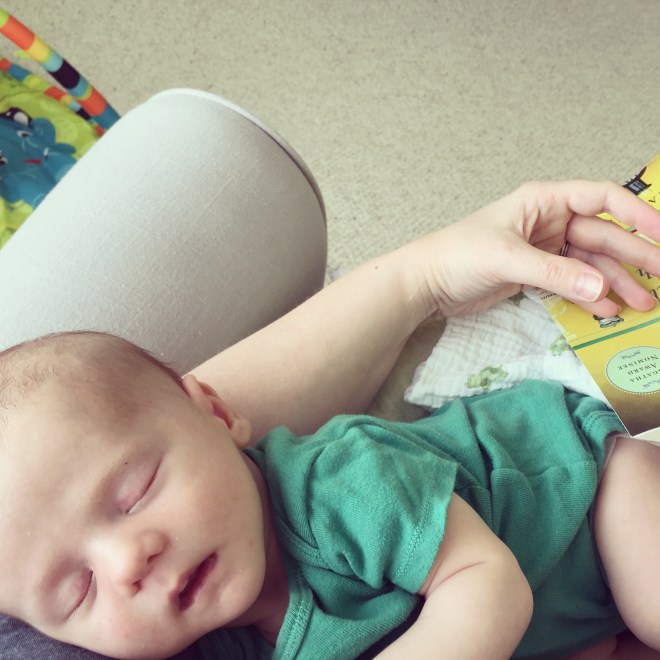
Seven books!  That’s a good month of reading with a little guy in the house.  I’d say the reason I’ve been able to knock out so many books this month has been…

image

Ahhhhh, the joys of the lap nap.  There’s nothing quite like whiling away the afternoon with a book while a warm baby snoozes on your lap.  I loved reading through Peanut’s lap naps too, and I know that snuggling Nugget while I read is going to be one of my favorite memories from this maternity leave as well.  I read some good books this month – the highlight being Overwhelmed, which prompted me to write not one, but two blog posts about it.  (I could have written more, but I decided to restrain myself.  It wasn’t easy.)  For May I have some fun Jane Austen adaptations to look forward to and a couple of parenting books that I’ve been meaning to read, and I think I’ll be doing some reading off my own shelves as well (fingers crossed).  I’m looking forward to another good month of reading… some of which, I hope, will take place OUTSIDE in the SUNSHINE.

Notes From the Overwhelm

overwhelmedI’ve recently gotten hooked on a new genre of non-fiction: books about time management (or the lack of it… lack of time, lack of management, what-have-you).  It started with The Fringe Hours, which I read a few months ago and which I think I’ll be going back to sooner than later.  I’ve also been meaning to read 168 Hours, but have been putting it off because I plan to track my time for a week while I read it, and that sort of time study wouldn’t tell me much right now, as I’m currently enjoying maternity leave.  And then there’s Overwhelmed: Work, Love, and Play When No One Has the Time, by Brigid Schulte.  I just started noticing this title making the rounds of the book blogs, but it was one blog in particular that convinced me I needed to pick up Overwhelmed, and right away.


Kim of Sophisticated Dorkiness wrote of starting Overwhelmed and returning it to the library because, well, it was overwhelming.  She explained:

One of my “genre kryptonites” is books about time management, especially motherhood and time management. I don’t have kids, but reading about it is one of the ways I’m helping myself think about whether I want kids or not. The first few chapters of Overwhelmed were filled with these rushed stories about mothers running late and working constantly and ferrying kids around that made me want to bury my head in the sand… so I returned it to the library.

Ironically, Kim’s reaction made me want to read Overwhelmed more.  You see, I’m not approaching this book or any other time management book from a perspective of thinking about whether kids are in my future.  I’ve already got kids.  They’re in my present.  So the thought of reading about some frenzied mothers who are dealing with the same intense time pressures I deal with on a daily basis (when not on maternity leave) was not off-putting to me; it was comforting.  A book about my people!  Maybe they’ll have some answers for me!  I logged onto the library website and reserved a copy immediately.  And well… well.  Yes.  This book is indeed about my people.  So much so that I thought I might pull a muscle in my neck from all the nodding along.

Schulte, like The Fringe Hours’ Jessica Turner, wears many hats.  She’s a mom, wife, and… oh… award-winning journalist for The Washington Post.  And in seeking to fill all of her roles, Schulte found herself in a state of chronic frenzy.  Stress.  Lateness.  General exhaustion.  She coined some fun terms for her time management issues.  The miniscule snippets of time, too short to do anything except maybe check one more item off the to-do list, contributed to a state of “time confetti.”  (Reading about Schulte’s time confetti made me want to get her together with Turner, who would encourage her to turn that time confetti into fringe hours and spend them on herself.)  And the state of exhaustion and angst from having to (or feeling like she has to) do it all, Schulte called the Overwhelm.

DSC_0065_01

(Mountain picture for serenity purposes.)

Ahhhhh, the Overwhelm.  I know it well.  I operate in a state of being perpetually overwhelmed.  Sometimes I manage to muddle through the chaos, but more often I feel as if I’m floundering in it.  When the Overwhelm gets to its worst point, I don’t feel like I fill any of my roles well.  There have been a few times in my life when the Overwhelm was really pulling me down, and I still shudder when I look back on them.  Third year of law school, that’s one.  I simply had too much on my plate – a full schedule of classes, a 20-hour per week internship, an international moot court competition, serving as President of my law school’s Alternative Dispute Resolution Board (like moot court, but our competitions were in things like negotiations and client counseling), teaching legal research and writing to a section of twelve first year students, and, oh yeah, all this during my first year of marriage.  I was practically losing my mind, was constantly fighting off colds, and forgot to attend several important meetings.  Not good.  And then there was my first year of motherhood – particularly after I returned to work from maternity leave.  I didn’t feel like I was doing anything well.  I was making mistakes at work (not irreparable mistakes, and not many, but I really hate to feel like I’m not at my best when I’m at work), I was bringing stress home, I was perpetually exhausted and snappish, and I was sick at heart because I was convinced I was missing Peanut’s babyhood.  It was a miserable time that I fixed by making a huge change in my life – moving to Buffalo and spending seven months as an “opt out” stay-at-home-mom.  (That was very good for me.  When the right opportunity came along, I was refreshed and ready to take another crack at being my best self at home and at work.)

But, yes.  I know the Overwhelm; I live the Overwhelm.

DSC_0071_01

Schulte takes on the Overwhelm and how it affects three areas of our life: work, love and play.  In the work section, she discusses the myth of the Ideal Worker.  (The Ideal Worker is never late, always works nights and weekends, has no home responsibilities, can travel at a moment’s notice, is available for infinite facetime… in short, the Ideal Worker is an almost impossible standard for moms, most dads, and anyone who wants some form of balance in their lives, to live up to.)  Schulte explains how the Ideal Worker has harmed families; mothers are either shunted to the side and placed into “Mommy track” or pushed out altogether, and dads who want to be involved in raising their children are harshly punished.  The only type of parent who doesn’t suffer in an Ideal Worker workplace is the “traditional” breadwinning/provider dad whose wife stays home to raise the kids and who as a result has no responsibilities (and no desire to spend time) at home.  That sort of dad is a dying breed; every year, the ranks of involved “new” dads grows.

As lawyers, hubby and I work in a field that is often entrenched in its worship of the Ideal Worker.  Certainly, there are exceptions, but these exceptions are notable for a reason – they’re rare.  And as a result, we constantly worry about balancing work and family obligations.  I’ve been lucky enough to land in a relatively family-friendly firm, where I’ve been given considerable flexibility without being pushed into “Mommy track.”  I’ve had no trouble rushing out of the office in the middle of the day to pick Peanut up from school if she starts running a fever, getting my work done from home later in the day, and I’m currently enjoying the generous maternity leave policy.  All the while, I’ve been able to work in the particular practice that I enjoy and in which I have an established expertise.  (My firm in DC?  Same thing.  I’ve been very lucky.)  But it’s impossible not to worry about these issues, when you work in a law firm.

Then there’s the “love” section, which focused mostly on families.  Schulte argues that just as harmful as those who worship the Ideal Worker are those who worship the Ideal Mother.  She explained how, in many families, the “gender revolution” has “stalled,” leaving women – even those who work outside the home and may be the primary breadwinners – disproportionately responsible for housework and child care.  Schulte notes a surprising phenomenon – American mothers today, many of whom are fully engaged in the labor force, spend more time with their children than the “Ideal Mothers” of the 1960s.  (That’s because those 1960s mothers, while yes, waiting with cookies and milk for their children returning from school, then nudged those children out the door to play while Mother met with her bridge club; in short, 1960s mothers enjoyed some pure leisure – more on that in a minute.)  American mothers today are putting in heavy hours on the job as managers, doctors, lawyers, and in every other field.  Then we come home and still are the ones putting dinner on the table, cleaning the house, and carrying the lion’s share of child care duties.  No wonder we’re overwhelmed!  Of course, that’s not to say dads do nothing.  Schulte devotes a chapter to “new dads” – meaning not necessarily men with brand new infants at home, but men who are embracing a new style of fatherhood – carrying diaper bags, chasing toddlers down while Mom works, and chatting with other dads on the playground about developmental milestones.  Some of the dads profiled work flexible schedules that allow them this involvement; others have made the choice to stay home or had it made for them in a layoff.  (I recognized my own husband in this chapter.  He doesn’t enjoy the luxury of a flexible work schedule, and he is employed, so you won’t find him on the playground at 3:00 p.m. on a Thursday, but he’s certainly an involved dad in the new style of fatherhood.)  Even in families with “new dads,” though, Mom often still performs just as much housework and child care as in other families – with the result being that everyone is overwhelmed.  Schulte devotes considerable space to discussing families who are negotiating this new frontier in parenting; some have come up with workable arrangements while others are still muddling through.

DSC_0074_01

(Heavy stuff.  Here’s another mountain picture so we can catch our breaths.)

Then there’s the third area of exploration: play.  Schulte examines leisure time, through the lens of history and in relation to other countries.  Her chapter on “Hygge in Denmark” was one of the most interesting and enlightening chapters of the book, describing how mainstream Danish families structure their time – seemingly miraculously – so that both Dad and Mom are able to do meaningful work, spend time with the kids, and enjoy their own leisure pursuits.  (Hygge is “the key to Danish happiness” and describes, basically, the state of really being in the moment and focused on what you are doing: “When you’re riding Icelandic ponies, ride Icelandic ponies.”)  Schulte had me wanting to move the whole family to Copenhagen.  In other chapters, she discusses the challenges – both external and internal – that keep women from fully exercising their right to leisure, and profiles groups such as the “Mice at Play,” a group made up of mostly moms who schedule “playdates” like trapeze lessons (!).  She describes the importance of play – not just leisure, or enrichment, but actual play – for adults (and made me want to sit for hours doing a puzzle, or book a ride on the Holiday Valley mountain coaster, immediately).  Schulte laments that moms rarely take time for pure leisure for themselves; their “fun” time is disproportionately spent with their children (hey, nothing wrong with that – I love my kids and want to spend time with them – but we moms also need some time for ourselves) and, even when they’re supposed to be unplugging and enjoying themselves (like on vacation), women are often busying themselves with taking the emotional temperatures of everyone around them, worrying that the family is having a good time, and ruminating on the vacation to-do list.  (I definitely can relate to that.  When I was a stay-at-home-mom, some of my favorite leisure hours were spent at Stroller Strides classes.  I loved Stroller Strides and looked forward to it all week… but it hardly counts as “pure play.”  I was burning calories, discussing motherhood with other moms, and constantly keeping one eye on my little sidekick to make sure she was happy, fed, entertained, and not in need of a clothing change.)  Women rarely take time to play in completely non-productive ways, focusing only on themselves, just for fun.  Maybe we think it’s selfish?  But it has to change.

Schulte ends the book with a section on her attempts to knit together her “time confetti” into blocks of useful time that she can dedicate to one of the aforementioned three areas – work, love or play.  She experiments with working in “pulses” of ninety minutes punctuated by breaks (not a bad idea, and something I might try to implement when I get back into the office after my leave ends), works with her husband on creating a more equitable division of labor in their household, and shares ideas for incorporating more play into a busy life.  While I wish there had been more space devoted to her experiments in creating a better balance, I’m certainly planning to try out a few of the suggestions that were there.

Cascade 7

I realize that this blog post has gotten insanely long.  It’s just that there’s so much in this book; I’ve barely scratched the surface.  In fact, I’m strongly considering buying a copy (maybe a few copies, so I have extras to hand out to the other frenzied moms I know).  As I was reading, I was repeatedly struck by the urge to underline and make margin notes – which, of course, I couldn’t do to my library copy.  It’s a relatively short book – under 300 pages of text – but there is a wealth of information, research, and observation crammed in there.

Now, it’s important to note that this book is aimed at a very specific demographic: working moms, primarily, although busy stay-at-home-moms and fathers in the “new dad” model would also find plenty worthwhile in it.  (Single folks with busy careers and lots of community obligations, or married or partnered individuals with similarly busy lives, would also recognize big chunks of the book that pertained to their own version of the Overwhelm.  But it’s true that Schulte is mainly talking to harried parents.)  As a working mom with young children, I’m squarely within Schulte’s target audience, which may explain why I kept shouting “That’s RIGHT!” as I read.  So while I did note some Goodreads reviewers complaining that the book doesn’t apply to their lives, I can’t relate to those comments, because this book relates very directly to mine.  And for where I am in life, I found Overwhelmed to be so many things – comforting (I’m not alone!), empowering, heart-breaking (oh, the section on our broken child-care system), and ultimately encouraging.

Recommended for: anyone who feels perpetually busy or strained by their out-of-balance lives.

WIDE SARGASSO SEA

wide sargasso sea

Wide Sargasso Sea, originally published in 1966, is Jean Rhys’ imagining of the backstory behind Bertha Mason, the “madwoman in the attic” from Jane Eyre.  “Bertha,” in Rhys’ version, is really Antionette Cosway, a beautiful young woman growing up on a dilapidated old plantation in the West Indies.  Antionette’s widowed mother eventually remarries, to a wealthy man named Mr. Mason, but the damage from their years of poverty and isolation is done.  Antionette’s mother dies mad and forsaken, and Antionette herself becomes a prize in marriage to an aloof man who withholds his love from her.  (That aloof man is Mr. Rochester, although he is never named in the story.)  Antionette (called “Bertha” only by her husband, and for no apparent reason) descends into drunkenness and – arguably – madness of her own, driven insane by her husband’s coldness.

Well.  I have to preface my thoughts on this book by saying that there was no way I could come to it without some preconceived biases.  After all, Jane Eyre is my all-time favorite book, and has been since high school.  I knew that the portrayal of Rochester in Wide Sargasso Sea probably wouldn’t be the most flattering.  But it certainly didn’t agree on any level with the story given in Jane Eyre – that Rochester was a fundamentally good man who had run into some very bad luck in his past.  (If the bad luck, that is, was his marriage to Bertha, which is certainly how Bronte presents things.)  The Rochester of Wide Sargasso Sea is, to put it mildly, a jerk.  When his wife begs him to tell her he loves her even a little, he refuses.  He also proceeds to have a wild night of passion with a maid who openly disrespects his wife, right next to his wife’s room and certainly within her hearing.  Not very nice.

Had Wide Sargasso Sea been a stand-alone type of work, with brand new characters, I may have liked it more.  But the incredibly unsympathetic portrayal of my favorite brooding literary leading man – while expected – didn’t endear the book to me.  I also felt that Antionette/Bertha’s descent into madness was a bit abrupt and didn’t really make sense.  She didn’t want to marry Rochester anyway, but we’re supposed to believe that she snapped overnight just based on his “withholding” of his love?  It seemed disjointed – Antionette goes from an unhappy, but certainly sane, young woman to a drunken, raving lunatic overnight.  I didn’t find the story particularly believable.  Of course, there is a question – and I believe Rhys intended to leave this open-ended – whether Antionette was really insane, after all.  She was certainly drunk on occasion, but was she really a lunatic?  Or was she just disheartened, and classified as mad because it suited Rochester’s purposes?  That would be an interesting question for a book club to explore.

There were other disconnects as well.  As mentioned above, Rochester calls Antionette “Bertha.”  Why?  No reason is given, even when Antionette says, in effect, “Why do you keep calling me Bertha?  That’s NOT my name!”  Rochester just replies that, in short, she seems like a Bertha.  While I don’t think that it would necessarily push me to the brink of madness, I would be pretty irritated if my husband suddenly started calling me by a different name because he thought it fit better than “Jaclyn.”  (Although when I taught arts and crafts at a summer camp in high school, my campers called me Cheryl, because they thought I seemed like a Cheryl.  I went with it.  But of course, they were my campers, not my husband.)

I did, however, give the book three stars (“I liked it”) on Goodreads.  Why, then?  If I wasn’t a fan of the portrayal of Rochester and didn’t find the main plot believable, how does this book merit three stars?  Well, I may not have liked the characters or the plot, but I loved the writing.  The book has a dream-like quality, which certainly reads right in light of the story.  None of the characters are particularly fleshed out, but that seems to work as well, because it’s as if the entire story takes place in a heavy tropical mist.  The writing was incredibly evocative – I could see the black velvet sky, smell the tropical flowers, and taste the rum.  The writing, and the atmosphere of the story, saved it for me.  That means a lot – I’m a very character-driven reader, and it’s rare that even excellent writing can rescue a book for me if I didn’t care for the way the characters were drawn.  So the fact that I still enjoyed the book, even while chafing at the description of Rochester and finding Antionette unbelievable, is really telling.

Recommended for fans of twentieth century classics, or novels set in the post-slavery West Indies.  Cautiously recommended for Jane Eyre fans, but don’t expect brooding heartthrob Rochester to make an appearance – this Rochester is straight up nasty.

I’m submitting this review as part of my Classics Club Challenge.

Reading Round-Up: March 2015

Reading Round-Up Header

Reading is my oldest and favorite hobby.  I literally can’t remember a time in my life when I didn’t love to curl up with a good book.  Here are my reads for March, 2015

Station Eleven, by Emily St. John Mandel – WOW, I really loved this.  Station Eleven is a chilling, yet uplifting, dystopia telling the story of a small band of musicians and actors traveling between settlements of survivors after a massive flu pandemic has wiped out 99.99% of the world’s population.  The novel alternates between several points in time to tell the stories of a few different characters – famed actor Arthur Leander, who collapses and dies onstage during a performance of King Lear on the night the flu first hits North America; Jeevan Chaudhary, ex-paparazzo turned paramedic who tries to save Leander’s life, and Kirsten Raymonde, a child actress who witnesses Arthur’s death, survives the flu, and becomes part of the band of traveling performers trying to keep art and culture alive in the cruel post-flu world.  I don’t want to say much more about this one, because I don’t want to spoil anything.  It’s a chilling, outstanding, heartwarming book – highly recommended.

Miss Buncle’s Book (Miss Buncle #1), by D.E. Stevenson – Barbara Buncle needs money.  She can’t think of any other way to earn it, so she decides to write a book and try to have it published.  The trouble is, Miss Buncle isn’t particularly creative.  She’s fairly dull – believed stupid by her neighbors – and decidedly lacking in imagination.  So she writes a book based on her town, Silverstream, in which her friends and acquaintances are barely disguised.  Miss Buncle is delighted when the book is picked up for publication – she can finally get a new hat! – and shocked when it becomes a runaway bestseller.  But it doesn’t take long before the residents of Silverstream realize that they’ve been immortalized in fiction – some of them, to rather ill effect – and they’re determined to smoke out the anonymous author hiding in their midst.  This was a gentle, fun, whimsical read – perfect for the first days with a newborn.

Queen of Hearts (Her Royal Spyness #8), by Rhys Bowen – Lady Georgianna Rannoch, thirty-fifth in line to the throne of England, is off on her farthest-flung adventure yet when her mother, the famed actress and “bolter” Claire Daniels, invites her along as company on a journey to America.  Claire is headed for Reno to get a quickie divorce from her current husband so that she can marry her German paramour.  Having nothing better to do, Georgie delightedly tags along and finds herself mixed up in a mystifying jewel heist and the murder of a Hollywood producer.  Light, silly and fun, as always.

Dead Wake: The Last Crossing of the Lusitania, by Erik Larson – I’ve only read one of Larson’s books before this one (In the Garden of Beasts, which I really enjoyed) but I knew as soon as I read the description of this one that I was going to have to read it.  I’ve never known much about the Lusitania disaster, and Larson promised a bigger story than the one we learned in history class (Germany torpedoed it, and caused the U.S. to join World War I as a result).  I was fascinated by Larson’s narrative of the disaster, and I learned a ton.  (For example, the Lusitania alone didn’t really get the U.S. into the war – it took another two years of affronts to the U.S. neutrality policy before we joined in.)  It’s history, but not dry in the least – compulsively readable, fascinating, and addictive.  Recommended to history buffs and fans of narrative non-fiction.

The Railway Children, by E. Nesbit – I’d downloaded this sweet story of three children whose family has fallen on hard times, and their love of the railroad near their new home, months ago and had been reading it in five minute snatches ever since.  I should know better than to read that way, because I never enjoy the story as much as it deserves until I really sink into it, which I finally did this month.  Bobbie, Peter and Phil are charming companions, and their adventures playing near the railroad are sweet and a pleasure to read.  Now I’m looking forward to reading more of E. Nesbit’s work.

The Buried Giant, by Kazuo Ishiguro – The new Ishiguro novel – his first in ten years! – is in some ways a departure from his previous work and in other ways, right in the same wheelhouse.  The Buried Giant follows the journey of a pair of elderly Britons, Axl and Beatrice, who are living in sixth-century Britain.  A supernatural mist clouds the land and robs its inhabitants of their memories, and Axl and Beatrice struggle to recall shared moments in their relationship as they travel to visit a son they barely remember.  Along the way their paths cross with several other travelers, all of whom have their own closely-guarded secrets.  I enjoyed The Buried Giant, and its themes of remembrance and forgetfulness (classic Ishiguro themes), although not as much as I enjoyed Never Let Me Go or especially The Remains of the Day (one of my all-time favorite books).  Still, I’d recommend it to Ishiguro fans or fans of the fantasy genre (which The Buried Giant is, nominally, although the fantasy elements of the story are not as important as the larger Ishiguro-esque themes).

That was a decent month of reading, if I say so myself!  Six books – less than I was doing in a month last year, but more than I’ve managed in any month since last October – and I enjoyed each one.  Dead Wake was probably the highlight; I couldn’t put it down.  Station Eleven was a close second.  But a little D.E. Stevenson, a little Georgie, and the new Ishiguro to round out the list make it a very good month indeed.  Here’s hoping the trend continues into April!

In Which I Search For Fringe Hours

the fringe hours

There aren’t enough hours in the day.  If I had time, I’d… How often have you heard those words?  How often have you spoken them yourself?  I know that I am guilty of complaining about lack of time far more often than I’d like, and I’m sure everyone around me is tired of hearing it from me.  But the fact is, though, that I’m living (as we all are) in a 24-7 society, that I’m constantly on the go, and that I’m holding down not one, but two full-time jobs (one as a lawyer, one as a mom).  I’m willing to bet that most of my friends who are reading this post get that.

We spend our days rushing from place to place and task to task.  A typical day for me involves getting up before the sun, spending an hour or more on coaxing Peanut to eat breakfast (she’s not a great eater and is rarely hungry in the morning, and we’re devoting substantial amounts of time and energy to getting her to gain weight upon the recommendation of her pediatrician), getting me ready for work, and getting Peanut ready for school.  Then it’s commute time; I’m either driving straight to the office or making a detour to drop Peanut off at school, depending on whether it’s hubby’s turn or my turn to do morning transportation.  Once I get to the office, it’s a mad rush throughout the day, ticking items off my to-do list (which never seems to grow any shorter).  I usually work through lunch, and often I have lunches with colleagues, either as part of firm associate bonding initiatives or as meetings.  If I’m lucky, I can grab twenty minutes to myself to read while I eat.  If I’m really lucky, I get to enjoy a nice long girlfriends’ lunch with Zan.  Then it’s back to the grind for the afternoon, until it’s time to either pick up Peanut (a dash to get to her school during a short window – I can’t really leave the office before 5:00 in good conscience, but I must be at Peanut’s school by her 5:30 pickup time – that usually leaves me cursing at red lights, jaywalkers and slow-moving traffic, all of which seem to conspire to make me late for pickup) or head home.  If it’s hubby’s pickup day, I linger in the office a bit longer, trying to cross a few more things off the list (still no shorter) before I head home to start dinner.  (It feels like luxury to cook dinner without Peanut underfoot, so I try to beat them home and at least get started if possible.)  Then it’s another long slog of trying to coax Peanut to eat a full meal, and we usually go through at least three time-outs for throwing food.  Then bath – it’s usually about 7:30 at this point, maybe later – and the teeth-brushing-story-reading bedtime routine.  Hubby and I negotiate with Peanut and try to convince her to stay in bed (ah, the joys of the big girl bed) and I may tiptoe out at some point, to finish cleaning the kitchen while hubby continues to preside over bedtime.  (Hubby usually makes a good start on the kitchen while I bathe Peanut, and often has the dishwasher loaded and running before he comes upstairs, which is incredibly helpful.)  I’ll pick up toys, perhaps turn over laundry, check emails one more time, and crash.

Those days leave me exhausted.  And when I read the question Jessica N. Turner (wife, mom of three, blogger, speaker, and full-time marketing professional; the woman wears some hats, yo) poses in the beginning of The Fringe Hours – how often do you fall into bed at the end of the day and realize you did nothing for you? – I found myself cringing.  The answer, for me, is: far more often than I’d like.  In The Fringe Hours, Jessica encourages all women (young professionals, wives, moms, empty nesters, whatever their roles) to make time for themselves every day.  Jessica’s theory is that when we consciously make space for our own happiness, we are better in all of our roles.  We can better serve our spouses, kids, families, communities, and colleagues if we aren’t constantly putting our own happiness and fulfillment on the back burner.

It’s not a new idea.  I’ve heard “you’ll be a better mommy if you take time for you” plenty of times, from plenty of sources.  (I hear it a lot from my husband, who is wonderful and supportive – I’m lucky.)  But Jessica approaches the idea from a fresh perspective.  She spends the early part of this slim but wonderful book addressing the obstacles that prevent women from taking time for their own pursuits – guilt and comparison being big ones (and both definitely apply to me).  She then moves on to advice on how to identify both what your passions are and where you might find your own fringe hours – those little pockets of time in your day that you can reserve for you.  And finally, she expands on her theme with advice on how to create those hours.  The book is packed full of good tips and advice, and there are writing exercises scattered throughout (I did a few, but decided to leave the rest for a re-read after I’d let the book sink in a bit and applied some of the advice).

The Fringe Hours is a lovely, encouraging book, and some of Jessica’s advice really resonated as advice I could at least try to implement in my own life.  For example:

  • Fringe hours don’t have to be hours.  I’m not currently at a place in life where I often have a solid block of an hour or more to do something just for me.  (Although I will need to find those blocks, eventually, when I start marathon training this spring.)  But fringe hours can come in small pockets, too – five minutes reading in the car while you wait for school pickup; ten minutes to write a card to a friend while pasta boils.  I often let those pockets slip by and I can do better about utilizing them.
  • Beware time wasters.  I fritter away far too many of my precious fringe hours (or minutes) on social media.  I like Instagram a lot, but I don’t need to be all caught up on Facebook.  I am working hard on forcing myself to stop scrolling through updates and just read the most recent.
  • Accept help when it’s offered, and consider paying for it.  If one of the grandparents offers to watch Peanut so hubby and I can escape for a date, I do try to take them up on that (although it can be hard for us to tear ourselves away from her).  And I’m lucky in that my husband helps out a lot with child care and household duties – he recognizes that we both work outside the home, and we’re both tired, and he puts in his fair share on the tasks that keep our family running.  But one thing I’m considering as a result of Jessica’s advice is paying for help more.  Of course we pay for the regular child care that allows us to work, but I’m talking about more than that.  We’ve talked about finding a trustworthy teenager to do some babysitting; that may take a backseat while Nugget is tiny.  But hubby has occasionally floated the idea of a cleaning service.  I’ve always rejected the idea, but lately I’ve been thinking about it.  Would it be so awful to have someone in to help with tasks like vacuuming, cleaning baseboards, scrubbing bathrooms?  It could certainly free up time – especially with (soon) two kids in the house.  I haven’t taken the plunge, but I’m thinking about it.
  • Make solo hobbies into family hobbies if they fit.  I’ve written about this before, and hiking is my big example.  Hiking was never a solo hobby for me – I would be nervous about venturing out truly alone – but hubby and I used to hike regularly as a couple and we’ve involved Peanut in our hikes since she was very small.  It’s a different experience to hike with a young child, but it’s just as fun.

Of course, it’s one book and while many parts of it spoke to me, there were certainly aspects that are not relevant to me right now, or pieces of advice that just won’t work in my life.  (It’s not one-size-fits-all, you know.)  In my case:

  • Jessica says that friends often ask her how she manages to “do it all” and still have time for herself, but she doesn’t do it all.  There’s unfolded laundry in baskets in her hallway, and dust on her mantle.  She prioritizes her own happiness.  Well, that’s great advice… but there’s unfolded laundry in my baskets, too, and dust on my mantle, and I still often can’t find the time for me.  I agree that it never hurt anyone to neglect those tasks on occasion… but I neglect them routinely and am still overloaded with responsibilities.
  • Jessica also encourages women to jettison extra responsibilities – even ones that are “good” things in and of themselves; they can become overwhelming if you do too much.  She gives, as an example, a stressful time in which she tried to participate in both a book club and a community group, and she realized that she couldn’t do both and had to drop one.  While I think it’s great to know your limits, I’ve already quit every “extracurricular activity” in my life.  I withdrew from literacy tutor volunteering (it was a good time for me to take a step back; my student was dropped from the program for no-showing too many sessions and we were beginning a long, stressful housing hunt).  And my Stroller Strides classes (one of my favorite parts of the week) sadly ended when our instructor’s three year franchise agreement expired.  I currently have no evening or weekend “responsibilities” yet – again – I still struggle to find the time.
  • Get up early… yeah, right.  Jessica shares an example of finding a big stretch of time in her day by waking up an hour or more before the rest of the house.  I would love to do that.  I used to get up early and get in a workout, and I always felt better and was more productive when I had that time for me.  But I’m pregnant and exhausted, and we’re still in a bedsharing phase with Peanut, and she can’t be left to loll about in the big bed alone (hubby usually gets up early to work before the day gets started) – she could fall out.  So carving out morning fringe hours is not possible right now.

Not sweating small household tasks, and getting rid of excess outside activity, are two of Jessica’s major pieces of advice, and she returns to them multiple times.  And I think there are many women who need to take that advice.  But for me, neither would help me to free up any fringe hours to speak of.  I could, perhaps, ignore the kitchen or leave the toys scattered around after bedtime… but that’s not easy for me to do.  And I have no more outside the home activities to jettison.  Someday, when the kids are older, I may be able to put ore of these pieces of advice into practice.  But right now, those aren’t tips that are going to free up any fringe hours for me (although I think they would for a lot of women).

I really enjoyed The Fringe Hours.  It was a wonderful, encouraging book and gave me plenty to think about.  I’ve already started practicing some of Jessica’s insightful suggestions.  Namely:

  • I’m trying to be more disciplined about carving out at least half an hour in the middle of the day to spend on myself.  Sometimes that means going for a walk if the weather is decent; other times it means reading over lunch.  I’ve read quite a bit more as a result.  It doesn’t happen every day, but I’m working on it.
  • I’m also trying to be better about not wasting time on social media.  I’m usually caught up on Instagram, because that’s faster for me and I enjoy it more.  But if I miss a few tweets or Facebook posts, it’s not the end of the world.
  • I’m working on accepting help when it’s offered – and asking for it when it’s needed.  I’ve never been great at this, but I’m doing my best.
  • I’m trying to identify my passions.  Jessica discusses at length the need for women to identify those things they are passionate about, and spend their fringe hours on those activities.  I have always loved to read, even though I’ve been lacking in attention recently.  And I’m looking forward to being cleared to run again.  Fringe hours are useless if you don’t spend them on your priority activities.

Finding my fringe hours, and figuring out how best to utilize them to make myself happy, is definitely not an easy thing to do.  It’s an ongoing process.  My goal each day is to take at least a few minutes to spend on my own personal fulfillment – I’m still falling short, some days, but I’ve been doing better since I made it a conscious practice.  The biggest challenge has been resisting the time-wasters, but even that is getting easier.  I’m so glad I read this book.  It couldn’t have come at a better time for me… and while I don’t expect to have large blocks of “me time” anytime soon, with Jessica’s encouragement I’m starting to see that the little pockets of time can add up, and the whole can be greater than the sum of its parts.

Have you read The Fringe Hours yet?  What resonated most with you? 

Reading Round-Up: February 2015

Reading Round-Up Header

Reading is my oldest and favorite hobby.  I literally can’t remember a time in my life when I didn’t love to curl up with a good book.  Here are my reads for February, 2015

Lila (Gilead #3), by Marilynne Robinson – In December, I read Gilead, Marilynne Robinson’s lyrical novel about a dying pastor’s relationships with his father and grandfather (told through the vehicle of a letter to his young son).  Lila is the third novel set in Gilead (the second, Home, I haven’t read yet, but it’s not a series that needs to be read in order) and I liked it even better than Gilead.  Lila focuses on the pastor’s wife – her history, how she came to Gilead, and how she ended up married to Reverend Ames.  I loved Lila’s voice, and her story was raw and heartbreaking but uplifting at the same time.  The writing, of course, was spectacular.  My only wish (not a complaint) was that Robinson would have shown more of Lila actually falling in love with Reverend Ames.  It’s clear by Gilead that she loves him very much, but in the beginning of their marriage she always seemed to have one foot halfway out the door.  I’d love to see their relationship develop in the six years between the end of Lila and the beginning of Gilead.  Perhaps Robinson is holding onto that story for a future book?  Let’s hope so.

The Minor Adjustment Beauty Salon (The No. 1 Ladies’ Detective Agency #14), by Alexander McCall Smith – I always love a visit with Mma Precious Ramotswe, and it had been quite some time.  This installment (the penultimate thus far, but I’ll be reading the most recent very soon, and then I’ll be all up-to-date again) was eventful as usual.  Mma Ramotswe is called upon to investigate the true identity of the purported heir to a prosperous farm, and also to uncover who has been threatening a local beauty salon.  The difference is that for most of the book, she’s flying solo, because her Associate Detective, Mma Grace Makutsi, is out of the office on maternity leave!  Mma Ramotswe is a little overwhelmed without her trusted colleague, and the scene of her crying at her desk was heartbreaking – for me and for Mr. J.L.B. Matekoni, who responds by attempting to take a course in how to be a modern husband (one of the funniest scenes in the book).  As always, the mysteries took a backseat to the characters’ lives, and I wouldn’t have it any other way with this series.

All the Light We Cannot See, by Anthony Doerr – I’d started this one back in November and set it down in the early chapters, because I wasn’t able to renew my library copy.  I bought my own copy but had no sense of urgency in tackling it.  Once I finally cleared my library stack, though, it was time to get back to this one, and when I got into it, I loved it.  Marie-Laure Le Blanc is a blind girl living with her great-uncle in the walled seaside city of Saint-Malo after fleeing Paris with her father as the Nazi army advanced into the city.  Werner Pfennig is a German engineering genius who is swept by powers far greater than himself into that same Nazi army.  Marie-Laure’s and Werner’s stories unfold in parallel until one day, their fates come together.  The writing was beautiful, the story captivating, and once I got through the relatively slow-moving early chapters I couldn’t put the book down.

The Fringe Hours: Making Time for You, by Jessica N. Turner – I’ve been struggling a lot lately with finding time (and attention) to pursue the things that I’ve always enjoyed doing.  Part of that problem is of my own making – I certainly fritter away too much time on social media and don’t use my spare time effectively – but much of it is the result of juggling a full-time job, a full-time toddler, and a full-time pregnancy.  When I saw The Fringe Hours reviewed enthusiastically on other blogs, I knew I had to see what it was all about.  Jessica, a full-time working mom and successful blogger who manages to find time for herself each day, is the perfect cheerleader for any woman (mom or not) looking to reclaim some time for herself.  Some of her tips aren’t really relevant to me right now, but others I’m already implementing and I’ve noticed a definite uptick in the amount of time I’m spending on my own happiness.  (That’s an uptick from next-to-none to a-little-bit, but it’s something.)  I’ll have more to say on this topic next week.

Four books again in February… not as much as I’d have liked to read, but it was a short month and I enjoyed everything, so I can’t complain!  The highlight was definitely All the Light We Cannot See, which I can’t recommend highly enough.  Reading pace is still relatively slow as I try to squeeze in baby preparations and make plenty of time for family activities with Peanut before her little brother arrives sometime in March.  (Ideally late March, because we’re still nowhere near ready.)  I also had a clogged currently-reading list (3-4 books instead of 1-2) most of the month, which always slows me down some.  But I have some good stuff to read in March – I’m hoping to get caught up on two mystery series, and I’m midway through a new release that I’d been itching to read and am loving so far – so stay tuned for updates at the end of the month!

Reading Round-Up: January 2015

Reading Round-Up Header

Reading is my oldest and favorite hobby.  I literally can’t remember a time in my life when I didn’t love to curl up with a good book.  Here are my reads for January, 2015

Roots, Shoots, Buckets and Boots: Gardening Together with Children, by Sharon Lovejoy – This was a Christmas gift from hubby, who knows that I am looking forward to starting a garden with Peanut this spring.  I was hoping that it would include things like art activities and learning games to play no matter what type of garden we choose to grow.  There was a little of that, but mainly the book was organized into different gardens that were all planned for you.  I did like the idea of the “pizza garden” and I expect that Peanut and I may try that one a few years down the road, when we’ve got our feet under us, but at the moment most of the suggested activities in here were beyond us.  It was still great for inspiration and encouragement, though, and I loved the beautiful illustrations, so I enjoyed it nonetheless.

As Chimney Sweepers Come to Dust (Flavia de Luce #7), by Alan Bradley – I know there have been mixed opinions about the seventh volume in the Flavia de Luce mystery series, but I loved it.  I missed the Buckshaw and Bishop’s Lacey environment, certainly, but seeing Flavia adapt to a new place and new personalities was great.  And the continuing storyline about Flavia’s mother’s legacy really has me excited.  I can see this series going on for quite some time and just continuing to get better and better.  My only complaint: now I’m all caught up again, and who knows how long I’ll have to wait before the next installment?

The French House: An American Family, a Ruined Maison, and the Village that Restored them All, by Don Wallace – The French-house-restoration-memoir genre is one of my “kryptonite” genres (meaning, I just can’t say no to one of these books) but this one didn’t really do much for me, I’m sorry to say.  I pushed through because I kept waiting for the book to get funny and heartwarming, but I just couldn’t really see where it ever did.  The villagers seemed unwelcoming, the American couple naive, and the French professor who arm-twisted them into buying a ruin and then fixing it to her specifications (their budget and desires apparently didn’t matter) struck me as manipulative and inconsiderate.  I’d heard such wonderful things about this memoir, but in the end I was mildly disappointed.

The Romanov Sisters: The Lost Lives of the Daughters of Nicholas and Alexandra, by Helen Rappaport – I’ve long been interested in late Imperial Russian history, and I love a good Romanov biography, and this one is an excellent addition to the library of Romanov knowledge.  The Romanov Sisters focuses on, as the title no doubt gives away, the Grand Duchesses Olga, Tatiana, Maria and Anastasia.  So many other Romanov histories focus on Nicholas, Alexandra, and Alexei, and there might have been some other kids too but they’re not really important, that I knew very little about the Grand Duchesses.  Even the four Grand Duchesses referred to themselves as a unit, “OTMA,” but in truth they had four very distinct (but all lovely) personalities.  Rappaport’s biography focuses on the sisters and their home life, only mentioning things like politics or Rasputin where they touched the sisters’ lives.  It was a refreshing and novel perspective and I thoroughly enjoyed getting to know “OTMA” better.  And as one Goodreads review I read said, you know what the end was going to be but you were still hoping for a different result.  (Alas, it’s not to be.  But there is one thing – as I tweeted while reading the book, there’s nothing like a Romanov bio when you’re having a lousy day.  At least you know their problems were bigger than yours.)

Not a bad January, I suppose.  It’s not as many books as I’d like to have to share with you, but The Romanov Sisters was quite the chunkster.  In terms of enjoyment, it was a mixed bag.  I liked flipping through Roots, Shoots, Buckets and Boots, and I reeeeeeeally enjoyed As Chimney Sweepers Come to Dust and The Romanov Sisters, but The French House fell flat for me.  I’ve got a busy February ahead, so I don’t expect much more in terms of a book total, but I am trying.  I’ve just started the newest Marilynne Robinson, and then I’m looking forward to digging into some mysteries next month – hope to have some good reads to report for you in a few weeks.