Diverse KidLit: Two Friends (January 2016)

diverse kidlit

Last year I loved having a project to follow all through the year – checking in each month with details of our family hikes was so much fun – and I’ve decided that 2016 calls for another long-term blogging project.  Since this is the year that I’m working on expanding my reading horizons and reading more diverse books, I thought it would be a natural fit to talk about some of the diverse books I’m also reading with my kids.  I believe that no age is too young to talk about the wonderful differences between all the people that make our world so magnificent.  So each month, I plan to feature a different children’s book celebrating diversity in its many forms.  I’ll showcase books that talk about racial diversity, religious and cultural differences, feminism and more.  I hope that my readers like this feature.  Comments and book recommendations are welcome, of course, but – as always! – let’s keep the chat respectful.  Now, enough chatter – January’s diverse kidlit title is…

image

Two Friends, by Dean Robbins

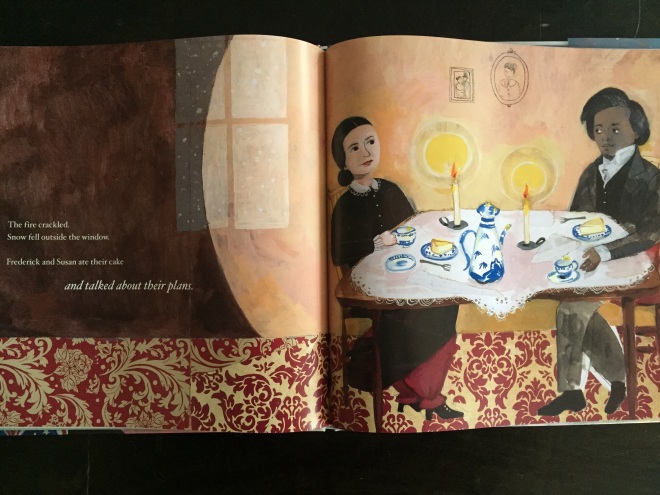
Based on a true story of the friendship between Susan B. Anthony and Frederick Douglass, Two Friends imagines these two pioneers of justice sitting down together for tea in Susan’s parlor on a snowy evening in Rochester, New York.  The book begins by describing the obstacles that both Anthony and Douglass faced – in Anthony’s case, because of her sex, and in Douglass’s case, because of the color of his skin.

image

Young Susan grows up wanting to learn everything that boys can learn, but she is not allowed to – because she’s a girl.

image

Young Frederick, born into slavery, teaches himself to read and begins to question why he should be denied rights that others enjoy.

Frederick and Susan grow up and begin to speak out, exposing the fallacies of a system that suborns people based on their sex or race.  While some people liked hearing what Susan and Frederick had to say, as Two Friends (simply and starkly) puts it, “others didn’t.”

image

Two Friends pictures Susan and Frederick – who really were friends – sitting down together to discuss their plans to change minds and raise awareness of issues of inequality and injustice…

image

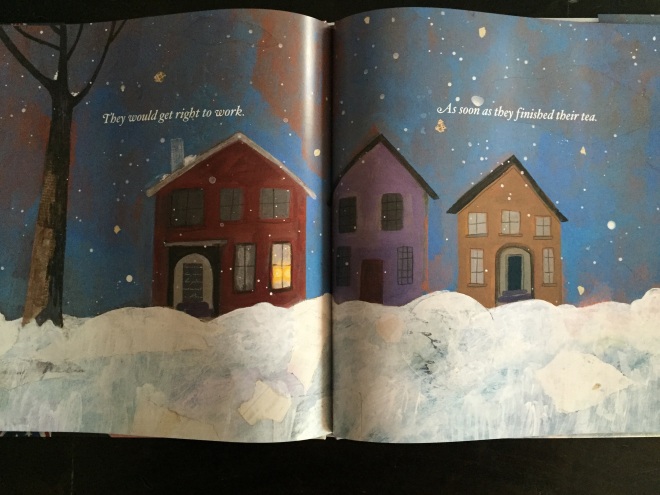
As soon as they finish their tea.

Two Friends is a gorgeous book.  The illustrations are eye-catching and beautiful, and the text provides a wonderful introduction to important debates we have had throughout our history – while it does not sugar-coat the issues of injustice, it is simple enough for very young children to understand.  Older children will almost certainly have some questions about the text – why couldn’t Susan learn what boys learned? why couldn’t Frederick vote? – and those questions will open the door for parents to begin explaining important issues in ways that children can understand.

What books do you use to introduce your children to difficult concepts?

Reading Round-Up: December 2015

Reading Round-Up Header

Reading is my oldest and favorite hobby.  I literally can’t remember a time in my life when I didn’t love to curl up with a good book.  Here are my reads for December, 2015

Fables, Volume 3: Storybook Love, by Bill Willingham – I am getting more and more interested in the Fables series as I continue to read through the comics – especially the budding romance between Snow White and Bigby Wolf.  In this volume, an assassination plot throws Snow and Bigby together in the wilderness with surprising results.  I love new twists on familiar stories, so I’m enjoying this.

Gotham Academy, Volume 1: Welcome to Gotham Academy, by Becky Cloonan – My first foray into DC Comics!  The Gotham Academy comic follows Olive Silverlock, student at a prestigious boarding school in Gotham, through roommate and boyfriend troubles – but there’s more.  Something happened over the summer – something involving Olive’s mother – that left Olive shaken and with a new fear of bats.  And now Gotham Academy might be haunted!  I found the story a bit difficult to follow, but the art was fun and the characters – especially adorable Maps! – were engaging.

Carry On, by Rainbow Rowell – I tried to describe Carry On to my husband, and what I came up with was “Fanfiction about fanfiction about a fictional book about gay wizards.”  Is it any wonder he was confused?  Let me try to explain: in Rowell’s popular YA novel Fangirl, main character Cath writes “fic” about a Harry Potter-esque series of novels called the “Simon Snow” series.  Carry On is Rowell’s take on Simon’s story.  It’s not meant to represent Cath’s “fic,” nor is it meant to be an actual Simon Snow novel by “Gemma T. Leslie” on which Cath’s fanfiction was based.  It’s basically Rowell’s fanfiction about fictional characters she herself created.  Still confused?  It’s okay.  Me too.  So, I moderately enjoyed Carry On, but I didn’t think it really lived up to its potential.  There was a lot of back story that was not presented (and I’ve read Fangirl – not all of the back story was in there, either) and I had the sense that the characters had a very vivid history that would have informed and deepened the story had I known what it was.  (Constant references to “that time Simon…” or “that time Baz…”)  It made for a frustrating reading experience.  All told, it was too bad, because (meta as it was) Carry On could have been really terrific, but instead left me a little flat.

Batgirl, Volume 1: The Batgirl of Burnside, by Cameron Stewart – My next trip into Gotham was easier to understand.  Barbara – moonlighting as Batgirl – has moved to Burnside (basically, Brooklyn to Gotham’s Manhattan) to get away from a turbulent past.  (Not all of the back story was presented, but I gather that Batgirl ended the last series of her comic recuperating after being shot by the Joker?)  She’s picked up some troublemaking new friends, her college project is in dire straits, and she’s got one heck of a social media addiction – can Batgirl keep it all together?  I really liked this!  I thought the art and the characters were a lot of fun, and the story was modern and exciting.

Browsings: A Year of Reading, Collecting and Living With Books, by Michael Dirda – Big disappointment here.  Normally, Browsings is a book that would ring ALL of my bells.  A book of personal essays ABOUT BOOKS!  Written by a Washington Post columnist!  With frequent references to DC and liberal politics!  But… gahhhhh.  Dirda came across as pedantic, pretentious, and deadly dull.  He seems to be a borderline hoarder who has never grown out of a childish predilection for classifying books as “girl books” and “boy books” (he actually refers to “boy books” with approval, more than once) and refusing to read books for the “wrong” sex.  And he kept ramming ponderous, self-consciously witty sentences with far too many clauses down the reader’s throat, while at the same time assuring the reader that his writing style is pared-down to the point of being austere.  (Sorry, Mr. Dirda.  Hemingway, you are not.)  I plugged doggedly away at this book far past the point when I should have given up.  And I was occasionally rewarded – “Aurora,” Dirda’s moving call to action on gun control, was a really breathtaking piece of writing.  But the gems were buried in way too much rock.

Sisters in Law: How Sandra Day O’Connor and Ruth Bader Ginsburg Went to the Supreme Court and Changed the World, by Linda Hirshmann – As a female lawyer, I owe a lot to O’Connor and Ginsburg, and I really enjoyed reading this fascinating history of their careers.  Their rises to the top of the legal profession were similar in many ways, and yet in many other ways, could not have been more different.  The book focused a great deal on Ginsburg’s employment discrimination cases from her time as an ACLU litigator, which were of particular interest to me, as I am a labor lawyer.  Sisters provided great information and lots of food for thought about feminism (and helped me crystallize my thinking about how we got to the point where we find ourselves today – with a very long way to go).

Black Widow Volume 1: The Finely Woven Thread, by Nathan Edmondson – I’d been itching to find out more about Black Widow before her movie comes out (not for awhile, but I had a suspicion that I might like the character, and I was right).  Natasha Romanoff is trying to make amends for her past as a KGB assassin, taking on dangerous – and often seemingly hopeless – assignments for little pay in order to support her “web” (which I took to be made up of individuals and families she harmed during her time as an assassin).  I liked getting a glimpse at Natasha’s world and Black Widow’s adventures, and I will definitely be following her.  I found Black Widow much easier to understand than Captain Marvel.  And enjoyed it that much more.

The Sword of Summer (Magnus Chase and the Gods of Asgard #1), by Rick Riordan – New Rick Riordan!  New Rick Riordan!  Let’s all just take a second and do a happy dance for NEW! RICK! RIORDAN!  (I just love Rick Riordan.)  So, The Sword of Summer isn’t brand new, but it’s the most recent Riordan and it’s also the start of a new trilogy focusing on the Norse gods, with a new leading character – Magnus Chase, homeless Bostonian cousin of bad@$$ daughter of Athena, Annabeth Chase (HAPPY DANCE FOR ANNABETH!).  Magnus has been living on the streets for two years after his mother was killed by terrifying monster wolves (wut) when one day, his Uncle Randolph – whom Magnus’s mother warned him never to trust – tracks him down and starts mumbling about ancient weapons, birthrights, all kids of weird mumbo jumbo.  Then a fire giant attacks Boston and Magnus dies.  The end.  Okay, not the end!  There’s lots more to come from Magnus’s adventures – he finds himself in Valhalla and then out of it again, searching for a legendary sword alongside a dwarf, an elf, and a Valkyrie – and racing against time to stop Ragnarok.  As Percy Jackson does with the Greek gods, Magnus encounters Norse deities including Thor and Odin, and it’s clear that while Rick Riordan has a very modern sensibility and a ripping sense of humor, he also totally knows his stuff.  Riordan’s books are surprisingly smart for being such entertaining reads, and now I can’t wait for the next Magnus adventure.  (I loved the character of Magnus – even more than I loved Percy Jackson; a warning, though – this book was more violent than any of the Percy Jackson and the Olympians novels.)  Only complaint: not enough Annabeth!  Always need more Annabeth!

The Givenness of Things: Essays, by Marilynne Robinson – Robinson’s newest collection of essays combines theology, political science, history, comparative literature study, and more disciplines – all mixed together and spun into breathtaking arguments by her remarkable mind.  I’m pretty sure I didn’t understand more than about five percent of what Robinson was talking about, but WOW, was this a wonderful book.  It’s hard for me to know what to say, because there was just so much to this slim volume and I’m still processing it – but I think it’s well worth reading for anyone who has to live in this crazy messed up America, which is many of us.

A good December, and a good 2015 in books!  Next week I will wrap up my year in reading, somewhat belatedly, but I’m happy with where I’m ending up.  December was a great mix of fun (Magnus Chase! comics!) and thought-provoking (Supreme Court! Marilynne Robinson!) and I ended the year on a high note with Givennness.  It was a bit of a challenge to fit much reading into December, what with the holidays, work stuff, and some sick days for the kids (pinkeye for Nugget, croup for Peanut) but I squeezed it in wherever I could and, as always, turning pages made me feel more grounded and comforted.  January is looking to be another busy month as we prepare to move, but I’m sure I will keep reading through it all.

Reading Round-Up: November 2015

Reading Round-Up Header

Reading is my oldest and favorite hobby.  I literally can’t remember a time in my life when I didn’t love to curl up with a good book.  Here are my reads for November, 2015

Lafayette in the Somewhat United States, by Sarah Vowell – I love Sarah Vowell’s work!  This is the third book I’ve read from her bibliography and I am always impressed by the thoroughness of her research, the quality of her social observations, and the witty, wry sense of humor with which she approaches her subjects.  Lafayette was no exception – in fact, it may be my favorite so far.  Vowell observed that the Marquis de Lafayette, an adventuring teenager who ran away from his pregnant wife and overbearing inlaws to become one of the most beloved figures in American history, was pretty much the only thing that could unite an incredibly fractious country.  Americans in the eighteenth and early nineteenth centuries couldn’t agree on much, but they could agree that they all adored Lafayette… and after reading Vowell’s tribute to the darling deadbeat daredevil, you will too.

Fates and Furies, by Lauren Groff – I loved Groff’s last book, Acadia, so was expecting great things from her newest work – and I was not disappointed.  Fates and Furies tells the story of Lotto and Mathilde Satterwhite and their passionate, creative partnership over their decades of marriage.  The first half of the book, Fates, is told with its focus on Lotto, a rich boy who is cut off by his odd bird of a mother after he marries Mathilde on a whim, but goes on to be a famous and successful playwright.  The writing is excellent and the setting is brilliantly portrayed.  If the book was just Fates, it would still be terrific – but then.  With Furies, the focus switches to Mathilde, and everything the reader thought they knew about the Satterwhites’ marriage suddenly blows up.  Revelations pile upon revelations, proving that marriage is a mystery, sometimes, even to the people in it.  This book deserves all the acclaim it has gotten.

Honor Girl, by Maggie Thrash – I devoured this graphic memoir, about the experience of falling in love at summer camp, in one sitting.  Maggie attends Camp Bellflower, a conservative Christian camp deep in the Bible Belt.  At the start of the summer, fifteen-year-old Maggie is insecure, unsure of everything except one thing: her deep, abiding love for the Backstreet Boys, and Kevin.  But then she meets Erin, a female counselor, and falls headlong into all the feelings.  The art so perfectly captured the spirit and feeling of the story.  I was rooting for Maggie and Erin to get together, even though I knew their feelings would never be tolerated at their conservative camp.  I just found this book so sweet, so endearing, and so fascinating.

Fables, Volume 2: Animal Farm, by Bill Willingham – The second volume of Fables picks up where the first left off.  Rose Red is sentenced to community service for the trick she pulled on the Fabletown community in the previous volume, and Snow White has a particular task in mind: a sisters’ trip up to the Farm, the secluded enclave where those Fables who are unable to pass as human live, presumably, a peaceful and idyllic life.  Not so much – Snow and Rose walk right into a revolution led by Goldilocks, all grown up into a gun-wielding revolutionary, and the Three Bears.  Best line of the series so far: “I’m Snow White, and I’m never outgunned.”

Kind of a light month of reading in November!  It’s been a bit wild and woolly around here.  I just got back (yesterday!) from a family trip to spend some time over Thanksgiving with my brother and sister-in-law in Colorado.  Before the trip I was working every night, trying desperately to avoid having to take work with me on vacation.  (I was unsuccessful and ended up doing a couple of hours of work each day.  Ah, well.  It happens.)  Then the trip itself involved almost no reading.  I brought a couple of books but barely took them out all week – between kids, work, sightseeing and family time there just wasn’t a moment to spare for reading.  So, yeah, a light month.  The good news is that I really enjoyed everything I did get to read this month.  As for December – well, I’m hoping for a longer list of books read, but with the holidays and preparing for a move my next couple of months are looking quite full.  Still, I’m sure I’ll read.  When life gets really hectic, it always makes me feel more grounded to come back to a book.

Reading Round-Up: October 2015

Reading Round-Up Header

Reading is my oldest and favorite hobby.  I literally can’t remember a time in my life when I didn’t love to curl up with a good book.  Here are my reads for October, 2015

Negroland: A Memoir, by Margo Jefferson – Jefferson is a critic and cultural tastemaker who grew up in a privileged enclave of the African-American community.  Her father was a prominent doctor at a historically black hospital; her mother was a socialite.  Jefferson referred to her upper-crust world as “Negroland,” and in her memoir of the same name she deconstructs the social mores and the origins of respectability politics in which she was steeped.  This was a wonderful book.  I am trying to read more about the experiences of people of color and I would highly recommend this book as a fascinating take on a community that hasn’t received much attention before.

The Complete Persepolis (Persepolis #1-4), by Marjane Satrapi – Persepolis is Satrapi’s graphic memoir of growing up in revolutionary Iran.  It’s been out for a few years and has been consistently highly regarded – even being made into an award-winning animated film.  I’d been meaning to check it out and finally picked it up for Banned Books Week (because it’s one of the most frequently banned or challenged graphic novels) and it was incredibly powerful.  Shocking in parts, but so well worth the read.

Go Set a Watchman, by Harper Lee – I’ll have a whole post coming up about my impressions of this book, and why I chose to read it.  So to keep this post short, I’ll just say that I didn’t like Go Set a Watchman.  I found the characters wooden and unconvincing, the story lacking, and the writing unpolished.  It was an interesting literary history exercise – fascinating to see the original seed of what became one of the greatest masterpieces of American letters – but in its own right, I don’t think Go Set a Watchman is worth reading.  (Fortunately it’s a quick read – only took me 24 hours.)

Undermajordomo Minor, by Patric DeWitt – Lucien “Lucy” Minor is scrawny, sickly, and a compulsive liar.  Looking for a life outside of his small town, he takes a job as Undermajordomo of a castle far away.  But something really weird is going on in the castle.  Lucy becomes involved with a local girl and tries to solve the mystery of what freakishness is taking place behind closed doors in his new place of employment.  This was good, but there was one scene that made me want to gouge my eyes out (and didn’t add to the plot at all) – and it loses a couple of points for me as a result.

The Heart Goes Last, by Margaret Atwood – New Margaret Atwood!  It took me awhile to get into Margaret Atwood, but once I did I really came to love her work.  This is another dystopia, and this one focuses on one couple: Stan and Charmaine.  They are living in their car when Charmaine, while at work at a dive bar, sees an ad for something called “The Positron Project.”  I won’t give away what it involves, but just tell you that Stan and Charmaine sign up and – of course – the Project turns out to be much darker than they were anticipating.  The Heart Goes Last is a bit of a departure for Atwood, as it focuses intently on one marriage instead of a broad, sweeping story, but it really works.  I know that opinions were mixed on this one, but I loved it.  It’s not going to replace MaddAddam as my favorite Atwood, but it’s pretty great in my opinion.

Big Magic: Creative Living Beyond Fear, by Elizabeth Gilbert – This was described as part tough love, part woo-woo, and that was pretty spot-on.  Elizabeth Gilbert’s non-fiction is kind of hit or miss for me, and this was mostly a miss.  I did like the Ann Patchett story (you’ll have to read it to find out) but aside from that, I didn’t find it as useful as I was hoping.  I thought I might be able to translate the advice beyond just a career in the arts (which is not my career path) to general life stuff, but I don’t think it transfers as well as I’d hoped.  Oh, well.

Lumberjanes, Vol. 2: Friendship to the Max!, by Noelle Stevenson, Shannon Watters and Grace Ellis – The second Lumberjanes trade paperback contained issues 5 through 8 and wrapped up the first story arc, and IT. WAS. AWESOME YOU GUYS!  Dinosaurs!  Greek gods!  Capture the flag!  The mythological mayhem at the Lumberjane Scouts’ camp was soooooo much fun.  I can’t believe it took me so long to find this comic, and now I want to devour it all.

Princess Decomposia and Count Spatula, by Andi Watson – So much fun!  This middle-grade graphic novel focuses on Dee, the Princess of the Underworld.  Because her father is completely useless, she has to do all the work of running the kingdom herself, with no help – until Count Spatula, the new palace chef, shows up.  Soon Dee is revived by the Count’s whimsical desserts, and King Wulfrun is not pleased.  Oh, no!  Read, and loved, for Readers Imbibing Peril.

Between the World and Me, by Ta-Nehisi Coates – This is going to be the biggest book of the year, I think, and I had to read it.  Coates’ memoir is written as a letter to his adolescent son and contains a personal history and a sweeping social analysis.  It was moving, powerful, shocking, sad, and uplifting.  A hard read, but so worth it, and a book that everyone should read.  EVERYONE.

Captain Marvel, Volume 1: In Pursuit of Flight, by Kelly Sue DeConnick – I was really confused about all the Captain Marvel comics out there, so I started with this 2012 run.  I loved the storyline (time traveling plane!) but the art was uneven – great for the first half, but I didn’t like it nearly as much in the second half.

Two Years Eight Months and Twenty-Eight Nights, by Salman Rushdie – The new Rushdie looked like it was going to be amazing, but I didn’t enjoy it quite as much as I expected to.  The plot was really intriguing, but I didn’t feel that the characters were particularly vivid, and the writing seemed a bit clunky.  I have enjoyed the other Rushdie works I’ve read much more.  This was still good, just not as great as it could have been.

Sorcerer to the Crown (Sorcerer Royal #1), by Zen Cho – Billed as a “diverse, feminist Jonathan Strange and Mr Norrell,” this story of magic in an alternate Victorian England was so fabulous.  Zacharias Wythe is the new Sorcerer Royal, the leader of the magical community in England, but enemies lurk everywhere he turns.  Zacharias is a freed slave and a black man, and his white colleagues do not appreciate deferring to him.  He is blamed for everything that goes wrong in the community, someone is trying to kill him, and he has a mysterious ailment that makes his nights a misery.  On a mission to try to figure out why England’s magic seems to be drying up, Zacharias stops by a school for “gentlewitches” and is appalled by the methods the school is using to teach the young women to suppress their magic (only males are allowed to practice magic in this England).  Soon Zacharias finds himself with an apprentice from the school and a new mission to reform magical education for women, and things become more complicated from there.  I LOVED THIS BOOK YOU GUYS and will be buying a copy.  Read it.  GO READ IT NOW.  My only regret about reading this is that I didn’t wait for the whole series to be out before picking it up, and now I have a long wait ahead for the next one.

Slade House, by David Mitchell – Also read and reviewed for Readers Imbibing Peril, I really enjoyed – well, if being scared out of my head can be classed as “enjoying” – this slim but spooky take on the haunted house story.  Classic David Mitchell elements – time-hopping, surreal imagery – combined with a really compelling and terrifying story made this a perfect read for right before Halloween.  Now I want to read The Bone Clocks, because I understand that some elements in Slade House would make more sense if you’ve read the main novel set in this world.

The Baby-Sitters Club: Kristy’s Great Idea (Baby-Sitters Club Graphic Novels #1), by Raina Telgemeier – I grabbed this on impulse at Target and it was a cute re-telling of a story I loved as a kid.  Some elements of the BSC don’t really hold up (they have to meet in Claudia’s room because Claudia has her own phone line, so cute!) but it was fun to revisit Kristy, Mary Anne, Claudia and Stacey.  I probably won’t get any more of these, but I had a good time with this one.

What a month of reading in October!  So.  Many.  Good.  Books.  Sorcerer to the Crown was the runaway highlight, but I also loved The Heart Goes Last and the new trade of Lumberjanes.  November reading has been a bit slower going, because we’ve been so busy at home, what with getting our house ready to list and hosting family and friends for a baptism, but I expect I’ll have plenty to share by the end of the month.  Hope all of my friends are having a good fall in books!

#RIPX: Princess Decomposia and the Grayer Twins… Shiver!


(Image by Abigail Larson)

2015 has been the year of the reading challenge – first Kerry’s BlumeAlong, then Adam’s Austen in August, and now I’m back to it, recapping my first time participating in the deliciously chilling R.eaders I.mbibing P.eril event.  This is the tenth year of R.I.P., but the first time I’m partaking, and there’s a simple reason for that – I’m a gigantic wimp and I really don’t go for scary books, as a rule.  But I’m trying to expand my readerly horizons, and I figured this Halloween would be a good chance to try a spooky read or two.  I started out more on the sweet end of spooky, with Princess Decomposia and Count Spatula, an adorable graphic novel of romance among the undead.  Then I upped the ante significantly and scared myself senseless with David Mitchell’s haunted house tale, Slade House.

princess decomposia Decomposia – Dee, to her friends, if she had friends – is the Princess of the Underworld, and being Princess of the Underworld is a tough job, y’all.  Dee’s father, King Wulfrun, is beyond useless, and Dee finds herself running the kingdom all by her lonesome.  She spends her days juggling piles of paperwork, solving everyone else’s problems, and never finding time to eat.  But all that changes when the palace chef quits – driven out, finally, by the king’s obnoxiously faddy dietary demands – and Dee has to hire a new chef, on the double.  Enter Count Spatula, a vampire with a sweet tooth and a heart of gold.  Count Spatula discovers that poor overworked Dee hasn’t had time for even a cup of tea in who knows how long, and he makes it his mission to make sure the princess is well fed.  Soon the Count’s whimsical desserts are winning over crotchety foreign dignitaries, and Dee herself is a new woman. Of course, King Wulfrun is horrified when he discovers that his daughter has been fraternizing with a vampire chef – but is the king really motivated by his daughter’s welfare, or is he just worried that with everything changing in the palace, he’s going to have to get off his lazy duff and actually govern his kingdom?
This middle grade graphic novel was sweet, funny and cute.  Dee is a darling and Count Spatula is a kindhearted, charming vampire.  (Matthew de Clermont, take notice!)  I loved the art, and the desserts that Count Spatula dreams into reality look and sound magnificent.  Princess Decomposia and Count Spatula was a great way to begin the spooky season and would make a perfect Halloween reading choice for someone – like me – who can’t stomach much in the way of fright or gore.  There’s no screams here – just sugar.

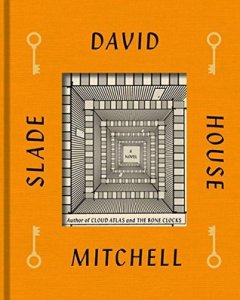
slade houseIn a nondescript back alley, down the street from a pub called “The Fox and Hounds,” there is a small iron door.  It’s not there for everyone, nor does it appear anytime you might look for it.  You can only find the door once every nine years, on the Saturday before Halloween.  That’s when someone special – someone with a gift – will be invited into Slade House, to wander the gardens and view the wonders inside and out.  But what really happens in the house?  As the publisher’s blurb perfectly put it: “For those who find out, it’s already too late.”

Scared yet?  So I had a feeling this book was going to terrify me… but I really, really wanted to read it.  I think that David Mitchell is fantastically talented.  I loved his modern classic, Cloud Atlas.  (And I’ve still not gotten to his recent novel The Bone Clocks.  Soon.  Really soon.)  Slade House is his take on the classic haunted house novel.  It’s a short book, but packed full of Mitchell’s prodigious imagination.  (Apparently it’s also set in the same “fictional universe” as The Bone Clocks.  You can read Slade House as a standalone work – it holds up – but I hear that reading The Bone Clocks first would have been helpful.  I did not, but now I want to read The Bone Clocks and then revisit Slade House to see what I missed the first time around.)  I pre-ordered Slade House because it was released on October 27th, and I knew that if I got on the library’s wait list there was no way I’d have it in time for Halloween.  (Yes, I decided to read a haunted house novel in time for Halloween.  I’m either a complete cliche, or an idiot.  Or both.)  So… Slade House lived up to its promise of being absolutely terrifying.  (For me.  Like I said, I am a gigantic wimp, so what scares the bejeezes out of me is probably, like, Tuesday for you.)  I read it in twenty-four hours, over the course of just a couple of sittings, and it kept me awake half the night.  It’s weird and creepy and… I just got a chill down my spine even writing this review.  If you’re into the paranormal, or just good writing and a rich imagination, Slade House doesn’t disappoint.  (And even though it’s not Halloween anymore, pick it up.  It would make great reading for a dark November night – and you will probably worry less than I did, knowing that I was reading it on the day before the door was scheduled to appear…)

Happy belated Halloween, you guys.  Did you read anything scary this year?  After Slade House I’m still sleeping with the lights on…

Reading Round-Up (September 2015)

Reading Round-Up Header

Reading is my oldest and favorite hobby.  I literally can’t remember a time in my life when I didn’t love to curl up with a good book.  Here are my reads for September, 2015

Malice at the Palace (Her Royal Spyness #9), by Rhys Bowen – I always love a visit to Georgie, and this one was no exception.  Left without a place to stay (again), Georgie is relieved when Queen Mary has another assignment for her – and this one involves living at Kensington Palace!  Georgie will be looking after Princess Marina of Greece, intended bride of Prince George.  It’s a plum assignment, but things get a bit dicey when the body of one of Prince George’s former lovers winds up in the palace courtyard.  With no shortage of possible suspects, solving this mystery will test all of Georgie’s ingenuity.  These mysteries are so much fun.

Kitchens of the Great Midwest, by J. Ryan Stradal – Eva Thorvald is the mysterious chef behind one of the most sought-after dinner invitations in the world, but how did she develop her flawless palate?  In a series of connected, but not quite, sequential stories, Stradal focuses on one personality and one part of Eva’s life at a time.  Sometimes Eva is a starring player in the story; other times she only makes a cameo appearance.  The stories were well-crafted, the characters very real.  I enjoyed this.

The Fellowship: The Literary Lives of the Inklings, by Philip and Carol Zaleski – Yawwwwwwwwn.  Sorry, but this was a total slog for me.  It might be because I tried to read it while I was exhausted from sleepless night after sleepless night… but I’ve read other nonfiction since Nugget’s birth, and this was the first that really couldn’t hold my attention.  I liked the Tolkien parts, but the Lewis sections were depressing (kill heroes much?) and I couldn’t care less about the other Inklings.  Skip this and read LOTR instead.

The Thrilling Adventures of Lovelace and Babbage, by Sydney Padua – I heard about this on the All the Books! podcast, and it did not disappoint.  Padua started writing a web comic about Ada Lovelace and Charles Babbage, two Victorian scientists who were famous as genius eccentrics in their day.  Babbage almost invented the first computer, and Lovelace (daughter of Lord Byron!) wrote code for the nonexistent machine.  Babbage was a failure and Lovelace died young, and Padua was bumming hard about that, so she invented a parallel “pocket universe” in which Lovelace and Babbage became an intrepid crime-solving team with the help of their computer.  IT.  WAS.  AWESOME.  (The George Eliot chapter was my favorite, obviously.  “Pray do not corrupt the cats with poetry.)  Love.  Love love love love love.  Please do a sequel, Sydney, pretty please with equations on top?

No Regrets Parenting: Turning Long Days and Short Years Into Cherished Moments With Your Kids, by Harley A. Rotbart – I blew through this one pretty quickly, and it was mostly common sense.  I’m always on the lookout for ways to make more memories with my family – the little ones are growing up so fast, and it’s hard being away from them all day – so I figured I’d pick up some suggestions here.  I probably did, but I’ve forgotten all of them.  Want my advice?  Skip reading this book, and just go make the darn memories already.

Secrets of the Baby Whisperer: How to Calm, Connect, and Communicate with Your Baby, by Tracy Hogg – Ugh.  So, I thought this was great while I was reading this, until I started feeling inadequate.  Really inadequate.  Really, really inadequate.  And then I mentioned some of the Baby Whisperer’s sleep theory to the kids’ pediatrician, and he gave it major side-eye.  A book that gets the stinkeye from the doctor and makes me feel like a lousy mother is… not recommended.

The Custom of the Country, by Edith Wharton – Read for my #FallingForEdith readalong, I won’t necessarily say I enjoyed the story of acquisitive, brash, social-climbing Undine Spragg.  In fact, she was kind of a… well, it rhymes with “itch.”  But the writing was spectacular (as usual, it’s Edith Wharton after all), the world was glittering and real, and I was glued to the book because, although I hated Undine, I just had to know what was going to happen.  The Custom of the Country might have been a book about unpleasant people, but it didn’t cool me on Edith Wharton at all.  Now I want to read The House of Mirth.

Adventure Time, Volume 1, by Ryan North – I have been hearing great things about this all-ages comic, so I finally checked it out.  It was pretty cute!  I especially liked Marceline the Vampire Queen (she’s over 1,000 years old, be cool, okay?).  But I have a feeling that a lot of the jokes were lost on me.  I guess there’s a TV show, and if you don’t watch it, big chunks of the comic won’t make sense?  I dunno – I guess that’s true, because I found this adorable but kind of confusing.

Fables, Volume 1: Legends in Exile, by Bill Willingham – Fables is a classic comic, and I figured I’d enjoy it because I always like new twists on familiar stories.  This one was great.  It was framed as a murder mystery – who killed Rose Red? – but also introduced a larger world.  All of the characters we remember from fairy tales have been exiled from Fairyland and are now living in Fabletown, a secret enclave in New York City.  King Cole is the Mayor, but he’s pretty much a figurehead – Snow White runs the show, with Bigby (Big B, Big Bad, get it?) Wolf as the Sheriff.  Prince Charming is a despicable rake, Beauty and the Beast are constantly fighting, and Fabletown itself is sort of hanging by a thread.  This comic stretched out over 22 volumes (with several spinoff series) and I hear it get better and better.  I can’t wait to dive deeper into this world – I already have the second and third volumes checked out of the library and waiting in my stack.

Not too shabby for the first month back at work!  I’m enjoying exploring a bit more of the world of comics.  It’s been a great way for me to read and meet new characters, but in manageable chunks of time.  (The next few months should be great ones for comics – the next trade paperback of Lumberjanes comes out on my birthday, and November will see several Star Wars trades released.  I can’t wait!)  The comics were sort of the highlights of the month, but I also enjoyed visiting with Georgie again, and Kitchens of the Great Midwest was a lovely read (it made me want to cook).  One thing’s clear, though – I have to lay off the parenting books.  They’re making me feel rotten and inadequate.  I do have a few more that I’m sort of interested in reading, but I’m taking a break for now.  With everything I have going on, I just want to read what I’m excited about – and at the moment, that’s mostly comics.  Next month, I think I’ll have some good stuff to share – I’ve already read a couple of great books in October.

The Custom of the Country (#FallingForEdith)

the custom of the country

Considered by many to be Edith Wharton’s masterpiece, The Custom of the Country follows an acquisitive, social-climbing anti-heroine from marriage to marriage.  When the novel opens, Undine Spragg, recently of Apex (a vaguely middle-American town) is living with her parents in New York City, navigating the social mores of the “stylish” set who have been closed off to her up until that point.  Undine’s father, Mr. Spragg, is rich and indulges his daughter – after a bit of fighting, maybe – in most of her whims.  Undine, for her part, is ambitious and striving, much like the young USA of the day.  (According to the introduction in the edition I read, it’s no coincidence that Undine Spragg shares her initials with United States.)  A lucky break – the quiet admiration of Ralph Marvell, one of New York society’s favorite sons – introduces Undine into the American aristocracy on which she has set her sights.  A whirlwind courtship later, they’re married and Undine is pregnant.  But Ralph, while he may be part of the exclusive crowd to which Undine is desperate to belong, is not rich – and so he soon proves to be a “disappointment” to his wife.  And instead of swallowing her “disappointment,” or – gasp! – learning to budget, Undine takes a not-quite-socially-acceptable-yet plunge and divorces Ralph.  Her next marriage, to a French Marquis, doesn’t fare much better – after brash American Undine makes a major faux pas by pressing her husband to sell some family heirlooms (so as to keep her Paris seasons in rich style) another break seems inevitable.  The novel ends – spoiler alert! – with Undine married to a billionaire from Apex who… it turns out… was actually her first husband!  WHAT!

My thoughts, which seem to lend themselves to bullet point form for this review:

  • Wharton has written a novel made up almost exclusively of unlikable characters.  I did like poor Ralph Marvell, and Clare Van Degen (repenting her marriage in diamonds) as well.  And I felt for poor Mr. Spragg, trying so hard to make ends meet in New York over the demands of his wife and daughter.  And that was pretty much it.  Now, usually, I’m a fairly character-driven reader.  If I can’t root for the main character, I find it hard to stick with a book.  There have been one or two notable exceptions, and this was one of them.  (W. Somerset Maugham’s The Painted Veil was the other.)  While I disliked Undine intensely (and that seemed to be the universal reaction) I really respected the literary achievement of making me hang with an unlikable character.  (I think that’s also what Jane Austen is trying to do, to a certain extent, in Emma – she famously wrote that she had created a heroine nobody but her would much like – but she falls short because, while Emma is an engaging novel, Emma herself is a far more likable protagonist than Wharton’s Undine.  Emma is flawed, but good at heart and pretty charming.  Undine is flawed, not good at heart, and really quite off-putting.)
  • Thanks to the introduction’s pointing it out, I was very aware of Undine’s representation of brash American-ness throughout the book.  (I quit reading the introduction shortly after the fact was noted, because it gave away a pretty major spoiler and sort of ruined the book’s big surprise for me.)  Wharton deftly skewers the nouveau-riche Americans of the day, holding Undine up against the old money (that’s mostly gone) standard set by Ralph Marvell and Raymond de Chelles and very pointedly showing the reader all of the areas where Undine and her upstart sort fall short.  Of course, old society doesn’t escape either – Peter Van Degen represents the very worst of what the “old money” set can mutate into – and it costs his wife and Ralph Marvell their happiness.
  • I found the name of Undine’s hometown – Apex – fascinating.  The word suggests a workaday kind of bland American outpost, but also the pinnacle of achievement.  And (spoilers!) Apex does turn out to be the pinnacle – for both Mr. Spragg, who never replicates the same success he had in Apex after the family arrives in New York – and for Undine, the fulfillment of whose wildest, most money-grabbing aspirations were rooted in Apex after all (despite her determination to be part of New York society at all costs).
  • I’ve now read two Wharton novels, and each of them had odd, arguably unsatisfying, endings.  (Spoilers!)  The Age of Innocence, one of my favorite books, ends with a whimper – Newland Archer on a park bench, widowed, deciding that he’s not going to attempt to reunite with Ellen Olenska after all.  And The Custom of the Country, which probably should end with Undine getting her comeuppance once and for all (certainly that would be more satisfying for the reader) ends instead with her rolling in money and her billionaire husband realizing that he’s got to “lump it” or be cast off like his predecessors.  Oof.  Yet I still – literary achievement again, here – really enjoyed the ride, horrible undeserving anti-heroine and all.  Well done, Edith Wharton.  Slow clap.

In reading The Custom of the Country, Jen and I were joined by two other smart and prolific readers, both of whom share my impression that Undine is just. the. worst.

Thoughts from my friend Zandria:

It’s not bad enough to fall into the “Not Recommended” category, but it was impossible to like it when I didn’t care for ANY of the characters — they all annoyed me in one way or another. Although it seems silly to say this, the main character was such an awful person I wanted the story to be over so I could stop giving her more attention than she deserved.

(Zan’s full post here.)

And the always-insightful A.M.B. had great thoughts on the subjugation of women as discussed in the book:

And poor Undine (which I can admit despite hating her). She is the product of stifling times. The demeaning gender norms of her day persist to some extent in ours; however, in our century, a woman as ambitious as Undine could reasonably strive to be a prominent person in her own right, and not just the wife of one.

(Read her full post here – and congratulations to Mr. A.M.B. on opening his own law practice!  I wish him much success and joy in his career.)

Have you read any Edith Wharton?  What do you think of her depictions of Gilded Age New York?

Reading Round-Up: August 2015

Reading Round-Up Header

Reading is my oldest and favorite hobby.  I literally can’t remember a time in my life when I didn’t love to curl up with a good book.  Here are my reads for August, 2015

Crossing to Safety, by Wallace Stegner – I loved this quietly dramatic story of the friendship between two couples.  Larry and Sally Morgan meet Sid and Charity Lang at an evening event for academics at the university where Sid and Larry are instructors.  The wives immediately bond over their pregnancies and before long the couples are closer than family.  Stegner’s novel tracks their friendship as it ebbs and flows over the decades, until they all reassemble at the Lang’s compound in the face of tragedy.  I’d never read any Stegner before and now I want to read everything he’s ever written.  The writing was gorgeous, the characters so real, and the plot – while slow – was marvelously wrought.

Minimalist Parenting: Enjoy Modern Family Life More by Doing Less, by Christine Koh and Asha Dornfest – I found this book while reading Goodreads reviews of Simplicity Parenting, which I read earlier this year.  The reviews promised a similar premise to Simplicity Parenting, but a friendlier approach.  I definitely found that to be the case.  Much of Minimalist Parenting was common sense, but it was a good vote of confidence to continue working on right-sizing our life and family activities, which is something that I’ve been thinking a lot about these days.

Book Scavenger, by Jennifer Chambliss Bertman – Twelve year old Emily is moving again; her parents write a blog about their quest to live in all fifty states, and it keeps the family on the go.  Emily wishes they would put down roots, but she is excited about living in San Francisco, which is the home base of Mr. Griswold, the creator of her favorite game, Book Scavenger (think geocaching with puzzles to solve, and books as the prizes).  But when something terrible befalls Mr. Griswold, Emily and her new friend James find themselves in possession of what they believe to be Mr. Griswold’s new game – and they’re not the only ones who want it.  This was a cute middle-grade novel.  Some Goodreads reviewers complained that it was too simplistic, but consider the audience; I thought it was a fun, quirky, light summer read.

Lumberjanes Vol. 1: Beware the Kitten Holy, by Noelle Stevenson and Grace Ellis – I will have a whole post coming up on this at some point, but Lumberjanes was my first foray into comics and I found myself really enjoying it.  Jo, April, Mal, Molly and Ripley are five friends looking forward to an awesome summer at Miss Qiunzilla Thiskwin Penniquiqul Thistle Crumpet’s Camp for Hardcore Lady-Types when they discover a pack of three-eyed foxes and the message “Beware the Kitten Holy.”  They are lured into a mystery involving river monsters, talking statues, and a boys’ camp where something is reeeeeeeally off.  This was a blast.  The dialogue was hilarious, the art was fun, and the mystery is drawing me in too.  And with that, I formally retract my previous words about not being interested in any comics.

Breakfast with Buddha, by Roland Merullo – Otto Ringling is on his way to the homestead of his deceased parents.  His sister Cecelia is supposed to accompany him, but instead she manipulates him into bringing along her guru, Volya Rinpoche.  Otto, a confirmed skeptic, finds himself liking the Rinpoche more than he expected to, and agrees to show the Rinpoche some American fun in exchange for philosophical discussions in the car.  They go to baseball games and discuss the meaning of life, and the journey changes Otto.  So… I liked this, but not as much as I thought I was going to.  I may seek out the next books featuring the same characters, but not for awhile – I didn’t love it enough to bump Lunch with Buddha and Dinner with Buddha up on my TBR.

Marvel Illustrated Pride & Prejudice, by Nancy Butler – Another comic, read for Austen in August.  I enjoyed this one a lot.  I love anything to do with Jane Austen, and the comic form was a cool way of experiencing her iconic work in a different style.  I had some feelings about the author’s introduction, but I didn’t let that interfere with my enjoyment of the comic.  This would be a great way for a lit lover to break into comics.

Love and Freindship, and Other Youthful Writings, by Jane Austen – My big reading project for Austen in August, I enjoyed reading Austen’s juvenilia.  I found it hilarious and just wildly entertaining.  (Everyone is drunk!  Everyone faints!  Everyone is horrible!)  It was fun to watch the young Austen cutting her teeth; now I want to go back to the six canon works to see if I can find passages that show her progression.

Jane Austen’s England, by Roy and Lesley Adkins – Another Austen in August project.  I found this cradle-to-grave tour of Georgian and Regency England interesting, but would have preferred if it had focused more on Austen herself and the middle class.  There was a great deal about the very rich and the very poor, which was interesting but not representative of Austen’s England.  I felt that the title was a hook to draw in Austen fans, and that Austen herself only made the occasional token experience; I think I’d actually have liked the book more if I didn’t feel a bit hoodwinked.

The Martian, by Andy Weir – Looooooooooooved this captivating tale of an astronaut’s survival on the red planet!  Mark Watney is a member of Ares III, the third manned mission to walk on Mars.  His crew is just settling in on their mission when a dust storm engulfs them.  Believing Mark to be dead, the rest of the crew aborts and leaves Mars – with Mark, still very much alive, left behind.  But Mark is plucky and brilliant, and he is determined to survive.  Steve and I both read and really enjoyed this, and now I can’t wait for the movie!  (Any babysitters want to volunteer to watch two ADORABLE children?)

August was a good reading month – lots of Austen in August fun, a new venture into comics, and a great sci-fi survival story.  How could I complain?  I think reading is likely to slow way down in September, now that I’m back from maternity leave (sniff – I miss the little guy so much).  But I’m looking forward to some good library reads this coming month, and along with my friend Jen I’m hosting an Edith Wharton readalong!  (If you haven’t joined us yet, please do!)  

How was your August in books?

Reading Round-Up: July 2015

Reading Round-Up Header

Reading is my oldest and favorite hobby.  I literally can’t remember a time in my life when I didn’t love to curl up with a good book.  Here are my reads for July, 2015

The Elephant Whisperer, by Lawrence Anthony My mom recommended this memoir by the owner of an African game reserve who saved a “rogue” herd of elephants and created an incredible bond with the creatures in the process.  It was wonderful.  I laughed.  I cried.  I priced African safari vacations.  I’ve always liked elephants (although I never considered them my very favorite animals, #whales4lyfe) but after reading Anthony’s memoir I have a new appreciation for their intelligence and magnificence.

Orchard House: How a Neglected Garden Taught One Family to Grow, by Tara Austen Weaver – Hmmmmm.  I had mixed feelings about this one.  There were certain things I loved – the descriptions of life in Seattle, and the luscious pages Weaver devotes to discussing the garden she is growing with her mother.  But I found myself frustrated when the author became petulant.  I could give many examples, but the hissy fit she threw when her sister-in-law told her that her nieces could not come eat strawberries at the last minute because they had swim lessons was particularly silly.  And her relationship with her mother was strange.  For instance, when her mother broke her back and a family friend/doctor told Weaver that Mom would need “a lot of nurturing” Weaver’s first thought was “But who will nurture me?”  Ummmmm, nobody?  You’re a grown woman, for goodness sake!  Get a grip!  Sigh.  Still recommended because of the garden descriptions, which were truly beautiful.

The Book of Speculation, by Erika Swyler – It’s probably a result of too much hype, but this magical realism story of a family of “drowning circus mermaids” didn’t wow me.  I predicted the twist a mile away and the story never really grabbed me.  A disappointment, because it’s been getting raves on other book blogs.  Maybe I just expected too much.

American Ghost: A Family’s Haunted Past in the Desert Southwest, by Hannah Nordhaus – Meh.  Another underwhelming one.  I was intrigued by the beginning, which describes a “haunting” at a Santa Fe hotel – the ghost being Nordhaus’s ancestor Julia.  But the book ended up being far more an exploration of Nordhaus’s German roots and her family’s settlement in New Mexico, and less about spooky stuff, which was what I wanted.  It was short, so I pushed through, but goodness.  I’m not even that interested in my own ancestors, let alone a stranger’s.

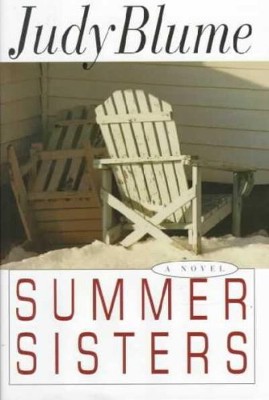
Summer Sisters, by Judy Blume – Read this one for Kerry’s BlumeAlong, and enjoyed it very much.  It was a re-read and I loved diving back into the story of the complicated friendship between Caitlin and Vix.  Full review here.

The Millionaire and the Bard: Henry Folger’s Obsessive Hunt for Shakespeare’s First Folio, by Andrea Mays – Loved this one!  Mays takes what could be a dry subject – Henry Folger’s rare book-collecting hobby and the building of the Folger Shakespeare Library – and turns it into a thrilling chase.  There were times I was quite literally on the edge of my seat, wondering if Folger would score a particularly coveted First Folio, and how much it would cost him.  He wasn’t the richest or most powerful rare book collector working at the time, but he was the most single-mindedly devoted to Shakespeare, and that set him apart.  A great read.

Doomsday Book (Oxford Time Travel #1), by Connie Willis – The first of my vacation books!  Oxford, in the mid-2000s, is home to a collection of time-traveling historians (!), including Kivrin Engle, who focuses on the Middle Ages.  When Kivrin determines to travel back to 1320, her mentor, Mr. Dunworthy, is extremely worried.  His worries prove well-founded when a crisis in present-day threatens to strand Kivrin in the past.  I predicted a couple of the twists, but still loved the ride. Time travel books are one of my weaknesses, and I had so much fun with this one.

Brown Girl Dreaming, by Jacqueline Woodson – I probably should have taken my time, so as to really enjoy it, but I couldn’t put down this free verse memoir of Woodson’s childhood in Civil Rights era South Carolina and Brooklyn.  The poems were beautiful and moving, and I immediately decided to buy a copy, because I can see myself reading it over and over.

The Life-Changing Magic of Tidying Up, by Marie Kondo – Even after finishing this one, I still can’t decide if it’s brilliant or bonkers, inspired or insane.  I think it might be a little of both.  Kondo’s method for “tidying up” (read: decluttering) makes a certain degree of sense (ask yourself if you really love something; if the answer’s no, get rid of it), but her conviction that “stuff” has “feelings” came off as completely loony tunes.  I will be applying some of her decluttering tips.  I will not be congratulating my socks on a job well done at the end of the day.

Nine books!  Not too shabby.  I’d hoped for more, since we were on vacation (with extra baby-holding arms available) for a chunk of the month, but I’m pretty pleased with what I did get read.  Not every book was a winner, but I’m making steady progress toward finishing up my absurd library stack, and that’s a good thing.  I have exciting reading plans for August – a few more library books I’m pumped about, and some Jane Austen for Roof Beam Reader’s Austen in August event.  Can’t wait to dig in!

Summer of #BlumeAlong, Part II: SUMMER SISTERS

summer sisters

It’s that time again – time to talk Judy Blume with my fellow #BlumeAlong participants!  If you missed previous discussions, #BlumeAlong is a Judy Blume readalong hosted by Kerry at Entomology of a Bookworm.  We’ve already discussed Are You There, God? It’s Me, Margaret, and now we’ve moved on to something a good bit steamier: Summer Sisters.

Synopsis

Victoria “Vix” Leonard is twelve years old when Caitlin Somers chooses her as a friend.  Vix can’t believe her luck when pretty, popular Caitlin invites her to spend the summer on Martha’s Vineyard.  Soon Vix is part of the family – Caitlin’s “summer sister” and surrogate daughter to Caitlin’s father Lamb and his new wife, Abby.  Those first summers are idyllic, sun-drenched months of sand, surf and… ahem… discovery.  But as Vix and Caitlin grow into teenagers, and then young women, their friendship will become infinitely more complicated.  Competition for boys and… ahem… milestones heats up with the summer sun, and Vix must learn to protect her heart, even from her summer sister.

My Thoughts

I read Summer Sisters years ago, when I was in high school.  (It must have just come out when I first picked it up, because the credits say it was published in 1998, and I graduated in 1999.)  I remember being fascinated by Caitlin’s privileged world, and blushing extremely hard at some of the girls’ antics, especially once island boys Von and Bru came on the scene.  (I was quite sheltered.)  When I first read Summer Sisters, it was a voyeuristic glimpse into a different world, and I liked that.

Reading it as an adult – and it is, most definitely, a novel for adults – what strikes me most is the complexity of the central friendship.  This is Judy Blume, and there is a huge cast of characters and many relationships to navigate, but Vix and Caitlin’s incredibly complicated friendship is the focal point.  It was bittersweet, certainly, and fascinating, and relatable to at least a certain extent.  After all, what woman has not had a complicated friendship or two of her own?  Girlfriends can be much more intense than boyfriends, and those teenaged years are the time to figure out the give and take that make up adult friendships.

It was there that I thought Vix was maddening.  I’ve had more than one complex friendship – we all have.  I’ve never had anyone quite like Caitlin in my life, but I have had friendships that have taken very intense turns.  I think it’s a right of passage for growing up female.  But a rite of passage means just that – passage.  Those friendships serve a purpose; they help us grow.  But ultimately, we must learn to assert ourselves and figure out how to be part of an adult friendship, and that was something that I don’t think Vix learned to do.  Those intense teenaged friendships don’t last.  They either evolve, or they fizzle.

I think it’s telling that neither of the women I currently consider my “best friends” were the other party in any of my very intense friendships.  One of my closest friends is someone I have known since middle school, and we have been friends since we met, but we really became close in college – once we were both mature enough to understand and partake in a more adult friendship.  The other woman is someone I met and became friends with in college – one of my sorority sisters.  It is those friendships, which escaped that truly intense period, that I think are going to last.  And my most Caitlin-esque friends?  I’ve lost touch with them, and I’m okay with that.  I can now see that they were not healthy relationships.  I can value them for what they were, but I’m glad they’re in the past.

Vix never quite learned to get over Caitlin, and their friendship never evolved.  Caitlin was always the dominant personality; Vix was just grateful that Caitlin chose her as a friend.  I kept waiting for Vix to tell Caitlin off (although, having read the book before, I knew she wouldn’t).  I had to agree with Vix’s college friends Maia and Paisley – I wasn’t sure, by that point, what Vix saw in Caitlin.  It seemed to me to be a one-sided friendship, and I wished that Vix, so mature in other respects, would grow up and demand a more equal, adult friendship.

I enjoyed Summer Sisters, although not as much as I did when I first read it.  I was less shocked by the “adult content” – since, you know, I am an adult now – and was more able to focus on the relationships.  I loved Abby, a figure who barely registered the first time I read the book – on this read, I found myself identifying with Abby more than anyone else.  And Vix’s brother Nathan broke my heart.

All told, Summer Sisters was – of course – well-written, engaging, and more than a little scintillating.  It was fascinating to read it as an adult, since I was about 16 when I last read it.  It might not be my favorite Judy Blume, but as summer reading goes, it doesn’t get much hotter than Summer Sisters.

Have you read Summer Sisters?  What do you think?