Helloooooooo! Did you miss me? Or did you (hopefully) not even notice I was gone? Steve and I spent the last three weeks traveling through Antarctica, with a few days in the Tierra del Fuego region of Argentina on the back end. There were whales, penguins, seals and sea lions galore – stunning blue glaciers and towering icebergs – brash ice to paddle our kayaks through – big rolling waves on the Drake Passage – new friends with whom to share the experience. It was absolutely epic, and I have a ton of pictures to sort through and stories to type up and share with you – so more coming very soon!
Theodore Roosevelt National Park is comprised of three separate units: the South Unit, the North Unit, and the Elkhorn Ranch Unit. Staying in charming Medora, we spent most of our time in the nearby South Unit. The North Unit was a long drive away, so we quickly decided it wasn’t going to happen on this trip – maybe another time. But we did want to check out another part of the park, so on our second full day in North Dakota, we piled in our rental car and drive two hours to this small park unit.
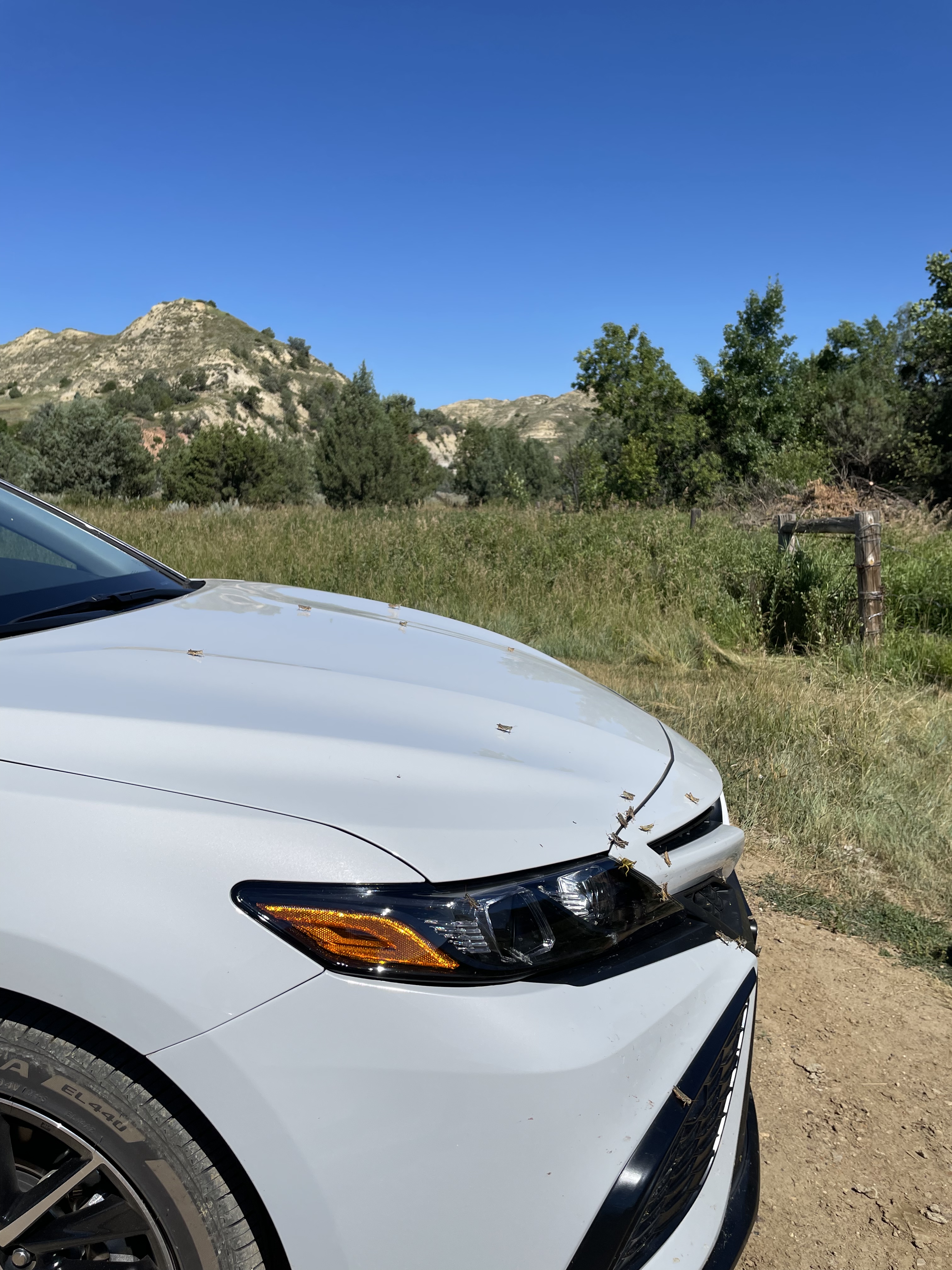
Side note: the front grill and hood of our rental car became a grasshopper graveyard. Peanut was horrified and disgusted. Nugget was fascinated.
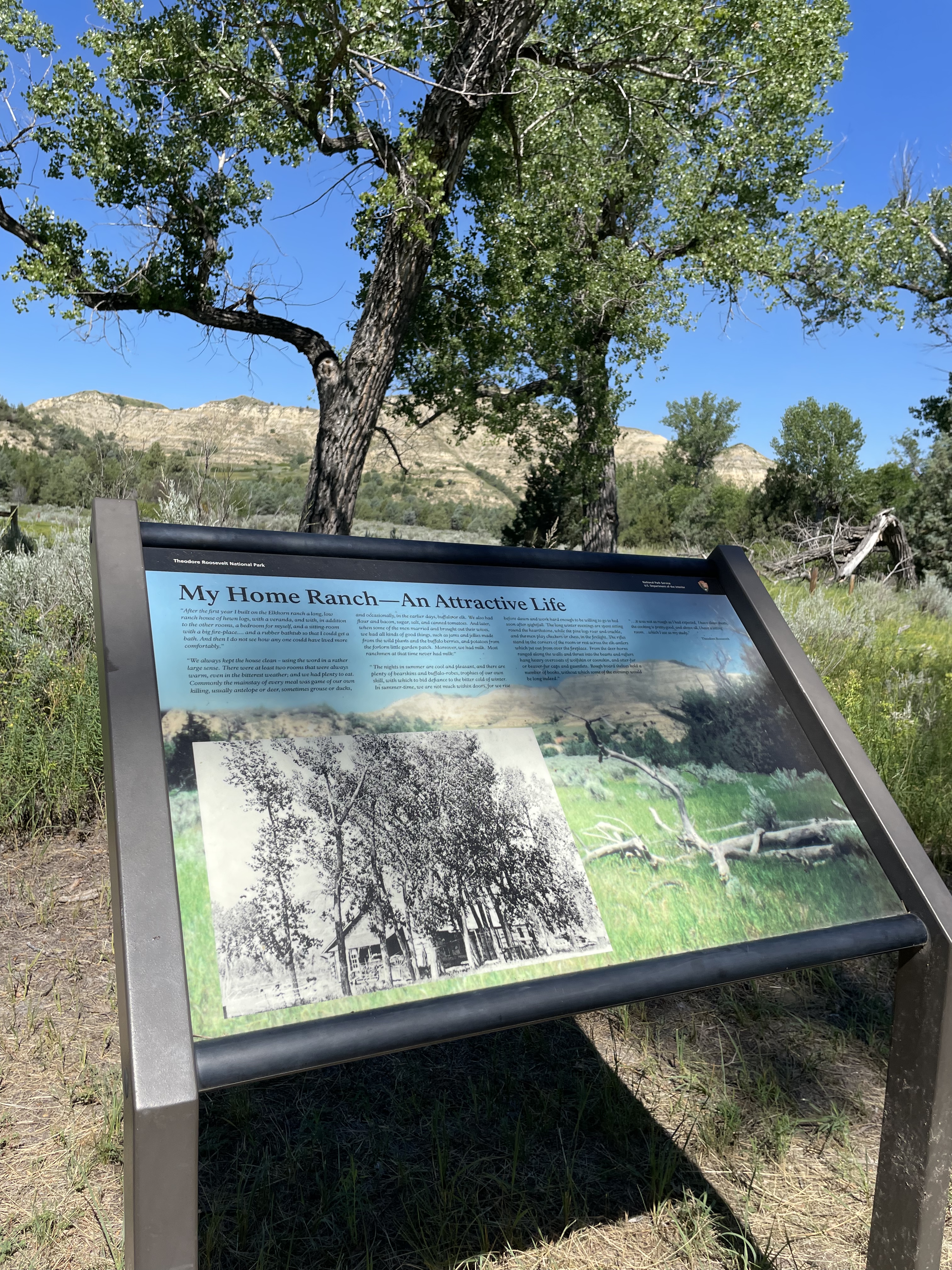
Elkhorn Ranch is famous as the Dakota badlands home of Theodore Roosevelt. While TR had a few different homesteads in the area – including the Maltese Cross Cabin (to be featured in a future post – keep reading!) – Elkhorn Ranch was his primary, and most-loved, home in North Dakota.
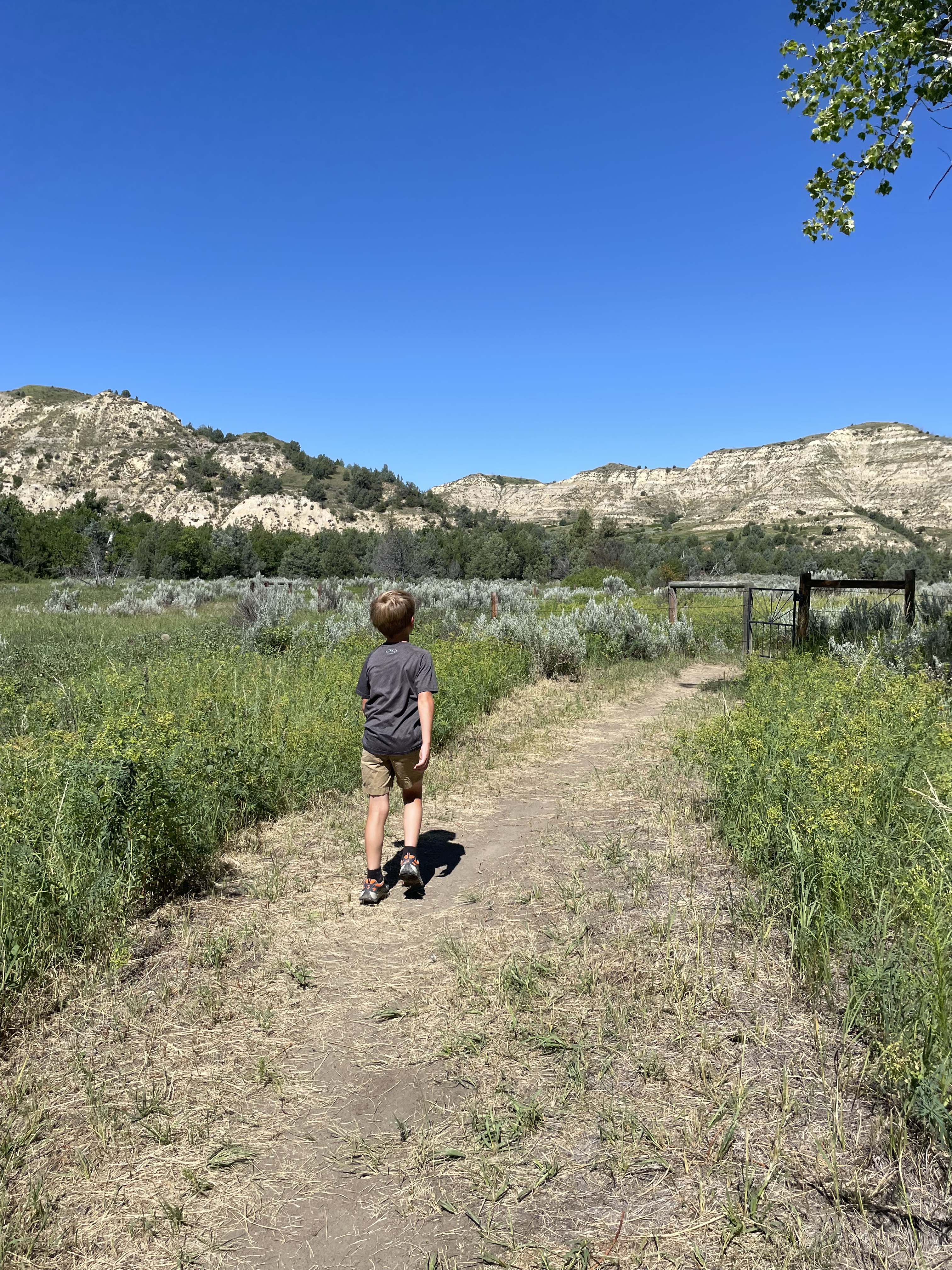
For no good reason that I can think of, I was under the impression that this hike led to an actual preserved ranch homestead that we could check out – like the Maltese Cross Cabin – or at least some interesting Old West ruins. But the ranch buildings are no longer standing, and the most a visitor can see is the suggestion of a floorplan. Not sure if it’s not really publicized that the ranch is no longer there, or my poor reading comprehension – the latter, probably. But note to would-be visitors: this is a lovely hike and the views at the end are rewarding, but there’s no ranch house anymore.
About those views…
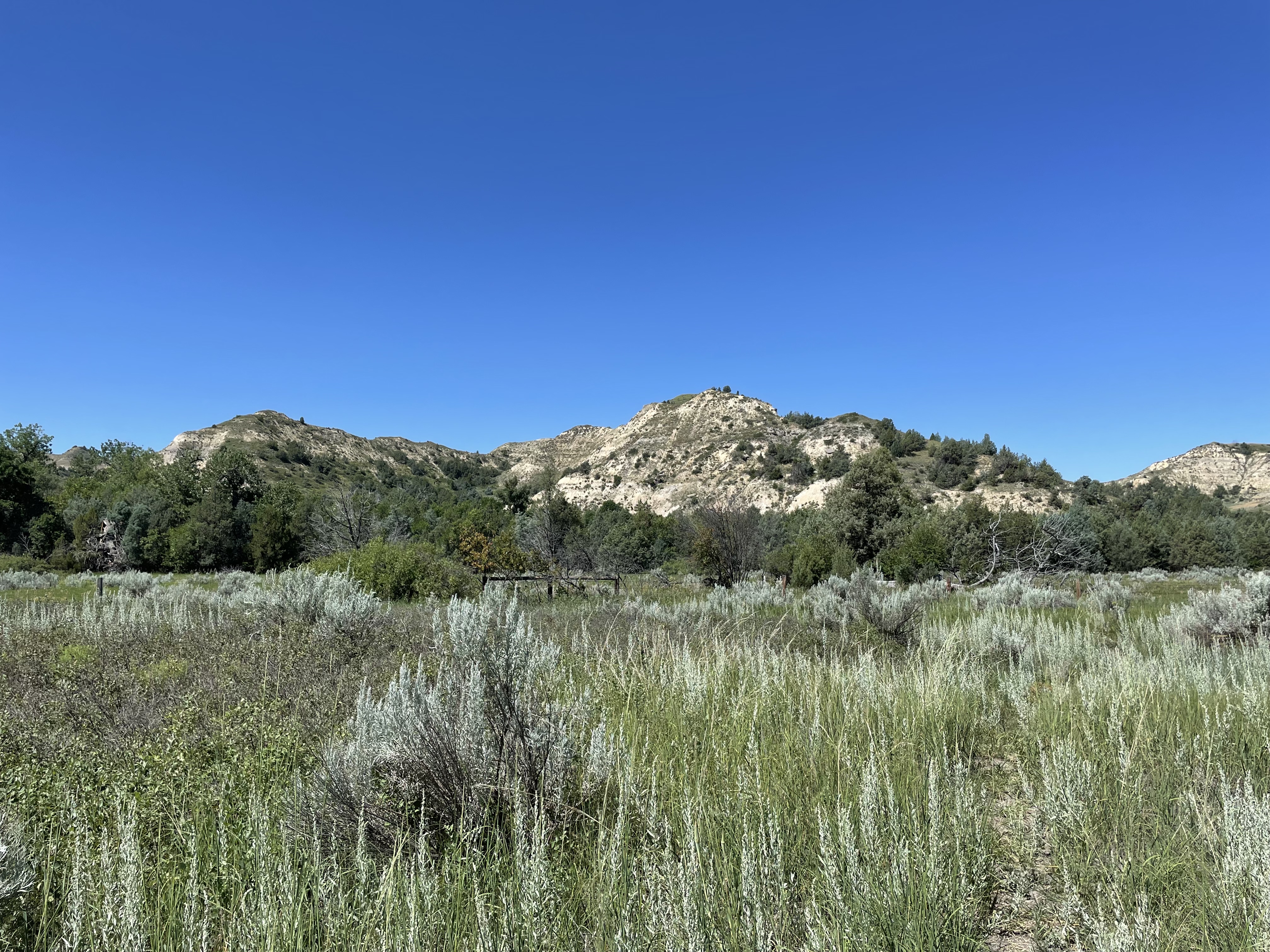
The hike culminates in a beautiful meadow surrounded by quintessential North Dakota badlands buttes. Just stunning – and the aroma, I can’t even tell you. Let’s just say if you ever get the chance to stand in a meadow surrounded by sage and breathe in, do it.
Worth every minute of that long drive.
Next week: we channel Laura Ingalls, hike the North Dakota prairie, and find some really cool petrified wood.
For a long time, I didn’t listen to much of anything. The occasional book on CD, podcasts on my commute – that was it. Times have changed and, thanks to Steve setting up my Spotify and linking it to my Echo devices, I now have infinite music. And since I haven’t cut back on audiobooks – quite the contrary – listening time is creeping up and I’m really enjoying that.
First of all, I’m still on my kick of alternating between listening to an audiobook and then catching up on the latest episodes in my (now mostly cleared of back content) podcatcher. It’s a nice way to squeeze in extra reading, and over the past few months I’ve eked out several books this way, namely:
The Christmas Hirelings, by Mary Elizabeth Braddon
God Rest Ye, Royal Gentlemen, by Rhys Bowen
Christmas Days, by Jeannette Winterson
Dinner with Edward, by Isabel Vincent
Smallbone Deceased, by Michael Gilbert
Horizon, by Barry Lopez
And as mentioned above, Steve set up my Spotify account (apparently I’ve had one for ages?) and linked it to my Echo devices, so now I can play any music I want in any room of the house (or my car). After years of professing that I’m just not that much of a music person (except for the Decemberists, of course), I am remembering how much fun it can be to get sucked into a good song or album. Nugget and I have been going down a major R.E.M. rabbit hole on our way to the ski mountain every weekend, and I recently discovered a “90s Road Trip” playlist that turned my car into a time machine. If you haven’t driven home from the grocery store belting out “Breakfast at Tiffany’s” then you haven’t lived.
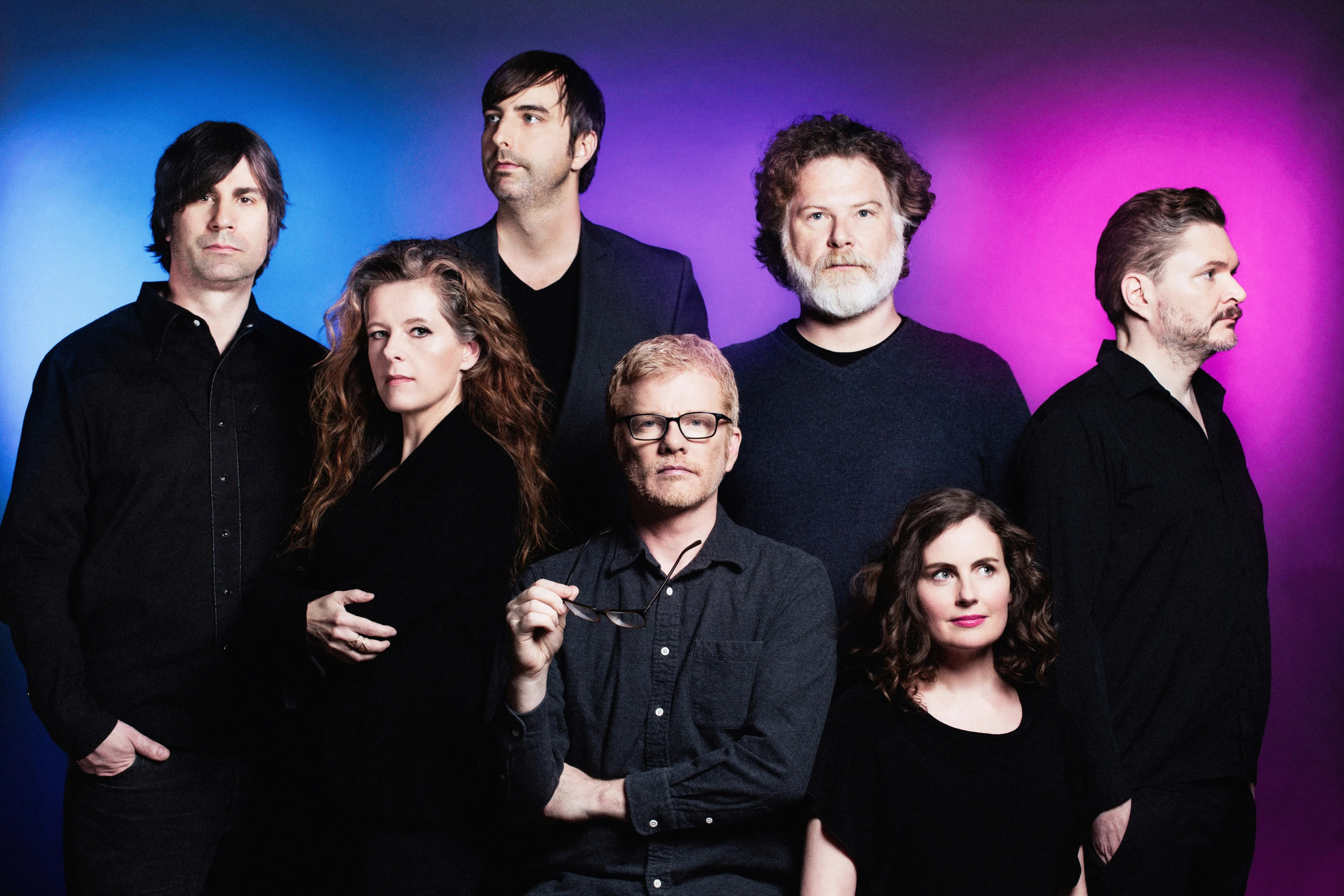
Sticking with the music theme, I have also been binging on The New Pornographers. Along with The Decemberists, these folks were the soundtrack to my life in law school days. They’re touring this spring (!!!) and playing the 9:30 Club in D.C. (!!!!!) and I’ve! Got! Tickets! (!!!!!!!) so clearly I need to prepare. Although they’re dropping a new album and I expect that will make up most of their songs. It’s not out yet, so – much, much more New Pornographers listening ahead.
Something else that’s coming my way and something else for which I’ve got tickets – Six the Musical! Are the kids tired of me walking around the house chanting “Divorced, beheaded, died. Divorced, beheaded… LIVE!” yet? Yes. Yes, they are. Too bad! My friend Amanda and I have a girls’ night planned when the U.S. tour comes to Baltimore, and we are ready for our crowning glory.
So much music here! What a fun season of listening it’s been. I’m sure this will balance out eventually but for now I am really enjoying reliving the 1990s and remixing Tudor history. What are you listening to lately?
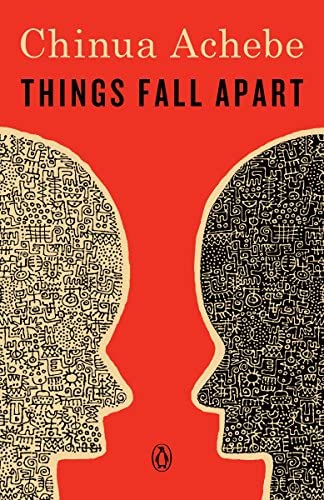
It’s amazing to think that Things Fall Apart is a debut novel – because it’s perfect. Perfectly formed and crafted, perfectly compact – just perfect.
When the novel opens, Okonkwo is a young man in Umuofia, a region in southeastern Nigeria. Already gaining prominence as a local wrestling champion, Okonkwo is determined to forge his own legacy and shake off the shame he feels at being the son of a ne’er-do-well father. The novel’s first section showcases Okonkwo’s determined progress from nobody to rich farmer and respected village leader. He’s a complicated character – engaging and interesting, but also brutal and misogynistic at times. (That made for an interesting dilemma to ponder while reading: Okonkwo is not an especially likeable character, but how much of my response to his behavior was directly tied to my 2020s western worldview? I try to approach each book as a learning experience and to question why I respond to certain characters in certain ways.)
As Okonkwo grows to manhood, he piles success on top of success. The reader watches as he clears hurdles, navigates setbacks – like crop losses – and comes back stronger than ever. It seems there is no challenge to which Okonkwo is not equal.
Enter white missionaries. By the end of the first section of the book, there are whisperings that white settlers have started to inflitrate the land. Okonkwo is unconcerned – at first.
But stories were already gaining ground that the white man had not only brought a religion but also a government. It was said that they had built a place of judgment in Umuofia to protect the followers of their religion. It was even said that they had hanged one man who killed a missionary.
Although such stories were now often told they looked like fairy-tales in Mbanta and did not as yet affect the relationship between the new church and the clan. There was no question of killing a missionary here, for Mr. Kiaga, despite his madness, was quite harmless. As for his converts, no one could kill them without having to flee from the clan, for in spite of their worthlessness they still belonged to the clan. And so nobody gave serious thought to the stories about the white man’s government or the consequences of killing the Christians. If they became more troublesome than they already were they would simply be driven out of the clan.
Eventually, white missionaries arrive in Okonkwo’s village and build a church. Soon, the village is divided between those who – like Okonkwo – value and continue to follow the old traditions, and those who are interested in the newly introduced Christian religion and want to see what it’s all about. Tensions rise as the village becomes more and more fractured, and when a local funeral leads to a tragic accident, Okonkwo and his family are exiled for seven years to Mbanta, his mother’s village. At first deeply depressed at the idea of leaving behind the village and all he has built there – because his farm and all his crops will be claimed by other villagers the second he departs – Okonkwo finds companionship and validation among his extended family in Mbanta. Soon he is prosperous again and is able to influence his family members to resist the colonizing newcomers and cherish their Igbo traditions, as his uncle reflects in a speech honoring Okonkwo at a family feast.
“If I say that we did not expect such a big feast I will be suggesting that we did not know how openhanded our son, Okwonko, is. We all know him, and we expected a big feast. But it turned out to be even bigger than we expected. Thank you. May all you took out return again tenfold. It is good in these days when the younger generation consider themselves wiser than their sires to see a man doing things in the grand, old way. A man who calls his kinsmen to a feast does not do so to save them from starving. They all have food in their own homes. When we gather together in the moonlit village ground it is not because of the moon. Every man can see it in his own compound. We come together because it is good for kinsmen to do so. You may ask why I am saying all this. I say it because I fear from the younger generation. for you people.” He waved his arm where most of the young men sat. “As for me, I have only a short while to live, and so have Uchendu and Unachukwu and Emefo. But I fear for you young people because you do not understand how strong is the bond of kinship. You do not know what it is to speak with one voice. And what is the result? An abominable religion has settled among you. A man can now leave his father and his brothers. He can curse the gods of his fathers and his ancestors, like a hunter’s dog that suddenly goes mad and turns on his master. I fear for you, I fear for the clan.” He turned again to Okonkwo and said, “Thank you for calling us together.”
After his seven years of exile are over, Okonkwo returns to his village to find it changed beyond recognition. The white missionaries have invaded every aspect of village life and only a few villagers seem to still hold true to their traditions. When a Christian convert unmasks a village elder during a religious ceremony – a deeply evil act – Okonkwo and a few other villagers reach the limit of their endurance and call for war against the colonizers. I won’t share more of the plot, because you really should seek this book out to read for yourself – but I will say, as anyone who has read anything about the history of colonization in Africa can guess – things don’t go well for Okonkwo.
“Does the white man understand our custom about land?
“How can he when he does not even speak our tongue? But he says that our customs are bad, and our own brothers who have taken up his religion also say that our customs are bad. How do you think we can fight when our own brothers have turned against us? The white man is very clever. He came quietly and peaceably with his religion. We were amused at his foolishness and allowed him to stay. Now he has won our brothers, and our clan can no longer act like one. He has put a knife on the things that held us together and we have fallen apart.”
I’ve had Things Fall Apart on my to-be-read list for ages, and I’m so glad I finally got to it. It was a slim volume and a fast read – I think I read it in one or two sittings – but packed full of beautiful writing and difficult concepts to consider. As we in western countries engage more and more with our own legacy of colonialism and erasure, this should be required reading. I’m sure I will revisit it, since there was so much to turn over and consider here; this is a book that will reward multiple re-readings for years to come.
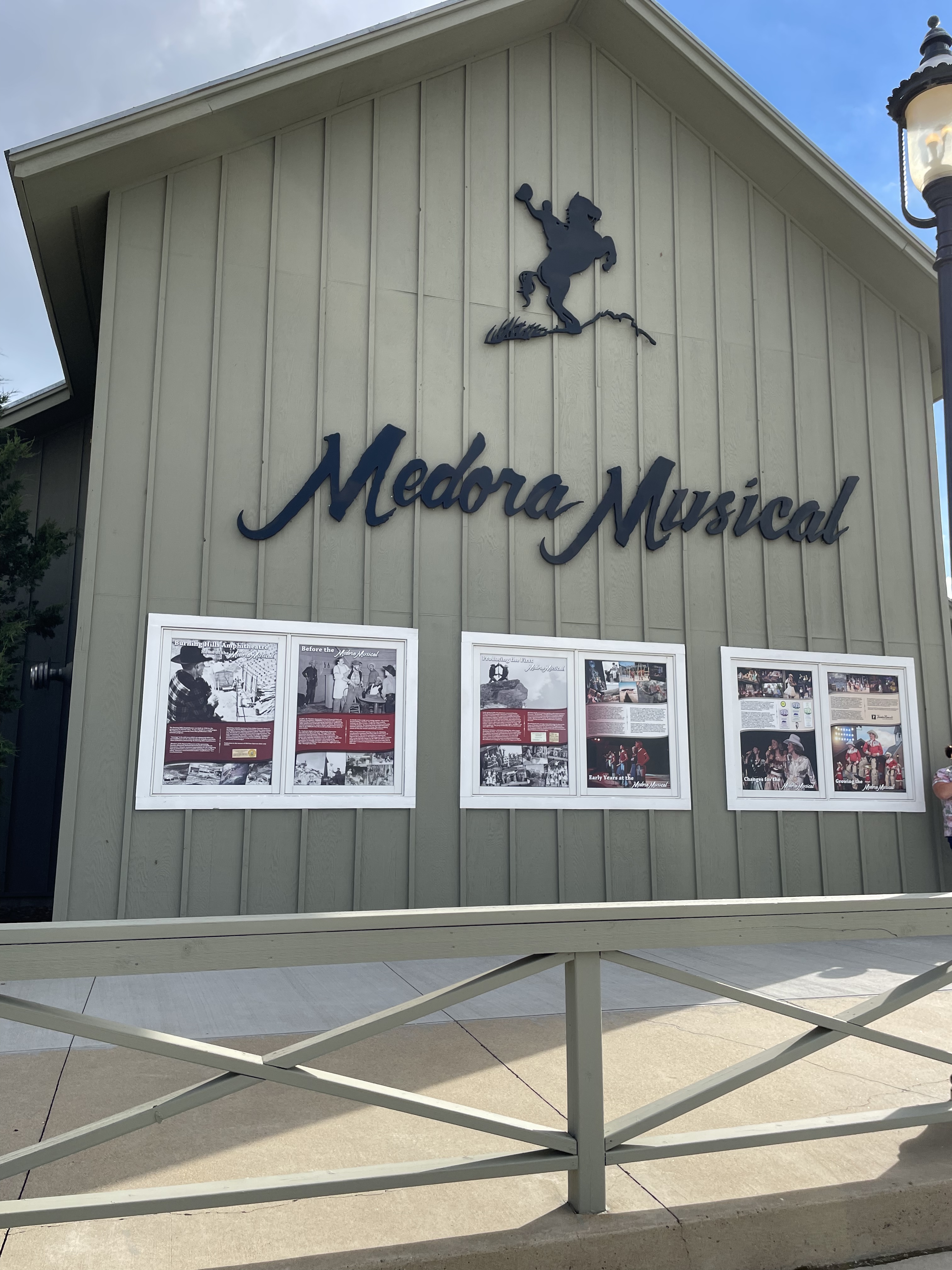
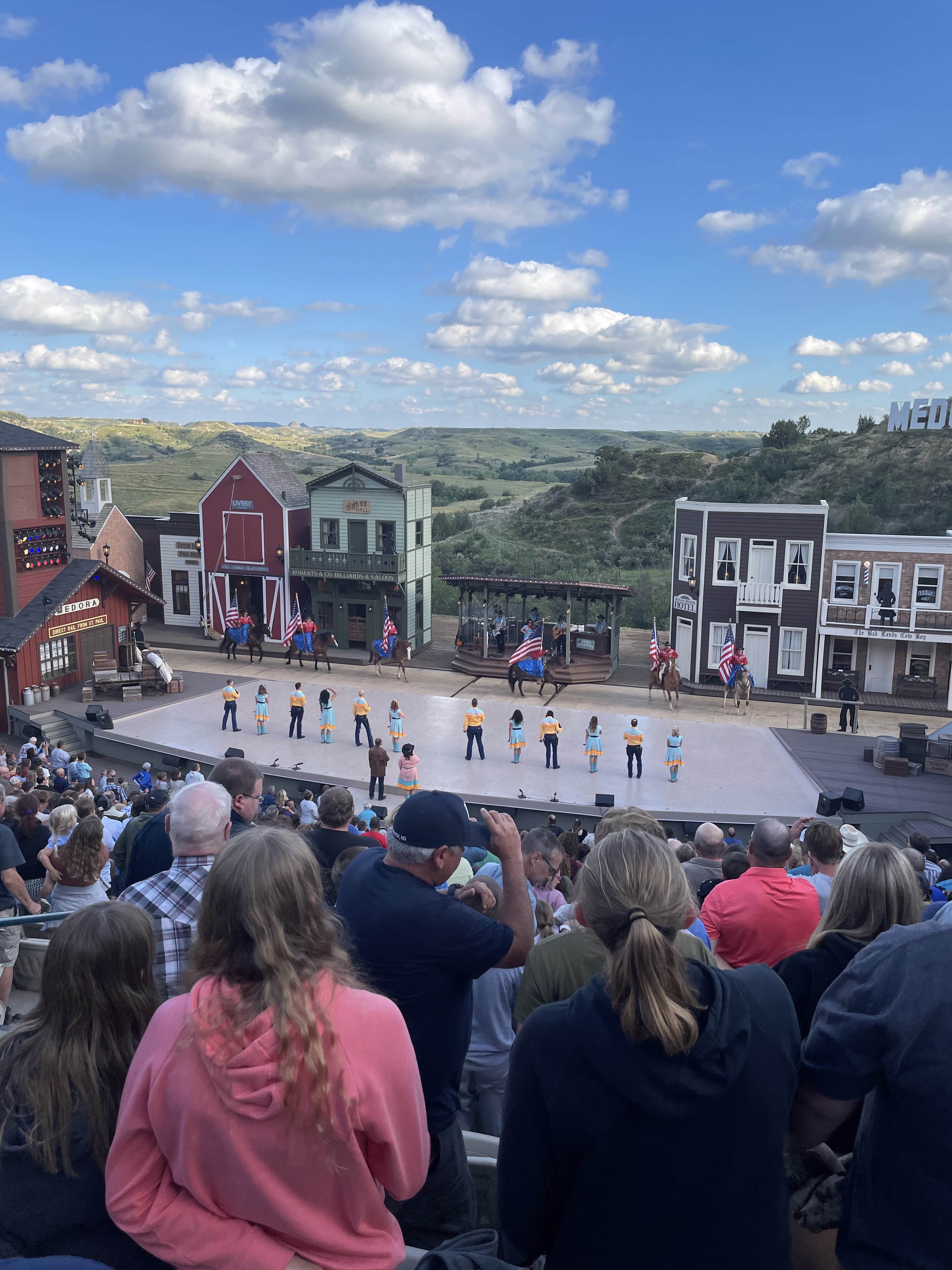
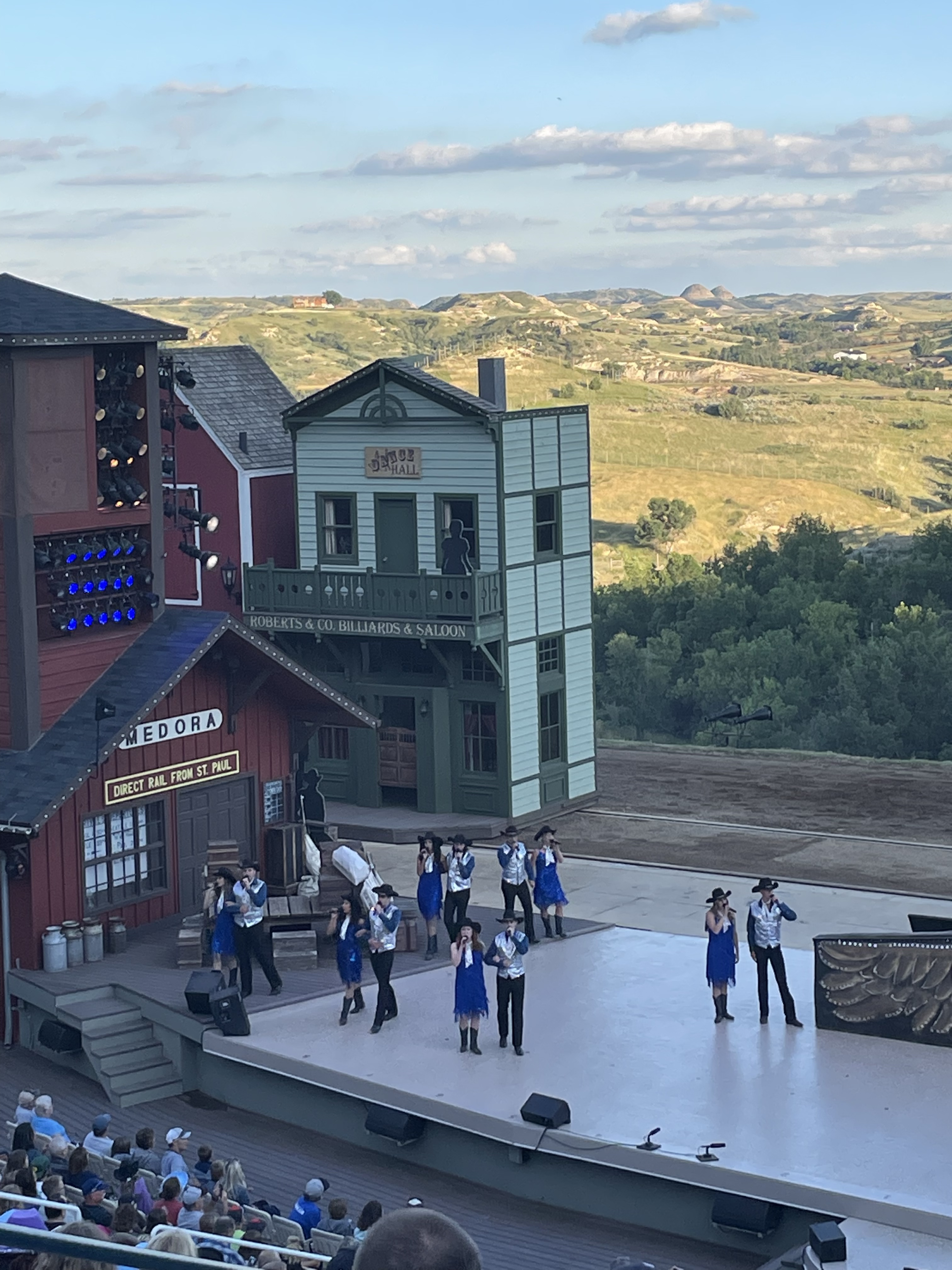
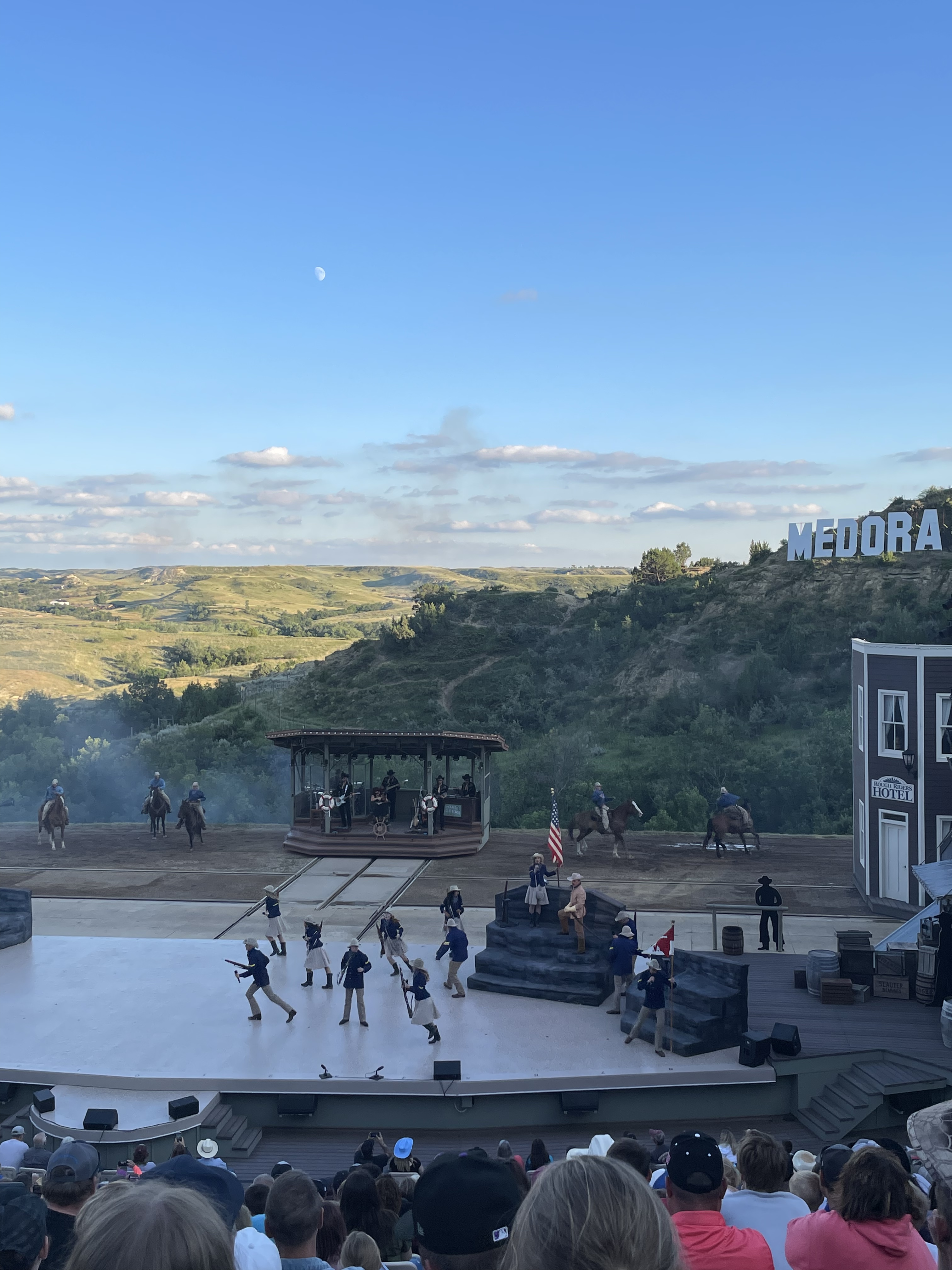
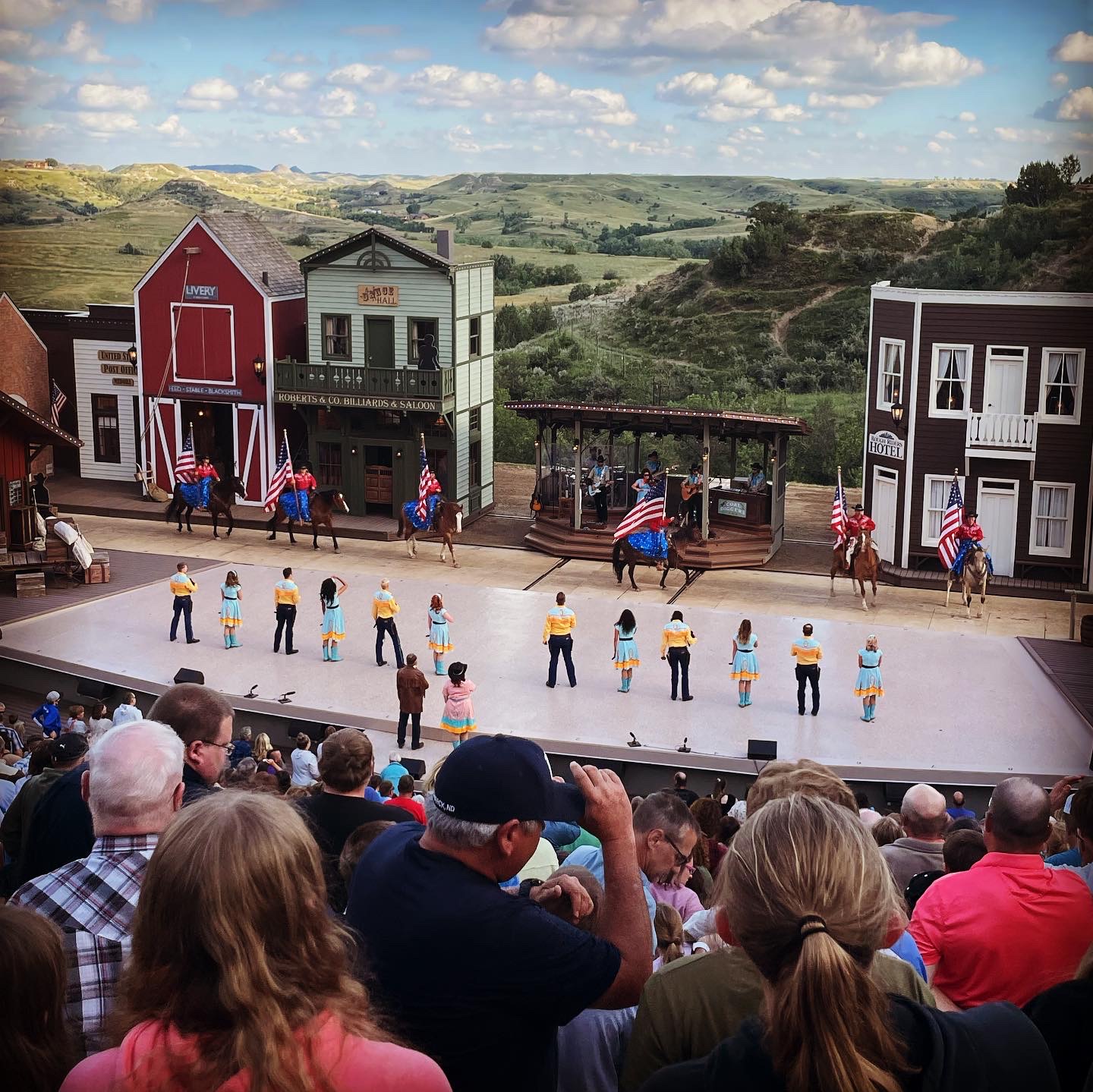
When planning our time in Medora, I wanted to find something for us to do that didn’t involve hiking – both as a change of pace and as a treat for Peanut, who was coming off a summer of musical theatre camp. Surfing around the travel internet, I found dozens of recommendations of The Medora Musical, a rollicking song and dance show that tells the story of the Dakota Badlands and Theodore Roosevelt’s life. It sounded fun and a little bonkers, so I booked us four seats. As we walked into the outdoor amphitheatre, I was stunned by the elaborate set, the Hollywood sign-style “MEDORA” in the hills behind the stage, and the amped crowd. Clearly, this was the place to be on a Saturday night in Medora.
We sat down, I provided popcorn in response to Nugget’s clamoring (he is a popcorn fiend) and we prepared for a wild experience. The dancers and singers delivered bigtime.
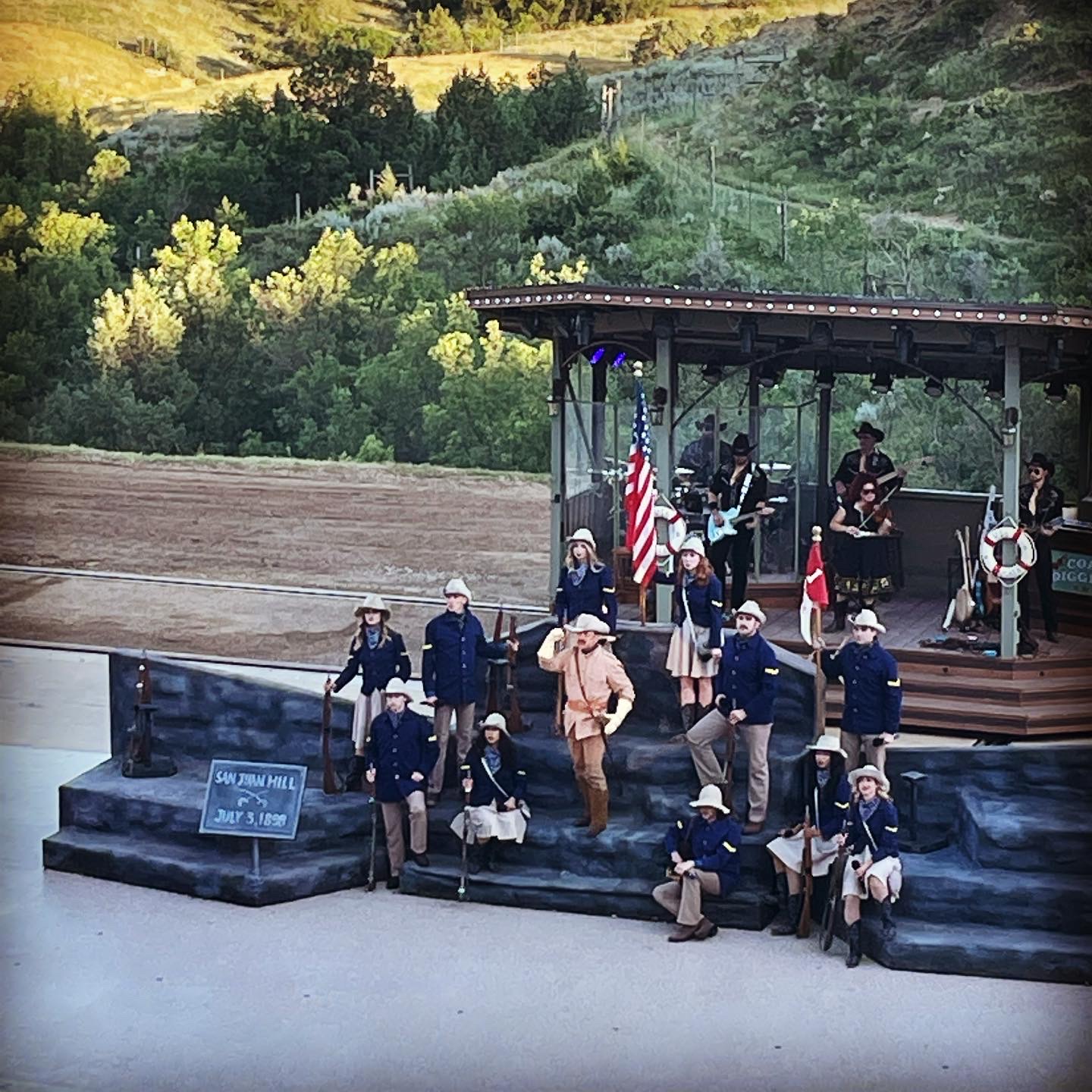
The western town scene moved around. There were horses ridden down from the hills and across the stage. There were explosions. There was a random basketball interlude.
The climactic scene featured a rider on horseback galloping down from behind the MEDORA sign, waving an American flag. I kid you not. It was absolutely wild.
I can’t recommend The Medora Musical highly enough. One of the TripAdvisor reviews I read noted that it was “not Broadway” but was of a quality equivalent to “the best regional productions.” That seemed about right to me; it was a higher-budget production than I was expecting – with the movable set, the horses, the many costume changes – and the kids loved it. (Steve and I enjoyed ourselves too.) I had just told them we were going to a “musical show” without more details – since I didn’t really know what it was all about, myself – and everyone was blown away.
What a fun night! I’m reliving it now, looking at these pictures, and grinning.Next week, we drive to a different unit of the park for a fun hike – check back then!
Winter is a time for cozying up with a cup of tea and a blanket and something good to watch – right? I think that’s the general consensus. As longtime readers know, I’m more of a book person than a screen person, but I still like a good show or movie. Here’s what I’ve been watching this season.
First, a re-watch. Steve and I are on our second time through Continent 7: Antarctica on Disney+ and loving it just as much as the first time. It’s a documentary show that follows several groups of scientists and support personnel through a season’s worth of science projects all around Antarctica. Naturally my favorite parts are the parts that feature Dr. Ari Friedlander, who is studying whales (YES) off the Antarctic Peninsula (where I’m going) but the whole show is just great.
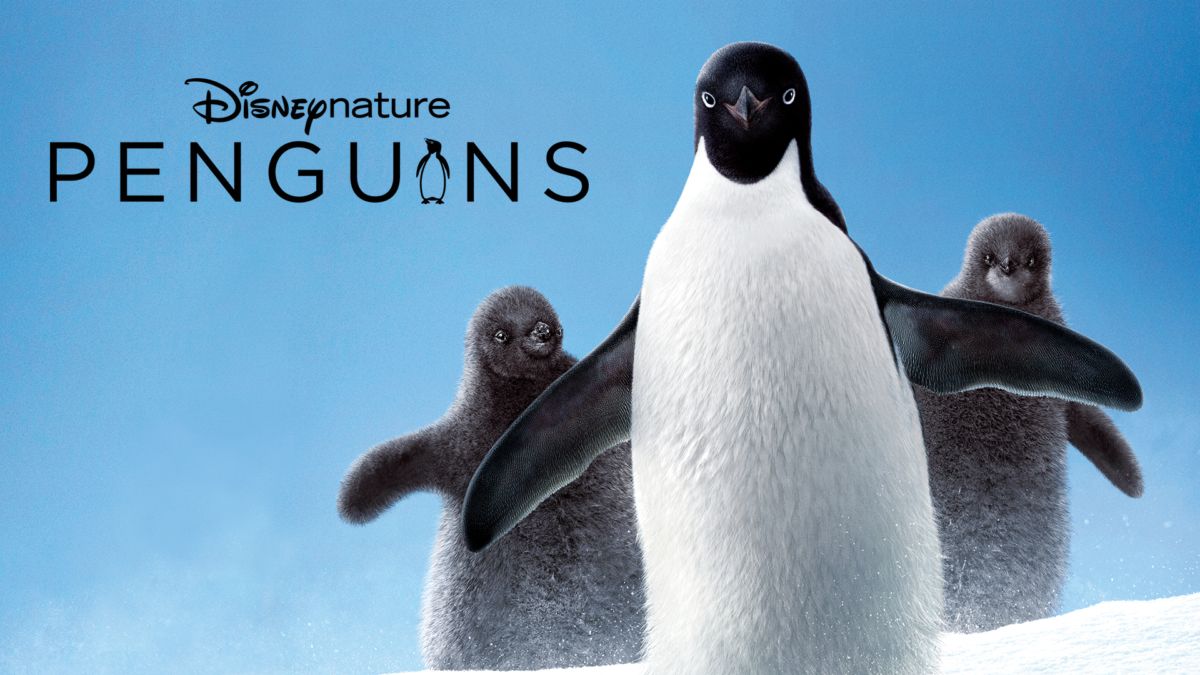
Another Antarctica-themed re-watch – naturally, we had to devote a night to Disneynature: Penguins. I love Steve the Adelie penguin and his family – we all cackle throughout this charming film.
Sticking with the classics and moving right along, this is our third year watching Winterwatch, for which the 2023 season is now available on Britbox! I can’t get enough of the BBC presenter team, with their cheerful banter, friendly competition, enthusiastic love of all things wildlife and science, and hope for the future. This show is beautifully filmed and engagingly presented and I’m so glad we can watch it on this side of the Pond.
Here’s something I’ve had on my list to watch for awhile – Bonnie Wright’s YouTube channel, GoGently. Or, as the kids like to say, “Mom’s watching Ginny Weasley clean out her closet without magic again.” Bonnie Wright is better known as the actress who played Ginny in the Harry Potter movies, and she has since grown up, moved to California, and started a new life as a director and producer and environmental activist. I love her gentle tips for simple but effective ways to clean up the Earth, and it’s fun to get a peek into her daily California life, too. (I love where I live, but every so often I consider California…)
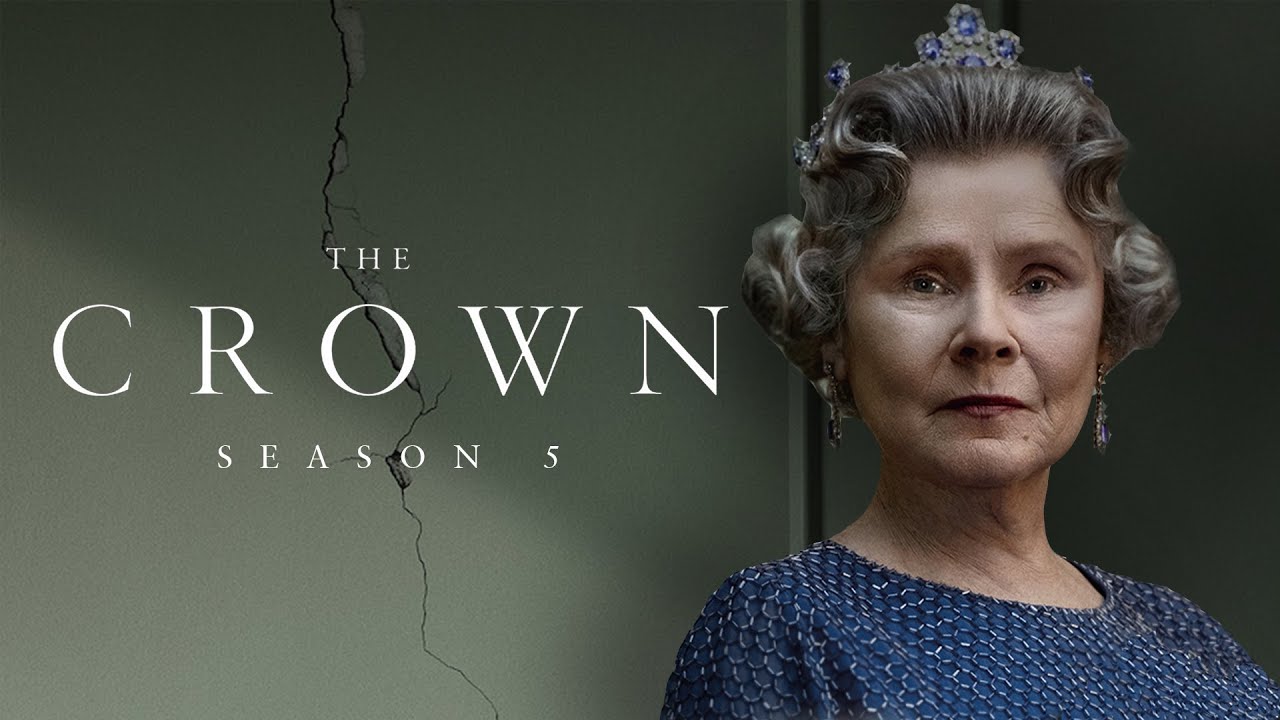
Finally, Steve and I have been carving out some living room date nights after the kids are in bed, to catch up on The Crown. We’re up to the 1990s now and it’s a lot of fun, although we’re still not sure we can get behind Imelda Staunton. She may very well be a delightful person, and she’s certainly a phenomenal actress. But at least once an episode, we each shout “Umbridge! No!” at the TV.
That’s a lot of watching! Don’t worry, I am still doing plenty of reading too. How about you? What have you been watching lately?
Not nearly as well-known as North and South or Wives and Daughters, Elizabeth Gaskell’s Sylvia’s Lovers follows along with Gaskell’s unusual (for Victorian times) featuring of a working-class heroine. Sylvia Robson is the daughter of a relatively prosperous – but by no means wealthy – farmer in northern England. When the novel opens, she is just coming into the bloom of her young womanhood, and her beauty is the talk of her local environs and responsible for enchanting her cousin Philip. Sylvia finds Philip, when she thinks of him at all, an annoyance and a bit of a pedantic.
Aside from Sylvia’s beauty, the other hot topic of conversation is the press gang. Under constant stress from Napoleon, the British Navy has turned to the shameful practice of impressment – rounding up able-bodied civilian men, kidnapping them, and forcing them to serve on Naval ships. No man, save for the very old, the very young, and the clearly disabled, was safe from roaming press gangs – although certain professions, including whalers, were supposed to be exempt from impressment. But “supposed to be” and what really happened were two different things, and the town is waiting with bated breath for the return of the “Greenland whalers” who base there in the winter. When the first ship appears in harbor, the press gang strikes and Charley Kinraid, chief harpooner, is shot and wounded. The town is abuzz with gossip about his heroism, and Sylvia is fascinated by Kinraid.
Kinraid has a reputation: he’s a bit of a womanizer and a heart-breaker. When he starts to court Sylvia – helped along by Farmer Robson’s lively interest in the whaler’s tales – Philip is dismayed. But their courtship is cut short by the press gang. Watching Charley be carried off, Philip promises to tell Sylvia what has happened to the whaler – but he says nothing. Sylvia, believing her fiance drowned, mourns and also grows up and grows more beautiful.
To be sure, it was only to her father and mother that she remained the same as she had been when an awkward lassie of thirteen. Out of the house there were the most contradictory opinions of her, especially if the voices of women were to be listened to. She was ‘an ill-favoured, overgrown thing’; ‘has as bonny as the first rose i’ June, and as sweet i’ her nature as t’ honeysuckle a-climbing round it’; she was ‘a vixen, with a tongue sharp enough to make yer very heart bleed’; she was ‘just a bit o’ sunshine wheriver she went’; she was sulky, lively, witty, silent, affectionate, or cold-hearted, according to the person who spoke about her. In fact, her peculiarity seemed to be this – that every one who knew her talked about her either in praise or blame; in church, or in market, she unconsciously attracted attention; they could not forget her presence, as they could of other girls perhaps more personally attractive. Now all of this was a cause of anxiety to her mother, who began to feel as if she would rather have had her child passed by in silence than so much noticed.
Philip’s decision to conceal Charley’s true fate from Sylvia is a fascinating plot. As a character, he is complicated. His broken promise destroys his life, Sylvia’s life, and several more lives by extension – to share more would be to spoil the plot. His motivations are the central question of the book: is it genuine love? Is it vindictiveness? Is it both? Did Philip truly love Sylvia? Did Charley?
Sylvia is a passive character. While she is operating with very imperfect information – Philip actively conceals Charley’s whereabouts from her and allows her to think he has drowned, on the flimsy basis that he’s probably going to die in some Naval battle or another, anyway – she generally just lets events happen. Now that’s partly a reflection of the realities of life in Victorian times, for a young woman – but several of Gaskell’s other heroines would have been a lot less passive. I can’t see Cynthia Kirkpatrick, for example, just sitting back and letting romantic drama grind her down. Cynthia is in charge of the romantic drama, thank you.
I think it’s Sylvia’s passivity that made this book a bit of a tepid reading experience for me. There’s a lot of dialogue, which makes the reading hard going, and Gaskell tends to veer into melodrama the longer things drag out. But that wouldn’t stand in the way of a really fabulous read if the heroine was a stronger character. Unlike the wonderful Molly and Cynthia of Wives and Daughters, or the strong and principled Margaret of North and South, Sylvia is bland and generally uninteresting. Her defining characteristic is physical beauty, and it’s on that basis – and that alone – she has two men falling at her feet. It’s hard to root for her or even to care, really, about what happens to her. Philip is the most well-rounded character – and it is interesting to consider whether he’s the novel’s hero or villain or anti-hero – and Charley comes across as little more than a plot device. It’s just all – bland.
Elizabeth Gaskell has written some of my favorite novels – Cranford in particular, and Wives and Daughters, both rank near the top of my desert island library list – but this isn’t one of them. If you’re new to Gaskell and want to start someplace, I suggest starting with one of those or with North and South.
Have you read Elizabeth Gaskell? Which of her novels is your favorite?
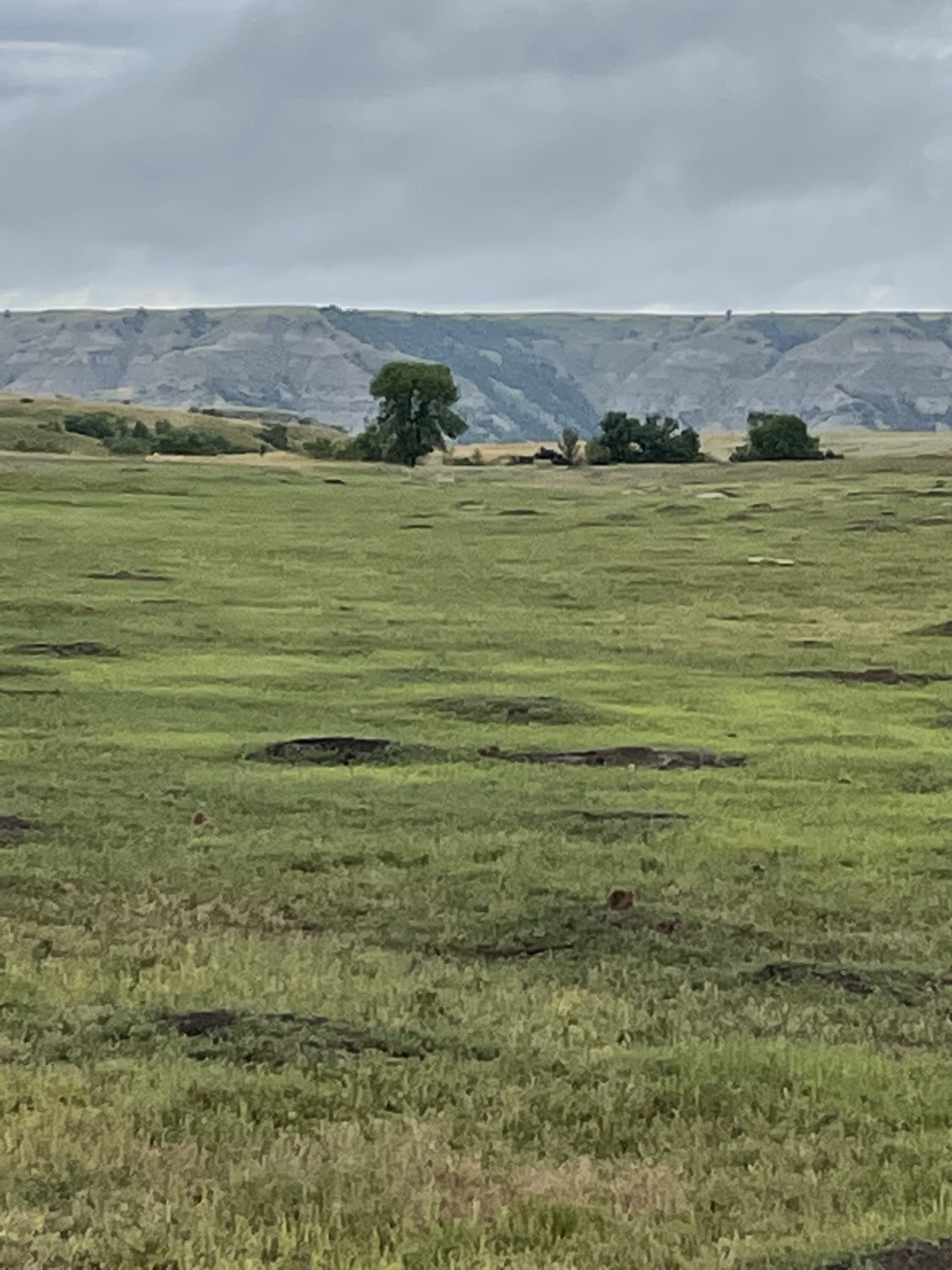
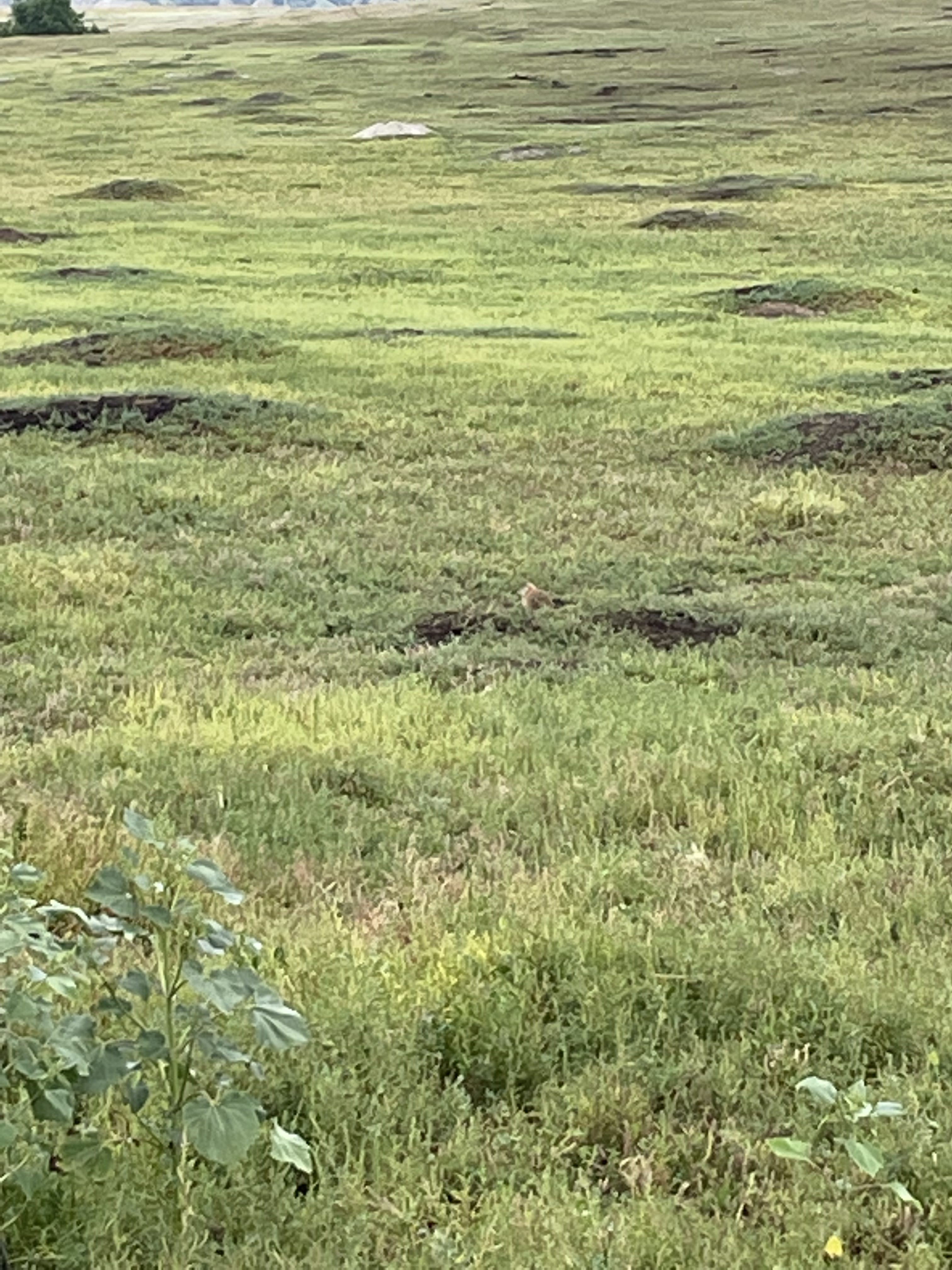
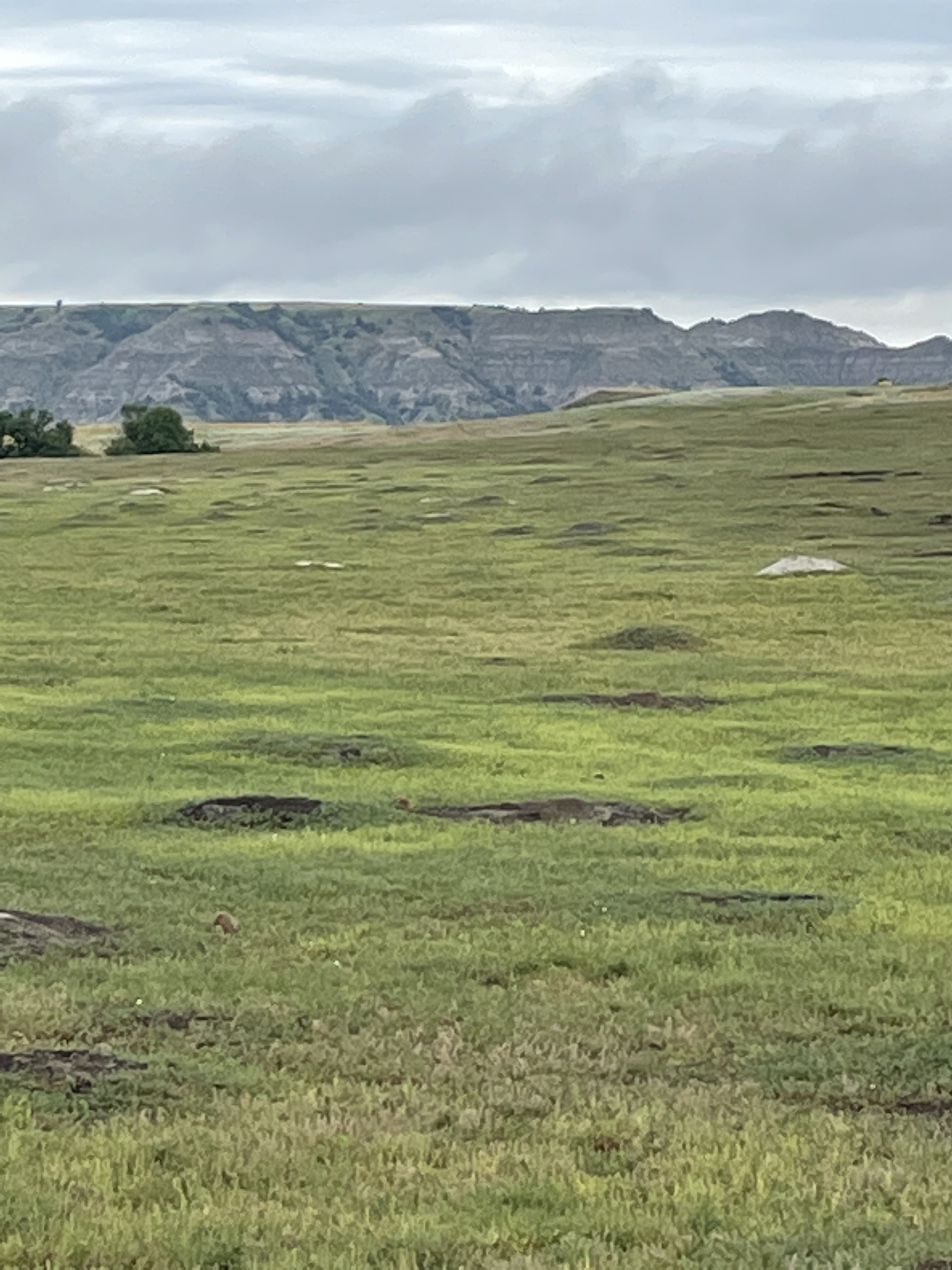
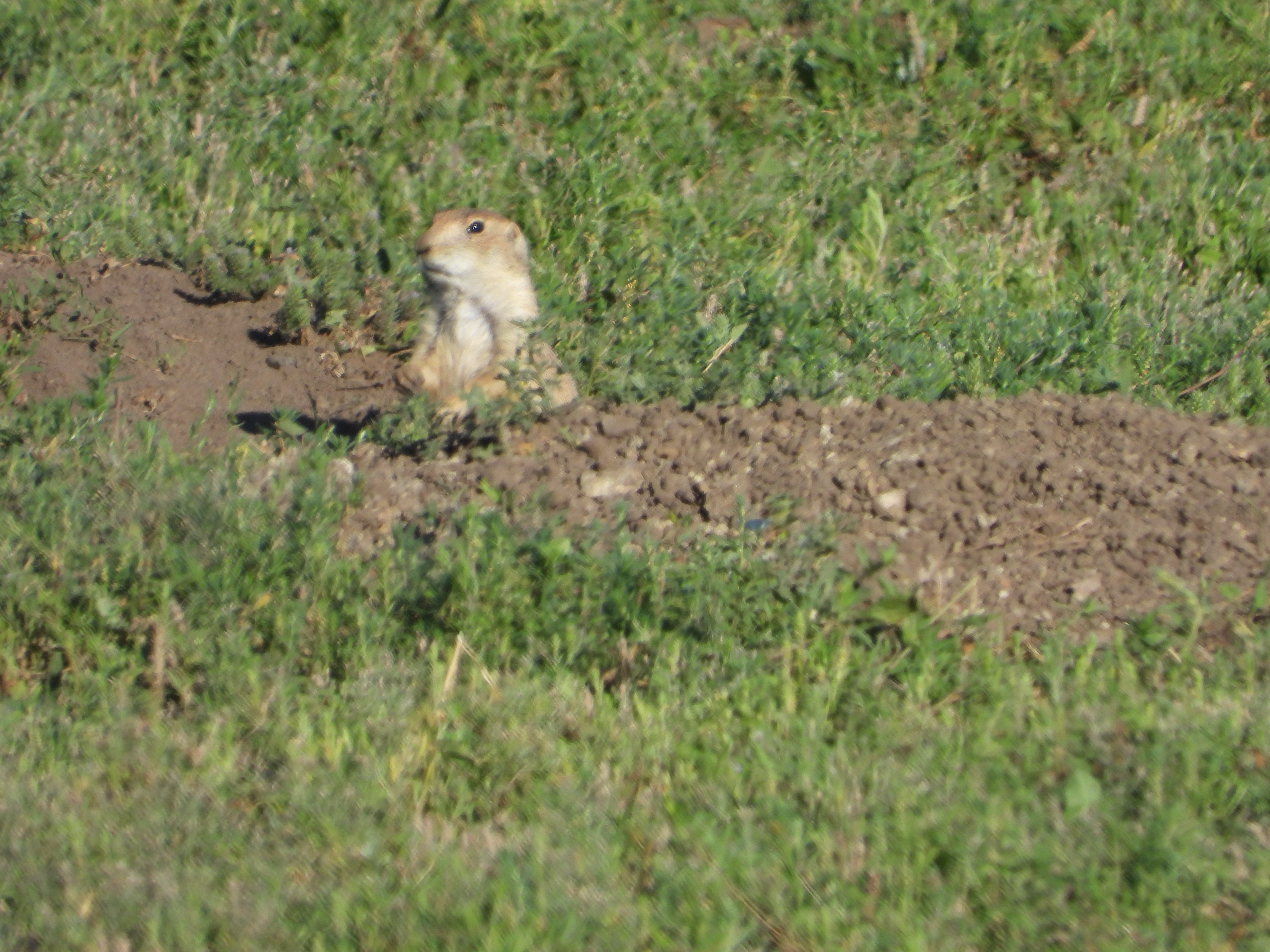
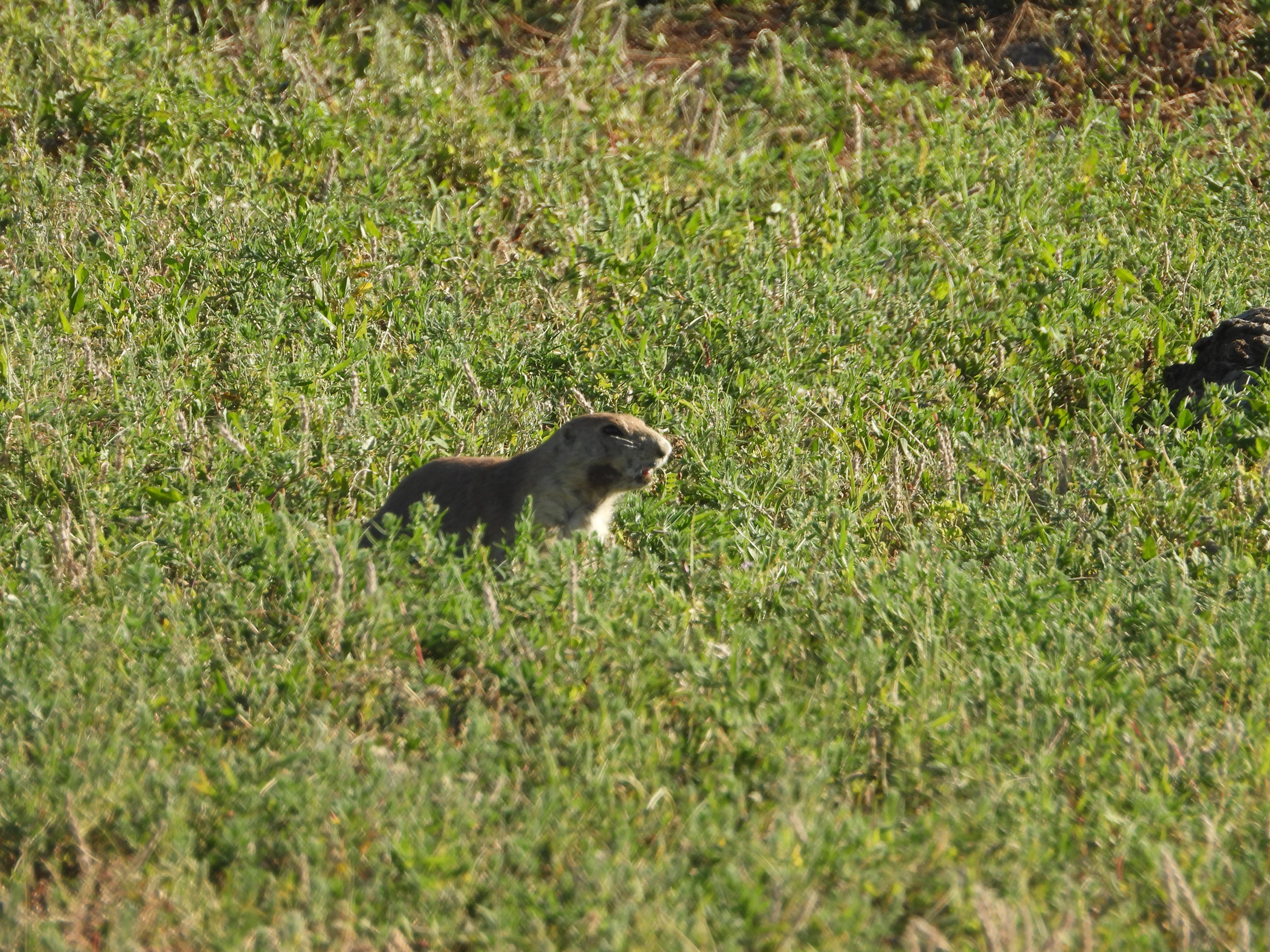
When visiting the Dakotas, there are a few animals on everyone’s list to see – naturally. I was, of course, hoping to see American bison and pronghorn antelope. But just as much so, or maybe more, was I hoping for those round, fuzzy, adorable residents of the grasslands: prairie dogs. I wasn’t overly confident that we’d spot them; they’re so small and the prairie is so big. But I wasn’t reckoning on Prairie Dog Metropolis.
Prairie Dog Metropolis is exactly what it sounds like – a veritable city of the prairie’s cutest residents. Right off a main artery through Theodore Roosevelt National Park, there is a stretch of grassland that is dotted with hundreds of prairie dog burrows. I can only imagine the complex network of tunnels under the grass.
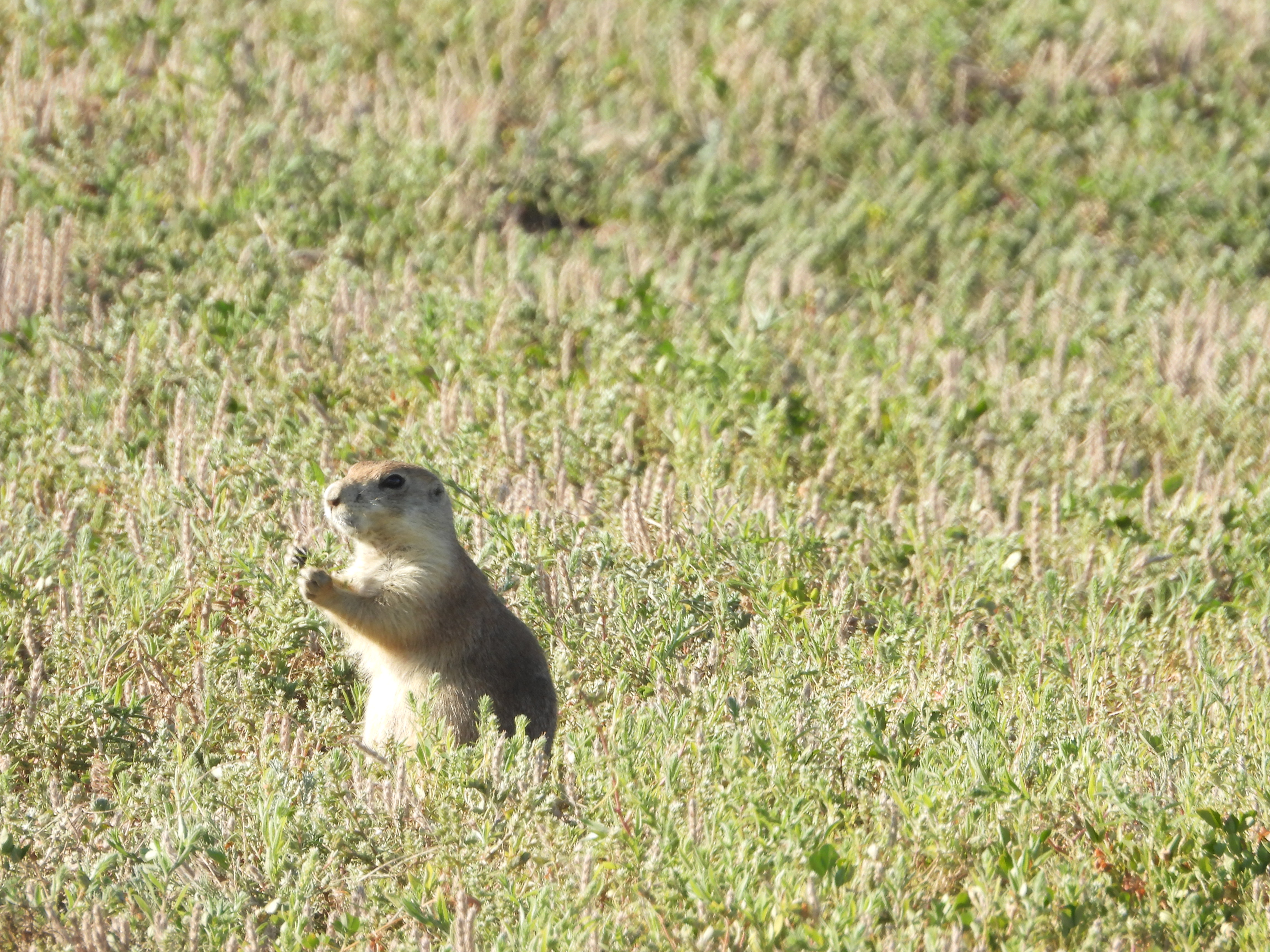
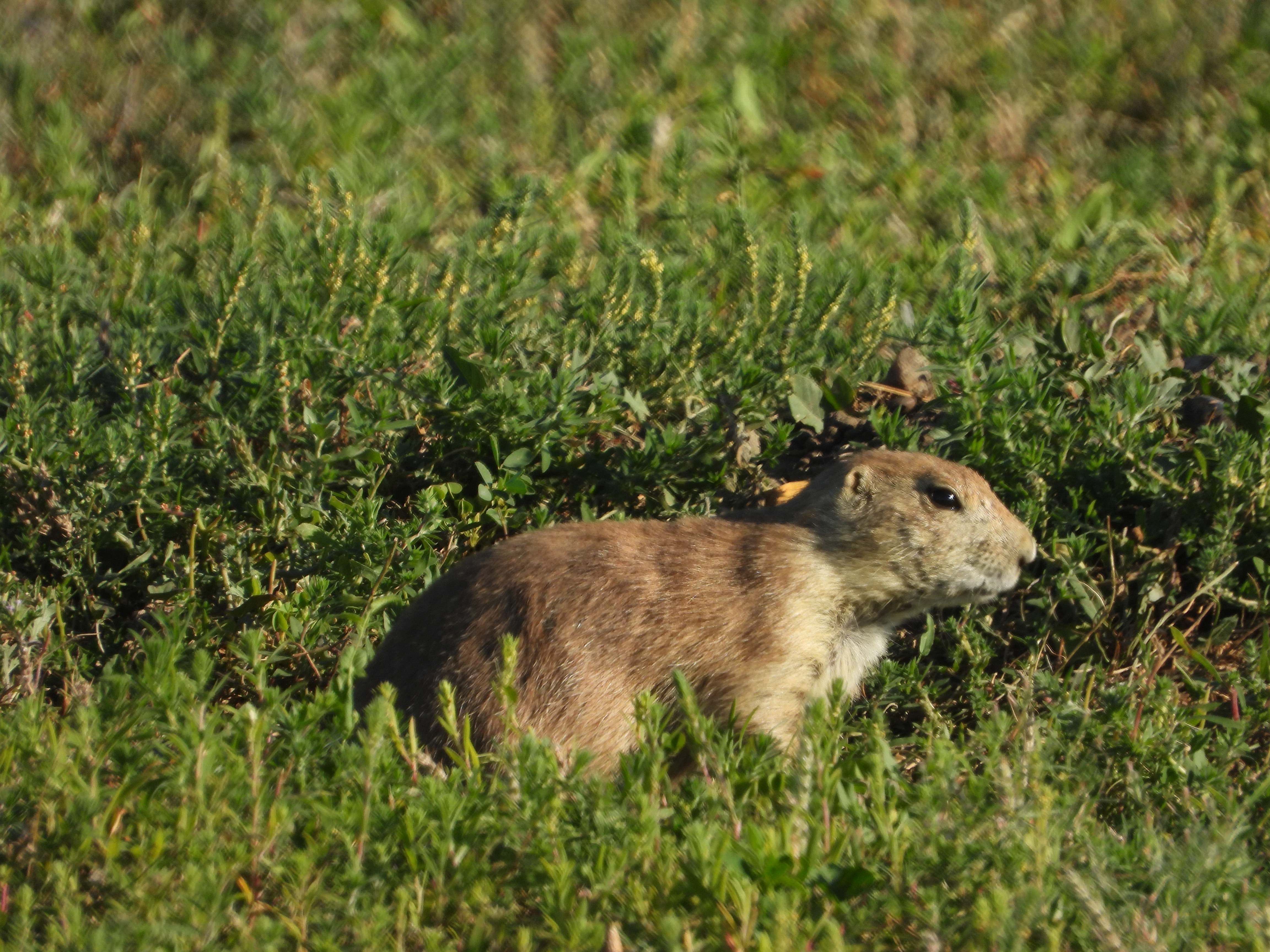
We pulled the car over and hopped out, being careful not to actually get close to any prairie dogs (in addition to not wanting to disturb them… they bite). But thanks to my wildlife camera and its ridiculous zoom, I got plenty of closeups. I’ll let (a few of) the many pictures speak for themselves.
I mean. You must be kidding me, right? They were so adorable.
Cuuuuuuuuuuuuute. Sorry I have no tips or interesting facts to share, just LOOK AT THAT NOSE!
Now, for the really important question. Who do I need to talk to, to get an apartment in Prairie Dog Metropolis?
Next week: we take in the biggest cultural spectacle in Medora.
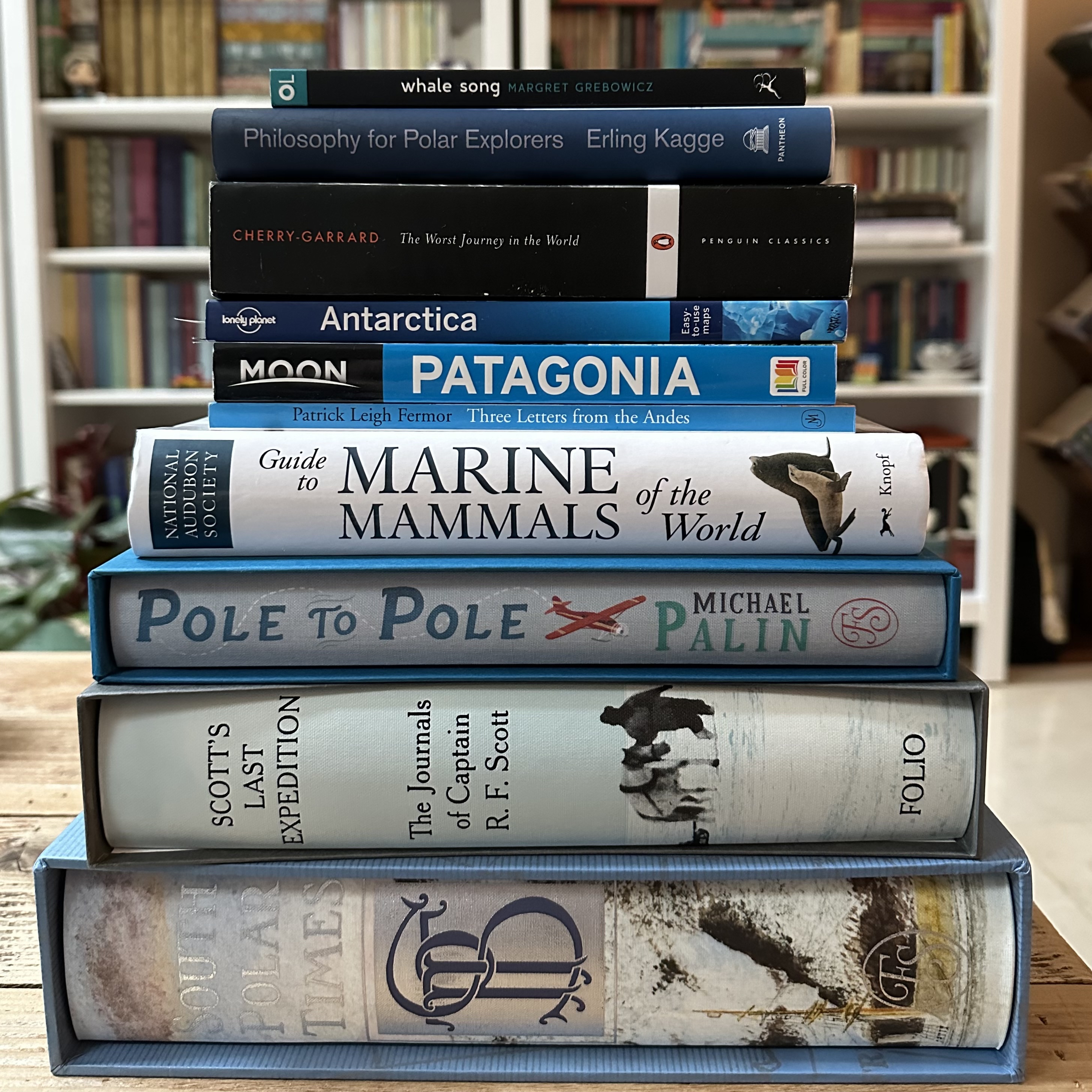
Excitement ahoy! My trip to Antarctica and Patagonia is finally approaching – I’ve been waiting for this moment for literally years. Steve and I booked – and paid in full for – our trip back in 2020, and we were originally booked on a voyage that was scheduled to sail in February 2022, but was later postponed for pandemic travel-related reasons (long story). After three years of hardly daring to believe we’re really going on this dream trip – and to be perfectly honest, I still hardly dare to believe it – it seems like it’s actually going to happen. Our final booking confirmation and documents arrived just days ago, and I’m currently elbows deep in all the literature that the expedition company sent, plus planning activities for the Patagonia portion of the trip. (Because people always ask, we’re traveling with Quark Expeditions and very excited.) And naturally my planning and preparation process includes books – lots of them. Here’s my Antarctica and Patagonia reading list, for both before and during the trip:
Before Embarkation Day:
Scott’s Last Expedition: The Journals of Captain R.F. Scott, by R.F. Scott – Robert Falcon Scott is one of the iconic Antarctic explorers and naturally I have his expedition diaries at the very top of my reading list. (Spoiler: not a happy ending.)
South Polar Times, by R.F. Scott and his crew – The South Polar Times was a magazine compiled by Scott and his expedition crews, and I have this absolutely gorgeous facsimile compilation from The Folio Society. I’ve been saving this to dive into closer to the trip.
Pole to Pole, by Michael Palin – Palin is a classic travel author and this is his account of an epic journey he made from the Arctic to the Antarctic. Because only a small portion of this book is actually devoted to Antarctica, I may save it to read after the trip – I definitely want to read it soon but it’s not my top priority.
The Worst Journey in the World, by Apsley Cherry-Garrard – A decidedly not starry-eyed account of Scott’s ill-fated expedition. It’s a bit of a doorstopper and I don’t know if I’ll get to it before the trip, so I also downloaded a copy for my kindle.
Philosophy for Polar Explorers, by Erling Kagge – I’ve already read this, which was a quick and mostly pretty common-sense roundup of life lessons that Kagge acquired during his quest to be the first person to complete the “three poles” challenge (walking to both the North and South Poles and reaching the summit of Mount Everest).
Whale Song, by Margaret Grebowicz, and Guide to Marine Mammals of the World, by the National Audubon Society – Since the reason we are going to Antarctica is to catch the southern whale migration (hopefully – Gaia permitting) I have whales on the brain right now. I’ve had Whale Song on my TBR for ages and this seems like a perfect time to read it. And I’m not planning to read all of the Audubon marine mammals guide, but I will flip through it and read over the sections on the wildlife we’re likely – or hoping – to see: Antarctic orcas, humpbacks, minke whales, Southern right whales (my dream sighting!), leopard and Weddell seals, etc. I may or may not bring the Audubon guide with me on the trip itself; I judged it worth the weight in my dry bag when Steve and I kayaked the Salish Sea back in 2019, so it has a history of coming with me on trips and it’s been splashed by salt water already. But I have most of my spare ounces dedicated to camera gear, so we’ll have to see if it fits this time.
Three Letters from the Andes, by Patrick Leigh Fermor – I’ve dreamed of hiking in the Andes since I was very young and I’m so excited to step foot in these mountains on the Patagonia portion of the trip, finally! The tiny corner of Argentina that I’ll be in – Tierra del Fuego – is just a small segment of what these iconic mountains have to offer, and I believe Leigh Fermor’s book focuses on other parts of the mountain range, but I still want to read it before Patagonia.
Lonely Planet: Antarctica and Moon Guides: Patagonia – Another couple that I won’t be reading from cover to cover but am definitely planning to review before the trip. The Antarctica guide is for information only, really, because our expedition team will be making all decisions about shore landings and we’ll go where we’re told to go. The Patagonia guide, which I gave to Steve for Christmas, will be handy for planning hikes and activities for a few days in Argentina, when we’ll be on our own.
Antarctica: A History in 100 Objects – Unpictured here, but I gave Steve an art book illustrating… as you can see… the history of Antarctica through a deep dive look at 100 objects. Not sure I’ll get to it before the trip, but I am definitely planning to borrow it from him and read it after we get home, if not before we leave.
En El Mar:
Once we’re actually at sea, I don’t expect to have nearly as much time to read as I do in everyday life – once we get our first sightings of Antarctica I expect all I’ll want to do will be to drink in the views of icebergs, breaching whales and bellyflopping penguins. But there are a few long plane journeys between me and the seventh continent, not to mention four days at sea on the Drake Passage (two days from Ushuaia, Argentina to the first sub-Antarctic islands, and two days back). We will have plenty to do even on Drake days – the expedition teams give wildlife briefings, and Steve and I will also be going through kayak equipment checks with our paddling group, not to mention I’m planning to spend multiple hours per day on the lookout for whale action. But some reading time might still be possible and it’s better to be prepared, right? So I’ve downloaded a suite of kindle content to read on the trip, time permitting. (And Drake Shake permitting, although I’m not prone to seasickness so I’m not really worried about that.)
South Pole Station, by Ashley Shelby – Thanks to Sara for this recommendation! I had not heard of it, but the summary sounded great, so I downloaded a copy to take with me and read on the Drake.
Terra Incognita: Travels in Antarctica, by Sara Wheeler – One of the things that I feel like my list is missing is a woman’s voice. Wheeler’s memoir about seven months she spent living on Antarctica sounds wonderful, and the fact that Beryl Bainbridge described it as “essential” is that much more the selling point.
South!, by Ernest Shackleton – My pre-trip reading is very Scott-heavy, so Shackleton needed a place on the list too. Plus, how can I resist that exclamation point? To paraphrase the great Phoebe Buffay: the exclamation point in the title scares me. It’s not just South, it’s South!
Where’d You Go, Bernadette, by Maria Semple – This is actually one of my favorite books, but I haven’t read it for years. I loaned Peanut’s kindergarten teacher my copy and never actually got it back. Kindle to the rescue. If you don’t know what this has to do with Antarctica I’m not telling.
An Antarctic Mystery, by Jules Verne – I have literally no idea what this is about. But it’s been on my kindle for years, awaiting this trip.
In Patagonia, by Bruce Chatwin – A classic of travel literature, which I’m planning to save for the return trip across the Drake, before the Patagonia segment of our adventure.
Horizon, by Barry Lopez – Lopez is one of the most revered of American nature writers and I’ve never read any of his work. He writes about northern climates much more – he has an entire book about the Arctic, which looks beautiful – but Horizon has some Antarctica sections. I have the audiobook and am planning to listen to it on the plane and at sea, especially if we have a rough crossing and I can’t read my kindle.
Well! Do you think I have enough reading material here? If I get to a third of this, I’ll be lucky – especially once we’re mid-adventure, I doubt I’ll be reading much. But better to have the books and not need them, right?
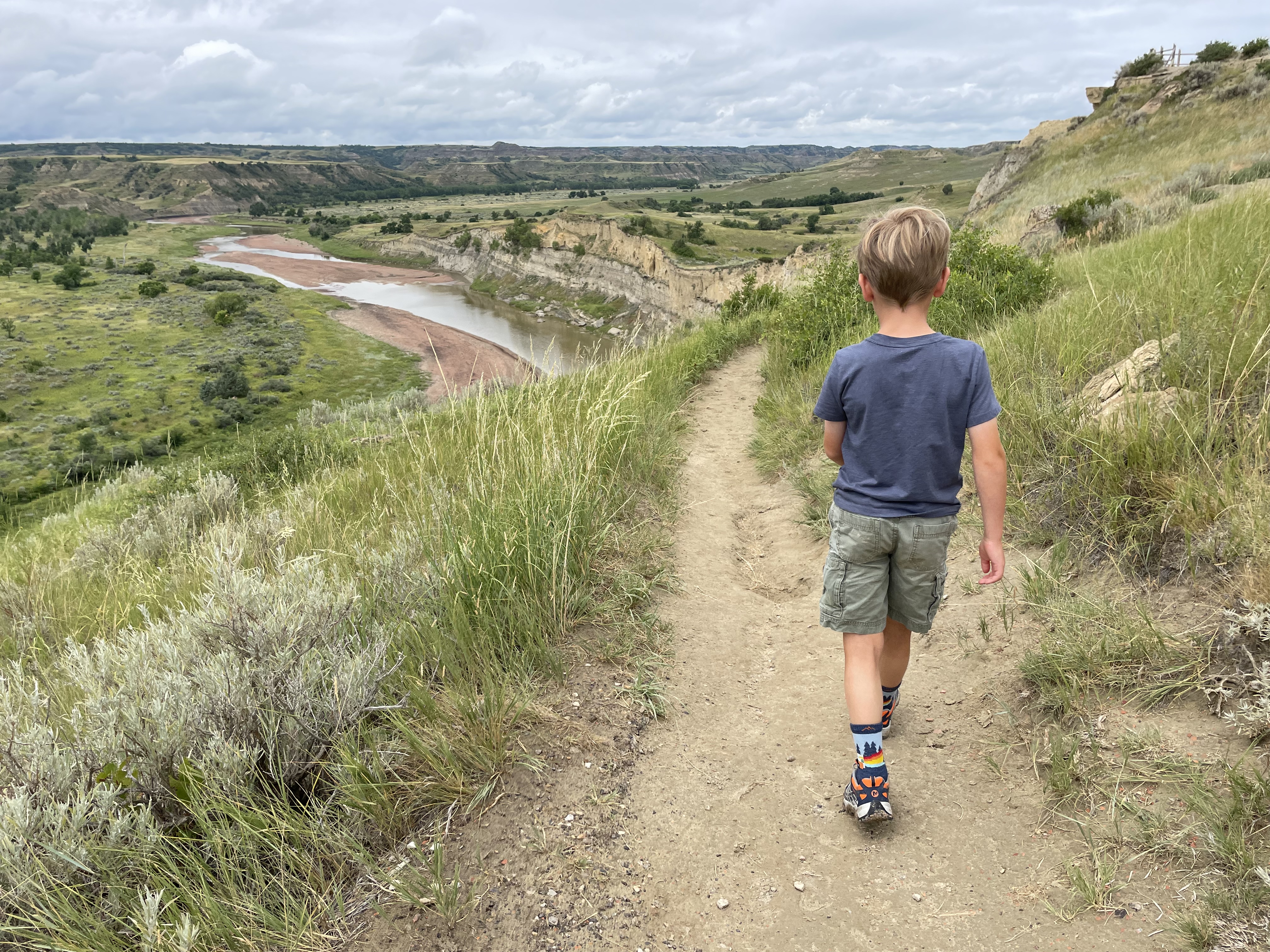
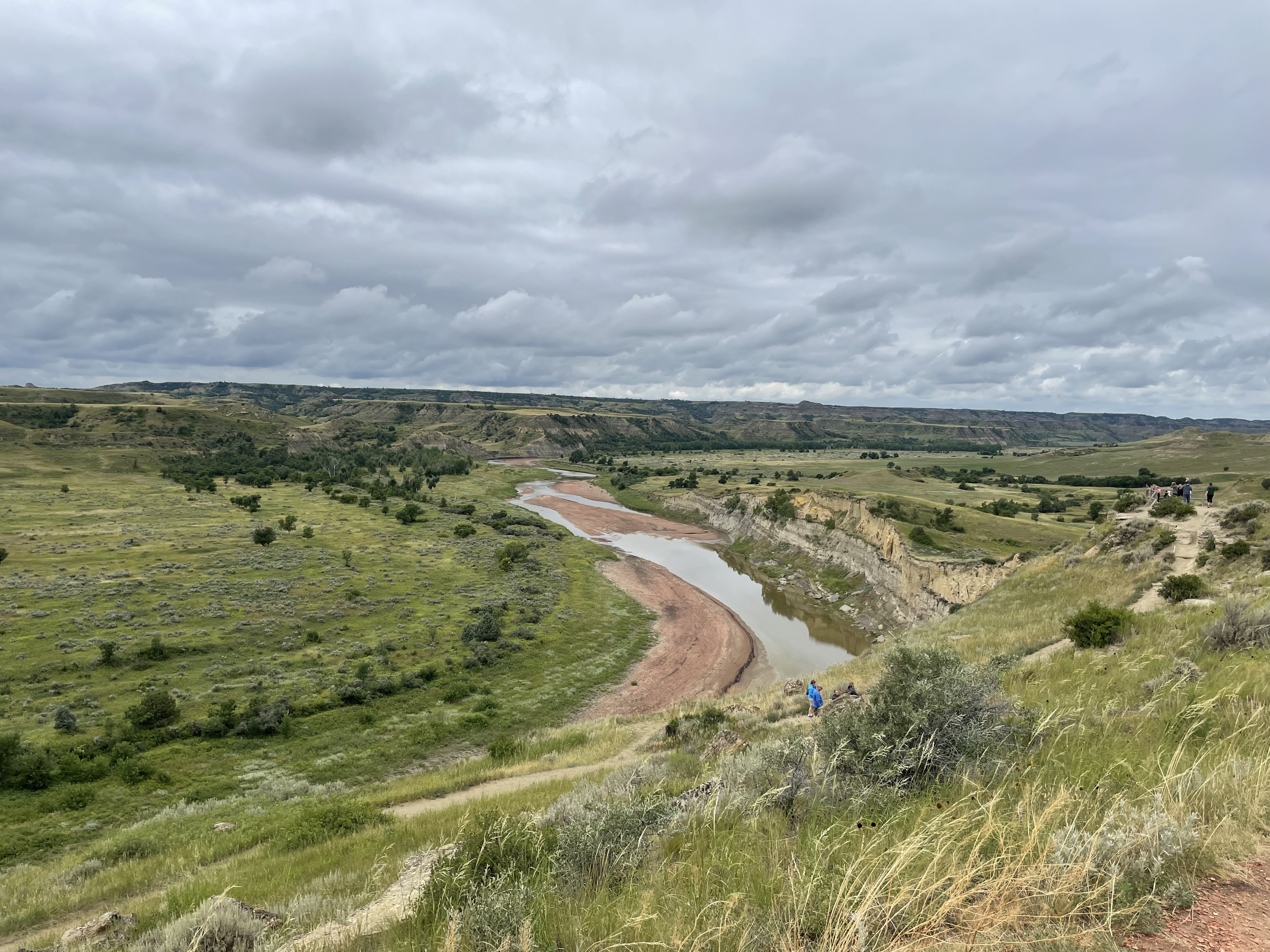
When on a hiking vacation, one must hike multiple trails per day, right? After hiking the Coal Vein Nature Trail, we drove directly to another trail on my list: the Wind Canyon Trail, a winding path high above the Little Missouri River valley.
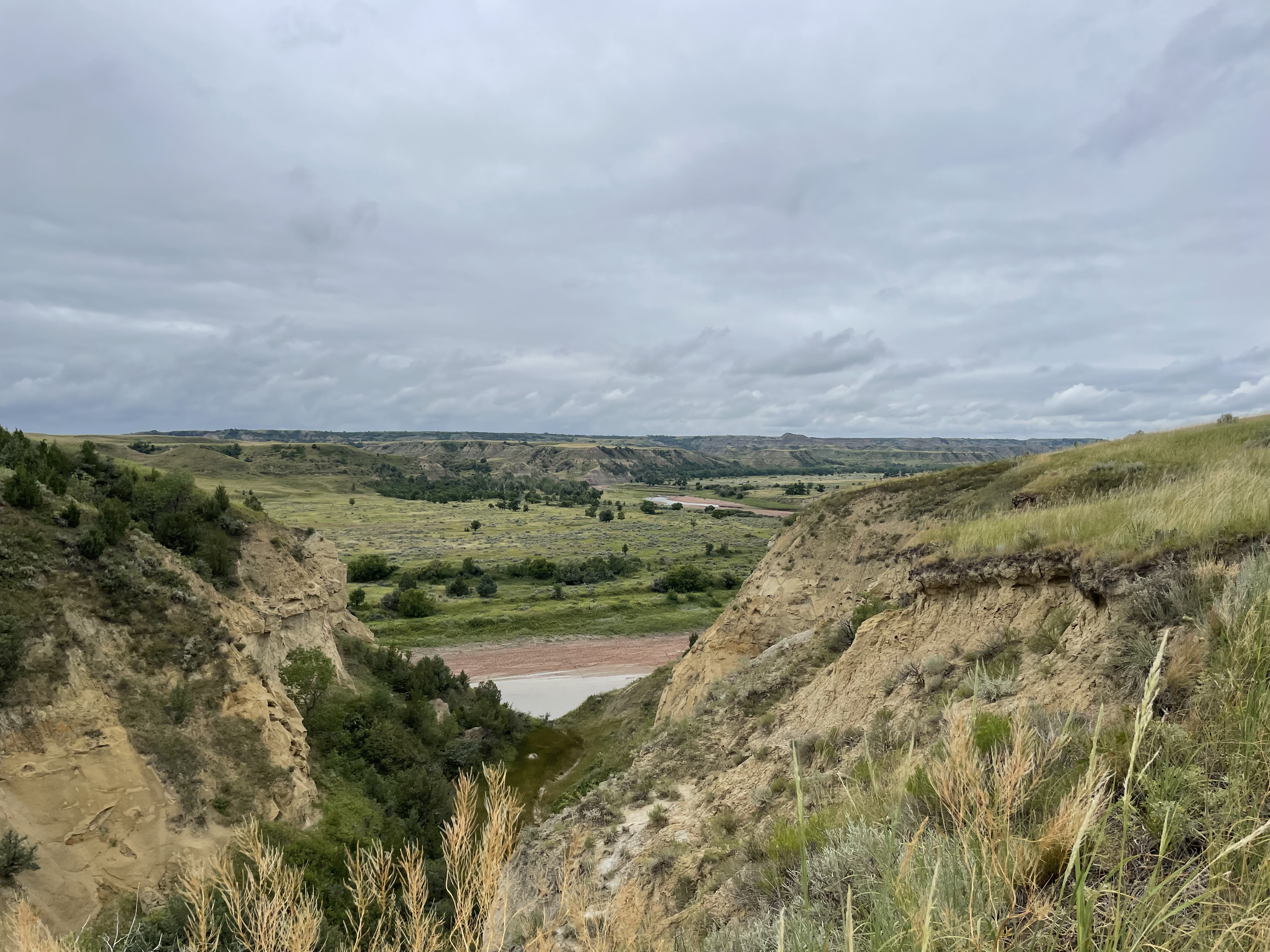
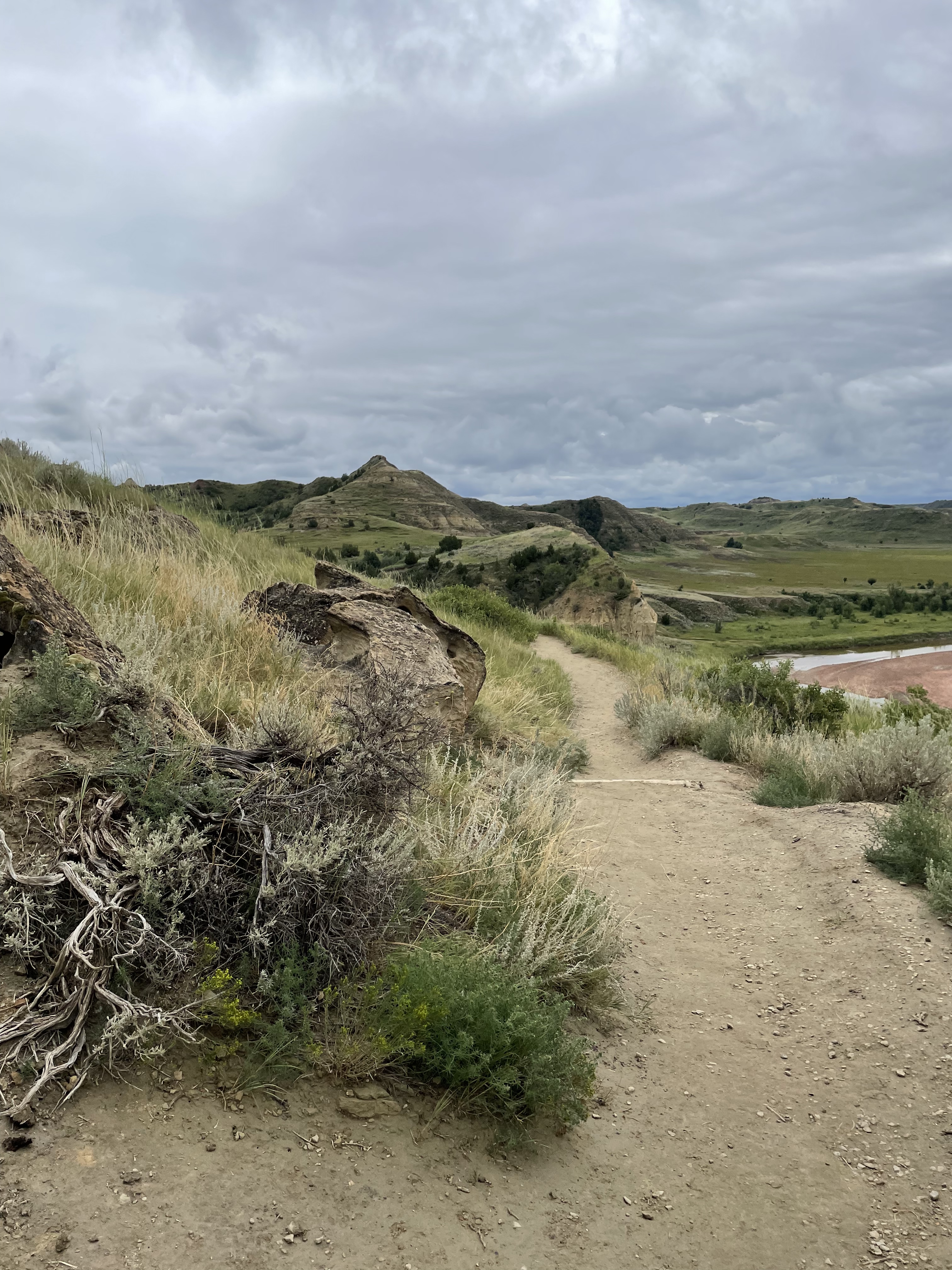
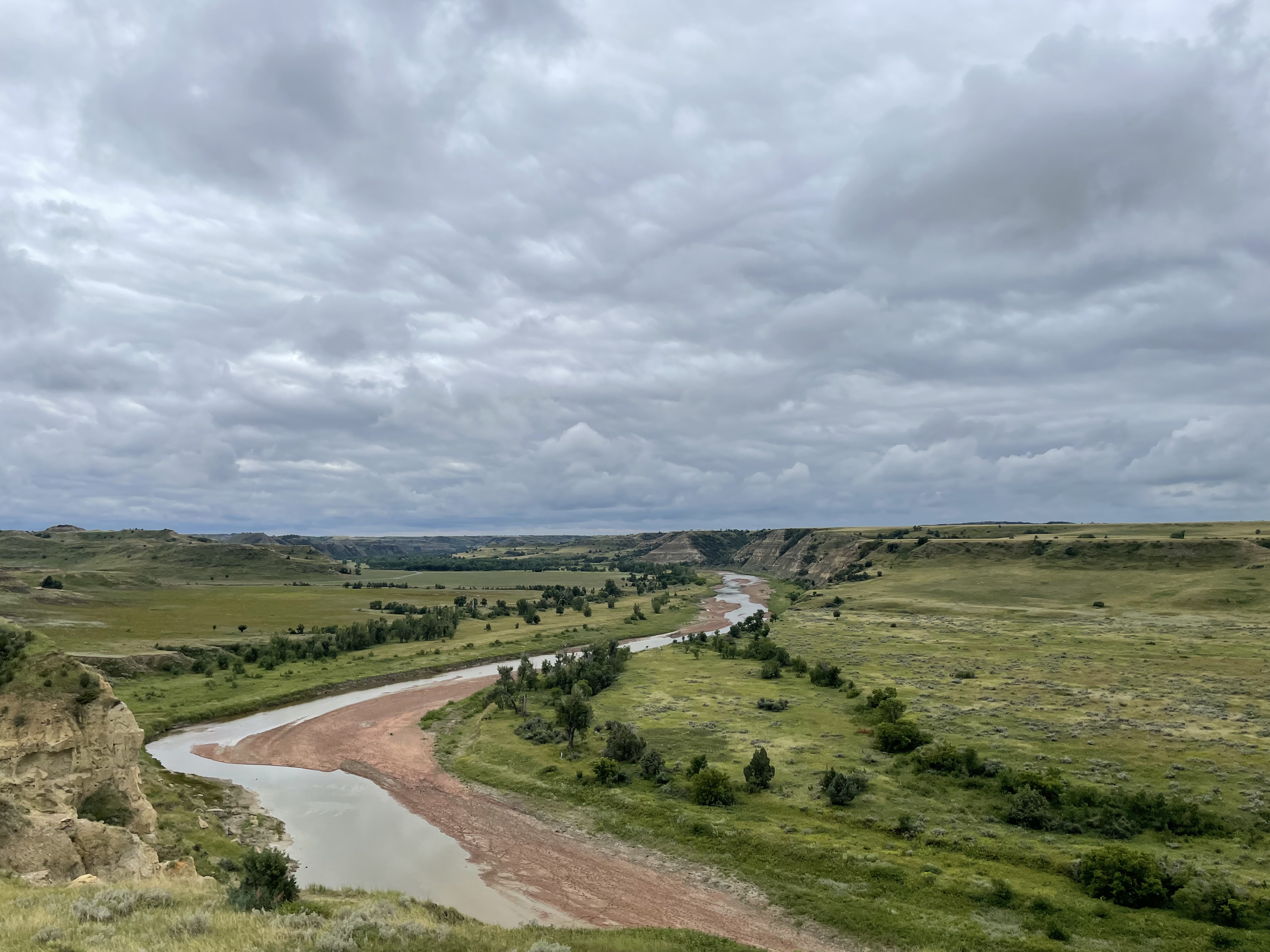
It’s not an especially challenging trail – being mostly flat – so the bang for hiking buck is outstanding. With hardly any effort at all in payment, we were treated to gorgeous vistas for the length of the trail.
I was a little worried about whether this path would work for us, to be honest. I have a couple of hikers in the family who are afraid of heights, so I always like to know what the exposure situation is before deciding on a hike. Despite the great views and the trail situated high above the river, this one did not bother my acrophobic family members. The river-side slope was gradual enough that no one felt exposed or had vertigo. Winning!
We were really hoping to see some bison on this hike. There were hundreds of bison tracks in the mud down by the riverbank, so they were definitely around – but we didn’t see any of them (this time; stay tuned).
But this hike was still fabulous even without the bison. I mean – how can you go wrong with those views?
Still on a search for bison, we decided to drive over to another spot that we thought might prove more successful – a small ranch house that provided the trailhead for a five mile loop, and was less than a ten-minutes’ drive away. We’d met an older couple on the Wind Canyon trail, who told us they had seen bison there that very morning.
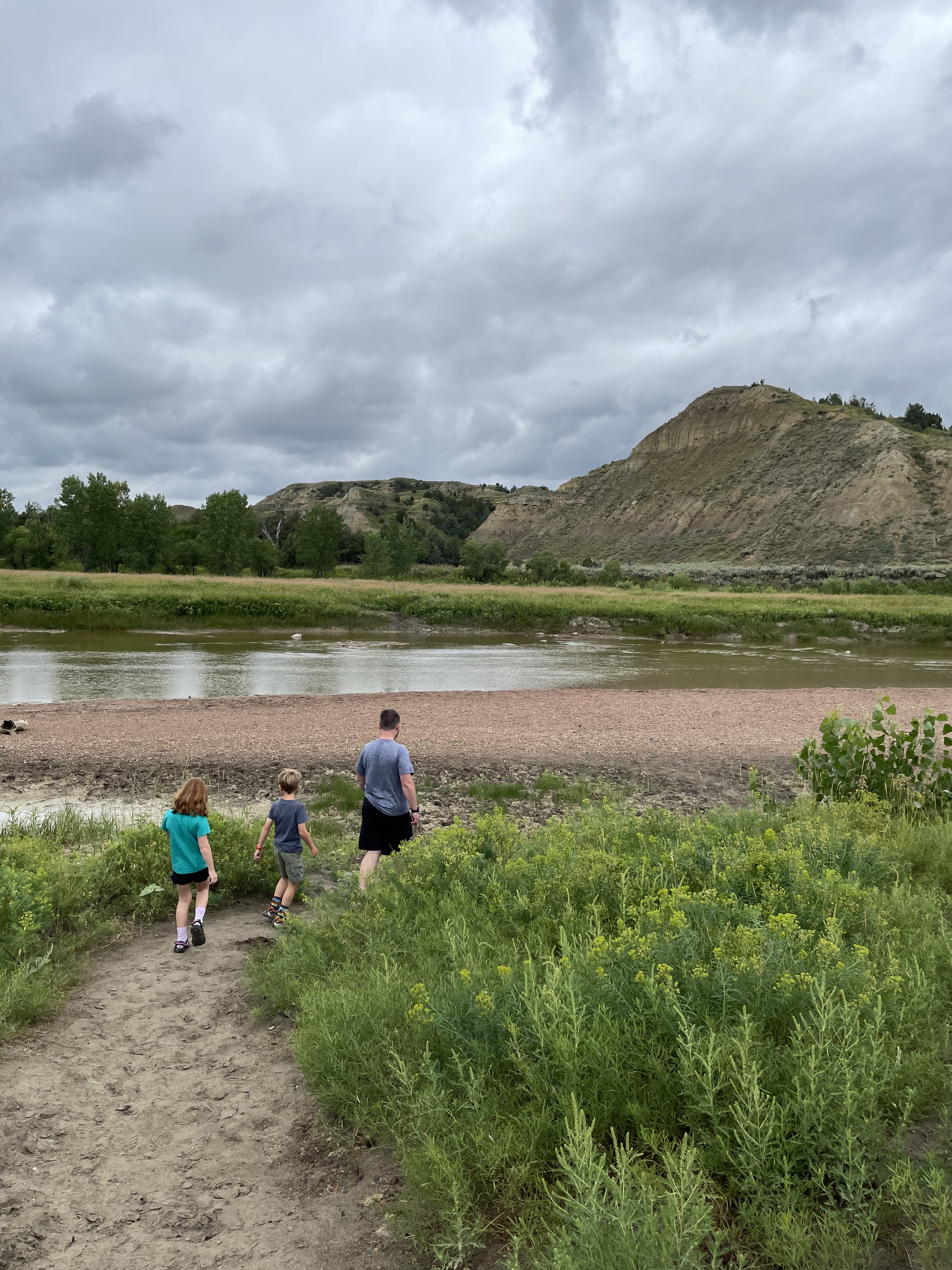
We didn’t want to do the whole loop – not realistic with the small hikers – but we decided to walk down to the riverbank and see what we could see.
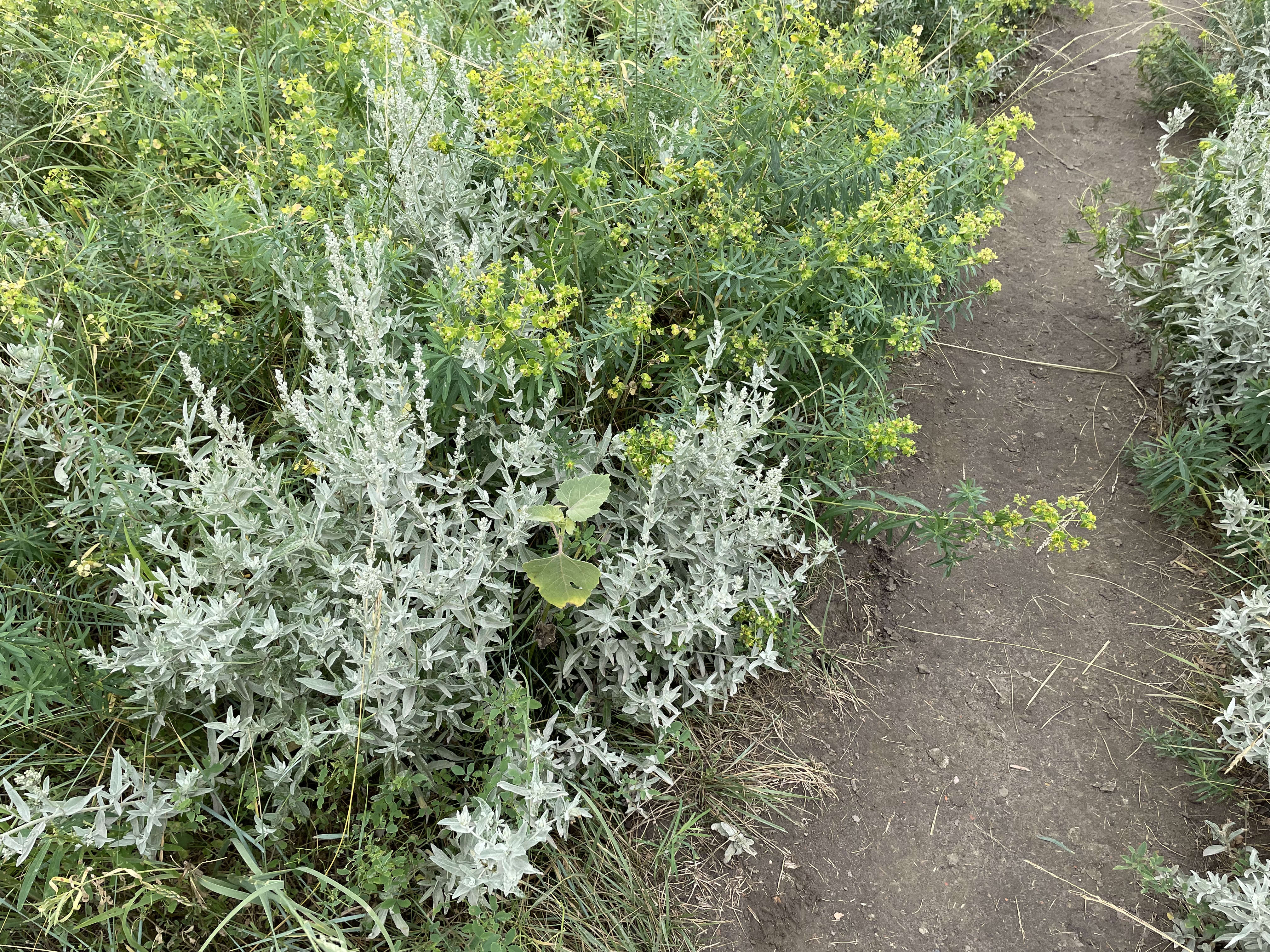
Plenty of sage along the trail! I love the smell of sage – one of my favorite things ever.
Little Missouri! (Note: I am not keeping the name of this hike a secret, I swear. I forgot it, and despite extensive googling I can no longer find it. And that’s also why I am not devoting an entire post to this pretty walk. If you’re in TRNP, it’s in the South Unit and there is a white house and a small parking lot, and that’s all I can remember. Sorry!)
Here’s a pretty riverbank picture to make up for my poor memory.
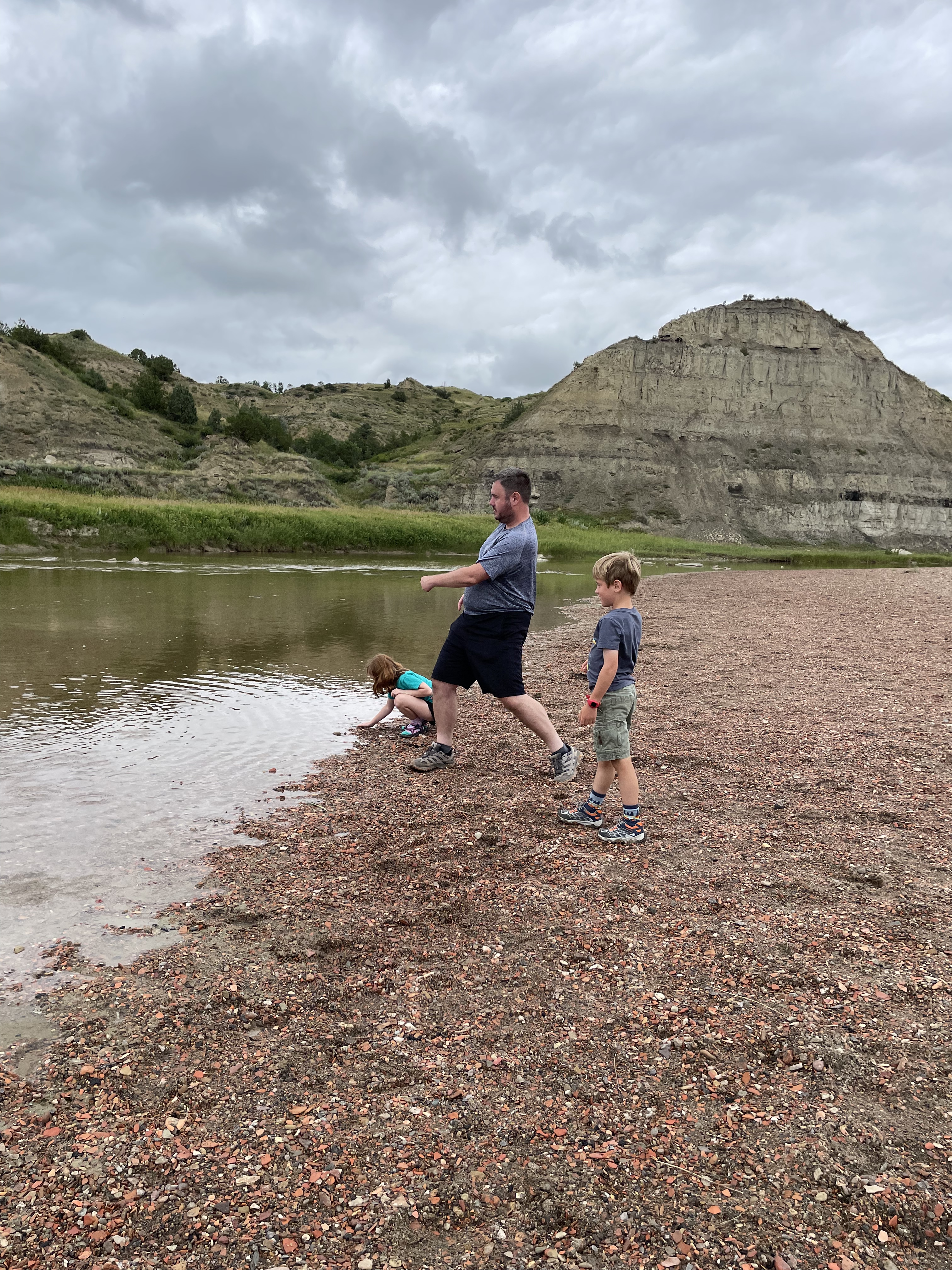
Despite no bison, we enjoyed our riverbank sojourn. We watched two hikers who were hiking the full five-plus mile loop cross the river (they had a good-natured argument over whether to take their shoes off or not – one did and the other didn’t), and the boys practiced their fastballs and sliders.
I love to build a little unplanned time into a vacation and this is a great example of why – we didn’t intend to do this walk; it was a spur of the moment decision that worked because we didn’t have anything else to do, and it was a lovely interlude to wander around the riverbank and do some splashing.
Next week: we visit the park’s cutest residents! Check in with me then.























 covered in flour