On the day we visited Corcovado National Park, I dashed off a quick post on Instagram with a few snaps I had taken on my phone, and the assurance that I’d had an amazing wildlife day but would have to get the pictures off my camera before I could share them. I hinted at the spoils though, promising pictures of animals colorful, animals very scary, and animals absolutely gigantic.
More to follow next week, but today I’m making good on that promise.
Colorful: scarlet macaws!
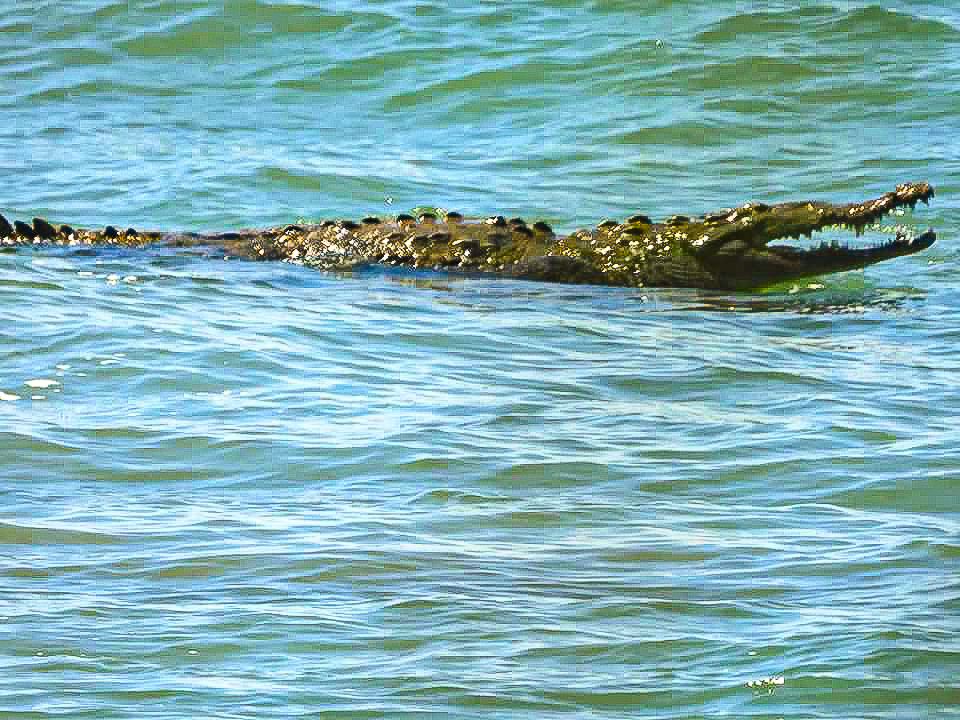
Very scary: a huge American crocodile, swimming around in the little bay where we’d arrived via a wet landing just a few hours before, gulp.
And absolutely gigantic: my loved ones, of course! A humpback whale family that played and visited around our boat on our way back to the lodge – absolutely breathtaking.
More to come about these critters, and the other amazing sights at Corcovado National Park, next week!
Last post headlined by the cover of Shirley – I promise! 😉
Shirley is less well-known than Charlotte Bronte’s Jane Eyre, and I’m wondering why that is. It’s a doorstopper, to be sure – about the same length as Villette, and longer than Jane Eyre – so that might have something to do with it. But in Shirley, Bronte delivers something that she does not deliver in her other novels (spoiler alert!): an unreservedly happy ending. But we’ll get to that in a minute.
Bronte called Shirley her novel of “Monday morning” and she planned for it to feel ordinary and workaday – and it does, but then again it doesn’t. Throughout the novel, you can read other influences. For example, she begins with a description of a northern textile mill and its attractive owner, the English-Belgian Robert Gerard Moore. Moore has ordered some textile frames to be delivered, but there’s labor unrest about; a group of disaffected mill workers lie in wait, ready to intercept and smash the frames on their way to their destination. Shades of Bronte’s friend Elizabeth Gaskell all over the place.
Jane Austen seems to be an influence, too. Bronte famously had little use for Austen, but some readers, meeting Shirley, hazard a guess that Austen influenced Bronte more than Bronte may have thought (or admitted). For instance, one character is described as “proud and prejudiced.” I mean. And then there are the witty asides.
“Rose, don’t be too forward to talk,” here interrupted Mrs. Yorke, in her usual kill-joy fashion, “nor Jessy either: it becomes all children, especially girls, to be silent in the presence of their elders.”
“Why have we tongues, then,” asked Jessy pertly; while Rose only looked at her mother with an expression that seemed to say, she should take that maxim in, and think it over at her leisure. After two minutes’ grave deliberation, she asked– “And why especially girls, mother?”
Yes, why especially girls, Mrs. Yorke?
One girl who would definitely take issue with Mrs. Yorke’s stern admonitions to her young daughter is the novel’s titular character, Shirley Keeldar. Shirley is a fabulous, fascinating character. Having inherited a fortune and a great estate, of her own right, from her late parents – Shirley is completely liberated from convention and social expectations. She goes where she pleases, talks to whom she chooses, and answers to no one but herself. In a time when women were little better than property, Shirley is a breath of the very freshest air. And in her character – said to be a portrayal of Emily Bronte, if she was rich and healthy – Shirley is wildly ahead of Victorian times. She sharply defends her single status and her choice of man to marry… maybe, eventually, when she is ready. She enjoys her position as “lord of the manor,” holds her own in business talk with the young mill owner Robert Moore, calls herself “Captain” and even uses masculine pronouns from time to time. (Can you believe it?! In a Victorian novel. My jaw was on the floor, in the very best way.) What is possibly even more incredible: other characters in the novel just accept her as she is – even the conservative clergyman, Mr. Helstone – referring to her as “Captain” and using masculine pronouns to refer to her as well. I found that astonishing.
I have loved Charlotte Bronte since high school, and one of the reasons is that once you get through the Victorian language (and occasional melodrama) she’s so very modern. Her thoughts and critiques ring very true for 2022. For example, she has some very unfavorable opinions of the “British mercantile classes” – male, of course. I can think of quite a few Americans in present day who fit this description, too. Some of them aren’t in Congress, but most are.
All men, taken singly, are more or less selfish; and taken in bodies they are intensely so. The British merchant is no exception to this rule: the mercantile classes illustrate it strikingly. These classes certainly think too exclusively of making money: they are oblivious of every national consideration but that of extending England’s (i.e. their own) commerce. Chivalrous feeling, disinterestedness, pride in honor, is too dead in their hearts. A land ruled by them alone would too often make ignominious submission – not at all from the motives Christ teaches, but rather from those Mammon instills.
Another way that Shirley is modern and unusual for a Victorian novel is that – while several characters are in romantic plotlines – the central relationship of the book is a friendship between two women. There’s Shirley, of course, but her co-heroine actually appears onstage first. Caroline Helstone is the vicar’s shy niece – abandoned to her woman-hating uncle as a young girl, she grew up sheltered and largely solitary. Her one social indulgence has been her friendship with her Belgian cousins, Hortense and Robert Moore. Hortense teaches Caroline French and domestic arts, and Robert – well, Caroline falls in love with Robert. Hard. The problem is that Robert is too focused on the success of his mill to even think about marriage, and Caroline is convinced she will never love anyone else, leading to some more of Bronte’s very pointed words.
Reflecting on her anticipated destiny as an unmarried woman, Caroline wonders where she will find meaning in her life if not as a wife and mother:
“Ah! I see,” she pursued presently; “that is the question which most old maids are puzzled to solve; other people solve it for them by saying, ‘Your place is to do good to others, to be helpful whenever help is wanted.’ That is right in some measure, and a very convenient doctrine for the people who hold it; but I perceive that certain sets of human beings are very apt to maintain that other sets should give up their lives to them and their service, and then they requite them by praise: they call them devoted and virtuous. Is this enough? Is it to live? Is there not a terrible hollowness, mockery, want, craving, in that existence which is given away to others, for want of something of your own to bestow it on? I suspect their is. Does virtue lie in abnegation of self? I do not believe it…”
“A very convenient doctrine for the people who hold it” – WOW. I mean, think about that for a second. That is next level cynical.
Caroline decides to do some life research by getting to know the local old maids, and goes on something of an old maid tour of the region. Her uncle, perhaps alarmed by this, decides it would be good for Caroline to make the acquaintance of the local heiress, just returned to her landed property. Introducing Caroline to Shirley Keeldar is possibly the only truly kind thing Mr. Helstone ever does for his niece (and he’s almost certainly got his own ends in mind) but what a result – Caroline and Shirley immediately hit it off, and their friendship is the anchor of the book. Even when it appears that they may both be in love with Robert Moore, the friendship thrives in Bronte’s capable hands. Books making female friendship the central relationship are rare in present day – in Victorian times, this was almost unheard-of. I was staggered, and delighted.
I won’t go into more detail, because this post is already too long as it is. But I wanted to note that there are a few other Easter eggs for careful readers to find – nods to both Emily Bronte’s Wuthering Heights and Anne Bronte’s Agnes Grey (both of which pre-dated Shirley by two years; I checked, because I wanted to make sure the references weren’t an accident). I won’t spoil them, so please let me know if you read Shirley and find the Easter eggs.
All in all, while it took me quite some time to get into Shirley, once I did settle into the narrative I absolutely loved it. Bronte’s modern story of female friendship and empowerment was Jane Eyre, but more cheerful. I just adored it, and it won’t be long before I have to revisit Miss Keeldar and Miss Helstone (and their men, but let’s be honest – the guys are supporting players, and I’m here for it).
Hey, look at this – a gallery of book covers instead of a picture of just Shirley again! I finally had a pretty decent reading week – attention, time, and ability to avoid doomscrolling were all on my side. At the end of the day, I really, really loved Shirley. It just took me awhile to get into it, and trying to read via a big omnibus collection was not a good strategy. Full review coming Wednesday, so I will reserve further thoughts for that post.
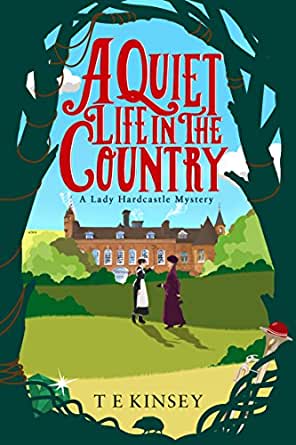
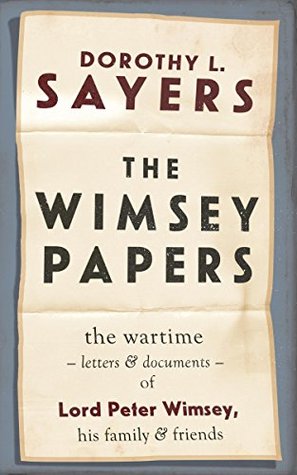
I was out of town last week, visiting my folks for the Fourth of July (we love getting up to the lake during the summer when we can and the timing worked out for us to be there over the holiday weekend this year – always fun) so I stuck with digital reading, getting through A Quiet Life in the Country, by T.E. Kinsey – a fun, light mystery starring a new-to-me sleuthing duo – and Agatha Christie’s A Caribbean Mystery on Audible. Loved the story, but the narrator wasn’t my favorite; she was fine, and the narration was great, but some of her character voices grated on me. Apparently I’m on a mystery jag right now, because when I wrapped up A Quiet Life and Caribbean Mystery (both on Sunday!) I turned to Dorothy L. Sayers and The Wimsey Papers. It’s short – just a collection of fictionalized letters and family documents that Sayers published as one-offs during World War II, some of which seem to have been an excuse for her to flex her philosophy muscle. I’m really enjoying it and will probably wrap it up this evening. And then what? No idea.
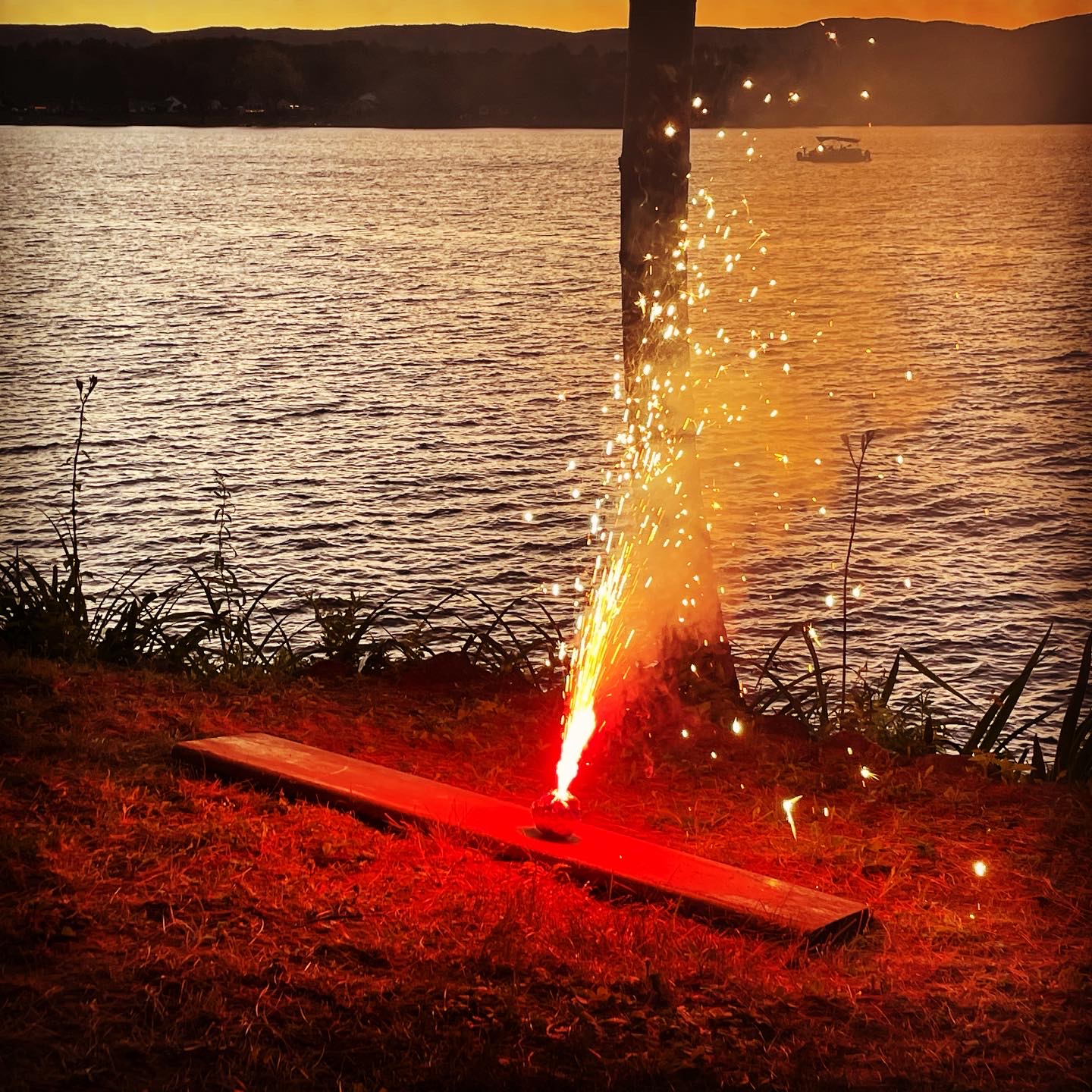
Fireworks! Hope you had a great Fourth, if you were celebrating. It’s really summer now!
On our third afternoon in Osa, we were hanging out in the open air lounge area of the dining pavilion at our hotel, drinking passion fruit daiquiris with our new dive buddies Garry and Donna. Donna wandered off for a cigarette and to look at some lizards, and after spending a few minutes trying to get interested in the computer talk in which the guys were engaged, I got up, grabbed my wildlife camera, and declared that I was taking a walk.
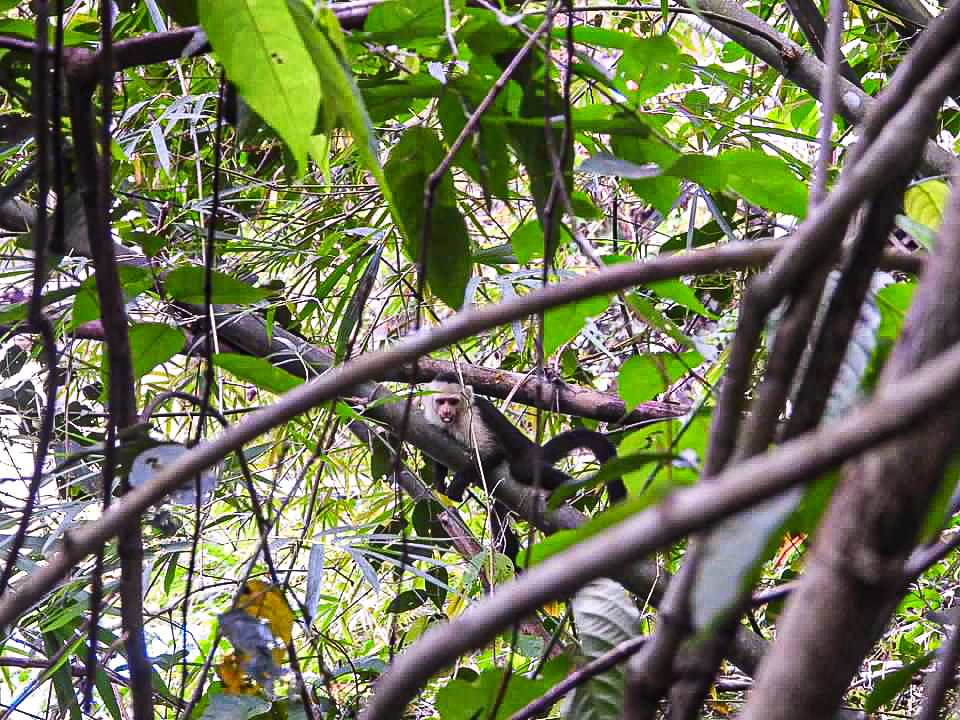
I wandered vaguely in the direction of the hanging bridge, with the dual goals of (1) getting my steps in, and (2) seeing an animal, any animal would do. I’d made it just to the hanging bridge when there was a commotion above me and a knot of excited German tourists pointed out a monkey in the trees. New mission: get a picture of the monkey.
Harder than it seemed. The little booger was moving fast.
GOTCHA.
I was delighted with my picture and decided to head right back to the dining hall and brag to the guys about my photo conquest. As I walked back in the direction of the lodge, I realized – the monkeys were going the same way.
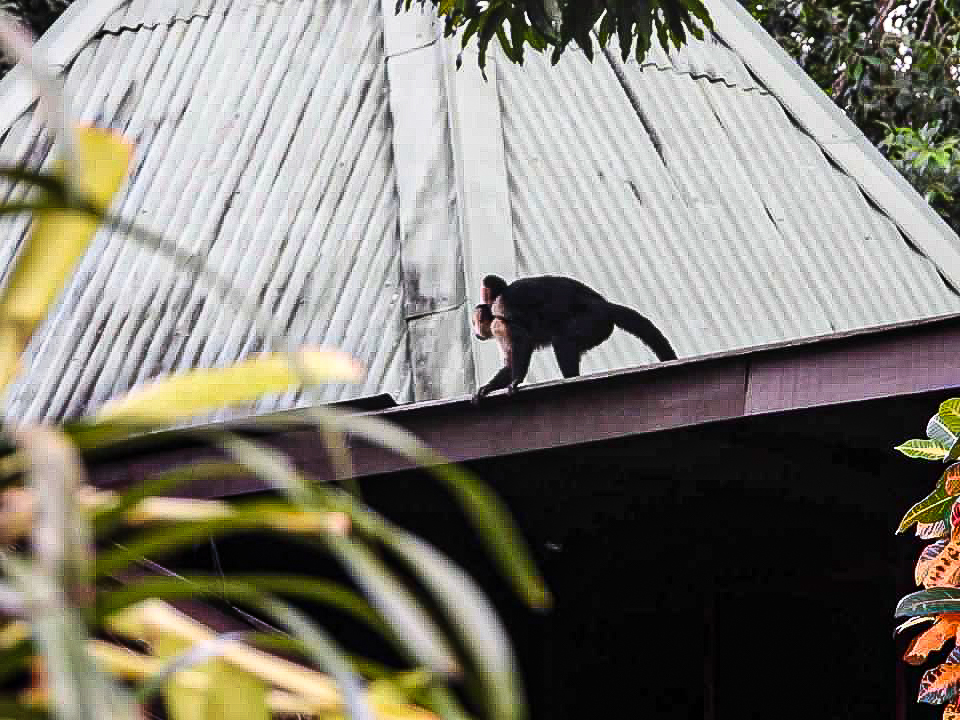
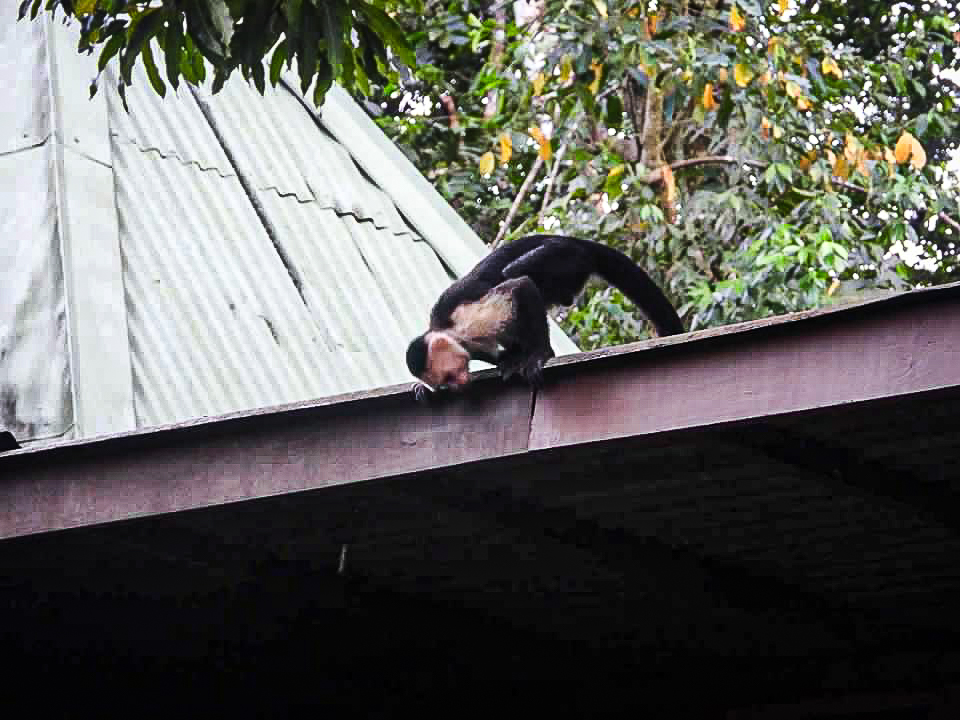
Yes, I said monkeys – plural. What I originally thought was one monkey turned out to be an entire troop. And they were all thundering across the tin roofs of our hotel’s outbuildings. It was a long line of noisy, exuberant mischief.
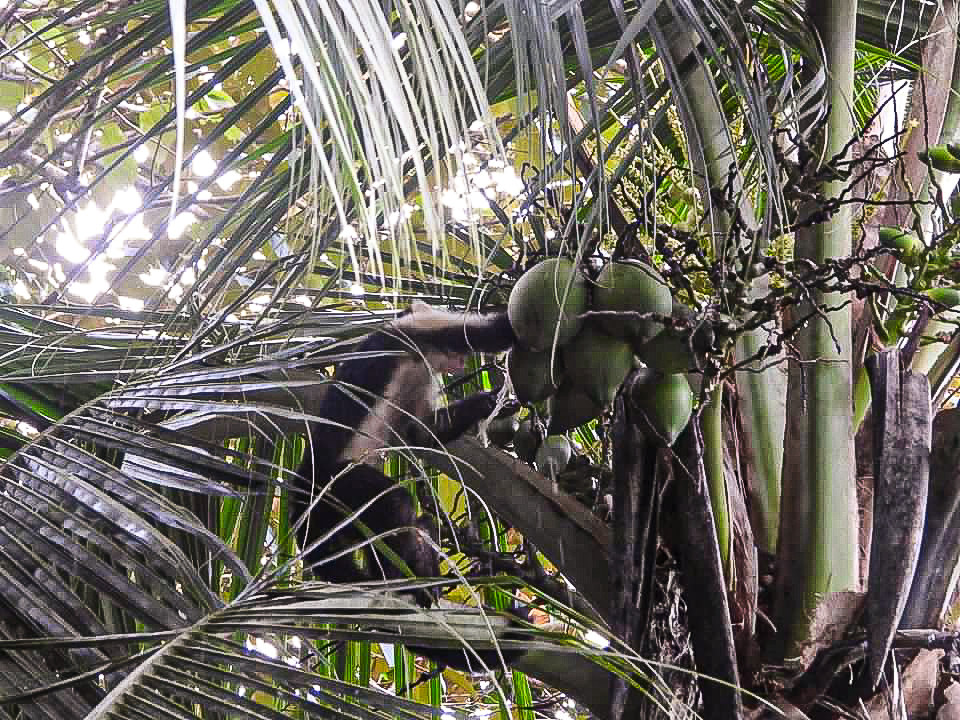
Except for this one, who stopped to grab a snack.
Yum, coconuts, delicious. I like young coconuts too, monkey! (He – or she – wasn’t interested in sharing.)
Meanwhile, the rest of the monkeys had made their way to the dining pavilion – where Steve and Garry were still hanging out – and were raiding a huge stash of bananas in the open air kitchen, because of course they were. The entire hotel guest population was streaming out from their languid afternoon hideaways to watch. So much for my monkey picture impressing the guys!
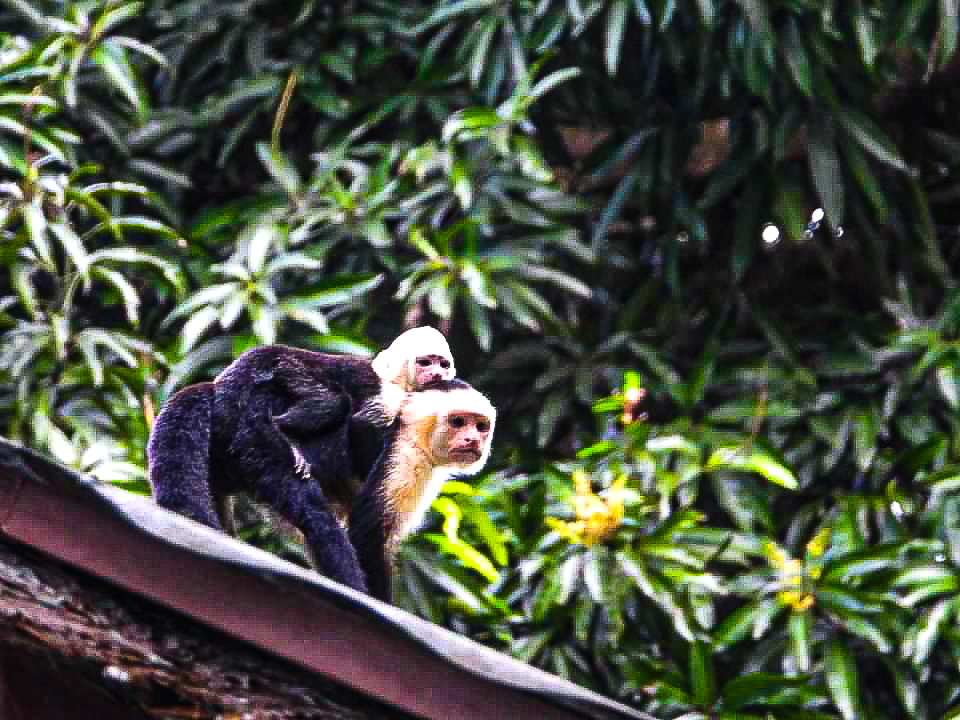
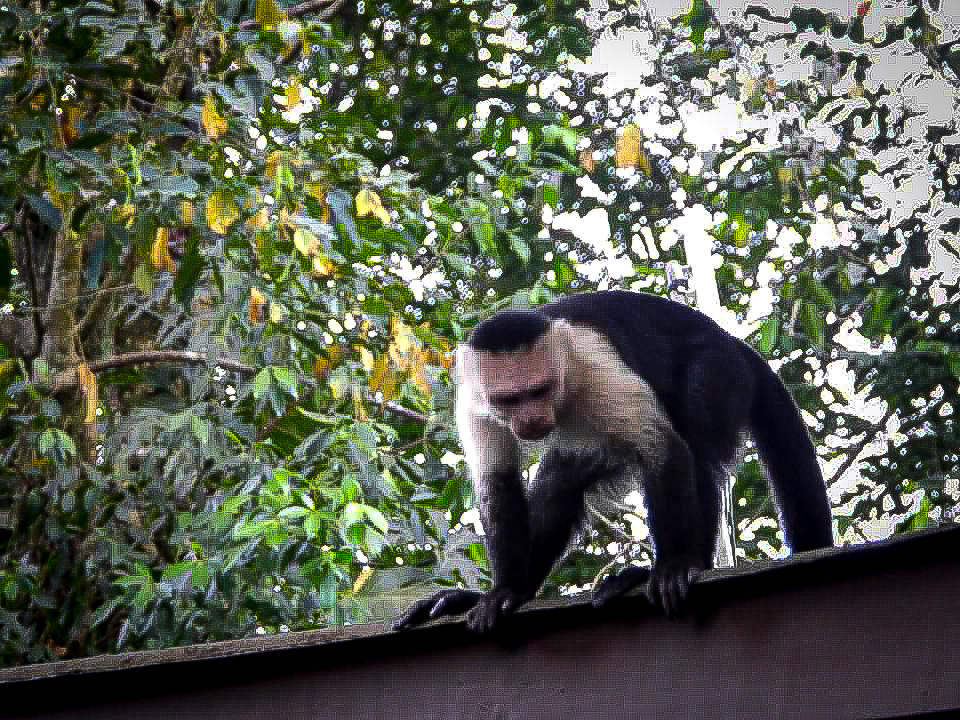
But I couldn’t be mad, because they were so stinking CUTE! I mean – look at that. And as you can see, some of them were MOTHER MONKEYS with BABY MONKEYS RIDING ON THEIR BACKS. Please excuse the all-caps, which really is warranted.
COME ON. I mean… COME ON!
We probably watched for about half an hour as they stampeded around the dining hall roof, leapt from the roof into the trees and back again, stole food from the kitchen and chattered incessantly at one another. Y’all, I’ve seen a lot of cute stuff but this was up there with the very cutest.
Eventually what we took to be a never-ending parade of capuchin monkeys did, in fact, end. And we returned to our passion fruit daiquiris, this time while clustered around my camera exclaiming over the shots I’d gotten of the monkeys and their monkey business. We came to Costa Rica hoping to have adventures and see wildlife, and man, oh man, was Costa Rica delivering.
Next week: more animals! Including some very colorful, some very scary, and some absolutely gigantic.
Reading is my oldest and favorite hobby. I literally can’t remember a time in my life when I didn’t love to curl up with a good book. Here are my reads for June, 2022.
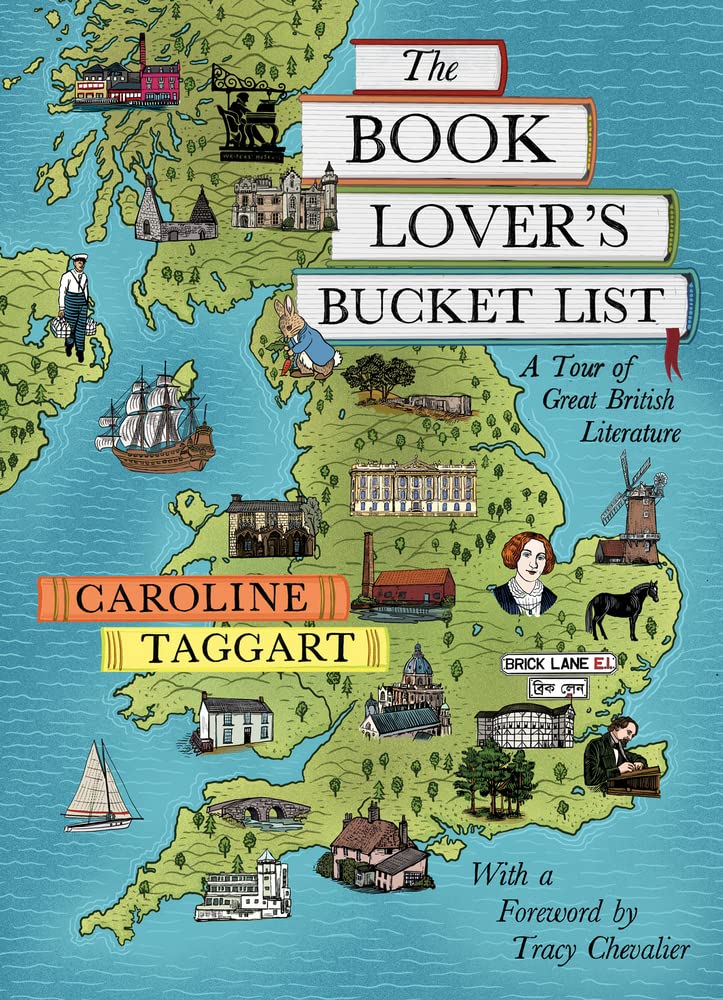
The Book Lover’s Bucket List: A Tour of Great British Literature, by Caroline Taggart – When I was just getting into reading books for adults, as a junior high school student, and also developing a yen for traveling, I happened upon a book called A Reader’s Guide to Writer’s Britain, and devoured it. So when I spotted The Book Lover’s Bucket List among the new publications being brought out by the British Library, I immediately pre-ordered it expecting pretty much the same reading experience – and that’s exactly what I got. Taggart takes readers on a tour of the different regions of England, as well as Scotland, Wales, and Northern Ireland. I appreciated that she featured both classic writers like Shakespeare and Austen, but also modern writers who will doubtless be classic someday, like Kazuo Ishiguro, Zadie Smith and Monica Ali. My reading list and my travel list expanded duly.
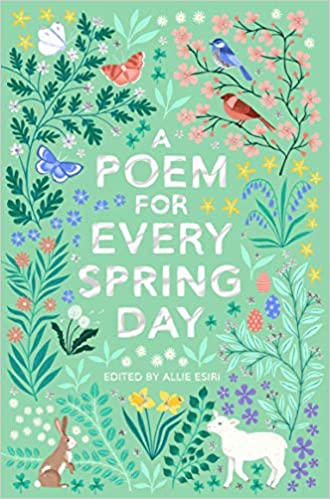
A Poem for Every Spring Day, ed. Allie Esiri – Once again, I got hopelessly behind on Esiri’s seasonal poetry collections – trying to read one poem in the morning and one at night every day is a lovely practice but doesn’t seem to be working in my current stage of life. So once again, as with A Poem for Every Winter Day, I found myself sprinting to the finish line. But it’s okay, because I enjoyed the selections very much.
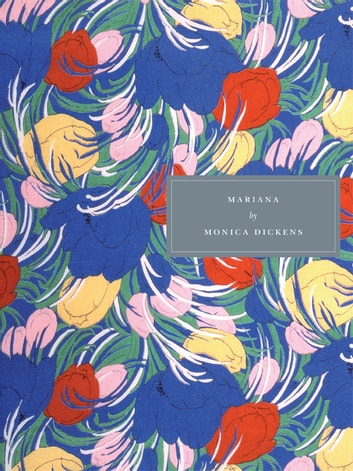
Mariana, by Monica Dickens – A few years ago, in a fit of honesty, I told a friend that “I don’t really want to read Dickens, but I want to be a person who has read Dickens.” That’s still pretty accurate, but if Charles Dickens’ great-niece Monica Dickens counts, then I definitely want to read Dickens. Mariana is a captivating, readable, and thoroughly enjoyable story of a young girl growing up in 1930s England. The reader follows Mary through childhood holidays with her late father’s family in the country, to school – where she meets and befriends the irrepressible Angela but has an otherwise crummy experience – to a short-lived, ill-advised, and spectacularly ill-fated attempt at drama school – to a similarly ill-fated romance in Paris – and finally to her meeting and falling in love with her soulmate. I couldn’t put it down.
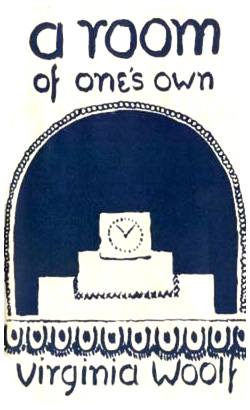
A Room of One’s Own, by Virginia Woolf – Cross this one off the list of “I’ve been meaning to read this for years.” A Room of One’s Own is Virginia Woolf’s long essay, adapted from a series of lectures she gave on women and fiction, in which she arrives at her famous conclusion: a woman must have money and a room of her own if she is to write. I know Virginia Woolf was a snob and not very pleasant to her domestic staff, but I didn’t find her exactly unsympathetic to the plight of working women throughout history, as I’d expected to. Rather, she laments that there could have been untold numbers of geniuses at the Shakespeare level (she even invents a sister for the Bard, “Judith Shakespeare,” and endows her with a better brain than her illustrious brother Will) but because women have been downtrodden and overwhelmed with childbearing, raising families, and just trying to keep everyone alive through the centuries, they have been cheated out of countless opportunities. I expect she is right about that. This was a good, interesting read.
Rhododendron Pie, by Margery Sharp – Sharp’s first novel has been something of a white whale for the bookish blogosphere – out of print and very difficult and expensive to get hold of – until Dean Street Press brought it out recently. (A common story. My shelves contain so many forgotten classics bought very affordably now. Thank you, Dean Street Press!) The Laventies are a haughty, intellectual family – mostly. Father Richard is into trendy interior design. Eldest sister Elizabeth is an inscrutable genius essayist. Brother Dick is an avante garde sculptor. And then there’s Mother, who hides away in her room, and sister Ann, who likes jigsaw puzzles, walking over the Downs, and going on picnics with the very run-of-the-mill neighbors. Ann is proud of her intellectual family… but also wants a more ordinary life for herself – setting herself up for a clash of values with her snobby intelligentsia relatives. I enjoyed this so much!
That’s a wrap on June – not much of a total for you, I’m afraid. Partly, that’s the result of a lot of doomscrolling this month; I’m working on that. And partly, it’s because of my decision midway through the month to start reading a lengthy Charlotte Bronte novel contained in an omnibus tome. I’ve transferred that over to my kindle and am nearly done, so I’m expecting more of a haul in July. But in the meantime, I may have only read a handful of books in June, but those books I did read were universally delightful. “Mariana” was the runaway highlight, but I really loved everything I read this month.
Are you all getting tired of seeing another post headlined by Shirley and no other books? Me, too, fam. Me, too. Clearly I bit off more than I could chew when I decided, you know what, I think I have the time and attention span right now for a doorstopper. The problem is, most of the books left on my Classics Club list are doorstoppers, and I’m getting down to the wire – I have exactly one year left on the challenge and I seem to have left all the really, really loooooooong books for last. Figures.
Anyway, I decided that trying to read Shirley in my omnibus volume of Charlotte and Emily Bronte’s complete novels was making it harder – it’s not easy to focus on a Victorian classic while constantly shifting positions around to get comfortable holding a massive tome. I read at the kitchen table for a few nights, which served me well when I read War and Peace about ten years ago, but a lot has happened in the intervening years and the kitchen table is not as cozy and welcoming of a place as it used to me. (If you must know, what has happened is two kids: the kitchen table is now permanently sticky no matter how many times I clean it.) So I downloaded a free ebook of Shirley to my kindle and am now reading much more comfortably, and – magic – my reading speed has picked up! I’m about three-quarters of the way through and will definitely finish it in the next couple of days. I don’t know if it’s just because I’m reading more comfortably on an e-reader than in a giant volume, but it also feels like the story has picked up and gotten more interesting, too. Looking forward to some time relaxing with Shirley today, and maybe I’ll even get ‘er done.
Happy Fourth, American friends! I feel a little sheepish these days admitting that Independence Day is my FAVORITE holiday, but there it is. It used to be second behind Christmas – when I was a kid – then moved into tie position when I was a young adult, and now as a mom it’s clearly in the lead. (Still love Christmas but it’s become very expensive, pressure-packed, and a LOT of work since kids arrived on the scene. #grinch.) Give me a day on the water, a turkey dog, and some sparklers to close it out. Now that’s a holiday!
Our hotel at Osa, Aguila de Osa Inn, was delightfully remote and inaccessible by road, but there were hiking trails leading in one direction from the property to the nearby town, and in the other direction through a series of landmarks extending as far as Corcovado National Park, if you cared to walk that far (it would be about six hours’ hiking in each direction). After our second day of diving, Steve and I decided to explore the trail to the first landmark – Cocalito Beach.
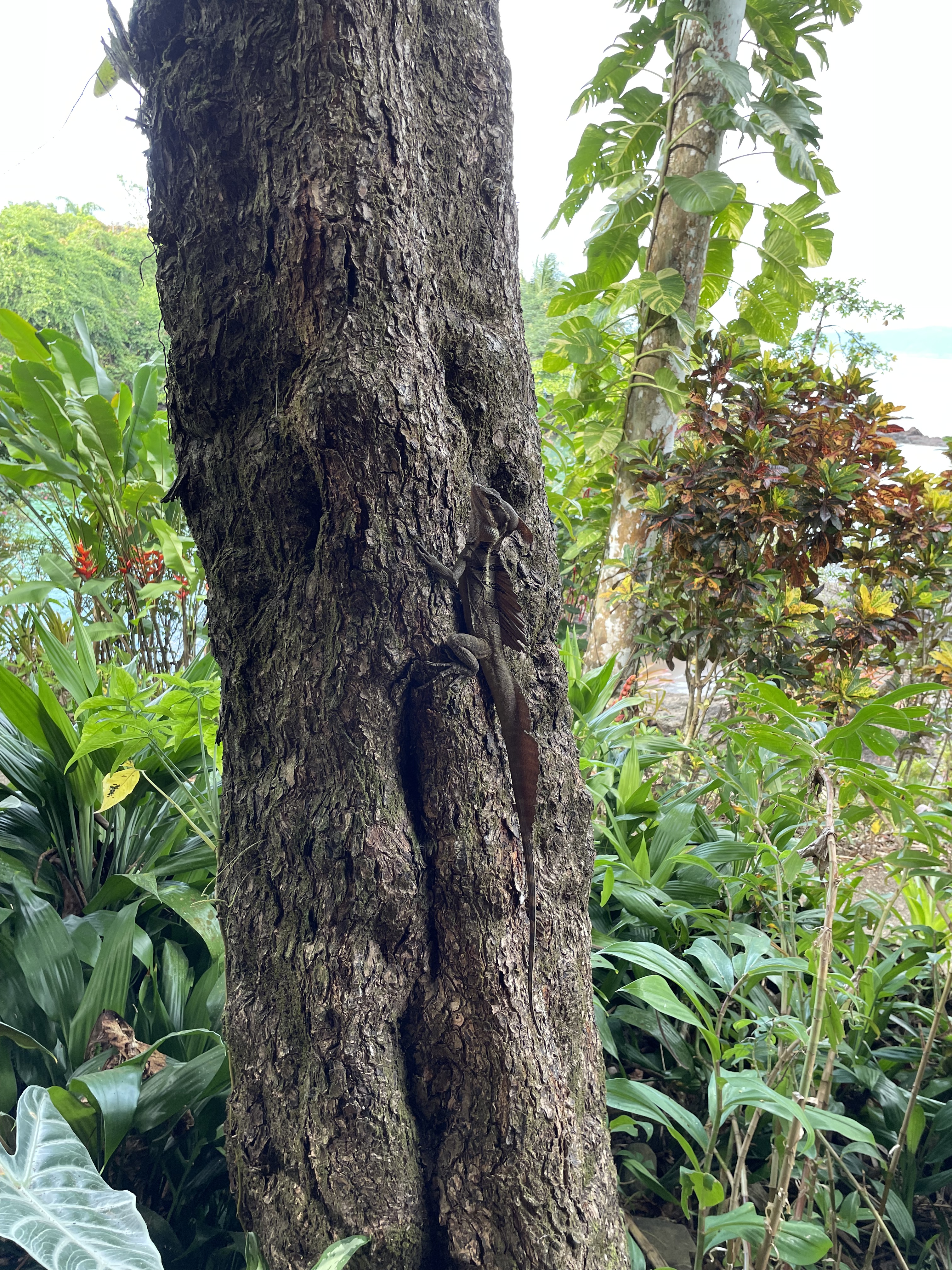
I could have sworn I took a bunch of pictures on the hike, but now all I can find is this tree:
(With a lizard on it – do you see him? I probably snapped this to show to Donna, who loves lizards.)
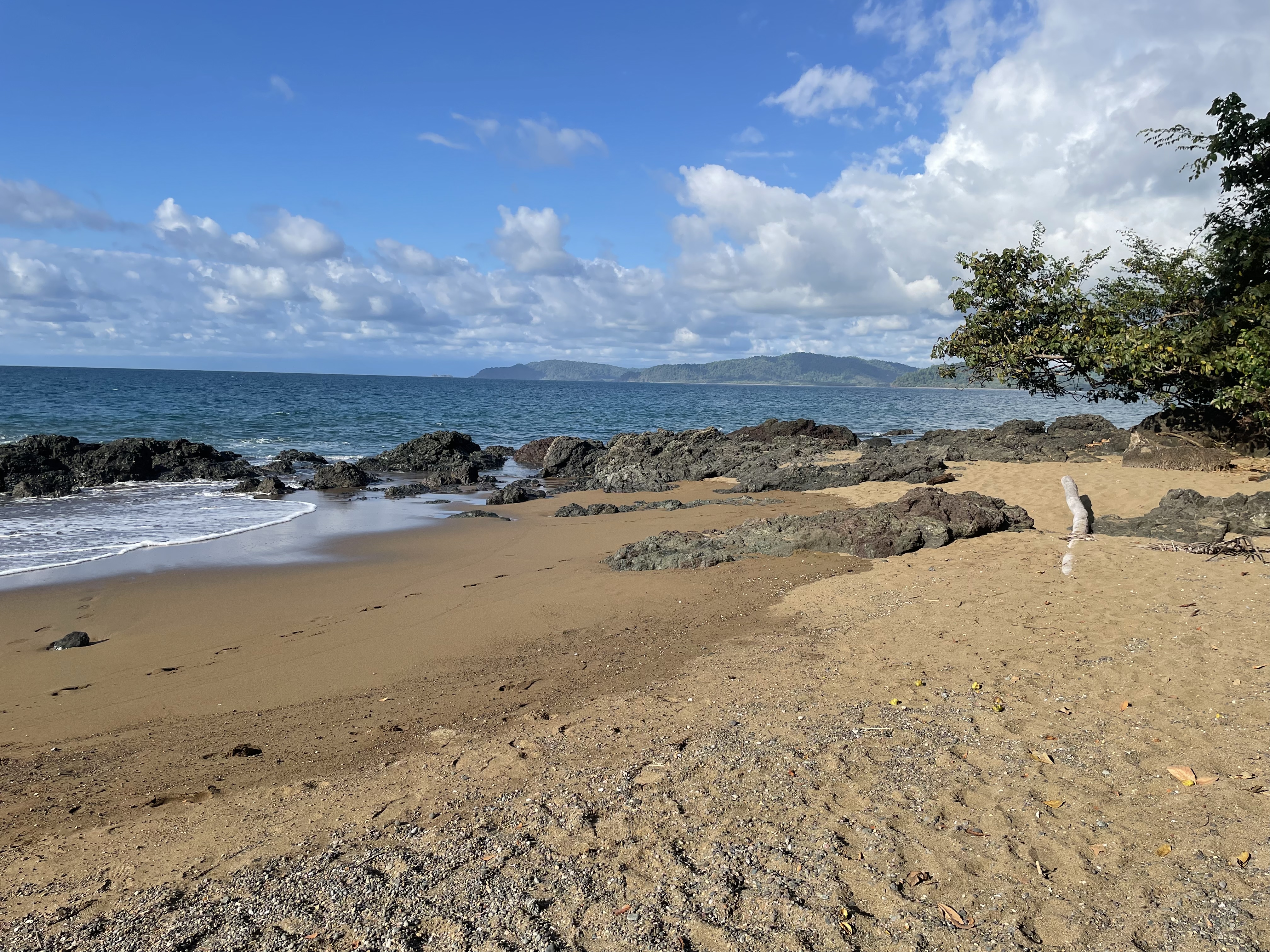
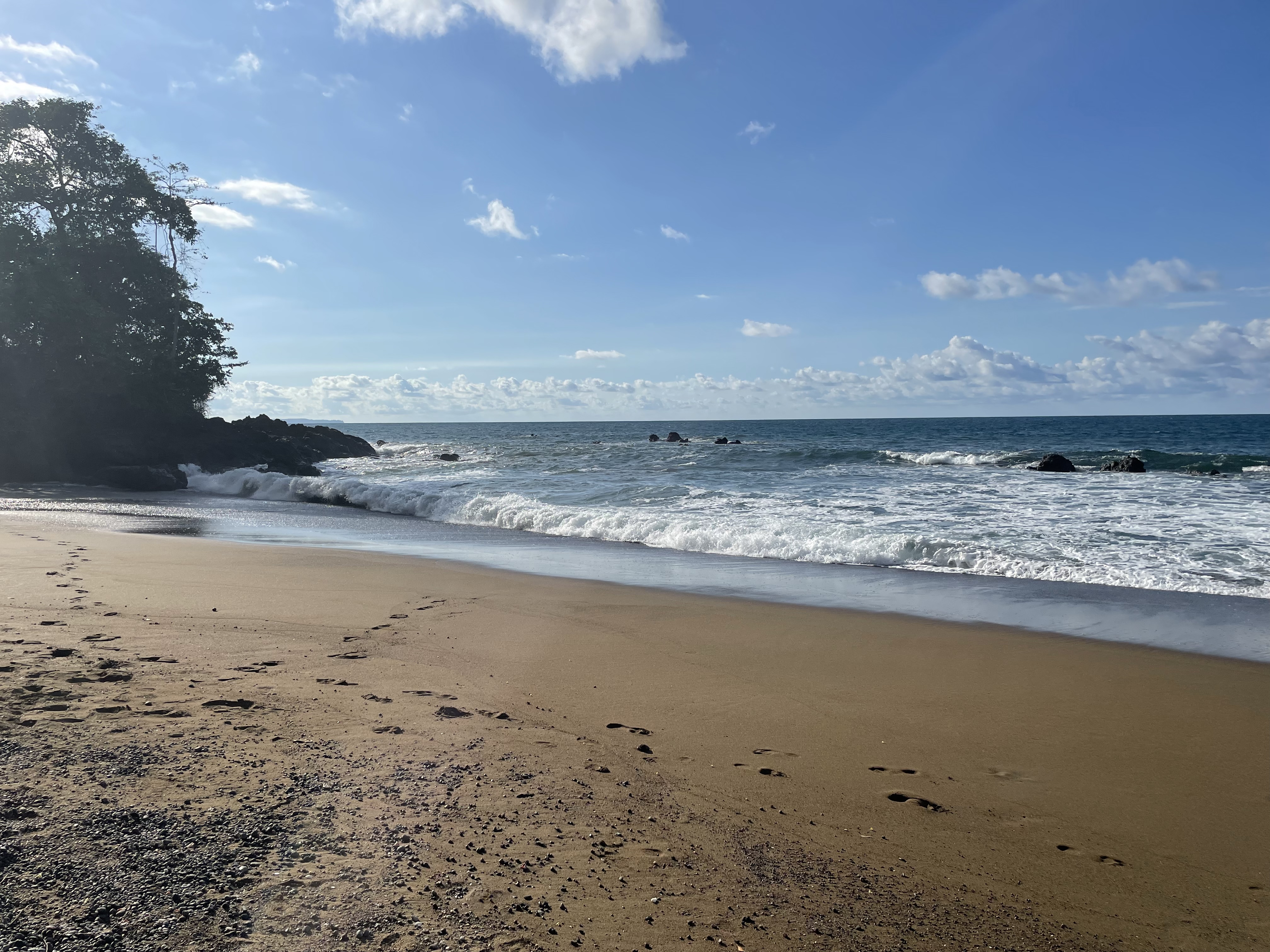
Anyway, it was about a twenty-five minute stroll over a little hanging bridge (the one we kayaked under on our first day in Osa) and through a winding hiking trail with a little bit of rolling elevation change, and we found ourselves here:
It doesn’t get better than this.
Pura vida, indeed!
I could have hung out here for hours, watching the surf roll in.
It was just a short hike to stretch our legs after two days of diving, but it felt good. And after spending hours exploring under these waves, I felt a bond with this ocean like never before.
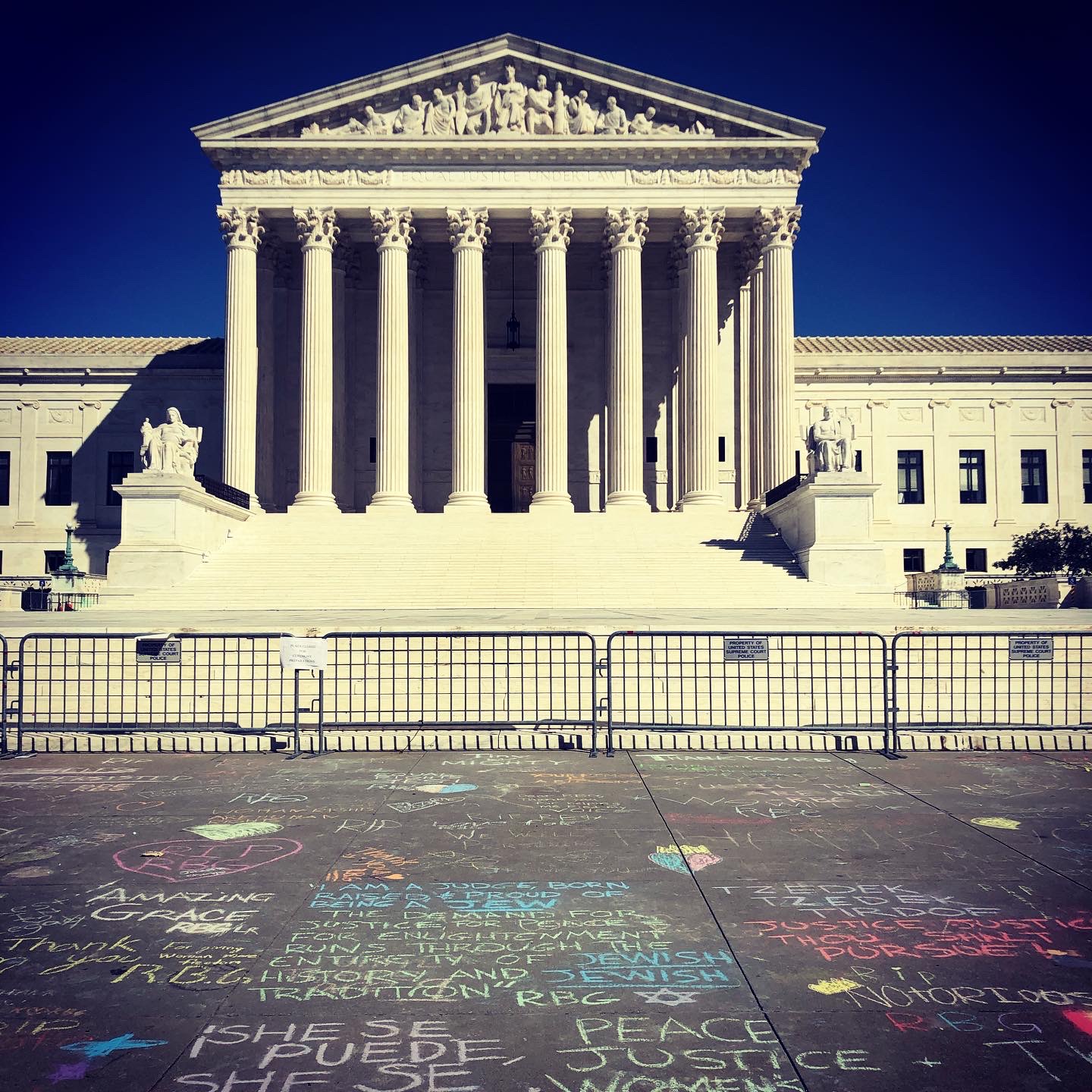
I mostly try to avoid talking politics on this little blog about books and travel and small joys. But I do have opinions that I’ve occasionally been unable to keep in. This past week has been a hell of a week – I think that’s probably not a controversial statement, right? (I hate it in this timeline, by the way. How do we leave?) Whether you’re happy with the rulings that have come out of SCOTUS over the past seven days or not, it’s been an onslaught of news and think pieces and I am exhausted. What it all boils down to, for me, is this: the patriarchy sucks and must be smashed. In the meantime, here are some books about how terrible the patriarchy is, if you needed to be reminded. Solidarity, sister.
Everyone already knows how boundary-pushing Charlotte Bronte was – Jane Eyre is recognized as one of the foremost pieces of feminist literature of all time, and Shirley, which I am reading now, features a protagonist who unashamedly calls herself “Captain” and occasionally uses masculine pronouns. (Yes, really!!) What is not always recognized is that Charlotte’s younger sister Anne Bronte was just as boundary-pushing, maybe more. The Tenant of Wildfell Hall, my favorite Bronte novel of all, features a woman who escapes an abusive husband in a time when divorce was unheard-of. It’s a moving, galvanizing, unsettling read.
Again, everyone already knows about The Handmaid’s Tale and its profound, maybe (hopefully not) prophetic influence. Less well-known is Margaret Atwood‘s fictionalized account of a real-life murder case: Alias Grace. In 1843, Thomas Kinnear and his housekeeper were victims of a gruesome murder. Two of Kinnear’s other servants, Grace Marks and James McDermott, were convicted of the crime – but the evidence against Grace was flimsy and based on unreliable recollections and narratives. Alias Grace is Atwood’s re-imagining of the crime, during the writing of which she revised her opinion of Grace Marks and her story. It’s a deeply alarming account of what happens when women are not believed.
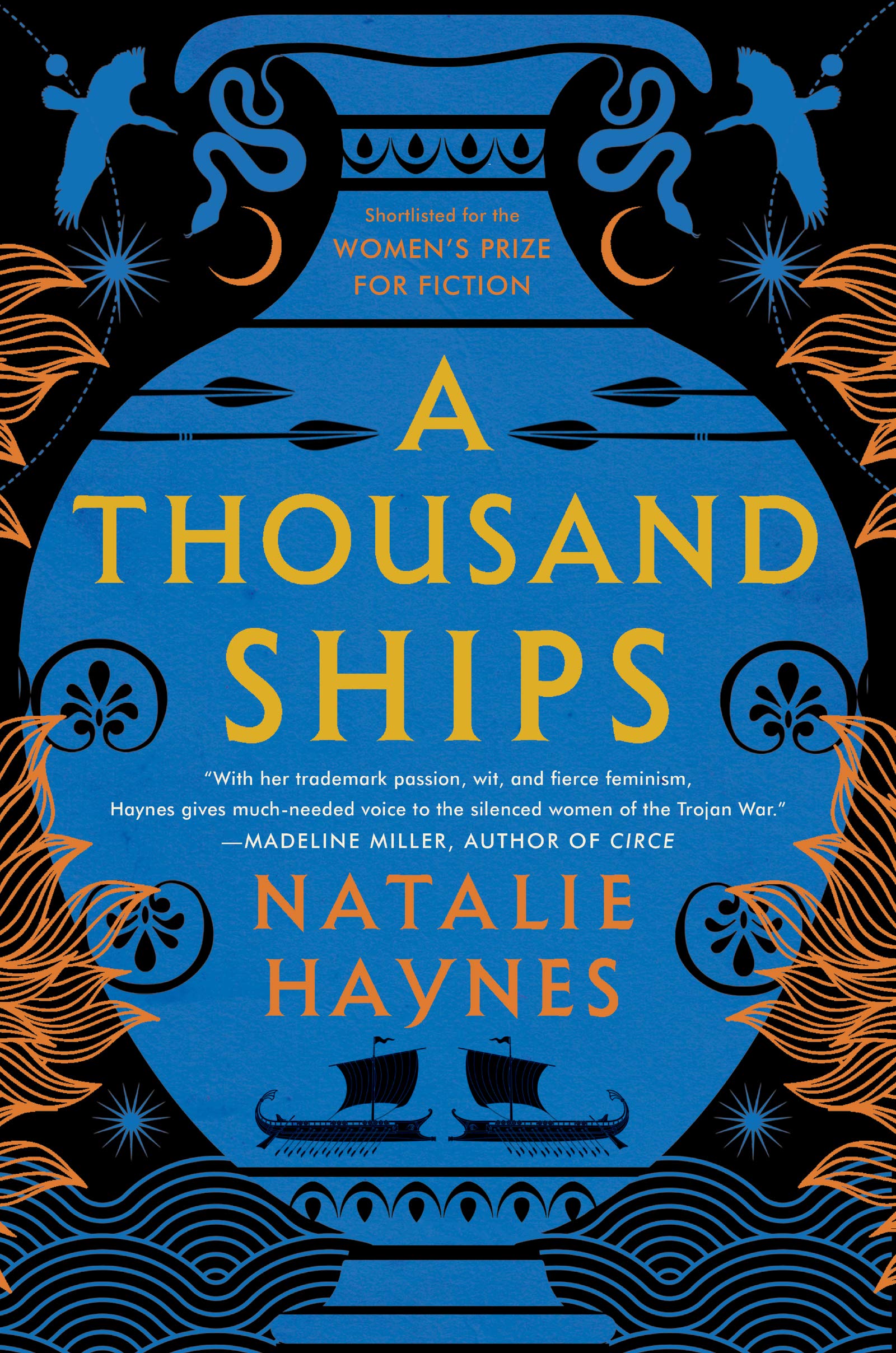
For something more recent, the brilliant Natalie Haynes explores a group of people whose voices have been silenced for millennia – the women of Homer’s epics Iliad and Odyssey. A Thousand Ships is a tragic, violent, often gruesome, sometimes inspiring but usually devastating, look at the quiet background characters who were ignored in favor of Achilles’ tantrums and Agamemnon’s bloodlust and Odysseus’ refusal to pull over and ask directions. Read it with a box of tissues. Because the patriarchy sucked then and it sucks now.
No need for a gallery today, because the only book I spent any time with – and it wasn’t much time, to be perfectly clear – over the last week was Shirley, by Charlotte Bronte, which I started last weekend. So I’m now at over a week and counting, and still only maybe a third of the way through? In my defense, it’s been an eventful week in the world – much doomscrolling has happened, and I’ve got to get back to putting my phone on its charging cradle in another room so that I can focus on my book. Multiple evenings last week I was either scrolling through my Washington Post app, researching how to move to Canada, or escaping into long phone conversations with friends or family members. What I was not doing: reading Shirley.
Also in my defense, Charlotte Bronte takes over a hundred pages to introduce the title character. Why?!
Anyway – summer is about to get super busy in these parts, and I don’t want to be toting my gigantic omnibus edition of Charlotte and Emily Bronte’s novels (especially since the publisher made the terrible judgment call of excluding the best Bronte, Anne) – so I need to get after it. I still have several nights of reading left in the book, and that’s best case scenario where I don’t doomscroll at all, so we’ll see how well I even do with that. No idea what’s up next in the book department, either, although I do have the audio version of Agatha Christie’s A Caribbean Mystery downloaded and ready to go, and I think that will be in my earbuds before too long.
It’s officially H-O-T in Virginia! Good thing we have somewhere to beat the heat.
After eight pool dives and two open water dives on our first full day in Osa, we staggered down to the dining pavilion after another ridiculously early wakeup for the third and fourth ocean dives and – hopefully – our certification as fully-qualified PADI open water divers.
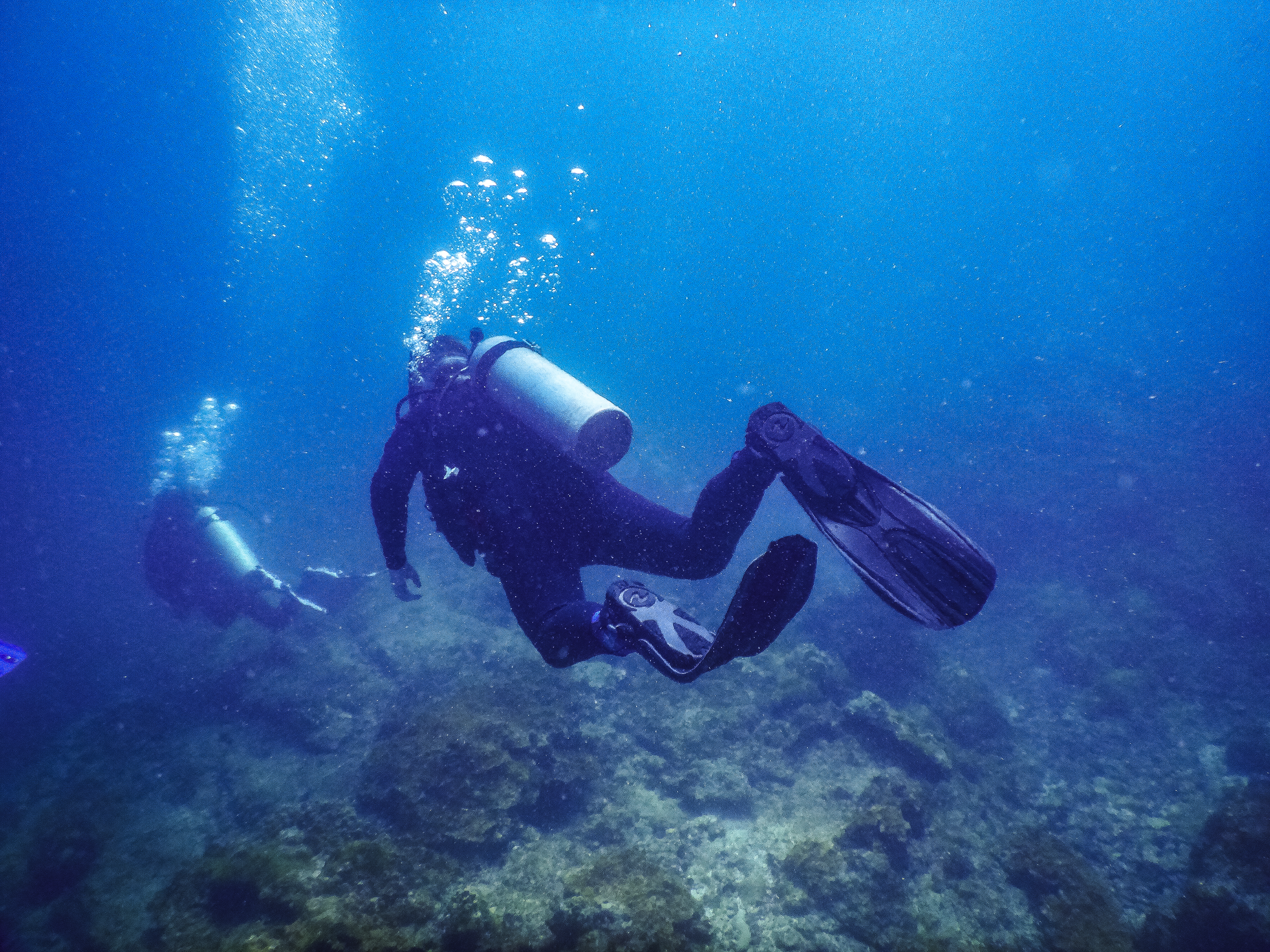
Full disclosure: the dives are such a blur in my memory, and the photos so mingled, that I am not 100% sure these are all from the second day of diving. Just go with it – and if it feels a little mixed up, well, that was the experience. I was really just trying to not die, okay? But I do know that the above selfie was from the second day of diving, taken while I clung to the anchor line and waited for Steve to fix a mask issue and descend to meet me. Also full disclosure: I did not mean to take this selfie; it was an accident.
I think it was the second day that I figured out I could hook my camera’s wrist strap to my BCD buckle. Game. Changed.
Dive buddy!
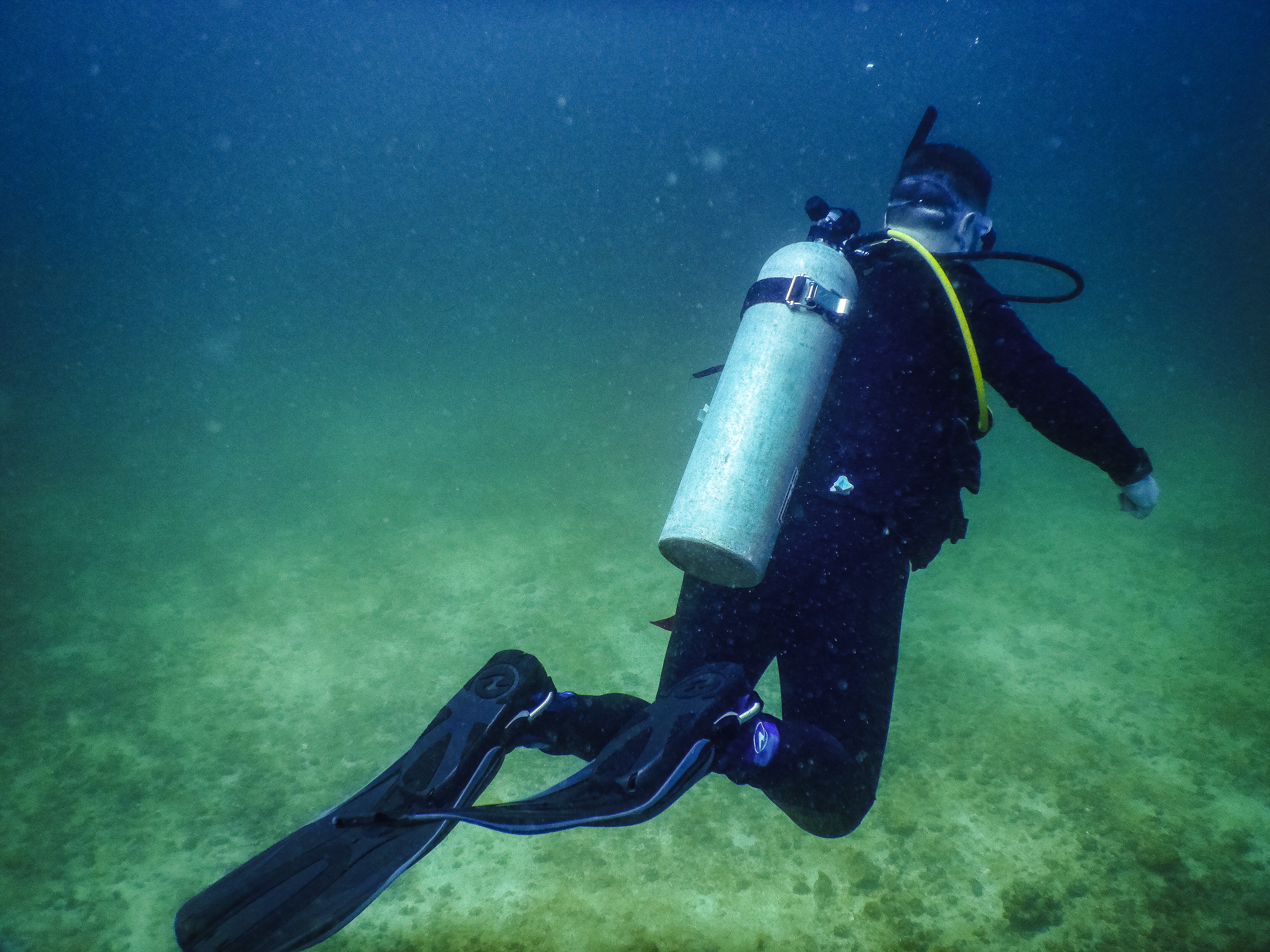
So much fun exploring below the waves with this guy. I can’t wait for our next dive adventure – more about that soon.
Also can’t say enough about what a wonderful divemaster and guide Quique was. I know I already waxed lyrical about his bubble-blowing and wildlife-spotting skills, and how safe we felt in the water with him. The only downside is that he set such a high bar that we’ll be measuring every future divemaster against him.
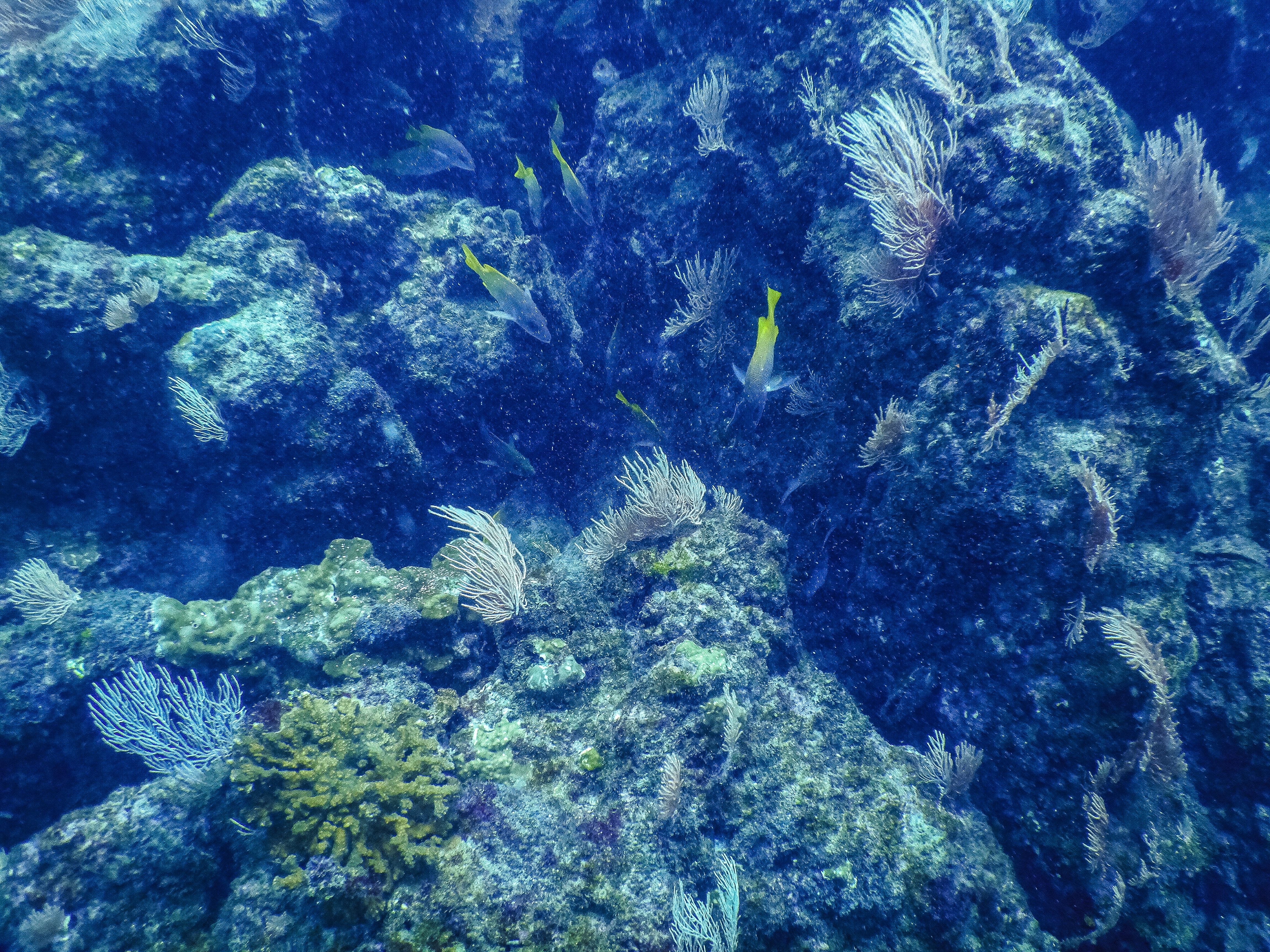
(That’s Quique’s fin in the upper left corner. See what I meant about his perfect buoyancy? No one else could get that close to the coral and never touch it. Amazing.)
While we were diving, all I could hear was the sound of my own breath – a long breath in, followed by a very bubbly exhale. But when we surfaced between the two dives of the day, Garry asked: “Did you hear all that noise?” Donna and I shook our heads and looked confused, but Steve said he had heard it – something like a shrill squeaking call? Quique and the boat captain told us that there were false killer whales in the area (!!!!!) and we’d been hearing them – sometimes faint, sometimes much louder/closer. Except that Donna and I hadn’t heard them at all. We got echolocated, and we didn’t even know it.
To be fair, I was a little distracted by something else that happened on the second day.
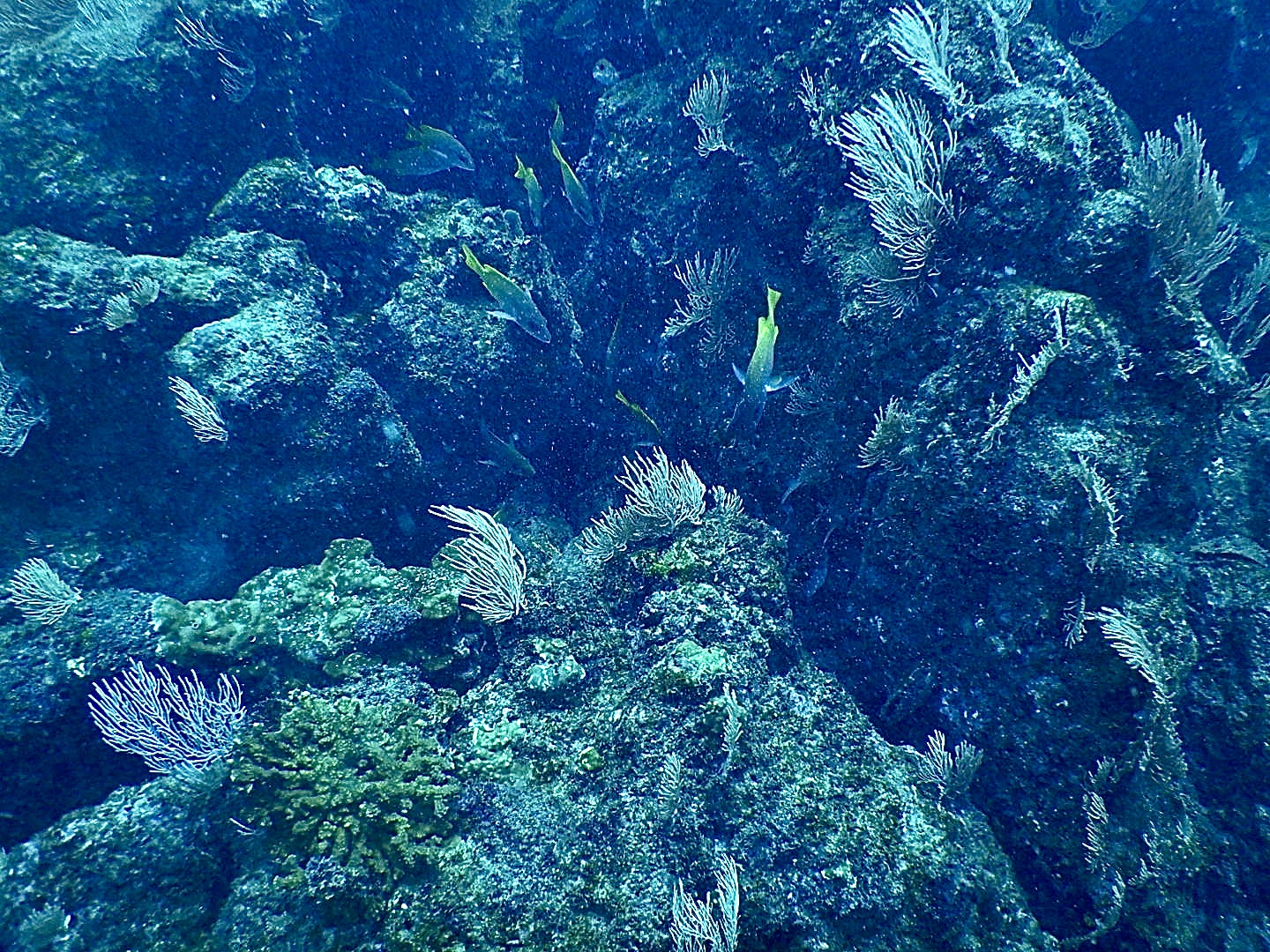
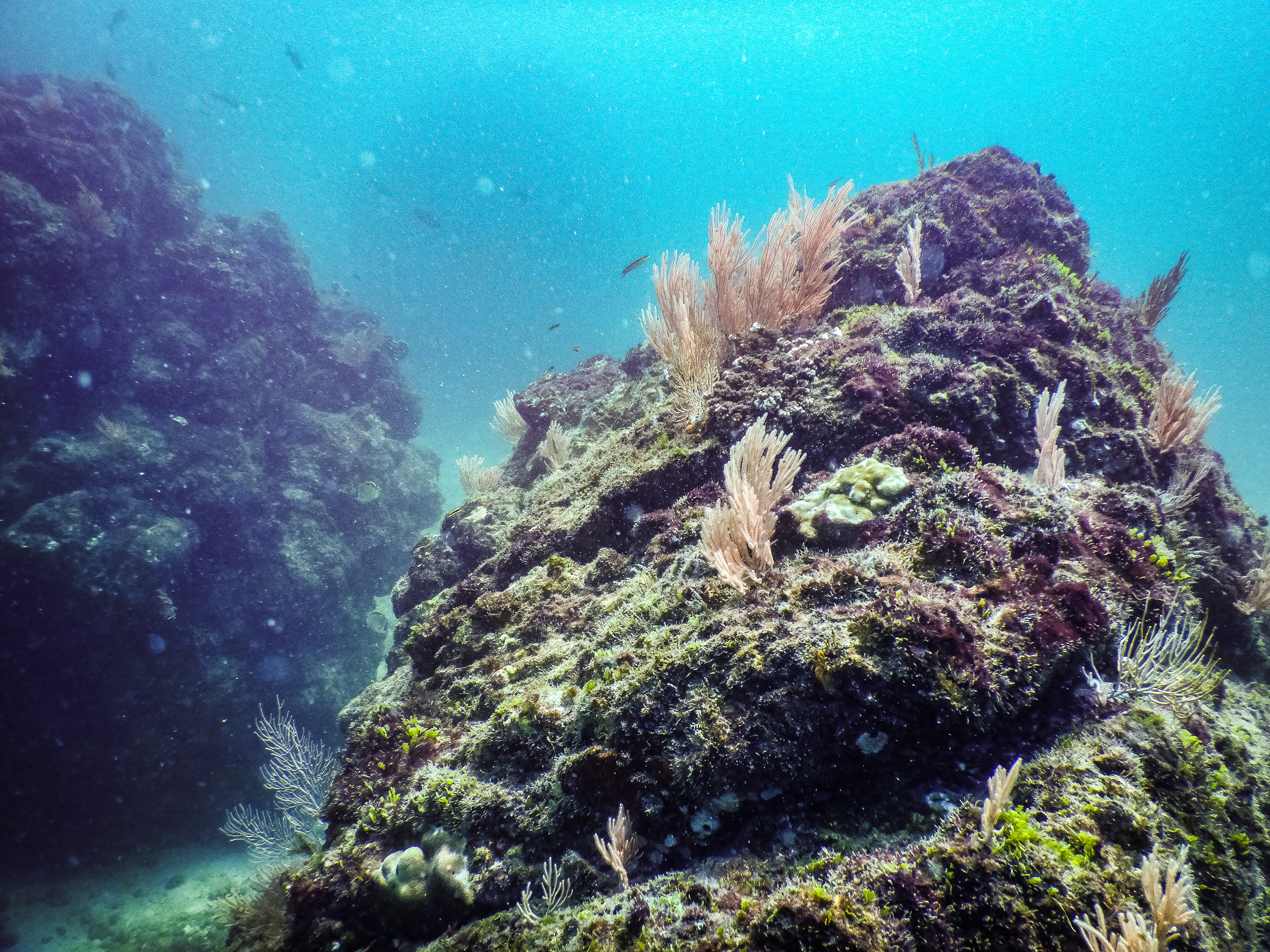
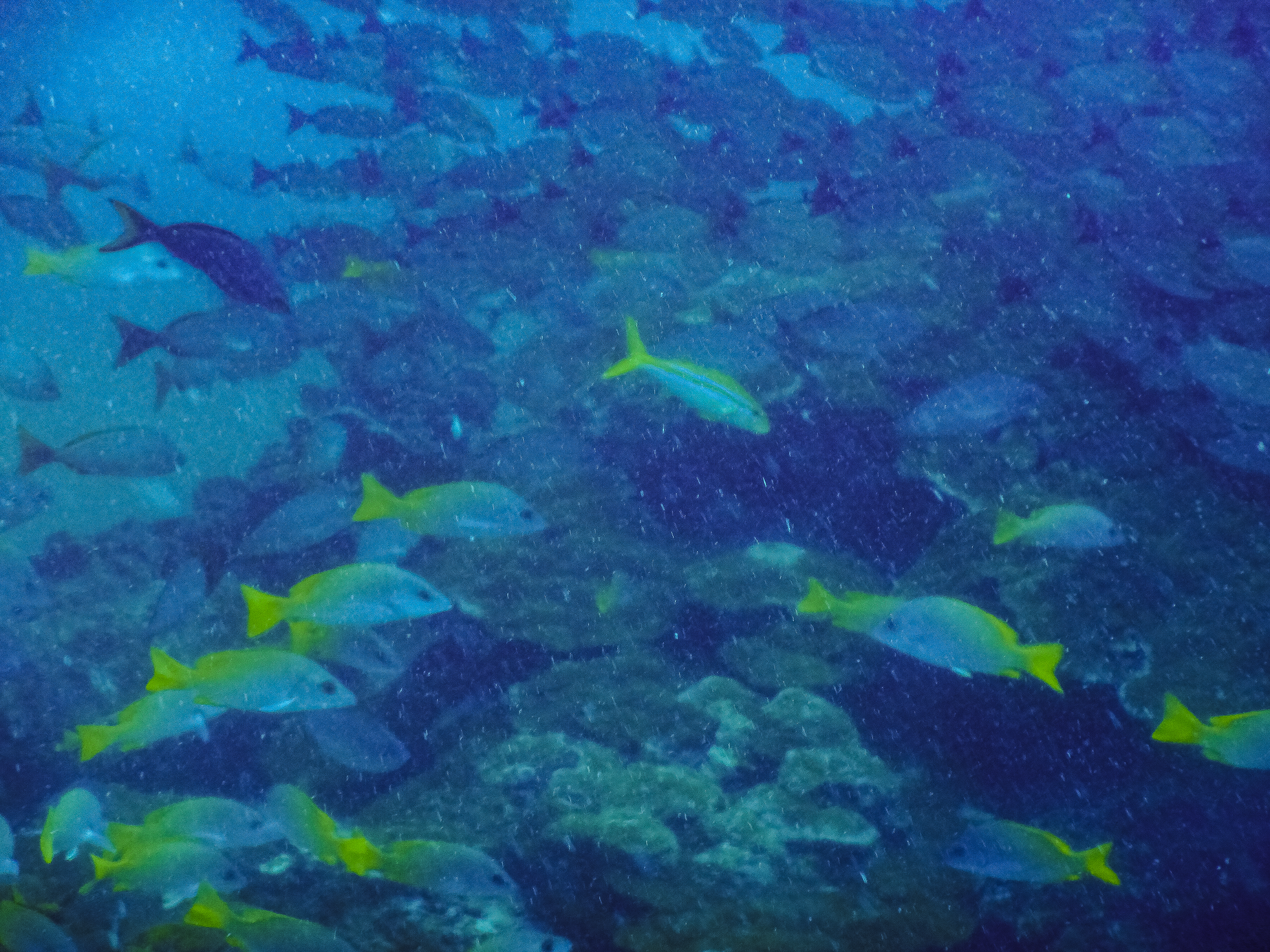
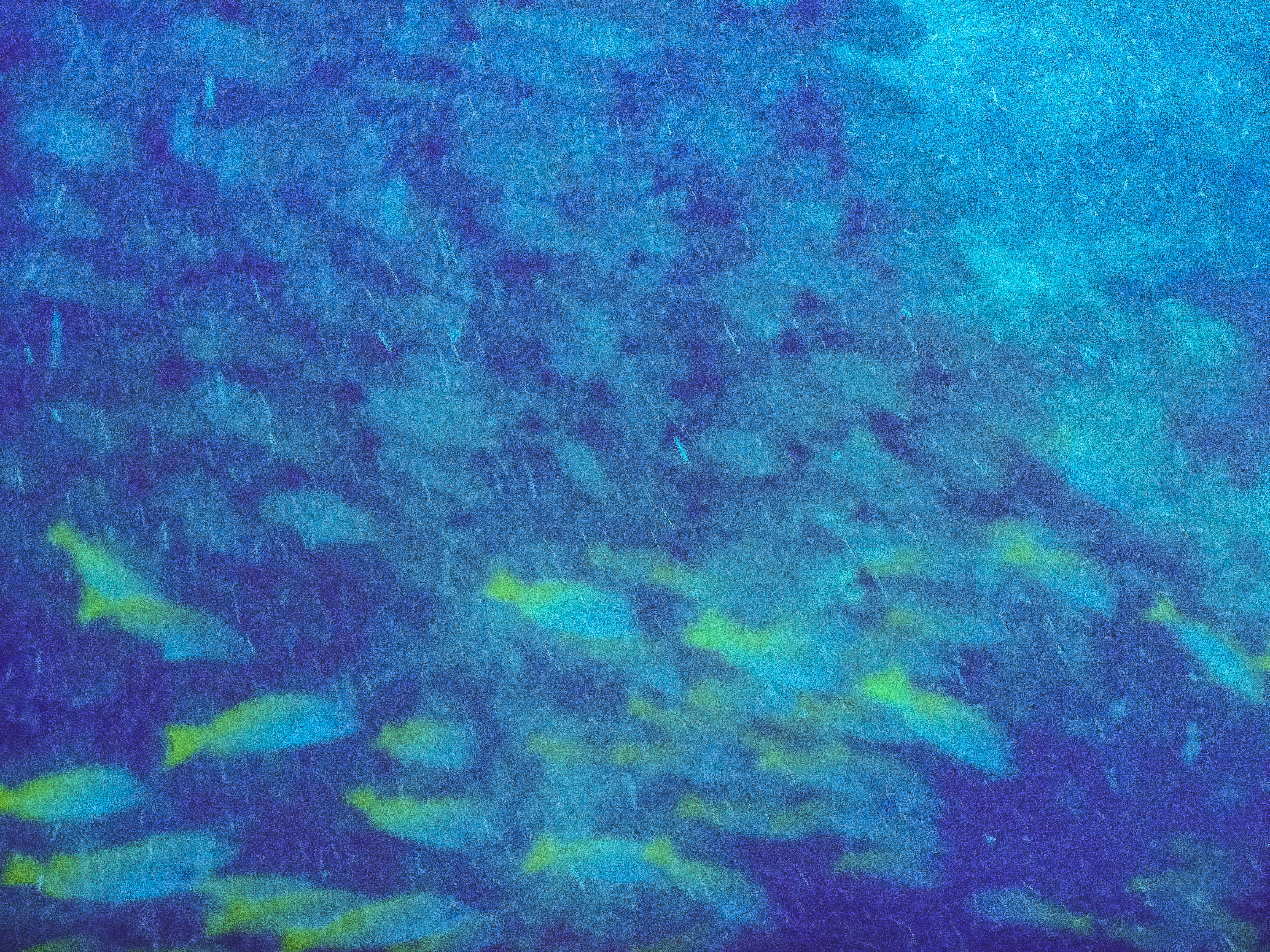
Quique had us swimming around a couple of tall, coral-encrusted rock formations and through a narrow-ish “swim-through” formation, when suddenly we were surrounded by a school of hundreds – maybe thousands – of fish.
Being surrounded by fish was exactly what I was worried about – that was what had made me panic when snorkeling. But my neoprene theory held true, and I surprised myself, again, by being totally at peace. I just floated in place, looked at the fish – and even took pictures.
Most of the fish didn’t get close to us. As Donna said, they were thinking “Let’s just get away from these sea lions – or dolphins – or whatever these large mammals are that look like they might eat us.” But knowing that they were not interested in getting up in my grill doesn’t mean believing it in the moment – so I was really pleased and proud of myself that being surrounded by fish didn’t bother me. (Thank you, neoprene!)
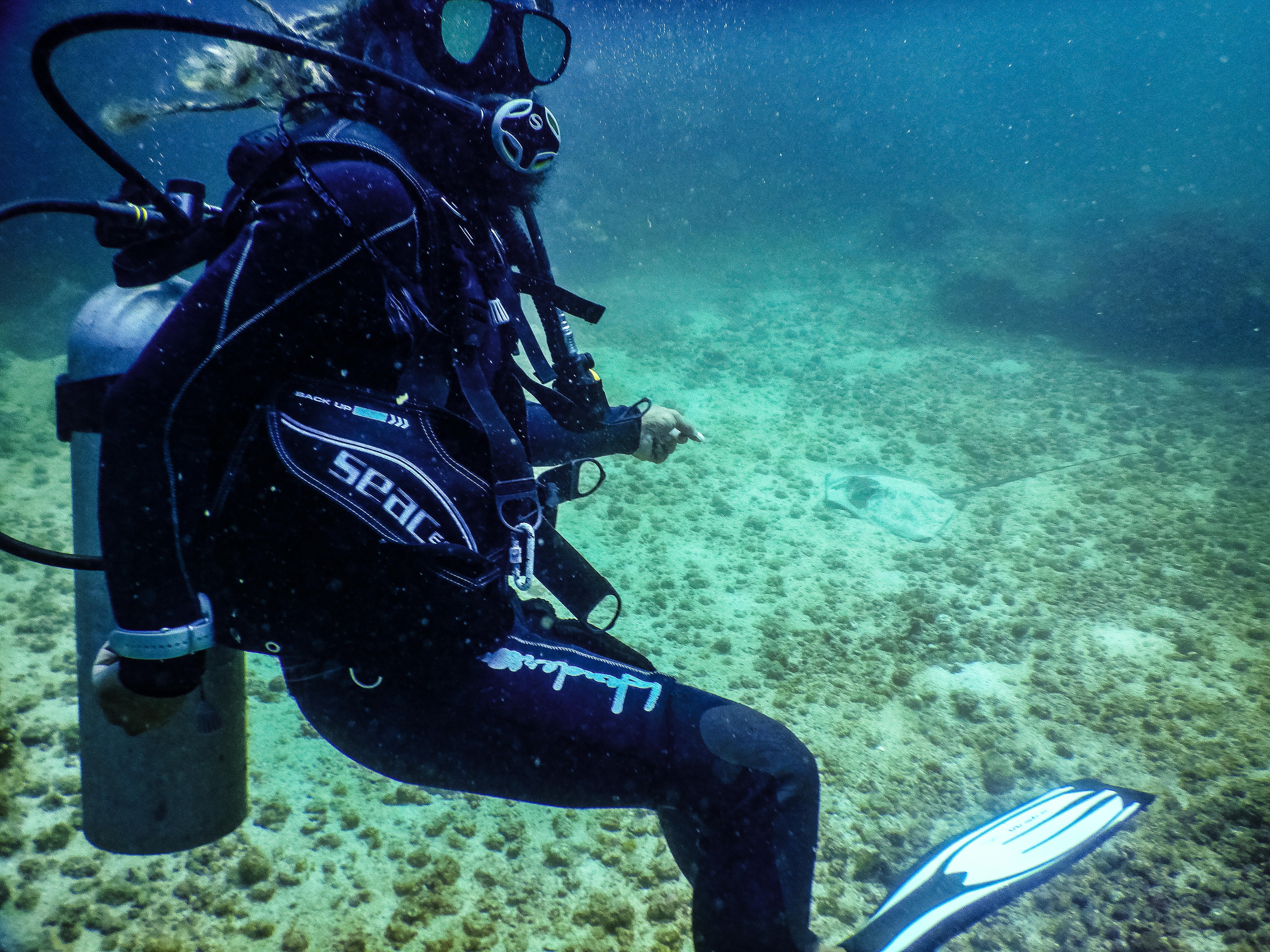
Steve and I demonstrated a few more skills for Quique (while Garry and Donna followed his direction to “swim around that rock and then come back”) and before I was ready to say goodbye to the underwater world, we were ascending, making our safety stop, and breaking the surface of the dive site. Back at the dock, Quique told us that we were naturals and had passed our skills with flying colors, and that we were now certified to dive as deep as eighteen meters – the deepest we’d gone in the two days. We sat with Garry and Donna late into the night (even knowing we all had an extra-early wake-up call the next morning) going over every moment of the four dives. The false killer whales that had echolocated us without Donna or me noticing a thing. The stingray’s threat display from the first day. The school of fish that surrounded us. The narrow swim-through. The reef sharks that we saw both days (I got video!) and all the sea turtles. Donna marveled that we had seen every animal I said I wanted to see, and made me promise to bring my magic wildlife summoning powers to Corcovado National Park the next day.
I was the one who wanted to get scuba certified, but I surprised myself by loving it as much as I did. Steve and I agreed – we couldn’t wait for our next dive adventure, although we didn’t know when or where that would be. (We had the added complication of needing to arrange childcare in order to go diving – something Garry and Donna gleefully were not contending with themselves.) We know where our next dives are coming from now, so keep watching this space for more salty content in the next few months – but first, we may have been saying goodbye to the underwater world but there was a lot more of Costa Rica to explore!




























 covered in flour