
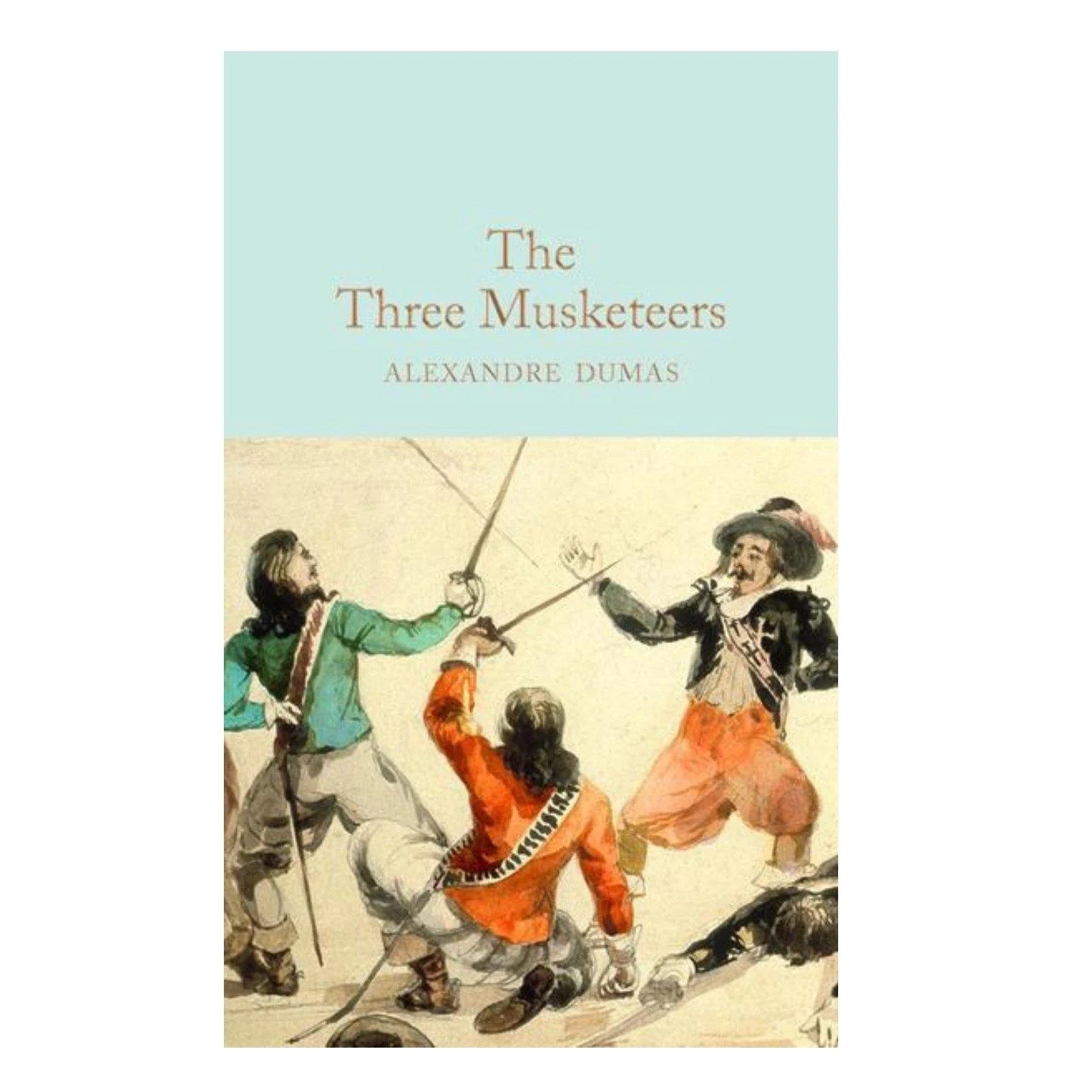
Victor Hugo is best known for two novels: the ponderous and earnest Les Miserables (which I read when I was an earnest high schooler) and the swashbuckling, silly The Three Musketeers. I’d missed this one up until now, and am glad to have finally made the time to read it.
The Three Musketeers follows the adventures of a young member of the King’s Guards, d’Artagnan, and his friends Athos, Porthos and Aramis – members of the King’s Musketeers. When the novel opens, d’Artagnan is making his way to Paris on a bright yellow horse, carrying a letter of introduction to the commander of the Musketeers, who hails from the same part of France. D’Artagnan is a fiery-tempered, quick-to-anger (but not exactly quick-witted) young man, and he immediately finds himself in a fight when a mysterious man insults the color of his buttercup-yellow horse. This is something of a theme with d’Artagnan – he duels first and asks questions later. In the fight, he loses his letter of introduction – but no worry, he proceeds to Paris anyway and gets the attention and patronage of the leader of the Musketeers, then promptly insults the three Musketeers and gets himself challenged to three duels in three hours. Whoops!
It’s no spoiler to tell you that d’Artagnan survives these first encounters with the Musketeers – since it happens right at the beginning of the very long book, he’d have to – unless this was a ghost story, which it isn’t. More than survives, he winds up their particular friend, and spends the rest of the book having swashbuckling adventures and engaging in romance and court intrigue with them. D’Artagnan falls in love with his landlord’s wife – a seamstress at the Louvre, who has the confidence of Anne d’Autriche, the Queen, and her lover the Duke of Buckingham. D’Artagnan’s lady love is kidnapped several times, at the machinations of Milady de Winter, a femme fatale and ally of the treacherous Cardinal Richelieu – but no fear, the Three Musketeers stand ready and willing to help their friend rescue his paramour. And to get falling-down drunk along the way, as much as humanly possible.
“Are you wounded?” he asked.
“Me? Not in the least. I’m dead drunk, that’s all, and never has a man done better at it. Good God, mine host, I must have drunk at least a hundred and fifty bottles on my own!”
“Mercy!” cried the host. “If the valet drank only half what the master did, I’m ruined.”
“Grimaud is a well-born lackey, who would never allow himself the same fare as I. He drank only from the kegs. Wait, I think he forgot to turn off the spigot. You hear? It’s running.”
D’Artagnan let out a burst of laughter that turned the host’s shivering into a hot fever.
At the same time, Grimaud appeared in turn behind the master, the musketoon on his shoulders, his head wagging, like the drunken satrys in Rubens’s paintings. He was soaked front and back in a thick liquid that the host recognized as his best olive oil.
The Three Musketeers is a fun, silly, page-turner of a book. D’Artagnan is always getting himself into and out of duels and love affairs, and the Musketeers are always getting themselves into and out of barrels of wine. (One of my favorite scenes takes place when d’Artagnan, the Musketeers, and their servants engage in a picnic on a battlefield, holding off English soldiers and stealing the weapons of hordes of the Cardinal’s men – while drinking a whole lot and having a generally noisy and raucous time.) But there are also some surprisingly thought-provoking moments among the carousing.
The center of the narrative revolves around the love affair between Anne d’Autriche and the Duke of Buckingham, and the machinations of Cardinal Richelieu. The Three Musketeers, and especially d’Artagnan, are really just pawns in these luminaries’ high-stakes games. But they risk death – and become killers themselves – for a queen and her lover and a Cardinal’s political gamesmanship. Which, when you cut through the swashbuckling silliness and the barrels upon barrels of French wine – is deeply distressing and wrong. So wrong that event d’Artagnan, leaving a would-be assassin with a sword through his chest as he makes his way to London to warn the Duke of Buckingham about Cardinal Richelieu’s latest plot, reflects on the unfairness of it all.
Then, casting a last glance at the handsome young man, who was barely twenty-five years old and whom he left lying there, insensible and perhaps dead, he heaved a sigh over the strange destiny that leads men to destroy each other for the interests of people who are strangers to them and who often do not even know that they exist.
The Three Musketeers and d’Artagnan are soldiers, trained to follow orders without questioning them, but even they stop to think – but why? Why am I expected to lay down my life for these people who don’t even know I’m alive? Not for a concept, like the freedom to be oneself and live without fear of persecution. Not for the protection of innocent lives. But for a Queen and her lover, or for a political puppetmaster’s power-grabbing games. And the injustice of that – that’s Hugo’s message.
That and also this: wine is delicieux.
Have you read The Three Musketeers? What did you think?
 covered in flour