
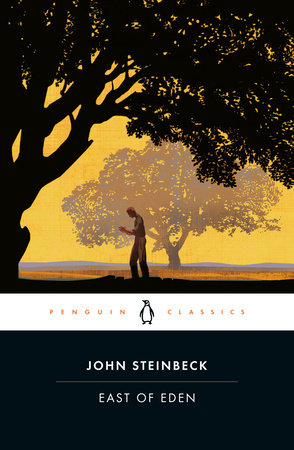
A review I read on Goodreads of John Steinbeck’s classic East of Eden assured the reader that they need look no farther: this is the Great American Novel. No doubt. Well – I don’t know if we can proclaim that status completely unequivocally, but it’s certainly a fair statement, arguably true and definitely defensible.
I’ve been a fan of Steinbeck’s work for a long time – I have read and loved both The Grapes of Wrath and Cannery Row multiple times, among his other novels and novellas – but somehow never made it to East of Eden. This is a multi-generational saga about two families that are doomed to repeat the Cain and Abel story in every generation. It’s gorgeous, epic, bruising, and true.
“It’ll be – who knows? maybe in our lifetime,” they said.
And people found happiness in the future according to their present lack. Thus a man might bring his family down from a hill ranch in a drag – a big box nailed on oaken runners which pulled bumping down the broken hills. In the straw of the box, his wife would brace the children against the tooth-shattering, tongue-biting crash of the runners against stone and ground. And the father would set his heels and think, When the roads come in – then will be the time. Why, we’ll sit high and happy in a surrey and get clear into King City in three hours – and what more in the world could you want than that?
What in the world, indeed.
The main plot focuses on Adam Trask. Adam grows up on the East Coast, but after a terrifying fight with his brother Charles and a stint in the Army, he marries a mysterious woman named Cathy and brings his bride to California. Cathy – now pregnant – schemes to get back East; she’s more than capable of getting her way and has no qualms about drawing blood and ruining lives, literally. When she gives birth to twin sons she immediately leaves Adam (and leaves him with a remembrance of her that I won’t spoil here, in case you want to read the book) and runs away to a house of women pursuing… the oldest profession. Adam pines for Cathy (who has renamed herself Kate and is giving way to all of her vilest, most murderous plans) but after a year of this pointless grieving, a local friend stages an intervention and forces Adam back to reality.

Adam chooses the names Caleb and Aaron – soon shortened to Cal and Aron – for his sons (rejecting his neighbor, Samuel’s, suggestion that he name them after Biblical brothers Cain and Abel). The generations of brothers with names beginning with C and A is maybe the one area where Steinbeck gets a bit heavy-handed. He makes it abundantly clear that his narrative is the Cain and Abel story repeated over and over (in slightly different ways) – but perhaps to the point where the reader gets a bit exasperated. We get it, we get it.
“Two stories have haunted us and followed us from our beginning,” Samuel said. “We carry them like invisible tails – the story of original sin and the story of Cain and Abel. And I don’t understand either of them. I don’t understand them at all but I feel them. Liza gets angry with me. She says I should not try to understand them. She says why should we try to explain a verity. Maybe she’s right – maybe she’s right. Lee, Liza says you’re a Presbyterian – do you understand the Garden of Eden and Cain and Abel?”
“She thought I should be something, and I went to Sunday School long ago in San Francisco. People like you to be something, preferably what they are.”
Adam said, “He asked you if you understood.”
Steinbeck’s point, of course, is that none of us really understand Cain and Abel. Some may think they do, but they don’t. (I am only vaguely familiar with the Old Testament, so I definitely don’t – other than a passing knowledge that Cain and Abel were two of Adam and Eve’s sons and Cain killed Abel.) But in any event, it’s here that the story really picks up: with the entry of Cal and Aron. While Adam is consumed with mourning the end of his relationship with Cathy, the boys remain vague shadows. After Samuel and family servant Lee stage their intervention, Adam begins to take an interest in his sons – and the reader gets to know them for the first time.
Maybe the difference between the two boys can be described in this way. If Aron should come upon an anthill in a little clearing in the brush, he would lie on his stomach and watch the complications of ant life – he would see some of them bringing food in the ant roads and others carrying the white eggs. He would see how two members of the hill on meeting put their antennas together and talked. For hours he would lie absorbed in the economy of the ground.
If, on the other hand, Cal came upon the same anthill, he would kick it to pieces and watch while the frantic ants took care of their disaster. Aron was content to be a part of his world, but Cal must change it.
Adam’s business does well and the boys grow up with every advantage that money can buy. And as they do, these differences become apparent. Aron is blonde, cherubic, adored by everyone around him. Cal is dark-haired, brooding, viewed with distrust and even dislike, while his father is respected and Aron is loved. It’s only too easy for Cal to feel the injustice of this and to grow up resentful.
This is where the story gets really interesting, and where Steinbeck turns the Cain and Abel story on its head. The reader starts out feeling an affinity for sweet Aron. You see shades of Adam’s violent brother Charles in Cal, and you dislike Cal for it. But when Adam makes the decision to leave his ranch and move his family – the boys and Lee, who has transcended the status of servant and is basically a member of the family at this point – to Salinas (where the reader knows Cathy is still living – a decision you know can’t possibly end well) you gradually start to feel more compassion for Cal. He desperately wants his father’s approval; he adores his brother; he is torn apart by grief at having been labeled as the bad one. Everything Cal does goes wrong in some way – even when he goes successfully into business for himself as a young man with the goal of presenting Adam with his earnings, Adam angrily rejects the money Cal has honestly earned, crushing Cal’s spirit. (That part broke my heart. I just wanted to hug Cal.)
I won’t tell you what happens between Cal and Aron, because you should definitely read it for yourself if you haven’t already. But if you have read it – or when you do – you’ll understand what I mean when I say that it’s all much more complicated than the Bible tale. And this is the genius of East of Eden – you begin the book thinking, “Of course, Aron is the good brother and Cal is the bad brother, and Cal is going to do something terrible to Aron.” But as you gradually begin to love Cal and cool on Aron, even knowing they’re going to repeat this Biblical story somehow, you start to ask so many questions. Who in my life am I labeling, wrongly? What has that done to them? Who has labeled me, and how did that change my behavior? Why was I originally drawn to Aron, why did I prefer him? When did that change? What would change in this story if the characters were more clear-eyed about both Cal and Aron? Where should I try to be more clear-eyed in my own life? They’re not comforting questions.
Adam sighed deeply. “It’s not a comforting story, is it?”
Lee poured a tumbler full of dark liquor from his round stone bottle and sipped it and opened his mouth to get the double taste on the back of his tongue. “No story has power, nor will it last, unless we feel in ourselves that it is true and true of us. What a great burden of guilt men have!”
This is certainly a story with truth and power. (To press home the point, Steinbeck even has himself appear as a minor character in the narrative. That might be the book’s only weakness: Steinbeck definitely doesn’t let you forget that this is the story of Cain and Abel, and that it’s one of humanity’s great truths. If you forget it’s a Cain and Abel tale, the characters will drink whiskey and discuss Cain and Abel. If you forget it’s true, the characters will go visit Olive Steinbeck so that young John can answer the door and remind you.) But it does what great literature – and maybe the Great American Novel – does; it pulls you into the narrative, makes you love and grieve for the characters, and gives you questions to ask about your own life. I adored it, couldn’t stop turning the pages, cried for Cal, and wished I’d read it a long time ago.
What is your favorite John Steinbeck novel?
 covered in flour