
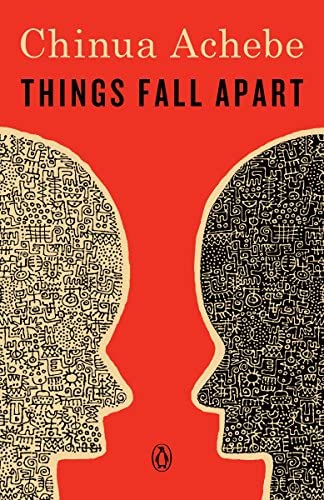
It’s amazing to think that Things Fall Apart is a debut novel – because it’s perfect. Perfectly formed and crafted, perfectly compact – just perfect.
When the novel opens, Okonkwo is a young man in Umuofia, a region in southeastern Nigeria. Already gaining prominence as a local wrestling champion, Okonkwo is determined to forge his own legacy and shake off the shame he feels at being the son of a ne’er-do-well father. The novel’s first section showcases Okonkwo’s determined progress from nobody to rich farmer and respected village leader. He’s a complicated character – engaging and interesting, but also brutal and misogynistic at times. (That made for an interesting dilemma to ponder while reading: Okonkwo is not an especially likeable character, but how much of my response to his behavior was directly tied to my 2020s western worldview? I try to approach each book as a learning experience and to question why I respond to certain characters in certain ways.)
As Okonkwo grows to manhood, he piles success on top of success. The reader watches as he clears hurdles, navigates setbacks – like crop losses – and comes back stronger than ever. It seems there is no challenge to which Okonkwo is not equal.
Enter white missionaries. By the end of the first section of the book, there are whisperings that white settlers have started to inflitrate the land. Okonkwo is unconcerned – at first.
But stories were already gaining ground that the white man had not only brought a religion but also a government. It was said that they had built a place of judgment in Umuofia to protect the followers of their religion. It was even said that they had hanged one man who killed a missionary.
Although such stories were now often told they looked like fairy-tales in Mbanta and did not as yet affect the relationship between the new church and the clan. There was no question of killing a missionary here, for Mr. Kiaga, despite his madness, was quite harmless. As for his converts, no one could kill them without having to flee from the clan, for in spite of their worthlessness they still belonged to the clan. And so nobody gave serious thought to the stories about the white man’s government or the consequences of killing the Christians. If they became more troublesome than they already were they would simply be driven out of the clan.
Eventually, white missionaries arrive in Okonkwo’s village and build a church. Soon, the village is divided between those who – like Okonkwo – value and continue to follow the old traditions, and those who are interested in the newly introduced Christian religion and want to see what it’s all about. Tensions rise as the village becomes more and more fractured, and when a local funeral leads to a tragic accident, Okonkwo and his family are exiled for seven years to Mbanta, his mother’s village. At first deeply depressed at the idea of leaving behind the village and all he has built there – because his farm and all his crops will be claimed by other villagers the second he departs – Okonkwo finds companionship and validation among his extended family in Mbanta. Soon he is prosperous again and is able to influence his family members to resist the colonizing newcomers and cherish their Igbo traditions, as his uncle reflects in a speech honoring Okonkwo at a family feast.
“If I say that we did not expect such a big feast I will be suggesting that we did not know how openhanded our son, Okwonko, is. We all know him, and we expected a big feast. But it turned out to be even bigger than we expected. Thank you. May all you took out return again tenfold. It is good in these days when the younger generation consider themselves wiser than their sires to see a man doing things in the grand, old way. A man who calls his kinsmen to a feast does not do so to save them from starving. They all have food in their own homes. When we gather together in the moonlit village ground it is not because of the moon. Every man can see it in his own compound. We come together because it is good for kinsmen to do so. You may ask why I am saying all this. I say it because I fear from the younger generation. for you people.” He waved his arm where most of the young men sat. “As for me, I have only a short while to live, and so have Uchendu and Unachukwu and Emefo. But I fear for you young people because you do not understand how strong is the bond of kinship. You do not know what it is to speak with one voice. And what is the result? An abominable religion has settled among you. A man can now leave his father and his brothers. He can curse the gods of his fathers and his ancestors, like a hunter’s dog that suddenly goes mad and turns on his master. I fear for you, I fear for the clan.” He turned again to Okonkwo and said, “Thank you for calling us together.”
After his seven years of exile are over, Okonkwo returns to his village to find it changed beyond recognition. The white missionaries have invaded every aspect of village life and only a few villagers seem to still hold true to their traditions. When a Christian convert unmasks a village elder during a religious ceremony – a deeply evil act – Okonkwo and a few other villagers reach the limit of their endurance and call for war against the colonizers. I won’t share more of the plot, because you really should seek this book out to read for yourself – but I will say, as anyone who has read anything about the history of colonization in Africa can guess – things don’t go well for Okonkwo.
“Does the white man understand our custom about land?
“How can he when he does not even speak our tongue? But he says that our customs are bad, and our own brothers who have taken up his religion also say that our customs are bad. How do you think we can fight when our own brothers have turned against us? The white man is very clever. He came quietly and peaceably with his religion. We were amused at his foolishness and allowed him to stay. Now he has won our brothers, and our clan can no longer act like one. He has put a knife on the things that held us together and we have fallen apart.”
I’ve had Things Fall Apart on my to-be-read list for ages, and I’m so glad I finally got to it. It was a slim volume and a fast read – I think I read it in one or two sittings – but packed full of beautiful writing and difficult concepts to consider. As we in western countries engage more and more with our own legacy of colonialism and erasure, this should be required reading. I’m sure I will revisit it, since there was so much to turn over and consider here; this is a book that will reward multiple re-readings for years to come.
Have you read any Chinua Achebe?
 covered in flour