
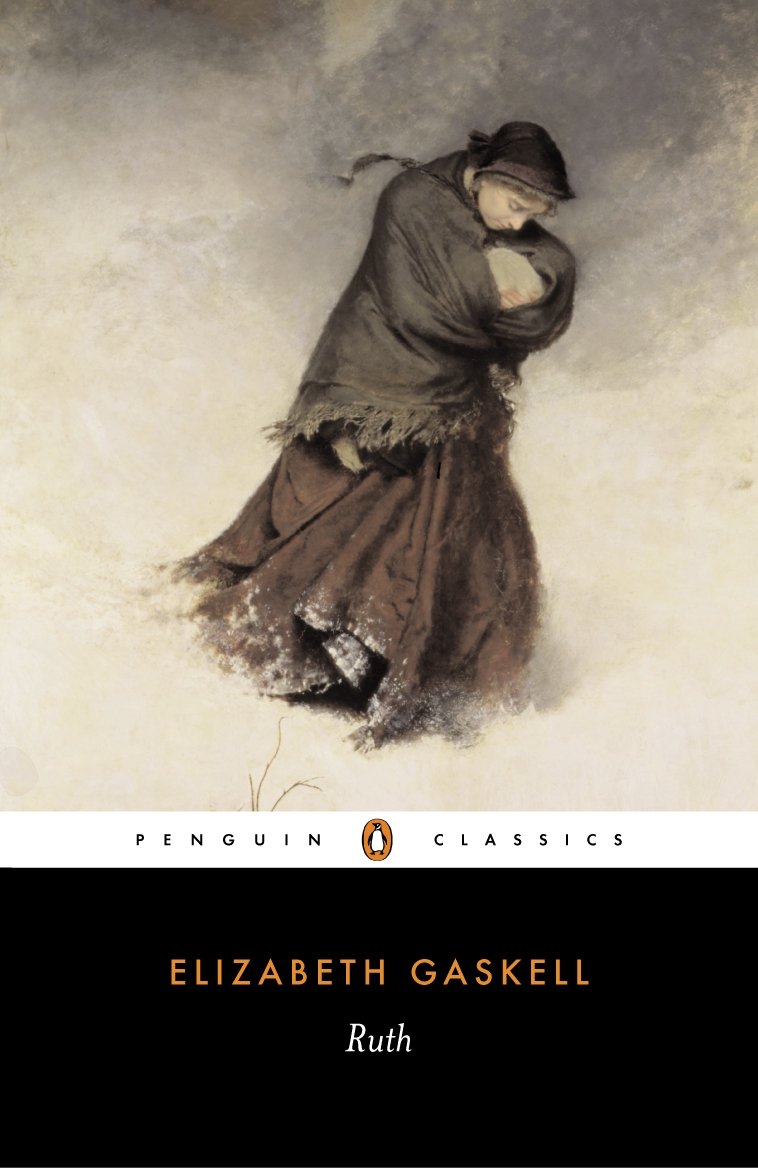
Two warnings! Spoiler alert, because it’s impossible to talk about Ruth without divulging important plot points. And also, I am going to get political.
Elizabeth Gaskell was well known as a writer with a social conscience, if a bit of a heavy-handed one – this is the author of North and South (or as I like to call it, Pride and Prejudice and Union Organizing) after all. In Ruth, one of her less well-known novels, she takes on the theme of the “fallen woman” and the unfair, unjust, inhumane fate faced by women and girls who were “led astray” in Victorian times.
When the reader first meets Ruth Hilton, she is a young seamstress – an orphan, around fifteen or sixteen years old, whose absentee guardian has apprenticed her to a dressmaker and punched out. In the dressmaker’s studio, Ruth rooms with an older girl, Jenny, who is a warm presence and a steadying influence. At the opening of the novel, the apprentices are working around the clock to finish outfitting the upper middle-class women of their faded industrial town for a local ball. Gaskell is clear that the ball (like the town) is nothing to write home about, but to Mrs Mason’s young apprentices, it’s the marquee event of the season. Mrs Mason, a greedy and looks-obsessed woman, chooses the four best-looking (although she says she is picking the “most diligent”) of her young apprentices to work as on-call seamstresses fixing small tears and pulls for her customers during the ball. It is there, in the seamstresses’ anteroom, that Ruth first encounters Henry Bellingham.
Mr Bellingham is a rich, irresponsible, and selfish young man. He notices Ruth immediately – her beauty is of a particularly striking kind – and makes it a point to get acquainted. One Sunday evening, out for a walk to visit Ruth’s old home after church, Ruth and Mr Bellingham are delayed and Ruth is caught by Mrs Mason, who immediately assumes that Ruth has been acting wantonly and shaming her establishment. In one fell stroke, Ruth loses her home and her job. Cast out without any money, and disclaimed by her guardian, she has no one to turn to but Mr Bellingham, who convinces her to accompany him first to London and then to Wales. In Wales, Mr Bellingham falls ill and is retrieved by his mother. Ruth is left alone, an outcast, and pregnant.
Most young girls in this position – Ruth is sixteen – would end up either in prison or in prostitution (likely to be followed by prison). Ruth, heartbroken, is determined to end her life – but she is rescued by Mr Benson, a Dissenting minister on vacation in Wales. Mr Benson’s progressive Christian principles will not allow him to leave a fellow creature in distress, and he convinces his sister Faith to join him in his quest to save Ruth. Together the Benson siblings concoct a story about Ruth’s being a young widow and bring her home with them. In time, Ruth welcomes a baby son and carves out a life for herself in the village. She becomes governess to the two youngest daughters of Mr Benson’s wealthiest parishioner and devotes herself to a modest life of Christian piety and her own redemption.
Ruth’s peace is not to last. Mr Bradshaw, her wealthy employer, decides to dabble in politics and put forth a candidate for Parliament – and the candidate ends up being Ruth’s former lover, Mr Bellingham, now going by a different name. Mr Bellingham recognizes Ruth and sets about trying to ensnare her again. But Ruth is different now: a mother, with people who depend on her, and more power and agency in her own life. In a spectacular act of courage – knowing that Mr Bellingham could, with one word, destroy her life and snatch her son from her – Ruth refuses his advances, although he wheels and cajoles.
She did not answer this last speech any more than the first. She saw clearly, that, putting aside all thought as to the character of their former relationship, it had been dissolved by his will – his act and deed; and that, therefore, the power to refuse any further intercourse whatsoever remained with her.
(I love that. It’s such an act of power, to decide that when someone has rejected you once you hold the power to decide not to let them back in your life.)
Ruth stands up to Mr Bellingham, but eventually her past does catch up to her and she is betrayed by a local gossip. She decides to leave, to spare the Bensons and her son the humiliation of associating with her, but in a revolutionary (for Victorian times) argument, Mr Benson convinces her to stay.
‘Nay, Ruth, you must not go. You must not leave us. We cannot do without you. We love you too much.’
‘Love me!’ said she, looking at him wistfully. As she looked, her eyes filled slowly with tears. It was a good sign, and Mr Benson took heart to go on.
‘Yes! Ruth. You know we do. You may have other things to fill up your mind just now, but you know we love you; and nothing can alter our love for you. You ought not to have thought of leaving us. You would not, if you had been quite well.’
‘Do you know what has happened?’ she asked, in a low, hoarse voice.
‘Yes. I know all,’ he answered. ‘It makes no difference to us. Why should it?’
Why should it? Well, this is Victorian England. Being a “fallen woman” or even a young girl who is unfortunate enough to be “led astray” inexorably fates a woman – and any baby she is unlucky enough to bring into the world – to the doom of being cast out from society forever. The blame falls all on the woman (or girl, more often), and none on the man – despite his unequal power and unfair advantages. The stain of illegitimacy is borne entirely by the innocent baby who happened, through no fault of his or her own, to be born out of wedlock (and on the mother, of course). Ruth was seduced by Mr Bellingham when she was sixteen years old, orphaned and without a friend in the world. (It’s clear she would never have tumbled to disaster if her mother was alive, or even if she had an older girl to guide her. Ruth’s warm and wise roommate, Jenny, had fallen ill and been taken home by her mother. As it is, the only person who has shown her any affection in months is Mr Bellingham.) Ruth is a teenager who was guilty of nothing more than being unlucky and a bit of a people pleaser, but she is deemed a “depraved woman” and cast out of society forever while her rich seducer goes on to live a cushy, luxurious life and eventually end up in Parliament. Figures.
Here’s the part where I get political! You have been warned.

Gaskell wrote Ruth to illustrate the spectacular unfairness of society’s laying 100% of the blame on the woman. It doesn’t matter if you are a teenager with your brain still developing and your synapses doing all kinds of weird crap, as we all know teenaged brains do. It doesn’t matter if you’re a poor orphan and you are seduced by a rich man and then left pregnant and alone while he rides off with his mother to eat oysters or do whatever selfish rich Victorians did. It doesn’t matter if you make exactly one mistake in your entire life. It’s not his fault. It’s yours. Ruth has to pay the price for her big mistake: being born a girl.
How barbaric! So glad things are different now. Or are they?
This summer, the Supreme Court ripped away a Constitutional right that women have had for fifty years: the right to control their own bodies and to decide whether or not to subject themselves to pregnancy in a country with embarrassingly high maternal mortality rates. The “forced-birth crowd” (as one of my favorite columnists, Jennifer Rubin of The Washington Post, so aptly calls them) heaped these coals of fire on the heads of a population in spite of majority support for reproductive freedom, thanks to the votes of two Supreme Court Justices who were confirmed to their seats despite being credibly accused of sexual assault. A majority of Senators didn’t think that forcing oneself on a woman was disqualifying. One expects that Mr Bellingham – with his “service” in Parliament – would find himself right at home in the United States Senate of the 2010s and 2020s.
The fact is, we still live in a world where the consequences of a relationship gone wrong are carried unequally – and often exclusively – by women. We still, deeply shockingly, live in a world where teenagers can be raped and then forced to give birth their rapists’ babies, and then called sluts. Or even in a world where teenagers can have lifelong consequences shoved down their throats in penance for the sin of being teenagers. You’d think we would be beyond a world where one mistake (and what teenager has ever made a mistake?) could ruin a life, but thanks to SCOTUS and Dobbs, we’re not.
One of the criticisms of Ruth that I read in Goodreads reviews was that Gaskell made her heroine so darn perfect. Other than her early error in judgment – being seduced by Mr Bellingham – Ruth is almost annoyingly flawless. While Gaskell, via the Bensons, repeatedly reminds the reader that Ruth is not perfect and has faults, she never actually says what those faults are. Ruth is modest, kind, serene, quiet, pious, studious, and devoted to her baby and to Mr Benson’s church. She’s basically a saint. Of course, she had to be, didn’t she? Gaskell was writing for a Victorian audience, making the unusual case that a “fallen woman” should not be made to pay a lifelong price for one mistake, and that it is spectacularly unjust for the woman to bear all of the consequences and the man – who invariably had all the power – to escape unscathed and go on to be a rich M.P. Ruth had to be perfect, or else Gaskell would lose her audience and her argument.
All I could think throughout Ruth was how unfair it was that a woman could live her entire life faithful to the highest principles of society and then have it all snatched from her in an instant. How one teenaged error could ruin her forever. How everything she does since that moment counts for nothing in the eyes of society (as represented by the judgmental Mr Bradshaw). This is Gaskell’s entire point. But it’s not just an interesting look back at a bygone time. We’re still very much living in this moment. And how shocking that so little has actually changed – of the stuff that matters – that a Victorian novel can so perfectly capture the injustice of our present moment in 2022.
It’s infuriating.
Have you read any Elizabeth Gaskell novels? Which one is your favorite? My heart still belongs to Cranford, tbh.
 covered in flour
Pingback: Reading Round-Up: September 2022 – covered in flour