
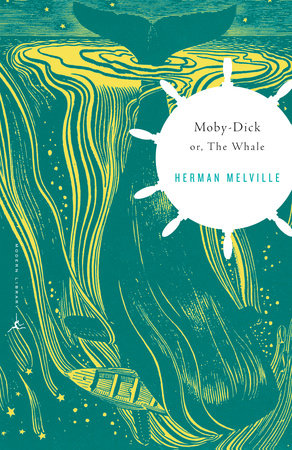
I tell you, the sperm whale will stand no nonsense.
That’s a pretty good thesis statement and summing-up of Moby-Dick, right there. Kind of feel like I don’t need to say much more, right? After all, Moby-Dick is such an entrenched narrative in American literature; it has even transcended classic literature and entered the pop culture lexicon. Rory Gilmore reads Moby-Dick in the very first episode of Gilmore Girls. So does Matilda Wormwood – the movie version, that is. There’s even a car insurance commercial currently airing, featuring Captain Ahab (he peers through a spyglass and shouts Thar she blows! at parking spots).
If you need a plot summary, Moby-Dick features a young sailor named Ishmael. (“Call me Ishmael” might be the most iconic opening line in the American literary landscape.) Ishmael has been sailing with the Merchant Marine, but has recently decided to sign onto a whaling voyage, shipping out of Nantucket. The first part of the novel follows his journey to Nantucket to find a ship to sail with. In an inn catering to whalers, Ishmael is told that there are no sleeping quarters available and he’ll have to bunk – sharing a bed – with a sailor named Queequeg. Ishmael and Queequeg quickly bond and become trusted friends – or maybe something more; throughout the book I wondered if there was something going on between those two. (I am not the only one to pick up on those cues. Google “Ishmael and Queequeg.”)
Queequeg accompanies Ishmael to Nantucket, where Ishmael signs them both on to one of the ships getting ready to depart on a three to five year whaling mission – the Pequod. Right away, there are signs all is not quite right with the Pequod. For one thing, the captain is nowhere to be seen. Two retired whalers, Captain Peleg and Captain Bildad, are preparing the ship for departure and give Ishmael a line of vaguely unsatisfying explanations for Captain Ahab’s absence. Ishmael is uncomfortable with the idea of signing up for a multi-year whaling mission without meeting the Captain who will have ultimate authority over him and over Queequeg. The vague unease grows when Ishmael and Queequeg are confronted by a “prophet” – a local Nantucketer named Elijah, who warns them off the Pequod and Captain Ahab. Ishmael waves off Elijah, but has a harder time pushing down his own doubts. He does, though, and ultimately both Ishmael and Queequeg board the Pequod and set off to hunt sperm whales.

Captain Ahab does eventually show himself, although that’s not the end of the mysteries aboard the Pequod. But one thing, he reveals right away – his real intention for this voyage is to hunt down and kill a white sperm whale that had previously bitten off his leg. To motivate the crew, he nails a gold doubloon on the main-mast, telling the sailors that the coin will go as a prize to the first one of them to spot the white whale.
“Captain Ahab,” said Starbuck, who, with Stubb and Flask, had thus far been eyeing his superior with increasing surprise, but at least seemed struck with a thought which somewhat explained all the wonder. “Captain Ahab, I have heard of Moby Dick–but was it not Moby Dick that took off thy leg?”
“Who told thee that?” cried Ahab; then pausing. “Aye, Starbuck, aye, my hearties all round; it was Moby Dick that dismasted me; Moby Dick that brought me to this dead stump I stand on now. Aye, aye,” he shouted with a terrific, loud, animal sob, like that of a heart-stricken moose; “Aye, aye! it was that accursed white whale that razeed me; made a poor pegging lubber of me for ever and a day!” Then tossing both arms, with measureless imprecations he shouted out: “Aye, aye! and I’ll chase him round Good Hope, and round the Horn, and round the Norway Maelstrom, and round perdition’s flames before I give him up. And this is what ye have shipped for, men! to chase that white whale on both sides of land, and over all sides of earth, till he spouts black blood and rolls fin out. What say ye, men, will yet splice hands on it, now? I think ye do look brave.”
Most of the crew gets on board with Ahab’s modified mission statement right away; the first mate, Starbuck, is really the only holdout, and he spends the rest of the book trying to convince Ahab to give up on this whole Moby-Dick suicide mission and just hunt regular sperm whales. Ahab, though, is described as “monomaniacal” – I believe the official legal term is kookoo bananapants. He’s singularly obsessed with getting revenge on the whale, even though the idea of revenge against an animal is… pretty ridiculous?
Most of the rest of the book is devoted to toggling back and forth between the Pequod‘s “adventures” (consisting of killing whales, which doesn’t seem to me like a good adventure) and delivering a treatise on whales, whaling, the whaling industry, and basically everything you would need to know if you wanted to become a whaler – which, thankfully, is now illegal under the International Whaling Convention (although there are loopholes that should be closed, and bad actors that violate the treaty). This was where Melville lost me. Having made it through hundreds of pages of Tolstoy on farming in both Anna Karenina and War and Peace, I figured Melville on whaling would be no big thing, but – it was simultaneously horrifying and a gigantic yawn. First of all, most of the “facts” about whales were just wrong. And the chapters upon chapters of Everything Ishmael Knows About The Whaling Industry were so boring that I lost interest in the plot (when there was a plot). Even when the book shifted back to the action – and there was always something exciting going on, storms! pirates! whales! – it didn’t hold my attention, because I was so worn down from the Endless Whaling Information Parade. At one point, after five chapters of the dullest typhoon ever, I looked up from my book, yawned, and remarked to Steve: “Wow, Melville can even make a typhoon boring.” Like a Goodreads reviewer I read, I started rooting for the whale to eat everyone, including Ishmael, just so it would end.
Which brings me to: reading Moby-Dick in 2021, we are all rooting for the whale, yes? If Melville hadn’t lost me with boredom, he would have lost me with his gleefully gory descriptions of hunting down and murdering whales. (Yes, I know whaling is part of our history. But thankfully we know better now – Marine Mammal Protection Act, ahoy.) Being a gigantic whale geek myself, I know that the “monsters” and “leviathans” that Ishamel and friends slaughtered were intelligent beings with a culture and a social structure and family bonds. History or no, I can’t enjoy reading about their murder, especially in the kind of detail Melville pours on the reader.
I recognize that this is a modern perspective that is particularly informed by scientific research in the conservation era, which has made clear that industrial whaling hundreds of years ago has directly, and substantially, contributed to the climate crisis we now face. Whales – particularly the big baleen and sperm whales, the same kinds of whales that Ishmael and his mates gleefully slaughter in Moby-Dick – are uniquely good at extracting carbon from the atmosphere, cooling the planet and counteracting climate change. Meaning that if our oceans teemed with whales the way they did before whaling ships rode the waves, we probably wouldn’t be in this mess now:
Humans have killed whales for centuries, their bodies providing us with everything from meat to oil to whalebone. The earliest record of commercial whaling was in 1000 CE. Since then, tens of millions of whales have been killed, and experts believe that populations may have declined from anywhere between 66% and 90%.
When whales die, they sink to the ocean floor – and all the carbon that is stored in their enormous bodies is transferred from surface waters to the deep sea, where it remains for centuries or more.
In the 2010 study, scientists found that before industrial whaling, populations of whales (excluding sperm whales) would have sunk between 190,000 to 1.9 million tonnes of carbon per year to the bottom of the ocean – that’s the equivalent of taking between 40,000 and 410,000 cars off the road each year. But when the carcass is prevented from sinking to the seabed – instead, the whale is killed and processed – that carbon is released into the atmosphere.
Sophie Yeo, “The world’s largest animals are unusually good at taking carbon dioxide out of the atmosphere,” BBC.com, 19 January 2021
It’s not just the carbon extraction from dead whales, either, the article goes on to explain. Whale excrement feeds armies of phytoplankton that mass on the surface of the water and capture 40% of all carbon dioxide, or four times the carbon dioxide captured by the entire Amazon rainforest. And the absence of big whales in their pre-whaling numbers has impacted other areas of the ecosystem, too, the article explains. For instance, orcas that once preyed on large whales have turned their attention to smaller prey, like sea otters, when whales became less abundant. The sea otter populations then declined, leading to an explosion in the sea urchin population (otters’ favorite food), and the resulting devastation of marine kelp forests – another carbon sink lost. Basically, the roles whales played in balancing the ecosystem were as colossal as they are. When the whaling industry decimated their populations, it placed humanity on a path to our current climate crisis.
All this to say: I have absolutely no sympathy for Ahab, Ishmael, Starbuck, Stubb, Queequeg (that’s right, even Starbuck and Queequeg!), or any of the rest of them. Whether or not they were enthusiastic about hunting Moby-Dick – by all reports a killing machine, GO MOBY GO – they signed on willingly to the idea of murdering (other) whales. And reading the (vivid!) descriptions of slaughtering and butchering whales made me ill.
Lest this review become as long as Moby-Dick itself, I’ll cut it off here. I didn’t care for the book – found it in equal parts boring and disgusting – and won’t read it again. That said, there were flashes of something wonderful; the comedic scene in which the second mate, Stubb, cheats another whaling ship out of their cargo – the beautiful and reverent description of a nursery pod of sperm whale mothers and calves – the poignant scene, just before the climactic chapters, between Ahab and the tragic Starbuck. And occasionally there will be a line or a paragraph that just stuns with its beauty. But that wasn’t enough to rescue the book for me; the combination of florid wordiness and reprehensible violence against cetaceans was too much. I’m glad I read it, because now I can say I have, but I don’t ever need to read it again.
Have you read Moby-Dick?
 covered in flour
I’ve never been able to finish Moby Dick. Like you, I found it incredibly boring. Unlike you, I bounced off the book the first time Melville switched from prose to stage play format.
That said, the 1956 movie version, directed by John Houston, written by Houston and Ray Bradbury (!!) — is fantastic. Much like James Whale’s (lol!) version of Frankenstein, the movie cuts out all the flab and leaves you with a thrilling story.
I might have to check the movie out – thanks for the recommendation! I’m a big whale hugger though, so not sure I could handle it. 😉
And yes, WHAT was up with the random stage directions? They popped up a few times. So weird.
Pingback: Reading Round-Up: February, 2021 – covered in flour