
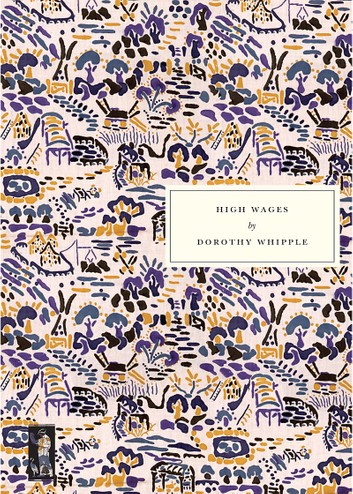
I’ve been slowly working my way through Dorothy Whipple’s bibliography – first Greenbanks, then The Priory, and now High Wages. Whipple is an author who deserves to be better known than she is, although word is spreading thanks to Persephone Books. High Wages, Whipple’s first novel, is a bit different from her later works; the protagonist, Jane Carter, is a single “working girl” with career dreams rather than a middle-class young woman destined for marriage, like Christine of The Priory. When the novel opens, Jane is wandering around the marketplace area of a small town outside Manchester, looking for a “place” that will allow her to escape her stepmother’s house. But for all her prosaic goals, Jane has a poetic streak.
Jane lowered her beauty-dazed eyes to Tidsley market-place. Beneath that canopy, it was transfigured. The peaky roofs of shops and houses stood up darkly in the January air, the windows reflected a green-blue like the shell of a bird’s egg. The lamplighter was going round, and now behind him shone a string of jewels, emeralds pale and effulgent. There was almost no one about. It was a moment. Jane sometimes had these moments. She stood still in them.
Jane quickly finds her “place.” As she walks through the marketplace on that early morning, she spots the proprietor of a garment shop hanging a “help wanted” notice in his window. Jane promptly walks into the shop and talks her way into the job. As a shop assistant, Jane discovers something of a calling – she is good at talking to the customers, even those who are much grander than she is, and she has an eye for pairing fabrics and embellishments that the ladies of Tidsley quickly come to appreciate. But being a shopgirl isn’t all charm and fun. Jane is always hungry; her boss’s wife never provides enough food. And Jane comes face-to-face with her powerlessness when her employer cheats her out of a large commission she earned, which would have made an important difference to her quality-of-life. Reflecting on the unfairness of her position, Jane asks the same questions that Mr. Barton, and the trade unionists, ask in Elizabeth Gaskell’s novels Mary Barton and North and South.
Why did some people – Sylvia Greenwood, for instance – have so much? Parents, money, a grand house, a grand car, grand clothes. It wasn’t fair. Not that she wanted all that. She wanted her due. She wanted that ninepence.
Why did some people have so much? And yet, compared with Lily, she herself must seem almost rich. Was it all like this? Did everyone look with envy at the one above? Funny. And funny, too, that the thought of someone else being worse off than you were yourself should make you feel more cheerful. Jane smiled grimly in the dark.
With this scene, I started noticing a lot of parallels between High Wages and Mary Barton in particular. Both Jane Carter and Mary Barton are dress shop assistants. Both dream of climbing to the middle class (although Mary Barton would prefer to marry her way to grandeur, while Jane Carter is happy to work her way up in trade, like many of the rich businessmen in the town did). Both cast their eyes at a young man from the moneyed set – in Mary’s case, the despicable Harry Carson; in Jane’s, the kind but flawed Noel Yarde. As I was reflecting on all the similarities between Mary Barton and High Wages, I came to this little Easter egg:
‘There’s that Evelyn Wood and Mary Barton going past again. That’s the tenth time, about, this morning. Hope they’ll catch something soon. If you and me walked about the streets like that, Jane, they’d call us a couple of tarts. . .’
I KNEW IT! It felt like a fun little wink from Whipple to her readers.
Mary Barton parallels aside: High Wages follows Jane as she works hard in the shop, befriends her fellow shop assistant – and then has a falling-out with her – suffers an embarrassment at a social event, and walks and reads through the weekends. But life circumstances pile on – after an unwanted advance, and the unfortunate consequences thereof, conspire to drive Jane from her hard-won position. A lucky break comes through just in time; Jane’s kindness to a customer pays off and she earns herself an investor and an opportunity to open her own shop – which she does in the face of her former employer’s insistence that she will fail.
Jane works hard – as the proprietress of her business, she does it all. (This reminded me of a mentor I once had when I was first starting out in my career. He and I visited a client who owned some restaurant franchises, and when we walked into one of the restaurants, the owner was behind the host’s stand. My mentor leaned over and said quietly to me, “This is what you do when you own the business. You do everything.”) And Jane’s hard work pays off; at the end of her first year, her accountant delivers the news that the store has been profitable beyond Jane’s wildest expectations, yielding handsome returns for both herself and her investor. Jane collapses in relief.
But what a grinding year it had been! How she had worked, early and late, doing everything, cleaning windows, polishing fittings, dusting, sweeping, buying and cooking her own food, interviewing travelers, selling in the shop, stock-taking, having sales, sending out bills, sending them out again and again, insisting on payment, dealing hardily with troublesome customers, going to Manchester and again to London to keep up with the times – Phew! What a year! The struggle had matured her; she felt more capable, more confident, but older. She didn’t think that anyone, looking at her now, would say she was too young to manage a shop.

Jane’s success in business continues to build as she works harder than ever, but her luck in love and personal life is less lavish. I won’t spoil the story, which is wonderful – if a touch melodramatic at times – suffice it to say, an ill-advised love affair threatens to destroy everything Jane has built, forcing her to examine what she values most in the life she has built, and whether she is truly prepared to throw away her independence for a man.
I enjoyed High Wages immensely. As I said above, it’s definitely not a “typical” Whipple novel (judging by the two I’ve already read). Whipple’s later works focus more on family dynamics; Jane is unusual in that she is a single “working girl” who places her career above aspirations of marriage. Whipple’s later – more family-oriented – novels recall Austen more than any other influence; High Wages, by contrast, constantly nods to Gaskell. And while I’m not sure any Whipple heroine will replace Christine in my heart, I can see myself cultivating a good solid friendship with Miss Carter, and revisiting High Wages again and again.
Have you read any Dorothy Whipple?
 covered in flour
Great review. I’ve read The Priory which I enjoyed very much, but yet to pick up more of hers.
Thanks! The Priory has been my favorite so far, but I have also really enjoyed Greenbanks and High Wages! I think you really can’t go wrong with Whipple.
I’m looking forward to picking up some more soon.
Let me know what you think when you do! 🙂
Sure 🙂
Pingback: Reading Round-Up: November 2020 – covered in flour