
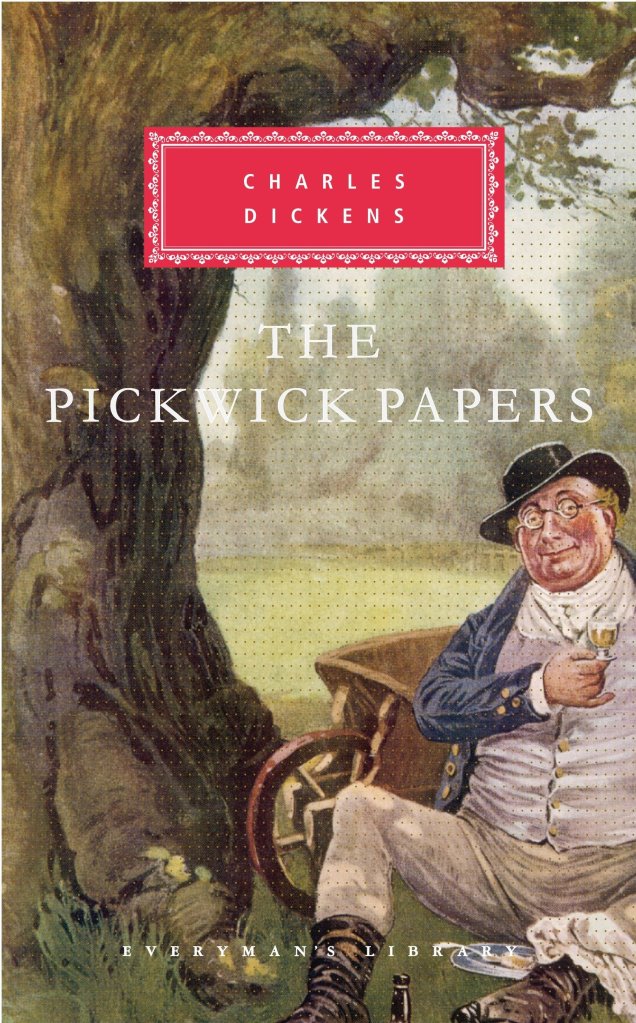
Beginning in 1836, the then-24 year old Charles Dickens, writing under the pseudonym “Boz,” began publishing a series of stories about Victorian gentleman Samuel Pickwick, Esq., and his faithful friends Tracy Tupman, Augustus Snodgrass, and Nathaniel Winkle. Mr. Pickwick is the founder, patron saint, and conscience of “The Pickwick Club,” a gathering of these and other gentlemen that appears to have no specific purpose. At a meeting of the club, Mr. Pickwick proposes that he and his friends travel around the countryside observing life, and report back to the club their observations of the same. The motion is heartily carried, and the four gentlemen set off from London and immediately become embroiled in all sorts of wine-soaked adventures.
“Nothing the matter,” replied Mr. Pickwick. “We–we’re–all right.–I say, Wardle, we’re all right, an’t we?”
“I should think so,” replied the jolly host.–“My dears, here’s my friend, Mr. Jingle–Mr. Pickwick’s friend, Mr. Jingle, come ‘pon–little visit.”
“Is anything the matter with Mr. Snodgrass, sir?” inquired Emily, with great anxiety.
“Nothing the matter, ma’am,” replied the stranger. “Cricket dinner–glorious party–capital songs–old port–claret–good–very good–wine, ma’am–wine.”
“It wasn’t the wine,” murmured Mr. Snodgrass, in a broken voice. “It was the salmon.” (Somehow or other, it never is the wine, in these cases.)
The four quickly become acquainted with a stranger who gets them into all sorts of trouble. The stranger – Mr. Jingle, as it turns out – is a “stroller,” or a traveling performer. He lives by his wits and by outwitting innocent souls with a little too much money for comfort – including Mr. Pickwick and his friends. Within a short space after making their acquaintance, Mr. Jingle accompanies Mr. Tupman (an admirer of the ladies) to a ball, where he proceeds to insult a very easily-offended and heavily armed gentleman. As Mr. Jingle was dressed in a suit borrowed from Mr. Winkle at the time (unbeknownst to Mr. Winkle), Mr. Winkle passes a very unpleasant next morning, having been challenged to a duel for an offense he has no memory of giving. (And indeed, an offense of which he is innocent, having passed the ball upstairs in his room, sleeping off a quantity of wine.) The duel scene is hilarious, and things only get funnier from there – and always seems to lead to lady trouble.
“Is it not a wonderful circumstance,” said Mr. Pickwick, “that we seem destined to enter no man’s house without involving him in some degree of trouble? Does it not, I ask, bespeak the indiscretion, or, worse than that, the blackness of heart–that I should say so!–of my followers, that, beneath whatever roof they locate, they disturb the peace of mind and happiness of some confiding female? Is it not, I say–“
The Pickwickians meet up with an old friend of Mr. Pickwick’s, one Mr. Wardle, who has two charming daughters and a spinster sister. They all toddle over to Wardle’s manor house at “Dingley Dell,” where more hijinks ensue. Mr. Jingle is involved, naturally; there is a failed elopement; a high speed chase in a post-chaise; and sundry other silliness. Having thoroughly embarrassed themselves, the Pickwickians move on and spend two years roaming the country and getting into and out of difficulties.

There’s also a lengthy side plot in which Mr. Pickwick is sued for “breach of promise” by his former landlady, after a misunderstanding leads her to believe he has proposed marriage to her. He spends some time hiding in Bath – in the Royal Crescent, of course – before returning to London to face the music, and he spends several months in prison alongside his faithful valet, Sam Weller (who is by far the best character in the book – somehow managing to carry out his employer’s business while kissing pretty housemaids on the regular). The Bardell v. Pickwick plot gives Dickens the chance to vent his spleen about lawyers, which is a practice I heartily endorse. (And has given me a good line to use on the next opposing counsel that irritates me in discovery: I shall call him a “mean, rascally, pettifogging robber.” Kidding…)
Pickwick was a delight – no less polished than later works, but much more lighthearted. Far from bogging down in the more than 950 pages (having been published in serial form, it was perhaps a bit too easy for Dickens to just keep the fun rolling instead of wrapping things up at an earlier point) I settled down with it every evening with delicious anticipation. All day, every day for a week and a half, I wondered what scrapes the Pickwickians were going to find themselves in, and all evening I laughed away as I found out.
My only complaint about the book: periodically, every five to seven chapters or so, Mr. Pickwick and friends are either regaled by a new acquaintance in a pub, or happen upon a previously unknown manuscript, telling a story that is completely unrelated to the plot or any of the characters. There is a former debtor who seeks revenge, a demon kidnapping, a talking chair that arranges marriages – you know, the usual sort of thing. I didn’t find the stories added all that much, and they were an irritating diversion from the plot. I’m sure “Boz” added them in to keep the serial going longer (and the paychecks coming) but the result in book form is a bloated narrative with annoying diversions. Had Dickens cut out the storytelling parts, the book still would have been over 800 pages, but it would have been pacier.
That’s a minor quibble, though. In all, Pickwick was wildly funny and a wonderful read. I’m sure I will come back to it repeatedly in future years, although I will skip the storytelling chapters.
“I shall never regret” said Mr. Pickwick in a low voice, “I shall never regret having devoted the greater part of two years to mixing with different varieties and shades of human character: frivolous as my pursuit of novelty may have appeared to many. Nearly the whole of my previous life having been devoted to business and the pursuit of wealth, numerous scenes of which i had no previous conception have dawned upon me – I hope to the enlargement of my mind, and the improvement of my understanding. If I have done but little good, I trust I have done less harm, and that none of my adventures will be other than a source of amusing and pleasant recollection to me in the decline of life. God bless you all!”
What is your favorite Charles Dickens novel?
 covered in flour
Pingback: Reading Round-Up: September 2020 – covered in flour
Pingback: 2020 in Books, Part I: By the Numbers – covered in flour