

It’s taken me a minute, but I am finally making some time to review Where Angels Fear to Tread, which I read way back in – March? E.M. Forster’s first novel is less polished than his later efforts – especially my favorite, A Passage to India – but it explores many of the same themes of travel, Imperialism, and culture clashes between wandering Britons and the people they encounter in other countries.
Where Angels Fear to Tread opens with a comedic scene at a train station: Lilia Herriton, a flighty young widow, is heading off to explore Italy. Her in-laws have mixed feelings about this: on the one hand, Lilia is about as spacey as they come, and the conservative Herritons are worried that she might get carried away and embarrass the family. But on the other hand, they never liked her to begin with and they’re not overly sad about getting rid of her temporarily, especially because she is leaving her young daughter in their care, to be raised as befits a child of the house of Herriton. To guard against the possibility of bad behavior, Lilia is accompanied by a local friend, Caroline Abbott, who is both substantially younger than Lilia and substantially (allegedly) smarter.
I’m sure you see where this is going. Caroline Abbott’s influence is either overstated, or unequal to the task of restraining Lilia’s impulses, or both – because the next the Herritons hear from either young woman, Lilia is engaged to be married to an Italian nobleman several years her junior. This cannot happen. Lilia the flaky daughter-in-law is bad enough. Lilia the Italian Countess is untenable.
Philip Herriton, Lilia’s brother-in-law, is dispatched to talk sense into the bride and groom and stop the wedding. Philip views himself as a man of the world and is eager to fall in love – but not too in love – with Italy. His first view of Monteriano, scene of Lilia’s folly, reveals the complexities of the landscape:
They were among olives again, and the wood with its beauty and wildness had passed away. But as they climbed higher the country opened out, and there appeared, high up on a hill to the right, Monteriano. The hazy green of the olives rose up to its walls, and it seemed to float in isolation between trees and sky, like some fantastic ship city of a dream. Its colour was brown, and it revealed not a single house–nothing but the narrow circle of the walls, and behind them seventeen towers–all that was left of the fifty-two that had filled the city in their prime. Some were only stumps, some were inclining stiffly to their fall, some were still erect, piercing like mass into the blue. It was impossible to praise it as beautiful, but it was also impossible to damn it as quaint.
***
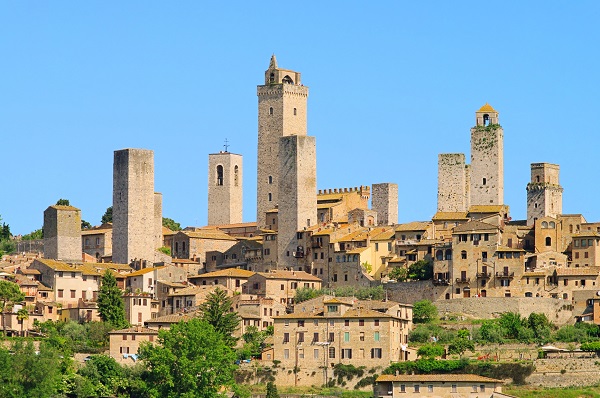
(San Gimignano, Italy – model for Monteriano – image sourced from Life in Italy.)
Spoilers ahoy!
When Philip arrives in Monteriano, charmed by the village and its towers, he immediately sets to work persuading the groom to back off. Unfortunately for his efforts – it’s too late. When Lilia wrote to inform her in-laws that she was engaged… she was actually already married. Oh, and it gets worse! The “Count” is actually the son of a dentist – there’s not a drop of aristocratic blood running through his veins. Philip is dismayed, but at the same time – he can’t deny that there’s something magnetic about Gino, Lilia’s non-aristocratic Italian husband.
Needless to say, Philip leaves without accomplishing his objective of breaking up the relationship – and then everything gets super sad. The marriage is not a success; Lilia and Gino immediately find themselves at odds and in constant tension, brought about mainly by their cultural disconnect and – as a result – very divergent expectations for the relationship. Lilia produces a baby and then promptly dies, of course. With Gino left alone with his new son, the Herritons turn their attention to concealing the baby’s existence from his half-sister.
Meanwhile, everyone is wondering how exactly the situation got so out of control. What happened to the supremely sensible Miss Abbott, dispatched to Italy to ensure that her older but dumber traveling companion didn’t do something regrettable? Philip grills her and discovers that the serene neighbor has unsuspected depths and grievances:
“I hated Sawston, you see.”
He was delighted. “So did and so do I. That’s splendid. Go on.”
“I hated the idleness, the stupidity, the respectability, the petty unselfishness.”
“Petty selfishness,” he corrected. Sawston psychology had long been his specialty.
“Petty unselfishness,” she repeated. “I had got an idea that everyone here spent their lives in making little sacrifices for objects they didn’t care for, to please people they didn’t love; that they never learnt to be sincere–and, what’s as bad, never learnt how to enjoy themselves. That’s why I thought–what I thought at Monteriano.”
“Why, Miss Abbott,” he cried, “you should have told me this before! Think it still! I agree with lots of it. Magnificent!”
(If you’re wondering, the answer is yes: Philip really is unbearably self-congratulating and pompous, and he really does think he is the most interesting man in the world.)
Ultimately, like all plans laid by the Herritons, the plan to conceal the baby’s existence from Lilia’s daughter goes awry. Gino himself spills the beans. Some quick strategic realignment later, the plan shifts from pretending the baby doesn’t exist to trying to adopt him so that he can be raised in a manner befitting the half-brother of a Herriton. (The apple doesn’t fall far from the tree. All of the Herritons are as generally awful as Philip – in fact, he’s probably the most open-minded, least irritating one out of the whole clan.) A “rescue” party is dispatched to Monteriano to convince Gino to part ways with his son – because convincing him not to marry Lilia went so well. /sarcasm
And, of course, the entire “rescue” party falls under Gino’s spell immediately.
So this strenuous day of resolutions, plans, alarms, battles, victories, defeats, truces, ended at the opera. Miss Abbott and Harriet were both a little shamefaced. They thought of their friends at Sawston, who were supposing them to be now tilting against the powers of evil. What would Mrs. Herriton, or Irma, or the curates at the Back Kitchen say if they could see the rescue party at a place of amusement on the very first day of its mission? Philip, too, marvelled at his wish to go. He began to see that he was enjoying his time in Monteriano, in spite of the tiresomeness of his companions and the occasional contrariness of himself.
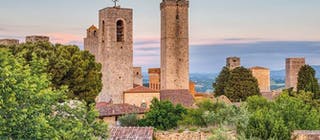
(Image of San Gimignano sourced from Lonely Planet.)
Miss Abbott, too, had a wonderful evening, nor did she ever remember such stars or such a sky. Her head, too, was full of music, and that night when she opened the window her room was filled with warm, sweet air. She was bathed in beauty within and without; she could not go to bed for happiness. Ha she ever been so happy before? Yes, once before, and here, a night in March, the night Gino and Lilia had told her of their love–the night whose evil she had come now to undo.
Forster is at his best in describing the romance and delight of Italy, which he clearly loves. One by one, the characters succumb to its joys. Monteriano becomes less dreary, Gino less embarrassing of a connection. And it also becomes clear that Gino actually loves the baby and doesn’t want to give him up, shocking the party from England into a rash action that brings about the climax of the story. I won’t tell you what that action is, nor will I give away the ending, but this is E.M. Forster, so that should tell you what you’re letting yourself in for.
As I mentioned above, the classic Forster themes are all there. You see beautiful travel writing, complex characters (there are no heroes or villains in a Forster novel, just characters of varying degrees of sympathy) and culture clashes generally brought about by British travelers attempting to impose their will on people they can’t understand. You can see the seeds of both A Room with a View and A Passage to India beginning to germinate in Where Angels Fear to Tread, which is fun. I love to read earlier works to see how an author’s powers mature, and there is a clear progression in Forster’s novels – but Where Angels Fear to Tread is worth reading on its own, even if it is not the pinnacle of his writing career. (I think most readers would say that’s Howard’s End, which I did think was wonderful, even if I loved Passage more.)
Have you read E.M. Forster? Which one is your favorite?
 covered in flour