
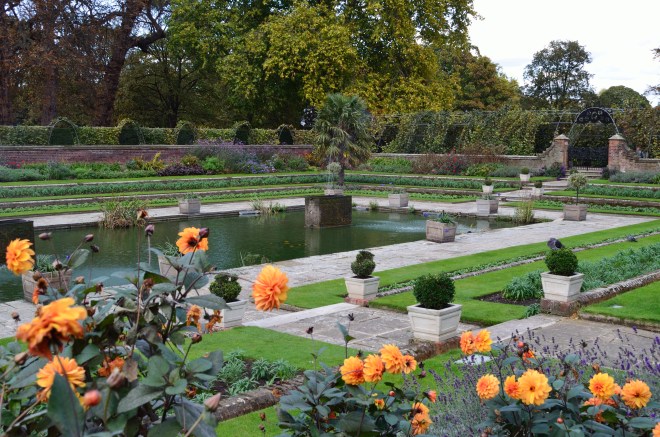
I am a gardener in aspiration, but not in fact. My next-door neighbor, Zoya, is an incredibly gifted gardener, and I often hang over the fence watching her putter about, moving plants from pot to ground to pot, pruning and adjusting and sprinkling. She goes in more for flowers and greenery (whereas I am always struggling with vegetables and herbs) and her patio is a dreamscape. (In case it needs to be said, the picture above: not Zoya’s patio. That’s the Sunken Garden at Kensington Palace in London.) Once Zoya asked me for advice on growing tomatoes, and I nearly fell over in shock. More often, I’m the one begging for her wisdom. For instance: I had a pot full of mint that died. I meant to pull the dead roots, but didn’t get around to it. The next spring, completely overnight, it burst with what appears to be mint… but not the same mint that died; it’s a completely different varietal. This freaked me out to no end, and I asked Zoya if it was safe to eat. She told me, “Don’t question it.” My sweet sister-in-law, Danielle, confirmed over FaceTime that it seems to be spearmint. But I’ve never planted spearmint. The dead mint was a peppermint varietal. How spearmint appeared, I can’t say, but the plant has been officially named “Jesus Mint.” Needless to say, I’m still staring at it, afraid to eat it.
So now you know all my gardening secrets: I can’t do it. Those of you who have been reading long enough to remember the Cayenne Pepper Incident of 2017 will not be surprised. But the black thumb doesn’t stop me from wanting to garden, planning and planting and watching and grousing when nothing grows, and it definitely doesn’t stop me from reading about gardens that are more lush than mine, and gardeners with actual, honest-to-goodness green thumbs. Maybe someday. For now, for those of you who are garden cursed like me, here’s some inspiration:

Elizabeth and Her German Garden, by Elizabeth von Arnim – This is probably the quintessential garden book (is it a memoir? is it a novel? what is it, exactly?) of the early twentieth century. Elizabeth was so ubiquitous at the turn of the twentieth that you can even spot – if you have eagle eyes and know what to look for – Anna Bates being given a copy of Elizabeth and Her German Garden in a country lane, in a scene in Downton Abbey. (Don’t ask me what season; I can’t remember. But the cover of the first edition is distinctive.) Elizabeth von Arnim was an Englishwoman who married a German aristocrat, and her “Elizabeth” trilogy (Elizabeth and Her German Garden; The Solitary Summer; and The Adventures of Elizabeth in Rugen) follow the eponymous heroine as she putters about, cursing the inability of the Proper German Woman to get her hands dirty, enjoying the gifts of nature and avoiding her responsibilities. There are many funny moments, some things that are sad, and a lot of gorgeous nature and garden writing. If there is anyone to inspire you to go outside and wander around, it’s Elizabeth. Of course, it helps when you have a massive country estate.
 Merry Hall, by Beverly Nichols – Speaking of massive country estates, meet Beverly Nichols – perhaps a rather salty successor to Elizabeth von Arnim. Merry Hall is the first in a trilogy (followed by Laughter on the Stairs and Sunlight on the Lawn, and what is it with me and lightly fictionalized memoir-ish garden trilogies?) featuring Nichols as he purchases and renovates an old Georgian manor house and surrounding garden, attended reluctantly by the wizened and grumpy head gardener “Oldfield,” his cats “One” and “Four” and a cast of local eccentrics. There is Miss Emily, who is always flinching and trying to buy vegetables from Nichols’ prolific kitchen garden; Marius, whose chief attribute is erudition; and Our Rose, a famous floral arranger who becomes Nichols’ adversary and bugaboo. Nichols is at his rapturous best when describing his beloved flowers; his descriptions of lovingly brushing aside fallen leaves to reveal the first snowdrops of spring are gorgeous, for example. He is definitely a mid-century writer and some of the writing is very much of its time – a.k.a problematic for modern readers. (I keep considering whether to write a blog post about this sort of thing, and waffling, because I’m not sure I have anything unique to say about it.) Ultimately, I enjoy Nichols’ voice and his garden writing enough to overcome the occasional jarring note, but the reader should not go in unprepared.
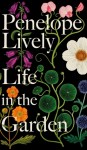 Life in the Garden, by Penelope Lively – For a more modern note, Penelope Lively’s memoir-ish (apparently all three of these themed books are memoir-ish) look back at the gardens of her life is gorgeous. From the cover art to the beautiful prose – gorgeous. Lively is a prolific and important writer of fiction (I read her astonishing Booker-winning novel, Moon Tiger, after becoming acquainted with her through this garden book) and she brings a writer’s sensibilities to the plant plot. Lively writes of her childhood in Egypt, the gardens of her adult years, and the small London establishment of her current golden years, and sprinkles in sections and chapters about gardens in literature. If you can tear yourself away from the stunning cover, you’ll find much to appreciate in Lively’s writing.

Elizabeth, Beverly and Penelope are definitely inspiring me as I mull over garden plans for my soon-to-be new place. There’s a lot of potential but also plenty to be done, and where am I going to put the tomatoes?
Are you a gardener, or just a reader of garden writing?
 covered in flour