
Photo credit: britishheritage.com
Four books. I’ve been waiting four books for this: the first cataclysmic encounter between Emmeline “Lucia” Lucas, Queen of Riseholme, and Elizabeth Mapp, doyenne of Tilling. E. F. Benson’s series is popularly known as “the Mapp and Lucia novels,” but the two principals don’t actually encounter one another until the fourth book in the series, Mapp and Lucia. Well – not exactly. In Mapp and Lucia we learn that our heroines (or villainesses, depending on your perspective) have met once before, when Miss Mapp visited Riseholme for a day and attended a social gathering at which Lucia was also a guest. But that’s the extent of their contact prior to this book – although they will become much better acquainted soon.
When Mapp and Lucia opens, we find Lucia bereaved. Peppino – dear Peppino! – Lucia’s indulgent husband, has passed away, leaving Lucia in mourning at The Hurst. Lucia being Lucia, she does mourning in excess; one would expect nothing less. But eventually the Riseholmites begin to worry, and Georgia Pillson, Lucia’s faithful deputy, is dispatched to bring her back to the life of the village. He does so – only too well – by informing her that there is to be an Elizabethan fete and Lucia’s frenemy, Daisy Quantock, is to play Queen Elizabeth. This will never do, but when Lucia is offered only a bit role in the festivities she decides it would be better to save face by clearing out altogether. As luck would have it, she finds a perfect excuse – a house for rent in the nearby town of Tilling, listed by one Elizabeth Mapp. And just as easy as the first movement of the Moonlight Sonata, Lucia has a change of scenery.
‘Well, Mapp, what luck?’ asked Irene.
Miss Mapp waited till Diva had shot in.
‘I think I shall tease you both,’ said she playfully with her widest smile.
‘Oh, hurry up,’ said Irene. ‘I know perfectly well from your face that you’ve let it. Otherwise it would be all screwed up.’
Miss Mapp, though there was no question about her being the social queen of Tilling, sometimes felt that there were ugly Bolshevistic symptoms in the air, when quaint Irene spoke to her like that. And Irene had a dreadful gift of mimicry, which was a very low weapon, but formidable. It was always wise to be polite to mimics.
‘Patience, a little patience, dear,’ said Miss Mapp soothingly. ‘If you know I’ve let it, why wait?’
‘Because I should like a cocktail,’ said Irene. ‘If you’ll just send for one, you can go on teasing.’
When Miss Mapp first receives Lucia’s inquiry, she considers it a coup. Mapp is not vacating Tilling – just her house – according to an annual scheme by a handful of Tilling ladies to rent out their houses and move into one another’s homes for the summer, turning a tidy profit. The success of the plan, year in and year out, depends on Miss Mapp, who has the largest house with the biggest rental income – Mallards.

Photo credit: gardenandtravelhub.com
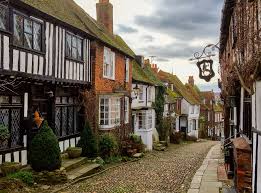
(Side note: can’t you just see Lucia queening it in that garden?) Mallards was not-so-secretly modeled after Lamb House, possibly the most literary house in the literary town of Rye. It was E. F. Benson’s house, and before that, belonged to Edith Wharton’s on-again-off-again bestie, Henry James. In a town that is lousy with literary landmarks, Lamb House (a.k.a. Mallards) is the perfect writer’s residence: as Benson so appealingly describes, in addition to its charming gardens it has a large window overlooking the street, at which the writer – or social coordinator – can sit and observe everything worth noting that happens in the town. Indeed, there are many – many – conspiracies unwound and plots hatched while Miss Mapp and Queen Lucia, respectively, watch furtively out the window and spin their wheels.
Miss Mapp rents Mallards out and moves into Diva Plaistow’s house, who moves into Quaint Irene’s cottage, and so on and so forth. When Lucia expresses an interest in Mallards, Mapp is delighted – not only can she take the newcomer for all she’s worth (jacking up the rent without telling her neighbors, in order to keep a bigger profit margin for herself), but she can use Lucia to bolster her own social credibility. Mapp plans to take Lucia under her wing and be responsible for introducing the most fascinating new temporary resident Tilling has hosted in recent memory. And of course, with Lucia looking to Mapp for direction on the Tilling social scene, Mapp will be the undisputed queen of the landscape.
There’s just one problem: Miss Mapp has not reckoned on… Lucia.
She turned her thoughts toward Elizabeth Mapp. During those ten days before Lucia had gone to Riseholme for the fete, she had popped in every single day; it was quite obvious that Elizabeth was keeping her eye on her. She always had some glib excuse: she wanted a hot-water bottle, or a thimble or a screwdriver that she had forgotten to take away, and declining all assistance would go to look for them herself, feeling sure that she could put her hand on the item instantly without troubling anybody. She would go into the kitchen wreathed in smiles and pleasant observations for Lucia’s cook, she would pop into the servants’ hall and say something agreeable to Cadman, and pry into cupboards to find what she was in search of. (It was during one of these expeditions that she had discovered her dearest mamma’s piano in the telephone-room.) Often she came in without knocking or ringing the bell, and then if Lucia or Grosvenor heard her clandestine entry, and came to see who it was, she scolded herself for her stupidity in not remembering that for the present, this was not her house. So forgetful of her.
There’s immediate friction. Miss Mapp frequently forgets that she has rented out her house – and therefore doesn’t have a right to walk in and out with impunity – and often comes barreling in on Lucia without invitation. (A terrible habit for a landlord. I speak from experience.) Lucia fixes that situation cleverly and to great comedic effect… but the result is that Miss Mapp sours on her tenant, and soon they’re entirely at cross-purposes.
‘Things are beginning to move, Georgie,’ said she, forgetting for the time the impending tragedy. ‘Nightmarches, Georgie, manoeuvres. Elizabeth, of course. I’m sure I was right, she wants to run me, and if she can’t (if!) she’ll try to fight me. I can see glimpses of hatred and malice in her.’
‘And you’ll fight her?’ said Georgie eagerly.
‘Nothing of the kind, my dear,’ said Lucia. ‘What do you take me for? Every now and then, when necessary, I shall just give her two or three hard slaps. I gave her one this morning: I did indeed. Not a very hard one, but it stung.’
‘No! Do tell me,’ said Georgie.
There are skirmishes, even battles. Lucia often prevails, but Miss Mapp scores her share of points, too. (Mapp, it turns out, is a much more formidable opponent than Daisy Quantock.) The characters in Tilling take sides, and it appears the entire town will soon be at war. Miss Mapp has one consolation: she’s only rented Mallards for the season. When August comes, Lucia will take herself, her piano-playing, her faux Italian speaking, and her eccentricities back to Riseholme. Right?!?!
‘Mapp, there’s news for you,’ said Irene, remembering the luncheon-party yesterday. ‘You must guess: I shall tease you. It’s about your Lulu. Three guesses.’
‘Not a relapse, I hope?’ said Elizabeth brightly.
‘Quite wrong. Something much nicer. You’ll enjoy it tremendously.’
A look of apprehension had come over Elizabeth’s face, as an awful idea occurred to her.
‘Dear one, give over teasing,’ she said. ‘Tell me.’
‘She’s not going away at the end of the month,’ said Irene. ‘She’s bought Grebe.’
Blank dismay spread over Elizabeth’s face.
‘Oh, what a joy!’ she said. ‘Lovely news.’
But here, again, Mapp does not reckon on… Lucia. After one final triumph in Riseholme (I won’t tell you what it is, because it’s absolutely delicious and you should read it for yourself) Lucia determines that she has no further heights to which she can aspire in Riseholme. In short, she’s won. And an energetic woman like Lucia is not content to simply rest on her laurels. She needs something in which to interest herself – a challenge. Having vanquished Daisy Quantock and conquered Riseholme once and for all, Lucia turns her attention to Tilling and Miss Mapp, and she decides to take up residence… permanently.
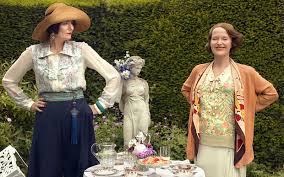
Photo credit: The Independent
(Fun fact: there is a recent – 2014 – TV adaptation of the books, in which Lucia is played by the fabulous Anna Chancellor, who memorably portrayed megabitch Caroline Bingley in the ultimate adaptation of Pride and Prejudice, the 1994 BBC miniseries starring Colin Firth, and who also happens to be a six-times great-niece of Jane Austen. I have not watched it yet, because I want to read through all of the books first. But it’s on my list.)
Hijinks ensue, as you can imagine. Parties are given; plots are hatched; social calamity is skirted and averted. (There is also an amusing side plot in which both Lucia and Georgie worry that the other is falling in love with them, unrequited.) There are battles fought, won and lost, over that precious commodity – the recipe for Lucia’s famous Lobster a la Riseholme. (It is Tilling custom to freely share recipes. Lucia doesn’t seem to understand that, and Miss Mapp cannot, simply cannot, abide this failing.)
And the Lobster a la Riseholme proves to be very important indeed, as it prompts the ultimate calamity when Mapp sneaks into Lucia’s new kitchen to steal the recipe on the day after Christmas. I won’t tell you what happens, except to say that it is both thrilling and slapstick. And I’ll tantalize you with this tidbit, which is sure to intrigue:
Again Georgie uttered woe like Cassandra.
‘There’s something coming,’ he cried. ‘It looks like a raft with its legs in the air. And there are two people on it. Now it’s spinning round and round; now it’s coming straight here ever so fast. There are two women, one without a hat. It’s Them! It’s Lucia and Miss Mapp! What has happened?’
What, indeed? You’ll have to read to find out, and to find out whether Mapp and Lucia ever bury the hatchet. Whether they do or not, the reader knows they won’t be able to bury it very deeply. And that’s lucky for us, because there are two more books in the series. I, for one, cannot wait to return to Tilling and witness the next skirmishes in the Mapp vs. Lucia war. Since we all have to choose sides, I’ll come forward and admit: I’m with Lucia. But really, I’m just in it for a good show, and that’s guaranteed.
Luciaphiles, unite!
 covered in flour